In a slowing job market and signs of rising unemployment, understanding how companies invest in their workforce has never been more critical. Workers are increasingly asking for meaningful employee benefits and are vocal about their needs for better support, whether it’s for financial wellbeing and the ability to cover their living costs, assistance with caregiving responsibilities, or clear paths for career progression.
JUST Capital’s polling continuously shows how consistent Americans are when it comes to what they want the nation’s largest public companies to prioritize – their workers. Year over year, worker issues including living wage, benefits, career development, worker health and safety, and diversity and inclusion get the highest prioritization and in 2024 comprise 42% of a company’s score in our Rankings of America’s Most JUST Companies.
Investing in workers was a recurring theme in JUST Capital focus groups that will inform the 2025 Rankings. Full findings will be published later this year. Related to how companies can create value for all their stakeholders, one participant shared:
“I feel like a happy employee makes a happy company.” – Male, 40-44, Moderate
And in fact, JUST Capital’s research shows exactly that: investing in workers pays off. Our Workers Leaders Index Concept – which tracks the top 20% of companies in our Rankings that perform best across all five worker-related issues – has outperformed the Russell 1000 Equal Weighted index by 16.46% from December 31, 2021 to July 31, 2024.
As we approach Labor Day, JUST Capital is highlighting the companies leading the way in fostering environments where workers feel valued, supported, and empowered to thrive by actively implementing comprehensive workplace policies that address their workers’ needs head-on. Our analysis found that the top 10 companies for worker issues are outpacing the rest of the Russell 1000 in a number of ways:
JUST Capital is proud to present the list below of Top 10 Companies for Workers with details on how they are leading on the issues that matter most to the American public. The following list is based on performance on Worker Issues from JUST Capital’s 2024 Rankings of America’s Most JUST Companies.
Ranked 2nd in Overall Rankings and 1st for Banks
Bank based in Charlotte, North Carolina
Bank of America invests in its employees’ financial and physical well-being by focusing on competitive wages and comprehensive benefits. The company demonstrates a commitment to paying living wages, with a minimum hourly wage of $23 – one of the highest disclosed among the Top 10 Companies for Workers and well above both the Russell 1000 average of $16.73 and the bank industry average of $18.22. In its commitment to supporting working families, Bank of America offers 16 weeks of paid leave for both primary and secondary caregivers and provides emergency backup care and subsidies for routine day care services. In addition, Bank of America embraces transparency on topics like pay equity and workforce demographics: it’s among the 12.5% of companies that publicly report the results of both their gender and race/ethnicity pay equity analyses and part of the 47% who disclose highly disaggregated workforce demographic data.
Ranked 5th in Overall Rankings and 2nd for Banks
Bank based in New York, New York
Citi demonstrates a strong commitment to fairness and family support through a range of initiatives focused on equity and employee-wellbeing. The company’s dedication to equity is reflected in its pay analysis results, which show that women globally earn over 99% of what men earn. Citi also provides highly disaggregated workforce demographic data by gender, race/ethnicity, and standardized job categories, underscoring its transparency and commitment to an inclusive environment. Supporting its workforce further, Citi offers up to 16 weeks of paid leave to primary caregivers and benefits like preferred access and up to 10% tuition discounts at Bright Horizons child care centers, along with emergency backup dependent care. The company also invests in professional development, providing an average of 38 training hours per employee and offering tuition reimbursement to support employees’ continuous learning.

Ranked 18th in Overall Rankings and 4th for Semiconductors & Equipment
Semiconductors & Equipment company based in Santa Clara, California
NVIDIA’s approach to fostering an equitable and supportive work environment is evident in its commitment to both pay equity and comprehensive employee benefits. Notably, the company offers robust parental leave benefits, including 22 weeks of fully paid leave for birth parents, 12 weeks of paid leave for non-birth parents, including fathers and adoptive parents, and support in offsetting childcare costs by providing a 10% discount on childcare at KinderCare centers. Additionally, NVIDIA stands out for its robust pay equity disclosure, as it is one of only 12.5% of companies overall and 23.5% among industry peers to disclose both their gender and race/ethnicity adjusted pay ratios. The company is also one of very few among the Russell 1000 companies we assess to disclose disaggregated pay equity data by different race/ethnicity categories, showcasing a high level of transparency.
Ranked 16th in Overall Rankings and 4th for Banks
Bank based in New York, New York
JPMorgan Chase invests in its employees’ financial well-being by offering a minimum hourly wage of $20, which exceeds the Russell 1000 average and represents the third highest minimum wage among banks. The company also supports new parents with 16 weeks of paid parental leave for both primary and secondary caregivers and families with various caregiving services. JPMorgan Chase’s equity practices are also reflected in its pay gap analysis results, which show nearly equal compensation across gender and racial lines. Additionally, the company maintains transparency in its diversity efforts by disclosing detailed demographic data by gender, race/ethnicity, and job category.
Ranked 6th in Overall Rankings and 1st for Health Care Providers
Health Care Provider based in Bloomfield, Connecticut
Cigna demonstrates its commitment to workplace equity through pay equity analysis, showing near-parity in compensation for female and underrepresented minority employees. The company also prioritizes transparency by sharing highly detailed workforce demographic data by gender, race/ethnicity, and job category, reinforcing its focus on fostering an inclusive environment. Additionally, Cigna supports its employees’ work-life balance with key benefits including 18 days of paid time off and seven days of paid sick leave annually, paid parental leave, flexible scheduling opportunities, and emergency backup dependent care support.
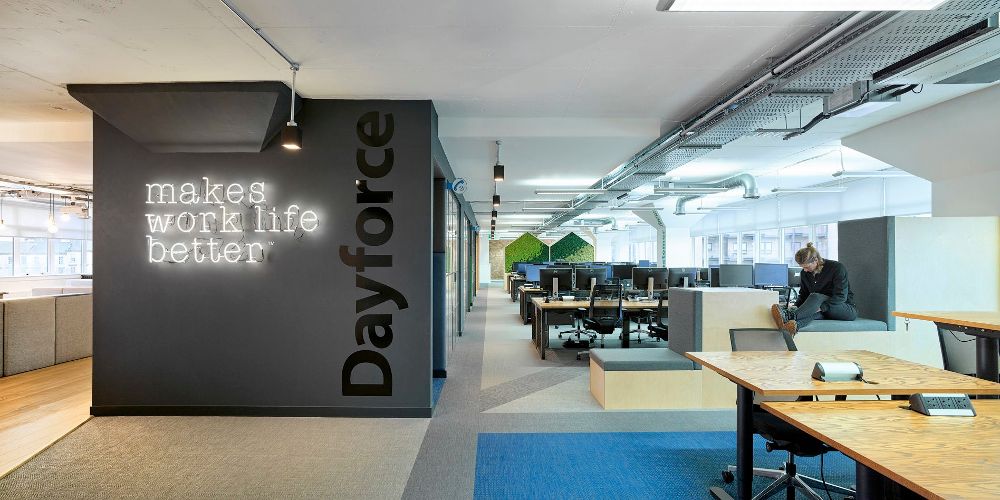
Ranked 51st in Overall Rankings and 6th for Software
Software company based in Minneapolis, Minnesota
Dayforce sets a high standard in the Software industry with its generous and inclusive parental leave policy, offering 17 weeks of paid leave to all caregivers. This is the highest offering at parity among the Top 10 companies and far surpasses the Russell 1000 average of 11 and 8 weeks of paid parental leave for primary and secondary caregivers, respectively. Additionally, Dayforce invests in its employees by providing unlimited paid time off, 10 days of paid sick leave annually, and both backup and subsidized dependent care benefits. Flexible scheduling opportunities further reflect Dayforce’s dedication to fostering a work environment that truly supports its employees’ diverse needs.
Ranked 90th in Overall Rankings and 1st for Consumer & Diversified Finance
Consumer & Diversified Finance company based in Detroit, Michigan
Ally Financial is among the Top 10 companies with the highest minimum wage of $23 per hour. This wage exceeds the Russell 1000 average of $16.73 and the Consumer & Diversified Finance industry average of $19.00, demonstrating a sustained commitment to competitive compensation for hourly employees. The company also supports working parents by offering equal parental leave to both primary and secondary caregivers and providing discounts on childcare to help ease caregiving costs. This combination of competitive wages and comprehensive family support underscores the company’s ongoing investment in its employees’ well-being and stability.
Ranked 9th in Overall Rankings and 2nd for Semiconductors & Equipment
Semiconductors & Equipment company based in Santa Clara, California
Advanced Micro Devices (AMD) demonstrates a strong commitment to employee well-being through a comprehensive range of benefits, supporting their work-life balance and professional development. AMD offers 12 weeks of fully-paid parental leave for the birth, adoption, or foster placement of a child, ensuring equitable support for all parents and new families alike. Also, the company provides up to 20 days of subsidized backup care annually to help employees with their caregiving expenses. In addition to its family-friendly policies, AMD supports employees’ work-life balance with a minimum of 15 days of paid time off, 20 days of paid sick and family time off, and workplace flexibility, enabling employees to choose what best fits their needs. AMD also supports employees’ professional development and encourages continuous learning through its education assistance program which offsets the cost of education.
Ranked 10th in Overall Rankings and 3rd for Semiconductors & Equipment
Semiconductors & Equipment company based in Boise, Idaho
Micron offers a range of robust benefits to support its employees, including 12 weeks of fully-paid parental leave for all expectant parents and at least 17 days of paid time off annually for rest and recovery. Additionally, the company supports career development and skill enhancement through its academic advancement program which provides financial assistance and resources for employees to pursue higher education and professional certifications. What’s more, Micron provides an average of 62 hours of career training per team member annually, significantly exceeding the industry average of 21 hours. Micron also performs regular pay equity analyses to foster a culture of fairness, ensuring sustained pay equity globally for women and people with disabilities, as well as across race/ethnicity and veteran status in the U.S.
Ranked 26th in Overall Rankings and 2nd for Transaction Processing
Transaction Processing company based in San Jose, California
Paypal demonstrates a strong commitment to employee support through its equitable compensation practices, robust professional development opportunities, and comprehensive benefits package. The company regularly conducts pay equity analyses by gender and race/ethnicity, and its latest assessment reveals that it has maintained 100% global gender and U.S. ethnic pay equity, reflecting its ongoing commitment to fairness and inclusivity. In addition to its focus on equitable compensation, PayPal supports employees’ professional development by offering tuition reimbursement to help cover educational costs and an average of 48 hours of training per employee annually, which is 2.4 times more than the industry average. The company also provides a comprehensive benefits package which includes unlimited paid time off, five days of paid sick leave, equal paid parental leave for all parents, and both subsidized and backup dependent care. To further promote work-life balance, Paypal also offers flexible working arrangements like hybrid work to accommodate diverse needs.
To learn more about our methodology, unpack your company’s performance on worker issues in the 2024 Rankings, and gain insights into how to improve on the issues that matter most to the American public, please reach out to corpengage@justcapital.com.
The job prospects, and on-the-job realities, American workers face today look different compared to a year, or even six months ago. Major employers continue to make announcements of layoffs or buyouts in some cases. The labor market is showing signs of slowing down, though it still remains tight. And inflation continues to hit the lowest-earning workers hardest. Amid this, a new Harris Poll survey found some Americans (42%) are worried about losing their jobs, but more (52%) are worried about worsening company culture.
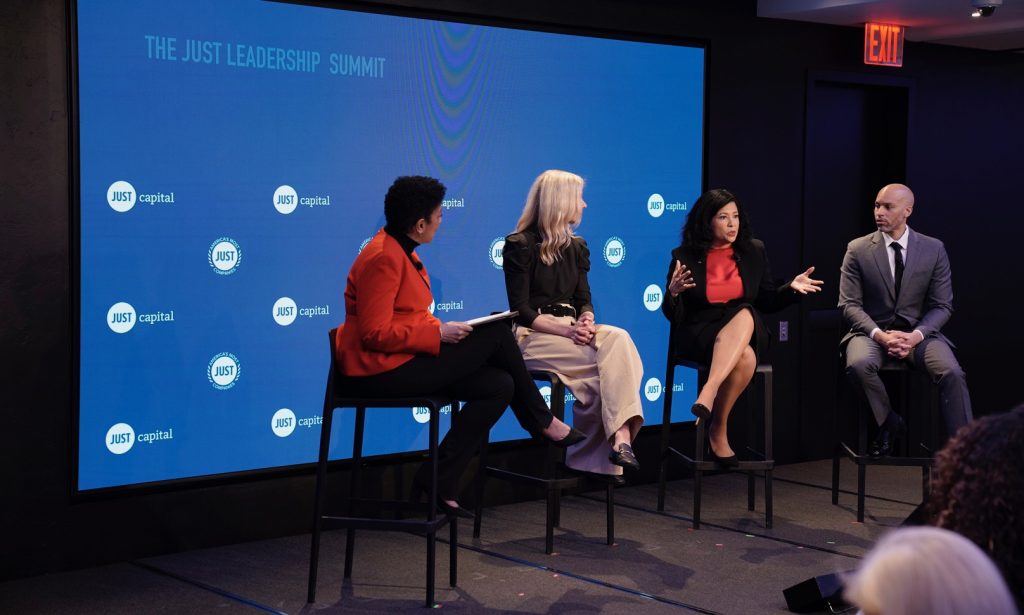
Providing the jobs that will retain employees and help provide for them and their families in this environment has become increasingly imperative. It’s part of the reason we developed our JUST Jobs Scorecard, as we continue to hear from the American public in our polling that investing in workers’ should be an employer’s number one priority when it comes to just business behavior and as attacks on “woke” companies and ESG continue. Last week, at our JUST Leadership Summit, we introduced the Scorecard and heard from job quality-focused corporate leaders and on how they’re approaching these issues. Together, they discussed the importance of investing in workers in ways that will ultimately bolster business resilience.
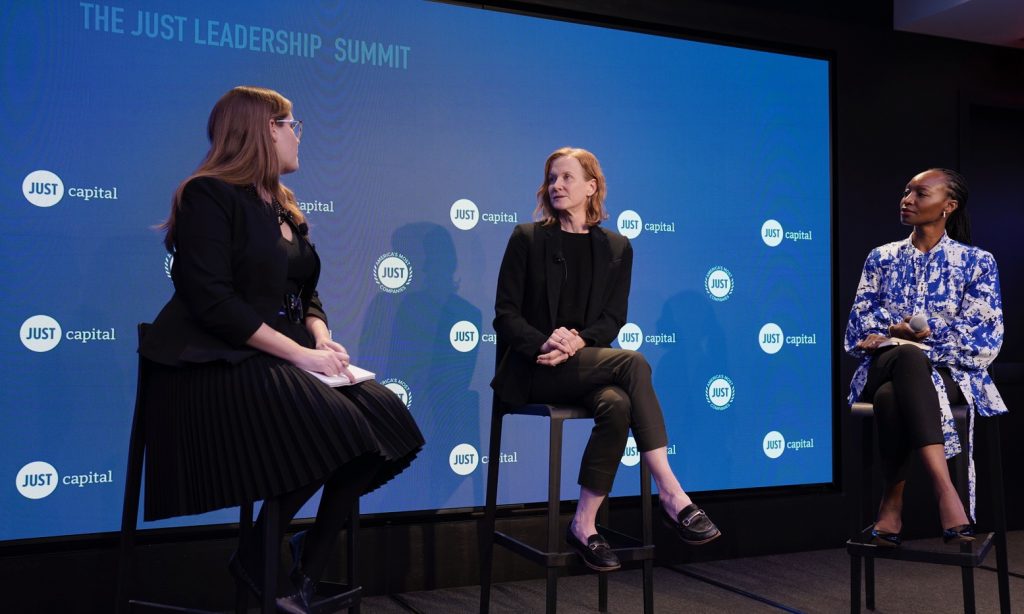
Our Chief Strategy Officer, Alison Omens, spoke with our Managing Director and Head of Corporate Impact, Tolu Lawrence, and Ann Ruble, Partner at Two Sigma Impact, to get insight into how tools like the Scorecard can help companies and investors systematically listen to workers. CNBC Senior Correspondent, Sharon Epperson, also sat down with Samantha Hammock, Chief Human Resources Officer at Verizon, Alicia Petross, Chief Diversity Officer at Hershey, and Randall Tucker, Chief Inclusion Officer at Mastercard to learn how they’re bolstering job quality right now, and what impact these actions are having on their workforce and business overall.
Watch the full discussion of each panel below and read on for key takeaways from both.
Both Lawrence and Ruble noted that part of the challenge in measuring job quality and taking action to address gaps is that companies don’t know where to start. For Two Sigma Impact, a private equity business advancing job quality within the companies in its portfolio, helping companies identify that data has been a key first step. “When you go into these mid-size companies, you’d think that that data [financial and operational metrics] would be clean and easy to access. But you go in there but they don’t have data lakes yet, they don’t have business intelligence tools,” Ruble said.
Two Sigma Impact might begin by suggesting that management look at internal mobility rates or retention rates by various diversity, equity, and inclusion (DEI) metrics, she said. Importantly, the voice of workers informs that process. Two Sigma Impact employs a “voice of worker” tool throughout the deal life cycle to “systematically” listen to workers, Ruble said.
Having a tool to identify and refine the right data to focus on is also a core element of the JUST Jobs Scorecard, Lawrence noted. “There’s a lot of data out there, but how do you make sure you’re measuring the data that’s going to have an impact? Because when you are measuring the data that’s going to have an impact, that’s when you see the long-term benefit and value of that data,” she said.
Part of the Scorecard’s focus is to help companies make sense of all the data out there and, in turn, see the long-term value in it, she added. Companies are able to take a look at how their performance on a particular metric compares to their peers or industry as a whole. Two Sigma Impact takes a similarly-minded approach in helping the leadership of companies it acquires better understand the state of job quality within their workforce. It decided on its four dimensions of job quality measurement – leadership, purpose, growth/advancement, fairness – to help executives more easily understand how they’re performing and underlying data points, Ruble said.
Once company leadership has a grasp on what data to measure, Ruble sees Two Sigma Impact’s next step as helping them “build the muscle” to continually track these metrics. The goal is to get companies to scale to the point where this is in their DNA, she said. And in her experience, having companies go through the process of understanding this data beyond “something on a balance sheet” changes them.
“As people learn more about how to measure the cost of turnover or not actually developing anyone in your workforce and having to hire from the outside every time…and really understand the engagement of your workforce and productivity measures, once people start learning about those things you kind of can’t not look at it again… It’s really just thinking about it differently,” Ruble said. Two Sigma Impact’s thesis is that good jobs make better companies and findings from the JUST Jobs Scorecard support that with leading companies in the Scorecard’s categories outperforming their peers.
Lawrence closed the session by raising a point JUST’s Head of Investor Strategies, Cambria Allen-Ratzlaff, often notes that 90% of the S&P 500’s market cap is in intangible assets, or human capital, though reporting on that hasn’t kept up. “When we talk about the future and what we need to be tracking in order to really understand how a company is performing, I think that’s really where we’re headed.”
Verizon’s Samantha Hammock, Hershey’s Alicia Petross, and Mastercard’s Randall Tucker joined CNBC’s Sharon Epperson for a discussion on JUST Jobs in Practice.
Hammock, Petross, and Tucker each kicked off the conversation defining what a JUST Job means for their company. Hammock raised being able to care for your own physical and mental well-being while Petross touched on the need for fair compensation that allows employees to care for their families and communities. “For us, we think of a JUST Job as creating a place or environment where the best people want to stay and thrive,” Tucker said of Mastercard’s point of view. This is what Epperson referred to as a “very measurable” perspective and one that Tucker sees connected to Mastercard’s performance overall.
Mastercard uses methods like employee engagement surveys, DEI metrics, and accessibility of its leadership team to measure job quality, he said. But he also raised the company’s move to tie ESG goals to compensation for all employees as another key mode of measurement. “The common denominator between everyone is that they want meaningful work, they want to know that they’ve contributed to society in a meaningful way…. And so everyone in our organization from the CEO to an analyst is also contributing to that goal,” Tucker said. Petross raised a similar, measurement- and business-relevant approach Hershey has taken toward its DEI efforts.
The company implemented its Say Hola initiative, which includes its first bilingual manufacturing facility, last year after seeing business-critical gaps in representation. “In 2020, when I started sharing some demographic stats, and I talked about the fact that in the U.S. and North America Black and Latino consumers are about 30% of our consumer portfolio. But at the time representation for those groups was about 15%. People could immediately feel the gap,” she said. Hershey’s employees have been proud of the program’s results too, she said. “Many in our manufacturing facilities have worked with us for 40-plus years, and they will say to me ‘I’m really proud that someone else who didn’t have my experience is able to get this job.'”
Part of the origin for Hershey’s Say Hola initiative came from the company’s Latino Business Resource Group, Petross said. And these groups have influenced other changes, as their mandate extends to “driving our commercial business and influencing company policy” – why Hershey refers to them as Business Resource Groups, instead of Employee Resource Groups.
When the company’s Women’s Business Resource Group came to management and noted that Hershey’s 14-week paid parental leave policy was lacking compared to its peers in the consumer packaged goods industry, the company took action. In January, following the Women’s Business Resource Group’s benchmarking, Hershey rolled out a 20-week paid parental leave program. “We’re in this spirit of co-creation and it’s one of the ways that we reinforce to employees that we hear you and we’re acting on what we’re hearing,” Petross said.
Hammock reinforced the importance on acting on what you’re hearing from employees – and acting quickly. “We all hear about survey fatigue. I don’t actually believe in survey fatigue. I believe what people are annoyed by is if you don’t do something about it. They’re happy to answer surveys all day long if you are listening and acting on what they are asking for,” she said. People want to see progress, she said, and they’re focused on the speed of change and if it’s implemented in a measurable way. To her, not acting on employee feedback is where businesses risk seeing employee “fatigue” around DEI and other areas of job quality.
In addition to employee feedback, Hammock raised adapting workforce investments based on the current economic climate or job market. While she said Verizon hasn’t been affected by cost cutting measures, the company is thinking about what the right investments to make are at a time when more Americans are switching jobs. Meeting people where they are through efforts like self-selecting benefits is key, she said. As is aligning those actions with strategic workforce plans – and being able to pivot when that’s not the case.
Petross made a similar point on Hershey’s approach to workforce investments amid shifts in the labor and economic markets. The company acquired three new brands over the past three years and never conducted layoffs, and, as a result, its focus is now on what it’ll take to retain employees. The company’s achieved gender and racial pay equity in the U.S. and is now looking to reach that globally by 2025, she said. Hershey has developed programs to foster internal growth, which was sparked in part by the realization that six of CEO Michelle Buck’s nine direct reports “grew up in the company.” Career growth is a big priority for the company’s workers and it’s adapted accordingly.
“Give me the skills and abilities to continue growing my career because that is the thing that is going to make my income sustainable,” Petross said, naming the second biggest piece of feedback, following compensation, Hershey receives from employees.
Whether a result of employee feedback, economic climate, or job markets, these leaders are adapting their job quality strategies. They’re not abandoning them. “It’s not going anywhere because it’s part of our value system,” Tucker said. “If we take a hit… our value system is who we are. That’s not changing.” And getting to the place of job quality as a core value starts with listening to workers, focusing on the right data related to those insights, and tying that to core business outcomes.
To unpack your company’s performance in the 2023 Rankings and JUST Jobs Scorecard and gain insights into how to improve on the issues that matter most to the American public, please reach out to corpengage@justcapital.com.
Employees at C.H.I., a garage door-manufacturer headquartered in Arthur, Illinois, received life-changing news last May. In 2015, private equity firm KKR acquired C.H.I. and granted its entire workforce – from those working in its factory to its corporate offices – ownership in the company. Last year, KKR sold C.H.I. in a $3 billion deal, marking one of the firm’s largest returns and, for C.H.I. employees, an opportunity to share in the wealth. With the sale, employees received equity payouts based on their tenure at C.H.I., with the average hourly worker earning $175,000 as a result.
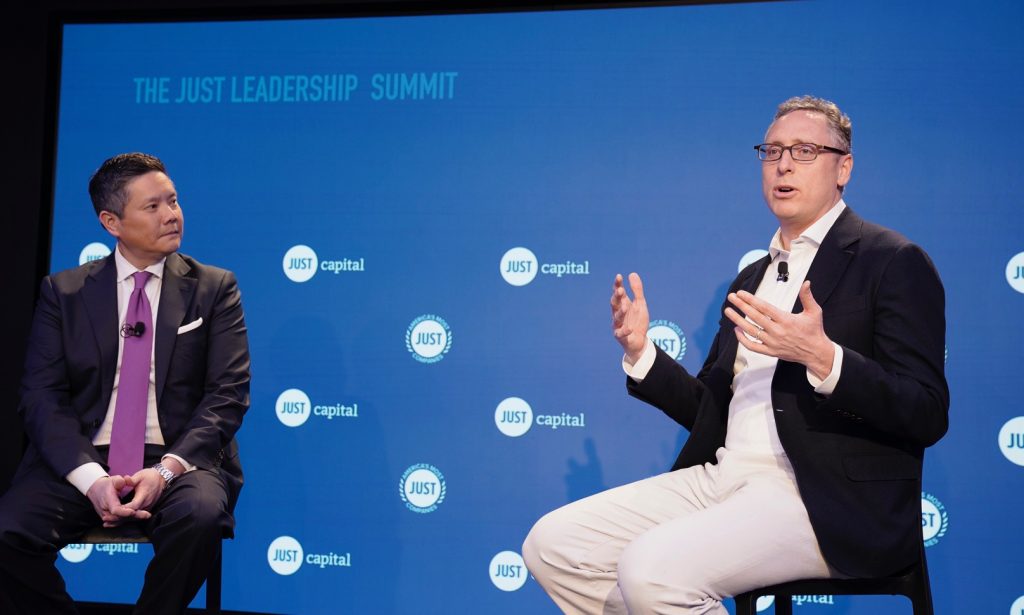
Hearing from C.H.I.’s workers themselves, the move was beyond what they had imagined from KKR’s employee ownership model and “all because someone held up their word to you.” These words grounded our conversation on employee ownership at the JUST Leadership Summit this week. KKR Partner and Co-Head of Private Equity Pete Stavros joined CNBC Senior Markets Correspondent Dominic Chu to discuss his work leading the firm’s employee ownership programs, how they’ve been successful, and their impact at the worker- and shareholder-level.
Stavros, who is also the Founder and Chairman of Ownership Works, a nonprofit supporting companies in implementing employee ownership models, touched on the origins of this work, referring to it as “an initial experiment” from his early days at KKR, but one that’s seen great success and has been in practice for nearly 14 years at 30 different companies.
“They don’t always go this well. This was a truly remarkable outcome,” he said. What’s been behind this outcome? For Stavros it’s come down to keeping the scale of opportunity top of mind, seeking CEO leadership that prioritizes accountability, and treating employee engagement at the same level as business.
At a time when jobs and the labor market remain at the forefront for corporate leaders, his points have weight for what companies should be prioritizing when it comes to employee engagement and job quality. Watch their conversation below and read on for key takeaways.
Stavros acknowledged that many employees at C.H.I. were understandably skeptical when KKR came in, not believing that this ownership program would amount to anything for them. And, six months later they still didn’t fully understand it, he said. The work to help workers understand how they could share in the company’s successes, and to tie that to more short-term outcomes, took years. Some of the results he shared for companies who have taken this long-term approach speak volumes to its benefits.
One of KKR’s biggest success stories, Ingersoll-Rand, saw its quit rate drop 90% over 10 years with this model in place, Stavros said. And C.H.I.’s profit margin rose from 20% to 35% under the employee ownership structure – a number that might be typical for a software company but is “unheard of” for a garage door-manufacturer. The longest-tenured employees at the company were given a payout worth 6.5 times their annual salary when it sold. Of the initial 10 companies the firm implemented this experiment at, half have sold with a return of more than three times the original equity invested and an additional four are projected to follow the same path, he said. “The track record is unparalleled in the history of private equity,” Stavros said. “None of our investors are sitting there going, ‘Wait a minute, who’s paying for this?’ and everyone is saying ‘How can we do more of this?'”
Chu opened the conversation noting that there’s a “touchy feely” aspect to this work that you don’t usually associate with private equity. And that, to Stavros, is an opportunity he’d like to see the industry capture. “For all of its problems, private equity is a very effective governance model and a very effective way of transmitting change,” he said. “If that governance model can be put to good use, it can be really powerful.”
The most important factor in the success of these programs, Stavros said, is leadership. “Like everything in the world, it starts and stops with leadership. If you have the right leader at the top this can be magic. If you don’t, forget it.”
As far as which companies are best suited to these programs, Stavros noted that public companies face quarterly reporting pressure, but that ultimately what matters more than company type or industry is leadership. CEOs with a lens and investment in the entirety of the company, including culture, are particularly primed for success he said. “One of the key screening criteria is, ‘what type of a human being is this?'”
Stavros believes this mindset is a mix of something inherent to CEOs and that comes over time. He pointed to the example of Kathy Bolahus, CEO of Charter Next Generation, a speciality film manufacturer that implemented an employee ownership program when KKR invested in the company in 2021. Kathy cries if her employee engagement scores aren’t good, Stavros said, because there’s a sincere, genuine passion for her people there – and a sense of responsibility. “They think the injustices in society exist, it is their problem to solve them for their people, and they can do it.” They’re not going to write off quit rates, for example, as just an industry problem, but take ownership for solving them, he said.
While some leaders may be more inclined toward this level of investment, Stavros believes all of them shift by merely going through the employee ownership process. “The process of going through this and rolling the model out and engaging, changes people. I don’t think you can coach them up in a room,” noting that one in three CEOs are moved to tears when they just start the process – not when the payouts come. Ownership Works is helping CEOs support each other through these changes, Stavros said, and build what Chu compared to a “coaching tree” in sports for executives to navigate these challenges.
That leadership mindset is most important when it comes to organizational culture. Stavros noted that what’s core to KKR’s approach is teaching CEOs and executives to approach culture-related issues and employee engagement in the same way they would operational issues. “The tools that we’ve developed are all about taking operational problem solving skills and applying them to fixing culture,” he said.
He brought up a hypothetical example of having a scrap problem at a manufacturing company. A CEO, in that instance, would run an analysis, problem solve on each of the issues, have a robust plan to measure against them, and “relentlessly” follow up with data, he said. He wants to see executives take the same approach to culture and engagement. “What we are trying to teach is ‘you know how to solve problems,'” he said. Using those problem solving skills to address low engagement and high quit rates has been key to KKR’s success.
And, importantly, to the ultimate reward for workers. By tying engagement and operational problem solving goals together, workers won out at C.H.I. “What had never been tried was engaging with the entirety of the workforce to drive operational improvement,” Stavros said of the previous C.H.I. owners’ strategies. C.H.I. had operational goals on issues like scrap reduction, labor productivity, and route density for deliveries that leadership would tie into short-term outcomes and investment for workers. Workers would receive reports on how they’d contributed to these goals day after day, he said, and receive rewards like a paid lunch if they’d met them.
“This was a million little things that took everyone pulling together to make happen,” Stavros said. Those small things added up to soaring profit margins, transformative payouts for employees, and a new example of the opportunity that lies in investing in workers.
On Monday, March 13 top corporate, investment, and sustainability leaders gathered for the JUST Leadership Summit – an annual event, now in its 8th year, to celebrate corporate leadership and spotlight action from investors and American companies to help build a more just economy. We discussed the broad state of play with Deloitte, why employee stock ownership is a winning strategy with KKR, how JUST jobs build better companies with Two Sigma, and recognized the achievements of this year’s JUST 100, the leaders topping our 2023 Rankings of America’s Most JUST Companies.
Explore the full video from Monday’s event below for insights into how corporate leaders can navigate today’s shifting ESG landscape, put workers first, and create more JUST jobs. A description of each panel, including timestamps, can also be found below.
Welcome Remarks | starts 0:50
An invitation to consider the challenges facing both American workers and corporate leaders today, and an introduction to the Summit’s panels.
Speakers
Driving Stakeholder Value Creation Through a Shifting Landscape | starts 10:10
In the current climate of imminent regulatory shifts and noisy political rhetoric, there are myriad unknowns about what the future of ESG and corporate sustainability strategies will require. Partner Kristen Sullivan shared insights into how Deloitte is advising clients and helping them navigate this moment with intelligence devised to accelerate JUST business practices and create value for investors.
Speaker:
Sharing the Wealth: A Fireside Chat with Pete Stavros | starts 26:40
Pete Stavros sat down with CNBC’s Dominic Chu to talk about today’s investing landscape and how he thinks the innovative strategies being deployed by the organizations he leads – KKR and Ownership Works – can not only improve the lives of millions of workers but also transform strategic business practices in America in the process. Includes a short video on the impacts of Ownership Works.
Speakers:
JUST Jobs Build Better Companies | starts 53:40
JUST Capital previewed our new innovative tool – the JUST Jobs Scorecard – that helps business leaders assess how companies are performing on job quality today and why we should all be investing in JUST Jobs to build better companies.
Speaker:
The Value of Listening to Your Workers | starts 1:01:20
There are multiple approaches to measuring job quality but perhaps no greater tool than listening to the workers themselves. In this session, we discussed how to unlock business value by using cutting edge survey tools and other strategies to engage with and respond to your workforce – an approach well-paired with the disclosure and performance thresholds available in JUST’s new Scorecard in determining where to make workforce investments.
Speakers:
Worker Voice | Chipotle starts 1:19:19 | Verizon starts 1:22:13
We hear directly from two JUST 100 employees – Eddy Caballo, Field Leader at Chipotle and Edwenna “Eddie” Ervin, Senior Engineer Project Manager at Verizon – about the impact their companies’ workforce investments have made in their lives.
JUST Jobs in Practice | starts 1:25:20
High-quality metrics, assessments, and benchmarks are key to understanding JUST Jobs, but then it’s time to put the insights into practice and make strategic investments in your workforce. In this session, we heard from C-suite leaders about specific actions taken and challenges overcome that generated transformative impacts for their workers and business outcomes for their companies.
Speakers:
JUST 100 Industry Leaders Spotlight | starts 1:53:00
JUST 100 Industry leaders are helping to shift norms and scale change across corporate America by influencing their respective sectors to do more in a continuous race to the top. They demonstrate through practice that an integrated stakeholder approach – where climate, sustainability, and equity are inextricably connected – leads to long-term impact and financial outperformance.
Speakers:

As 2023 has unfolded, the spotlight on jobs and job quality hasn’t let up. News of layoffs and questions of if and when a recession will hit persist. Some employers are choosing to raise wages as workers across the country feel the impacts of inflation on their wallets. While these issues are exacerbated at the moment, and have been for the last three years, JUST Capital polling has consistently found that the American public wants companies to put their workers first. This is true across demographics we survey, including age, race, gender, income group, and political affiliation.
For companies, navigating how to invest in their workers and prioritize job quality remains a challenge. While there are emerging definitions of what “good” performance looks like, we lack clear standards for what companies should be disclosing and how to benchmark their efforts. To help companies navigate this space, we created the JUST Jobs Scorecard. The JUST Jobs Scorecard is a data-driven, interactive tool that helps corporate leaders assess job quality performance on 28 data points across seven key topic areas and prioritize ways to improve through clear disclosure and performance thresholds from “no disclosure” up to the “leading” practice.
This first iteration of the JUST Jobs Scorecard has provided us with some key insights into what we can currently measure and how we might incentivize more JUST Jobs in America today. The first takeaway is stark: there is low disclosure across all companies, even on basic job quality policies and practices. That fact tells us this is an emerging – not established – area of focus regarding corporate stakeholder performance and disclosure.
Through a more positive lens, corporate leaders can consider it a “blue ocean” opportunity, where leadership can quickly be established by taking action to disclose more data around how they are investing in and supporting their most important value creators – their workers.
Where consensus exists on what data to disclose, how to disclose it, and the business case behind why it’s important, we see real progress. A great example is within Workforce Race/Ethnicity Diversity Data, where we’ve seen disclosure of the gold standard – the EEO-1 Report or similar intersectional data – more than triple in the last year alone.
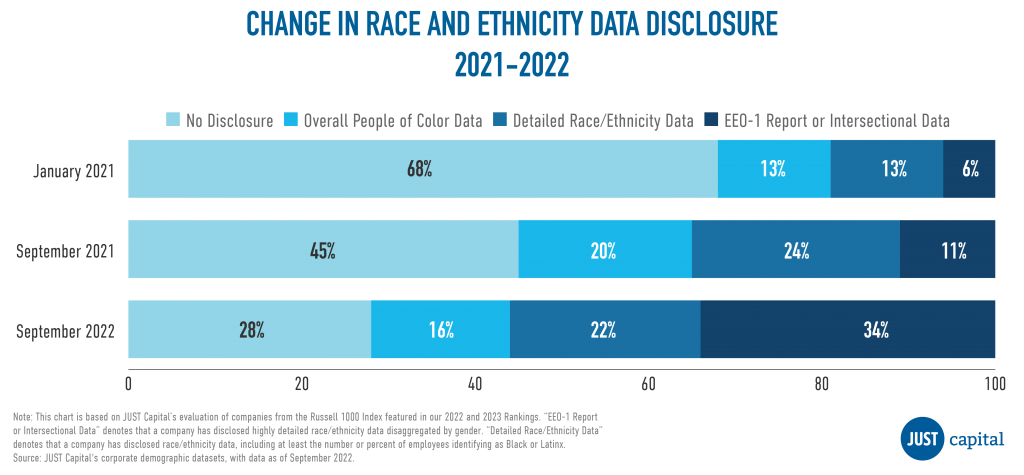
That said, this data point is only one of a few that we are tracking in the Scorecard that have high levels of disclosure. That group includes:
In contrast, disclosure across three quarters of all data points in the Scorecard is less than 40% as illustrated in the chart below:
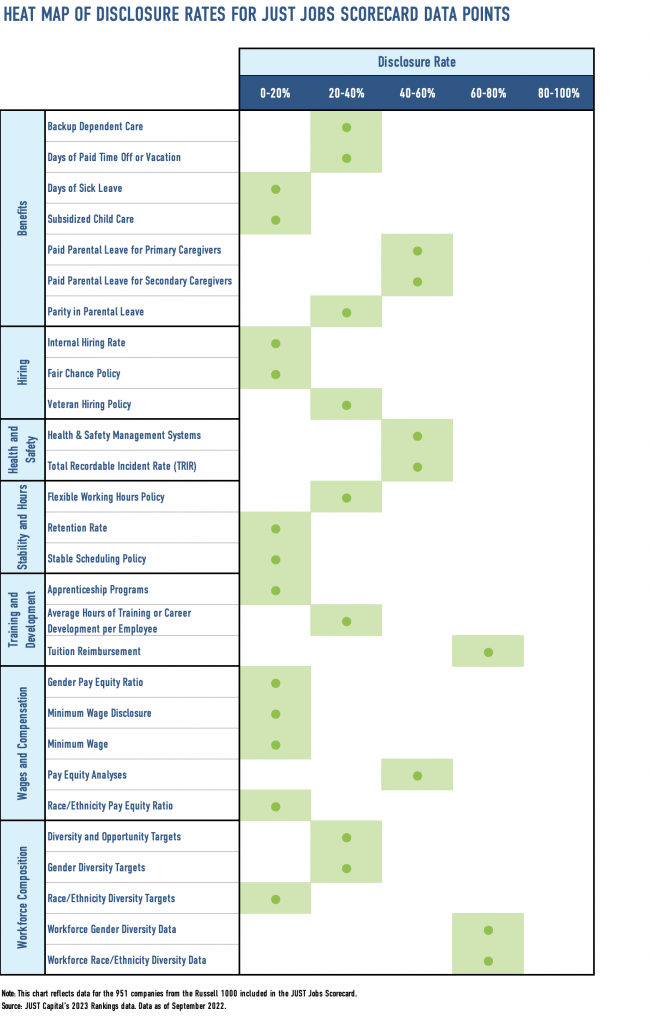
These results indicate a pressing need to incentivize business leaders to increase transparency on key job quality metrics. There is ample benefit for employers: by clearly communicating their employee value proposition, companies are able to better recruit, retain, and advance employees. They’re also meeting the growing expectations of their shareholders. But the current state of disclosure also provides an opportunity for companies to demonstrate leadership as they lean into disclosure and performance improvements on the issues that matter most to their workforces – and to the American public.
Even on some metrics of top priority to Americans we polled, such as wages, the vast majority of Russell 1000 companies lack transparency.
The impacts of the COVID-19 pandemic might lead one to assume that companies are clear about the necessity of disclosing that they provide paid sick leave to their employees. In fact, only 9.3% of Russell 1000 companies disclose any paid sick leave, and some corporate leaders on this issue may not receive their due because of a lack of transparency about that fundamental benefit.
When it comes to retention and advancement – clear indications that a company is a place for long-term growth and opportunity – disclosures are also low: just 4.2% of companies disclose a retention rate and 7.4% disclose an internal hiring rate.
Ultimately, the JUST Jobs Scorecard makes it clear that major U.S. companies have a leadership opportunity, in many aspects, in front of them. Taking action to disclose key job quality metrics, and improve them where needed, can help set a company apart as an employer of choice. It can also establish a company as a leader on jobs at a crucial juncture for the U.S. labor market. And it’ll benefit the bottom line as well.
We took a look at the market performance of the top quintile of companies within the overall JUST Jobs Scorecard Overall Score and Topic Scores. Each area showed substantial alpha in 2022. The top performers in Safety and Training led the way, with 12% alpha each, but the outperformance in each category further reinforces the importance of creating just jobs to drive long-term business success.
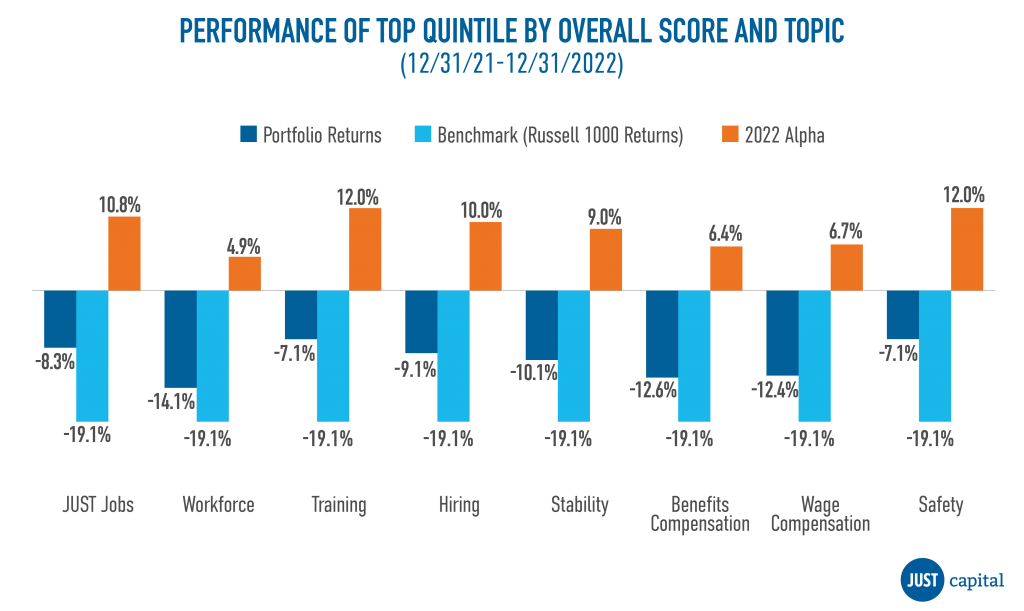
So, the business and investor case are there. Where, and how, to start on the journey remains a challenge for many corporate leaders. That’s where the JUST Jobs Scorecard comes in. JUST Capital will soft launch the Scorecard on April 5, at which point corporate leaders at Russell 1000 companies will be able to view their Scorecards, respond to insights through additional disclosure and guided implementation, and share valuable feedback before a public roll out later this year.
To unpack your company’s performance in the upcoming JUST Jobs Scorecard and gain insights into how to improve on the issues that matter most to the American public, please reach out to corpengage@justcapital.com.
JUST Capital’s polling of the American public and current policy debates continue to emphasize the importance of inflation and worker wages. We recently featured new data analysis showing low disclosure among the Russell 1000 companies on minimum wage rates and public minimum wage increase announcements resulting in real wage gains, and we also wrote a Fortune editorial dispelling the wage-price spiral myth and making the case that companies can unlock business value by regularly raising employee wages to match inflation.
This week, the Bureau of Labor Statistics reported that the headline CPI in November increased 7.1% year over year, and the core CPI – excluding food and energy – increased 6%. These were both lower than the figures for October and suggest that inflation is cooling, though price pressures remain throughout the economy. In turn, the Federal Reserve slowed the rate of increase in the federal funds rate to 0.5%, down from 0.75% in previous meetings.
Another highlight from this week is that even though real wages grew from October to November, they still declined year over year – they fell 1.9%, on average, despite nominal wage growth. However, some in the media continue to imply that workers’ nominal wage increases are the main driver of inflation and need to be reduced to lower inflation. This is despite empirical research from the International Monetary Fund showing that nominal wages can continue to increase while inflation declines, allowing real wages to eventually grow, and Federal Reserve Bank of San Francisco President Mary Daly saying last month there is no evidence of a wage-price spiral. In addition, household debt has reached multi-year highs, and the personal savings rate has dropped precipitously to its lowest since 2005.
Only time will tell if the Federal Reserve is able to achieve a “soft landing” or if it will push the economy into a recession. It is worth emphasizing, however, that even though inflation will likely decline further in 2023, it will remain above the Fed’s 2% target, which will continue to negatively impact family budgets if real wages continue to decline.
Within this context, to help investors, companies, and workers understand the relationship between inflation and wages, we are presenting three charts to concisely show how inflation reduces the purchasing power of wages and causes pay cuts for workers over time.
1. Inflation Reduces Purchasing Power
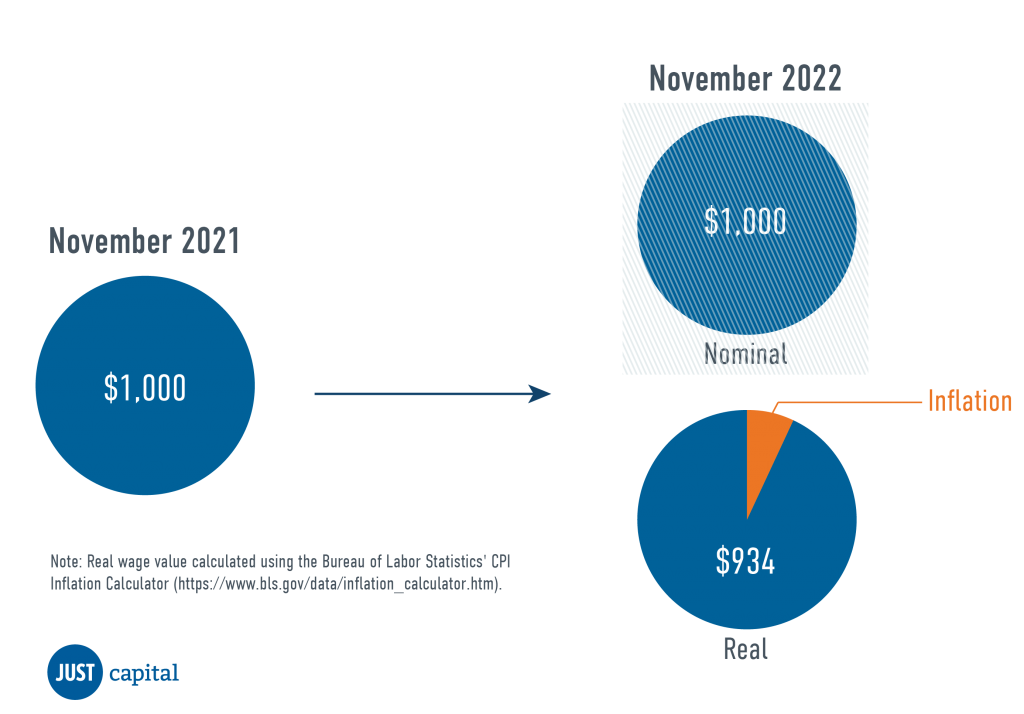
Imagine the following scenario. You have $1,000 in cash in November 2021. You don’t spend it, so you still have $1,000 in cash in November 2022. But because annual inflation was 7.1%, that money is really worth $934 in November 2021 dollars. $1,000 is the nominal value, and $934 is the real, and the real value is what matters for workers and companies.
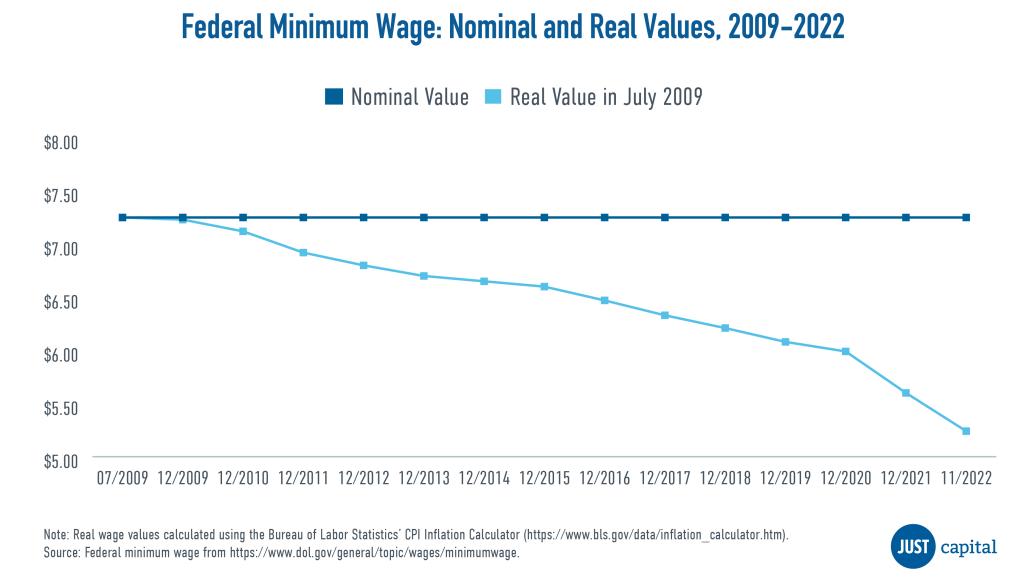
2. Without Wage Increases, Inflation Causes Pay Cuts for Workers
We can see how inflation affects wages by looking at nominal and real values over time. When wages are not increased, their real value, or purchasing power, declines. Because the federal minimum wage has not been raised since July 2009, when it was set at $7.25 per hour, its real value has dropped, and in November 2022 it had a purchasing power of $5.24 in July 2009 dollars. This means that a worker earning the federal minimum wage has effectively received a 28% pay cut over the past 13 years due to inflation.
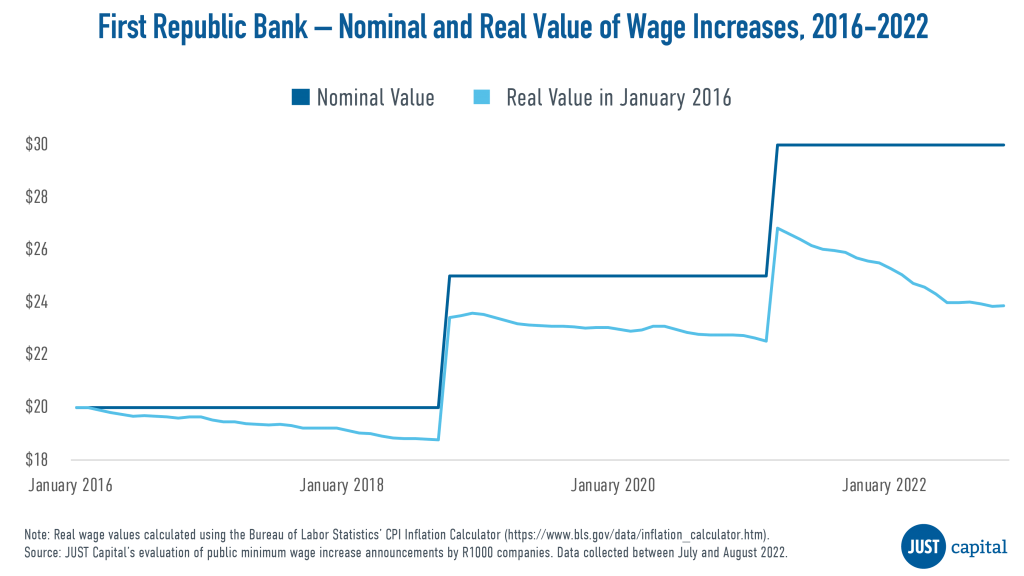
3. Even With Wage Increases, Inflation Causes Pay Cuts for Workers in the Period Between Each Increase
Even when wages are adjusted upwards by wage increases, inflation causes the real value of wages to decline in the periods between wage increases. First Republic Bank offers the highest publicly announced minimum wage rate among the R1000 companies at $30 per hour, and it has granted three wage increases since January 2016. But as can be seen, inflation causes a pay cut for workers in the periods between each increase, and the real value of wages is one of peaks and valleys due to inflation. In addition, that pay cut is amplified when the inflation rate is higher (i.e., compare the steepness of the curve from March 2021 to November 2022 compared to the previous two periods between wage increases when inflation was lower).
These charts show how inflation reduces the real value of wages over time. This hurts American workers, who effectively receive pay cuts, as well as American companies, which potentially face lower employee satisfaction, retention, and productivity. Regardless of how successful the Federal Reserve will be in achieving a “soft landing” in 2023, businesses can unlock value by understanding this relationship between inflation and wages and regularly raising employee wages to match inflation, benefitting workers, companies, and the U.S. economy at large.
