September 15, 2022
JUST Capital’s 2022 Issues Report – The People’s Priorities is by Jennifer Tonti, Managing Director, Survey Research & Insights.
The current economic environment is a marked difference from the one rocked by the COVID-19 pandemic and ensuing recession in 2020, and the “restart” we began to see in 2021. This year, ongoing pandemic-related supply shocks and repercussions from Russia’s invasion of Ukraine have helped to spark the highest inflation in decades. Soaring costs and economic uncertainty about a recession are impacting the national mood. And Federal Reserve Chair Jay Powell recently warned Americans that the Fed’s plans to continue rate hikes to slow inflation will “also bring some pain to households and businesses.” Economic inequality that was exacerbated by the pandemic could widen further in a sharper slowdown, understanding low-wage workers are often the first to lose hours and jobs.
It’s to be expected that the social, economic, and political disruptions at any moment will have some bearing on Americans’ attitudes and values during that time. In every year that we’ve been measuring which issues matter most to the public when it comes to just business behavior (what we call The People’s Priorities), the events of that year can determine which issues Americans deem more important than others, as well as the degree to which the public prioritizes each issue.
This year, the resounding refrain from the public is that America’s largest companies should put workers squarely at the heart of just business practices, foremost by paying their workers a fair and living wage.
Over the last six years, Worker Issues have consistently commanded the highest share of priority among the 20 stakeholder-related issues we measure, and this year is no different. Four of the five Worker Issues we track – including paying a fair, living wage; protecting worker health and safety; providing benefits and work-life balance; and investing in workforce training – are among the top six priorities of the public, and the collective prioritization of all five worker issues will comprise 44% of a company’s score in our Rankings of America’s Most JUST Companies.
What is more, despite increasing media attention and political rhetoric that the country is incredibly polarized, we are not divided as a country when it comes to just business behavior. There is broad consensus across all demographic and political cohorts that Workers should be corporate America’s top priority – something we also found in our recent survey on Workers & Wages. Specifically, among every demographic group – liberal, conservative, high-income, low-income, men, women, young generations, older generations, and white, Black, and Hispanic Americans – the Workers stakeholder is the top priority. And for every one of these demographic groups, the most important Issue is “Pays workers fairly and offers a living wage that covers the cost of basic needs at the local level.”
Every year we begin our annual Rankings process by facilitating a series of group conversations with a diverse mix of Americans across the U.S., to help us broadly understand the business behaviors and actions that they consider to be most “just.” These focus groups enable our research team to hear the unvarnished voice of the public speak to what issues matter most, and whether their opinions have changed over time. The polling team then distills the focus groups’ major themes into statements that capture these concepts, which we call “Issues.” In 2022, this work yielded 20 Issues, which is consistent with the number of Issues last year.
Since the public initially tells us that all of these Issues are of high importance, we then conduct a choice modeling exercise as part of our Annual Survey work, allowing us to derive the relative importance of these 20 Issues. From here, we extract a “weight” per Issue that we use as the foundation for our Rankings of America’s Most JUST Companies. The weights below reflect the probability that an individual would choose that Issue as most important to defining a just company, based on a representative sample of 3,002 Americans. These weights power our analysis of corporate stakeholder performance at the country’s largest companies, including JUST’s annual Rankings.
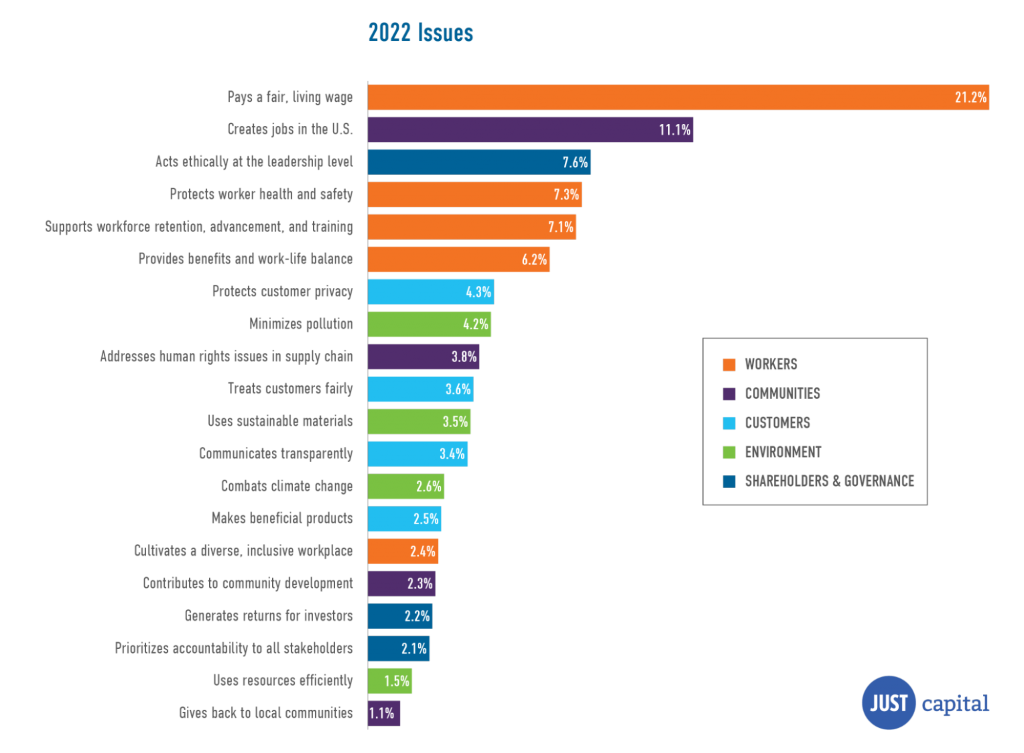
Each issue is color-coded by the stakeholder it most impacts. While we reference the prioritization of several Issues in this report, please note that the relative importance between many of these Issues often varies by a fraction of a percentage point.
Below we take a deeper look at these Issues, and focus on a few that have made substantial movement up or down in relative importance this year.
The above chart shows that four of the five worker Issues are among the top six overall. Most notably, “Pays workers fairly and offers a living wage that covers the cost of basic needs at the local level” is the top-most prioritized Issue for the third consecutive year, and will comprise a significant 21% of companies’ scores in our 2023 Rankings. This is a nearly six percentage point increase from last year, with three-quarters of Americans saying that this Issue is “more important” (including 50% saying it is “much more” important) than last year. And as we mentioned above, among each of our key demographic groups, this is consistently the top-prioritized Issue.
The current economic climate has undoubtedly impacted the public’s priorities. Findings from our partners at The Harris Poll show that 83% of Americans say their top concerns include the economy, inflation, and jobs. And despite the July U.S. job rate reaching pre-pandemic highs, eight in 10 Americans remain concerned about America entering a recession. Maintaining a stable job with a wage that enables a family to make ends meet each month is crucial staying afloat in today’s uncertain economy.
It is doubly important that wages rise in step with inflation. A recent JUST Capital poll shows that 87% of Americans say large U.S. companies have a responsibility to regularly increase wages to keep up with the rapidly rising cost of living. Large majorities of Americans also think that companies that pay a living wage are better for their workers, more competitive in their industry, and better for the U.S. economy overall. Unfortunately, this is more of an aspiration than a reality for workers in our economy today. As the U.S. Bureau of Labor Statistics reported last month, average weekly earnings may have risen 4.2% from June 2021 to June 2022, but real weekly earnings decreased 4.4% in that same time period.
This Issue also captures the concept of fair pay, which both ensures fairness of pay between peers as well as equal pay for equal work across gender, race, ethnicity, etc. Even in 2022, women continue to struggle to be paid at parity with their male colleagues – in 2022, women are paid 82 cents for every dollar earned by men, with even wider pay gaps for women of color, including Black, Hispanic, and American Indian women who earn 79, 78, and 71 cents to the dollar, respectively. Equitable pay – across gender and race/ethnicity – is a critical element in better, fairer treatment for companies’ most valuable assets: their workers.
In 2022, “Protects the health, safety, and well-being of workers beyond what is required by law” comprises 7.3% of a company’s score in our Rankings, showing that even two years from the height of the pandemic, protecting worker health and safety continues to be critical to the public. What’s more, two-thirds of Americans say that this Issue is more important this year than last.
Upward mobility for workers is an additional area of focus for Americans in an unsettled labor market. McKinsey finds that career advancement is the main reason people continue to leave jobs during the Great Reassessment. As such, “Focuses on workforce retention and employee advancement by providing training, education, and career development opportunities” has moved up five places, and comprises 7.1% of a company’s score in our Rankings.
Finally, “Offers a quality benefits package and supports good work-life balance for all employees” comprises 6.2% of a company’s score, a level unchanged from the previous year. As we saw in our August 2022 survey on workers and wages, majorities of Americans believe companies have a responsibility to provide quality, affordable health insurance to all adult workers, including part-time workers (84%) and match employee contributions to retirement savings plans (74%). And in our April 2022 survey focused on how companies support women in the workplace, 64% of respondents said it was important for companies to provide all workers at least 12 weeks of paid parental leave to promote equity at work.
There is a very clear business case for corporate leaders to focus on worker issues. Investments in good jobs can reduce the high costs incurred from absenteeism and turnover, increase a company’s labor productivity, and ultimately grow its revenue. Companies can also gain a competitive advantage as their corporate reputation attracts values-aligned job seekers, customers, and ESG investors. To help companies assess, measure, and improve performance on the worker issues that matter most to the public, we’re proud to announce the creation of a new JUST Jobs Program.
One Issue that falls under the Communities stakeholder, “Creates jobs in the U.S. and provides employment opportunities for communities that need them,” is once again #2 in relative importance, comprising 11.1% of a company’s score in our Rankings. 60% of respondents say that creating jobs in the U.S. is more important than last year.
Ethical leadership, an issue that falls under Shareholders & Governance, continues to be of high importance to Americans as well. “Compels leadership to act ethically and with integrity and to avoid wrongdoings” comprises 7.6% of a company’s score, and is the third most important Issue in 2022. Earlier in the year, our focus group participants told us that they are paying attention to how leadership acts – or doesn’t act – on important societal issues. Our polling confirms that Americans want corporate leaders to take ownership when companies make mistakes or become embroiled in a crisis or controversy. Action is perceived as good faith. Failure to own up to mistakes results in reputational damage.
The Environment stakeholder has grown to encompass 12% of the model. Americans told us that Minimizing pollution (up five places to become the eighth most important Issue) and Combating climate change (up two places to the 13th most important issue) are higher priorities for Americans in 2022, helping to propel the Environment stakeholder’s importance in our Rankings this year.
A need for increased transparency and disclosure from companies has been a key, recurring theme we heard in focus groups. This year, the refrain was louder than ever. As such, we modified the language in this Issue to broaden the focus to be more inclusive, and in turn, the Issue “Is transparent in communications with customers about its products, services, and operations” has moved up four places to become the 12th most important to Americans.
Another notable change is the “Cultivates a diverse and inclusive workplace with equal opportunity” Issue, which fell in priority from seventh most important in 2021 to 15th in 2022. Make no mistake: our polling shows that Diversity, Equity, and Inclusion continues to be an important element of just business behavior, with 92% saying that it is important for companies to promote racial equity in the workplace, and 77% saying that racial equity cannot be achieved until all workers are paid a living wage. What is more, half of respondents say this Issue is more important than last year.
One possible explanation for this decline is that we are two years removed from the racial justice movement our nation rose to in response to George Floyd’s death. And with economic matters such as inflation and recession closer to home for many Americans, when it comes time to prioritizing this issue over others, its relative importance falls.
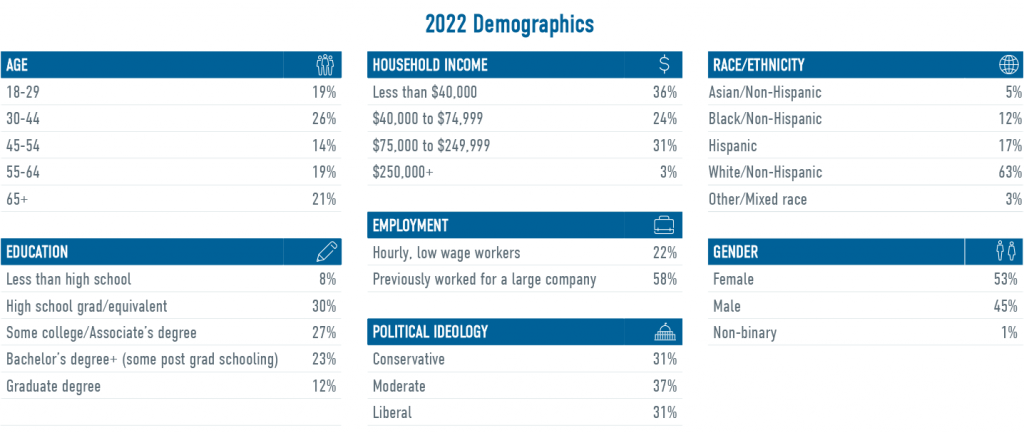
The Priorities of the Public are based on responses from more than 3,000 U.S. adults and are representative of a cross-section of Americans. This means we hear from a variety of voices, both by demographic such as race/ethnicity, gender, income levels, and age, as well as behavior such as political ideologies or active investors. Remarkably, we found that there is substantial consistency in the Issues most important to these groups, with nearly all cohorts prioritizing the same top three: Pays a fair, living wage; Creates jobs in the U.S.; and Acts ethically at the leadership level.
With a few exceptions, each demographic is fairly unified in how they want corporate America to prioritize the top five Issues, demonstrating remarkable unity and consistency in a year when companies are increasingly under scrutiny from politicians and pundits for “being out of touch with the values of everyday Americans” or that stakeholder-focused capitalism is not “a reflection of consumer demand.”

To provide further clarity around how to better balance stakeholder interests, we classify each Issue by the stakeholder it affects most, organizing the 20 Issues into five stakeholder groups: Workers, Customers, Communities, the Environment, and Shareholders & Governance.
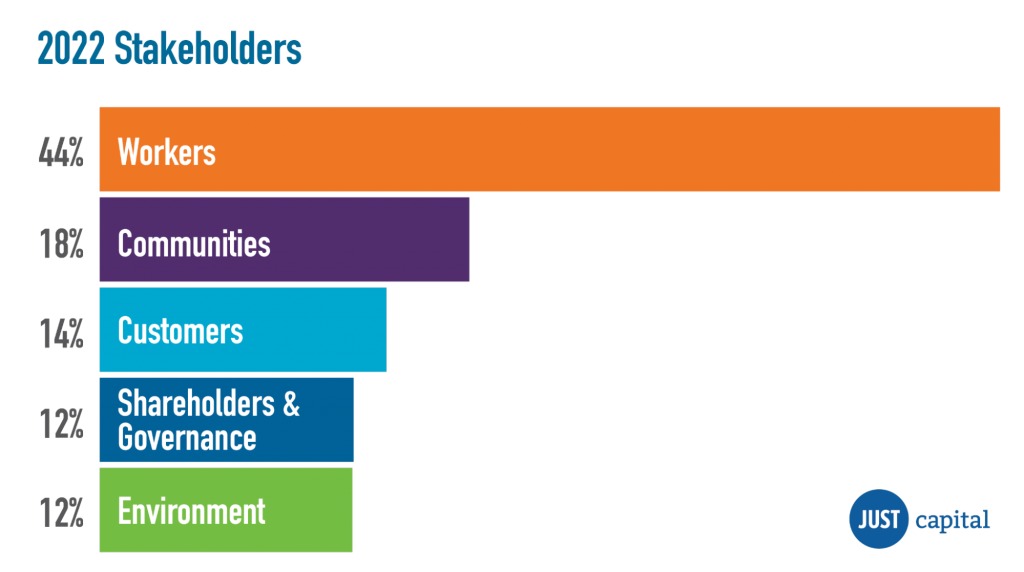
Specifically, we assign each of the 20 Issues to the one (and only one) stakeholder it most impacts. For example: “Compels leadership to act ethically and with integrity and avoid wrongdoings” is assigned to Shareholders & Governance, whereas “Makes products or offers services that benefit society” is assigned to the Customers stakeholder. The weight of each stakeholder group is calculated by summing all of its associated Issue weights.
For the sixth consecutive year, the American public prioritizes Workers as the most important stakeholder by a significant margin. The Workers stakeholder considers a company’s performance on factors related to how it invests in its employees, including (1) paying a fair, living wage, (2) protecting worker health and safety, (3) providing benefits and work-life balance, (4) cultivating a diverse and inclusive workplace, and (5) supporting workforce retention, advancement, and training.
The Communities stakeholder considers a company’s performance on factors related to how it supports its communities, including (1) creating jobs in the U.S., (2) addressing human rights issues in the supply chain, (3) contributing to community development, and (4) giving back to local communities.
The Customers stakeholder considers a company’s performance on factors related to how it treats its customers, including (1) protecting customer privacy, (2) treating customers fairly, (3) communicating transparently, and (4) making beneficial products.
In 2021 we added “Governance” to the Shareholders stakeholder be more representative of the Issues included in this grouping that explore how a company maintains good governance and delivers value to its shareholders by (1) acting ethically at the leadership level, (2) generating returns for investors, and (3) prioritizing accountability to all stakeholders.
The Environment stakeholder considers a company’s performance on factors related to how it reduces its environmental impact, including (1) minimizing pollution, (2) using sustainable materials, (3) combating climate change, and (4) using resources efficiently.
When looking at stakeholder prioritization across demographic groupings, we see significant alignment, with some specific areas of variance. For instance, Issues relating to the Environment are prioritized more highly among respondents under age 30 and Democrats, whereas Shareholders & Governance Issues are prioritized more highly by those age 65 and older.

There has never been a more urgent moment for corporate America to embark on the journey to becoming more just, and we hope this latest survey report provides clear guidance on how companies can reevaluate their priorities and better align their practices with the values of the American people. The data shines a clear, bright light on the specific actions businesses can take today to rebuild trust in business and markets as a force for good.
Since its inception, JUST Capital’s mission has been to build an economy that works for all Americans by helping companies improve how they serve all their stakeholders: workers, customers, communities, the environment, and shareholders. The goal is to encourage and incentivize real change in corporate America’s leadership.
At the core of our work is a robust research program that starts with focus groups in which we ask the American public to identify the policies, practices, and behaviors companies should prioritize to be considered just, (which we call “Issues”). These Issues include fair pay and living wage; a more diverse and inclusive workplace; stronger, healthier communities; good jobs; a cleaner environment; and more. Then, based on sophisticated polling of a representative sample of Americans, we estimate the relative importance of these behaviors – in other words, how important to defining a just company each behavior is relative to others.
Since 2015, JUST Capital has surveyed more than 160,000 Americans – representative of the U.S. adult population – asking them to define just business behavior. For the past two years, we have partnered with SSRS, an objective, non-partisan research institution that provides scientifically rigorous statistical surveys of the U.S. population, to survey more than 3,000 Americans on their perspectives.
Before answering questions about the just behavior of large companies, it is important for respondents to have a clear definition of the concept. Below is the definition we provided to our focus group and survey respondents in 2022: A just company operates in a way that serves its workers, customers, shareholders, the environment, and the communities it affects, even if it comes at a cost.
We conducted the 20 question survey online with a probability-based sample attained through the exhaustive statistical sampling methods employed by SSRS. The SSRS Opinion Panel is a nationally representative probability-based web panel, and findings are generalizable to the general adult population.
The full survey was conducted from June 22 to July 11, 2022 among a general population sample of 3,002 English- and Spanish-speaking U.S. adults 18+ years of age, with an oversample of 540 Hispanic and 460 non-Hispanic Black respondents. Panelists were sent an email invitation to take the survey online as well as up to eight reminder emails throughout the field period. The survey program was optimized so that respondents could complete it using a desktop or laptop computer as well as a mobile device. In total, 1,063 completed the survey on a computer and 1,939 completed on a mobile device.
The margin of error is +/- 2.2% at the 95% confidence level. Results were weighted to U.S. Census parameters for age, gender, education, race/Hispanic ethnicity, and Census Division to ensure representativeness of the U.S. population. All margins of error include “design effects” to adjust for the effects of weighting.
To identify the priorities of the public, we calculate for each Issue the probability that an individual would choose that as most important to defining a just company. As such, there are 20 probabilities calculated from the 20 Issues. These probabilities can be referred to as weights as each represents the relative importance of one Issue versus another. To illustrate more explicitly, the Issue “Creates jobs in the U.S.” was assigned a weight of 11.1% as there is a 1.11 in 10 chance that a respondent chosen at random will identify this Issue as most important in defining a just company. By comparison, the weight assigned to “Generates returns for investors over the long term” has a 2.2% weight.
Our full body of survey work for 2022 also includes six focus groups conducted in partnership with The Harris Poll and eight additional surveys fielded throughout the year. To learn more about how this survey data drives JUST Capital’s analysis and Rankings of the largest publicly traded U.S. companies, visit the Methodology section of our website.
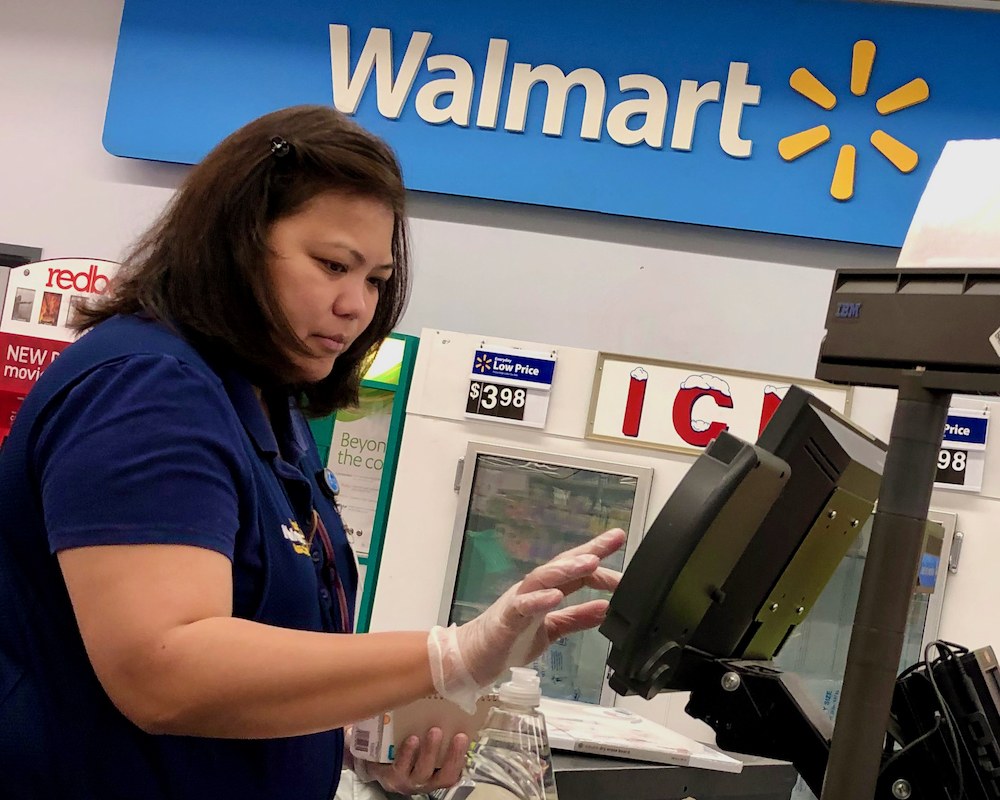
With inflation in the United States at 9.1% in June, the highest level since November of 1981, it would seem counterintuitive to invest in wages right now – but that’s exactly what some companies are doing. And, when looking at our latest polling and historical data, it’s not only a popular decision, but a savvy one.
As we approach the end of summer, we’re in a particularly interesting economic moment. Economists, investors, and analysts are hotly debating whether or not we’re on the brink of a recession or even already in one, and the tech industry has generally taken a significant hit. For the average American family, high gas and grocery prices are stretching paychecks. But we’re also seeing Americans continue to benefit from a very tight labor market and leverage their influence over current or existing employers. With all of this in play, it can be confusing to get an assessment of how Americans are experiencing it.
We turned to our Survey Research team to get an idea. Due to the timeliness of the data, we’re previewing here our upcoming intensive polling report on worker issues in America. Drawing from a diverse pool of Americans, we found in June that large majorities are looking to corporations to meet the challenge of inflation through investments in their workforces.
What Americans are expecting from the country’s largest corporations
The survey found that 87% of Americans say large U.S. companies have a responsibility to regularly increase wages to keep up with the rapidly rising cost of living, and 84% believe companies have a responsibility to pay full-time adult workers in frontline jobs enough to make ends meet.
Digging deeper, we had respondents compare two hypothetical companies – one that increases wages above the rising cost of living, and another that increases wages but at a rate that is less than the cost of living. The company that provides the real raise in wages was rated by vast majorities of Americans to be:
Taking this into consideration, it’s important to recognize the difference between nominal wage increases, those that are unadjusted for inflation, and real wage increases, those that are. As the U.S. Bureau of Labor Statistics reported last month, average weekly earnings may have risen 4.2% from June 2021 to June 2022, but real weekly earnings decreased 4.4% in that same time period.
Two recent examples can show how this plays out. In May, Bank of America announced that it was raising its minimum hourly wage to $22 from the $21 hourly wage it had previously announced in October 2021. For hourly workers, wages increased by 4.8%, but when adjusted for inflation, there was a real wage loss of 0.9%. Back in March, Santander Consumer USA Holdings also raised its minimum hourly wage, for a 16% increase to $20. Adjusted for inflation, this was roughly a real wage increase of 6%, meaning Santander lifted wages beyond the level of inflation.
How companies are already responding
With the debate continuing over the contribution wage increases are making to inflation, any wage increase at this moment is still a strong signal to existing and potential employees, from low wage to high wage earners, that the company is invested in them.
Over the past few months, companies like Walmart, ExxonMobil, Microsoft, and T. Rowe Price have raised wages, offered higher bonuses, and increased benefits, with some specifically citing the challenges of inflation.
This approach not only benefits workers who may suddenly find themselves struggling to maintain their cost of living, it’s smart business. There is a wealth of peer-reviewed research over the course of years that has found both that investments in workers’ wages and benefits can lead to higher productivity, and, perhaps even more importantly in this economic moment, while estimates may vary it is commonly understood that the cost of replacing a worker is significantly higher than what it would take to retain them.
As the economic story unfolds JUST Capital will continue to track inflation’s impact on American workers and how large corporations are responding.

The last two years have required America’s corporations to confront an unrelenting series of large-scale, complex, and interrelated new challenges. Many have done so with aplomb (as our work at JUST Capital has showcased) and with financial indices setting new records, you’d be forgiven for thinking all is well in the world.
For the American worker, however, things aren’t so straightforward. The Omicron variant of the coronavirus has led to cases climbing across the country, with businesses temporarily shutting down, companies scrapping or delaying return-to-office plans, schools going remote, and flights being grounded. Supply chain disruptions, inflation, political infighting, ongoing social and cultural division, climate chaos, and, of course, an unprecedented labor market dislocation have all piled on the pressure.
Many workers continue to grapple with staff shortages at their companies. The Department of Labor recently reported that more than 4.5 million people voluntarily left their jobs in November, yet another record, with hospitality and other low-wage sectors seeing especially high quit rates. These numbers don’t yet reflect the impact of Omicron but, as its effects unfold, workers are clearly at the end of their rope. Their message to companies is clear: Do more!
At JUST Capital, this accords with what we’ve heard from the American public over the last seven years. Since 2015, we’ve been asking Americans to identify what issues matter most when it comes to just business behavior. Their responses form the basis of our annual Rankings of America’s Most JUST Companies, with our 2022 edition to be released next week with our partner, CNBC.
Each and every year the Americans we poll have been consistently united across demographics – liberal and conservative, high-income and low-income, men and women, millennials and boomers – in wanting companies to put workers first.
This is the case once again. As companies battle through what you might call the “Great Reset,” and with seemingly no end in sight to the pandemic and its economic and political ramifications, the good news is that the American public stands firm and united on what they believe companies should prioritize.
In our latest Issues Report, the foundation of our annual Rankings weighting, Americans chose “Pays a fair, living wage” as the year’s most important Issue, representing over 15% of our model for scoring companies’ stakeholder performance. This is followed by “Creates jobs in the U.S.,” making up 13% of our scoring model. This Issue rose from the number eight spot in last year’s report, reflecting the hemorrhaging of jobs from the U.S. economy in the early stages of the pandemic – and, now, a reconsideration of what jobs workers are willing to take. Rounding out the top three Issues is “Prioritizes accountability to all stakeholders,” which comprises over 10% of companies’ scores and is up from the number 11 spot in last year’s report.
This jump in importance for accountability aligns with findings from our latest annual survey results, which hint at a growing frustration among the public with corporate America’s perceived lack of action.
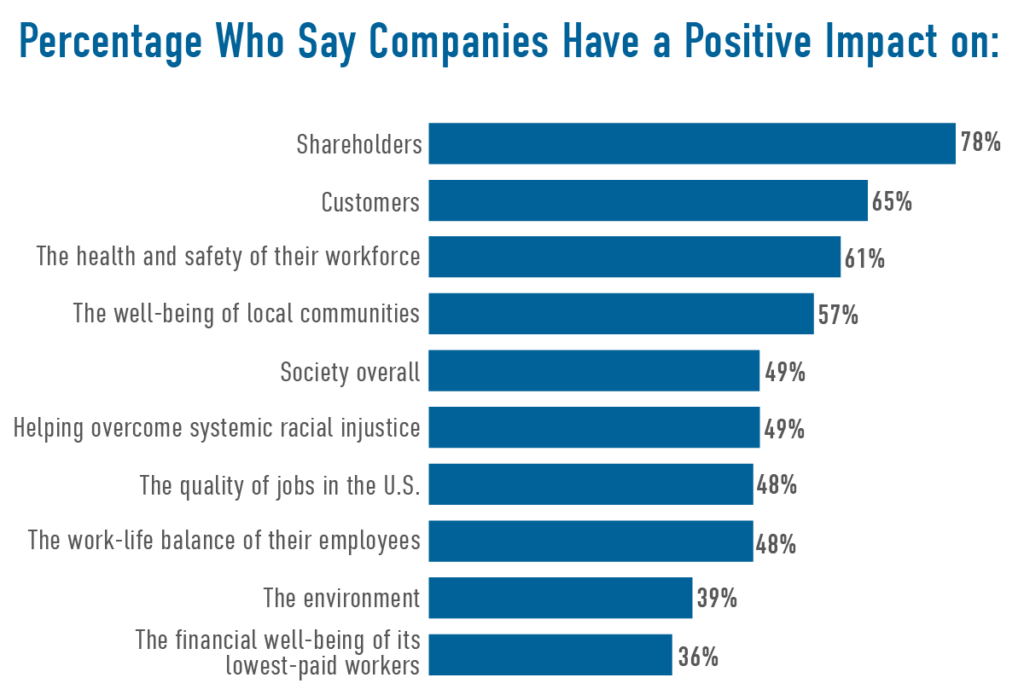
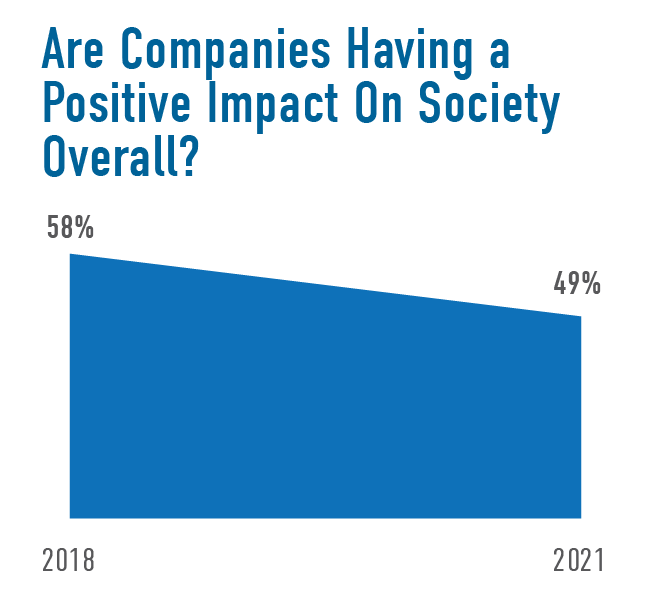
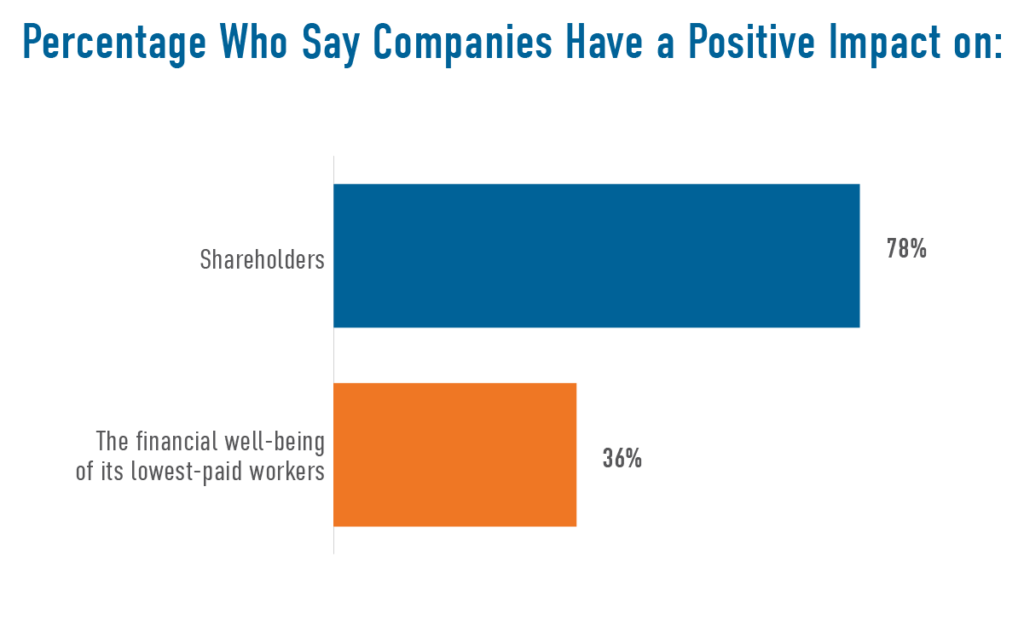
Only 49% of those we polled believe companies are having a positive impact on society. Respondents were also more than twice as likely to believe that companies are having a positive impact on their shareholders (78%) than on the financial well-being of their lowest-paid workers (36%). Just 22% said they believe business is heading in the right direction.
Americans appear to be losing patience with corporations’ willingness to act on their priorities. For example, to attract workers in a tight labor market, many employers have raised starting wages, but it remains unclear if recent wage hikes are part of a larger investment in long-term worker financial security – what JUST polling has shown Americans are looking for from companies – or merely short-term expediencies.
Companies participating in our Worker Financial Wellness Initiative – including Chipotle, PayPal, Prudential, and Verizon – are showing what this long-term leadership looks like through holistic assessments of workers’ financial security, and continuous peer-to-peer learning. At the same time, the concept of a “JUST Job” is emerging: One that allows for not only financial security for workers, but for opportunity, training and advancement; that prioritizes diversity, equity, and inclusion as core tenets; and that allows workers to protect their own health and safety and that of their families.
Underpinning all of this is trust and accountability. It should be no surprise that holding executives accountable to the interests of all company stakeholders finished so high on the list of priorities. Of the Americans we surveyed this year, 84% agreed that companies “often hide behind public declarations of support for stakeholders but don’t walk the walk.” Greater transparency and disclosure can help here. For example, if raising wages is the company’s stated priority, then sharing more information on the current company minimum wage and how it relates to local living wages will help. If prioritizing retention is the goal, companies should disclose more on internal promotion rates. Sharing information like this is an important part of the trust-building process.
At the end of the day, it’s only by showing genuine progress on the issues that matter that companies can build and maintain trust. We know what those issues are, and we know what leadership looks like. With financial markets hitting all-time highs, the onus is now on corporate America to act.
With our 2022 Rankings of America’s Most JUST Companies, we’ll be highlighting the country’s largest employers that are taking action on these issues. Join us next week to learn how those that are leading the way are helping shape a new definition of corporate success and, ultimately, forge new trust with their stakeholders.
Just Capital’s 2021 Issues Report: The People’s Priorities is by Jennifer Tonti, Managing Director, Survey Research & Insights.
As the country struggles to emerge from the pandemic, corporate America continues to face a reckoning with labor policies and practices.
Month over month, the American workforce is seeing record-setting rates of quitting. The latest jobs report from the Department of Labor shows 4.4 million workers left their roles in September, with low-wage workers, employees of color, and women in non-management roles making up a disproportionate amount of those leaving. At the same time, workers across different industries are striking or staging walkouts to make their voices heard. The country is in a moment that’s been deemed The Great Resignation and The Great Reassessment, representing a shifting balance of power between workers and employers.
For corporate leaders, it’s never been more urgent to align their actions with the public’s priorities to meet shifting expectations accelerated by the pandemic. Each year, we ask the American public to identify what Issues matter most when it comes to just business behavior. Those Issues, The People’s Priorities, become the foundation for how we track, analyze, and incentivize corporate behavior change, including our Rankings of America’s Most Just Companies.
The Issues at the core of our ongoing survey research consistently provide a data-driven roadmap for what corporate leaders should prioritize. And this year we’re seeing the price of inaction. What some might have considered latent sources of market risk – human capital management, diversity and inclusion, climate change – have now become core strategic concerns for corporate leaders. And they have a once in a generation opportunity to shift mindsets and ways of working to meet this moment and create a more just, equitable, and resilient future for us all.
It’s critical to note that despite being incredibly polarized in many respects, the American public – liberal, conservative, high-income, low-income, men, women, young generations, and older generations – has been unified in what it wants from corporate America over the six years we’ve conducted this survey, and that is for companies to put workers at the heart of just business practices. This year is no different. All five Worker Issues – including paying a fair, living wage, protecting worker health and safety, providing benefits and work-life balance, investing in workforce training, and cultivating a diverse and inclusive workplace – are among the top 10 priorities of the public, as they were last year as well.
Below we showcase the key Issues that rose to prominence in 2021 to provide corporate leaders with clear direction for where they should focus their efforts to make their companies more just and stave off emerging challenges from The Great Resignation.
This year, our survey research yielded 20 priorities for just business behavior, or Issues. The percentages below reflect the probability that an individual would choose that Issue as most important to defining a just company, based on a representative sample of 3,000 Americans. These probabilities can be referred to as “weights” in that they represent the relative importance of one Issue versus another. We also looked at the data across a selection of demographic breaks – race and ethnicity, political ideology, younger and older generations, low-wage workers, and active investors – and found that there is remarkable consistency in how each perceive Issues the most important to them, with nearly all prioritizing the same top three: Pays a Fair, Living Wage; Creates Jobs in the U.S.; and Prioritizes Accountability to all Stakeholders.
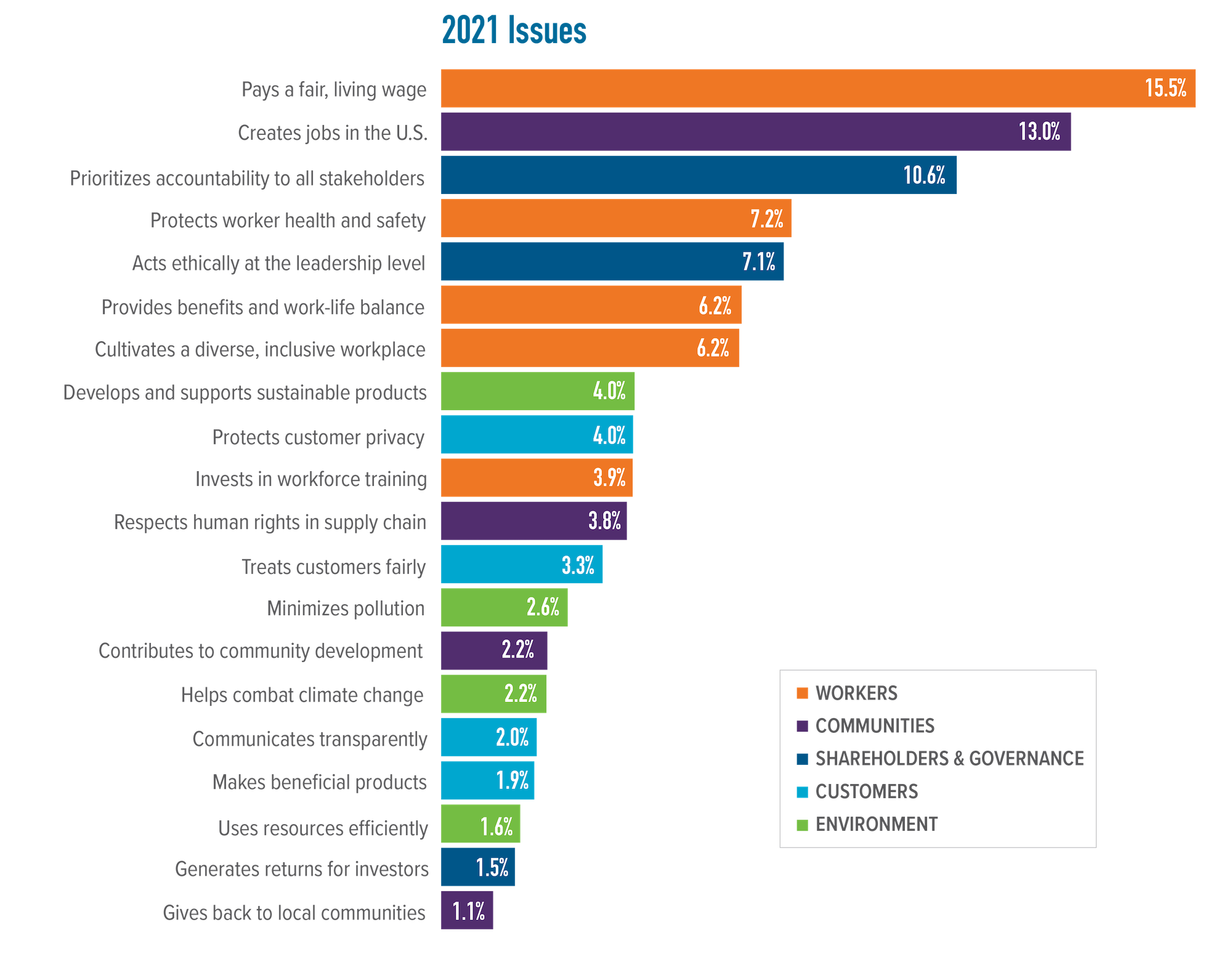
Each issue is color-coded by the stakeholder it most impacts. While we reference the prioritization of several Issues in this report, please note that the relative importance between many of these Issues often varies by a fraction of a percentage point.
Below we take a look at several key Issues that either rose to the top or moved up significantly in 2021.
“Pays workers fairly and offers a living wage that covers the cost of basic needs at the local level.”
This Issue has consistently remained one of the top three since Just Capital began polling the public in 2015, and gained nearly six percentage points from last year. That three-quarters of Americans said that this Issue is more important this year than last is no surprise: Workers – particularly those in lower-wage sectors such as retail and hospitality – are walking off jobs at a record rate, often citing insufficient pay, as a primary driver.
Our omnibus polling fielded in July underscores the importance of fair pay to the American public: More than half of respondents (55%) said that in order to compete for workers in a challenging labor market, large companies should prioritize offering higher starting wages to hourly workers. A majority also indicated that higher starting wages (66%) and more comprehensive benefits (76%) should be long-term policy changes, rather than short-term hiring solutions.
“Creates jobs in the U.S. and provides employment opportunities for communities that need them.”
This Issue rises to #2 in relative importance, up from #8 in 2020, and more than two-thirds say that creating jobs in the U.S. is more important than last year. The sharp focus on jobs makes sense considering the country lost over 20 million jobs in the early days of the coronavirus crisis. And despite the fact that the U.S. economy has reportedly recovered 80% of those jobs, there are still four million fewer jobs than there were before the pandemic.
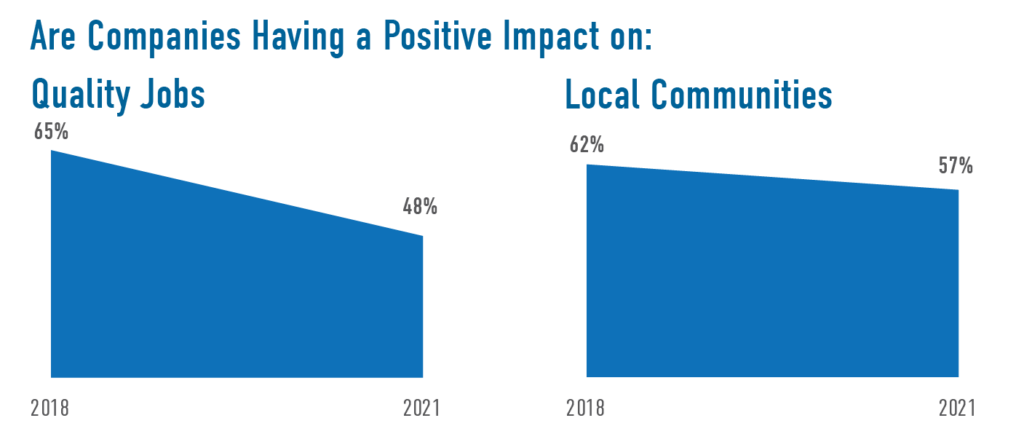
Myriad surveys and reports show that frontline workers in particular are seeking higher quality jobs, especially in communities that have limited employment opportunities. From our 2021 Americans’ Views on Business Survey, the percentage of Americans who say companies have a positive impact on the quality of U.S. jobs has fallen almost 20 percentage points – from 65% in 2018 to 48% in 2021, demonstrating that the public wants companies to focus on creating good quality jobs for American workers to regain trust.
“The board of directors holds executives accountable to the interests of its workers, customers, communities, and the environment, as well as shareholders.”
In 2021 this Issue more than doubles in priority, from 4.2% to 10.6%, and moves to #3 from #11. This is due in part to our refinement of the wording of the Issue this year to reflect prioritization of leadership accountability to stakeholders, beyond creating value for them. In our focus groups this year, we heard loud and clear that we’ve entered a new era of accountability where people want to make sure companies have moved beyond talking the talk and are walking the walk. In our polling from summer 2020, nearly nine in 10 Americans agreed that the COVID-19 crisis provided an opportunity for large companies to hit “reset” and focus on doing right by their stakeholders.
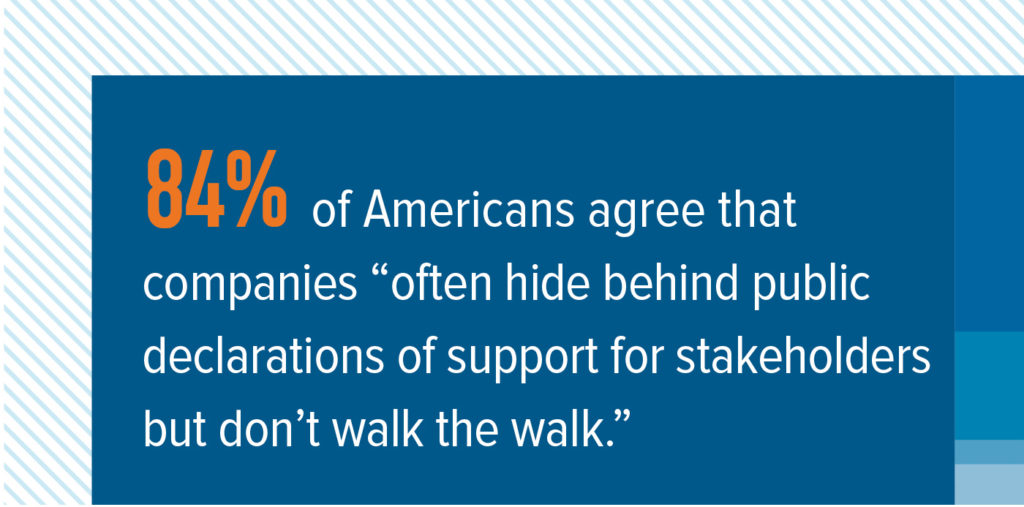
More recent polling shows companies are not moving quite fast enough. In our 2021 Americans’ Views on Business Survey, 84% of Americans agreed that companies “often hide behind public declarations of support for stakeholders but don’t walk the walk.” Americans want companies to follow through on their stakeholder commitments and to be held accountable for prioritizing them.
“Protects the health, safety, and well-being of workers beyond what is required by law.”
The pandemic amplified the need for companies to enact measures to safeguard the health and safety of their workforces; in particular, those deemed essential and/or serving on frontlines, such as healthcare, retail, and factory workers. In 2021, this Issue continues to be critical to the public – with Protecting Worker Health & Safety moving up two places to the fourth most important issue. What’s more, close to 70% of Americans say that this Issue is more important this year than last.
Yet, as the two-year anniversary of the COVID-19 outbreak draws near, the care and attention that companies paid workers during the height of the pandemic seems to be waning – especially for frontline workers who continue to fear for their health and/or face belligerent customers. Findings from our research fielded in March found that there remains serious disagreement between workers and employers about the state of workplace safety. Workers reported experiencing lower levels of health and safety protections than employers reported providing, and were nearly twice as likely (37%) as employers (19%) to report that their health and safety often takes a back seat to profits. The arrival of the Omicron variant demonstrates how important this Issue will continue to be for employers in 2022 and beyond.
“Leadership acts ethically and with integrity and avoids wrongdoings.”
Ethical Leadership rounds out the top five most important Issues this year. Last year, four in five Americans agreed the pandemic had exposed underlying structural problems in our society and opened their eyes to acceptable and unacceptable corporate behavior. They have become more attuned to what behaviors are right and wrong, and the public wants corporate leaders to take ownership when companies make mistakes, cause a crisis, or become embroiled in a controversy.
Our 2021 Views on Business Survey results show Americans are looking to leaders to get things on track: Currently only 22% say companies are headed in the right direction, versus 47% who say companies are headed in the wrong direction, and another 31% who say they don’t know.
“Offers a quality benefits package and supports good work-life balance for all employees.”
While this Issue has consistently ranked in the top 10 priorities year over year, the pandemic significantly changed how people think about the balance between life and work. The components that comprise this Issue – from health insurance to paid time off, paid sick leave, and paid parental leave, as well as remote work and child care – have been driving questions at the heart of the Great Reassessment. One prime example: The pandemic has sparked a child care crisis in our country. With kids schooled at home for the majority of this year and last, the pandemic accentuated the need for quality, affordable caregiving opportunities for working parents – and how the lack thereof has ripple effects across the workforce, particularly for working mothers.
Our August survey on caregiving showed that 41% of respondents had either personally experienced or know someone close to them who has missed work to provide child care for their families, and 36% said either they have, or they know someone who has left a job or switched to part-time work. Companies that listen to their workers and develop benefit offerings that meet their evolving needs will be better poised to win the race for talent as the tight labor market continues into 2022.
“Cultivates a diverse and inclusive workplace with equal opportunity and pay without discrimination.”
The issues of diversity, equity, and inclusivity (DEI) continue to be at the forefront of the minds of Americans when it comes to just business behavior. More than half (54%) of respondents say this Issue is more important than last year. Further, our Views on Business analysis shows that a majority (61%) agrees that companies are indeed making progress advancing DEI in the workplace.
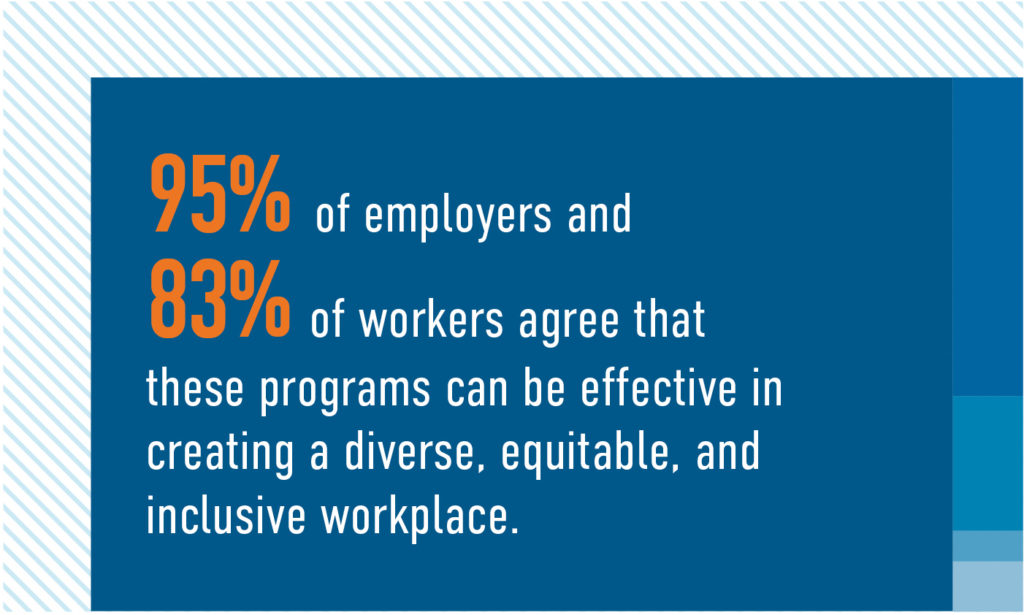
Our November survey of employers and workers in large companies shows that, a year into our nation’s reckoning with racial injustice, most employers (94%) and workers (74%) say that their organization has made a commitment to advancing DEI in the workplace. However, there is also notable divergence in the two groups’ perspectives on how far their companies have come, suggesting that increased accountability and action is still needed. Leaders should more actively seek out feedback from underrepresented groups to deepen and broaden the work.
“Reduces the environmental impact of its products and services by using sustainable materials and renewable energy.”
Although environmental issues comprise just 10% of our ranking model, a significant share of that number belongs to the sustainable products Issue, which has moved up six places to number eight in overall importance, from 14. In 2020, 38% said this Issue is more important than the previous year. In 2021 that percentage grew to 53%, demonstrating the public’s growing interest in supporting renewable energy, low-carbon technology, products made from recyclable/recycled materials, and more.
In our Climate Week poll from September, roughly three-quarters of Americans said that companies that take the following steps can have a moderate-to-high impact on climate change: making changes to ensure all aspects of their business are environmentally sustainable (75%); using environmentally friendly materials (74%); and oil and gas companies leading the transition to clean energy and end fossil fuel production (73%).
A commitment to stakeholder capitalism represents a new North Star for business leaders today.
To provide further clarity around how to better balance stakeholder interests, we classify each Issue by the stakeholder it affects most, organizing the 20 Issues into five stakeholder groups: Workers, Customers, Communities, the Environment, and Shareholders & Governance. Specifically, we assign each of the 20 Issues to the one (and only one) stakeholder it most impacts. For example: “Leadership acts ethically and with integrity and avoids wrongdoings” is assigned to Shareholders & Governance, whereas “Makes products or offers services that benefit society” is assigned to the Customers stakeholder. The weight of each stakeholder group is calculated by summing all of its associated Issue weights.
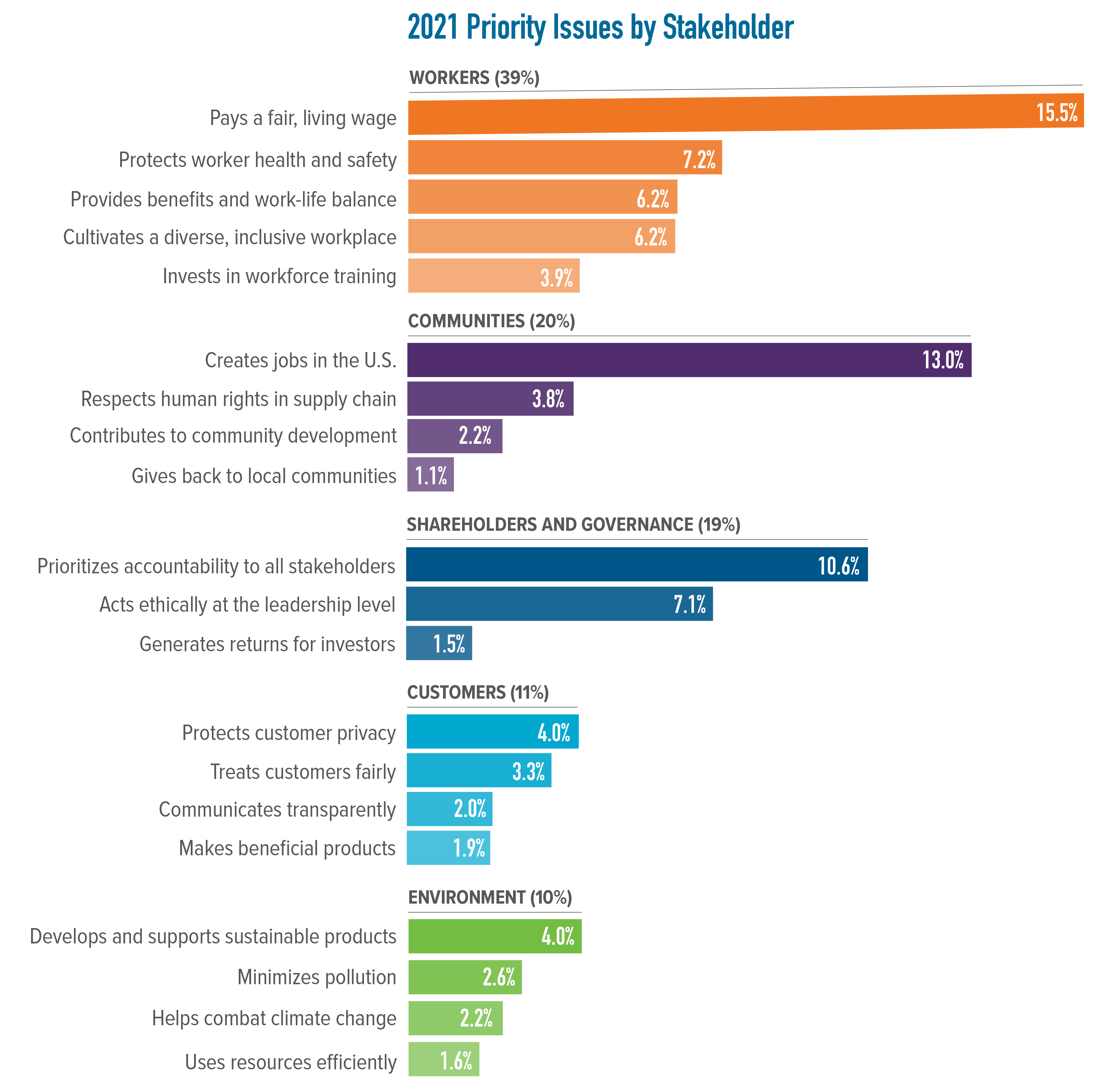
For the sixth consecutive year, Workers are prioritized as the most important stakeholder by a significant margin, with five underlying Issues among the top ten overall priorities of the public. The Workers stakeholder considers a company’s performance on factors related to how it invests in its employees, including (1) paying a fair, living wage, (2) protecting worker health and safety, (3) providing benefits and work-life balance, (4) cultivating a diverse and inclusive workplace, and (5) investing in workforce training.
The Communities stakeholder considers a company’s performance on factors related to how it supports its communities, including (1) creating jobs in the U.S., (2) respecting human rights in the supply chain, (3) contributing to community development, and (4) giving back to local communities.
In 2021 we added “Governance” to the Shareholders stakeholder be more representative of the Issues included in this grouping that explore how a company maintains good governance and delivers value to its shareholders by (1) prioritizing accountability to all stakeholders, (2) acting ethically at the leadership level, and (3) generating returns for investors.
The Customers stakeholder considers a company’s performance on factors related to how it treats its customers, including (1) protecting customer privacy, (2) treating customers fairly, (3) communicating transparently, and (4) making beneficial products.
The Environment stakeholder considers a company’s performance on factors related to how it reduces its environmental impact, including (1) developing and supporting sustainable products, (2) minimizing pollution, (3) helping combat climate change, and (4) using resources efficiently.
The path forward is clear. Americans want to see companies shift from a focus on shareholders toward supporting all the stakeholders impacted by their business: including their workers, customers, communities, and the environment, as well as their shareholders. The pandemic accelerated the need for this shift, and the Great Reassessment is showing that progress is not happening fast enough for the majority of Americans.
There has never been a more urgent moment for corporate America to embark on the journey to becoming more just, and we hope this latest survey report provides clear guidance on how companies can reevaluate their priorities and better align their practices with the values of the American people. The data shines a clear, bright light on the specific actions businesses can take today to rebuild trust in business and markets as a force for good.
Since its inception, Just Capital’s mission has been to build an economy that works for all Americans by helping companies improve how they serve all their stakeholders: workers, customers, communities, the environment, and shareholders. The goal is to encourage and incentivize real change in corporate America’s leadership.
At the core of our work is a robust research program that starts with focus groups in which we ask the American public to identify the policies, practices, and behaviors companies should prioritize to be considered just, (which we call “Issues”). These Issues include fair pay and living wage; a more diverse and inclusive workplace; stronger, healthier communities; good jobs; a cleaner environment; and more. Then, based on sophisticated polling of a representative sample of Americans, we estimate the relative importance of these behaviors – how important for defining a just company each behavior is relative to others.
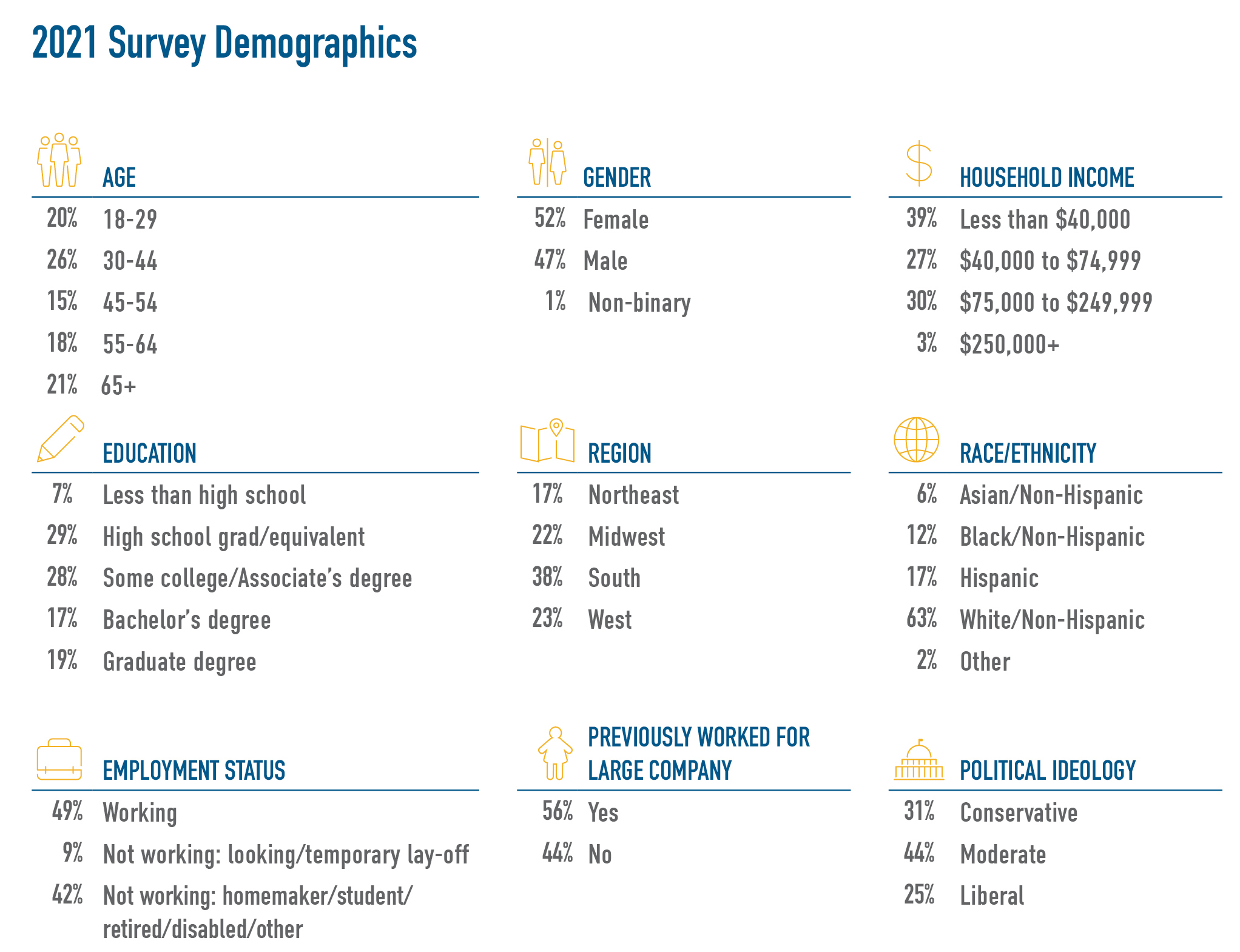
Since 2015, Just Capital has surveyed more than 150,000 Americans – representative of the U.S. adult population – asking them to define just business behavior. For the core of this year’s survey, we turned to SSRS, an objective, non-partisan research institution that provides scientifically rigorous statistical surveys of the U.S. population to engage 3,000 Americans who reflect a cross section of America. We captured perspectives across generational and ideological divides, varying income and education levels, race, gender, and more.
Before answering questions about the just behavior of large companies, it was important to first define the concept. Below is the definition we had provided our focus group and survey respondents: A just company operates in a way that serves its workers, customers, shareholders, the environment, and the communities it affects, even if it comes at a cost.
We conducted the 20 question survey online with a probability-based sample attained through the exhaustive statistical sampling methods employed by SSRS. The SSRS Opinion Panel is a nationally representative probability-based web panel, and findings are generalizable to the general adult population.
The full survey was conducted from July 28 to August 10, 2021 among a general population sample of 3,000 English- and Spanish-speaking U.S. adults 18+ years of age, with an oversample of 507 Hispanic and 461 non-Hispanic Black respondents. Panelists were sent an email invitation to take the survey online as well as up to eight reminder emails throughout the field period. The survey program was optimized so that respondents could complete it using a desktop or laptop computer as well as a mobile device. In total, 1,230 completed the survey on a computer and 1,770 completed on a mobile device.
The margin of error is +/- 2% at the 95% confidence level. Results were weighted to U.S. Census parameters for age, gender, education, race/Hispanic ethnicity, and Census Division to ensure representativeness of the U.S. population. All margins of error include “design effects” to adjust for the effects of weighting.
To identify the priorities of the public, we calculate for each Issue the probability that an individual would choose that as most important to defining a just company. As such, there are 20 probabilities calculated from the 20 Issues. These probabilities can be referred to as weights as it is the relative importance of one Issue versus another. To illustrate more explicitly, the Issue “Prioritizes accountability to all stakeholders” was assigned a weight of 10.6% as there is a roughly one in 10 chance that a respondent chosen at random will identify this Issue as most important in defining a just company. By comparison, the weight assigned to “Contributes to community development and uses local products and resources where possible” has a 2.2% weight.
Our full body of survey work for 2021 also includes six focus groups conducted in partnership with The Harris Poll and 10 additional surveys fielded throughout the year. To learn more about how this survey data drives Just Capital’s analysis and rankings of the largest publicly traded U.S. companies, visit the Methodology section of our website.
Every November 11, our nation pays tribute to military veterans who have served in the U.S. Armed Forces. At Just, we want to honor the moment by taking stock of how the public views corporate America’s responsibility to veterans, and by analyzing how companies are currently performing when it comes to supporting the American veteran workforce. Our findings show the ways in which the public believes corporate America can best support this cohort and in turn, contribute to creating a more just and equitable economy that supports all Americans
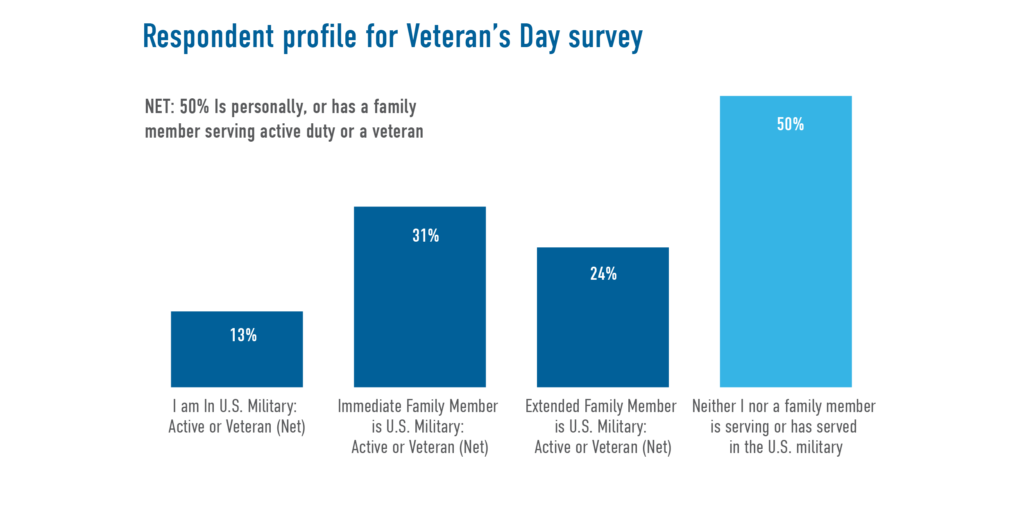
Just Capital, in collaboration with our research partners at The Harris Poll, surveyed active duty military and veterans, their family members, and the wider public. Of the 3,058 respondents, about 13% were active duty or veterans themselves, 31% were immediate family members of veterans or those serving active duty; 24% were extended family members of veterans or those serving active duty; and 50% were neither veterans themselves nor had family who were (respondents could fall into more than one group, therefore percentages do not add to 100%).
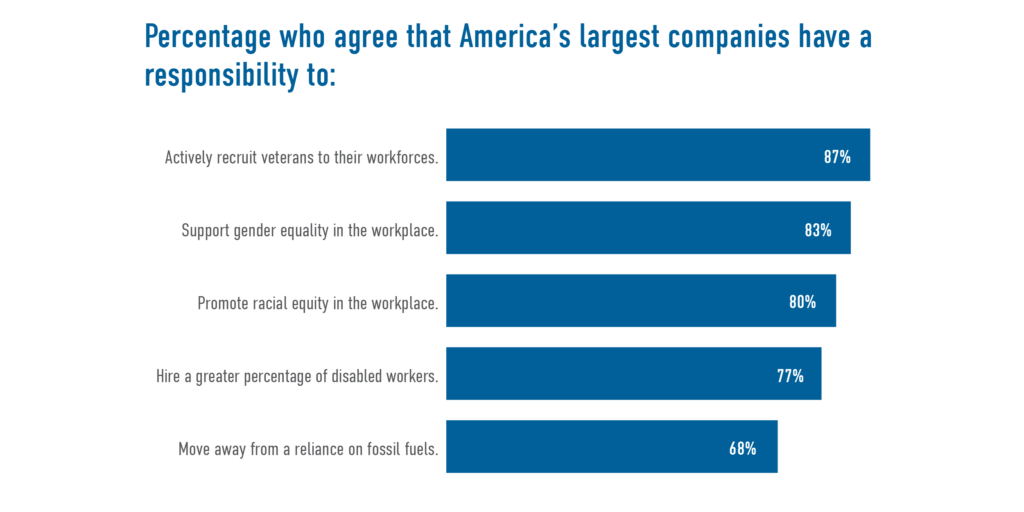
Over time, our polling has consistently shown that a strong majority of the public believes that, as corporate leadership is the driving force behind just business behavior, CEOs of large companies have a responsibility toward addressing issues of societal importance. Across a list of issues affecting society, the biggest percentage (87%) of respondents say America’s largest companies have a responsibility to actively recruit veterans to their workforces.
While only 37% of the companies we rank disclose having veteran hiring policies, by and large, respondents say that they would support companies that start new hiring initiatives, and the topmost means of support is purchasing that company’s goods & services or recommending them to friends and family. Those who are veterans themselves or are family of veterans say they would support these companies to a much greater degree (61% would recommend a company, 53% would purchase from that company) than non-veterans (44% would recommend, 36% would purchase).
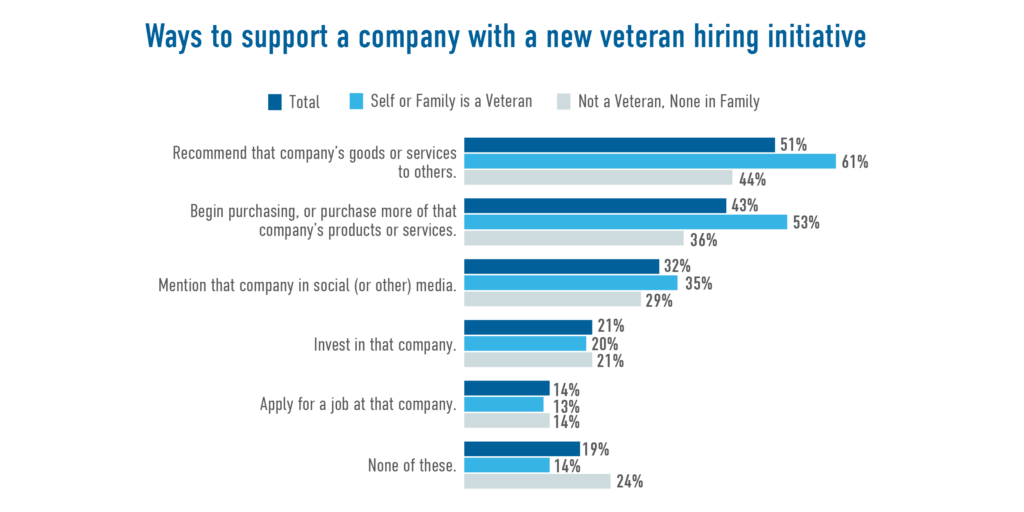
Looking at the responses to this question across different age brackets, there are generational gradients on recommending and purchasing. Respondents ages 45+ are more apt to recommend or purchase from a company that has announced a veterans hiring initiative, while applicants age 44 and below are more apt to apply for a job at the company or post about the company on social media.
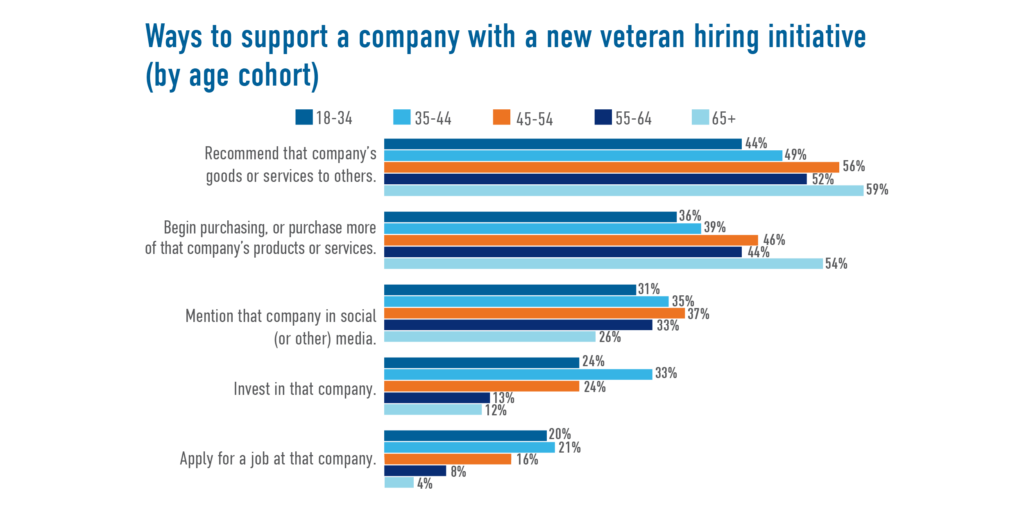
We also see that one in three millennials (age 35-44) say they would invest in a company that started a hiring program, the highest percentage across all generational splits, and about twice that of older Americans (13% among Age 55+). Millennials are a generational segment who are primed to invest and are at a point in their lives in which they may have the means to do so by a more significant margin than older or younger generations.
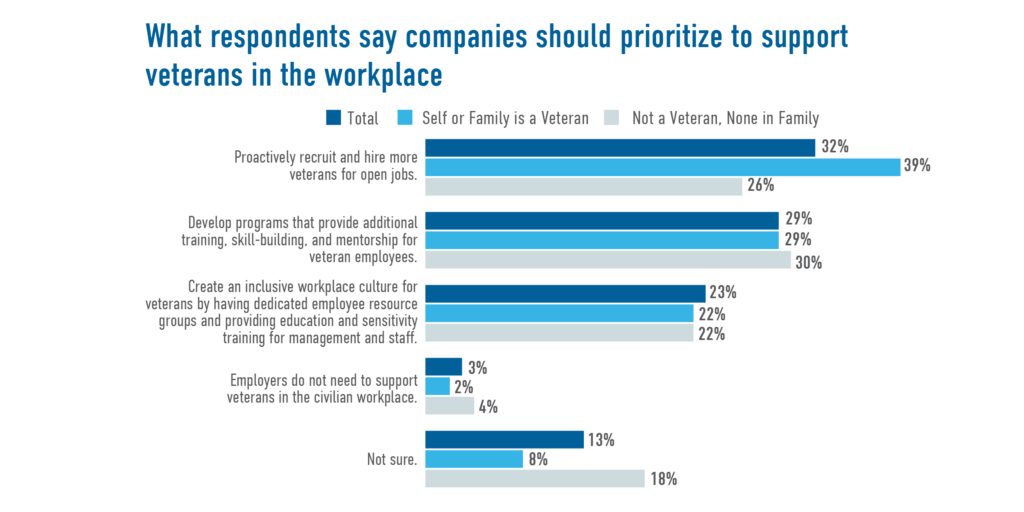
We then asked respondents about their opinions on the myriad ways that companies can support veterans. About one in three (32%) say that recruiting and hiring more veterans to the workforce is the primary way companies can help, with more veteran respondents (39%) choosing this option than non-veterans (26%). Another way in which companies can support veterans is by developing training, skills, and mentorship programs for their workers (29%) and creating a more inclusive culture (22%), with similar percentages across respondent status choosing these two options. Those who are neither veterans nor have vets in their families are most likely to be unsure about the matter.
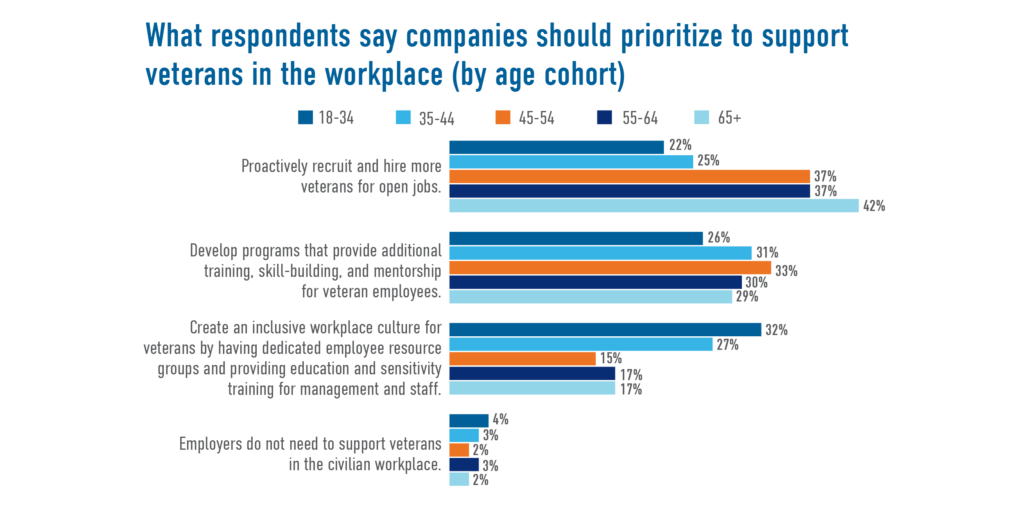
There appears to be some differences in opinion on the key way companies can help veterans when we look at results across age cohorts. Younger respondents (age 18-34), are significantly more likely to choose “create an inclusive workplace culture such as dedicated employee resource groups and education and sensitivity training for management and staff” than older respondents, who are more supportive of hiring more veterans for open jobs, by a factor of almost two to one over the younger generation.
Although veteran recruiting is also a key issue, the reality is that veterans face lower unemployment than others. The unemployment rate for veterans has been consistently lower than nonveterans since the early aughts. In 2020, the unemployment rate for veterans was 6.5%, while for nonveterans it was 8.0%.
Issues of veterans’ employment are somewhat deceptive – underemployment is more likely to be a key struggle within this group, with around 12% of veterans underemployed and about 34% more likely to be underemployed than non-veterans. Veterans in the workforce may not be engaged to the full extent of their abilities, resulting in difficulty both finding and landing jobs that closely match training and skills honed during their military experience.
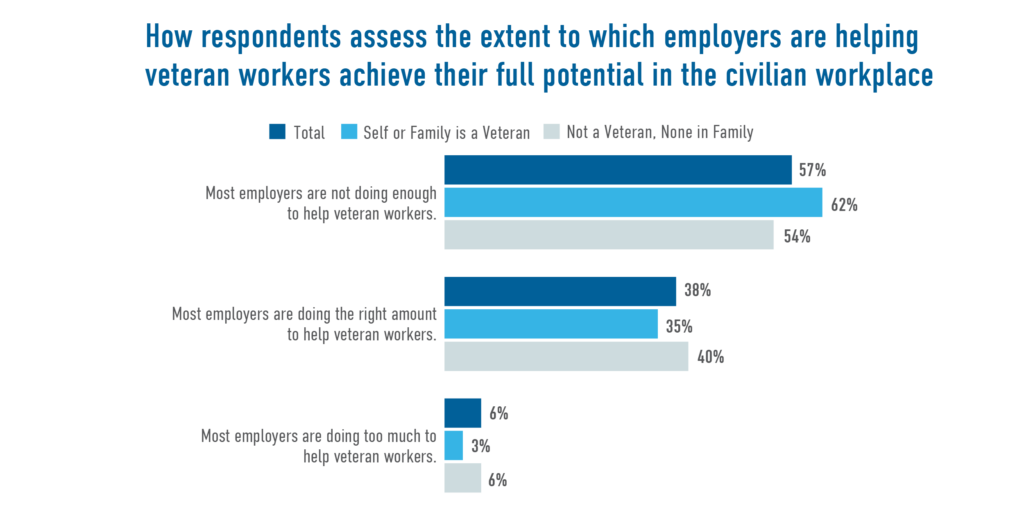
There is public awareness that underemployment is an issue. When asked how much employers are doing to help veteran workers achieve their full potential in the civilian workplace, a majority (57%) say most companies are “not doing enough,” and more veterans (62%) than non-veterans (54%) say employers aren’t doing enough.
Providing more inclusive support to veteran employees is an issue both in the workplace and in a company’s surrounding community. America’s largest companies have aways to go to align with the public’s priorities and develop programs to address not just unemployment but underemployment – and in our companion analysis, we see that these efforts also pay off in the market. As we mark Veterans Day this year, we are reminded that corporate leaders play a key role in supporting American veterans, and that the public at large is eager to support the companies that make these efforts a priority.
This survey was conducted online within the United States by The Harris Poll in partnership with Just Capital from October 25–27, 2021 among 3,058 U.S. adults ages 18 and older. The survey is not based on a probability sample, is not representative, and therefore no estimates of theoretical sampling error can be calculated. For complete survey methodology, including weighting variables and subgroup sample sizes, please contact Jennifer Tonti, Managing Director, Surveys & Polling at jtonti@justcapital.com.
Just Capital’s 2021 Americans’ Views on Business Survey is by Jennifer Tonti, Managing Director, Survey Research & Insights.
As we continue to move forward from the COVID-19 pandemic, we find ourselves in the midst of an economic sea change – in one of the tightest labor markets in history despite millions of Americans still out of work. In August alone, an unprecedented 2.9% of the entire workforce, some 4.3 million people, quit their jobs as part of the labor market reckoning dubbed The Great Resignation. And American workers rose up during “Striketober” to demand better working conditions and higher pay.
It remains to be seen what the long-term impacts of these shifts will be – and whether this is a temporary blip for our economy or a greater shift in how people think about the role of business in society. In this year’s Survey of Americans’ Views on Business, we’ve turned to the public once again to ask them how they think corporate America is doing today – and provide a lookback on our findings over the years to see how views have shifted.
Since 2015, Just Capital has surveyed more than 150,000 demographically diverse Americans, asking them what they believe is most important when it comes to just business behavior. Polling the public not only helps us understand what Americans want from corporate leaders today, it provides a data-driven roadmap for how companies can better align their business with the public’s priorities and help address the country’s most pressing societal challenges.
In 2021, many of the positive views we’ve heard from the public from past surveys seem to be reversing course, and Americans increasingly believe that business is heading in the wrong direction, with a decreasing focus on workers in favor of shareholders. But they also believe that corporate leaders can play a critical role in addressing core societal issues – from income inequality (70%) to racial equity (64%) to climate change (56%).
“Organizations should not be creating the world’s problems but actually solving them,” suggested former Unilever CEO and Just Capital Board member Paul Polman in a recent Financial Times interview. Americans agree that companies should aim to do more good by focusing on their stakeholders’ long-term interests and taking responsibility for their impact on the wider world.
Here’s what we learned:
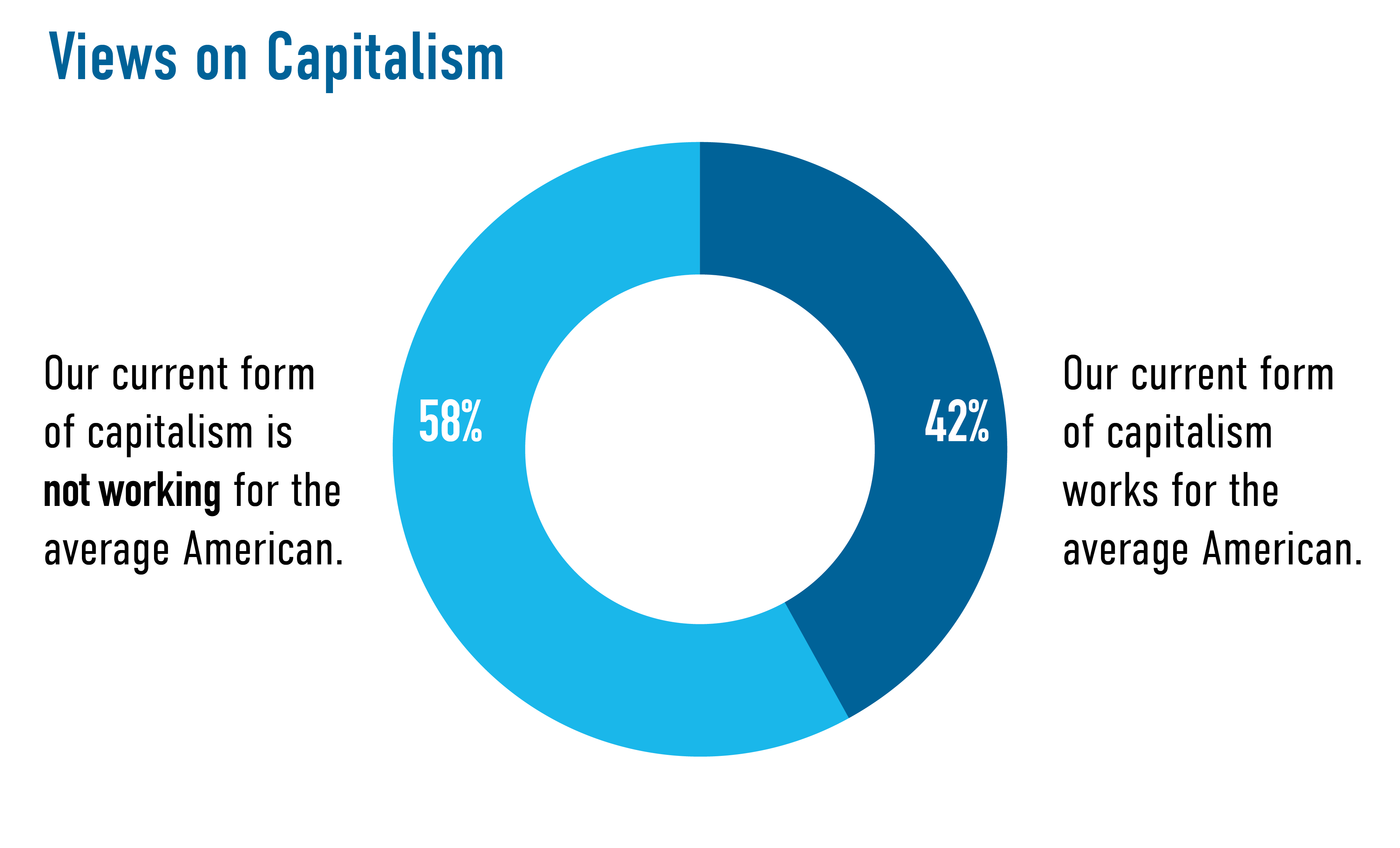
A majority (58%) says that our current form of capitalism is not working for the average American. This finding is supported by 61% who agree “The Coronavirus pandemic has made it clear that America needs a more evolved form of capitalism.” These two findings underscore that, in the eyes of the public, large companies are still operating like business as usual, and the average American is not reaping the benefits promised by the capitalist model.
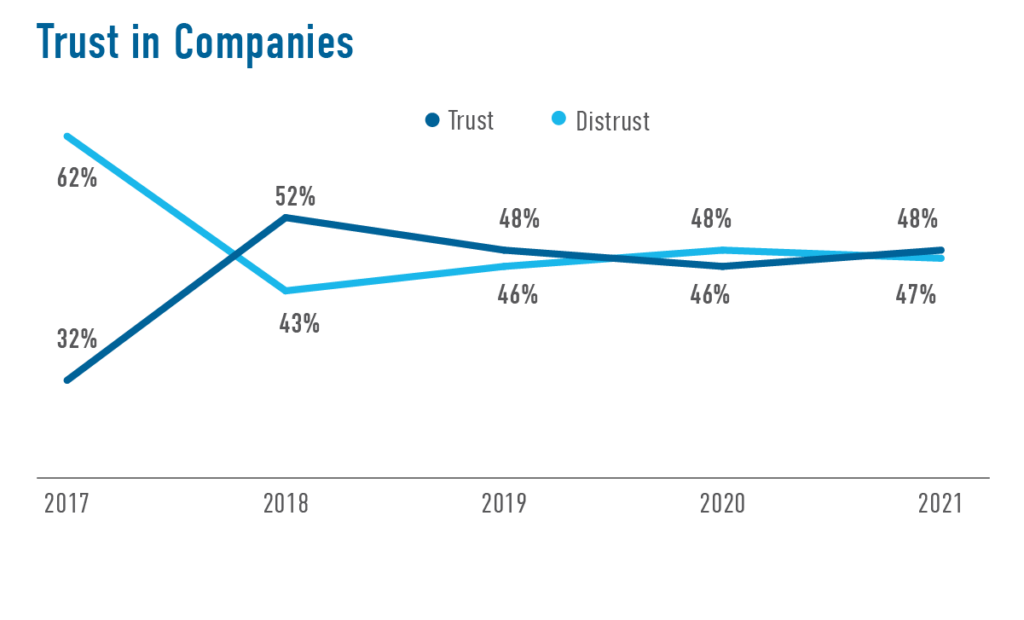
By the same token, Americans’ trust in business has stagnated. Although Edelman’s Trust Barometer shows that business is the most trusted institution (compared to major institutions such as government and media), our research shows that Americans’ trust in business has plateaued over the last four years, with roughly equal proportions saying they trust companies (48%) as distrust them (47%).
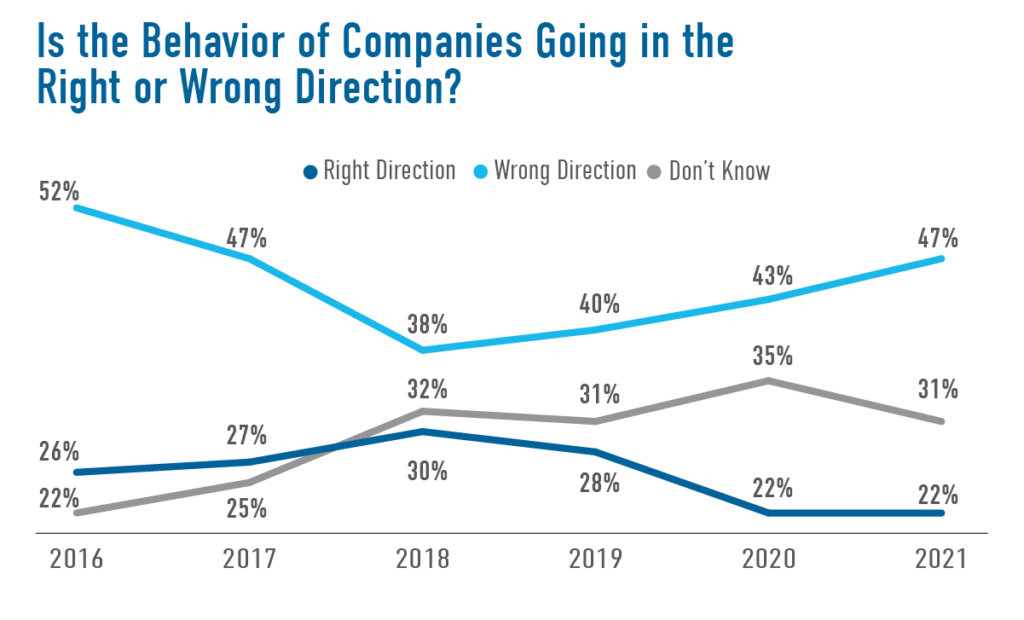
Since 2016, we have asked the public whether they think companies are heading in the right or wrong direction. The optimism we saw emerging in 2018 has started to slowly reverse course; in 2021, just 22% say companies are headed in the right direction (a similar percentage as when we started asking this question five years ago), versus 47% who say companies are headed in the wrong direction. Another 31% say they don’t know if companies are moving in the right or wrong direction, which could be an indication of their mixed feelings about the issue.
In August of 2019, CEOs of the Business Roundtable challenged Milton Friedman’s shareholder primacy doctrine and redefined the purpose of a corporation to promote “an economy that serves all Americans.” All told, today 243 signatories have committed to lead their companies for the benefit of all stakeholders, which includes serving their workers, customers, communities, the environment, and shareholders.
Yet in the two years since that announcement, there is significant skepticism that companies are actually following through on their commitments: 84% agree that companies “often hide behind public declarations of support for stakeholders but don’t walk the walk.”
The following chart shows that the public is less confident that companies are actively demonstrating a positive impact across key stakeholders. For example, the percentage who say companies are having a positive impact on shareholders (78%) is significantly greater than those who say the environment (39%) or the financial well-being of lowest paid workers (36%).
When we look at some of these measures over time, once again we see that the public’s perspective is that companies are moving in the wrong direction. For example, the percentage who say companies have a positive impact on society overall has fallen from a high of 58% in 2018 to just 49% of Americans in 2021.
Similarly, the percentage who say companies have a positive impact on the quality of U.S. jobs (65% in 2018) falls almost 20 percentage points (48% in 2021) as does the percentage of those who believe companies are having a positive impact on the well-being of local communities (62% in 2018 to 57% in 2021).
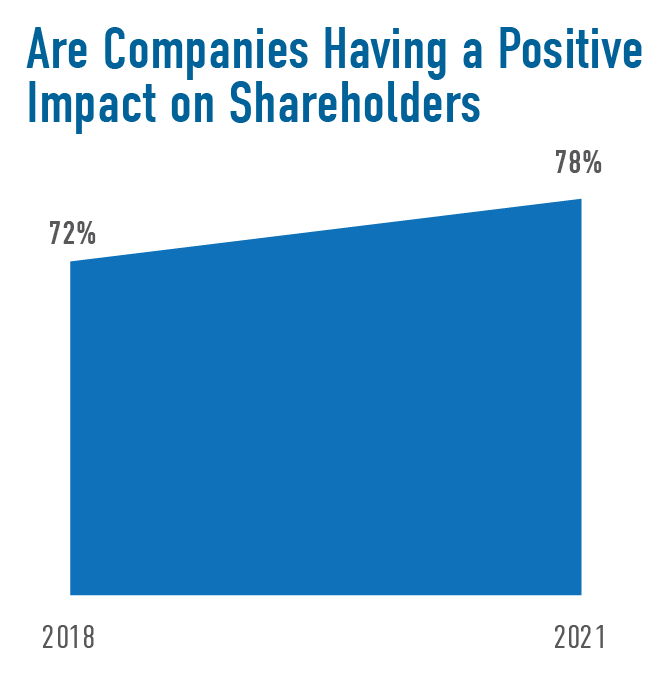
Compare those trends with the percentage of Americans who say companies are positively impacting their shareholders: This number has ticked upwards, from 72% in 2018 to 78% in 2021.
Another question asks for the public’s thoughts about which stakeholder – shareholders, customers, or workers – is the top priority for companies. For each of the last five years and by a significant but varied margin, Americans have said shareholders. Although the percentage had been trending downward, in 2021 that dip has reversed yet again, with just about half (51%) saying shareholders are a company’s top priority. At the same time, the percentage of those who said workers were a company’s top priority – which had reached a high of 37% in 2020 – has fallen to 30% in 2021.
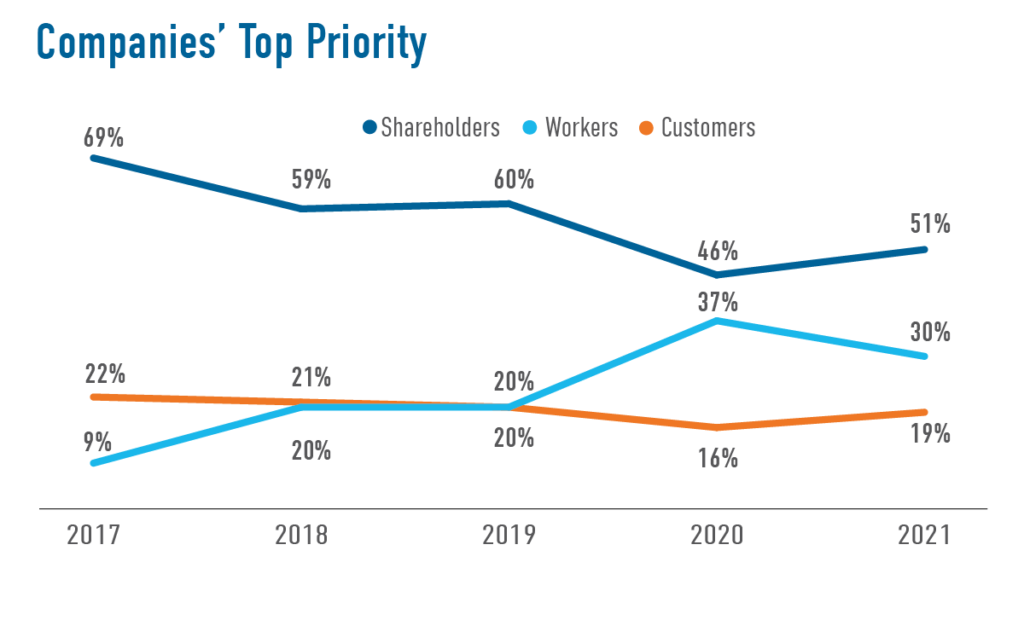
The data reflect that Americans continue to believe that workers are being left behind. Low wages, poor benefits, and the continued strain of health concerns during the pandemic have made working conditions next to impossible for America’s frontline workers, and the public is taking notice. Particularly when the media is paying close attention to the groundswell of workers who, feeling more empowered than ever to fight for better treatment from their employers, are striking, walking-out, or simply resigning.
Revisiting the chart on positive impact for specifically worker-related issues brings the Great Resignation to closer focus. Compare the 78% who say companies have a positive impact on their shareholders to the percentage who say companies have a positive impact on the financial well-being of their lowest-paid workers (36%), and you see that Americans believe companies’ focus on shareholders is greater their focus on their lowest-paid workers by a margin of 2-to-1.
Despite the increasing skepticism we see from the American public, respondents also believe that change is possible – that corporate leaders have a key role to play in addressing the most critical issues of our time and that they’ve done right by their stakeholders through the COVID-19 pandemic and moving through our nation’s reckoning with racial injustice.
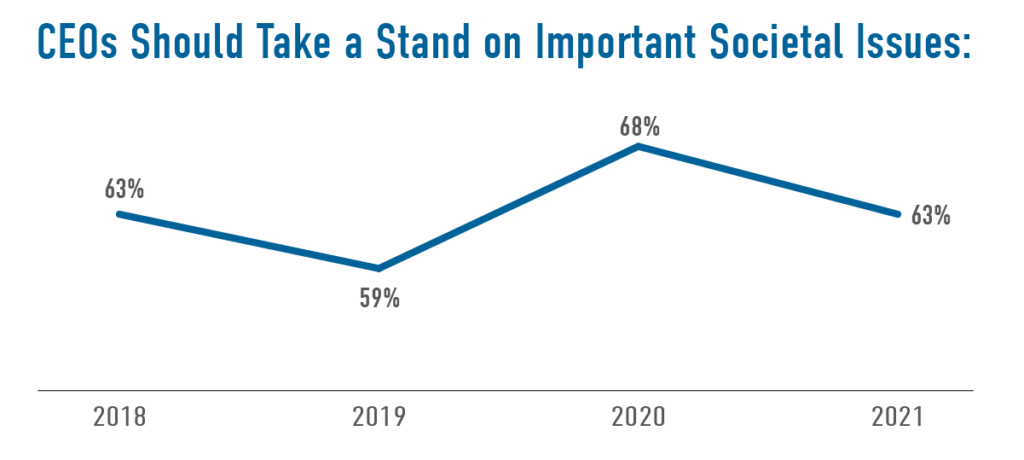
The public has consistently maintained that corporate leadership is the driving force behind just business behavior. Although the numbers may vary slightly year over year, the proportion is relatively stable over time: a majority of Americans (63%) believe CEOs of large companies have a responsibility to take a stand on important societal issues.
When we look at views on business across demographic disaggregates, we see a lot of consistency between different groups. CEOs taking a stand on societal issues, however, is one case in which Americans don’t necessarily see eye to eye. Americans who identify as liberal are almost two times as likely as conservatives to say CEOs have a responsibility to take a stand on societal issues (81% liberal vs. 42% conservative).
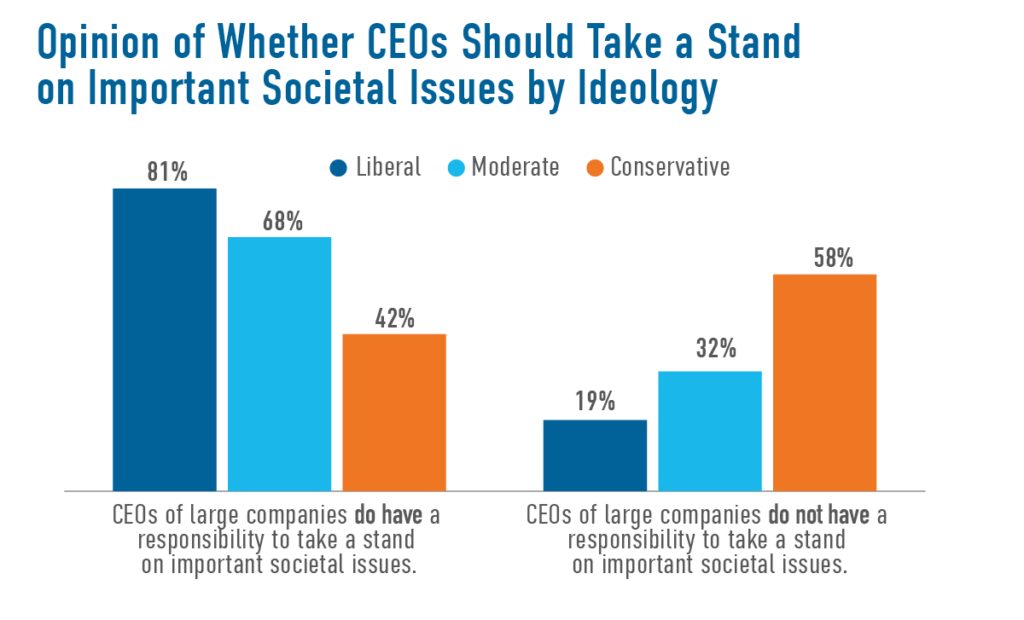
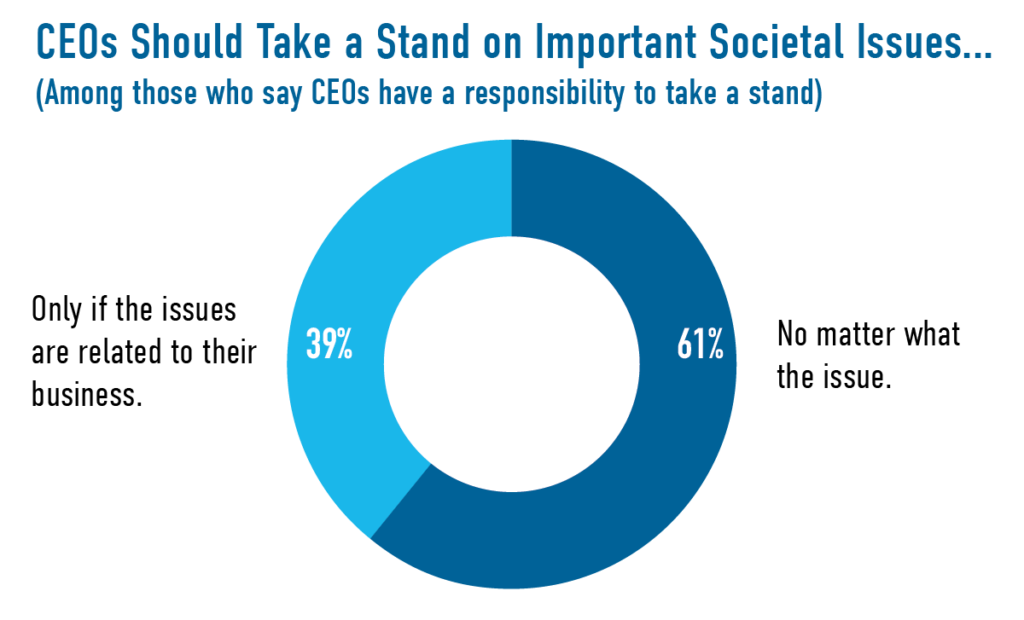
Of the almost two-thirds who say that CEOs have a responsibility to take a stand, 61% of that group says they should do so no matter the issue, and not necessarily focus on issues that directly impact their business.
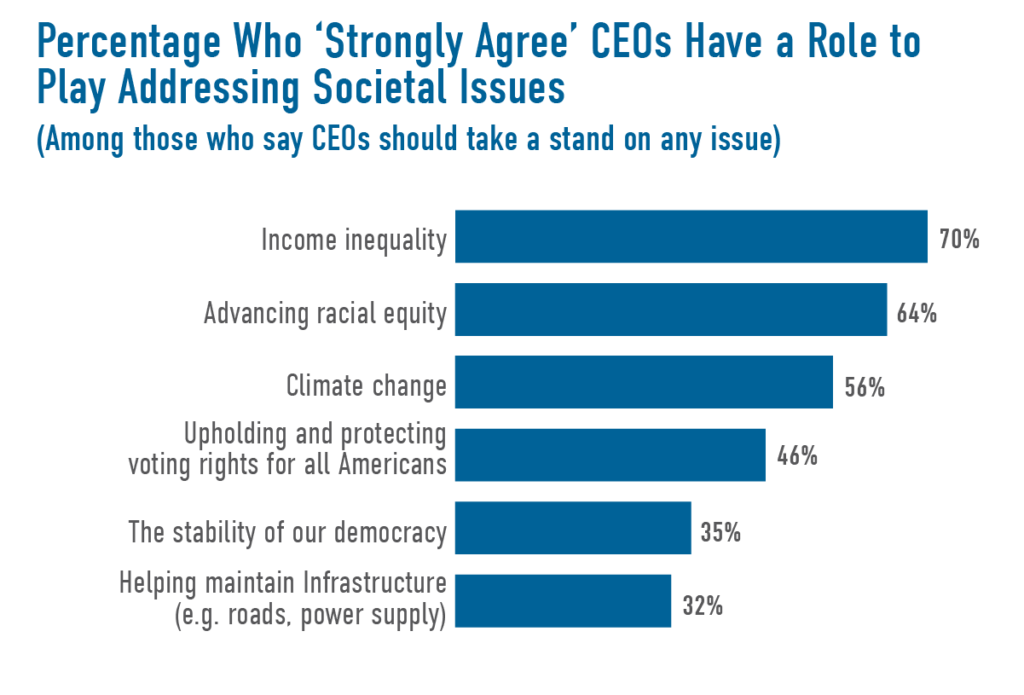
In 2021, we asked which societal issues CEOs should address. Among those who say CEOs should take a stand no matter what, 70% strongly agreed that leadership should address income inequality. The other most important issues were racial equity (64%) and climate change (56%).
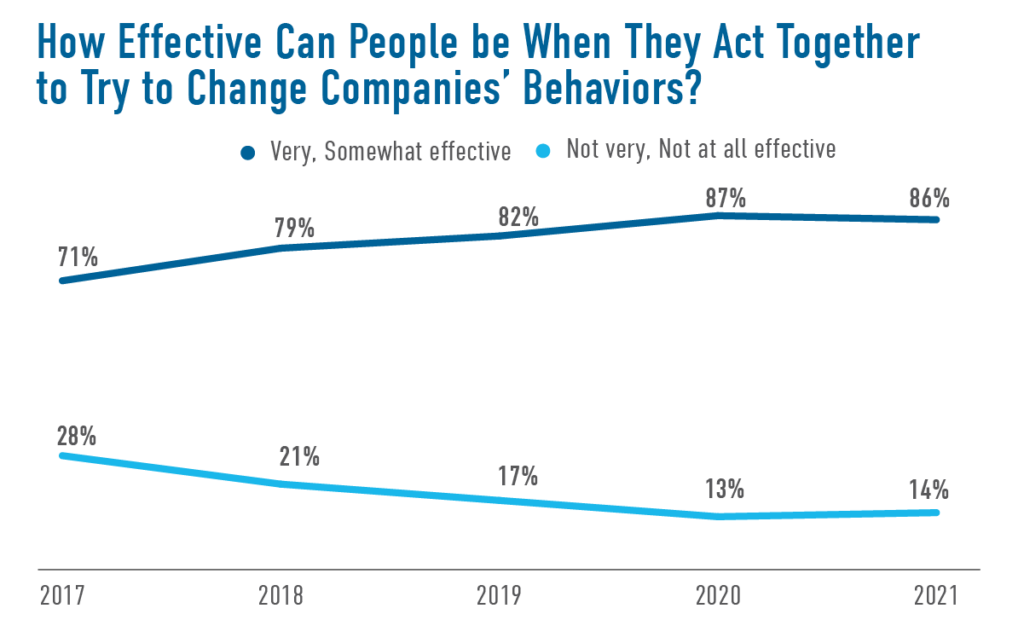
When asked if business can be a positive force for change, a large majority (84%) agreed. Additionally, people believe that their own actions can shape the future: 86% of Americans say people can be effective when they act together to try to change companies’ behaviors, up 15 percentage points since we first asked this question in 2017.
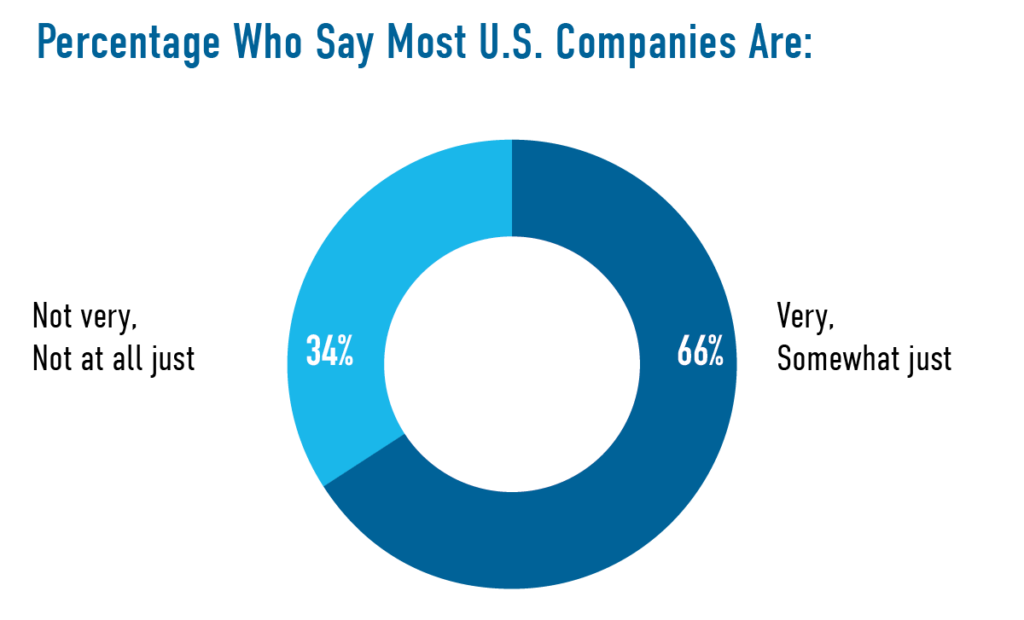
With regards to just business behavior, we found this year that two-thirds of Americans think most companies are very or somewhat just, up from 60% in 2019.
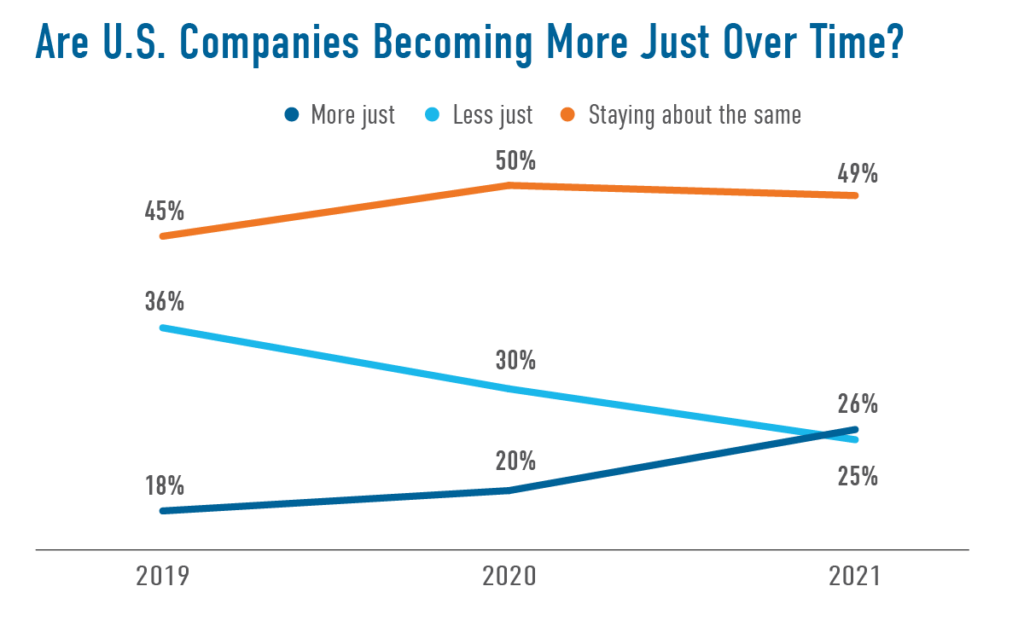
We also asked Americans whether they think companies are becoming more or less just over time – and although a plurality say that they have stayed about the same, a growing percentage say companies are becoming more just while a decreasing percentage say companies are becoming less just.
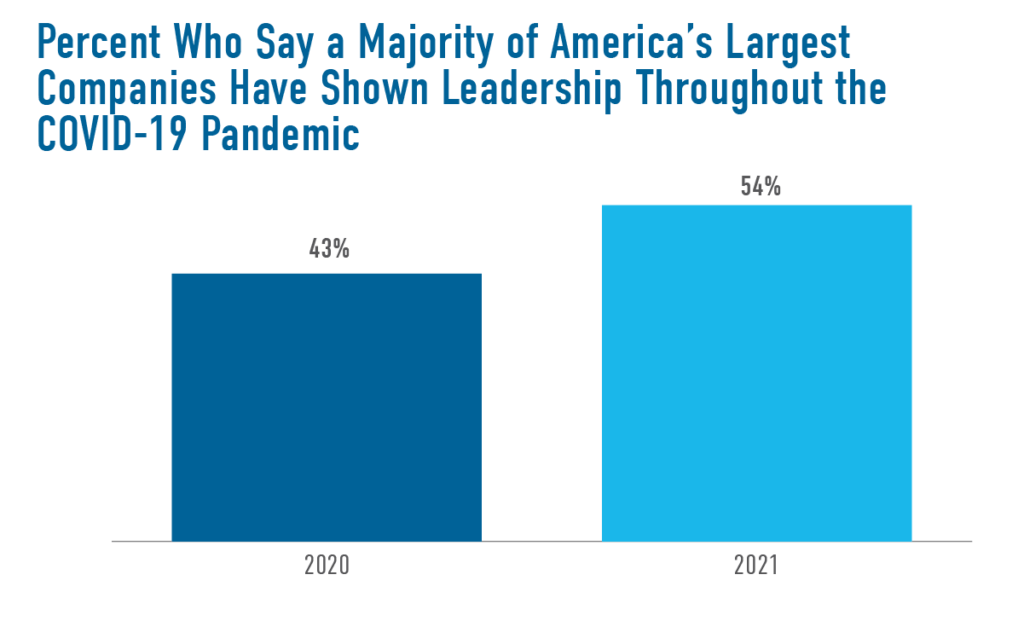
Positive assessments of corporate behavior are perhaps informed by the public’s views on how companies have weathered the events of the past two years. More than half (54%) say companies have shown leadership throughout the pandemic, up from 43% in 2020.
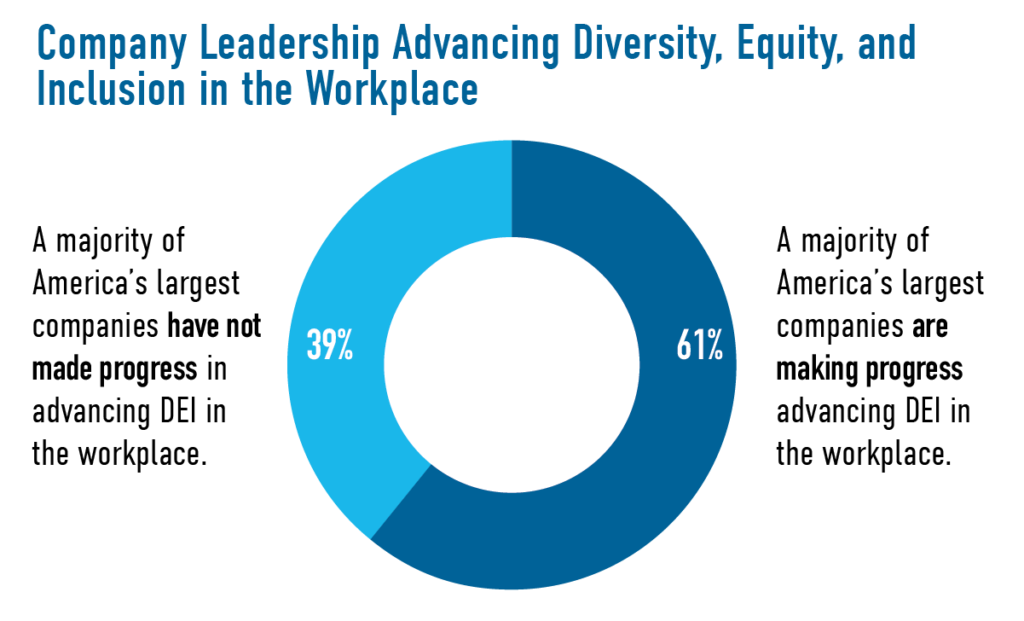
Assessments of company leadership making a commitment toward diversity, equity, and inclusion in the workplace over the past 12 months show similarly positive results, with 61% of Americans saying a majority of companies are making progress advancing DEI.
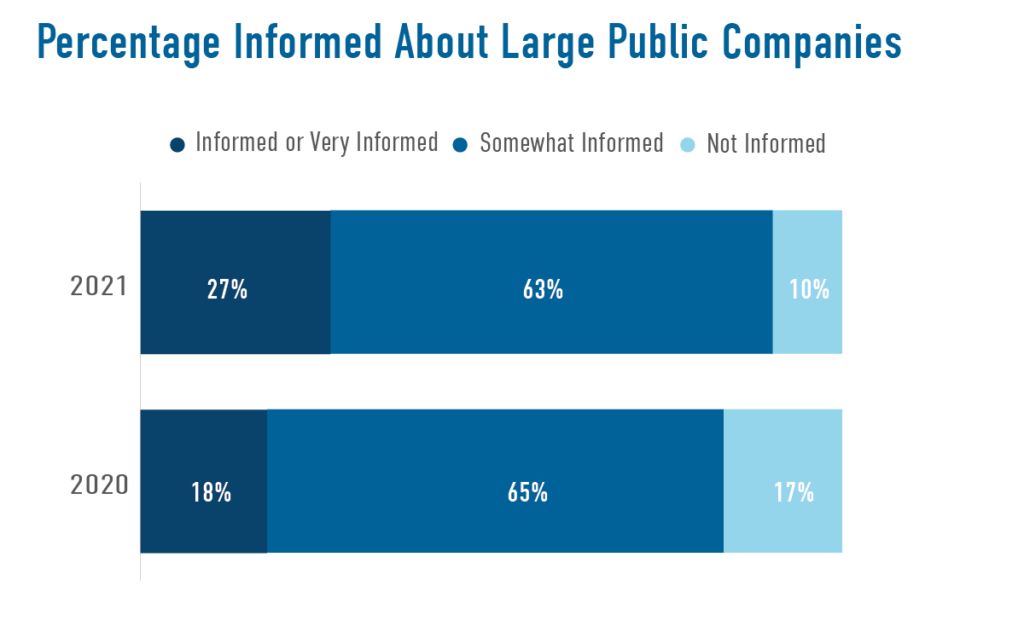
That Americans have strong opinions about large U.S. companies may be attributable to a significant and growing percentage of the public being informed about corporate activities and behavior (in 2021, 27% say they are Informed or Very Informed, up from 18% in 2020), undoubtedly due to an prodigious amount of media coverage on the topic throughout the pandemic.
For all of corporate America’s positive momentum toward achieving a more just business model, this year’s survey data shows that leadership has more work to do in addressing the needs of all their stakeholders, particularly treatment of their lowest paid workers. Last year, almost nine in 10 Americans said the pandemic was “an opportunity for large companies to hit reset and focus on doing right by their workers, customers, communities, and the environment.” While Americans saw positive gains on some key metrics, there has been some backtracking from those gains in the past 12 months.
If progress is truly to be made toward a more just economy that serves the needs of every American, then corporations must continue to listen and respond to the issues that matter most. Toward that end, Just Capital will be releasing in December the “The People’s Priorities” showcasing which Issues rose to the top in this year’s Annual Survey and the final Issue weights that will underpin our Rankings of America’s Most Just Companies in 2022.
The Americans’ Views on Business survey was conducted in association with SSRS – an objective, non-partisan research institution that provides scientifically rigorous statistical surveys of the U.S. population. Just and SSRS conducted the 20 question survey online with a probability-based sample between July 28 and August 10, 2021 among a general population sample of 3,000 English- and Spanish-speaking U.S. adults 18+ years of age, with an oversample of 507 Hispanic and 461 non-Hispanic Black respondents.
The margin of error is +/- 2% at the 95% confidence level. Results were weighted to U.S. Census parameters for age, gender, education, race/Hispanic ethnicity, and Census Division to ensure representativeness of the U.S. population. All margins of error include “design effects” to adjust for the effects of weighting.
