
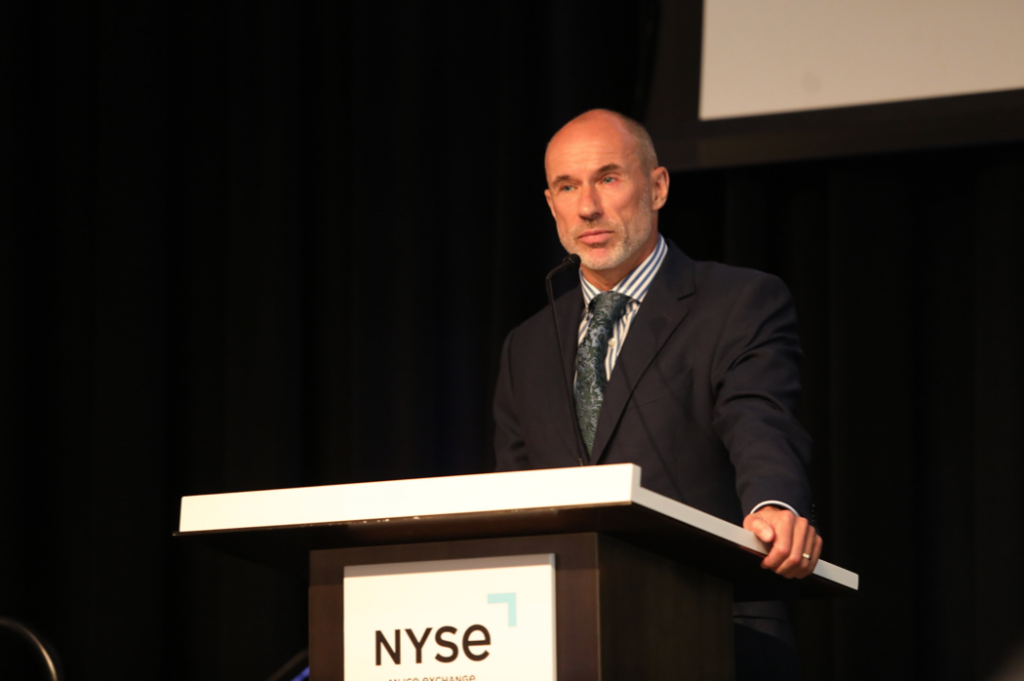
This week we marked the five-year anniversary of the JUST ETF. Launched in partnership with Goldman Sachs Asset Management, the fund has delivered exactly what we expected: solid financial return and measurable positive change on just business behavior.
At a time when ESG is coming under sustained attack, the American public has provided a powerful alternative framework. The entire model that underpins the index on which the fund is based – our proprietary JUST U.S. Large Cap Diversified Index (JULCD), which comprises companies in the top half our Rankings across every sector – is driven by the opinions and priorities of the American people, on a fully representative basis. And it’s outperformed the Russell 1000 by 8.78% since inception through May 31, 2023.
To the best of my knowledge, the funds supported by JUST Capital (including the JUST ETF, the Sustainable Impact Investing UIT with SmartTrust and Argus Research, Natixis AIA Racial Equity Direct Index Fund, and a suite of SMAs alongside USA Financial) remain to this day the only products available to investors that are expressly designed and built around the priorities of the American people. As I wrote in an article about the ETF anniversary earlier this week, I believe it’s a remarkable achievement that shows just business is indeed better business.
On Monday, we celebrated the occasion with an event at NYSE that featured some powerful speakers, including Catherine Winner, Goldman’s Global Head of Stewardship, Roy Swan, Director of Mission Investments at The Ford Foundation, and the CEO of Amalgamated Bank, Priscilla Sims Brown. The discussion ranged from proxy voting to the morality of markets to what Swan called “patriotic capitalism.” You can explore more insights from the discussion here.
A system that delivers growth, generates strong returns for investors, and creates value for all stakeholders on a sustainable basis is desperately needed, and perhaps within our grasp.
Be well,
Martin
PS: As I’m writing this, the Supreme Court has ruled against affirmative action in college admissions, which may have a significant impact on the business talent pipeline. Business leaders are beginning to react. We’re following this closely.
CNBC’s Leslie Picker moderates a panel titled “The Value of Investing in Just Business” at JUST Capital’s five-year anniversary event in honor of the JUST ETF, alongside Goldman Sachs Asset Management. Other speakers include JUST CEO Martin Whittaker, Head of Investor Strategies Cambria Allen-Ratzlaff, and more.
RepRisk interviews Martin on the issues Americans find most important, how the firm’s data helps ensure our Rankings reflect real-time events, and why the outdated narrative of business success is holding back sustainable markets.
JUST Board Member Peter Georgescu writes for Directors and Boards on why “stakeholder capitalism is nothing more than smart capitalism” and reflects on the legacy of Henry Ford as a pioneer of turning profits while simultaneously helping the individuals who made those profits possible.

“It’s really important for companies to listen to their employees. That’s the way they show that they actually care.” For Chipotle Field Leader Eddy Ceballo, who started 12 years ago as a Crew Member, his company’s commitment to investing in its people has helped him not only accelerate his career but support his team in doing the same.
Eddy’s story is one in a new video series we recently launched as part of our Worker Financial Initiative, which helps companies assess and improve their workers’ financial health. Hear more from Eddy – as well as from Chipotle Chief Operating Officer Scott Boatwright – about the ways in which workforce investments not only support employees but drive better business outcomes.

(Image credit: Christopher Galluzzo)
“Call it ESG. Don’t call it ESG. Call it global warming. Don’t call it global warming. The point is – keep pushing forward on issues that matter on a values level.”
“Investing in your people is probably one of the smartest decisions you’ll ever make as a leader, that’ll pay massive dividends to your organization today and in the future.”
IBM releases a new report on CEO decision-making in the age of AI. 69% of CEOs see benefits from generative AI across their organizations while their executive teams are more wary of the new technology.
Fortune interviews Mathias Döpfner, CEO of Axel Springer, on AI’s short-term impact at his companies and his longer view on the future of journalism.
The Wall Street Journal sits down with Google’s Chief Sustainability Officer Kate Brandt to discuss how AI can accelerate the fight against climate change.
A new survey is out from Insight Enterprises and Harris Poll on generative AI in the workplace. One major finding: 8 in 10 (81%) companies have generative AI policies and/or strategies established or in the works.
USA Today provides an overview of how the Supreme Court’s decision to strike down affirmative action in college admissions could affect workplace diversity, equity, and inclusion initiatives.
ISSB Chair Emmanuel Faber speaks with the Financial Times about the IFRS Foundation’s recently released Global Sustainability and Climate Reporting Standards, which provide a consistent playbook for companies on how to disclose key climate metrics.
Fortune writes about the ways one Fortune 500 Company is helping its employees overcome anti-trans legislation and discrimination. Intuit offers its workers coverage for gender-affirming care, relocation benefits, and hosts a yearly company-sponsored trans summit.
Financial Times highlights the more-than 50 companies that recently signed GLAAD’s statement in support of LGBTQ communities and rejecting harassment and bullying. While statements of support like this have become commonplace during Pride Month, recent polling from Harris and Ipsos signals that companies face increasing backlash from consumers and politicians for their stance on key social issues, including LGBTQ rights.
The Wall Street Journal reports on frontline workers who are receiving “hero pay” for their service during the COVID-19 pandemic. West Coast dockworkers recently negotiated $72 million in bonuses due to hazardous conditions during the lockdowns.
Millions of U.S. workers will now be protected under a new law aimed at stopping discrimination against pregnant women. The Pregnant Workers Fairness Act will provide a range of accommodations to pregnant workers, including flexible hours and closer parking. CBS News has the story.
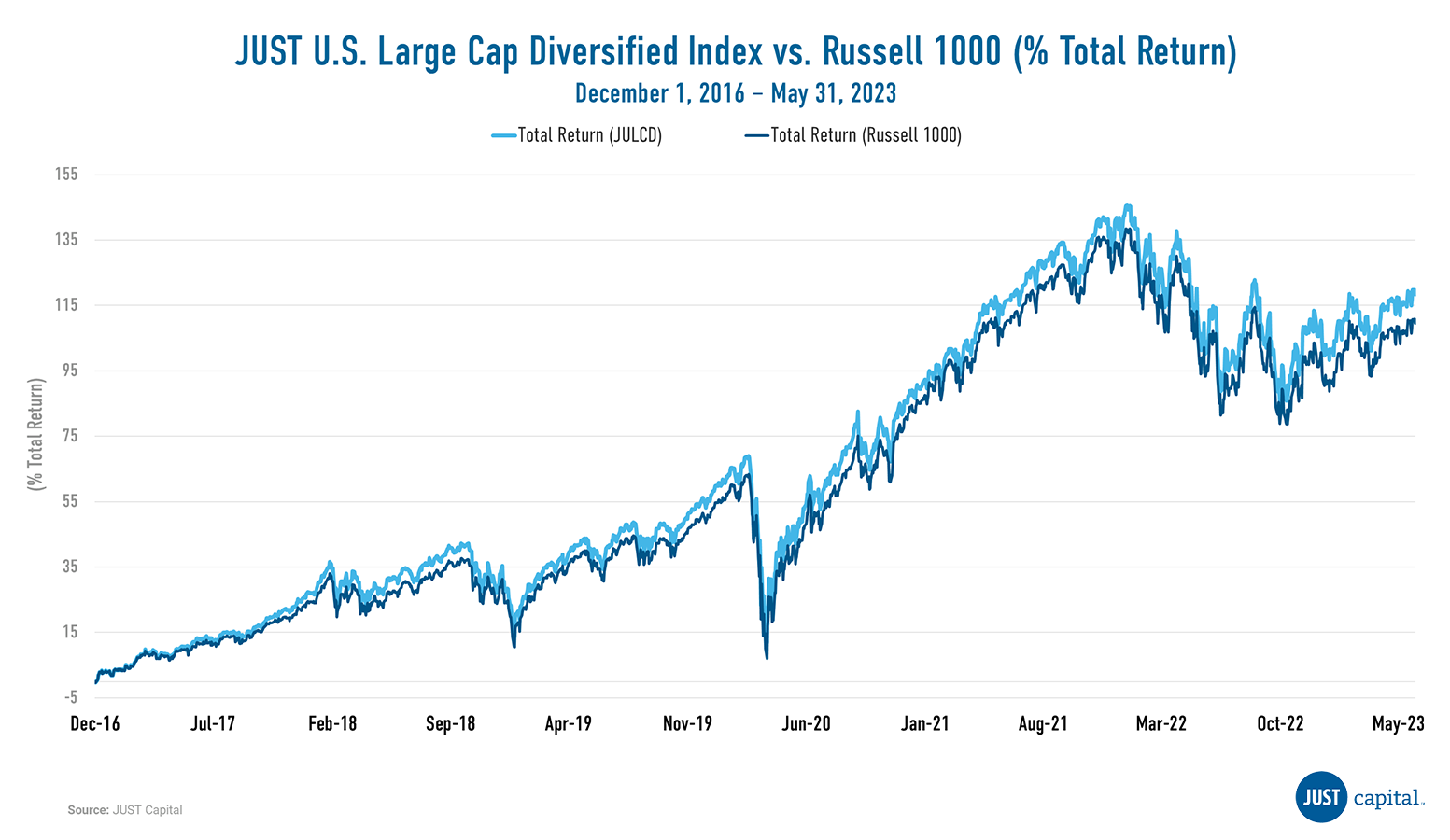
Happy 5th Birthday, JUST ETF! On June 7, 2018, we launched the JUST ETF, powered by our proprietary JUST U.S. Large Cap Diversified Index (JULCD). The JULCD, which represents the top half of companies in JUST Capital’s Rankings of America’s Most JUST Companies, by industry, has outperformed the Russell 1000 by 8.78% since inception through May 31, 2023. This means that, if you invested $100 in the fund at launch, you would have nearly $220 in your pocket today.
Learn more about the JUST ETF – including how the companies included are delivering value not only for their shareholders but for all their stakeholders – here.

President Joe Biden and Labor Secretary Marty Walsh. (Kevin Dietsch/Getty Images)
The Department of Labor is proposing a rule that would reverse two enacted under the Trump administration last year, making it easier for Americans to have environmental, social, and governance (ESG) funds in their 401(k) retirement plans and for their fiduciaries to base proxy votes on ESG factors.
The proposed rule, “Prudence and Loyalty in Selecting Plan Investments and Exercising Shareholder Rights,” has four effects on retirement plans: plan fiduciaries are clearly allowed to consider ESG factors as material to their clients’ risks and returns, ESG factors can be considered “collateral benefits” (e.g. participants who want to keep their retirement funds out of tobacco or fossil fuel companies) as long as these funds still serve clients’ financial interests, there will be new disclosure requirements for funds chosen for ESG-related collateral benefits, and fiduciaries will be allowed to consider ESG factors when selecting funds for Qualified Default Investment Alternatives (QDIAs; a 401(k)’s default investment plan).
The rule also eliminates barriers to fiduciaries considering ESG factors as material to their proxy votes. Both components of the proposal acknowledge that ESG factors are material to investors. JUST Capital agrees and considers it aligned with the American public’s wishes and best interests, and strongly supports the proposal.
Our public comment submission to the DOL is below, addressed to Joe Canary, Director of the Office of Regulations and Interpretations.
Dear Director Canary,
JUST Capital is pleased to submit this comment in strong support of the U.S. Department of Labor’s proposed rule, Prudence and Loyalty in Selecting Plan Investments and Exercising Shareholder Rights (“the Proposed Rule”), 86 Fed. Reg. 57272 (Oct 14, 2021). We applaud the DOL’s effort to clarify that the managers of 401(k)s and private pension plans, governed under the Employee Retirement Income Security Act (ERISA), can and should consider material ESG factors in their investment decisions. Below we share our support for this rule. First, a note about JUST Capital.
Background on JUST Capital
JUST Capital is a nonprofit, co-founded and chaired by Paul Tudor Jones, that exists at the intersection of business, finance, and civil society to build a market that works for all Americans. To drive change at scale, JUST Capital uses a combination of data-driven research and strategic engagement to shift norms and practices in corporate America and the financial markets away from a shareholder primacy model toward one that delivers value for all stakeholders. Each year, JUST Capital surveys thousands of Americans to identify the issues that matter most to them when it comes to just business behavior. JUST Capital then tracks, measures, and ranks the performance of publicly-traded companies (currently the Russell 1000) on these criteria, identifying the tangible steps each company can take to create greater value and support for all of their stakeholders, including investors.
We engage all market participants, including policymakers, investors, and the general public, to drive change at scale on society’s biggest challenges:
Request for Comment Regarding: The Department of Labor (Department) in this document proposes amendments to the Investment Duties regulation under Title I of the Employee Retirement Income Security Act of 1974, as amended (ERISA), to clarify the application of ERISA’s fiduciary duties of prudence and loyalty to selecting investments and investment courses of action, including selecting qualified default investment alternatives, exercising shareholder rights, such as proxy voting, and the use of written proxy voting policies and guidelines.
As an organization that is driving the narrative about stakeholder capitalism, tracking American sentiment, and making the business case for prioritizing ESG, JUST Capital welcomes the DOL’s proposal. We believe there is a powerful business and investor case for company leadership on stakeholder issues. Our research and index performance supports this view.
The proposed rule reinforces the fact that the market, and Americans, are increasingly factoring ESG considerations into their investment decisions – and we know that ESG factors are material to financial performance. Morningstar data shows that asset flows into U.S. sustainable open-end and exchange traded funds reached a record $51.1 billion in 2020, up by more than double 2019’s total, and nearly 10 times higher than 2018 flows. We believe the DOL’s proposal is a step in the right direction to ensuring fiduciaries, and ultimately individuals, are able to fully and fairly seize the opportunity in this growth.
As ESG has become increasingly politicized, JUST Capital polling shows that the vast majority of Americans, regardless of political ideology, want companies to prioritize the same issues: paying a living wage, providing good jobs, cultivating a strong, diverse and inclusive workforce, and protecting workplace health and safety. The DOL’s new proposal is one way of helping drive capital to the companies leading on these and other important issues. Relatedly, we endorse the DOL’s removal of the restrictions on the use of ESG products as Qualified Default Investment Alternatives (QDIAs) – given that plan participants have the autonomy to opt into those or different investment vehicles. We agree wholeheartedly that workers and retirees should be able to make informed, values-aligned decisions about their retirement funds. The DOL is wise to ensure that Americans have access to prudent investment options that provide collateral benefits for workers, communities, and the environment.
We appreciate that the DOL’s proposal would reverse the detrimental provisions of two rules that the previous administration adopted in late 2020, Financial Factors in Selecting Plan Investments and Fiduciary Duties Regarding Proxy Voting and Shareholder Rights. Among the provisions of these rules is the untenable “pecuniary test” stating that a fiduciary can factor ESG-related benefits into deciding between competing investments only when the funds are “economically indistinguishable.” This provision, known as the “tie-breaker rule,” fails to acknowledge that climate and other ESG factors are themselves material financial risks to markets, and that they are “no different than any other ‘traditional’ material risk-return factors.” This and other burdensome rules have caused investor confusion, stifling fiduciaries and plan sponsors from considering ESG factors in their decision-making and proxy voting. Consequently, they have denied American workers and retirees access to ESG investment opportunities that offer competitive returns and reduce risks to their investments. Therefore, we celebrate that the proposed rule, consistent with the original spirit and intent of ERISA, would restore fiduciary authority to consider all relevant factors when choosing among available investment options.
Thank you for providing the opportunity to comment on a vital issue that has potential to help mitigate climate and other ESG risks, prove the business case for prioritizing ESG, and shift financial markets to better serve workers, communities, and the environment in alignment with Americans’ values.
Sincerely,
Martin Whittaker
CEO, JUST Capital

U.S. Labor Secretary Marty Walsh testifies before a Senate subcommittee. (Alex Wong/Getty Images)
Today, the Department of Labor (DOL) proposed a new rule to support employers and fiduciaries in incorporating environmental, social, and governance (ESG) factors into investment options offered in retirement plans covered under the Employee Retirement Income Security Act (ERISA). The proposed rule would allow retirement plan administrators to consider ESG in their initial selection of investment options, and to make ESG-focused funds the default investment option for plan participants. It marks a departure from Trump administration rules, which many asset managers, retirement plan advisors, individual investors, and others criticized as deterring ESG incorporation.
The announcement reinforces the growing influence of ESG factors to broader market flows. Morningstar data shows asset flows into U.S. sustainable open-end and exchange traded funds reached a record $51.1 billion in 2020, up by more than double 2019’s total and nearly 10 times higher than 2018 flows. JUST Capital welcomes the DOL’s proposal as a step in the right direction to ensuring fiduciaries, and ultimately individuals, are able to fully and fairly seize the opportunity in this growth.
The DOL’s move marks the latest show of the Biden administration’s commitment to prioritizing ESG. The Securities and Exchange Commission (SEC) has focused on mandating ESG disclosure, and, with input from the public including JUST, has signaled that disclosure on human capital issues will be part of these efforts. With these measures taking shape, we’re continuing to bring C-suite leaders, investors, policymakers, and other stakeholders together to address the key challenges and opportunities that lie ahead for corporate America.
As ESG has become increasingly politicized, JUST Capital polling shows that the vast majority of Americans, regardless of political ideology, want companies to prioritize the same issues: paying a living wage, providing good jobs, cultivating a strong, diverse and inclusive workforce, and protecting workplace health and safety. The DOL’s new proposal is one way of helping drive capital to the companies leading on these and other important issues, and, if approved, we look forward to seeing its impact in practice.
Labor Day 2021 marks nearly 18 months into the COVID-19 pandemic in the U.S., and this week we highlighted the 32 companies – by industry – that have prioritized their workers during these tumultuous times. The companies – which top our Rankings on worker issues within their industries, from Retail to Software to Transportation – have established practices to keep their workers safe during the pandemic, disclosed demographic details as a first step toward advancing racial equity, offered benefits to help workers climb the job ladder, and more.
For this edition of Chart of the Week, we take a look at how these 32 companies perform compared to the rest of the Russell 1000 companies we rank:
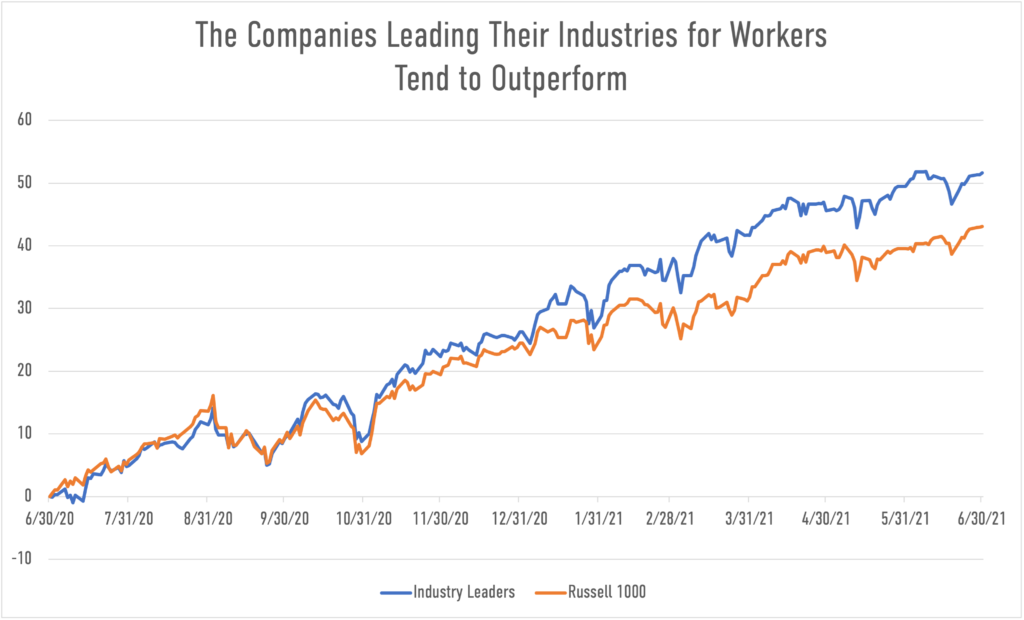
Looking at these industry leaders (excluding the top company for Internet – Facebook – as it is under review for our 2021 Rankings), we see that they have outperformed the Russell 1000 by 8.6% over the trailing one-year period.
These companies are at the forefront of their industries – and many at the vanguard of corporate America overall – when it comes to worker well-being. And their performance shows that, even during one of the most challenging years in recent history, it pays to treat your workers well.
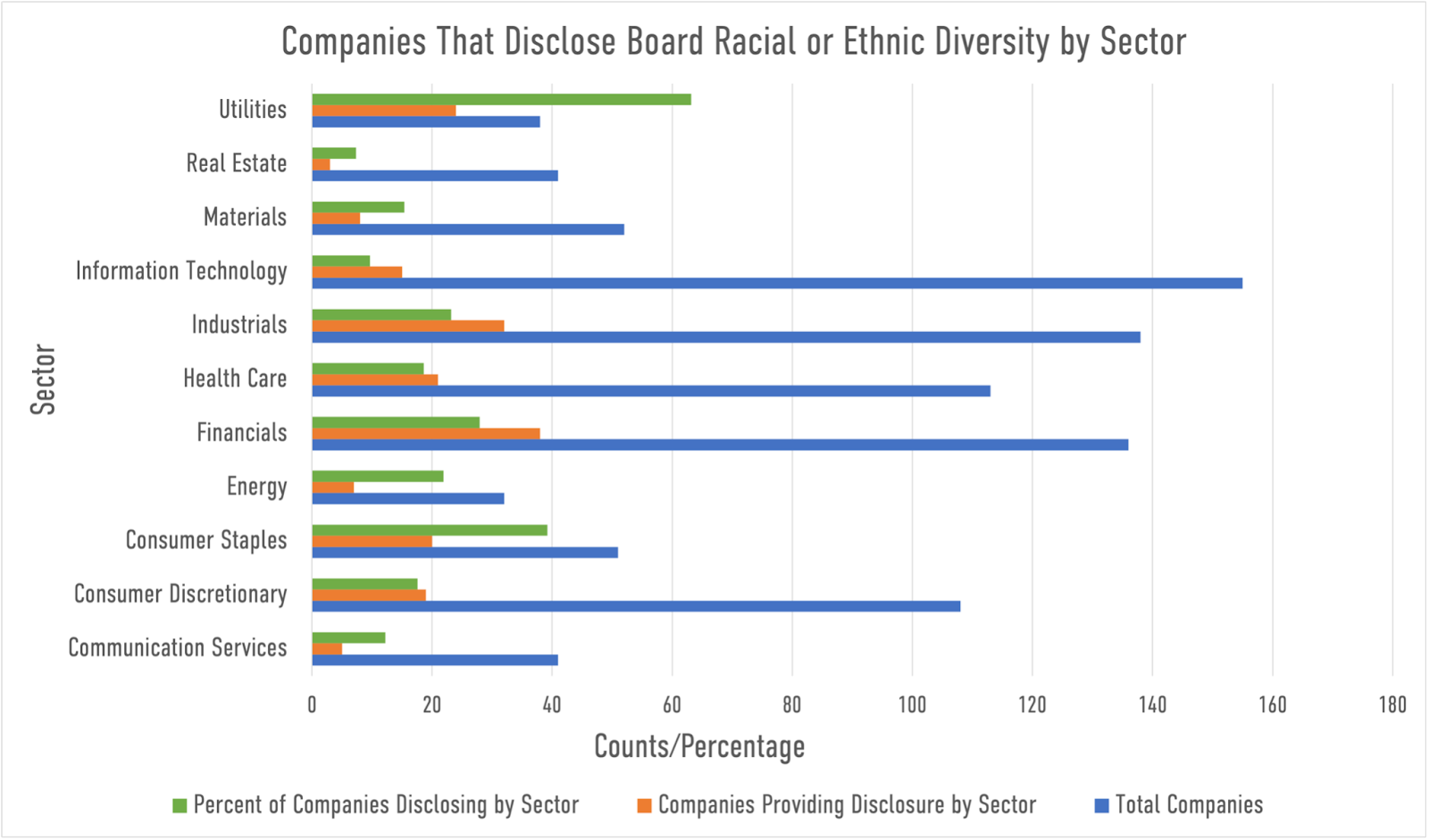
Following up on our recent report exploring racial and ethnic board data disclosure at the 100 largest employers in the Russell 1000, we’re now going to take a look at our larger Rankings set of companies in that index, analyzing the characteristics of those that disclose their racial and ethnic board diversity relative to those that do not.
With increased external pressure for greater board diversity from investors, financial exchanges, and government, it is clear that stakeholders are expecting corporations to include in their commitments to fighting systemic inequity by building diverse boards. Organizations like the Board Diversity Action Alliance argue that diverse leadership at the very top is necessary to make these commitments work. A growing number of shareholders are convinced – as we highlighted in last week’s chart, board diversity has constituted 9% of ESG proposals this proxy season.
Our charts this week highlight the sectors that have provided disclosure of their boards’ racial and ethnic diversity relative to other sectors that did not disclose. Looking at the data, we see significant disclosure percentage-wise within the Utilities sector, with 63% of companies disclosing their board racial and ethnicity data, followed by 39% of companies in the Consumer Staples sector. It is worth noting that many of the country’s largest utilities companies operate in states with board disclosure requirements like California, Illinois, and New York.
American Electric Power (JUST Ranked #53) is an example, however, of a utilities company that has gone beyond a requirement for disclosure, with 50% of its board seats filled by directors who are not white men as of April 2021, as disclosed on its website.
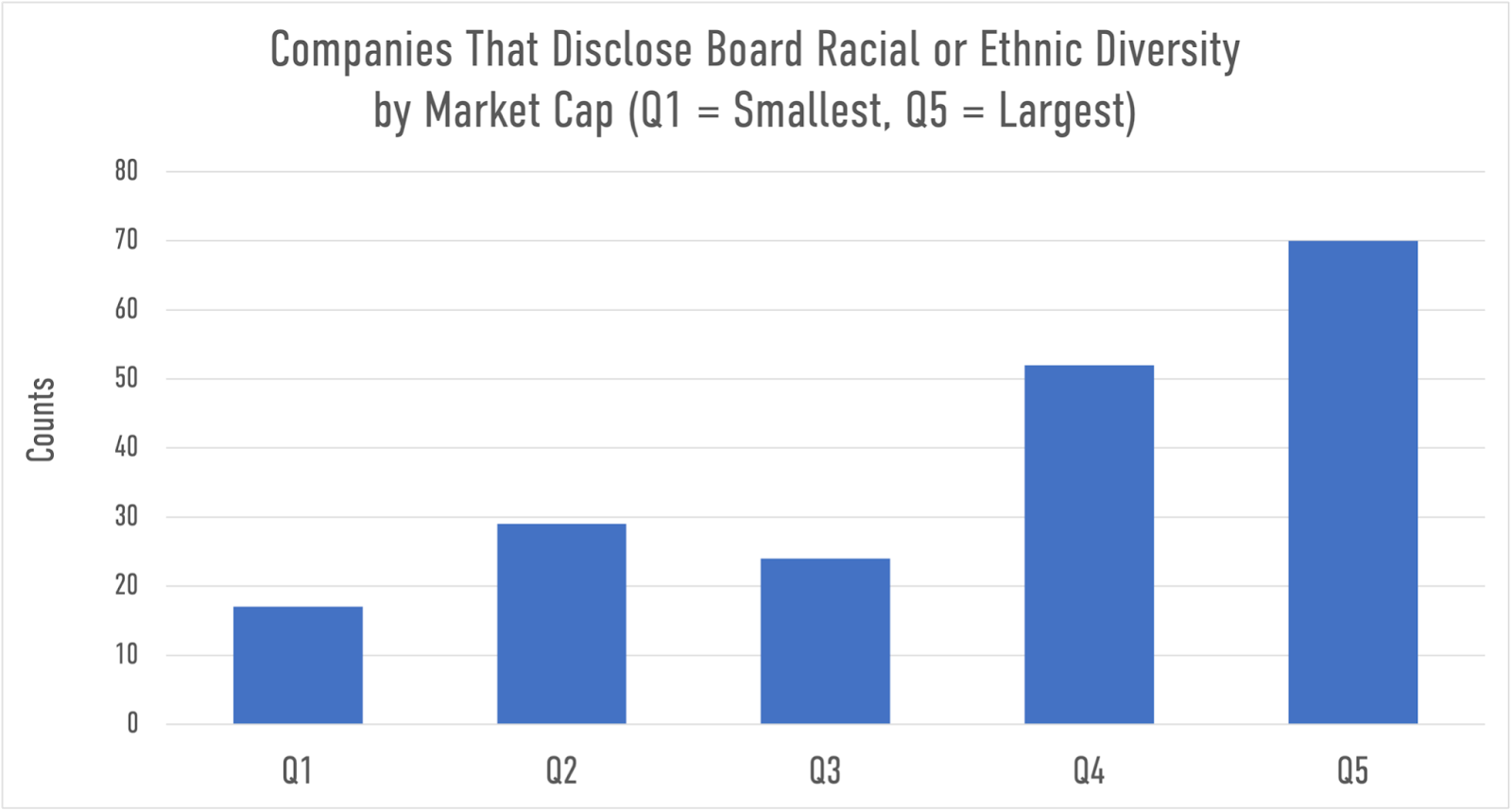
Looking at the breakdown of companies by market cap, we see that companies in the two largest market capitalization quintiles (Q4-5) are most likely to disclose relative to the three lower market cap quintiles (Q1-3).
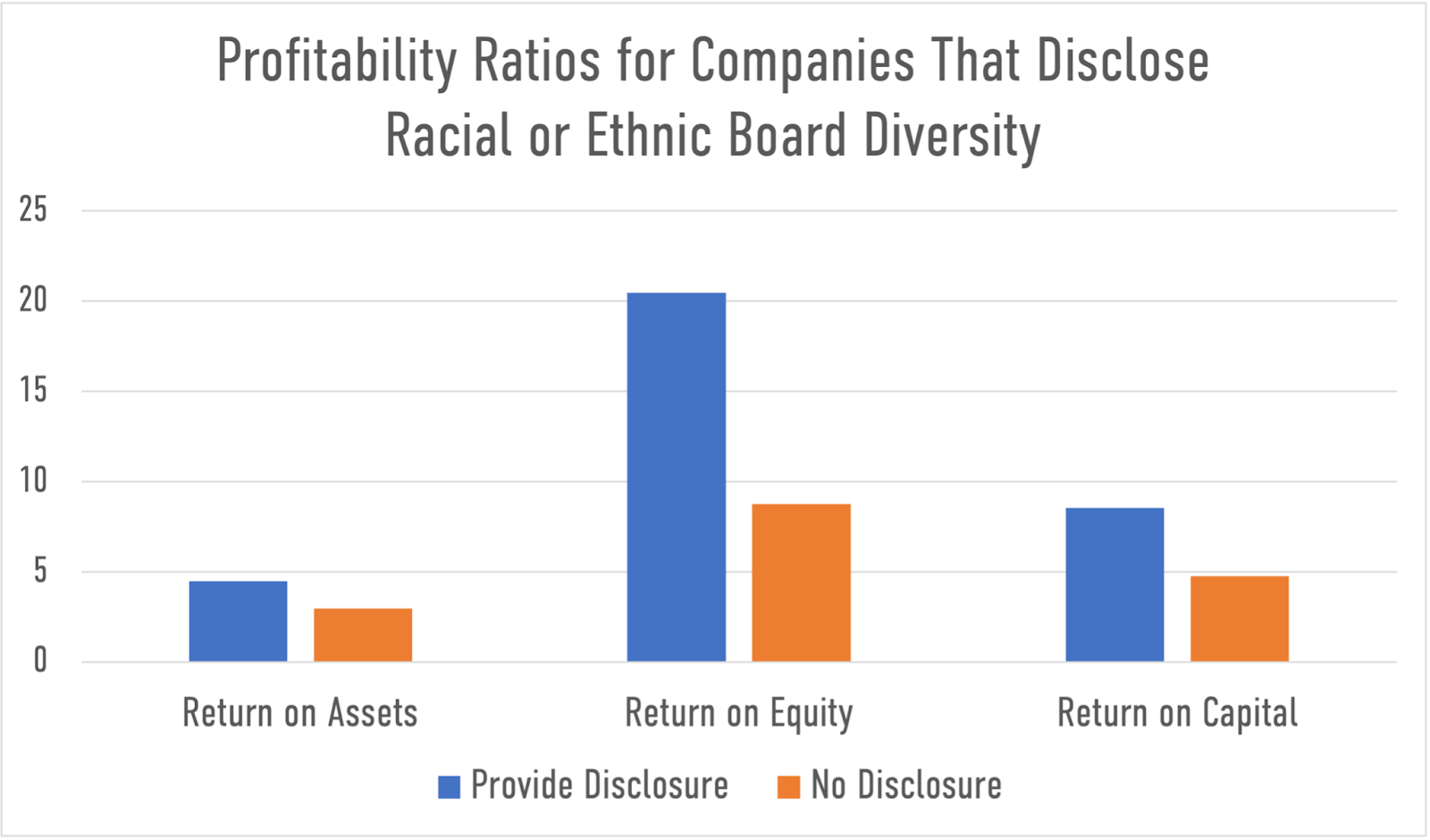
We also looked at profitability ratios, financial metrics analysts and investors use to measure and evaluate the ability of a company to generate profit relative to revenue, balance sheet assets, operating costs, and shareholders’ equity during a specific period. Companies commonly look for a high ratio, as this means the business is performing well by generating revenues, profits, and cash flow.
Looking at the data for Return on Equity (ROE), Return on Assets (ROA), and Return on Capital (ROC), we see that each is significantly higher for companies that disclose racial or ethnic board diversity data.
Lastly, we see a cumulative return of 42.9% over the trailing 12 months (as of 5/31/2021) from the 193 companies that disclose board diversity data by race and ethnicity, compared to the 735 companies that provide no disclosure at all, with a return of 35.3%.
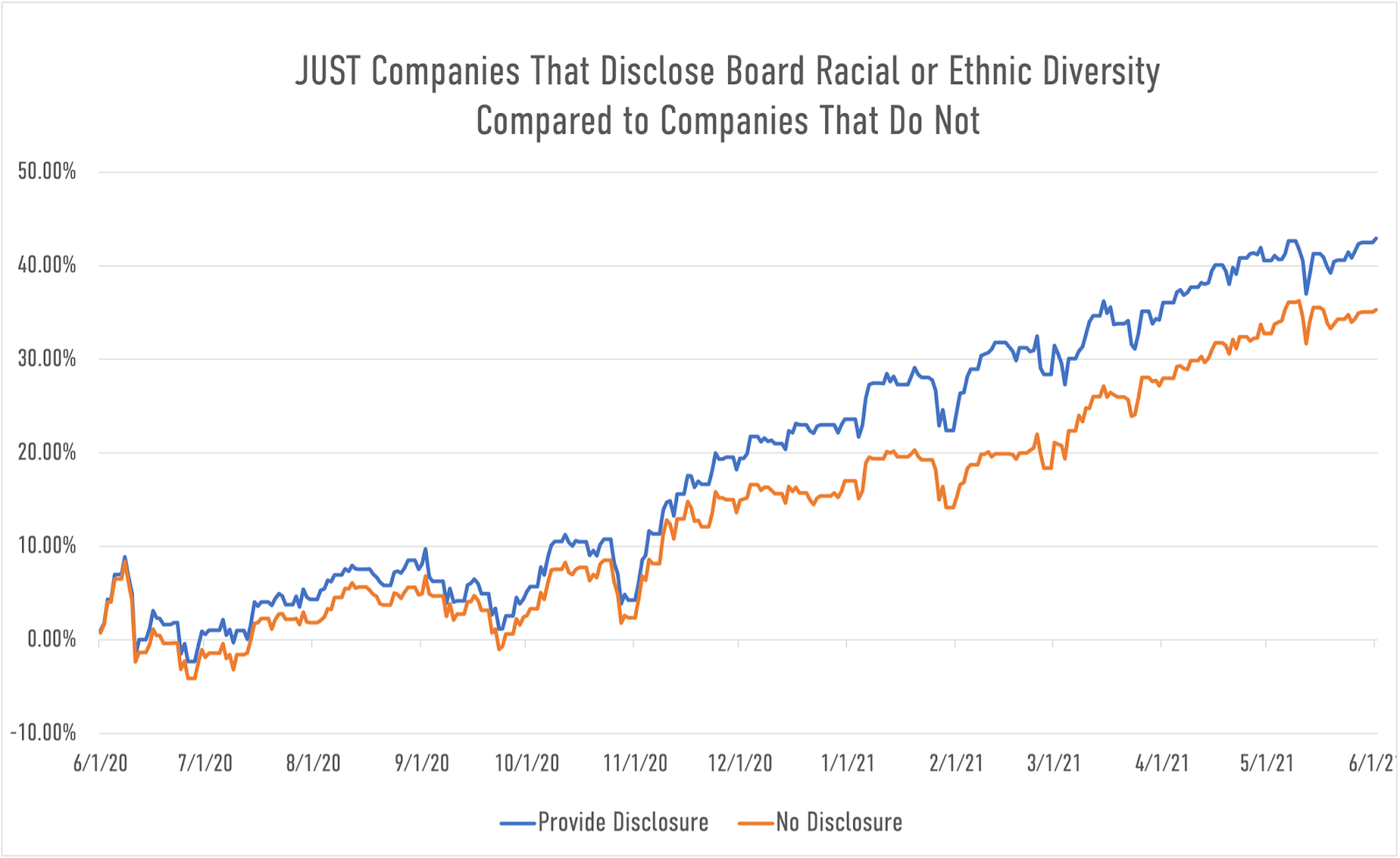
Increased disclosure is one of the key first steps to advancing toward racial, ethnic, and gender diversity – whether in the boardroom or in the workplace, and as we explore in detail in our JUST Report published this week, there are clear indicators that pressure to release board composition data is not letting up. While companies have historically wanted to keep this data close, especially if they consider it unfavorable, our analysis indicates that at the least, there is no financial disincentive to releasing it and pursuing greater diversity in the boardroom.
If you are interested in supporting our mission, we are happy to discuss data needs, index licensing, and other ways we can partner, please fill out our request form to answer a few questions, and someone from our Investor Solutions team will reach out to you within two business days. Please send any requests to republish our Chart of the Week charts to Charlie Mahoney.
In this week’s chart, we pull from the June 2021 edition of the ESG Acceleration report from MUFG Research (NOTE: member gated) to highlight not only the rise in the number of shareholder resolutions filed but the wide range of ESG issues addressed.
The chart below highlights the broader trend in the rise of shareholder activism related to ESG issues and how investors are increasingly using proxy votes to express their views on company behavior, rather than relying on company disclosure. This past year, climate change, human capital metrics, and diversity, equity, and inclusion (DEI) were especially relevant to shareholders. Increased demand for transparency, targets, reporting metrics, and business impact assessments have all rapidly gained momentum, as we see below.
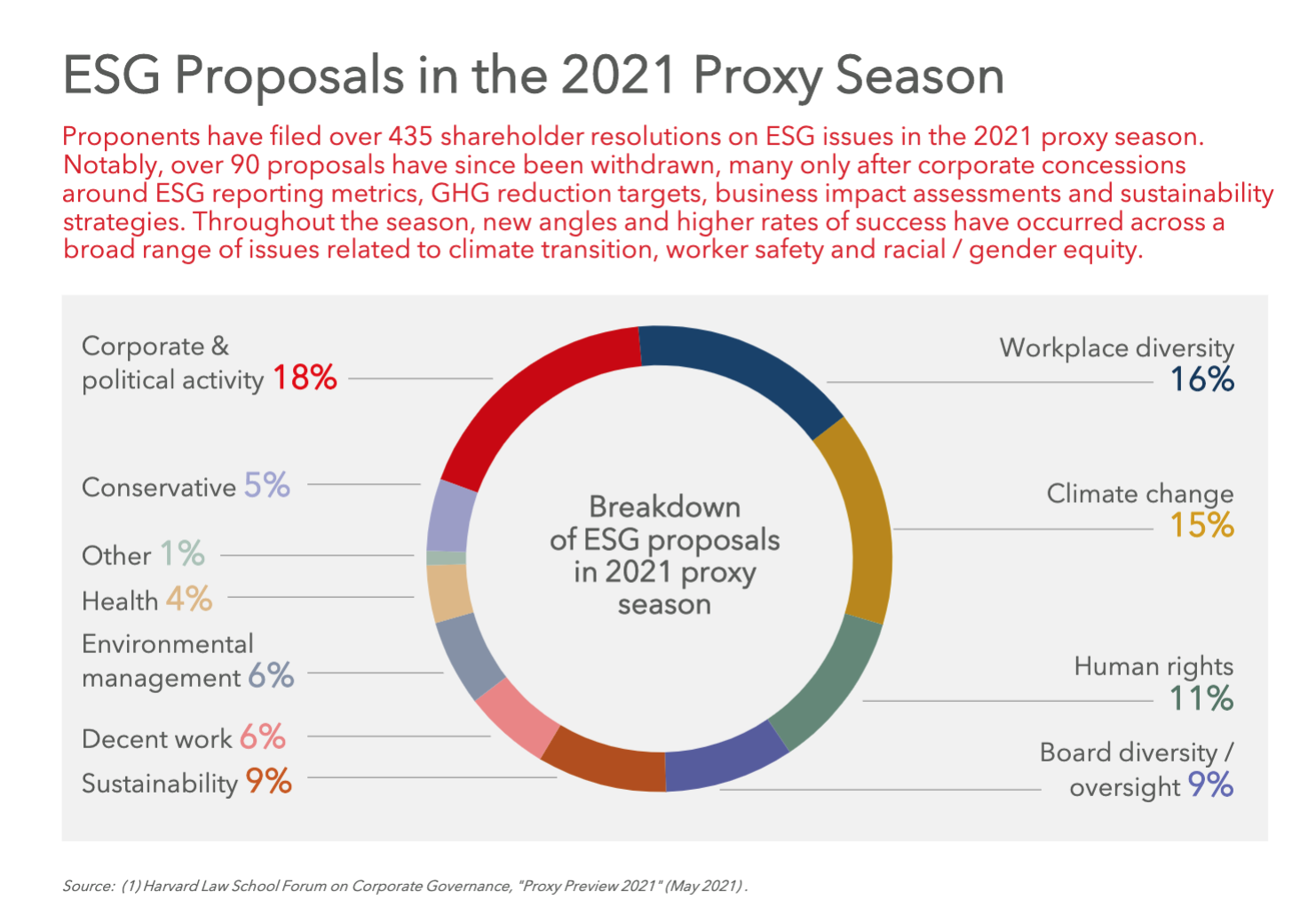
Investors and shareholders continue to demand more, as disclosure is considered a meaningful first step – however, it doesn’t always lead organizations to take meaningful action toward their ESG goals. Bloomberg reports campaigns launched through June 21 at companies with a market value of more than $1 billion reached 116, up from 87 over the same period in 2020. Furthermore, we see the demand for more than disclosure in corporate debt issuance as well, as investors show their willingness to pay a premium or “greenium” for companies to publicly link their debt to ESG goals, with the sustainability-linked-debt market expected to surpass $200 billion this year per S&P, up 54% from the year prior.
Last month, activist investor Engine No. 1 won three of four contested board seats as part of its $30 million Reenergize Exxon campaign, demonstrating that ESG activism can drive actual change and will continue to be a focus as we emerge from the pandemic. Engine No. 1 has continued its activist approach this week with an initiative to empower passive investors through the launch of a new ETF (ticker: VOTE) that aims to encourage better behavior using its shareholder voting rights and will follow voting guidelines aiming to get businesses to invest in employees, communities, customers, and the environment. We’re actually going to be speaking with them and Betterment on June 30th on how they hope to transform retail investing with this offering. Sign up to listen here.
To further highlight the surge in ESG proposals meant to change corporate behavior, we’re showcasing another chart from MUFG. This one is focused on BlackRock, the world’s largest asset manager and an outspoken supporter of sustainability initiatives over the past few years, and how its votes have broken down over the last year.
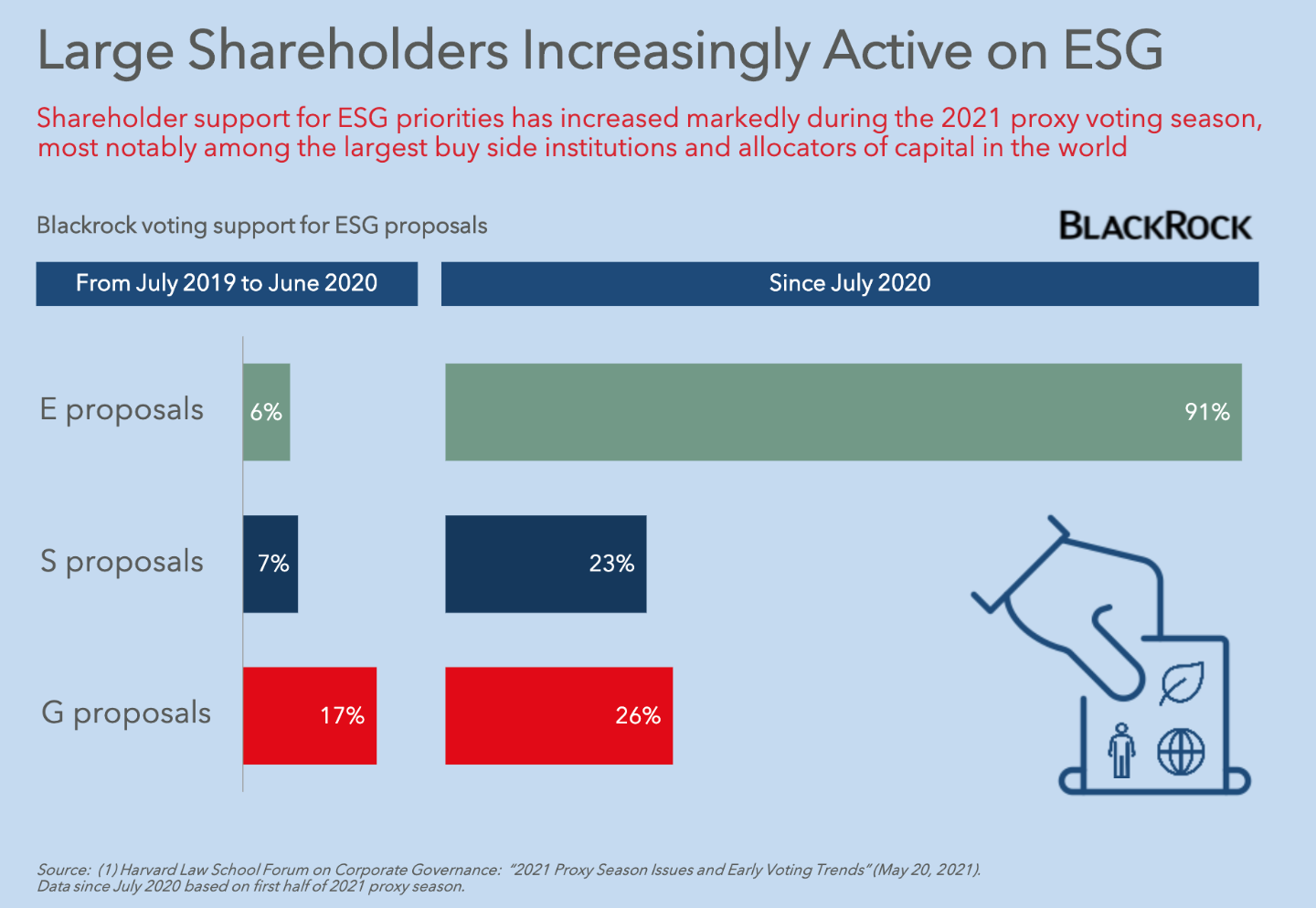
It is clear we are at the forefront of a shift toward broader transparency and accountability. Investors and shareholders not only demand to know what the benchmark looks like for the companies they invest in, but how they are progressing on the broader commitments they have made to address them. As we have seen from Engine No. 1, ESG shareholder activism is now at the forefront as human capital, DEI, and environmental proposals continue to gain traction and importance in 2021’s proxy season.
If you are interested in supporting our mission, we are happy to discuss data needs, index licensing, and other ways we can partner, please fill out our request form to answer a few questions, and someone from our Investor Solutions team will reach out to you within two business days.
