
This interview was created in collaboration with the Financial Health Network.
Over the last few years, expectations of how employers treat their workers has undergone noticeable shifts. Employees from across sectors increasingly expect more holistic support from their employer. High-performing employers are taking note, recognizing that a holistic benefits strategy – one that focuses on the whole employee – results in a more stable, financially healthy workforce.
Part of a holistic benefits strategy includes recognizing individual workers as members of families and communities. Access to paid leave is estimated to increase mothers’ labor force participation by approximately 20 percent during the first year following their child’s birth. Furthermore, having access to paid medical leave has led workers to experience less stress from financial insecurity during a health shock. Recently, Levi Strauss & Co. (LS&Co) expanded its paid family leave plan to be more inclusive of its global workforce. Using data and feedback from employees, HR leaders designed a paid leave benefit that provided support to a wide range of employees.
In this interview produced by JUST Capital and Financial Health Network (two of the partners in the Worker Financial Wellness Initiative) we talk with Tracy Layney, Levi Strauss & Co.’s Chief Human Resources Officer, discussing the company’s decision to continue expanding their paid family leave plan.
One of the most important ways that LS&Co. stands up for our values is by standing up for our most important audience: our employees. We see it as our responsibility to create an environment that enables employees to be healthy, happy, and successful at work and at home.
We’ve seen the positive impact of paid leave in our employees’ lives since we introduced paid parental leave in 2016. Access to paid family and medical leave is not only the right thing to do for employees, but it’s the smart thing to do for business. So, in 2020 we expanded the benefit to include paid family leave. Then, at the beginning of this year, we enhanced the standard of our paid leave benefit around the globe to ensure our eligible employees have equitable access to time off work for maternity leave, parental bonding leave, and family care leave.
We had heard strong feedback on the need for paid family leave from our workforce. From a U.S. home office perspective, more than 50% of our population is made up of individuals between the ages of 36 and 55 – part of the so-called “sandwich generation” that is more likely to be caring for both a child and an elder at the same time. We realized that to truly support employee well-being, we must support employees’ ability to care for their closest family members, whether that person is a child, spouse, parent, or domestic partner, without worrying about their job or their paycheck.
Over the past few years, we’ve implemented and advocated for paid family leave and paid sick leave for our employees in certain locations and have seen firsthand the impact this has had on our employees’ lives. Our people make us who we are, and it’s our responsibility to create an environment that enables them to be healthy, happy, and successful, both at work and at home.
We wanted to ensure eligible employees receive the same paid leave benefit regardless of their geographic location, so we created a global core minimum standard. This allows us to provide eligible employees with up to:
Our goal with the enhancement was to create an equitable global core minimum standard, thus providing a stronger safety net for our employees wherever they are located. Our previous policy minimums were contingent on local laws and standards around the world — employees were in theory eligible for a variety of paid leave benefits depending on their region, but it didn’t always work out that way in practice. By raising the minimum standard across the board, many LS&Co. eligible employees will and are currently experiencing an enhancement in this benefit.
Our driving force and our motivation is our employees. At LS&Co., our people make us who we are and it’s our responsibility to create an environment that enables them to be healthy, happy, and successful at work and at home. Companies play a role in being the employer their employee needs in today’s landscape. This includes ensuring their people don’t have to choose between their careers and their health.
Companies should expand access to paid leave because this issue directly affects them, their workforces, and their ability to stay competitive in our modern U.S. economy. I would encourage everyone to foster conversations with their companies and dig deeper into the business rationale behind it.
Paid family leave is a relatively small investment with a very meaningful return, our actual expense is tracking under initial projected expense. Our paid family care policy globally costs us only 36% of what we’d projected, and since our global enhancement in January, we’ve had over 260 leaves across 20 countries.
During COVID, our company saw much lower attrition and impact on women than the average numbers across the U.S. and we believe it is because of our benefits and company culture (It is an expense to rehire and train people – paid leave boosts retention.) We realized that to truly support employee well-being, we must support employees’ ability to care for their closest family members, whether that person is a child, spouse, parent, or domestic partner, without worrying about their job or their paycheck.
Also, showing employees we have their backs cultivates loyalty, supports productivity, and fosters a culture where people do their best work. Comprehensive family and medical leave policies also help further equality and diversity goals, allowing more people to take advantage of professional opportunities that present themselves.
At Levi Strauss & Co., we are committed to offering a wide array of benefits and support for our employees in ways that are both tailored to their unique needs and can help them look after themselves and their loved ones, and one of those ways is through our ongoing mental health and well-being offerings. Most recently, we expanded access to Lyra Health’s emotional well-being support, available to all our employees around the world and their household family members.
Ongoing mental health resources are ingrained in the day-to-day culture and benefits of LS&Co. These include providing accessible, always-on resources that help our people prioritize mental and physical health and manage symptoms of stress, anxiety, and depression, should they arise. We train our managers to lead from the heart and with understanding. There is no one-size-fits-all leadership style, but by making small changes in the way we communicate with our people, we can foster a culture rooted in authenticity and empathy.

The business case for investing in workers is surely watertight at this point. Strengthening career pathways, training, wages, work schedules, health benefits and all-round workforce culture is associated with greater employee engagement, higher productivity, increased retention and other advantages, all of which contribute to superior competitive performance, higher shareholder returns and more. As an aside, our worker-focused index outperformed the Russell 1000 Equal Weighted Index by a massive 103.75% from 1/1/2018 through the end of January this year.
Worker issues also present opportunities for corporations to demonstrate their own unique brands of leadership. As an example, we’re excited to report that the energy company Avangrid (NYSE:AG) – a 2024 JUST 100 member ranking 12th overall and #1 in the utilities industry – announced this week it is joining our Worker Financial Wellness Initiative. Co-founded in partnership with PayPal, the Financial Health Network and Good Jobs Institute, the Initiative supports companies in advancing worker economic wellbeing and is a key part of our Corporate Impact Lab, where we help companies collaborate to take concrete actions in key stakeholder areas.
Looking down the list of companies that top their industry on worker issues in our 2024 Annual Rankings you might see some names that surprise you: Zillow, Amazon, Peloton, Cummins, Disney, Nike, Trane, Keysight Technologies, eBay, RTX, Hasbro, and QuantumScape (Automobiles and Parts in case you were wondering). Each leads in its own way. And their policies, ranging from industry-leading wages to flexible working schedules and sick leave, are exactly the kind of thing the public wants to see. Interestingly, in a survey of 600 C-Suite and HR leaders released this week, improving child care benefits was voted the most important major work benefit priority in 2024. Happily, we track that too.
Be well,
Martin
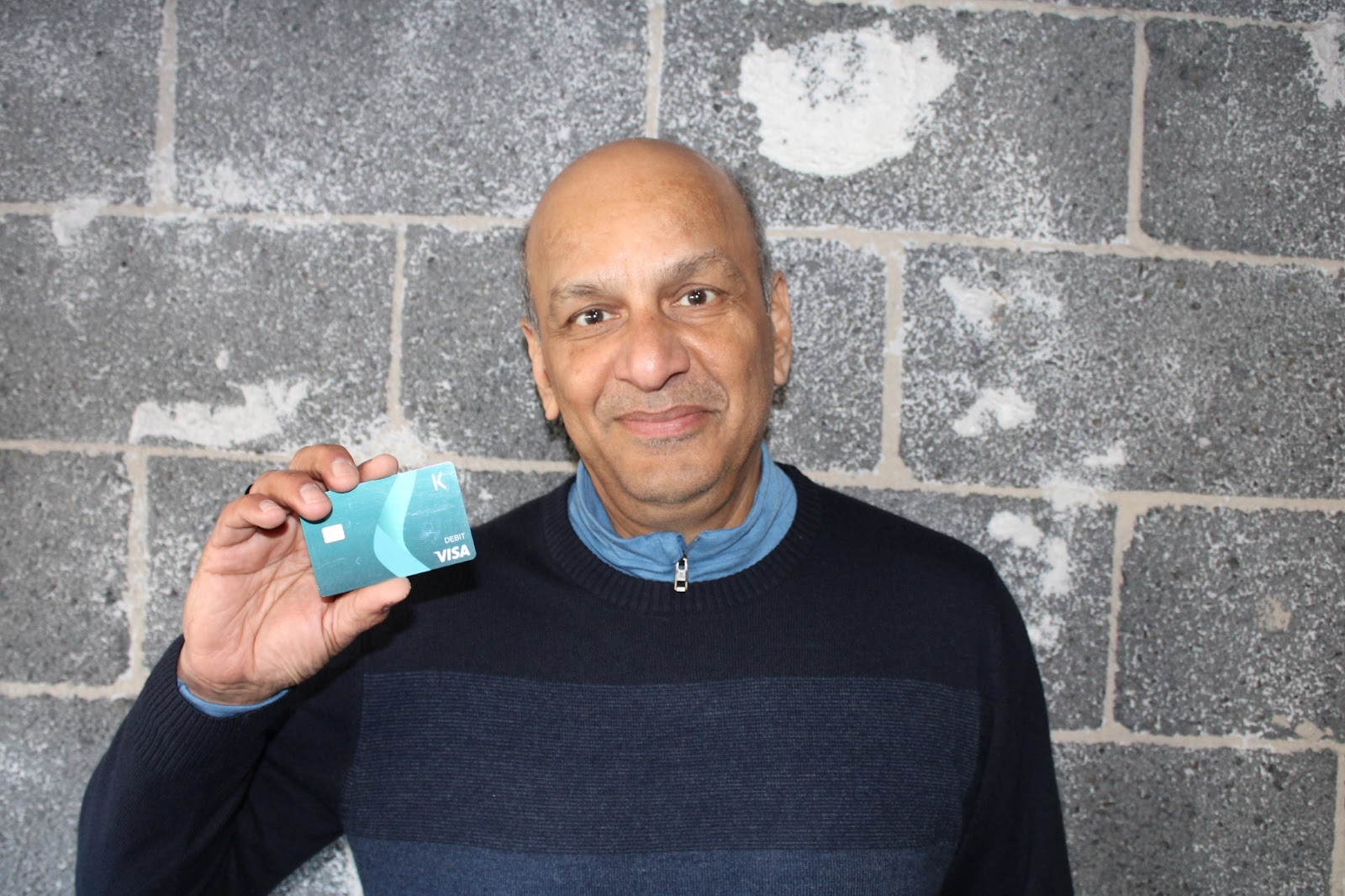
“Modern consumers want to do good. They don’t just want to buy a product – they want their product to have a story and create a positive impact. But how do they know if a company is truly aligned with their values or just greenwashing?
The Karma Wallet Card, launching spring 2024, will directly integrate JUST Capital’s ratings into every transaction – alongside 40+ other data sources, allowing cardholders to see the ethical score of the companies they purchase from in real-time … Knowledge is power – and when consumers are provided with actionable knowledge, they can make better choices.”
– Jayant Khadilkar, CEO and Co-Founder of Karma Wallet.
Avangrid joins JUST Capital and PayPal’s Worker Financial Wellness Initiative. Check out the company press release here.
Karma Wallet announces a partnership with JUST Capital, using our data to help consumers align their spending with their values.
The corporate rush for A.I. dominance is causing a major increase in many company’s carbon footprints as data farms balloon and more energy is needed for processing power. The New York Times has the full story.
CNBC speaks to an engineer who is worried that Microsoft’s Copilot Designer app is not safe for its “E for everyone” rating, saying that the app can create incredibly violent images with the right prompts.
The Securities and Exchange Commission this week adopted rules to enhance and standardize climate-related disclosures by public companies. As The Wall Street Journal explains, the disclosures are slightly watered down from what was proposed by not including Scope 3 requirements, but many companies could find themselves facing pressure from investors and other countries to track them anyway.
The Washington Post reports that the JetBlue and Spirit Airlines merger has been killed in the wake of antitrust objections to the deal. The merger would’ve created the 5th largest airline company in the world.
Bloomberg reveals that 56% of America’s largest companies are boosting childcare perks in 2024, with the rising cost of childcare becoming a consistent pain point for their employees. In a similar vein, JUST 100 company AT&T recently highlighted their investment into fertility and family planning support, another area companies are putting resources in.
A number of investors in Apple issued a joint statement raising concern over the company’s approach to unions after retail employees accused the company of “intimidation tactics to deter organizing”, claims denied by Apple. Apple has agreed to commission a third-party report on its union-related activity, The Financial Times reports.
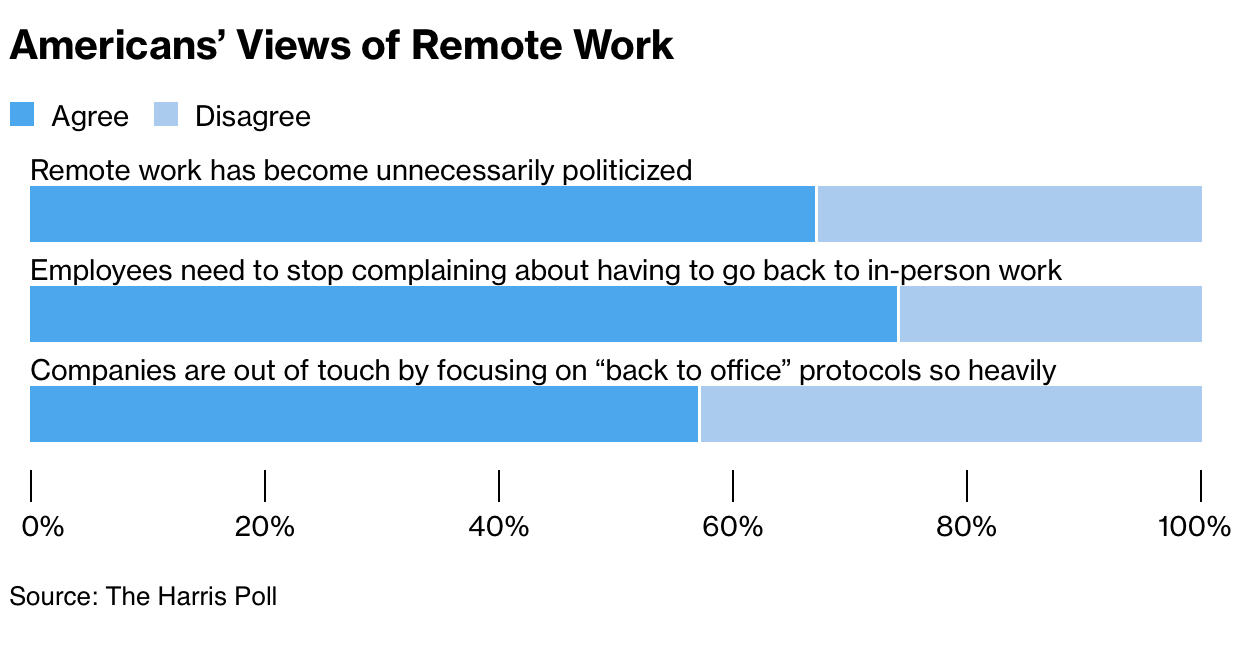
Bloomberg dives deep into recent Harris Poll data on how Americans’ views of remote work are changing. Interestingly, while a majority of Americans believe remote work has become unnecessarily politicized, they also believe that employees need to stop complaining about having to go back to in-person work. Look at all the data here.

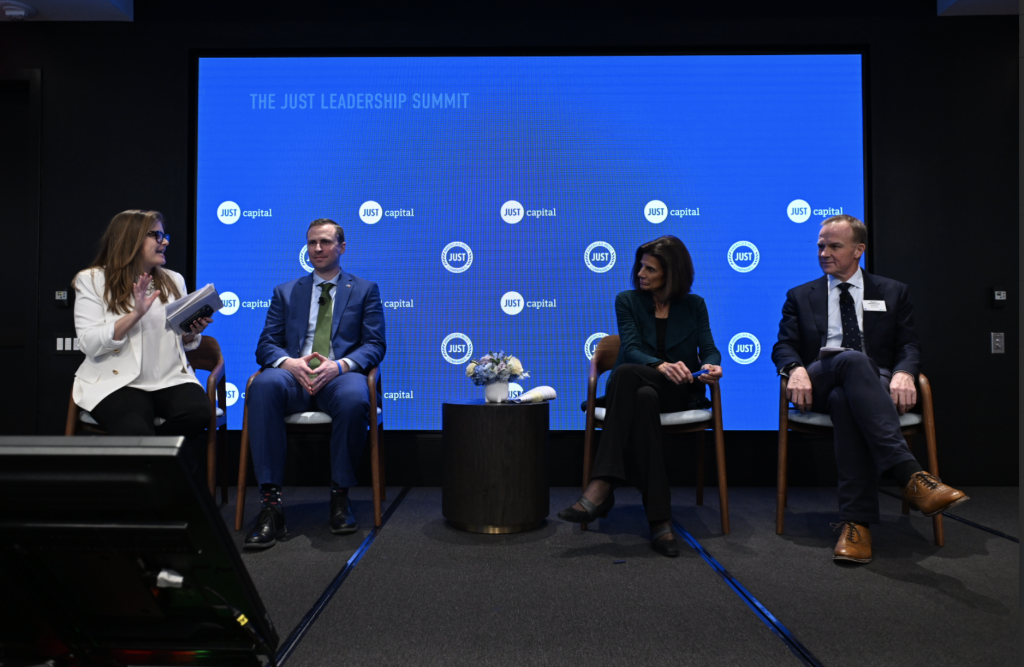
For Justin Lagasse, CFO of leading sustainable energy company Avangrid, using a stakeholder model for decision making is just as much about driving business outcomes as it is about doing what’s right for customers, workers, the environment, and shareholders.
Despite pushback against Environmental Social and Governance frameworks, or ESG, Lagasse said that applying a broader stakeholder model, where decisions prioritize sustainable business practices, is not purely about compliance, but about driving long-term value.
“What’s really happened on the ESG front is it’s become about disclosures and compliance and I think because of that, it’s dissociated the value attribution that it provides,” Lagasse said at JUST Capital’s 2024 Annual Leadership Summit earlier this month. “We use ESG to drive business and financial outcomes.”
Avangrid ranked highly in JUST Capital’s 2024 Annual Rankings of America’s Most JUST Companies at No. 12 overall and No. 1 in its industry. It earned these designations through a variety of investments, including supporting the career development of its workforce and demonstrating a clear commitment to climate leadership, such as pursuing an aggressive 1.5-degree net zero climate target.
Speaking with JUST Capital President Alison Omens, Lagasse noted that in today’s economic climate, a company’s investment in its workers not only serves as a catalyst for individual prosperity and job satisfaction but also contributes significantly to a business’ resilience and sustainable growth.
On Wednesday, Avangrid announced it was joining The Worker Financial Wellness Initiative, a part of JUST Capital’s corporate leadership network implemented in partnership with PayPal, Financial Health Network, and Good Jobs Institute. Joining the initiative will help Avangrid continue supporting employees’ financial security and health.
Since Avangrid was formed in 2015 by joining multiple utility companies together, its leaders have placed a concerted emphasis on creating a unified corporate culture, where employee well-being is a core tenet. Leveraging data for a more personalized approach to employee benefits is central to their strategy, as they continue to work alongside a cohort of companies dedicated to improving the financial health of workers nationwide.
And while Avangrid continues to invest in improved employee financial well-being, it has already taken substantial steps to drive its employees’ overall well-being, implementing initiatives that focus on work-life balance, career development, and diversity, equity, and inclusion.
By joining the Worker Financial Wellness Initiative, Avangrid looks forward to building upon its investments in its workforce, which will underscore and build on solutions for customers and continue to create value for shareholders.
As Lagasse said at JUST’s Leadership Summit, he’s focused on investments that will build on the company’s success “not only tomorrow, but for the long term.”

March 6, 2024 — Avangrid, Inc. (NYSE: AGR), a leading sustainable energy company and member of the Iberdrola Group, is continuing to prioritize their employees’ financial security and health by joining The Worker Financial Wellness Initiative by JUST Capital and PayPal. The Initiative, established in collaboration with the Financial Health Network and Good Jobs Institute, offers resources to help companies assess and improve workers’ financial health.
“We want to be a company that attracts top talent to build long-term careers,” said Pedro Azagra, Avangrid CEO. “We do this by not only helping our employees grow professionally, but also supporting their well-being. The Worker Financial Wellness Initiative will cement us as a benefits leader and help us continue to enhance our programs and resources.”
The Worker Financial Wellness Initiative was launched in 2020 and engages directly with corporate leaders to promote the business value of financial health investment and empower them to perform worker financial health evaluations. Today, the initiative includes companies such as Chipotle, Chobani, Even, Prudential Financial, Synchrony, and Verizon, representing one million American workers. Since joining the initiative, participating companies have expanded and enhanced benefits, increased wages, created new ownership opportunities, and more.
Joining this initiative builds upon Avangrid’s commitment to caring for its people by providing diverse, equitable, and inclusive benefits that focus on their total health—physical, emotional, mental, and financial. This includes providing a leading 401(k) employer match, paid parental leave, comprehensive employee assistance program (EAP), and fertility and family forming benefits. Avangrid has also continued to expand its holistic benefits package by recently launching new programs such as a student loan debt repayment benefit, an emergency savings program, and mandatory financial training.
“Now is the right time to take our benefits to the next level by focusing on individual wellness,” said Kyra Patterson, chief human resources officer at Avangrid. “By leveraging data, we can take a more granular and personalized approach to the benefits we offer to take care of our employees. The Worker Financial Wellness Initiative will help us take this next step by leveraging research, tools, and a diverse network of subject matter experts dedicated to optimizing employee health and well-being outcomes.”
Tolu Lawrence, Chief Impact Officer at JUST Capital, an independent nonprofit dedicated to demonstrating how just business – defined by the priorities of the American public – is better business, noted that Avangrid’s participation in this insightful network of executives is monumental.
“Our polling of the nation’s public shows time and again that Americans of all backgrounds want CEOs to prioritize investing in workers,” said Lawrence. “And our research shows that companies that prioritize the well-being of their workers out-perform those that don’t. Avangrid is on a journey that will not only deeply impact the lives of its workers, but also has the potential to inform the trajectory of the energy industry at large. We look forward to welcoming them into the network and collaborating with our partners to drive impact with Avangrid and for its workers.”
Sarah Kalloch, executive director of The Good Jobs Institute echoed the sentiment, saying, “Research has shown how meaningful investment in employees can create productive, engaged, and motivated workforces that not only create better lives for workers, but also deliver real, sustained value for customers and shareholders. We are excited to support Avangrid on this journey.”
Media Contacts:
Sarah Warren, Avangrid
sarah.warren@avangrid.com
585-794-9253
Marguerite Ward, JUST Capital
mward@justcapital.com
For Shanelle Forde, an Associate Software Developer at Prudential Financial, the most important role in her life is that of mom. “What’s important to me, at the top of my list, is my son,” she said. Working at Prudential, in her own words, “absolutely allows” her to be there for her son, without having to worry about how she’ll make ends meet.
Shanelle is just one of the nearly 1 million employees represented through companies participating in the Worker Financial Wellness Initiative, which helps companies take steps like raising wages or expanding access to benefits to bolster the financial health of their employees. To learn how those actions have impacted their lives and livelihoods, we set out to hear from workers firsthand through a compelling new video series.
This is Shanelle’s story:
Shanelle, a single mother, first came to Prudential through the company’s partnership with Year Up, an organization working to increase access to job and education opportunities for young adults. After six months of classroom training, Shanelle joined Prudential for a six-month internship and has been with the company for four years since. During that time, she’s had the opportunity to complete leadership and software training that have allowed her to level up in a way she’d never been able to before.
“One of the biggest differences I notice from my other jobs and Prudential, is how supported we are as employees,” she said. “When you support your workforce, your workforce absolutely supports you.”
Importantly, Prudential’s support allows Shanelle to come into work and focus on just that – work. A big part of that came from the company’s efforts to increase its employees’ financial literacy, she said, including access to tools to plan out retirement and other savings goals. Having that knowledge and support has been transformational for Shanelle.
“It has allowed me to be a better parent,” she said. “But it also allows me to be a better worker because now when I come to work, I’m happy. I don’t have to focus on those things like, ‘oh, how am I going to pay my rent?’ I can just come to work and focus on the work.”
Providing these resources and support for its employees also aligns with Prudential’s core business, Lata Reddy, Senior Vice President of Inclusive Solutions at Prudential shared with us. “As a company, our purpose is to make lives better by solving the financial challenges of our changing world. That’s why we provide a robust suite of benefits and tools that includes savings, physical and mental health benefits, dependent care resources and financial wellness offerings like tuition reimbursement to support employees to be more financially secure,” she said.
Listening to and acting on employee experience is becoming increasingly important. The stories of workers like Shanelle are a potent reminder of the power that companies have to create meaningful change for their workforce. And Prudential’s leadership is recognizing that this ultimately translates into business success.
“A decade’s worth of research shows that when workers are more financially secure, key business outcomes improve such as productivity, customer satisfaction, and employee turnover and engagement. We have been creating financial wellness tools for employers and customers since we were founded almost 150 years ago,” Reddy said. “Shanelle is a shining example of how employees can thrive with the right support and resources.”
Hear from other employees about the impact worker financial wellness programs have had on their lives:
The Worker Financial Wellness Initiative is a vibrant and growing community of business leaders dedicated to improving the financial health and security of their workers. The Initiative includes peer learning opportunities for C-suite leaders; creating resources and events for HR and compensation professionals; providing direct assistance to companies on how to develop and deploy a Worker Financial Wellness Assessment, and use it to identify areas for improvement and immediate next steps; and public opportunities to celebrate corporate leadership.
To learn more about the Initiative and how you can join, click here.
In her eight years working for Verizon, Edwenna (Eddie) Ervin has never stopped learning. “I want to be better and Verizon wants me to be better, and together we can do it.”
After starting out in frontline customer service, working directly with Verizon’s enormous consumer base, Eddie immediately began making use of her company’s robust training and career development benefits. “I started working on my Master’s degree as soon as I possibly could, and it did not cost me a dime.” Now a Senior Engineer Project Manager, she continues to pursue educational opportunities while working for Verizon (“I can’t stop training when it’s there for free”), earning certifications that help her be better at her job.
Eddie is just one of the nearly 1 million employees represented through the Worker Financial Wellness Initiative, which we launched in collaboration with PayPal, the Financial Health Network, and the Good Jobs Institute to help companies bolster the financial health of their employees. To learn how those actions have impacted their lives and livelihoods, we spoke with workers firsthand in a compelling new video series.
This is Eddie’s story.
Investing in people like Eddie is not just a nice-to-have – it’s part of Verizon’s long-term business strategy, something we learned in conversation with Kevin Cammarata, Verizon’s VP of Benefits. “You can’t build tomorrow’s network with yesterday’s skills,” he emphasized. “We’re very focused on intentionally growing and developing our employees because our customer’s needs are evolving. And so our skills and our ability to meet them needs to match.”
Last year, the company invested more than $175 million in learning and development initiatives for its employees, forging opportunities for individual advancement while improving customer service. Cammarata shared that tuition assistance and training are also just part of Verizon’s exemplary benefits program, which also encompasses paid parental leave, retirement savings, adoption services, and more – all of which “affect our employees in profound ways.”
Importantly, those benefits are not just available to Verizon’s corporate team, but extend to its call center and retail employees, engineers and more. This inclusive approach enables employees like Eddie to grow and thrive, no matter where they are in their career journeys. “The ability to train up makes me feel open and free to learn new things,” she shared. “It makes me less afraid to try something new.”
In addition to its strong benefits, Verizon is also a leader when it comes to wages, last year raising its minimum wage to $20/hour. “Companies need to pay attention to their employees’ financial wellness,” explained Eddie. “If your employee doesn’t have their basic needs – a car to get to work, money for lunch – they cannot show up and be their best for your customer.”
This is where the business case can and must be made. “We need to make investments in our people to help them balance both the needs of our customers and the needs of their families,” Cammarata underscored, echoing Eddie’s point that only when employees are able to meet their own needs can they meet the needs of their customers – in turn, generating revenue for the company. “By creating good jobs and taking care of your employees, you can achieve the business results that you need.”
This doesn’t come without its roadblocks, and for Cammarata, being part of the Worker Financial Wellness Initiative has provided the opportunity to work alongside like-minded companies wrestling with how to deliver greater value to their employees while balancing other business challenges. “There’s not one right path for every company,” he shared, but in establishing a shared philosophy for serving their workforces, “I think we all believe we’ve found ways to be able to benefit our workers and to be able to have successful business outcomes.”
This sense of striving fuels both Cammarata and Eddie, who told us that “Verizon is a place where we strive to be better. Yesterday was good, but tomorrow we’ll do better.” And because, as Cammarata said, “you can’t build tomorrow’s network with yesterday’s skills,” the key to doing better tomorrow is workers. And by investing in workers, ensuring that they have what they need to not just live their lives but to thrive, corporate leaders can also ensure a better, more thriving future for their companies.
Hear from other employees about the impact worker financial wellness programs have had on their lives:
The Worker Financial Wellness Initiative is a vibrant and growing community of business leaders dedicated to improving the financial health and security of their workers. The Initiative includes peer learning opportunities for C-Suite leaders; creating resources and events for HR and compensation professionals; providing direct assistance to companies on how to develop and deploy a Worker Financial Wellness Assessment, and use it to identify areas for improvement and immediate next steps; and public opportunities to celebrate corporate leadership.
To learn more about the Initiative and how you can join, click here.
