

By Daniel Krasner and Aleksandra Radeva
Providing good jobs means paying workers well, supporting their well-being, offering career advancement opportunities, and building inclusive work environments. Failure in these areas can come at a high cost for businesses by creating a vicious cycle of attrition, negatively impacting productivity and undermining overall profitability. But investments in job quality foster loyalty and satisfaction among employees and are linked to better performance and lower turnover, benefitting a company’s bottom line. Prioritizing such investments is also a way to align corporate strategy with the American public’s business priorities, as our seven years of polling data show worker issues consistently rank the highest.
As business leaders continue to navigate the challenges of attracting and retaining top talent, offering quality jobs is one way for companies to maintain a competitive edge in the labor market.
But which companies stand out for their workforce investments? JUST Capital’s JUST Jobs Scorecard and The Schultz Family Foundation’s American Opportunity Index (AOI) assess company performance on job quality by tracking the policy investments that companies make and the outcomes of these investments for their employees. Among the hundreds of companies analyzed in both tools, JPMorgan Chase (JPMC) emerged as a leader with programs focused on fair and equitable compensation, employee career development, and inclusive hiring practices across their workforce.
For JPMC, aligning workforce investments with strategic goals is critical:
“Our employees are key to our success in serving customers, clients and communities. We aspire to have the best talent in the marketplace and to foster a work environment in which all of our people are supported, feel like they belong, and are able to make an impact through their work. In addition to providing a positive and inclusive work environment and offering a competitive pay and benefits package, we invest in our employees with training and upskilling opportunities and support along the way so they never stop learning.” – Trish Dever, Head of Total Rewards at JPMorgan Chase
For more than five years, JUST Capital’s survey research shows that ‘Paying a fair, living wage’ continues to be the top business issue for the American public. Unsurprisingly, pay is also the primary reason for quitting a job cited by workers. Recognizing the critical role of pay in job quality, JPMC ensures a minimum hourly wage of at least $20 – one of only 2% of companies featured in the JUST Jobs Scorecard to disclose doing so. Importantly, JPMC’s minimum wage meets the national living wage estimate for a single working adult of $17.46/hour in 2023 – or the minimum amount that a full-time worker with no dependents requires to cover basic budgetary needs, as estimated by the MIT Living Wage Calculator. Only 4% of the Russell 1000 companies we assessed in the JUST Jobs Scorecard disclose paying a wage that meets the single adult living wage estimate, and even fewer – just 2% – disclose paying at least $20/h, placing JPMC among a small minority of companies that prioritize this level of wage-based investment in their entry-level workers.
A commitment to fairness is another element of JPMC’s compensation strategy. The company conducts periodic pay equity analyses and is among just 12% of Russell 1000 companies overall and 31% of banks that disclose both their gender and race/ethnicity adjusted pay ratios.
Beyond competitive and fair compensation, JPMC prioritizes employee development and training – another key consideration for workers in choosing to remain at a company. JPMC offers tuition reimbursement, apprenticeship programs through their Analyst and Associate hiring, and Emerging Talent Programs, which aims to build more inclusive pathways into the financial sector for untapped talent, such as individuals who are either pre-college or lack a conventional university degree. Just 17% of banks and 26% of the Russell 1000 overall disclose offering apprenticeship programs and the career pathways they make possible. JPMC’s focus on professional development and upskilling opportunities underlies the company’s strong performance on the promotion dimension in the AOI, which assesses JPMC employees’ promotion prospects and their ability to advance their career beyond the organization.
Building on its commitment to employee training and advancement, JPMC also emphasizes inclusive hiring practices, including a dedicated veteran recruitment policy and efforts to support justice-impacted individuals. With over 18,000 veterans and 3,100 military spouses currently employed, their Military Pathways Rotational Programs offers extensive support, including training, mentorship, and networking, aiding service members’ transition to civilian roles.
Another way JPMC supports inclusive hiring is through expanding its second chance hiring models to better reach qualified candidates and collaborating with the Second Chance Business Coalition to develop best practices for hiring individuals with criminal backgrounds. As a result of these efforts, in 2022, second chance hires comprised 10% of all of the company’s new U.S. hires that year. JPMC is one of 11% of banks and 6% of Russell 1000 companies to give justice-impacted individuals a second chance.
Increasingly, companies are prioritizing job quality and targeted workforce investments. The business case for these investments is clear, as they contribute to long-term organizational success and profitability.
The policies that emerge from JPMC’s workforce investment priorities can be tracked through our JUST Jobs Scorecard, and the policies’ positive impact on JPMC employees can be explored through JPMC’s performance on the American Opportunity Index.
To learn how we’re engaging on job quality issues, unpack your company’s performance on the JUST Jobs Scorecard, or join a corporate community of practice focused on peer learning and expert feedback on workforce well-being, please reach out to corpengage@justcapital.com
The COVID-19 pandemic exposed weaknesses in global supply chains, resulting in increased attention to supply chain risks, including child and forced labor. Recent EU regulation will require additional due diligence on global supply chain risks and large companies like those within the Russell 1000 that operate across regions will experience pressure to evaluate the effectiveness of their policies or face significant penalties abroad. We also see in our polling that human rights issues in supply chains are fairly important to the American public, ranked at 11th in 2023.
At the same time, domestic workers are increasingly prioritizing freedom of association and collective bargaining. In late 2023 polling of the American public’s view on business, “majorities from every political party (92% of Liberals, 86% of Moderates, and 74% of Conservatives) [were] in support of collective bargaining.”
In response to this environment of heightened scrutiny and public polling data, JUST Capital and RepRisk partnered to analyze trends in risk incidents among companies in the Russell 1000 Index over the last decade with a focus on the most recent three years (2020-2023) and key issues including Supply Chain, Child and Forced Labor, and Freedom of Association and Collective Bargaining. We then examined how and if disclosure of policies and actions to mitigate these risks influence their incidence.
Supply Chain Risk:
Unsurprisingly, RepRisk recorded an increase in risk incidents related to supply chains such as human rights risks, geopolitical risks, poor labor practices and use of conflict minerals during the pandemic for Russell 1000 companies. However, the count of these incidents has returned to pre-pandemic levels in the last three years. As vendors and suppliers are considered part of the supply chain, supply chain risks were found to be linked to companies who are held accountable for the actions of their suppliers. Heightened regulatory scrutiny underscores the need for comprehensive risk management strategies to ensure compliance and mitigate potential liabilities across global supply chains.
Child and Forced Labor Risk:
According to the UN, child labor incidents globally declined between 2000 and 2016. However, conflicts, crises, and the COVID-19 pandemic have reversed this trend, pushing families into poverty and forcing more children into labor. Though the majority of Russell 1000 companies have not been linked to child and forced labor, a small subset have, despite regulatory efforts and the reputational consequences.
Freedom of Association Risk:
Freedom of association risk refers to violations of workers’ rights to organize and collectively bargain, and includes, for example, interfering with union formation and participation, retaliation against striking workers, and refusal to comply with union agreements. Over the last three years, RepRisk has captured an increase in freedom of association risks within the Russell 1000 companies. This coincides with increased attention to workers’ rights issues in the US, highlighting the growing importance of addressing labor rights and maintaining ethical employment practices.
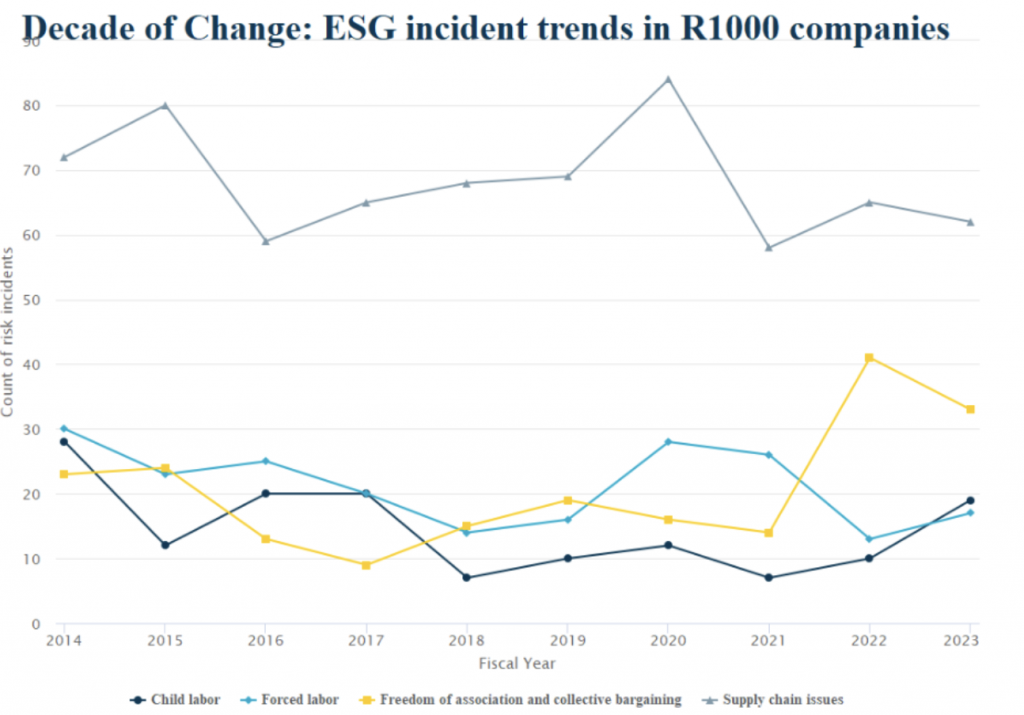
Over the past 10 years, the recorded risk incidents are linked to a subset of just 192 Russell 1000 companies. In the more recent three-year period, this subset has narrowed down to 106 companies with recorded risk incidents.
Across all four risk categories, there have been 902 risk incidents in the last 10 years, with 291 incidents reported in the last three years.
JUST Capital takes RepRisk’s data in these four areas and rolls them into a singular data point called Labor & Human Rights Controversies in the Supply Chain, which are then filtered for the highest severity.
In JUST Capital’s 2024 Rankings, there were 87 unique risk incidents of this type, distributed over 54 companies, following the trend of a high concentration of risk incidents in a small number of companies.
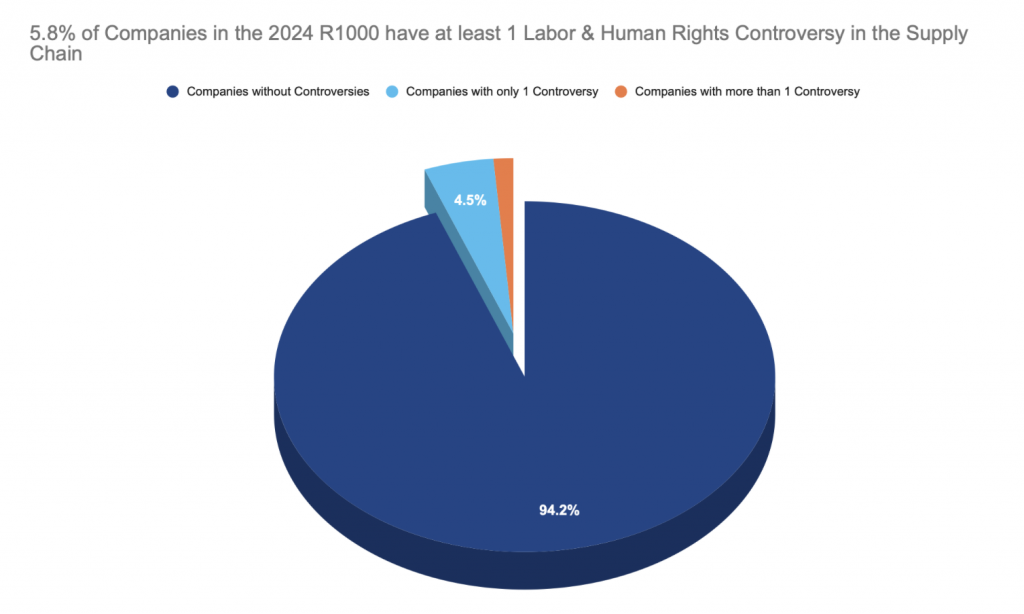
Of the 36 industries JUST Capital evaluated between 2020 and 2023, 13 had no companies with risk incidents, 10 had one, 9 had two, and 4 had greater than two. These four highest risk industries are Retail, with 9 risk incidents, Clothing & Accessories and Food, Beverage & Tobacco, both with 6, and Restaurants & Leisure with 5. Risk is defined by the number of incidents in an industry – rather than percent, as industries vary in size – with the highest-severity risk incidents regarding labor and human rights in the supply chain.
When analyzing a portion of JUST Capital’s human rights data in conjunction with risk data, we found that there was no clear relationship between industry risk and industry disclosure of policies and actions to mitigate these risks.
JUST Capital Policy and Action Data Points
JUST Capital identifies human rights data points assessing the degree to which companies are actively auditing and reporting on human rights within their supply chain as well as taking remedial action. You can learn more about the below policies and actions and our methodology HERE.
Policies:
Actions:
The following graphs reveal the percent of companies within each of the four highest risk industries that are disclosing policies or actions on the six data points above that JUST Capital uses to assess a company’s human rights efforts.
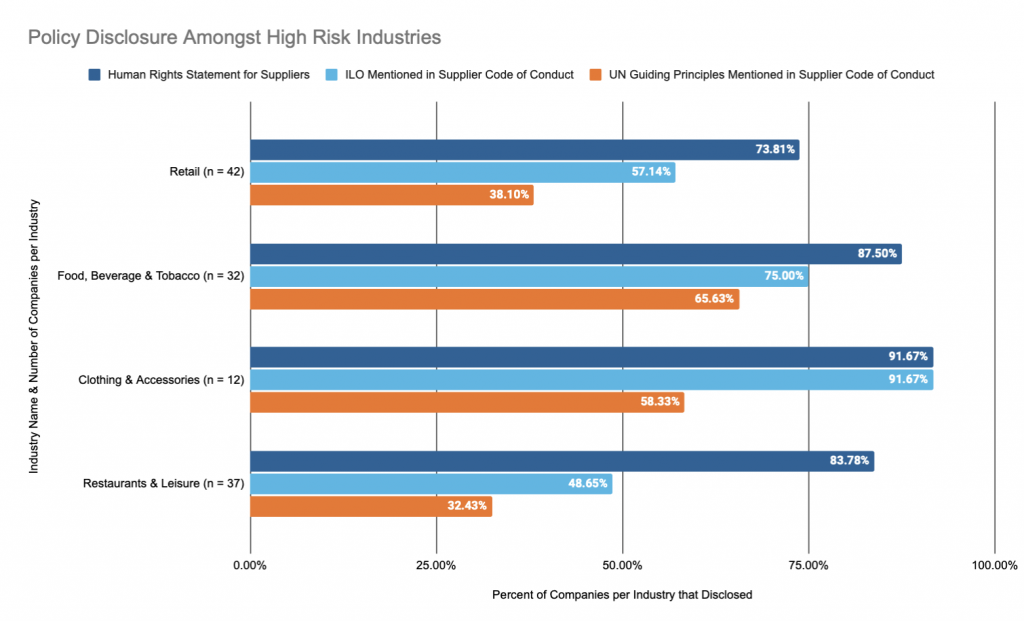
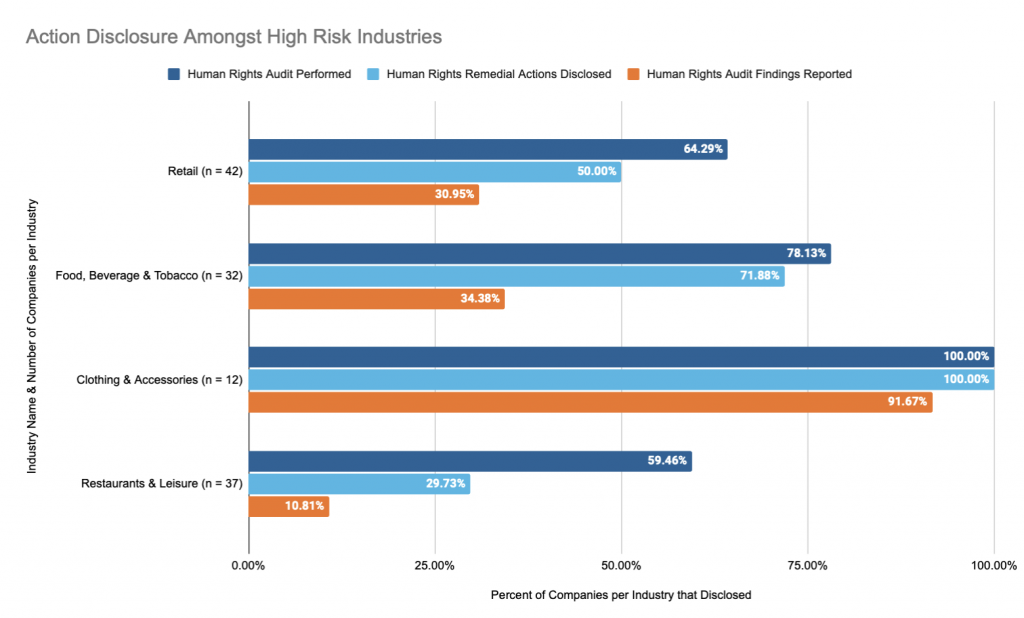
Rates of disclosure of global supply chain risks and associated actions vary among industries. This is evident in the comparison between Clothing and Accessories vs Retail. Retail reported the lowest percent of disclosure, while Clothing & Accessories showed the highest rate of disclosure amongst high-risk industries. This is likely due to the fact that Clothing & Accessories is a more heavily regulated industry as companies produce a similar product whereas Retail involves a variety of products, limiting the ability to standardize disclosure requirements.
When compared to industries of a similar size, high-risk industries were found to have lower rates of disclosure. For example:
Discussion
Industries with no – or minimal – risk incidents had high rates of disclosures of sustainable human rights practices. However, industries with known exposure to human rights and supply chain risks had high rates of disclosure as well, indicating that rates of disclosure do not necessarily mitigate incidents of risk. Rates of disclosure could be indicative of legal requirements applying more heavily to one industry, pushing for further human rights due diligence, e.g. disclosure of remedial action plans or reporting the findings of human rights audits. Perceived salience or applicability to the human rights space plays a role, leading to a natural order of leading and lagging industries. Companies in industries that rely on global supply chains are going to have somewhat high disclosures compared to less clearly implicated industries. Risk mitigation in the form of these six data points is not foolproof. For example, reference of the UNGPs may be indicative of a company’s commitments, but did not influence the number of risk incidents occurring. Across all industries, more work can be done to mitigate these types of risks, especially in light of increasing scrutiny on these issues from the American public. In a mixed-policy, region-dependent environment, standardization benefits companies trying to ensure compliance.
About this Partnership
JUST Capital is an independent nonprofit dedicated to demonstrating how just business – defined by the priorities of the public – is better business.
JUST Capital engages RepRisk as their third-party data partner for collecting data on systematic risk incidents, as reported by media and other stakeholders, taking into account incident severity, relevance, and prominence, and scales these by a company’s global revenue to account for the increased attention that large companies experience.

There’s been a lot of attention paid to how many women have exited the workplace since the pandemic began. If you’re a business leader, you know first-hand how challenging a reduced workforce can be, and forward-looking companies are continuing to assess their policies to ensure that women can stay and thrive within their work environments. According to studies from Deloitte and McKinsey about women in the workforce, companies looking to retain women should consider adopting practices that promote flexibility.
And, according to recent economic data, things are looking up for women’s participation in the workforce. Women’s labor force participation is the highest it has been since pre-pandemic levels at 57.6% in February 2024, and the share of women aged 25-34 employed reached an all-time high of 75.3 percent in October 2023. As this upward trend in employment continues, as it’s expected to, the need to create more equitable opportunities for women persists. Women continue to make an average of $0.78 on the dollar compared to men, and the pay disparities are even greater for Black, Native, and Latina women. Women are also more likely to be in lower-paying careers, which again disproportionately impacts women of color.
JUST Capital has analyzed a subset of key metrics from our 2024 Rankings to identify a subset of companies that prioritize women in their workforce through several specific policies or practices. Last year four companies met the following criteria:
JUST Capital is proud to announce our Top Companies for Women in 2024, 13 companies, four of which were also named in 2023, that have demonstrated commitment and prioritization of women in the workplace, including:
* Indicates a company that was named in the JUST Capital Top Companies for Women in 2023.
Read below to learn more about their policies and disclosures.
Most of the data for this analysis comes from our JUST Jobs Scorecard, which will become publicly available on April 4, 2024 (with the exception of the board diversity data). We invite you to access this data-driven interactive tool intended for companies to assess their performance and transparency on key job quality practices and worker policies, including those highlighted in this analysis. Sign up for our newsletter to receive updates about the scorecard.
If you’re a corporate executive, you can also learn more about your company’s rankings by getting in touch. To unpack your company’s performance in the 2024 Rankings, gain insights into how to improve on the issues that matter most to the American public, and/or how to engage with JUST to take action to support worker well-being though the Corporate Impact Lab, please reach out to impact@justcapital.com.
Leading Companies
Adobe offers a range of well-being benefits to meet the needs of its diverse workforce and a range of paid leave benefits to meet caregivers across the spectrum, including 16 weeks of paid parental leave parity. In 2022, Adobe celebrated 5 consecutive years of global gender pay parity, indicating their commitment to equity across the company. One of their employee equity initiatives is the Women at Adobe Network with a mission to attract, develop, and engage Women at Adobe and allies, to foster connection and growth, and to create an environment that empowers every woman to define and achieve her own success.
American Express emphasizes that potential employees can join “a winning team that embraces collaboration and offers the support and flexibility you need personally and professionally.” As a way to support employees, they offer parental leave parity with 20 weeks of all birth events (pregnancy, adoption, or surrogacy) and backup childcare and in-home care for adult loved ones. In addition, in 2021, American Express Company achieved pay equity across gender and race for the second year in a row.
For over 16 years, Bank of America has conducted rigorous analysis of employee compensation with third-party experts. Their 2022 equal pay for equal work analysis –- covering their regional leadership hubs (U.S., U.K., France, Ireland, Hong Kong, and Singapore) and India – showed that compensation received by women was on average more than 99% of that received by men. As part of their emotional wellness and benefits programs aiming to help employees through everyday life events whether critical or special, they offer paid parental leave parity at 16 weeks.
As part of Cencora’s – formerly AmerisourceBergen – investments in people, human capital, and DEI, the company reported that women in the U.S. make 99.4 cents for every dollar a male employee makes. The company also reports that 34% of their leadership positions (vice president and above), 46% of their manager positions (manager level and above), and approximately 30% of their board of directors are women.
After conducting their first pay equity analysis in 2021, Dayforce – formerly known as Ceridian – took remedial steps to reduce and eliminate known disparities in pay equity. They currently have a less than 1% pay disparity between men and women globally, and no pay disparity between white and non-white employees in the United States. In addition to offering both backup dependent care and subsidized child care, they offer paid parental leave parity at 17 weeks.
Intel has maintained gender pay equity globally and race/ethnicity pay equity in the U.S. since 2019 as part of their RISE program of inclusive goals which also includes exceeding 40% representation of women in technical positions by 2030, creating a more inclusive STEM pipeline through education initiatives with girls and underrepresented groups, and a variety of other diversity goals throughout their value chain and workforce development.
In July 2022, Intuit made salary adjustments across ten job codes after performing a global pay equity analysis to ensure there were no longer statistically significant differences in pay based on gender or ethnicity. In the U.S., women earn on average 99.8 cents for every $1.00 men earn. Additionally, they offer paid parental leave parity at 16 weeks.
At the financial firm, women make up 41.6% of the company’s board. The company also offers paid parental leave parity at 16 weeks after removing differences between offerings for primary and secondary caregivers. Additionally, in 2022, JPMorgan Chase reported that those who self-identify as women globally were paid 99% of what men were paid.
In 2022, Merck achieved greater than 99% pay equity for women to men employees, as well as people of color (including Black, Hispanic and Asian-American employees) and white employees. Additionally, 46% of their board are women, and they offer a variety of flexible work time benefits such as summer hours, remote work, telework, job sharing, and part-time work.
NVIDIA performs an annual pay equity analysis in partnership with a third-party firm and has maintained pay parity for women, Asian, Black/African American, and Hispanic/Latino employees when compared with employees who are white men for the past three years. They ensure that pay practices are analyzed “across rating, education, years of experience, job function, family, and level.” The company supports a hybrid work environment and also provides 22 weeks of fully paid parental leave for primary caregivers, including a flexible return to work for parents after their leave.
Pay equity studies by a third party at Organon found that the company has 99.5% gender pay equity in the United States, UK, and Switzerland, covering 60% of their employees globally with plans to conduct additional studies in other markets. Additionally, 9 of 13 or 69% of their board of directors are women, inclusive of women of color.
S&P Global Inc provides parental leave parity with 26 weeks of paid leave for primary and secondary caregivers, whether birth, adoption surrogacy, or foster care placement of a child. This program is unique not only for its length and parity, but in that the employee will be paid for up to 26 weeks or the current statutory minimum by country, whichever is higher. Within their flexible work opportunities, the company includes flex hours and work-from-home options.
Zillow has reported on their pay equity analyses since 2015 and in 2022, women were paid within 1 percentage point of men. Primary caregivers at Zillow are offered a total of 20 weeks of fully paid leave and employees have flexible work options and as many as 85% of employees working remotely, allowing for prospective employees away from core offices to become Zillow employees.
This report was written by Daniel Krasner, Rachael Doubledee, and Matthew Nestler.
Just Capital’s data shows the overwhelming majority of Americans from all political and demographic backgrounds want companies to prioritize worker wages. Until recently, the conversation has centered around workers who are on a company’s payroll.
But now, some business leaders are recognizing their power to set standards not just for their own workforce, but also for the companies that comprise their supply chains, the vast network of companies that support another’s operations.
New Just Capital research identified five companies mandating or encouraging their supply chains to pay their workers a living wage: Accenture, Morgan Stanley Capital International (MSCI), Smartsheet, Analog Devices, and Teradyne.
But there’s much room for leadership in this area. Of the Russell 1000, just 30 have policies on living wages for supply chain workers, per the analysis.
Addressing worker wages in a firm’s supply chain helps boost the bottom line. One report published by the University of Cambridge and other partners noted benefits of living wages, including decreased human capital losses due to increased retention and lower turnover. In the supply chain, this translates to greater reliability and higher quality products from suppliers. Influencing suppliers to treat workers fairly, pay a living wage, and actively supporting suppliers in attaining these targets is an important strategy that some companies are already adopting.
It also helps companies protect their reputations. Pressures from expected EU Regulations and recent headlines around American companies’ labor violations and exploitation of migrant children have underscored the importance of accounting for supply chains, and ensuring that they are reliable and do not expose companies to reputational risk.
CEOs focusing on their workforces and supply chains have tremendous power to reshape the American economy, Just Capital’s joint research with Revelio Labs estimated that roughly 11.1 million workers do not make enough money to support a family of two working adults and two children.
In this report, Just Capital outlines the current state of America’s largest companies when it comes to supplier wages, as well as best practices for business leaders.
To understand how companies influence suppliers on living wage, we took a closer look at disclosures of America’s largest public companies. We found that just 30 companies in the Russell 1000 require or encourage suppliers to pay their employees a living wage. Out of those 30, nine companies describe this policy as a supplier requirement.
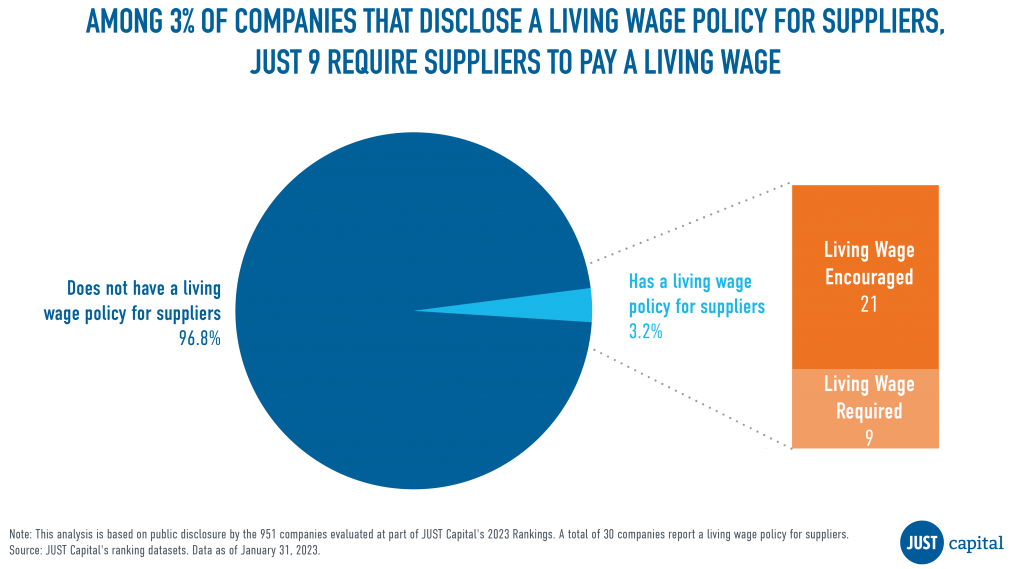
Companies who introduce living wage clearly with a definition and guidelines help suppliers understand, prioritize, and conform to requirements.
Although there are multiple living wage estimators and accrediting institutions, both domestically and internationally, they all follow similar methodological approaches and include common elements when estimating a basic needs budget. At Just Capital, we use MIT’s Living Wage Calculator to evaluate company wage performance for their United States employees on two population-weighted national average living wage estimates. These estimates provide two wage thresholds for different family sizes (one full-time worker with no children and two full-time workers with two children).
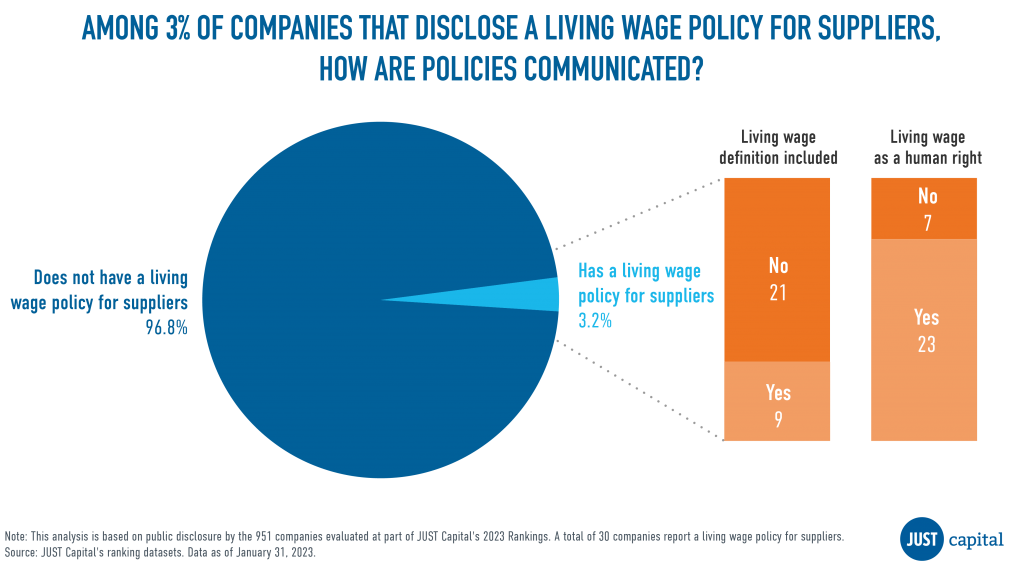
Of the 30 companies that encouraged or mandated living wages for supply chain workers, 23 companies stated that they considered receiving a living wage to be a human right. Interestingly enough, we found that only 9 of the 30 companies included a definition of living wage.
To better communicate their expectations to supply chain partners, companies can publicly clarify how they understand the concept of living wage by publishing a definition.
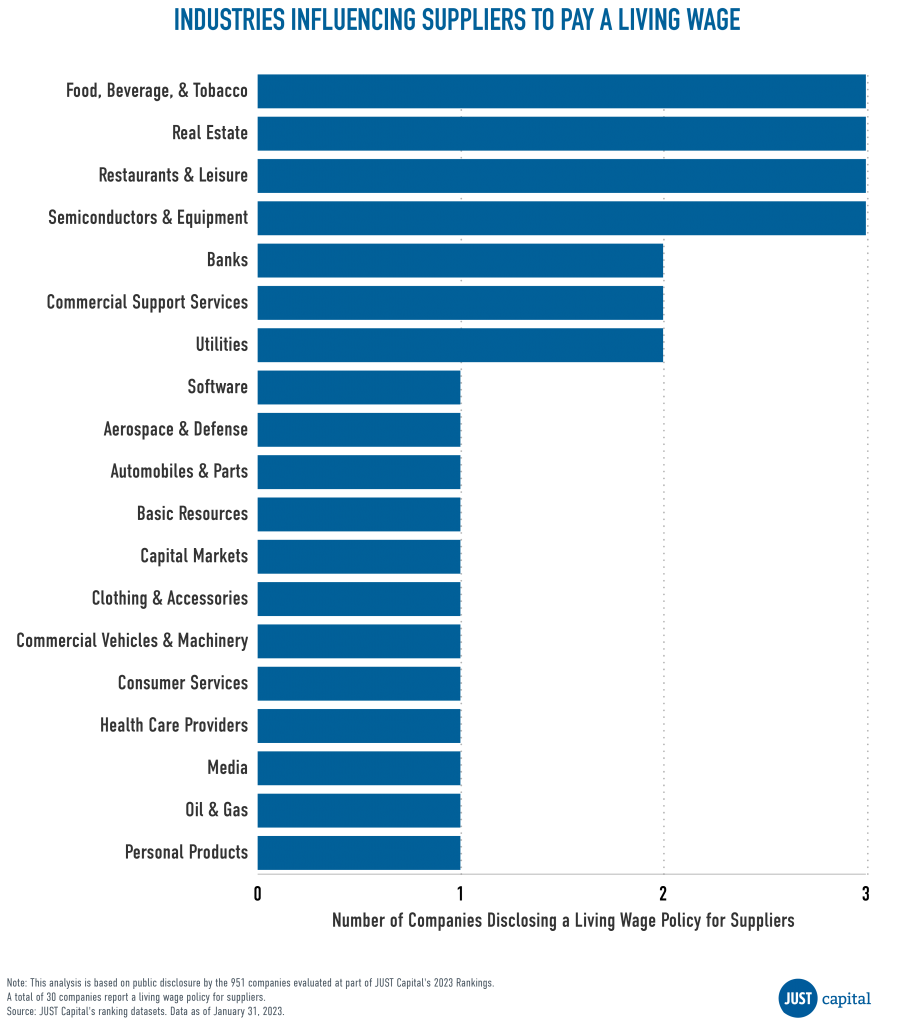
While we expected to find that companies who influence their supply chains to provide a living wage might be concentrated in industries with short supply chains and majority white collar workers, instead, we found that there is low but somewhat industry-distributed traction around companies encouraging or requiring their supply chains to pay a living wage. 19 out of the 36 industries we track (or 53%) were represented across the 30 companies that influence their suppliers to pay a living wage. The sheer diversity in the companies recommending this important benchmark to suppliers demonstrates that for these industries, the concept of living wage is not a foreign concept.
Through our analysis we identified five companies: Morgan Stanley Capital International (MSCI), Accenture, Analog Devices, Smartsheet, and Teradyne who are leading on supply chain living wage commitments as well as wages for their own employees. In modeled estimates (produced by Just Capital in partnership with Revelio) of the share of employees earning a living wage at each Russell 1000 company, all five of these organizations were in the top quartile of companies in terms of that predicted share. What’s more, all five disclosed a living wage policy or encouragement for suppliers. These companies’ approaches suggest three best practices in supply chain living wage commitment disclosure:
Morgan Stanley Capital International (MSCI) (Commercial Support Services)
Morgan Stanley Capital International (MSCI) is a research firm focused on investments and stock analytics. They have some of the strongest language in the Russell 1000 around disclosure, requiring rather than encouraging that suppliers pay their employees a living wage. In addition, MSCI provides a clear definition of living wage which is essential in influencing behavior change.
Accenture (Commercial Support Services)
Accenture specializes in strategy and consulting around a broad range of services for companies to optimize their business operations. Accenture is headquartered in Dublin, Ireland, and works to scale living wages throughout their own operations and supply chain.
Accenture has developed an action plan and targets for scaling living wage throughout their global operations and supply chain, and they regularly disclose progress and update targets. They currently hold a ‘real living wage’ accreditation in the United Kingdom, and require suppliers in the United Kingdom to pay employees a living wage. At present, they strongly encourage suppliers in global operations to pay a living wage. As part of their work with suppliers, they also employ best practices such as regularly reviewing supply chain practices. They are meaningful contributors in the global conversation about living wage, and frequently collaborate with the World Economic Forum to provide guidance and best practice solutions.
Analog Devices Inc (Semiconductors & Equipment)
Analog Devices, Inc. (ADI), is an integrated circuits company based in Wilmington, Massachusetts. Analog devices is one of the few companies in the Semiconductor Industry that encourages suppliers to provide a living wage to employees as an addition to scaling living wage in their own workforce. ADI has identified living wage as a key focus area in self-education to improve their own operations and supply chain practices. While they do not offer a definition of living wage yet, they are clear in providing guidance on how they would like suppliers to treat their employees– recommending suppliers provide employees with paid vacation and sick leave.
Smartsheet (Software)
Smartsheet specializes in project management and team collaboration software. While they do not define living wage for suppliers or their own operations, they do require suppliers to pay employees a living wage. They also include additional working conditions that suppliers are required to uphold including a safe and healthy work environment, and ethical conditions. Smartsheet has an eye toward passing the living wage down past their own operations and suppliers; in addition to requiring that suppliers pay a living wage to their employees, they also require that suppliers also pay their own contractors a living wage and guarantee the same working conditions. This kind of impact is far reaching, leveraging multiplier effects to create positive changes in workers wages well beyond their own operations.
Teradyne (Semiconductors & Equipment)
Teradyne is a semiconductor company specializing in test equipment headquartered in North Reading, Massachusetts. Teradyne discloses that they ensure a living wage for their own employees through their own labor practices, and they expect suppliers to follow the same practice. While they do not supply a definition of living wage, they have focused efforts on improving their supply chain practices, and clearly disclose strategies and processes taken to improve and engage supplier practices. They outline a management approach designed to ensure that they are implementing responsible sourcing practices that engage all stakeholders in their own company, environment, governance, the communities they impact and in the products that they produce.
