In August 2019, the Business Roundtable (BRT) – comprising Chief Executive Officers (CEOs) from some of the largest U.S. companies – vowed to move away from shareholder primacy in favor of stakeholder capitalism by redefining the purpose of a corporation to promote “an economy that serves all Americans.” The statement was originally signed by 181 CEOs, and as of August 2021 has increased to 243 who have committed to lead their companies for the benefit of all stakeholders.
Two years after the Business Roundtable’s announcement, Just Capital, in collaboration with The Harris Poll, has checked in with Americans on how well they think large U.S. companies have been upholding these principles. Read the full report below for an in-depth exploration of attitudes towards capitalism and the impact of large corporations on stakeholders, and check out some of our key findings here.
Events over the last year have tested the country’s frayed social fabric like no other year in recent memory. Growing partisan polarization has been well-documented, and partisan antipathy has intensified to a point where 91% of Americans say that they see strong conflicts between Democrats and Republicans. Everything, from the COVID-19 pandemic to presidential approval ratings, shows widening gaps in attitudes between Americans of different political views. It seems that the only thing that the American public – across all ideological factions – can agree on is that Democrats and Republicans disagree on even basic facts.
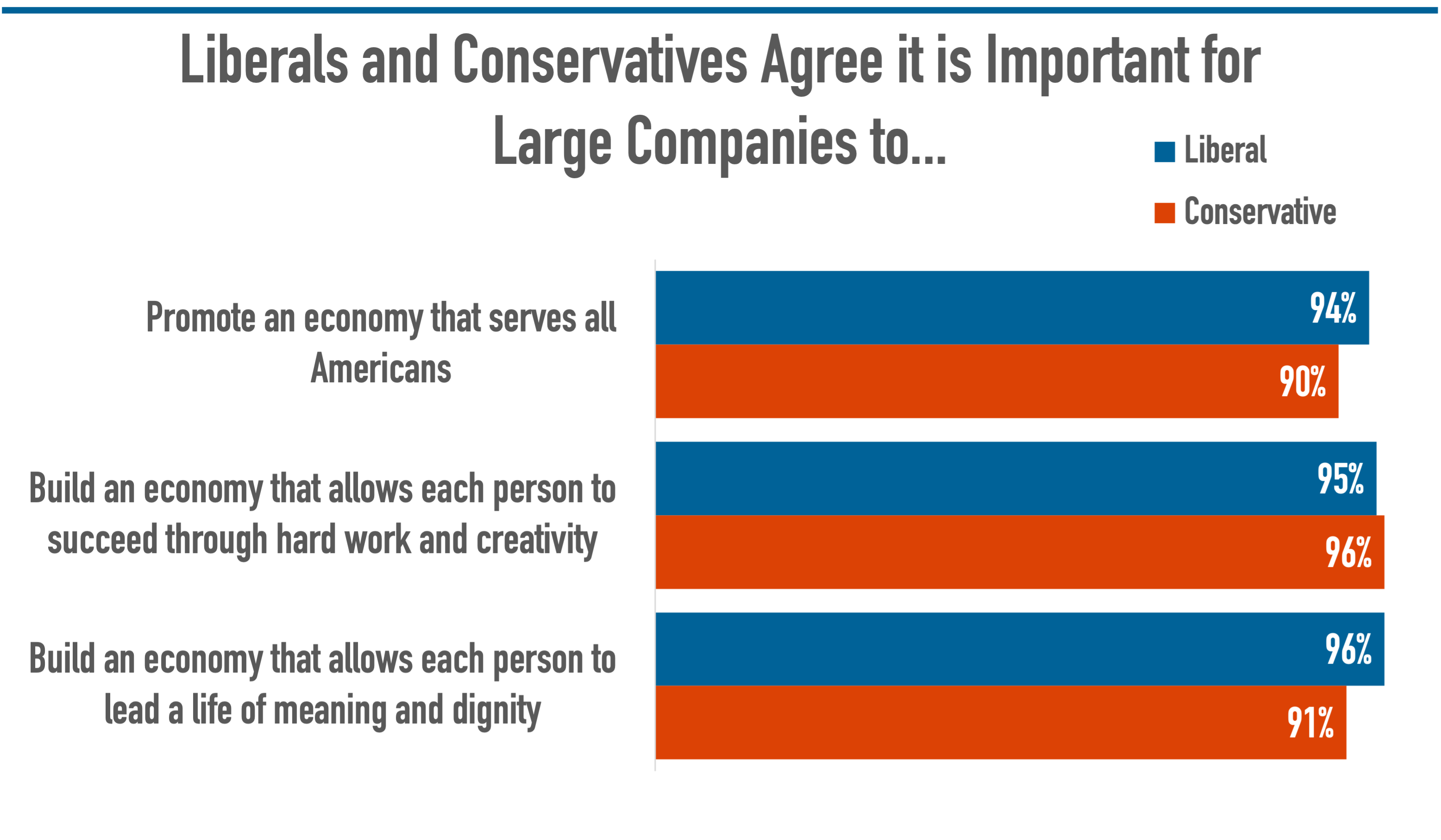
Our annual survey, however, has captured a common ground among liberal and conservative respondents when it comes to their views on stakeholder capitalism, with large majorities of each group agreeing that it’s important for companies to promote an economy that serves all Americans, as well as one that builds an economy that allows each person to succeed through hard work and creativity and to lead a life of meaning and dignity. And both groups largely agree that business can be a force for positive societal change (88% of liberals and 74% of conservatives).
Across ideological divides, Americans also agree on what the top eight priorities for creating this vision of stakeholder capitalism should be – among them, paying a living wage, cultivating an inclusive workplace, and protecting workplace health and safety. This alignment signals that stakeholder capitalism may represent a broad-based solution for achieving a more equitable economy that all Americans, regardless of their ideological perspectives, can get behind – in particular, when it comes to how companies treat their workers.
Overall, Americans want to see companies pay a fair, livable wage to their workers – it is the top priority for conservatives and #2 for liberals (securing human rights across the supply chain is the top priority for liberals). Ethical leadership ranks #4 for both groups on the list of priorities. And among the top eight priorities overall, liberals put slightly more emphasis on issues of human rights and workplace diversity compared to conservatives, while conservatives put slightly more emphasis on job creation and workforce investment compared to liberals.
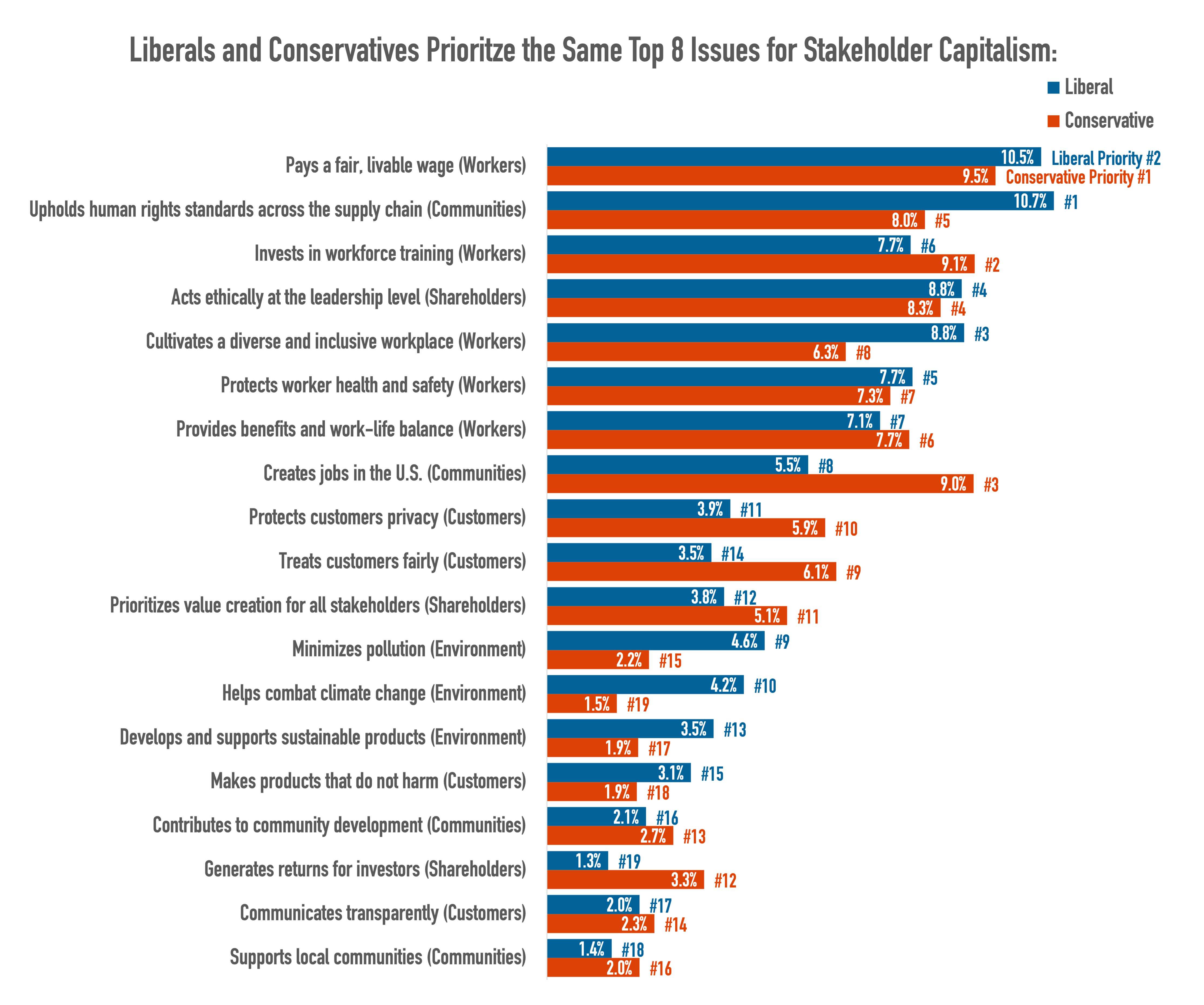
Further down the list of priorities, some predictable differences emerge. Liberals are more concerned about environmental issues compared to conservatives, such as limiting pollution (#9 for liberals and #15 for conservatives) and reducing carbon emissions (#10 for liberals and #19 for conservatives). Conservatives put a higher priority on generating profits (#12 for conservatives and #19 for liberals).
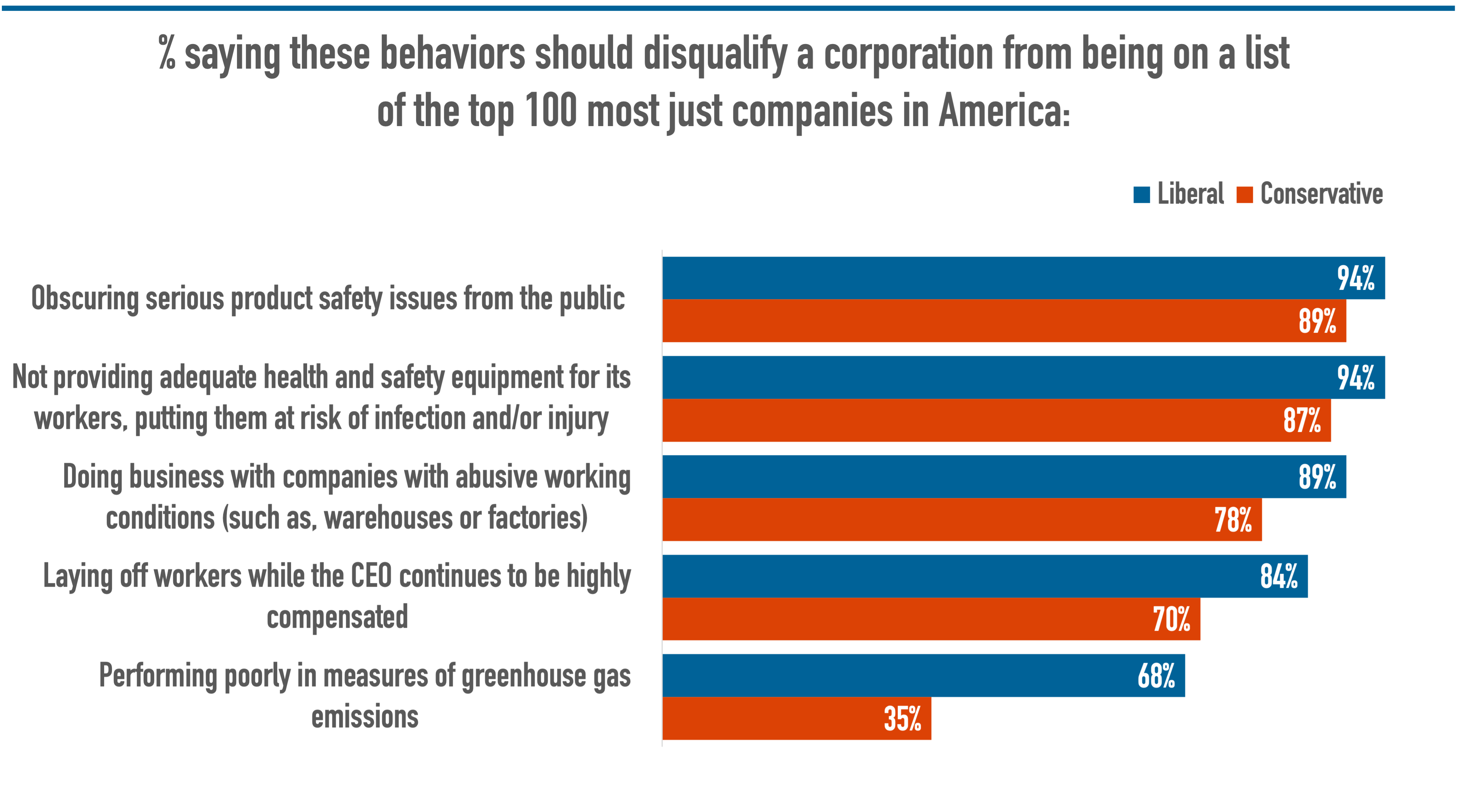
Liberals and conservatives also largely align on the business behaviors that they view as unjust. Large majorities of both groups believe it is unjust for corporations to hide product safety issues from the public, put workers at risk by not providing adequate health and safety measures, do business with companies that have abusive working conditions, and continue providing high pay to CEOs while laying off workers. The only issue that presented a split in opinion about unjust corporate behavior is greenhouse gas emissions – 68% of liberals believe corporations that produce more greenhouse gas emissions are unjust, compared to 35% of conservatives.
Despite the intense polarization that undeniably exists in our country today, a path toward unity seems to exist in how we approach stakeholder capitalism. Business leaders can do their part by putting forward a broader, more inclusive economic vision that allows all people to contribute and achieve their potential. And companies can take action by making the security and well-being of their workers their top priority – a move that truly bridges the ideological divide.
If there’s one thing that has emerged after the events of the last week, it’s the clear need for healing and leadership across society. It aligns with the priorities we continue to hear from the American people, who, in our latest poll conducted in late December, say that business and government have a collective responsibility in tackling the critical issues of our time.
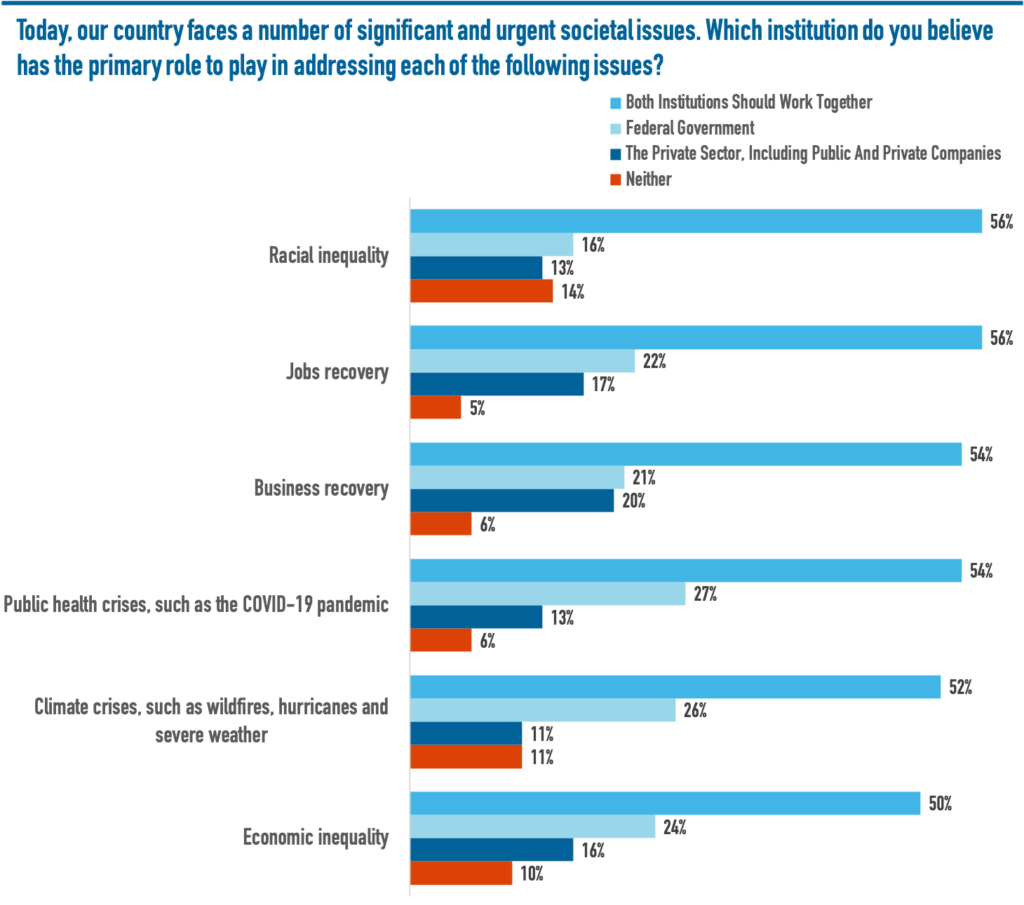
In an effort to understand whether there is bipartisan support for collaboration between business and government, we asked Americans whether they think the federal government or the private sector should play the primary role in addressing issues from racial inequality to public health to climate. Most respondents said they believe that they should work together. Specifically, 50% or more believe that business and government should join forces to address racial inequality, business/jobs recovery, climate crisis, economic inequality, and the public health crises, far outweighing those who think either the federal government or private sector are primarily responsible to drive change on the issues.
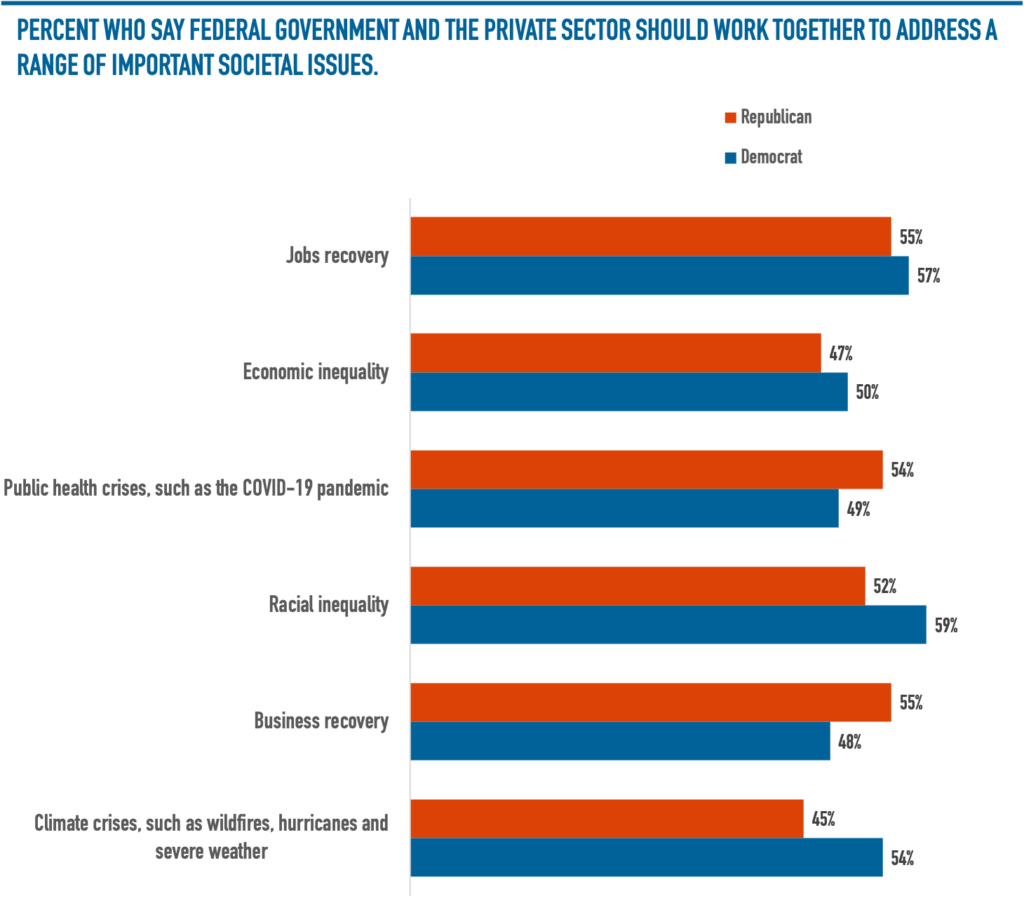
When looking at these issues, there is clear agreement across partisan lines that collaboration between business and government is needed, suggesting that there is rich opportunity to work together across the aisle in elevating shared values and identifying solutions. To wit: Majorities or pluralities of both Republicans and Democrats agree that the federal government and the private sector should work together to address society’s most pressing issues, including racial inequality (52% of Republicans and 59% of Democrats), jobs recovery (55% of Republicans and 57% of Democrats), and public health crises such as the COVID-19 pandemic (54% of Republicans and 49% of Democrats).
We see similar alignment on the issues we capture in our annual survey. In our 2020 Report, we found that liberal and conservative Americans align on the top eight priorities for stakeholder capitalism – in particular, Americans from different ideological backgrounds agree that companies must prioritize their workers. Overall, fair pay and livable wages for workers is the top priority – it sits at the top of the list for conservatives and at the #2 spot for liberals (who say that basic human rights across a company’s supply chain is their top priority) – and ethical leadership is #4 on the list for both conservatives and liberals. Among the top eight priorities, liberals put slightly more emphasis on issues of human rights and workplace diversity, while conservatives put slightly more emphasis on job creation and workforce investment.
America’s largest companies have a role to play in helping to heal the country’s divisions and to create an economy that works for all. The public agrees that businesses can do this by lifting up workers – providing a fair and living wage, job opportunity and stability, and an inclusive workplace – and want to see the private and public sectors work together to address the country’s most urgent social and economic challenges. 2021 can still be a year of great promise, and the business community can lead the way, starting with ensuring the financial wellness of all their workers, advancing racial equity in the workplace, and by actively engaging with government leaders to identify and implement solutions to some of the country’s greatest challenges.
As we close out 2020 and look to the Biden-Harris inauguration, a key question has begun to emerge: will business leaders continue to take a stand on the critical social issues of our time?
While social leadership is not new for corporate America, the last several years have seen an unprecedented rise in CEO activism, coalescing around the Business Roundtable’s 2019 statement that the purpose of a corporation is to create an economy that serves all Americans. C-suite leaders have become increasingly outspoken in recent years – during which the American people have witnessed growing and vast economic inequality, social unrest, and the impacts of climate change. As President-Elect Biden prepares to usher in a Democratic administration, speculation has emerged around whether CEOs will continue the trend and both speak out and engage on the biggest societal issues of the day.
Over the course of this year, Just Capital has surveyed the American public to get their take on the role they believe companies – and their leaders – must play in addressing the myriad of social crises of our time, from the COVID-19 pandemic to our nation’s reckoning with racial injustice to the challenges to democracy emerging from the recent election.
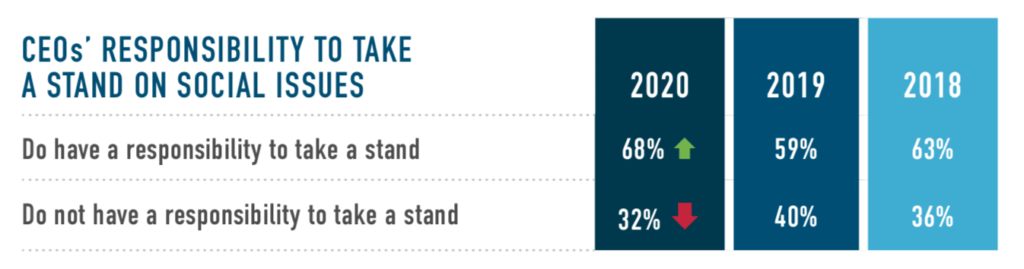
Across the board, we’ve found that Americans agree that companies have a role to play, and that they see corporate leaders as societal leaders. Specifically, when we ask Americans whether they think CEOs have a responsibility to take a stand on key social issues, more than two-thirds of respondents told us that they do, an increase over the last two years:
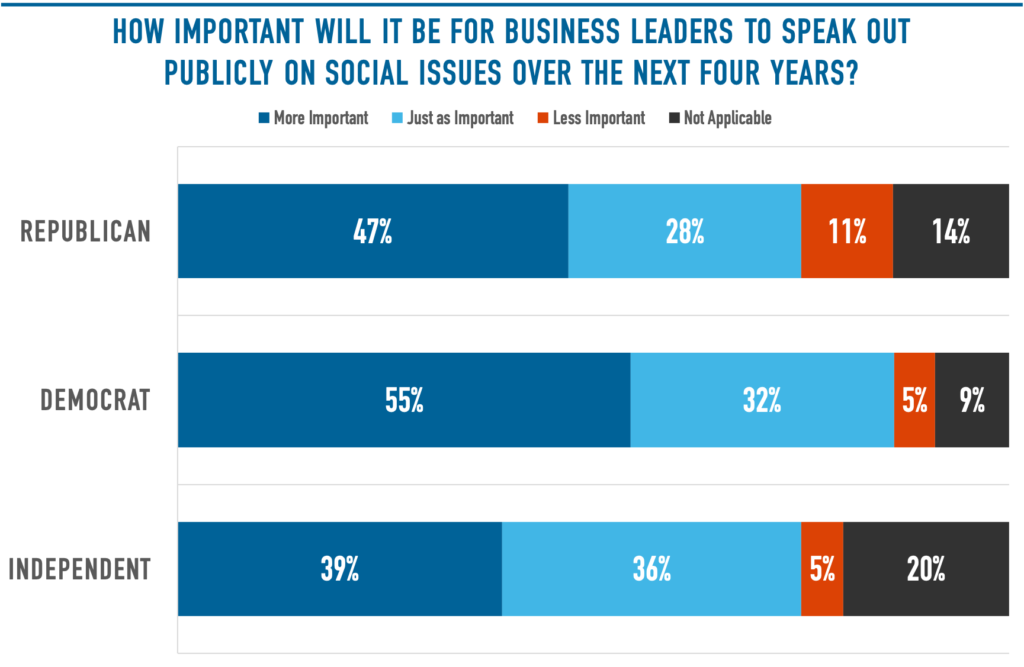
And as we look forward to the next four years under a new administration we recently asked the public whether they think it will be more or less important for corporate leaders to speak out on social issues. An overwhelming 79% of Americans say it will be just as important, or more important, for corporate leaders to speak out publicly on social issues over the next four years, compared to today. Only 8% believe it will be less important over the next four years. 47% of respondents believe it will be even more important, while 32% believe it’s just as important. 14% think the question is not applicable because they do not think it is important for business leaders to speak out on social issues.
Across party lines, there is agreement overall that it will continue to be as important, or more important, for corporate leaders to speak out over the next four years, though Democrats seem to most firmly hold this belief. 87% of Democrats see continued corporate activism as more, or just as, important, while 75% of both Republicans and Independents share this view.
It’s early days, but already we’re seeing corporate leaders begin to engage with the incoming administration on core stakeholder issues. 40 companies – including Microsoft, Citigroup, Walmart, and Ford – sent a letter to the transition team earlier this week, urging the U.S. to rejoin the Paris Climate Accord. And last month, Microsoft president Brad Smith shared his thoughts on the election, calling for “bipartisan collaboration and government and industry cooperation” on issues core to its business, from new data privacy laws to nationwide internet accessibility. Meanwhile, President-Elect Biden has signaled that workers will be central to its efforts over the next four years, promising to help create “an economy that gives every single person across America a fair shot and an equal chance to get ahead.”
As our nation transitions to the Biden-Harris administration, Just Capital will continue to track these efforts, looking not only at how corporations act but at what the American public believes is most important. Stakeholder capitalism will no doubt remain in focus as both government and business leaders begin to align on what comes next.
In our 2020 survey – which explores what the public wants from corporate America in this time of crisis – we found that vast majorities of Americans agree that large companies should (a) promote an economy that works for all Americans (92%), (b) build an economy that allows each person to succeed through creativity and hard work (94%) and (c) allow each person to lead a life of meaning and dignity (92%). From this research it is clear that the public thinks that companies have a critical role to play in society: that they can, and should, do their part to ensure that the country’s economic system upholds and reflects our shared values – that we are all in this together, that we each have the opportunity to contribute, and as a result, that all are able to live a life of dignity.
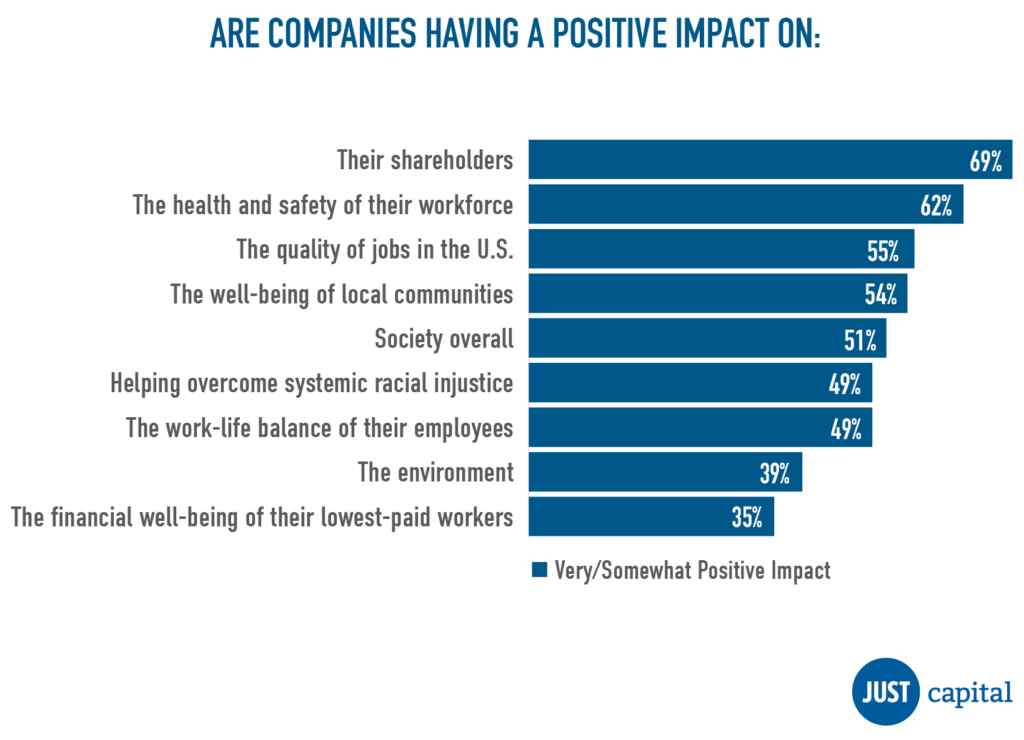
Yet while Americans acknowledge companies have an important role to play in contributing to the betterment of society, the country is split on how well companies are actually doing: 49% say companies are doing well promoting an economy that works for all Americans, vs. 50% who say companies are not doing well. And while the public gives corporate America good marks for how they’re serving their shareholders (69% believe large companies are having a positive impact on their shareholders), few believe companies are doing enough for their workers: around one in three say companies are having a positive impact on the financial well-being of their lowest paid employees (35%), and just half believe companies are having a positive impact on society overall (51%).
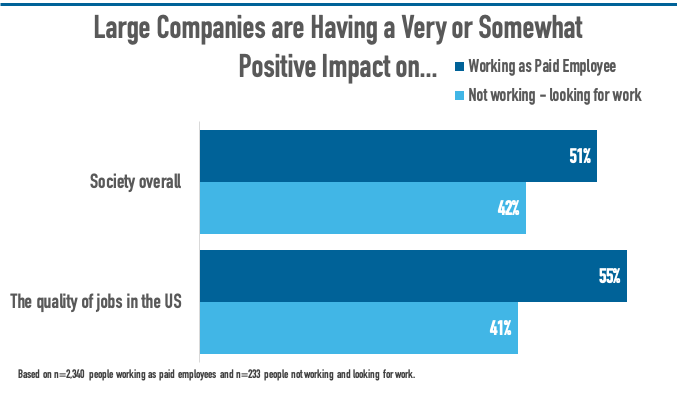
Complicating matters further is the economic consequence of navigating through nine months of a pandemic. According to Pew, roughly 15% of American adults lost their jobs due to the COVID-19 outbreak this spring, and half remain unemployed. When we look at what out-of-work Americans – those who are unemployed and seeking work – believe companies are having a positive impact on, we find that their degree of optimism precipitously decreases. This group shows significantly greater skepticism about whether companies are doing their best to promote a fair and inclusive economy:
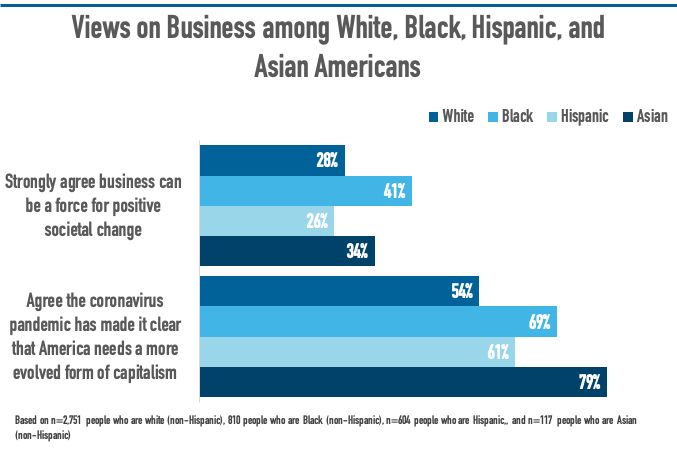
While a full economic recovery is still a ways off, data is showing the recovery is shaping up to be highly unequal. Unemployed Americans are disproportionately young, Black, and/or Hispanic, with many living in low-income households. While the overall unemployment rate eased down to 6.9% in October (from 7.9% in September and 8.4% in August), the jobless rate for Black Americans (10.8%) and Hispanic Americans (8.8%) remains high. Black, Hispanic, and Asian Americans are much more likely to agree that the COVID-19 pandemic has made it clear that the country needs a more evolved form of capitalism (69%, 61%, and 79% respectively) compared to white Americans (54%). And Black Americans are much more likely to strongly agree that business can be a force for positive social change (41% strongly agree, compared to 29% overall).
We have much work to do to ensure that our economic system reflects our shared American values of inclusion and opportunity. Large companies have a clear leadership role in promoting an economy that works for all, and have the resources, talent, and innovative mindset to succeed. Corporate America can start by taking action to improve the financial wellness of their workers. There is certainly a business case for doing so, but it’s also just the right thing to do – and what Americans increasingly expect from the business community.
