JUST Capital has been tracking how America’s largest companies are responding to the COVID-19 crisis and we can now chart changes between the launch on March 24 and our latest update on April 21, 2020. Our data shows that, of the 100 companies we’ve analyzed, the majority have implemented new policies and practices related to customer accommodations, production and distribution changes, and work from home policies.
Most interesting, perhaps, is that companies continue to evolve their policies over time as the true scope of this crisis comes into view. For example, the number of companies making special customer accommodations has grown significantly over the past few weeks.
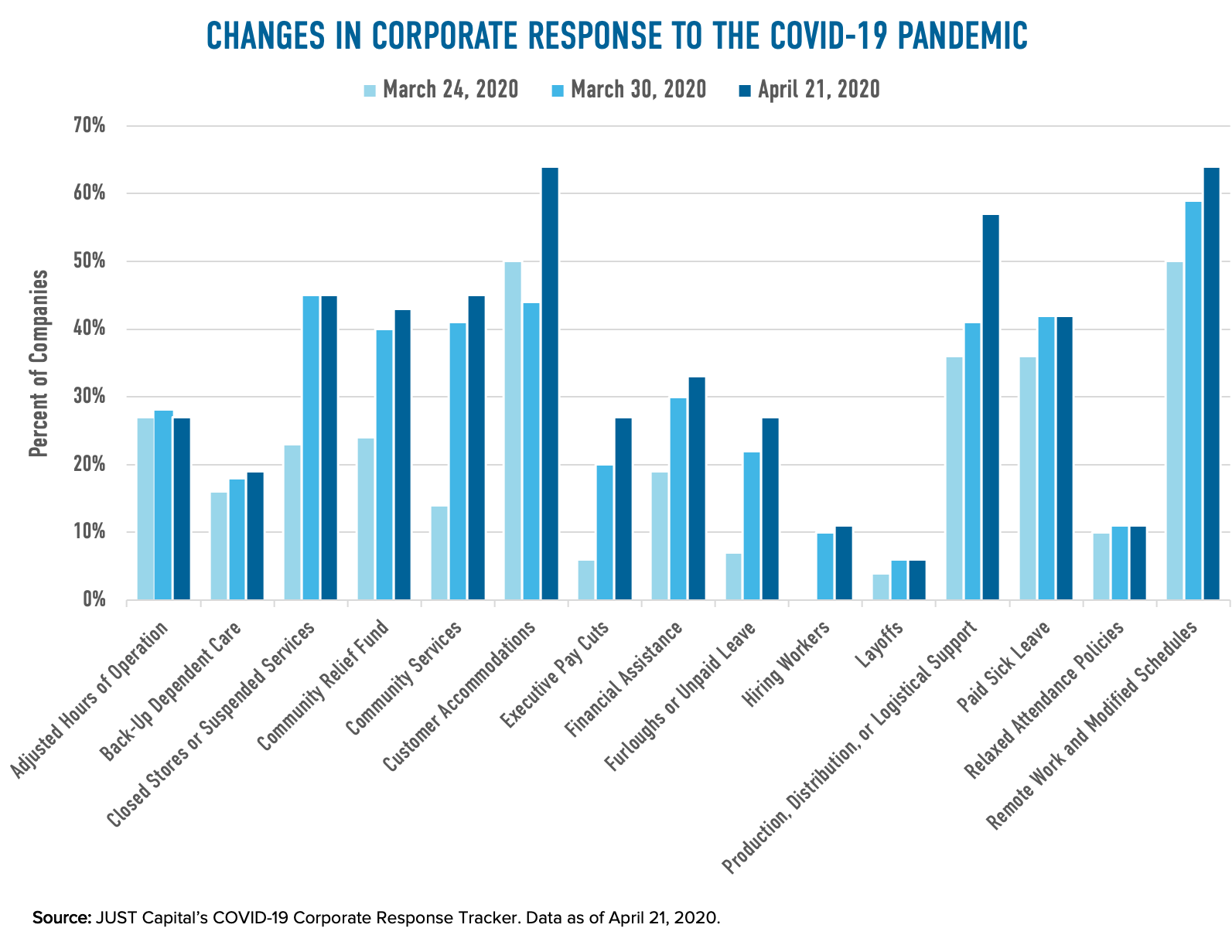
But clearly, that’s not all. Some of these policy shifts are for the better, and others are troubling. Over the last month, the number of companies that have:
Over the course of the next week, we will unpack some of these specific policy changes in more detail. And if you’re looking for more insights, take a look at our daily policy blog, which includes updates from companies outside of the largest 100, our recent analysis on paid sick leave, and the rest of our coronavirus content channel.
The COVID-19 pandemic has created a global health and economic crisis that has placed us all on war footing, and companies are at the frontline. JUST Capital knows that companies face unprecedented operational and financial challenges and are making difficult decisions each day, including how to support their workers, customers, and communities in the face of declining revenues. We also know that each company, and each industry, is different and so options available to some may not be available to others. The stark reality is that the strategic decisions companies, along with the government and civil society, make today will ripple across our economic system for years to come.
JUST Capital has always aspired to elevate the values and priorities of the American people to help guide corporate decision making and just business behavior. In these trying times, as business leaders are struggling to understand what is “just,” we’ve created the following guiding principles. These are embedded in the very essence of stakeholder capitalism and built around five years of public opinion research on what constitutes just business behavior. They are meant to help guide CEOs and corporate leaders as they craft their strategic responses to the coronavirus pandemic and likely recession.
As a companion to these principles, JUST has also created an ongoing digital tracker of corporate responses to the COVID-19 crisis to assess what’s happening on the ground, elevate best practices, and share what good looks like in this rapidly shifting landscape. We’ve also highlighting how some of America’s largest companies have already embraced these principles in their initial responses to the coronavirus.
Here are our five leadership principles and how they connect to what we’re tracking:
JUST Capital’s polling shows that the American public’s top priority when it comes to just business practices is the treatment of workers. Americans believe companies should pay workers a fair and living wage, provide robust benefits, and maintain a safe work environment. These practices are even more crucial today as companies face unparalleled concerns about survival and protecting their workforce.
For too long, millions of workers in the United States have been financially insecure, with many living paycheck to paycheck. Despite the longest economic expansion in U.S. history, 40% of Americans can’t cover an unexpected expense of $400, according to the Federal Reserve. The coronavirus has shone a bright spotlight on the financial vulnerability of our workforce and the existing structural inequalities in our economy.
As companies respond to the ongoing pandemic, they should, as much as possible, prioritize the health and financial security of all their workers, especially their low- and middle-wage workers, who will experience the most economic hardship. And while circumstances are changing rapidly, there is much companies can do to support those workers today:
JUST Capital is tracking corporate announcements related to: paid sick leave, temporary closures, one-time bonuses, and treatment of vendor and contract workforces.
We also know from our polling that the American public places a high priority on companies creating and retaining quality, stable jobs in the U.S.
Work structures and arrangements are changing rapidly for many Americans. Some are working from home for the first time while caring for children who can’t attend school. Others are still working at their place of business but taking on new roles and responsibilities. In immediate responses to this new reality, many companies have proven to be nimble and innovative. Companies should also adopt a similar mindset as they prepare for a potential recession, exploring new work structures and practices in order to avoid layoffs and additional hardships for workers:
JUST Capital is tracking companies’ announcements related to: work from home policies, layoffs and furloughs, outplacement services, and commitments to rehiring employees.
Government officials across the country are pursuing policies to stop the spread of coronavirus and minimize strains on our healthcare systems, families, communities, and businesses. Corporate America is well positioned to help implement efforts already underway and advocate for additional government interventions. While each company brings a unique voice and set of resources, there are a few actions that all companies can consider:
JUST Capital will soon be tracking companies’ announcements related to: stock buybacks.
The American public wants companies to support the communities in which they operate through local sourcing and support, charitable giving, and paying a fair share of taxes. Companies should assess how strategic choices could better support their suppliers, the government, and community members. They can:
JUST Capital is tracking companies’ announcements related to: community support, participation in relief funds, customer services, and supply chain practices.
Our polling has found Americans care deeply about ethical leadership, and we see that this is of utmost importance in a period of uncertainty. Also, nearly 60% of Americans believe that CEOs have a responsibility to take a public stand on important social issues. If there were ever an important social issue, supporting stakeholders in a crisis is it. CEOs and C-suite executives who are committed to practicing stakeholder capitalism should lead by example, vowing to be the first line of defense against a financial downturn. Leaders can:
JUST Capital is tracking companies’ announcements related to: executive compensation and pay cuts, as well as buyback and dividend programs.
This once-in-a-generation moment is the opportunity for all CEOs who have pledged their commitment to purpose-driven leadership and serving all their stakeholders to put those values into practice. Adopting a stakeholder-oriented response to this pandemic is key to minimizing its public health and economic impacts, and will help companies bolster their resilience to weather an economic downturn.
When companies provide paid sick leave, workers can stay home and protect their customers and the community from the virus, while also maintaining their economic security. When workers are fairly compensated, they can continue to buy the products they need, benefitting the overall economy. When companies prioritize customers’ health and meet their changing needs, this better serves Americans and strengthens customer loyalty. When companies recognize the importance of maintaining the financial stability of their suppliers, local communities reap the benefits. And when business executives lead by example by reducing executive compensation and companies pursue creative frontline job solutions like shift-sharing, we can minimize job loss while restoring trust.
Each year, for the last three years, our polling has shown that 80% of Americans believe that companies don’t share their successes with their employees and instead prioritize shareholder needs above all other stakeholders. At this time, it is critical for companies to take this moment to demonstrate a new commitment to walking the talk on purpose-driven leadership and supporting their stakeholders. This will be the moment where companies define their future, and make choices now that should support a faster recovery and long-term competitive advantage.
“Companies that look after all of their stakeholders, we think they’re better for us all. Edwards Lifesciences epitomizes that. They’ve walked the talk for a long time.”
How does a major medical corporation manage to stay wildly profitable while still supporting its stakeholders?
Our CEO Martin Whittaker joined Edwards Lifesciences CEO Mike Mussallem on Yahoo Finance for a deeper look at the policies and beliefs that have made it such a successful organization for workers, customers, communities, the environment, and its shareholders. A must-watch segment.
Back in August, the Business Roundtable, an association of the chief executive officers of nearly 200 of America’s largest and most influential companies, released a new Statement on the Purpose of a Corporation. After 41 years of endorsing a governance model of shareholder primacy, the organization boldly committed to focus on delivering value to all its stakeholders, “for the future success of our companies, our communities and our country.”
181 CEOs signed the Statement, committing to lead their companies for the “benefit of all stakeholders – customers, employees, suppliers, communities and shareholders.”
Critics of the shift generally fell into two camps – those who believed the Statement went too far, undermining fiduciary duty, and skeptics who believed it didn’t go far enough, representing mere words, not actions.
For the converted, many saw the Statement as a reflection of how many top CEOs currently run their companies, while others saw it as a historic paradigm-shift that would help companies, boards, and investors chart a new course for the future of capitalism.
Regardless of where you stood on that skeptic-to-convert spectrum, everyone started asking for a scorecard that would help us understand how these companies were actually performing on key stakeholder issues.
JUST Capital has the answer. Our mission, as a nonprofit organization, is to openly and transparently measure, in a data-driven way, corporate performance on stakeholder issues, as well as to incentivize improvements. We have been doing this for four years. We are also the only organization tracking how the American public thinks about stakeholder performance, and which issues they prioritize.
Today we are pleased to release a stakeholder analysis for the Business Roundtable Signatories, based on the analysis that fuels our 2020 Rankings of America’s Most JUST Companies, as well as our own framing for how companies can optimize the creation of value in this new era of stakeholder capitalism.
JUST Capital has polled more than 96,000 Americans over the past five years to intimately understand which issues the public wants corporations to prioritize to restore trust and create an economy that serves all Americans. We also have four years of corporate performance data on those issues, as well as market analysis that shows the business and investment case for adopting these business behaviors.
By the Numbers
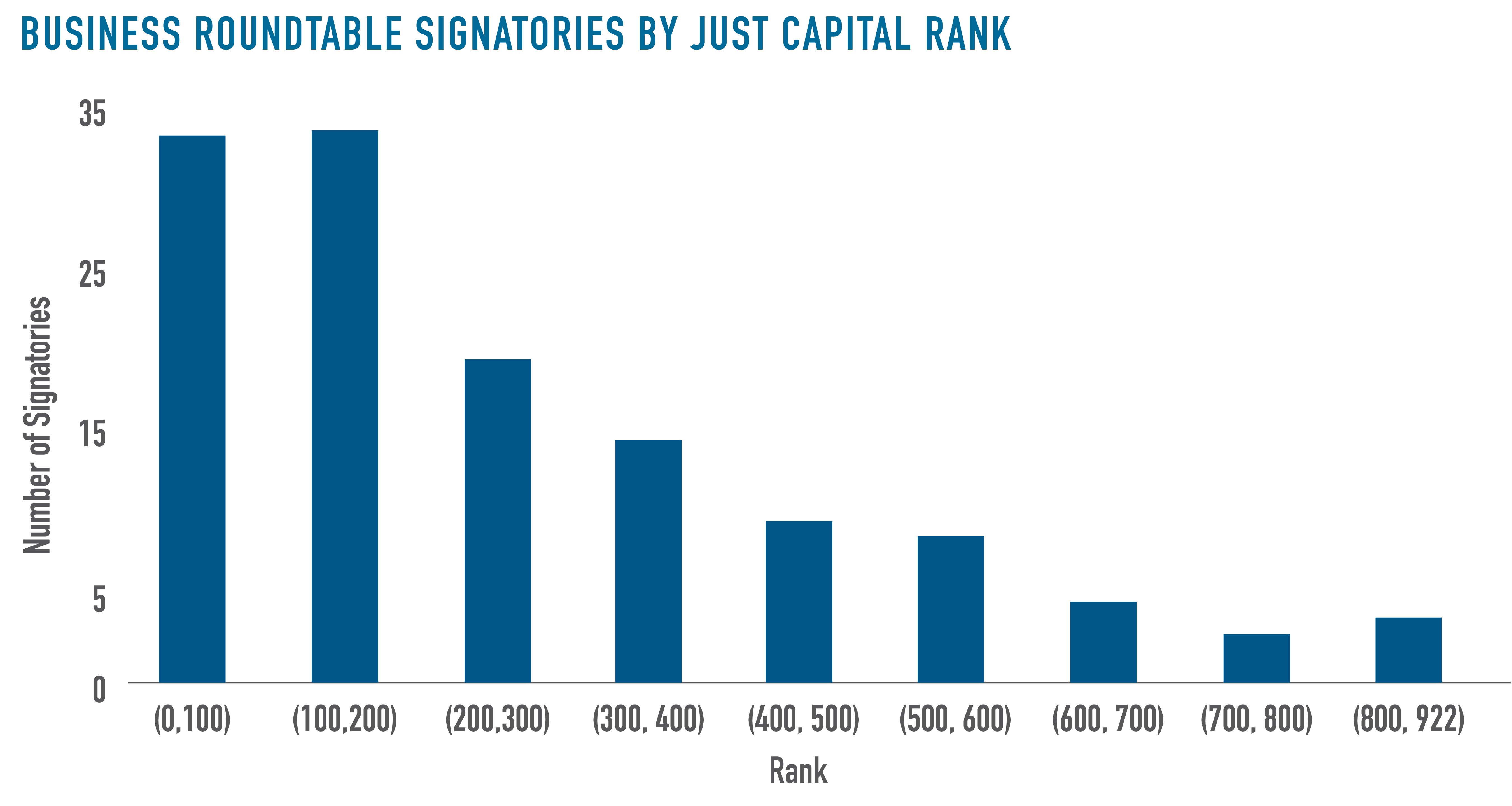
Overall, a healthy majority of the Roundtable’s signatories scored well this year. They are not performing quite as well as the top companies, the JUST 100, but are close. And 34 of the signatories are, in fact, featured in the JUST 100, including Apple, Salesforce, Anthem, P&G, Cisco, GM, IBM, AT&T, Accenture, and Xylem.
Our analysis is based specifically on 134 of the 181 signatory companies, as we track, measure, and rank Russell 1000 companies each and every year. If a company is not included in the Russell because they are a private corporation or for other rules-based reasons, we do not yet have data on those companies. For the 134 signatories that were included in our universe, we analyzed those companies across five stakeholder groups – including Workers, Customers, Communities, the Environment, and Shareholders – covering 29 Issues – like whether companies pay a living wage or protect the environment, and over 400 data points – from paid parental leave to veteran hiring and supplier policies.
Here’s how 134 of the Business Roundtable signatories stack up:
Serving Stakeholders
So aggregate performance was high. We next explored how the Business Roundtable signatories performed regarding key issues relating to each stakeholder.
First a note to explain that our stakeholder definitions are modestly different than the Business Roundtable’s purpose statement framing. We think similarly about employees (which we categorize as “Workers”), Customers, and Shareholders. The Roundtable considers issues relating to the environment and sustainable business practices as a component of how they serve communities, whereas the American public sees the Environment as a separate stakeholder. JUST combines supplier issues that matter most to the public – like upholding human rights standards in the international supply chain and supporting local, diverse, and veteran suppliers in the communities in which they operate – within our Communities stakeholder, rather than breaking suppliers out as a separate stakeholder.
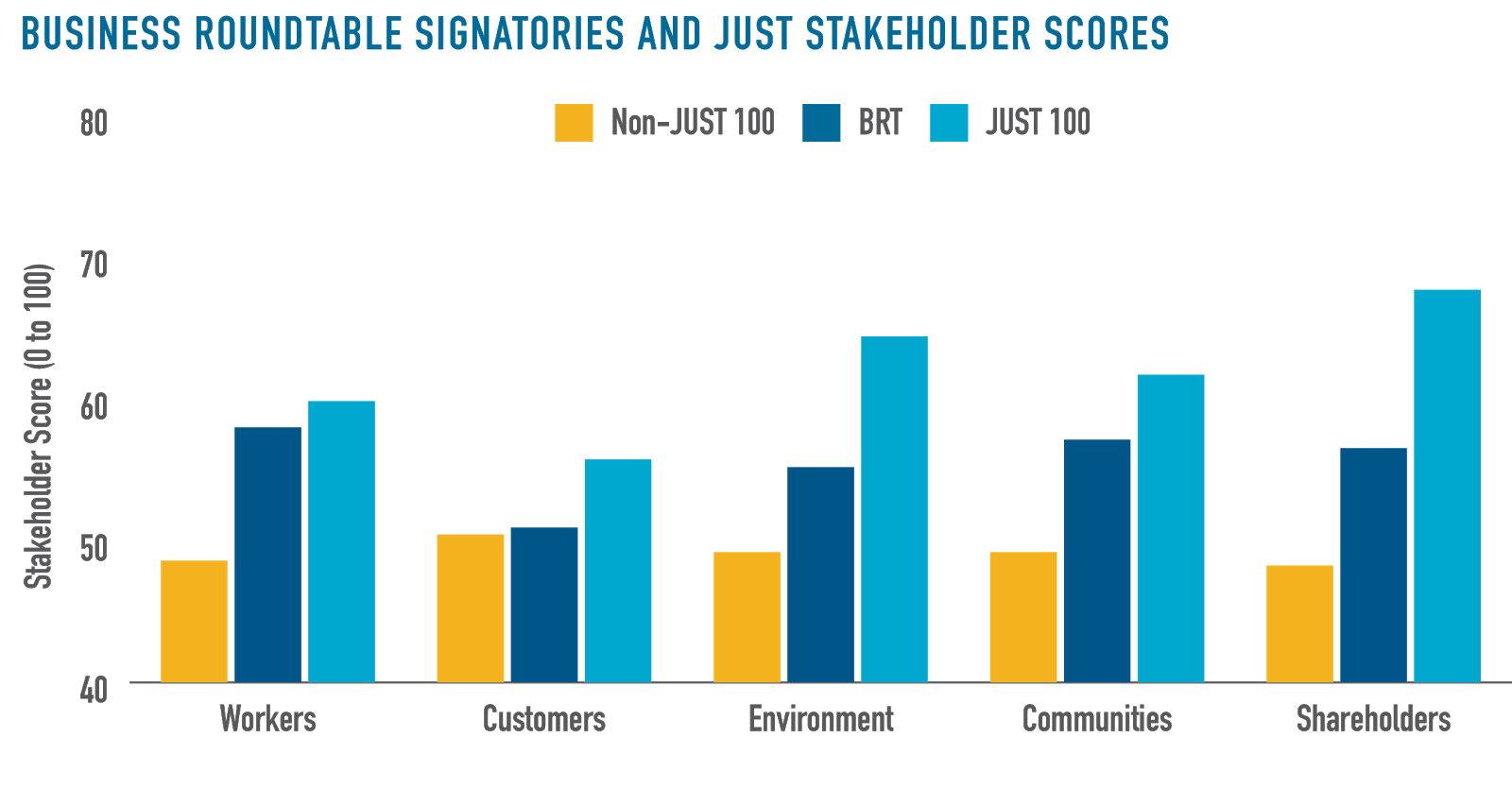
Overall, you can see that the 134 Business Roundtable signatories are performing well above average when it comes to serving their stakeholders, except for Customers, where we are measuring issues like creating quality, safe products that do not harm health, the environment, or society, and protecting privacy.
Specifically, compared to other Russell 1000 peers not in the JUST 100, the Business Roundtable signatories perform:
Note: the “Non-JUST 100” category above includes all of the Russell 1000 companies we rank minus the JUST 100.
Impacting the Future
While the current performance of the Business Roundtable signatories shows that many of the top companies are already operating with a stakeholder-focused mindset compared to their peers, increased investments by this incredibly influential community of corporations could have massive ripple effects throughout our economy.
For instance:
In the coming year, we will continue to track the actions they make toward their commitment – to support their workers, customers, communities, and more – in an effort to understand how this shift toward stakeholder capitalism impacts our economy, and the lives of all Americans.
On the road to a more just marketplace, America can only get so far without the bold efforts of its corporate leaders. And tech companies, which have contributed to some of our nation’s most pressing challenges – from data privacy to income inequality – may currently stand at the forefront of solving them.
Microsoft, this year’s top company in JUST Capital’s Rankings of America’s Most JUST Companies, announced yesterday that it would invest $500 million in affordable housing in the Seattle area – a move that signals a long-term commitment to the company’s local community.
Arriving on the heels of fellow tech giant Amazon’s announcement that it would build new campuses in Long Island City and Richmond, Microsoft’s announcement also reflects an ambitious effort to tackle the impacts – including growing income and housing inequality – that it has had on the local communities where its industry is concentrated, not unlike Salesforce CEO Mark Benioff’s initiatives to support San Francisco’s homeless population.
And this is not the first time that Microsoft has done so – its efforts to address data privacy issues and expand paid parental leave policieshave positioned the company head and shoulders above the competition. And not only with regard to ethical concerns – Microsoft has outperformed its peers in recent quarters, and its latest commitment is just another example of the company’s proactive efforts to address issues before external factors, including the market, force its hand.
In our Rankings, Microsoft ranks not only first overall, but is also tied for third for the work it does to maintain strong relationships with communities. A few other key metrics that drive Microsoft’s high performance in the 2018 list of America’s Most JUST Companies include:
As more and more U.S. companies seek to align their business practices with the priorities of the American public, Microsoft’s efforts to address its societal impacts can and should serve as an example to companies across all industries – not just in the tech sector – of how they can support a form of capitalism that works for all the people it serves.
This article was originally published on Forbes.com.
On December 10, we celebrated America’s Most JUST Companies in New York, along with Forbes, JUST 100 leaders, and special guests from the business, investment, and impact communities.
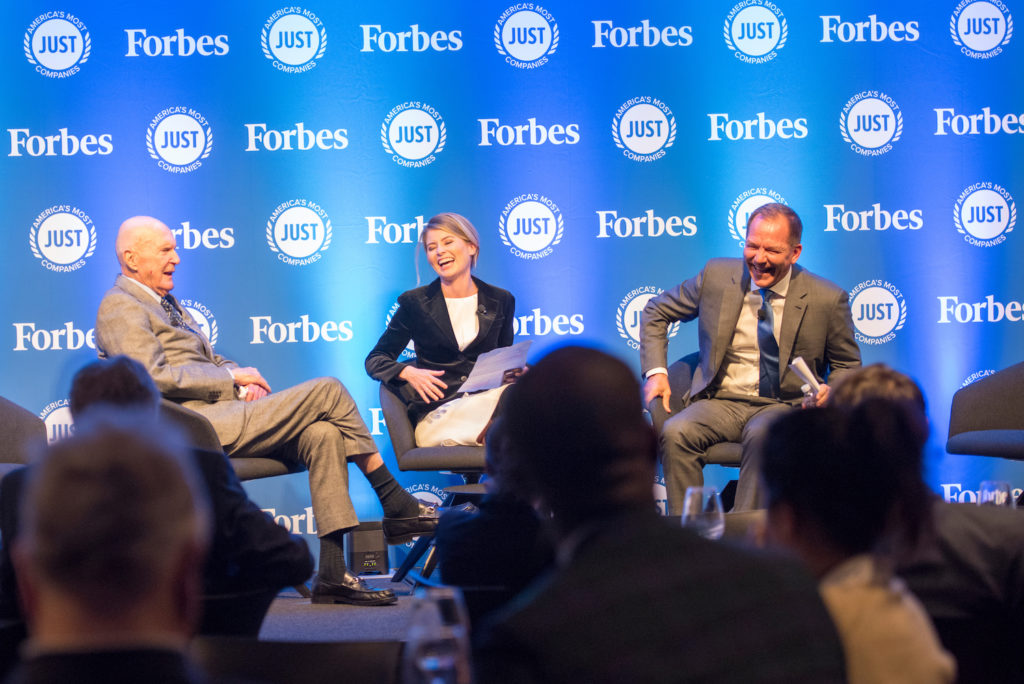
JUST Capital Co-Founder and Chairman Paul Tudor Jones II kicked off the night with a lively conversation with legendary hedge fund manager Julian Bloomberg anchor Vonnie Quinn to discuss the markets and the business case for being just:
Peggy Johnson, Executive Vice President of Microsoft and Michelle Miller of CBS then unpacked how America’s Most JUST Company is transforming its culture and products to do right by the people it serves.
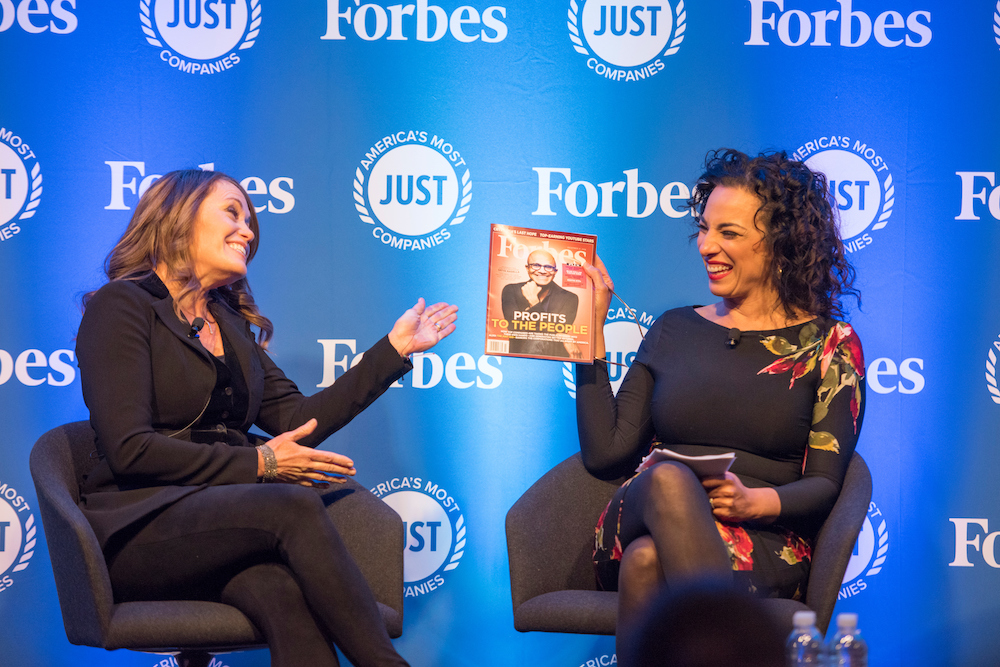
Finally, Michelle and Peggy were joined on stage by Alicia Boler Davis, Executive Vice President, Global Manufacturing, General Motors, Craig Buchholz, Chief Communications Officer, Procter & Gamble, and Ardine Williams, Vice President of Worldwide People Operations, Amazon for a provocative discussion on leading just companies through turbulent times.

Watch the video of the complete program here:
And stay tuned as we are thrilled to continue to highlight companies doing right by America and their work in building a more just marketplace that works for all. Here are some more favorites from the celebration:
