A recent headline I appreciated (and chuckled at a bit) notes companies are “hoarding” workers. The economic term is apt for how companies traditionally have approached their workforce: a cost to be managed. And so in the early days of the pandemic, with so much uncertainty, the answer was to lay off mass numbers of people to conserve capital. Yet, two and a half years later, we’re still paying for that decision in non-resilient supply chains, ill-trained workers, and ongoing turnover costs.
I’m often asked if I think the pandemic changed how companies fundamentally see their workers, and, with a potential recession oncoming, if we’re sliding toward business as (pre-pandemic) usual. The hoarding phenomenon is one example that I believe implies some fundamental conventional wisdom may be changing in favor of an emerging business strategy that: 1. Acknowledges that human capital can be a source of value creation, and that replacing that capital costs a lot in terms of productivity, recruitment costs, and institutional knowledge, and 2. Reflects a growing awareness that workers are more than capital, that investing in people can lead to strong, positive culture changes, and that underinvesting in human capital (or ignoring it altogether) can leave companies vulnerable to consumer and worker pressure.
Of course, this approach isn’t new, and didn’t emerge with the pandemic. Yet, for those of us who are focused on the momentum of the last couple of years around jobs and worker value, there’s an urgency to ensuring that trend continues, and we don’t return to pre-pandemic normal. The American people believe, and share that urgency. JUST Capital continues to see polling on how intensely they want to see companies invest in their workers.
It’s part of the reason we recently launched our JUST Jobs program. JUST Jobs is meant to highlight how companies are acting on the lessons from the past two and half years on the importance of workers – and which ones haven’t lived up to the rhetoric. Concerns about a potential recession and inflation make these questions more urgent. I spoke last week at CNBC’s Workforce Executive Council, where conversation focused on how to manage worker issues in a turbulent time. Knowing that this question is at the top of many people’s minds, and that simultaneously there’s significant work underway to secure the progress that’s been made, I wanted to observe and connect the dots around what’s currently happening.
JUST Capital is in a lot of rooms with different economic players, from corporate leaders to investors to civil society leaders. I’ve come to think about the work underway, and what needs to happen, in three buckets: the definition of a good or “just” job, the measurement of a good job, and the investment in creating good jobs.
Each bucket has seen different levels of progress recently. We spoke with some of the largest U.S. companies to gauge their reactions and thoughts on the work underway and what’s still to come, and have collected an overview of what we’ve found.
The Aspen Institute and Families and Workers Fund spearheaded a process over the last six months to define what a good job is, recently launched as the Good Jobs Champions Group’s Statement on Good Jobs and Working Definition. We were excited to facilitate corporate conversations that informed the multi-stakeholder-based definition, led by Kelley Frances Fenelon, our Director of Programs and Engagement. There is other work underway, from additional survey work of Americans to listening directly from workers on what constitutes a good job. I believe that in the next six months or so, we’ll have far additional clarity and shared language around what constitutes a good job.
And in the meantime, it’s useful to pause and lift up the elements of the Good Jobs Champions Group’s Working Definition that found clear resonance within our facilitated corporate conversations and aligned with corporate leaders’ priorities – as well as notice where there are sticking points or differences in approach. Most importantly, company representatives were excited to see a “North Star” understanding of job quality that could inspire action across different companies in different industries. Shared language, they agreed, is inherently helpful, even as businesses will tailor any good job definition’s component parts to align with their unique employee value proposition.
But moving beyond the usefulness of a definition in general, what did they like about this one? By focusing on three thematic areas – economic security, economic mobility, and equity, respect, and voice – the working definition acknowledges that no single aspect can address the whole of job quality. Instead, high-profile (and certainly important) aspects of job quality like compensation are rightly portrayed as one part of a larger puzzle. That point came up time and again, as company representatives across industries expressed appreciation for the definition’s inclusive approach.
A few elements of the definition also stood out as forward-looking to companies as they race to define how they’ll attract, develop, and retain the right employees. While the table stakes issues that provide for workers’ economic security can’t be ignored, the corporate representatives emphasized that it’s increasingly important for companies to demonstrate that individual employees are valued and integral to the success of the organization. That can look like being meaningfully included in operational decisions that impact their role, supported with leave and benefits policies, and invested in as an individual who has room to grow within the organization.
Another emerging focus for companies is attention to wealth-building opportunities so that, as one representative put it, people can go beyond surviving to thriving. Company leaders pointed to wealth-building opportunities as a leading advantage for employers of choice with initiatives like financial literacy education, retirement savings, employee stock ownership programs, and education and training for career advancement.
And yet, company representatives noted that any good jobs definition will, by nature, paint with a broad brush, thereby making it difficult at times to see how some elements apply across the workforce. Should all positions offer employee stock ownership? How do fair scheduling practices apply to a salaried managerial or even executive leadership role? In a sense, these questions ask: For whose jobs are these definitions meant? A counterpoint was raised by several company representatives as well – the definition usefully signals the importance of job quality features that are not yet commonplace across the U.S. workforce, and demands thoughtfulness about what employees at all levels of a company should expect from their job.
In doing so, the Good Jobs Champions Group’s Working Definition allows companies to prioritize the future of work at their organization in the midst of a highly competitive talent environment by creating jobs that, as one participant hoped, really make people want to stick around.
Ultimately, however, a job quality definition is only as good as it is useful, and those we spoke with saw how this one could be carried forward and put into action. From being used as an internal tool to advance conversations about workforce initiatives, to providing a point of reference in comparison with an existing employee value proposition, to even serving as an accountability mechanism to check internal priorities, most company representatives could immediately envision how they’d use the definition. They were also eager to see what might be built beyond the definition to capture context (e.g., how key elements like good managers and robust, diverse employee pipelines come into play) and inform improving practice (e.g. benchmarking tools and leading practice examples).
Those hopes for what’s to come align with my own sense for what’s needed. Once we have a definition, how do we capture whether companies are living up to its promise?
There are two things needed to measure a good job: Agreement on specifically what to measure, so that everyone can benchmark and track according to the same metrics and the data itself.
I was on a panel last week that Jobcase hosted, with the Rise Fund and the Burning Glass Institute. The three of us functionally represented three kinds of data: Publicly disclosed, private, and crowdsourced. This means what we’re measuring could focus on disclosure of certain policies and practices or outcomes of those activities. This is one of the elements that we and others will continue to work through – how do we best construct metrics that recognize the unique, and complementary, value of different datasets.
The U.S. Department of Labor has also been facilitating a similar dialogue (we’ve been honored to co-lead the workstream on corporate data) on how to integrate different sets of data from different sources to create a holistic view of jobs. So there is some progress on aligning these approaches to measuring good jobs, or at least getting much clearer on what the differences are and how to use each appropriately.
On access to data, we are seeing momentum in a couple of areas, including last week’s release of the American Opportunity Index. What’s important about this index is that it’s one of the first times that crowdsourced data is standing on its own to assess companies relative to each other. It speaks to how much data has now been aggregated from job sites and other places so that research organizations can begin to use employees’ own, self-reported data to track real workers and their progress.
On the public disclosure side, rates are still quite low. JUST Capital did a recent assessment on the workforce data that we use in our Rankings, and it shows that much data disclosure is below 50%, and for data that investors and researchers really want (turnover rates, total workforce compensation, training costs) that number is much lower. According to an assessment JUST Capital did a year ago, most were less than 10% or even 5%.
As for jobs strategy at private companies, we’ve been part of several conversations recently in which we discussed with investors, like those in private equity, ways they can determine which businesses are implementing a good jobs strategy – and invest accordingly. So stay tuned for more on that, too.
Finally, and most crucially, none of this matters if we don’t see movement on the creation of good jobs.
Our main message to companies on creating good jobs is to start with some fundamental questions. These questions are applicable regardless of industry, type of workforce, and more. I spoke at Slack’s Future Forum event this week and I suggested executives ask four main questions about their workforce, with a particular focus on frontline workers:
Once you have the answers, start to align how to address those questions with your business strategy. These questions are how JUST Capital orients our programmatic work, as well. It’s why JUST Capital and PayPal, in partnership with the Financial Health Network and the Good Jobs Institute, launched the Worker Financial Wellness Initiative to support companies as they decide which questions to ask first and how they’ll go about answering them. JUST Capital will also be launching a cohort on racial equity in the coming months.
One company may make different choices about how to address the results of the questions, and at the end of the day, a workforce strategy, along with a stakeholder capitalism and purpose strategy, must align with operational strategy. Otherwise, it often simply becomes noise, and the first thing to cut.
We’re seeing significant movement both from investors and workers on the topic of good jobs. Both State Street and BlackRock are putting an increasing focus on how companies should think about their human capital strategy. The Human Capital Management Coalition, a group of institutional investors representing over $8 trillion in assets that is co-chaired by our Head of Investor Strategies, Cambria Allen-Ratzlaff, continues to push companies for fundamental workforce disclosure data. And, as ESG has become seen as political, the “S” or Social issues, continue to be built out as an example of a real value driver (something I wrote about at the beginning of this year).
Workers themselves are also starting to apply real pressure. Whether it’s organizing unionization pushes, leveraging social media to highlight workplace conditions, or refusing to remain in a workplace that doesn’t provide quality jobs or access to opportunity, workers are increasingly feeling empowered to speak up when they feel like their employers aren’t living up to their expectations.
Finally, governments have taken more of an active role. In California, the legislature recently passed a law essentially establishing a workforce council for the fast food industry. The SEC has also continued to signal that it will take up human capital disclosure soon. At a recent SEC Investor Advisory Committee, two JUST Capital colleagues presented on the importance of human capital.
JUST Capital believes in the catalytic effect of large companies through their own footprint and that of their suppliers. We work with the largest publicly-traded companies in the United States, which employ around 20 million people. According to our recent assessment, half of those people do not make a family-sustaining living wage. Wages and compensation are obviously one core element of a good job. We launched the JUST Jobs program to focus directly on those 10 million people through this program, and indirectly the lives of the 160 million people who are employed in the United States.
Defining, measuring, and creating JUST Jobs is core to the program. The primary tool we’ll employ in this effort is a JUST Jobs Scorecard, which will track elements of a good job year-over-year using publicly available data, and show how each company stacks up relative to their peers. The Good Jobs Champions framework noted above is influencing what we measure, along with our and others’ polling work. We’ll be using the Scorecard to show companies where they can improve for their workers, and work with other nonprofits that are experts on specific elements of that on further improvement recommendations.
We’ll also continue to share the business benefits for an investment in good jobs. We’ll uplift research that continues to show that investing in workers leads to better productivity, lower absenteeism, more innovation, and lower turnover costs. We’ll partner with academics and others to continue to interrogate and highlight these facts.
We’re focusing on this topic at this moment because there is urgency to ensure that we don’t unlearn the lessons of the last several years. And the American people are very clear, according to a number of recent surveys conducted by JUST Capital, that this is the issue that companies should be focused on.

This week, we’ve got an interview with AOL cofounder and investor Steve Case about his “Rise of the Rest” tour, the subject of his new book of the same name. For the past eight years, Case and his team have pursued his vision for accelerating the flow of venture capital going to entrepreneurs and startup communities in places outside of the traditional coastal hubs. He’s been to over 40 cities – including Baltimore, Chattanooga, Cincinnati, Detroit, Minneapolis, and Nashville – and talked to hundreds of people, literally traveling the country to take the pulse of entrepreneurs and community leaders everywhere.
What he found, and what anchors his vision, resonates closely with JUST’s mission. “Every company is ultimately about its people, and part of what JUST has done .is highlight that and the benefits of investing and properly rewarding people.”
He believes, for example, that big corporations should do more to build local entrepreneurial ecosystems, like Delta, Home Depot, and UPS have done in Atlanta. “If they’re staying close to entrepreneurs who are doing innovative, disruptive things, they’re more likely to see the future as opposed to being overwhelmed by it.” This is something that constantly surfaces in our polling and survey work too.
He’s passionate about building strong American jobs in order to close the opportunity gap, strengthen communities, and help people who are struggling and feeling left behind – all things that are baked into our Rankings and programs work, including our new JUST Jobs program.
And he sees too the importance of creating more reasons for people to feel like they have a stake in the future. “I think it’s critical we do that if we are going to have a country that continues to lead the world,” he said.
It’s a stirring vision that we know a large majority of Americans share. Heading into some potentially stormy economic and political waters, we need to keep it front of mind.
Be well,
Martin Whittaker
Activision Blizzard is found to have withheld raises from employees actively engaged in an unionization effort.
Amazon moves to freeze corporate hiring. It’s the most recent company to do so amid growing economic uncertainty.
Anthem is facing a U.S. government lawsuit arguing the insurance company submitted inaccurate data and fraudulently collected Medicare payments.
Delta announces a partnership with MIT to discover new ways to eliminate contrails, the white clouds that trail airplanes, that stay in the sky longer than usual and have a more severe environmental impact.
Meta faces a class action lawsuit from shareholders who argue that the company knowingly worked to create a toxic environment for its users in order to increase traffic and revenue.
Target joins 140 companies in the S&P 500 with a majority of board leadership composed of people of color and women. The list also includes Disney, Best Buy, and General Motors.
Paying a fair, living wage is consistently the most important issue to Americans we poll across demographics. JUST’s Kavya Vaghul, Kelley-Frances Fenelon, and MIT’s Amy Glasmeier break down what exactly a living wage is, how MIT calculates it, and how factors like family size, location, and inflation affect its value. It’s the first of a new series called “JUST Jobs Explained” that we hope will become a useful tool for business leaders.
Facing rising inflation, recession fears, and growing job disengagement, corporate leaders have a clear directive from the American public on where to turn their focus: workers. Martin and the Ford Foundation’s Ritse Erumi wrote an editorial for Fortune about why now’s the time for companies to invest in their workers – an imperative majorities Americans across the political spectrum support.
ESG and stakeholder capitalism continue to face partisan backlash – largely grounded in debate around “E” actions. Bloomberg Green asks the question: Are these attacks harming key worker issues like wages and health and safety? And turns to our latest Issues Report to highlight why “S” issues should hold greater weight in investment decisions.
JUST’s Managing Director and Head of Investor Strategies Cambria Allen Ratzlaff spoke to the Financial Times about investor pushes for the SEC to require greater human capital disclosure from publicly traded companies. Cambria also joined CNBC’s ESG Impact event this week to discuss human capital data and the role of disclosure to drive change.

On November 2, Martin will join Reuters for its ESG Investment North America 2022 conference to discuss how best to quantify “S” issues like workforce diversity and financial security, and how to integrate these elements into investing strategy. Register here to attend this conversation and hear from senior leaders across the investment community.

“An engineering degree is ‘wow’ and very well-respected. I have one myself. But it’s not necessarily the be-all, end-all indicator of someone’s potential.”
“There are a lot of things that are negative – with inflation, Ukraine, the pandemic, all kinds of things – but there’s a more positive, inspirational story of not just certain people, or even certain places, but more broadly what’s happening. I felt there’s a reason to be more hopeful, but we have to continue to build on some of the initial foundational efforts over the last decade.”
“I think a big part of what’s driving ‘labor hoarding’ is the memory of how quickly the economy returned to growth after the last recession and the labor shortages that quickly emerged. Even with the economy slowing right now, business surveys and employment data continue to confirm that labor shortages persist. This has been costly for employers who have been forced to pay up to attract new workers.
Labor hoarding right now reflects two things: 1) the expectation that what could become a recession will be shallow and brief, and 2) the conclusion that it would likely be cheaper in the long run to hang on to extra labor now than to lay off workers now and recruit them again when growth returns.”
Our friends at the Aspen Institute and Families and Workers Fund shared their in-depth statement on what constitutes a “good job”, as part of their Good Jobs Champions Group initiative.
Fortune releases its Most Powerful Women list, marking the 25th anniversary of the rankings. Karen Lynch, CEO of CVS Health takes the top spot.
PWC releases its Annual Corporate Directors Survey. A couple of eyebrow-raising findings: Half of board members surveyed would like to replace one or more of their fellow directors, and only 45% of respondents said they believe there’s a link between ESG factors and company performance.
EY publishes its CEO outlook survey. The study found that company leaders are committed to steering their organizations through disruption and adapting to the new environment that is developing out of a convergence of political, social, and economic factors.
ESG funds have boomed in the last few years, and the Wall Street Journal reports that regulators are beginning to ask questions around transparency, saying disclosures are opaque and standards are too relaxed. The SEC has proposed a common benchmark for how sustainable investment products are labeled, marketed, and reported.
Bloomberg reports that women failed to gain any board seats at the largest U.S. banks in 2022. Additionally, they only gained two net seats this year among members of the S&P 500 Bank Index.
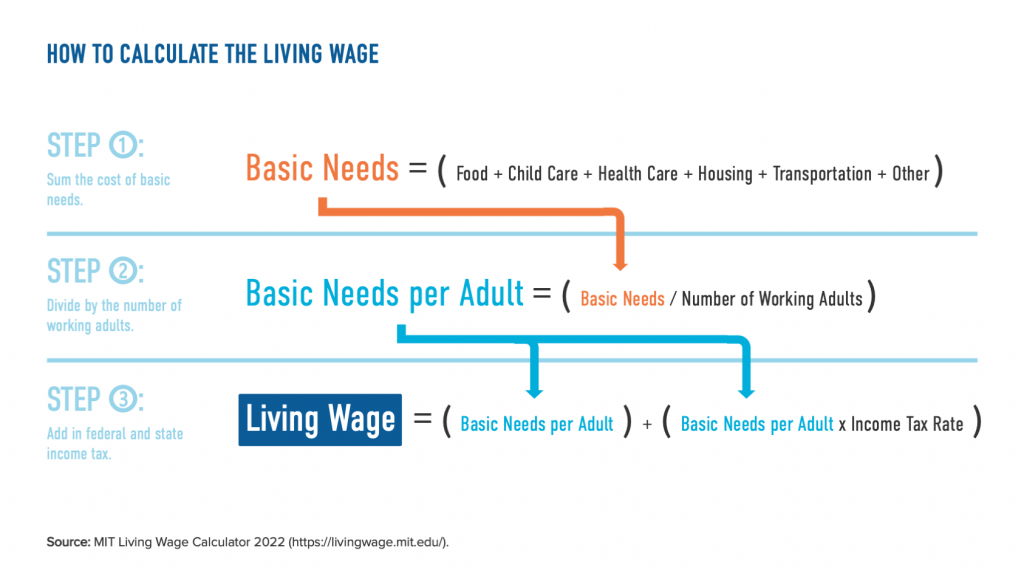
This week’s chart comes from our new living explainer. Our survey research this year found that, once again, paying a fair, living wage is the top priority Americans have for companies. With this issue consistently top of mind for the public, we put together a living wage guide with the help of MIT’s Amy Glasmeier. Dig into the work here.

Team JUST Capital: 2022 TCS New York City Marathon
We’re excited to share that JUST Capital is an Official Charity Partner for the 2022 TCS New York City Marathon. Six supporters will be representing JUST in the race and running 26.2 miles on November 6th. Over the coming weeks, we’ll introduce each runner, share why they’re running for JUST, and encourage support for their individual fundraising goals.
Today, we’re proud to kick off with our CEO Martin Whittaker. “I’m running the New York City Marathon because I value the JUST team and the JUST mission so much,” he said. “The path to a more just economy is much further than 26.2 miles, but I’m committing to cross this finish line in support of our incredible team and accomplishments to come.”
Make a gift to help Martin reach his goal!

Attending the CNBC Delivering Alpha Investor Summit this week it was clear that many believe we are likely to enter a recession at some point in the next year, with some – notably Stanley Druckenmiller – thinking it could be particularly deep and prolonged. Growing up in the UK in the 1970s and early 1980s, I remember what deep recession coupled with high inflation feels like. It’s not pleasant. Strikes, job losses, gutted communities, and a “Winter of Discontent.” Perhaps most of all, a pervasive feeling of anxiety and uncertainty. Inevitably, those in the lower and middle strata of the economic ladder suffer the most.
In such conditions, it’s going to be up to the private sector to find ways to do more. We need capitalism at its very best, as Meredith Sumpter from the Council for Inclusive Capitalism said to me recently. How does this happen? What should companies, especially large corporations, actually do to help society’s stakeholders? Eight years of polling Americans on this very topic has given us some pointers. And top of the list is the idea of investing in people.
This is why we launched JUST Jobs, a new umbrella program that applies the full JUST Capital playbook to support the nation’s largest companies in advancing just jobs. The work will build on our existing corporate engagement programs to lay out concrete pathways on all the top priorities of the public: paying a fair, living wage; creating jobs; providing key benefits; stable scheduling and on-the-job safety; better hiring, retention, development and advancement practices; retirement savings; and so on.
At our launch event this week, leaders from AEP, Mastercard, Franklin Templeton, and other organizations spoke eloquently about the power of the business case, why it’s better for shareholders, and also the scale of the potential social impact. And with an estimated 7.6 million workers in the Russell 1000 already not earning enough to support a single person with basic, local living costs, the need is clear.
If you’d like to learn more, please let us know.
Be well,
Martin Whittaker
Amazon raises hourly wages for delivery and warehouse workers to $19 per hour, from $18 per hour, as part of its plan to spend roughly $1 billion on pay hikes over the next year.
AT&T, T-Mobile, and Verizon plan to help customers hardest hit by Hurricane Ian, offering unlimited talk, text, and data, and waving overage charges in parts of Florida worst affected by the storm.
McDonald’s is facing a $10 billion lawsuit on claims that the company is intentionally excluding Black-owned media outlets from its advertising efforts.
Meta and Bain pilot a new platform designed to engage employees in corporate decarbonization goals, sharing insights into how they can reduce emissions within the company.
Microsoft pledges to support public policies that would reduce global carbon and decarbonize power grids. The tech giant hopes to achieve carbon negativity by 2030, though its emissions rose by 21.5% last year.
Starbucks announces that it’s ready to begin contract negotiations in October with the hundreds of stores that have voted to unionize across the country.

On November 2, Martin will join Reuters for its ESG Investment North America 2022 conference to discuss how best to quantify “S” issues like workforce diversity and financial security, and how to integrate these elements into investing strategy. Register here to attend this conversation and hear from senior leaders across the investment community.
Despite being the public’s biggest priority for companies, corporate data on wages is lacking. We’re proud to announce a new partnership with Revelio Labs, a leading labor market data provider, to help fill that gap. Together, our modeling has already found that about half of U.S. employees at Russell 1000 employees aren’t earning a family-sustaining income.
Our latest Insights to Impact virtual event focused on how to define, create, and scale JUST Jobs – and the strong business case for doing so. Hear from leaders at Amalgamated Bank and Franklin Templeton on the long-term value of investing in workers, American Electric Power and Mastercard on embedding equity and upward mobility into workforce strategies, and The Families and Workers Fund on the challenge of measuring job quality.
Hear from JUST Senior Director of Research Kavya Vaghul, alongside other speakers at this summer’s Good Jobs Summit, on why businesses and investors should make job quality a North Star in a newly released video from The Families and Workers Fund.
Last week, Martin joined Workday’s Senior Director of Environmental Sustainability Erik Hansen for a conversation at the Nest Summit on the state of corporate climate commitments and the company’s own climate leadership. Catch up on the full discussion here if you missed it.
This week, we also announced a new partnership with ESG Book, a leading ESG technology and data provider, to incorporate its data into the methodology for our Annual Rankings of America’s Most JUST Companies.

“The real economy of the United States is intangible. People are at the heart of the value.”
“We’re doing outreach to women who have the skills, have an interest, introducing them to what this kind of work is, but then we’re giving them mentors and we’re paying them to go through the training. And at the end of this program, in a year to14 months, we’re going to hire them into full-time jobs. … You have to sometimes build that pipeline and not wait for it to happen.”
“It’s a little nerve-racking right now as the money I’m getting from disability doesn’t even cover half my monthly mortgage payment. The 60% payments are based off my base salary, so it’s a significant drop in income. I had money saved up just in case, and I’ll have to go through it because I am not willing to give up days with my baby. I want to take 12 weeks, but I don’t know if the money I’ve saved is going to cover the whole time. It’s only my salary. It’s a huge stress.”
Axios reported union popularity is at a 57-year high, reaching 71% approval in a recent Gallup poll. It’s the highest approval rate since the1960s.
Airport workers are on strike at multiple airports across the country. The Washington Post has the story on the labor action that started with an open-ended strike on Monday at San Francisco International Airport and has spread to 21 airports nationwide.
A new working paper by economists in California and Europe argues that executives should be paid based on their ability to improve ESG metrics at their company. A growing number of companies have taken up the practice of ESG-linked pay over the last few years, including Apple, BP, and McDonalds.
Workers say their pay isn’t keeping up with inflation. A Bank of America-sponsored survey shared first with CNN found nearly three in four employees feel the cost of living is outpacing wage growth. NPR writes about the great resignation, dynamism, and the search for a job that can offer financial security in a turbulent economy.
Roy Swan of the Ford Foundation says ESG is a risk management framework on CNBC’s Squawk on the Street. Fortune reports on the need for ESG to protect companies’ profits. The Conference Board is out with a new report on shareholder voting trends, including an increase in ESG-related proposals.
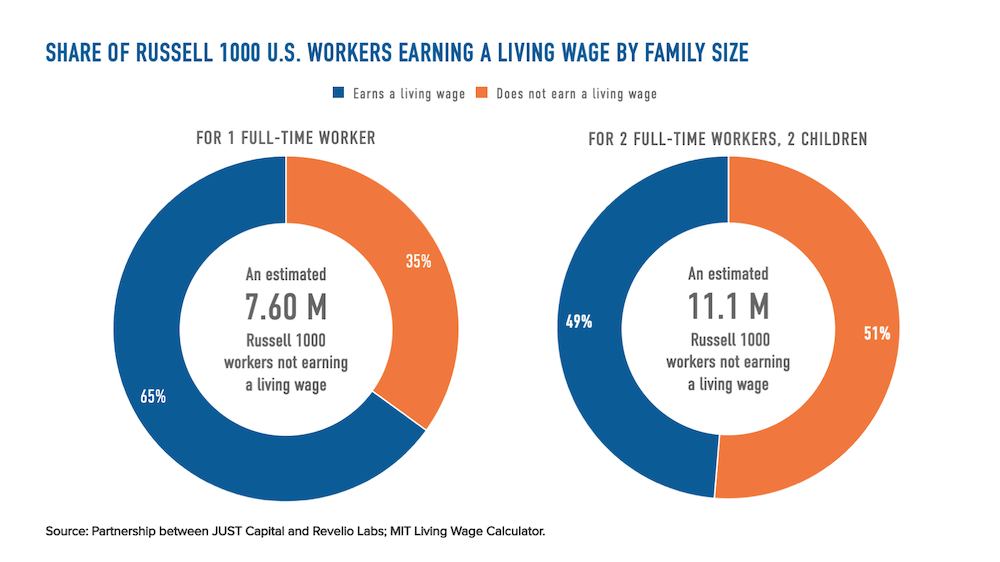
JUST and Revelio found that some of the largest U.S. employers among the Russell 1000 have a disproportionate share of low-wage jobs and still have a long way to go when it comes to meeting the expectation of the American public to pay a fair, living wage. Read more in our first collaborative article with Revelio about the state of workers at America’s largest companies.

Abigail Disney
CEO, Folk Films
JUST Capital Board Member
Abigail E. Disney is a filmmaker, activist and the Emmy-winning director of The Armor of Light. Abigail focuses on storytelling that fosters peace, justice, and human understanding. After years as a nonprofit volunteer and activist and stay-at-home mother, Abigail founded Fork Films and leads the production company as CEO.
Abigail released her feature documentary The American Dream and Other Fairy Tales last week, which provides a poignant view into America’s inequality crisis seen through the lived experience of Disney theme park workers.

For the third consecutive year, paying a fair and living wage ranks as the top priority for the American public when it comes to just business behaviors. JUST Capital’s 2022 Issues Survey – The People’s Priorities found that paying a fair, living wage was the most important business Issue this year, doubling in importance over the last two years, and will comprise 21% of our Annual Rankings of America’s Most JUST Companies model in 2023. To put this into context, the next highest priority – creating jobs in the U.S. – was the second most important issue at 11%. What’s even more compelling is that despite increasing rhetoric that the country is incredibly polarized, across every demographic group we surveyed – political affiliation, race, gender, age, or income group – Americans are united in wanting companies to prioritize paying a fair, living wage as the most important business Issue today.
Despite the overwhelming consensus that companies have a responsibility to pay workers enough to make ends meet and be transparent with job seekers about pay, there is remarkably little public data available to track explicit performance on wages by even the largest companies, like the Russell 1000 corporations JUST ranks. That’s why we are proud to announce our new partnership with Revelio Labs, a leading labor market data provider that is working to create the first universal HR database, to fill the measurement gap on corporate wages.
The current state of corporate wage disclosures is poor, non-standardized, and mostly voluntary
There are many reasons why publicly available wage data in the U.S. is sparse. They include concerns over privacy, perceived litigation risk, and exposure of corporate trade secrets. Some concerns are more real than imagined, and some are even shared by those tasked with oversight. Federal agencies, for instance, do not currently disaggregate results from tax records or employer surveys by companies in a nod towards worker and employer privacy. In an ideal world, companies would provide equitable access to such data. But as it stands, the vast majority of disclosure on human capital metrics is voluntary, and thus public companies seldom have the incentive to release information about wages in their corporate social responsibility or diversity, equity, and inclusion reporting.
In 2017, the Securities and Exchange Commission adopted the Dodd-Frank mandate requiring public companies to disclose the pay ratio between the CEO’s and median employee’s compensation in annual proxy statements, offering a rare window into the state of pay at public companies. The rule, however, provided companies with significant flexibility in identifying who the median worker is and how to calculate the median, with the ability to change this definition every three years. As a consequence, the publicly reported median worker pay data is incomparable and inconsistent.
The odds of finding standardized, non-mandatory disclosure on wage data are also low. If shared at all, companies voluntarily disclose three wage-related metrics: (1) the cost of salaries, benefits, and pensions; (2) pay equity analyses by gender or race and ethnicity; and (3) minimum wage rates for hourly employees. Even though we’re in an economic climate characterized by fierce competition for talent among employers and rising inflation, under 10% of Russell 1000 companies disclose their minimum wage rates for hourly employees, the only disclosure among the three that can actually tell us anything about the bottom end of the wage distribution.
Modeling estimates are required without comprehensive, standardized disclosure of data
While we wait for better company-specific wage data from government agencies and continue to push for increased voluntary disclosure among companies on key job quality issues like wages, we have to get creative by knitting together whatever wage data is available. That is a big reason why JUST’s annual Rankings has relied on models to help us estimate metrics on the state of wages among Russell 1000 companies. But not all models are created equal.
Historically, these models used a combination of crowdsourced data reported by current and former employees and data from federal agencies like the Bureau of Labor Statistics to construct a wage distribution for each company. But even this approach was a blunt instrument for assessing corporate wages: Without sufficient company-specific data, the results suffered from clustering and data bias.
JUST Capital and Revelio Labs have partnered to bring out the best and mitigate the worst of available wage and employment data
To develop a model that more accurately measures the state of corporate wages for JUST’s annual Rankings and beyond, JUST has partnered with Revelio Labs to leverage its unique workforce datasets and modeling capabilities. Together, we have radically improved our visibility into the wage and salary distribution for each Russell 1000 company, adopting Revelio’s innovative machine learning model to predict salaries. This new wage and salary distribution enables us to produce estimates for three data points within the “Pays a fair, living wage” Issue: (1) the median U.S. worker pay (to compare to CEO compensation), (2) the share of U.S. workers earning a living wage to support a family of two full-time workers and two children, and (3) a score that evaluates how fairly a company pays for similar occupations compared to its industry peers.
Read an overview of how it works in our methodology summary or dig into the full methodology for a deeper explanation.
What have we learned so far?
The results from our joint modeling work give us several new insights about the state of wages among Russell 1000 companies. Most notably, we’ve learned that while estimates show that these companies pay better on net than the typical American employer, a slim majority of their workers still may not be earning enough to make ends meet.
At the typical – or median – Russell 1000 company, for instance, 50% of full-time workers earn above roughly $65,000 annually, which is over $10,000 per year more than the median earnings of full-time workers nationwide.
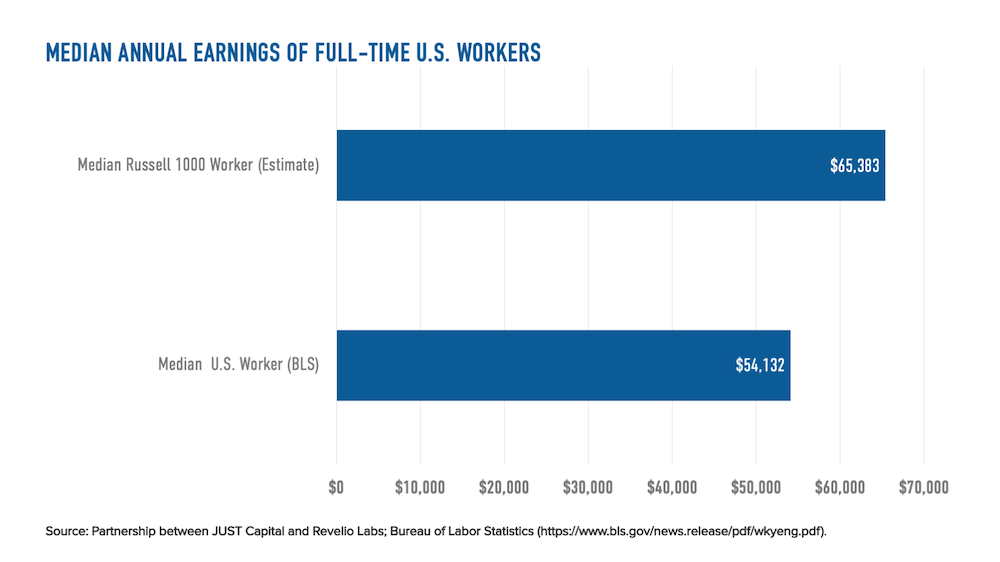
These higher salaries and wages at Russell 1000 employers overall, however, do not translate to greater economic security for all Russell 1000 workers. In fact, our estimates show that 51% of all the workers at Russell 1000 companies, who in total made up about 15% of the employed population in the U.S. in 2021, are not earning a family sustaining living wage, a national population-weighted average of $24.16 per hour in 2022 according to our partners behind the MIT Living Wage Calculator. That’s about 11.1 million workers who are not making enough working full-time to support a family that has another full-time working adult and two children. We further estimate that about 35% of Russell 1000 workers do not earn enough to meet their own basic needs – or a living wage for one full-time employee without dependents, a national population-weighted average of $17.46 per hour in 2022.
These findings underscore the reality that some of the largest U.S. employers among the Russell 1000 have a disproportionate share of low-wage jobs and still have a long way to go when it comes to meeting the expectation of the American public to pay a fair, living wage.
In the coming weeks, we’ll be exploring more insights from these wage models. While these modeled estimates are just that, estimates, they nevertheless provide an insightful starting point from which we will iterate and improve. We will use these findings to better understand how America’s largest companies are performing on what Americans are prioritizing more than ever – creating JUST jobs.
Lisa Simon is a Senior Economist and Daniel Firester is a Lead Data Scientist at Revelio Labs.
On September 28, JUST Capital held its latest Insights to Impact virtual event – Defining a JUST Job for Today’s Economy.
In an increasingly polarized country, the American public (and a growing number of institutional investors) are remarkably united in wanting companies to prioritize their workers. And investing in workers today requires creating truly “JUST Jobs.” But what is a JUST Job? This virtual convening set out to answer that question by exploring specific ways companies can close the gap toward all workers earning a living wage, advance equity & mobility, and deliver on the DEI commitments that are crucial to evolving the modern workforce.
JUST Capital’s Chief Strategy Officer, Alison Omens, kicked off the event highlighting our latest polling insights around jobs and wages in America. Our annual Issues Report, examining the public’s priorities for companies, found that once again “Pays a fair, living wage” is the most important issue to Americans across all demographics. And, four out of the top six Issues are Worker-related. Additional polling found that, not only do 84% of Americans believe large companies have a responsibility to pay full-time adult workers in frontline jobs enough to make ends meet, but large majorities of Americans also believe companies it’s a company’s responsibility to regularly increase wages to keep up with the rapidly rising cost of living (87%), provide quality, affordable health insurance to all adult workers, including part-time workers (84%), provide clear career pathways to job opportunities with higher pay (83%), and more.
It’s clear the American public supports the idea of a “JUST Job,” setting the stage for the conversations ahead.
Next up, JUST Capital’s Cambria Allen-Ratzlaff, Managing Director & Head of Investor Strategies, moderated a discussion on how creating JUST Jobs builds long-term value with speakers Meredith Miller, Director, Amalgamated Bank and Managing Member, Corporate Governance and Sustainable Strategies and Anne Simpson, Global Head of Sustainability, Franklin Templeton. Together, they addressed the very real challenges of prioritizing corporate investment in workers, fair wages, and DEI advancement. “People matter in investment. Value creation in a company doesn’t just come from deploying capital,” Simpson said, emphasizing that this is as much a mindset shift as it is a market one.
The next session focused on advancing equitable mobility, with insights from industry leaders from JUST Capital’s 2022 Workplace Equity and Mobility Ranking, American Electric Power and Mastercard, on how they’re supporting workers’ financial security and creating equitable pathways for their economic advancement. The session was moderated by Leslie Boissiere, Vice President, External Affairs from The Annie E. Casey Foundation (our partner on the ranking) with insights from Sandy Nessing, Vice President and Chief Sustainability Officer, American Electric Power, and Randall Tucker, Chief Inclusion Officer, Mastercard.
And finally, we concluded with a conversation on defining and measuring a JUST Job, which highlighted actionable takeaways about how corporate America can get closer to creating quality jobs. Moderator Kelley-Frances Fenelon, Director of Programs and Partnerships at JUST Capital, spoke with Rachel Korberg, Executive Director, The Families and Workers Fund and Kavya Vaghul, Senior Director of Research, JUST Capital.
Tolu Lawrence, Managing Director of Programs and Partnerships at JUST Capital, closed out our program with thanks to the cross-sector network of organizations that support our work on JUST Jobs including MetLife Foundation and The Annie E. Casey Foundation. If you’re interested in learning more about how to engage with JUST Capital on this topic, please submit this short interest form and a member of our team will be in touch soon.
If you weren’t able to attend or missed any part of the event, the full video is available below.
Following the 125th anniversary of Labor Day in the U.S. – celebrating workers’ contributions to companies and the economy – JUST Capital is excited to announce a new initiative dedicated to increasing the prevalence of quality jobs in America.
Each year, we poll the American public to find out what matters most to them when it comes to just business practices. And each year they prioritize worker- and job-related issues above everything else. This transcends partisanship, geography, and income – in other words, the American people are aligned.
Importantly, the majority of Americans think companies are falling short when it comes to their workers: 80% of Americans believe that companies do not share enough of their success with employees, and nearly 60% think companies are putting their shareholders above everyone else.
The public’s desire for change is understandable when you consider the current economic climate. Wages are slowly rising, but inequality is rising faster, exacerbating longer-run trends. Since the Great Recession, more than half of total income growth has gone to the top 10% of Americans. There are signs that such fundamental change is happening: the Business Roundtable took an important step last week, stating that the purpose of a corporation is to provide value to all stakeholders from employees to customers to communities, not just their shareholders. Business leaders have an opportunity to pursue practices that will make this vision for corporate America a reality.
That’s why JUST Capital is excited to be investing in a new Quality Jobs Initiative as part of our mission to align the market with the values of the American people. The key purpose of the Quality Jobs Initiative is to tie together all the work we’re doing on worker- and job-related issues, surface the business case for good jobs, and showcase the current state of play – from corporate leadership to new insights about types of work and practices – on quality jobs. We’ll be conducting new research on workers, contractors, and quality job practices, engaging companies in a series of one-on-one conversations and small group convenings, working to create more clarity and case studies on human capital standards and practices, and celebrating companies leading the way.
Our FREE weekly newsletter about the future of capitalism and the movement to build a more equitable marketplace in America.
The Quality Jobs Initiative will comprise four key areas:
Transparency and Disclosure: We believe that human capital disclosure is the first step of performance analysis and a key step toward change. Already this year, JUST Capital launched the Win-Win of JUST Jobs and the JUST Jobs Policy Tracker, which surfaces worker policy data across all 890 companies we track on nine issues – including diversity and inclusion policies and targets, tuition reimbursement, and work-life balance – representing hundreds of hours of work from our research analysts. This tracker enables anyone – from workers to corporate leaders to investors – to see, for example, every company that has conducted and published the results of a gender pay equity analysis. Over the next year, we will engage companies that do not yet disclose all their policies to make the business case for greater transparency and serve as a thought-partner as they work to achieve higher disclosure.
We are also pleased to be partnering with NYU Stern Center for Sustainable Business to provide their researchers with data on quality jobs so they can assess correlation between quality jobs and corporate financial performance across different sectors, as well as assess how well the “S” in ESG is capturing quality jobs.
Frontline Workers: Business leaders know that frontline workers are crucial to the success of their businesses. We are engaging companies with significant frontline workforces to identify and share policies that ensure frontline jobs are good jobs. In partnership with MIT Sloan Professor Zeynep Ton’s the Good Jobs Institute, we will be co-hosting corporate leaders in a workshop for companies to detail the business case for transitioning to a good jobs strategy. We’ll also be working with companies in surfacing best practices in training, scheduling, and other management policies.
Contract Workers: Increasingly, companies are contracting with vendors, temporary help agencies, and other entities to contribute to and support the production of their goods and services. We are exploring the role of corporate America in creating economic opportunity for workers reliant on these companies regardless of their employment status. Through engagement with companies we seek to advance research on the business dynamics driving the utilization of contractors and alternative work arrangements.
Mapping Wages: Underpinning all of the work described above is the research that shows that many workers in America don’t earn enough to cover life’s expenses. In addition to engaging companies on specific policies that would improve the economic outcomes of workers, we will be putting forth new ideas for how to measure, quantify, and think about wages. That includes mapping companies’ wages in America, assessing intra-firm inequality, developing a “Living Wage Index” to track progress, and modeling the economic benefits of businesses paying their workers a living wage.
We’re incredibly excited about this new work, and believe that by partnering with companies and foundations on this new Initiative, we can introduce new insights that make the business and investor case for quality jobs, thereby supporting a shift in corporate practice toward more just business behavior as defined by the American public.
We’d like to thank our foundation partners for their support of elements of the Quality Jobs Initiative, including: the Robert Wood Johnson Foundation, the Ford Foundation, the Annie E. Casey Foundation, the Surdna Foundation, the Nathan Cummings Foundation, the Alfred P. Sloan Foundation, and others.
by Alison Omens with contributions from Patrick Oakford.
