
Working mothers make up a significant portion of the American workforce – nearly one-third of all employed women currently have children under the age of 18 – and many must find a way to delicately balance work and care responsibilities.
In our 2022 caregiving survey, 84% of women (compared to 68% of men) said access to child care is a problem for women in the workplace, and 70% of women (compared to 53% of men) say access to paid family leave is a problem for women in the workplace. Further, women are more likely than men to say the ideal number of weeks for parental leave is 12 or more weeks (56% of women, 46% of men). When not provided adequate caregiving support, many women are forced to make difficult decisions and nearly 43% end up leaving their careers.
With no federal oversight of paid leave and caregiving policies, and with women five-to-eight times as likely as men to experience a caregiving impact on their employment, corporate leaders are being asked to take the lead. More and more companies are taking action – as of September 2022, 60% of the companies we rank disclosed a paid parental leave policy, up from 47% the year before. But there’s a long way to go, with 40% of companies disclosing no such policies and an average of just 10.5 weeks for primary caregivers among those that do.
This year, in recognition of Mother’s Day, we’re highlighting three companies that stand out for their commitment to working mothers – going above and beyond on issues including paid parental leave, subsidized child care, and more. Among the 951 companies we ranked in 2023, we found that Eli Lilly, Intuit, and US Bancorp provide best-in-class support to parents – and especially mothers – in their workforce.
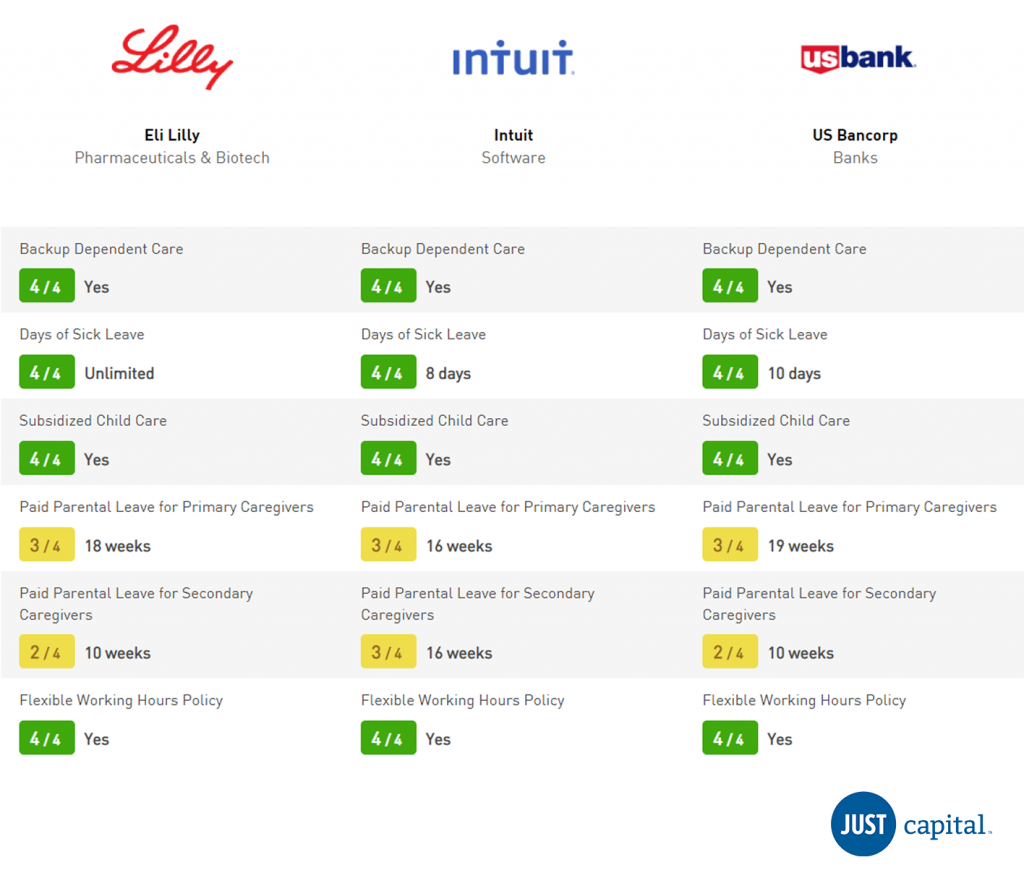
Each of these leading companies:
Read on below to learn more about key policies and disclosures and how these three companies support moms in the workplace as they navigate the challenges of caregiving in the “sandwich” generation – caring for both their children and their older relatives.
Intuit
Ranked 7th in Software and 65th overall
Software company based in Mountain View, CA
Intuit offers comprehensive caregiving policies to support working mothers, including 16 weeks of paid parental leave for both primary and secondary caregivers. By offering parity in parental leave and giving both parents the opportunity to bond with their children without worrying about work obligations, Intuit reduces gender-based discrimination, promotes gender equality, and combats the “motherhood penalty.” Intuit deepens its commitment to mothers by offering backup dependent care, flexible scheduling, and subsidized child care. Their dependent care program supports full-time and part-time employees working 20 or more hours a week, as well as seasonal employees, and covers regular and temporary child care, adult care, and elder care. Additionally, employees receive eight days of sick leave per year to attend to their own health needs or those of a dependent. Intuit aims to support employees “by offering benefits [they] need to stay healthy, achieve financial security, and enjoy peace of mind.”
US Bancorp
Ranked 9th in Banks and 56th overall
Banks company based in Minneapolis, MN
US Bancorp has implemented several policies and programs to support mothers in the workplace. All parents welcoming a new child through birth or adoption receive 10 weeks of paid parental leave, with an additional nine weeks of paid pregnancy leave for the parent giving birth. In addition, mothers have access to a maternity support program offered free through their insurance, and all parents can utilize an employee assistance program for practical advice and resources for help with health, finances, family and relationships, work-life balance, and more. US Bancorp also offers subsidies for childcare, flexible scheduling options, and backup dependent care reimbursement for up to five days of emergency care for both children and the elderly. Furthermore, US Bancorp offers 10 days of sick leave “for medical appointments, personal illness, the illness of a family member, to care for a family member when their school or place of care is closed due to a public health emergency.” US Bancorp asks employees to bring their best selves to work, and in return will “invest in benefits and programs that embrace what makes each of us unique and empowers all of us to thrive.”
Eli Lilly and Co
Ranked 16th in Pharmaceuticals & Biotech and 235th overall
Pharmaceuticals & Biotech company based in Indianapolis, IN
In 2019, Eli Lilly and Co expanded its paid parental leave to 10 weeks for both primary and secondary caregivers, with an additional eight weeks of leave for recovery for birthing parents. Eli Lilly and Co CEO Dave Ricks said of the expansion, “We’re proud to expand this benefit, reinforcing our commitment to a diverse, inclusive and flexible workplace, Lilly has always been a company grounded in strong family values. We hold a firm belief that the well-being of our employees – and those they go home to each day – is foundational to our purpose to create medicines that make life better for people around the world.” To further support mothers, Lilly also offers backup dependent care, as well as robust flexible scheduling through Lilly@Work, which allows employees to create custom schedules to best fit their needs, and based on their role, employees can work reduced schedules or work with other employees to create a job sharing arrangement. In addition, the company offers “Caregivers Time Off,” which is up to 64 hours of paid time off per year as a primary caregiver to an immediate or extended family member – whether natural, legally adopted, step, foster, or through marriage or domestic partnership – when they are ill or injured. Should mothers need to take time off to care for their own health, Lilly offers unlimited sick leave, which can be used to care for oneself or a dependent.
While there is still a long way to go, companies are increasingly supporting working parents, helping to ease their transition back to work and encouraging employees to stay with their companies long term. These actions help both working parents and their employers thrive – with 80% of companies that offer paid family leave reporting an increase in employee morale and 70% reporting an increase in employee productivity. By prioritizing retention of working parents, corporate leaders can support their companies’ bottom line and avoid unnecessary costs, with recent analysis showing that replacing an employee who leaves after childbirth can cost anywhere from 20% to 213% of their annual salary.
Furthermore, these benefits provide a key response to the urgent calls for more inclusive workplace practices. 64% of mothers overall are the primary earners in their homes, while a significant 84% of Black mothers fill this role – underscoring the need to support working mothers as part of the growing demand for corporate commitments to diversity, equity, and inclusion.
As we continue to navigate the ongoing caregiving crisis, employers play a pivotal role in ensuring that mothers have the support they need to remain in the workforce. Corporate leaders looking to build more inclusive practices that support working mothers can look to these three companies as examples of leading practices. By prioritizing this key workforce demographic, corporate leaders can help to build a sustainable future not only for working parents but for their companies overall.
JUST Capital, in collaboration with partners, established the Corporate Care Network to advance the well-being of workers and demonstrate the long-term value of investment in workers. The Network is committed to driving increased access to care benefits, including paid leave and flexible work policies, and highlighting leaders in the space.
If you’re interested in gaining insights into how to improve on the issues that matter most to the American public, and learning how your company can get involved in the Network, please reach out to JUST Capital impact@justcapital.com.

This report was written by Jordyn Avila, Senior Strategic Partnerships Manager, Corporate Impact, and Matthew Nestler, Director of Research Insights, Corporate Impact.
In recent years, the COVID-19 pandemic has exposed the severity of America’s ongoing childcare and caregiving crises – with a recent analysis showing that 22% of American workers are also caregivers. Reports suggest that the childcare industry continues to deteriorate, exacerbating the obstacles that working parents already face in achieving work-life balance, including the lack of federally mandated parental leave.
In a recent Just Capital survey, we found that 64% of Americans believe that in order to promote gender equity in the workplace, it is necessary for companies to provide at least 12 weeks of paid parental leave to all workers.
Despite strong support from the public, there is no guaranteed paid leave for the American workforce. The United States is one of just seven countries in the world without paid maternity leave and one of 83 without paid paternity leave. In the U.S. today, only the Family and Medical Leave Act (FMLA) provides eligible employees up to 12 weeks of unpaid leave per year, compared to an average of 29 and 16 weeks of paid maternity and paternity leave, respectively, among countries with mandated parental leave. Furthermore, just 56% of American workers have been found to be eligible for FMLA leave, with numbers even lower for people of color and low-wage earners. As of January 2023, 13 states and Washington DC offer paid parental leave (with five policies not yet in effect), though not all offer the 12 weeks Americans agree are necessary.
Due to this lack of governmental support, it’s largely up to companies to take the lead on paid parental leave. And with just 23% of civilian workers estimated to receive paid family leave – and only 12% of low-wage earners in the private sector – the need for action is urgent. Furthermore, paid parental leave is not only beneficial for working families. Because it provides opportunities for increased labor force participation and potential GDP increases, as well as improved employee performance, paid parental leave can strengthen companies and the economy overall.
In an effort to better understand how corporate America is currently delivering on this issue, we analyzed whether America’s largest companies – the Russell 1000 – disclose paid parental leave policies, and if so, what that disclosure looks like. This analysis is part of our new Corporate Care Network – which will explore how companies are supporting working families and spotlight best practices from corporate leaders taking the lead on issues from subsidized child care to paid parental leave. Dig into the full findings below.
In analyzing the Russell 1000 companies we rank, we found that 60%, or 568 companies, disclosed a paid parental leave policy as of September 2022 – a 13 percentage point increase over the year prior when 47%, or 444 companies, disclosed.
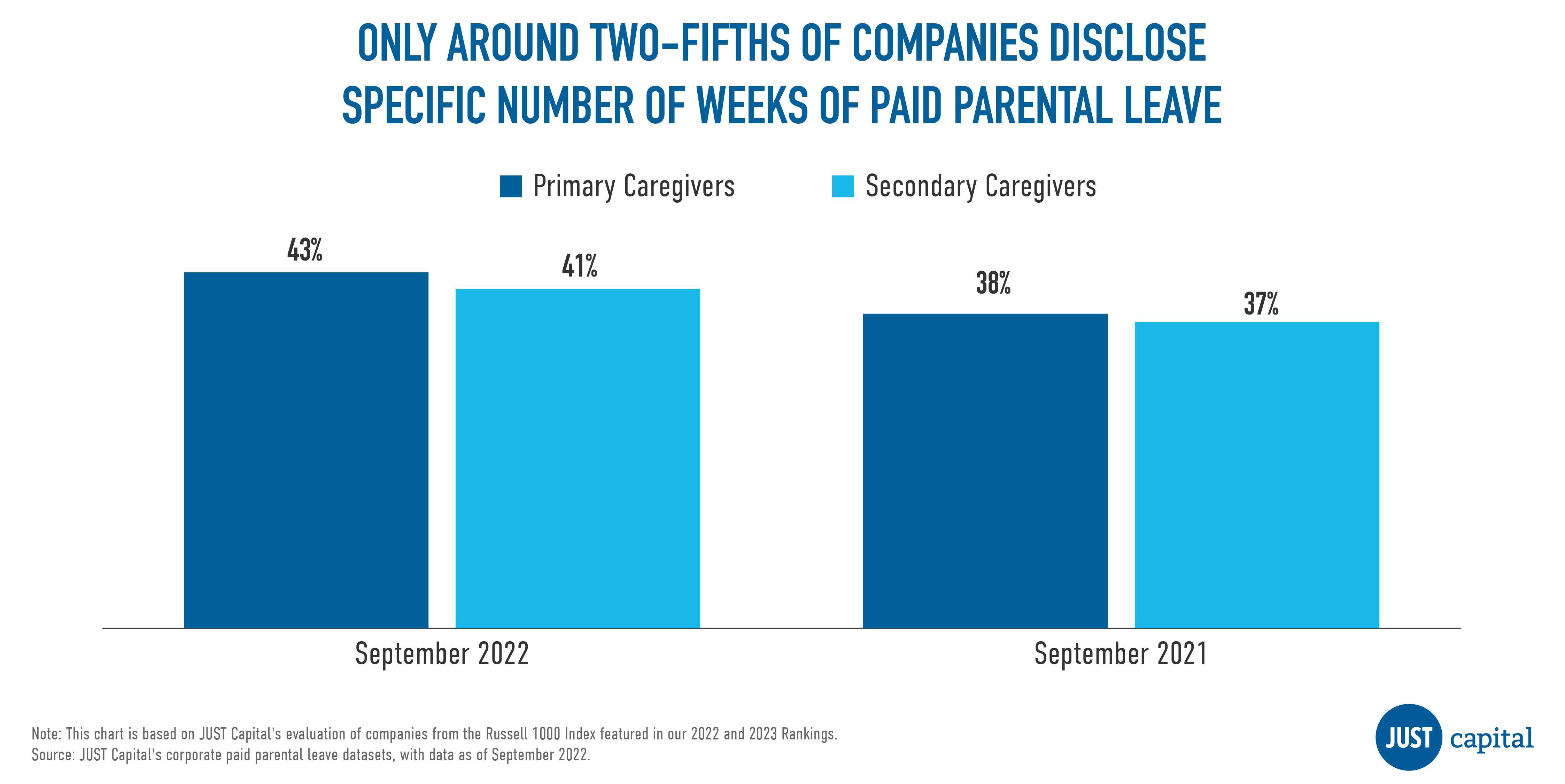
While this increase is heartening, when we look closer at the data we find that far fewer companies disclose the specific number of weeks offered to primary and secondary caregivers, with 43%, or 408 companies, providing the number for primary caregivers and 41%, or 388 companies, disclosing the same for secondary caregivers. We did find that, like the overall disclosure percentages, these numbers also increased over the past year, with 47 more companies disclosing the number of weeks for primary caregivers (38% to 43%) and 36 more disclosing for secondary caregivers (37% to 41%).
The benefits of paid parental leave are significant for both primary and secondary caregivers. Study after study shows that access to paid leave leads to better health outcomes for both mothers and children. It’s also been found that when men take paid leave, we see lower divorce rates, closer relationships between fathers and children, and lower rates of postpartum depression and other maternal health issues. With growing support for equitable weeks of paid parental leave, disclosure of specific weeks for both primary and secondary caregivers is a critical first step for corporate leaders looking to drive change on this issue overall.
While disclosure itself is key to understanding the current landscape of paid parental leave, it is increasingly considered a corporate best practice to offer parity in paid leave for both primary and secondary caregivers. Leading to better outcomes for workers and their families, parity in paid leave is a more inclusive practice, acknowledging all family types and the roles that parents play in childcare, regardless of their gender identity, relationship status, or sexual orientation.
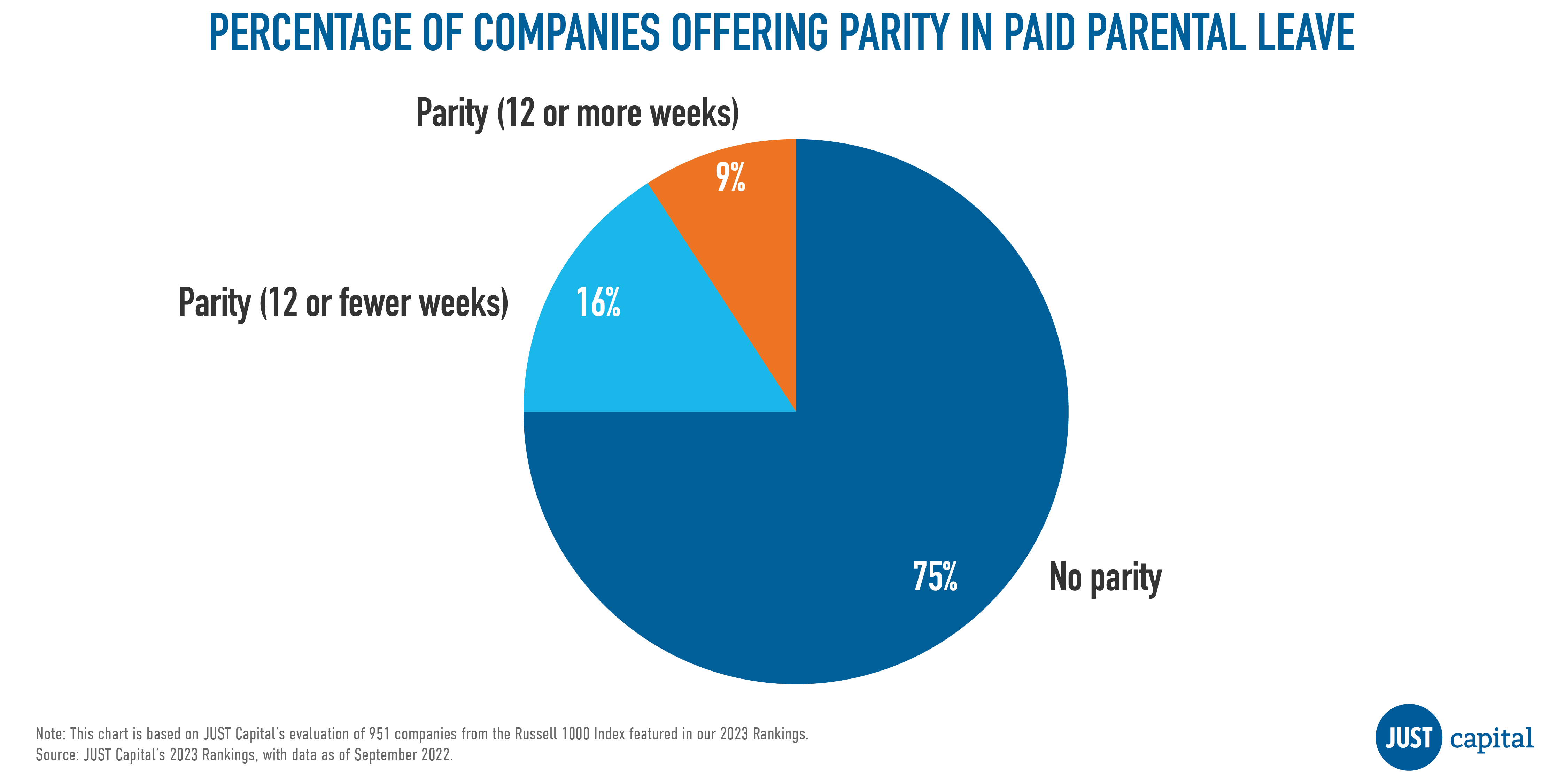
To assess how companies perform, we look at how many provide parity in leave at or more than 12 weeks. As of September 2022, 9%, or 87 companies, provide equal weeks of paid leave to primary and secondary caregivers, compared to 6%, or 59 companies, a year earlier – an increase of 3 percentage points and 25 companies.
Among the 36 industries we analyze, none demonstrated full disclosure, in which all companies disclosed the specific number of weeks of paid leave for both primary and secondary caregivers. Just nine of these 36 industries had a disclosure rate above 50%, though there were some standouts. Of the 25 companies in the Oil & Gas industry, 72% disclosed the weeks of paid parental leave offered to both primary and secondary caregivers, closely followed by the Internet industry with 67% of companies disclosing, Transaction Processing (65%), and Banks (63%).
16 industries have a disclosure rate between 30% and 50%, representing 196 companies that disclose the number of weeks of paid leave for both primary and secondary caregivers. However, nine industries fell below the 30% disclosure rate.
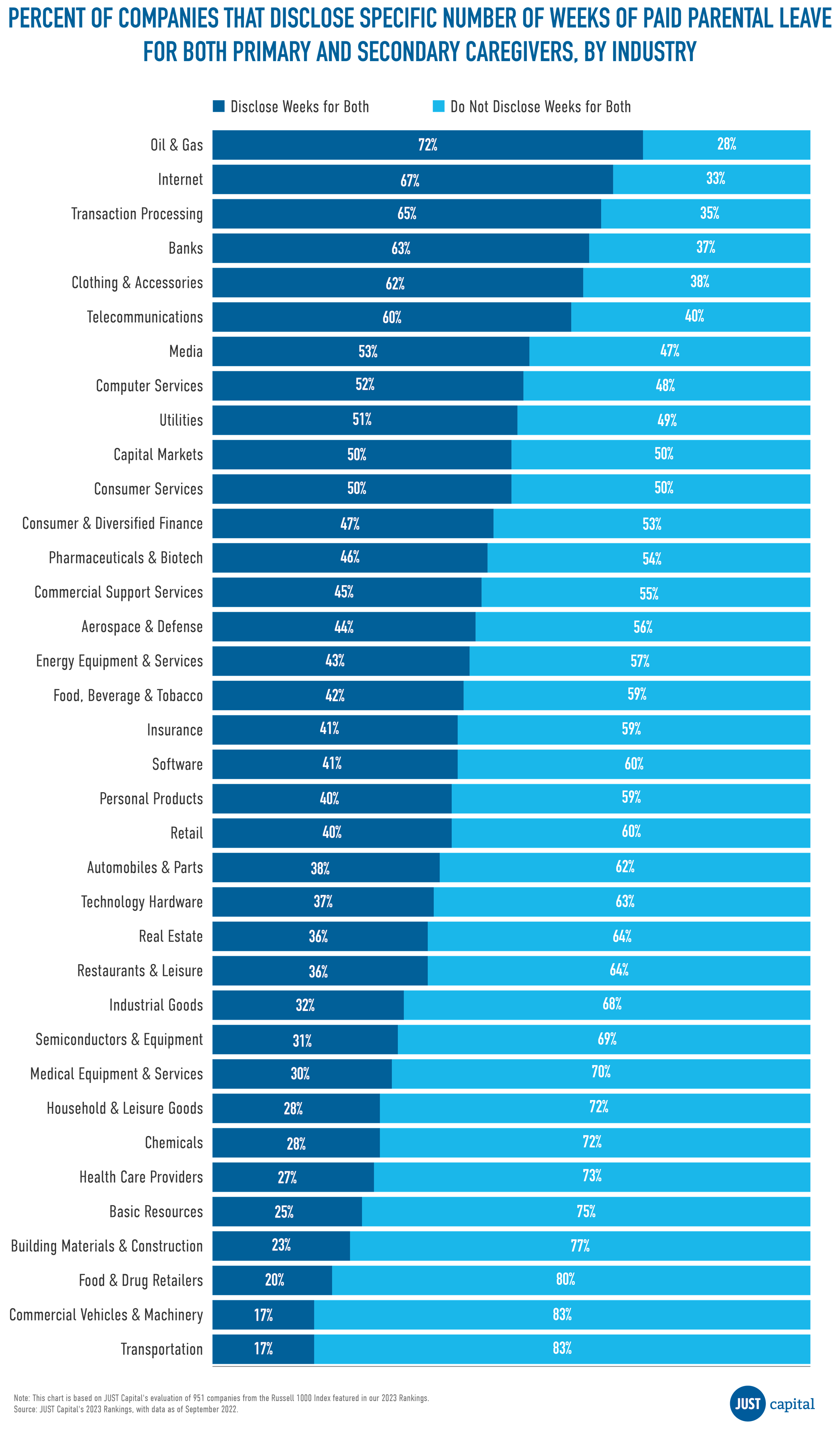
Based on these findings, there is a clear opportunity for Russell 1000 companies – particularly in certain industries – to not only disclose that they offer paid parental leave, but the number of weeks they provide.
In looking at the policies of companies that disclose the number of weeks of paid leave, we found that primary caregivers receive between one and 26 weeks, with a mean of 10.5 weeks, and a median of 10 weeks. Secondary caregivers also receive a range of one to 26 weeks, but the mean and median are 7.6 weeks and six weeks, respectively. As a way to further assess performance, we quantify the average number of weeks of paid parental leave for both primary and secondary caregivers by industry. The highest performing industry is Internet, offering 18 weeks on average for primary caregivers and 17 on average for secondary caregivers. Software is also leading by offering an average of 16 and 12 weeks to primary and secondary caregivers, respectively.
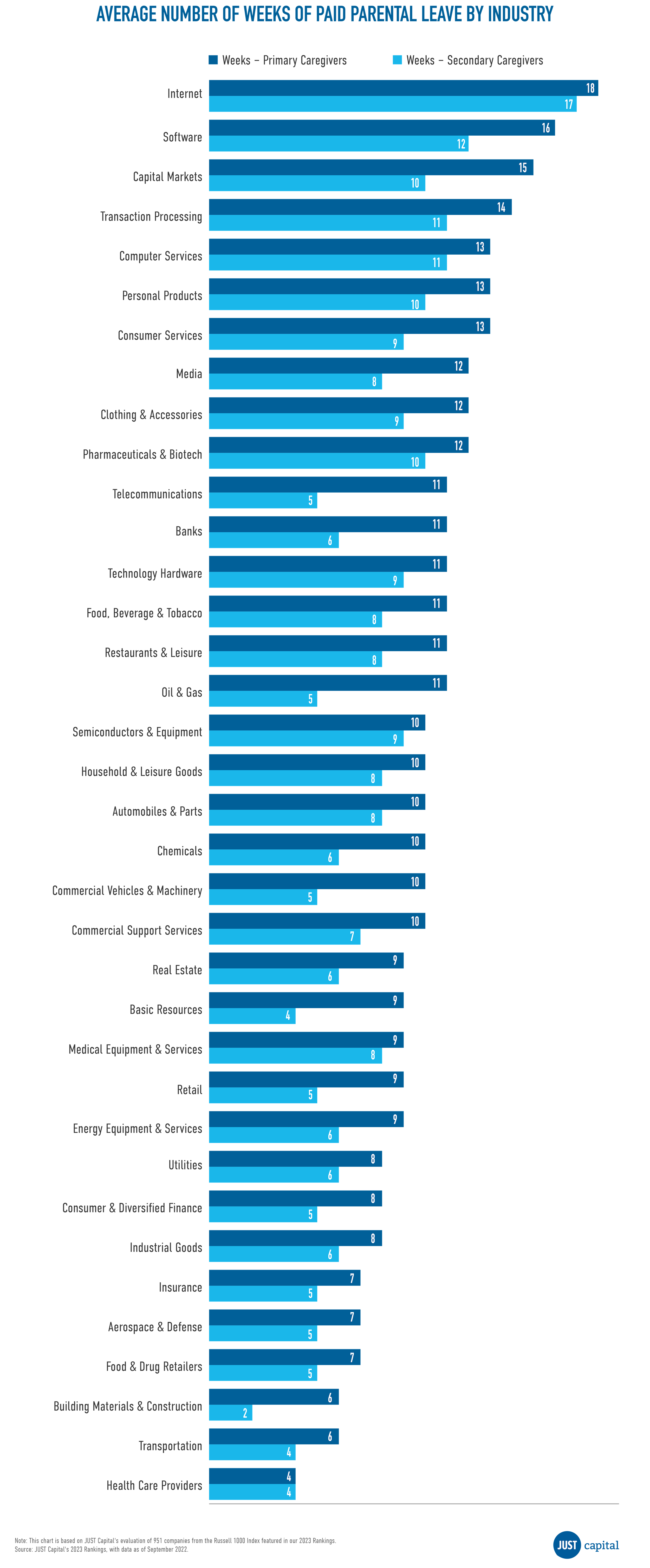
Although our Just Jobs Scorecard awards the highest score (4/4) to companies offering 24 weeks or more of paid parental leave, this analysis reveals that 10 industries offer an average of 12 or more weeks of paid parental leave for primary caregivers, while only two offer the same for secondary caregivers. 26 industries offer, on average, fewer than 12 weeks of paid parental leave for primary caregivers and 34 offer the same, on average, for secondary caregivers. For primary caregivers, 15 industries offer between 10 and 12 weeks on average, and for secondary caregivers, 17 industries offer between 4 and 6 weeks.
Only Health Care Providers offered an equal average amount of leave for primary and secondary caregivers. All other industries provided more weeks of paid parental leave to primary caregivers.
While our latest analysis signals that corporate America is steadily improving its efforts around paid parental leave, millions of workers around the U.S. do not have access to paid parental leave to welcome home their newest family member, to recover from a birth event, and to adjust to life with a new child. Women, people of color, and individuals who identify as LGBTQ are least likely to have access to paid leave, exacerbating racial and gender inequities in workplaces. Without a federal mandate or policy, workers of all types rely on the private sector to ensure that they have access to adequate paid parental leave, a key benefit for companies to improve retention, attract talent, and strengthen employee health and wellness and engagement.

After the COVID-19 pandemic exposed the caregiving crisis in the U.S., some progress was made to expand parental leave benefits, especially on the state level. Despite this, America still does not offer any federal law mandating paid parental leave, leaving companies to set their own standards.
Americans want leadership on this issue. A 2022 poll by JUST Capital found that 64% of Americans believe that it is necessary for companies to provide 12 weeks of paid leave for all parents. The reality is, only 23% of private industry workers had access to paid family leave through their employer in 2021, according to the Bureau of Labor Statistics.
Companies have an opportunity to not only generate outsized impact for workers, but also for their bottom line, and the economy at large. Paid parental leave contributes to higher retention, increased recruitment rates, and improved employee performance. When women don’t have access to leave, 30% of them will exit the workforce within a year of giving birth, according to one study.
To demonstrate leadership and meet the needs of their workers, companies can disclose the amount of leave they offer, ensure that the benefits apply to all workers regardless of gender, and then expand the amount of leave according to leading practice.
JUST Capital identified six companies prioritizing paid parental leave for their workers with the leading practice of offering 24 weeks or more of paid parental leave for both primary and secondary caregivers: HPE, S&P Global, Snowflake, Dropbox, Lululemon Athletica, and Zoom Video Communications. Read on below to explore the details of their disclosures and check out our report on paid parental leave data disclosure trends to see what industries are leading and lagging when it comes to paid leave policies and performance.
Ranked 1st in its industry and 7th overall
Computer Services company based in Houston, Texas
For the second year in a row, HPE makes our list of companies leading on paid parental leave. In addition to providing up to 26 weeks of paid leave for both primary and secondary caregivers, they also offer parental transition support programs, where new parents can work part time for up to 36 months to transition and ease back into work. HPE approaches benefits comprehensively to support workers holistically, through “physical health, mental, emotional and financial well-being, and social connections to community.”
Ranked 2nd in its industry and 19th overall
Commercial Support Services company based in New York, NY
S&P Global provides paid parental leave of 26 weeks for its workforce, including both full-time and part-time employees. This leave is available to “all S&P Global parents, regardless of gender” as soon as they are hired, meaning there is no waiting period or tenure requirement. S&P parents are also able to take the leave “within 12 months of the birth, adoption, surrogacy, or foster care placement of a child.”
Ranked 14th in its industry and 433rd overall
Computer Services company based in Bozeman, Montana
Snowflake discusses its paid parental leave policy within its broader benefits program. It provides 26 weeks of paid parental leave to employees, and in addition offers other fertility benefits and time off work. They tout “generous time-off and various leave plans for [workers] to rest, refuel, and sustain a great work-life balance,” which has been shown to lead to better retention and recruitment rates.
Ranked 14th in its industry and 184th overall
Software company based in San Francisco, California
Dropbox continues to be a leader on paid parental leave for the second year in a row, by providing employees with 24 weeks of paid parental leave for all employees. They also offer mental and physical wellness benefits to support parents as they navigate returning to work and adding to their family.
Ranked 3rd in its industry and 163rd overall
Clothing & Accessories company based in Vancouver, Canada
Lululemon has a motto when it comes to their benefits policies: “when life works, work works”. For the second year in a row, Lululemon is a leader on paid parental leave, providing paid leave of up to six months to global employees at all levels, which is particularly inclusive given they are the only retail store to make the list. They double-down on inclusivity by ensuring that leave is applicable to all parents and adoptions.
Ranked 17th in its industry and 200th overall
Software company based in San Jose, California
Zoom offers up to 24 weeks of paid parental leave to its full-time employees in the United States. As parents adjust to life with a new child, they also offer supportive benefits, including access to career re-entry coaching after returning to work following parental leave and a robust mental health benefit.
Representatives from Russell 1000 companies can now access their JUST Jobs Scorecard through our secure Corporate Portal to see how their company compares against their peers on paid parental leave and 20+ other data points utilizing our new threshold benchmarking analysis.
JUST Capital, in collaboration with partners, established the Corporate Care Network to advance the well-being of workers and demonstrate the long-term value of investment in workers. The Network is committed to driving increased access to care benefits, including paid leave and flexible work policies.
If you’re interested in learning more on how your company can become involved, please reach out to JUST Capital impact@justcapital.com.

(Morsa Images/Getty Images)
At JUST Capital, our job is to cut through the noise. To help guide business leaders on issues Americans care about most. One issue Americans overwhelmingly want leadership on is care benefits, mainly paid leave, childcare support, and flexible work.
Nearly 76% of Americans recognize that access to child care is problematic and 64% believe companies should offer at least 12 weeks of parental leave for all caregivers, our polling shows.
In our new list of the top 6 companies leading on parental leave we highlight a few companies that are ahead of the pack, by offering 24 weeks or more for both caregivers. This includes Hewlett Packard Enterprise, S&P Global, Zoom, and others. The business case for such leadership, in case you were wondering, is strong.
We’re also tracking policy disclosure and performance on the issue. As of September last year, 60% of America’s largest public companies disclose a paid parental leave policy (compared to 47% the year before), although only two-fifths of them provide the specific number of weeks of paid leave for primary and secondary caregivers. And just 9% of America’s largest companies give both primary and secondary caregivers 12 or more weeks of paid parental leave. In fact, the industries with the lowest number of reported weeks may surprise you (see our chart of the week below).
At the Global Citizen NOW event later today our own Tolu Lawrence, JUST Capital’s Managing Director of Programs and Partnerships and Head of Corporate Impact, is launching our new Corporate Care Network to help company leaders dedicated to advancing access to and awareness of care benefits. To learn more about the network and its benefits, or to inquire about joining, visit our website.
Be well,
Martin
The week we are highlighting the top six companies for paid parental leave from our 2023 Rankings.
In addition to publishing two reports representing the inaugural research connected to our new Corporate Care Network, our Director of Quantitative Research and Analytics, Mona Patni, produced our latest Q1 2023 Quarterly Review of Stakeholder Performance Report analyzing the long-short spread across all five stakeholders and reporting on the top and bottom five contributors to the top decile and the bottom decile for each.
Next Monday, May 1, Martin will join Fortune CEO Alan Murray, Founding Director of NYU Stern Center for Sustainable Business Tensie Whelan, and Brand New World Studios CEO Brad Siegel and Director Joanna Durr for a discussion about the role of business and society. The evening begins with a special preview screening of Brand New World Studios’ new documentary that features numerous interviews with today’s business leaders reimagining capitalism and the role of the corporation. Register here to attend the event at NYU from 6:30 to 9:30 PM.

(Drew Angerer/Getty Images)
“This government action was patently retaliatory, patently anti-business, and patently unconstitutional,” Disney alleges in its civil complaint filed Wednesday against Governor Ron DeSantis.
Authors of a Deloitte study explain why women trust their employers less than men do in Harvard Business Review, noting that well-intentioned policies like flex time and performance-based compensation tend not to benefit women as much or in the same ways as they do men.
America is still experiencing significant inflation. Axios reports that rising pay for workers is not the primary factor fueling price increases. The Wall Street Journal discusses how companies like McDonald’s and PepsiCo are continuing to flex their pricing power. And The New York Times explores the role of high service prices.
According to a new KPMG survey, 77% percent of executives believe that generative AI will have a bigger impact on broader society in the next three to five years than any other emerging technology. Pew reports 62% of Americans believe AI will have a major impact on jobholders, with majorities opposing employers using AI in making hiring decisions and tracking employees’ movements.
LinkedIn rolls out a new feature enabling workers to search for companies that align with their values. Quartz reports the tool encourages employers to promote their commitments to career growth and learning, DEI, social impact, environmental sustainability, and work-life balance.
The Washington Post reports on the impending shareholder votes at Citi, Wells Fargo, and Bank of America which could put pressure on the banks to set more ambitious climate targets.
Pew releases new survey data revealing Americans views on climate change: A majority of Americans support the country becoming carbon neutral by 2050 and the public sees room for both the federal government and corporations to act on climate change.
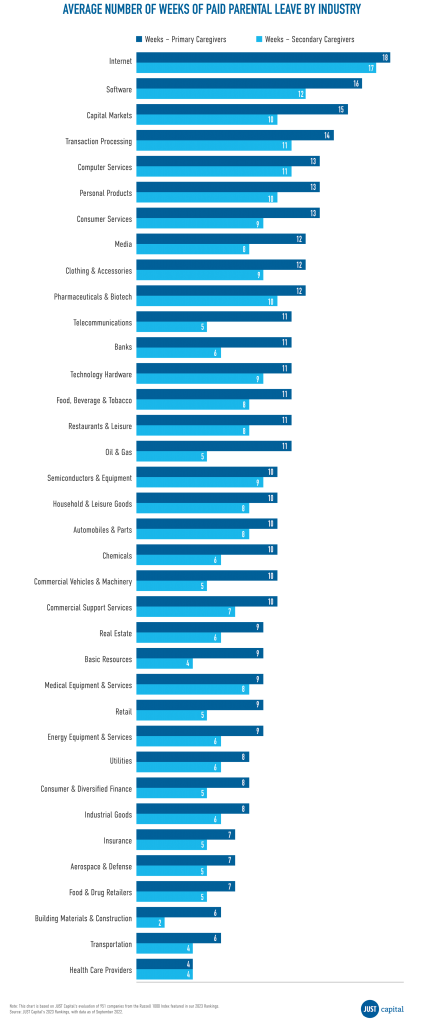
Our new analysis of parental leave disclosures among the Russell 1000 examines differences in practices across industries. We found that 10 industries offer an average of 12 or more weeks of paid parental leave for primary caregivers – while only two offer the same for secondary caregivers. Internet and Software companies lead on weeks-offered for both caregivers, while Health Care Providers and Transportation companies offer the least amount of leave, on average. Dig into more industry insights in our latest report.
Note: If you’re looking for the 2023 version of this list, click here.
This year, Women’s History Month also coincides with another milestone: the two-year mark of the COVID-19 pandemic. Over that time, the impact of the pandemic on women’s labor participation and career trajectories has been stark. Women have yet to recoup pre-pandemic employment rates, and are seeing declines in workforce participation as of late, while men inch closer to pre-COVID numbers.
Mothers who have worked throughout the pandemic have also experienced stalled growth and lower pay among other negative career impacts. A recent survey from CNBC and Momentive found 29% percent of women with children under 18 say their career has taken a setback in the last 12 months, compared to 18% of their peers with older or no children. The strain working mothers have come under during the pandemic has also prompted the U.S. Equal Opportunity Employment Commission to issue new guidance warning that discrimination against caregivers in the workplace may be unlawful.
The challenges working parents face are exacerbated by the ending of pandemic-era policies like the child tax credit and the lack of a national paid parental leave policy in the U.S. In the absence of federal policy, it is incumbent on corporate America to support working families and a more resilient workforce. Parental leave policies that are gender neutral and allow for an equal amount of paid time off for both caregivers are considered expert-recommended best practice. In addition to helping shift cultural norms to encourage working fathers to take paid leave, such policies can help support child development, women’s participation in the workforce, and family financial well-being, and serve the needs of LGBTQ parents.
Yet, the majority of the largest public U.S. companies don’t disclose that they have a paid parental leave policy. We took a look at disclosures among the 954 companies we analyzed for our 2022 Rankings and found 53% do not disclose and 47% do disclose a paid parental leave policy. In addition, 8% disclose a paid parental leave policy of at least 12 weeks for both primary and secondary caregivers.
Among those that do disclose, only five – HPE, Etsy, Dropbox, Netflix, and Lululemon Athletica – offer six months or more of paid leave for both primary and secondary caregivers. Read on below to explore additional details on their disclosures.

Ranked 2nd in its industry and 75th overall
Computer Services company based in Houston, Texas
A leader in its industry, HPE supports its working parents through its HPE Work That Fits Your Life policy. The policy includes 24 weeks of paid parental leave for both primary and secondary caregivers. The company also offers its employees the option to work part-time for 36 months after the birth or adoption of a child and has launched a return-to-work program to help parents and others who have been out of the workforce for at least one year.

Ranked 7th in its industry and 102nd overall
Retail company based in Brooklyn, New York
A consistent leader on gender equity, Etsy’s paid parental leave policy covers 26 weeks for both primary and secondary caregivers. Etsy’s policy gives employees the flexibility of taking this leave over a two-year period. The company also offers financial assistance with costs associated with adoption or surrogacy.

Ranked 15th in its industry and 246th overall
Software company based in San Francisco, California
Dropbox provides 24 weeks of paid parental leave for its global workforce, an industry-leading policy that applies to all parents whether they are birthing, non-birthing, or adoptive. The policy also offers employees the flexibility to return from leave on a part-time schedule to ease the transition back to work.

Ranked 4th in its industry and 142nd overall
Media company based on Los Gatos, California
Netflix offers the highest amount of paid parental leave of all Russell 1000 companies JUST ranks, at 52 weeks for both primary and secondary caregivers. The company also supports the family journeys of its workforce through its global family forming benefit, which provides fertility, surrogacy, and adoption assistance for employees and their partners regardless of marital status, sexual orientation, or gender.

15th in its industry and 543rd overall
Household goods and apparel company based in Seattle, Washington
Lululemon’s policy covers up to six months of paid parental leave for all levels of its workforce, with total paid time off determined by each employee’s tenure with the company. The policy is also gender neutral, and applies to maternity, paternity, and adoption leave.
Ian Sanders is a JUST Capital Research Intern, focusing on workers and wages.
To this day, the United States remains the only country among its economically advanced peers without a legislated paid parental leave policy, which provides parents paid time off around childbirth or adoption. And as a consequence, only 18% of private-sector workers have access to paid family leave. Recognizing that paid parental leave is critical for the physical, social, and economic health of families, a patchwork of state policy has emerged to fill the gaps.
States aren’t the only ones that have stepped up, though. Increasingly, companies have established their own paid parental leave policies, supported by a wealth of research that shows that these policies are good for business, too. Through these efforts, 29% of workers at large firms in the private sector receive paid family leave benefits. But there’s still a long way to go.
Which is why we applaud the Business Roundtable’s letter to Congress last Thursday, on behalf of member CEOs serving more than 15 million employees, urging lawmakers to make paid family leave available to “as many working Americans as possible.” The letter was penned by Ginni Rometty, CEO of IBM and Chair of the Education and Workforce Committee on Business Roundtable, and comes as Congress is set to provide all federal workers with 12 weeks of paid parental leave. Our question is always: What do the data show? Do Business Roundtable companies live up to their verbal commitment when it comes to paid parental leave? According to data used in our 2020 Rankings of America’s Most JUST Companies, it turns out BRT companies are more likely to offer paid parental leave, although they provide fewer weeks of leave compared to non-BRT companies.
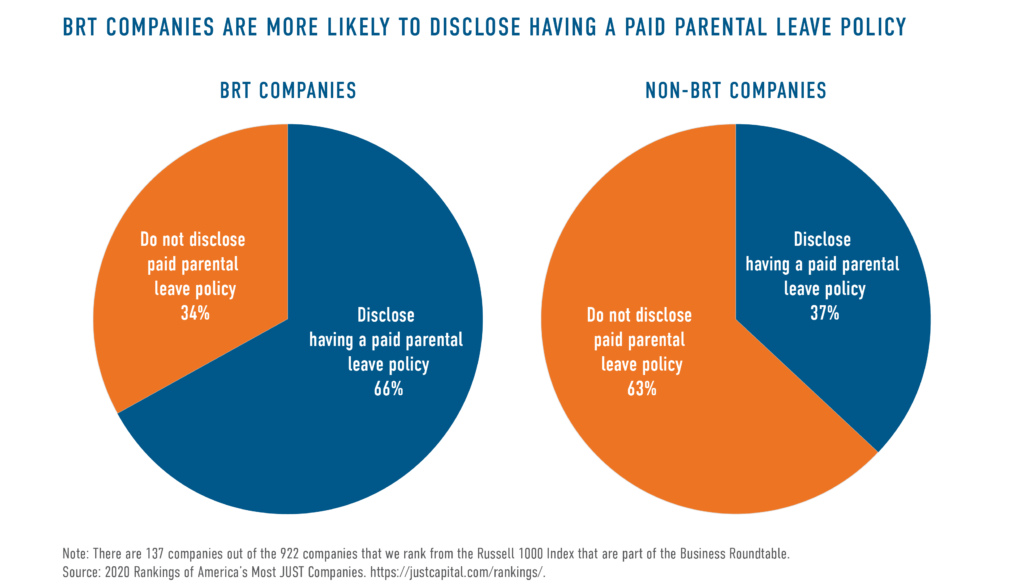
Across the 922 large-cap companies we rank, 378 companies, or 41%, disclose having a paid parental leave policy. Among the 137 Business Roundtable companies we rank, however, this share is much higher. We found that 66% of Business Roundtable (BRT) companies disclose having paid parental leave while just 37% of non-BRT companies disclose the same. In other words, BRT companies are nearly two times more likely than their non-BRT peers to disclose offering paid parental leave to their employees.
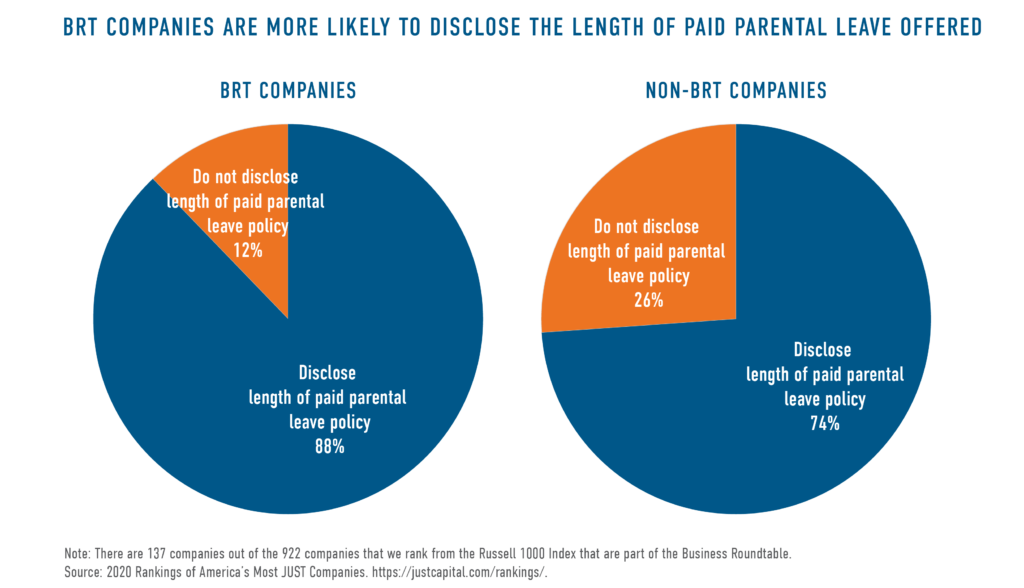
Yet just having a paid parental leave policy isn’t sufficient. Research also shows that the length of paid parental leave is just as important. Fewer companies disclose this information. Of the 378 companies that we note have paid parental leave policies, 77% share the number of weeks of leave available to new parents, whether new mothers, fathers, primary or secondary caregivers, or adoptive parents.
Among BRT companies that have a paid parental leave policy, 88% disclose details about the length of leave, while 74% of non-BRT companies with a policy disclose the same.
This detailed disclosure allows us to further unpack exactly how many weeks of paid parental leave companies offer. Overall, companies give about 12 weeks of paid leave to mothers and roughly seven weeks of paid leave to fathers. BRT companies perform slightly less well, on average, offering about 11 weeks of maternity leave and six weeks of paternity leave.
Taking a closer look, we find that, of the BRT companies that disclose the length of paid leave for new mothers, 18% offer under six weeks of leave, 32% offer six to 12 weeks, and 50% offer 12 or more weeks. Of the BRT companies that disclose the length of paid leave for new fathers, roughly 57% offer under six weeks, 32% offer six to 12 weeks, and 11% – just eight companies – offer 12 or more weeks of leave. A higher proportion of non-BRT companies offer longer leave for both mothers and fathers: For instance, 59% and 22% of non-BRT companies that disclose the length of maternity and paternity leave, respectively, provide their employees with 12 or more weeks.
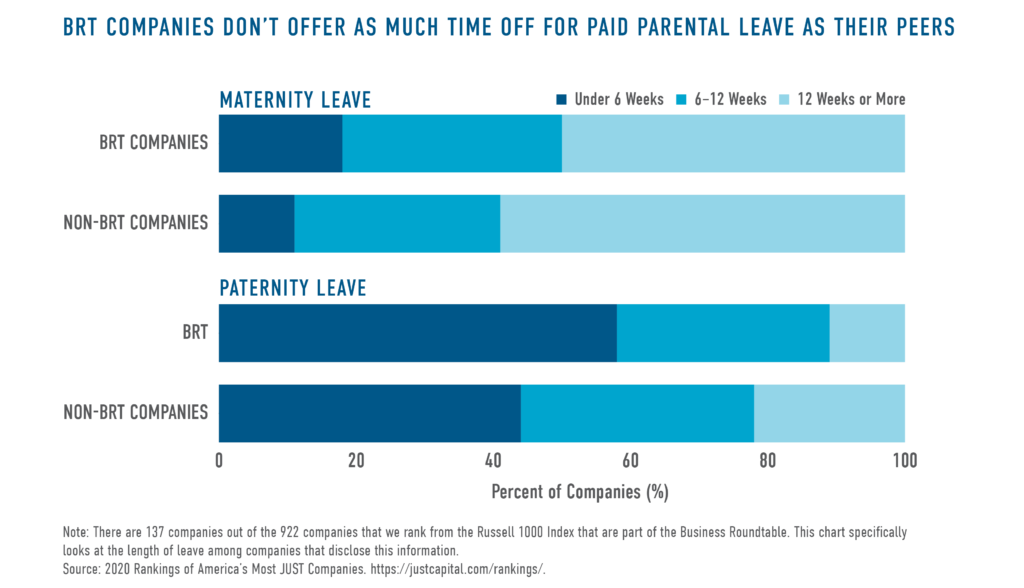
Due to much lower levels of disclosure, we were unable to analyze details about paid parental leave among adoptive parents, and parents of all gender identities. While this is a limitation of this research, it signals that paid parental leave policies could benefit by being more inclusive and using more inclusive language. Rather than “mother” and “father,” the language some companies might utilize would be “primary and secondary caregiver.” Some companies have adopted this language already, but gendered parental categories remain the norm.
Implicit in the findings about length of leave – and concerns about the inclusivity of paid parental leave policies – few policies offer equal time for mothers and fathers to bond with their new children despite the fact that research shows gender-neutral paid parental leave helps curb persistent gender inequality. This problem is not endemic to BRT companies, though they show considerably more room for improvement compared to their peers.
Among BRT companies that disclose the length of their paid parental leave programs, 5% – or four companies – provide 12 or more weeks of paid leave given to both mothers and fathers. 16% of non-BRT companies have 12 or more weeks of gender-neutral leave.
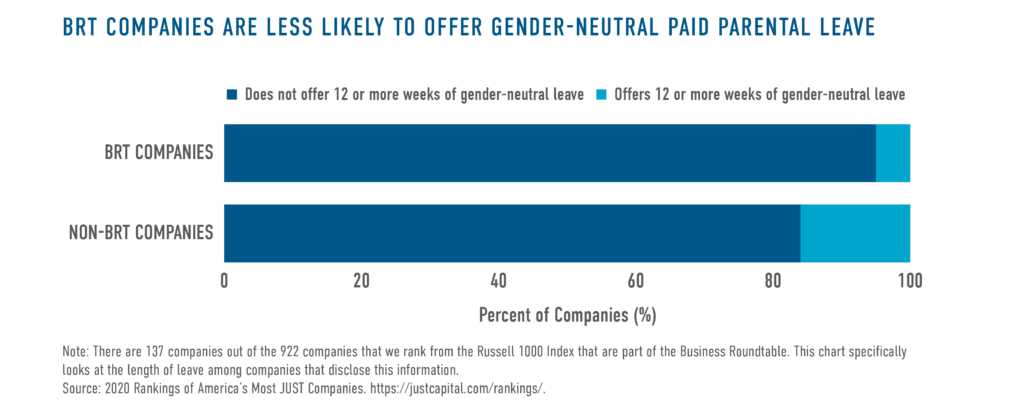
The first step in this shift toward gender-neutral paid parental leave is of course the establishment of policies that are inclusive of parents of any gender. But a deeper shift must also take place in and around corporate culture, where men often feel unable to take leave even when they have it. Still, fathers are also fighting for this kind of leave – JPMorgan Chase, a BRT member, settled a lawsuit this year extending paid leave to fathers that is equal to the leave it offers mothers, ensuring that its 16-week commitment is administered in a gender-neutral way.
Across the board, companies – whether part of the Business Roundtable or not – have room to improve when it comes to offering paid parental leave. Until the U.S. catches up to its peers, eyes are on the private sector to not only offer paid parental leave to workers, but innovate how best to serve working families today – inclusive not only of birth mothers and fathers, but of adoptive parents and individuals of all gender identities. We applaud the BRT’s letter and know from our annual survey that the American public is looking to companies to lead on issues like this. The efforts of BRT companies, and others providing standout leave policies, are undeniably critical for employees across all sectors, and we will continue to track what companies take the lead and how the landscape – driven by initiatives like the BRT’s – shifts in the months and years to come.
This post was updated on January 7, 2020 to more precisely reflect our analysis of whether companies disclose paid parental leave policies, rather than whether they offer it.
