With 11 days to go until the election, Just Capital’s 2024 Americans’ Views on Business Survey, released this week, carries extra significance. Our longest running survey, it has captured how Americans – on a fully representative basis – feel about capitalism, business and society since 2015. Are we as divided on our views about the role of corporations in society as we are about politics? Which issues generate the greatest levels of public support and/or disagreement? How has that changed over the years? And how might CEOs, boards, and senior executives navigate today’s turbulent world?
What emerges from this year’s survey is surprising agreement on many issues and a clear direction for corporate leaders. Here are some highlights:
I urge you to check it out and of course, your feedback is always welcome.
Be well,
Martin
(AWS)
“If there are people who just don’t work well in that environment and don’t want to, that’s okay, there are other companies around. When we want to really, really innovate on interesting products, I have not seen an ability for us to do that when we’re not in-person.”
In the wake of the longshoreman strike, Kevin O’Leary, famed businessman, investor, and TV personality, explains his take on why he thinks automation could actually increase wages for workers at ports.
The Wall Street Journal takes a hard look at the ongoing crises at Boeing and Intel. Their assessment: because these companies are so intrinsically tied to American business and safety, it is a national emergency to ensure they’re fixed, stating, “The U.S. still designs the world’s most innovative products, but is losing the knack for making them.”
Meanwhile, while it doesn’t solve the company’s problems, Forbes explains why Boeing’s 35% wage hike is a game changer.
The Associated Press reports that Google and Amazon are each making massive nuclear investments in an attempt to power their data centers with clean energy.
PepsiCo will be adding more chips into the bags in many of their snack foods to win back customers who’ve abandoned their brands thanks to higher prices and smaller portions. CNN has the story.
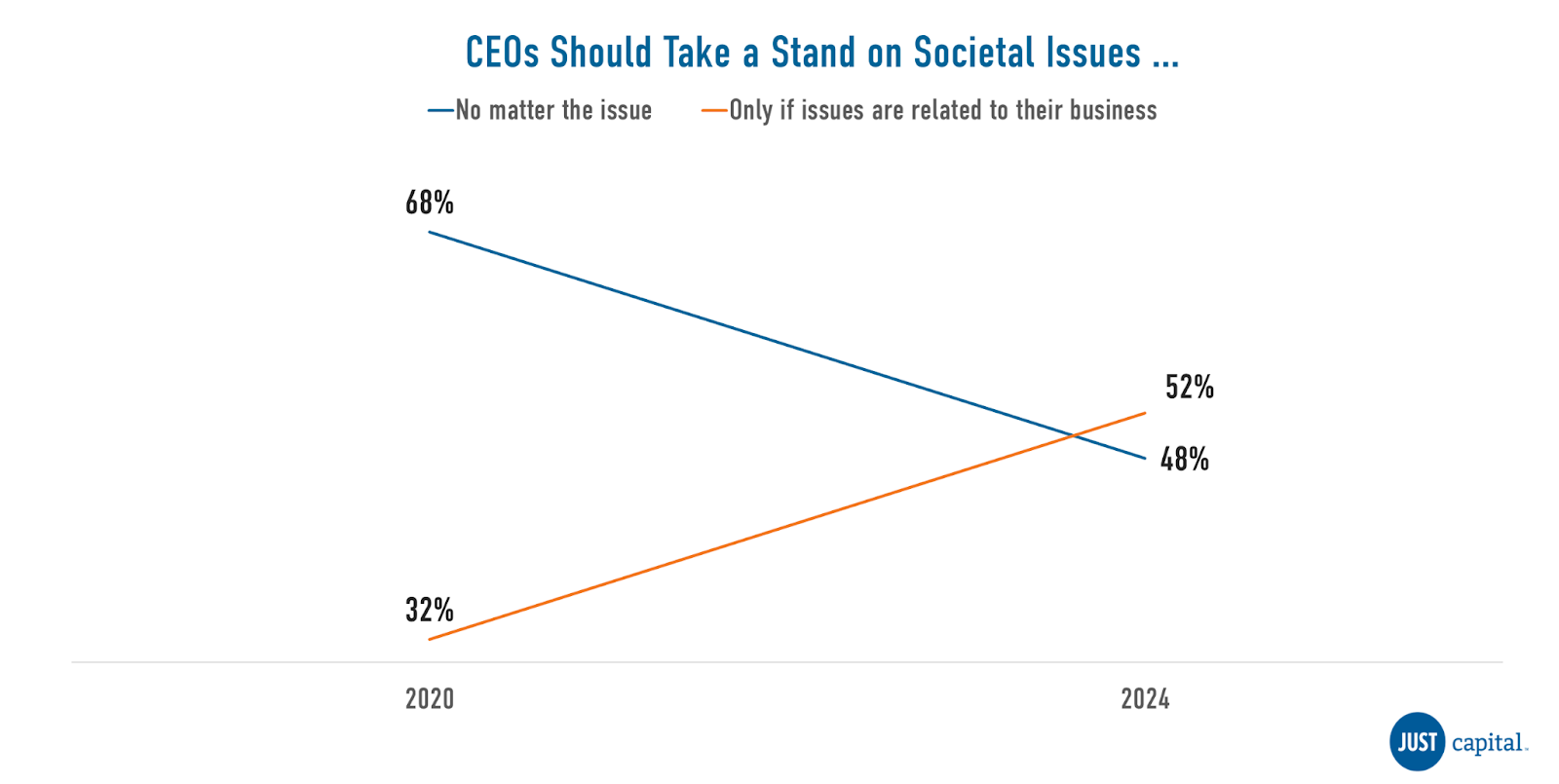
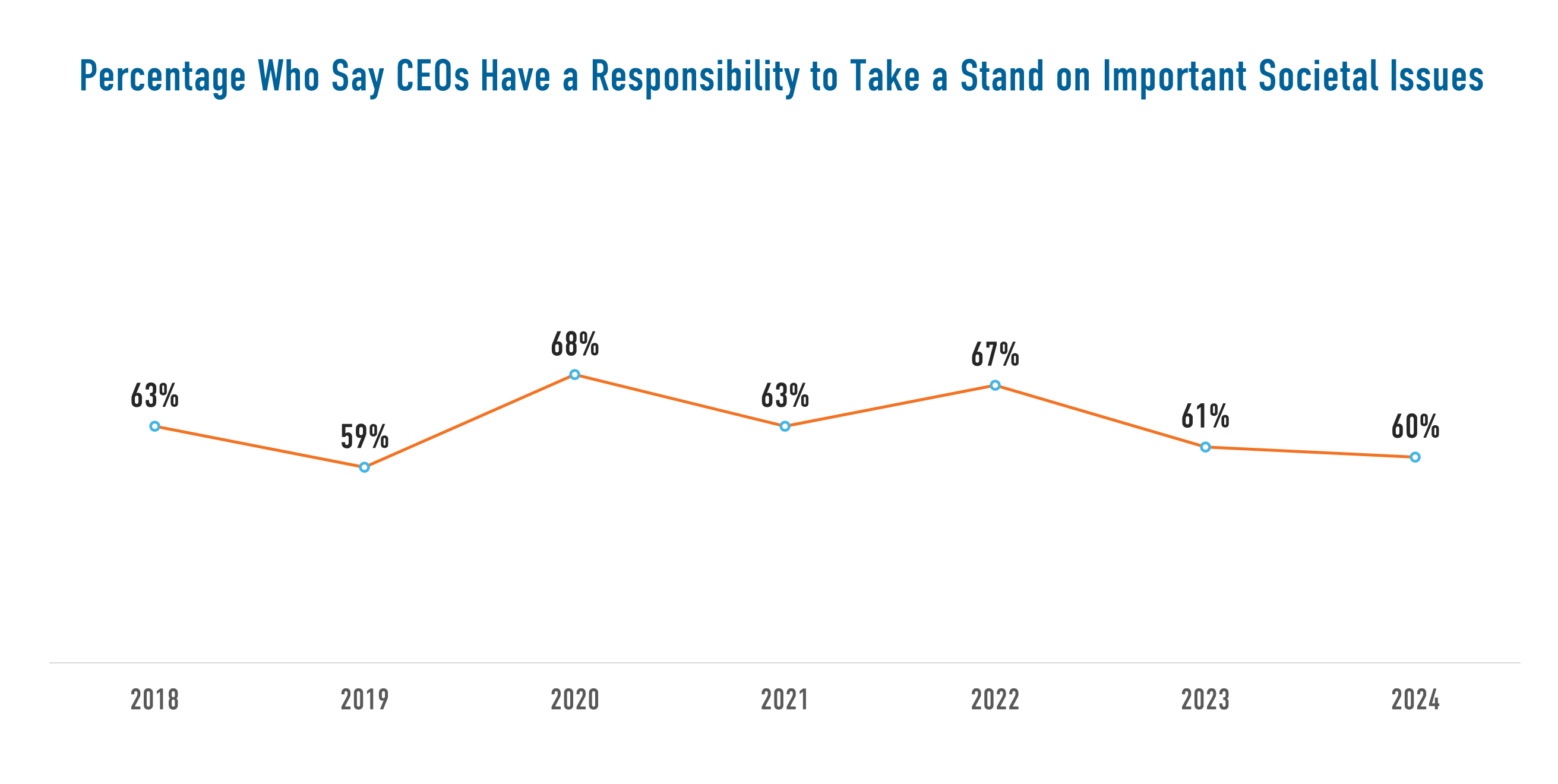
This chart comes from our 2024 Americans’ Views on Business report and shows the nuanced landscape CEOs must navigate. While the number of respondents who agree CEOs have a responsibility to take a stand on important societal issues has remained consistent around 60% since 2018, the type of stand has changed. In 2024, 52% responded that CEOs should focus on societal issues where impact dovetails with business performance compared to 32% in 2020. Explore the rest of the insights here.
Corporate leadership today is a challenge of the highest order. CEOs must navigate a deeply divided political landscape, rapidly shifting stakeholder demands, ongoing economic uncertainties, and myriad technological, regulatory, and environmental forces that present risk and opportunity in equal measure. Performance expectations are sky-high, scrutiny is intense, and the margins for error are nonexistent.
Against this backdrop, there is one voice that – perhaps surprisingly – provides business leaders with both calm reassurance and clear direction: that of the American people. Just Capital’s Americans’ Views on Business Survey, our longest-running longitudinal survey, captures this voice in all its rich, diverse detail. And its central message this year is striking. Despite being highly polarized on political issues, Americans are generally united in their expectations for corporations – particularly in areas where positive societal impact dovetails with positive business performance.
Specifically, we find that the majority of Americans – regardless of political party, ideology, or other demographic differences – not only agree that business can and should be a force for good in the world but also are closely aligned on what precisely that means: paying people fairly, investing in their workforce, treating customers better, offering products or services at a fair price, minimizing harm to the environment, strengthening communities, and even making good on climate commitments.
In tracking the public’s views on business over the past decade, we have seen the contours of American opinion evolve considerably. Whereas in previous years we saw greater demand for CEOs to speak out on social issues, opinion is now much more divided. On transparency and disclosure, it is clear that in today’s low-trust environment, people hunger for more information on what companies are actually doing, not what they say they are doing. Despite the broad agreement that capitalism and the economy need to work for all Americans, opinions clearly diverge on whether this is actually happening.
Through it all, one message is constant: The American people want companies to create value for all their stakeholders as a path to creating more value for their shareholders, for themselves, and for society at large. As our investment work demonstrates, this “win-win-win” is not mere conjecture; it’s a fact. This report serves as a blueprint for any corporate leader, board member, or investor who aspires to this outcome.
Each year, we ask the American public to identify and prioritize what issues matter most when it comes to just business behavior. We always start the process by hosting a series of focus groups. This year, we began by asking participants a simple question: What do you think the chief responsibility of America’s largest companies is? Although many responded that it is to make and sustain profits, participants went on to explain that companies are also expected to balance profitability with practices that value society, and they should serve the interests of their workers, customers, communities, and the environment alongside those of their shareholders.
In assessing which stakeholder the public believes is, in fact, the top priority for companies, it is clear that (with 56% of the vote) shareholders come out on top. This is a significant increase compared to four years ago, when workers garnered a much higher share of the vote.
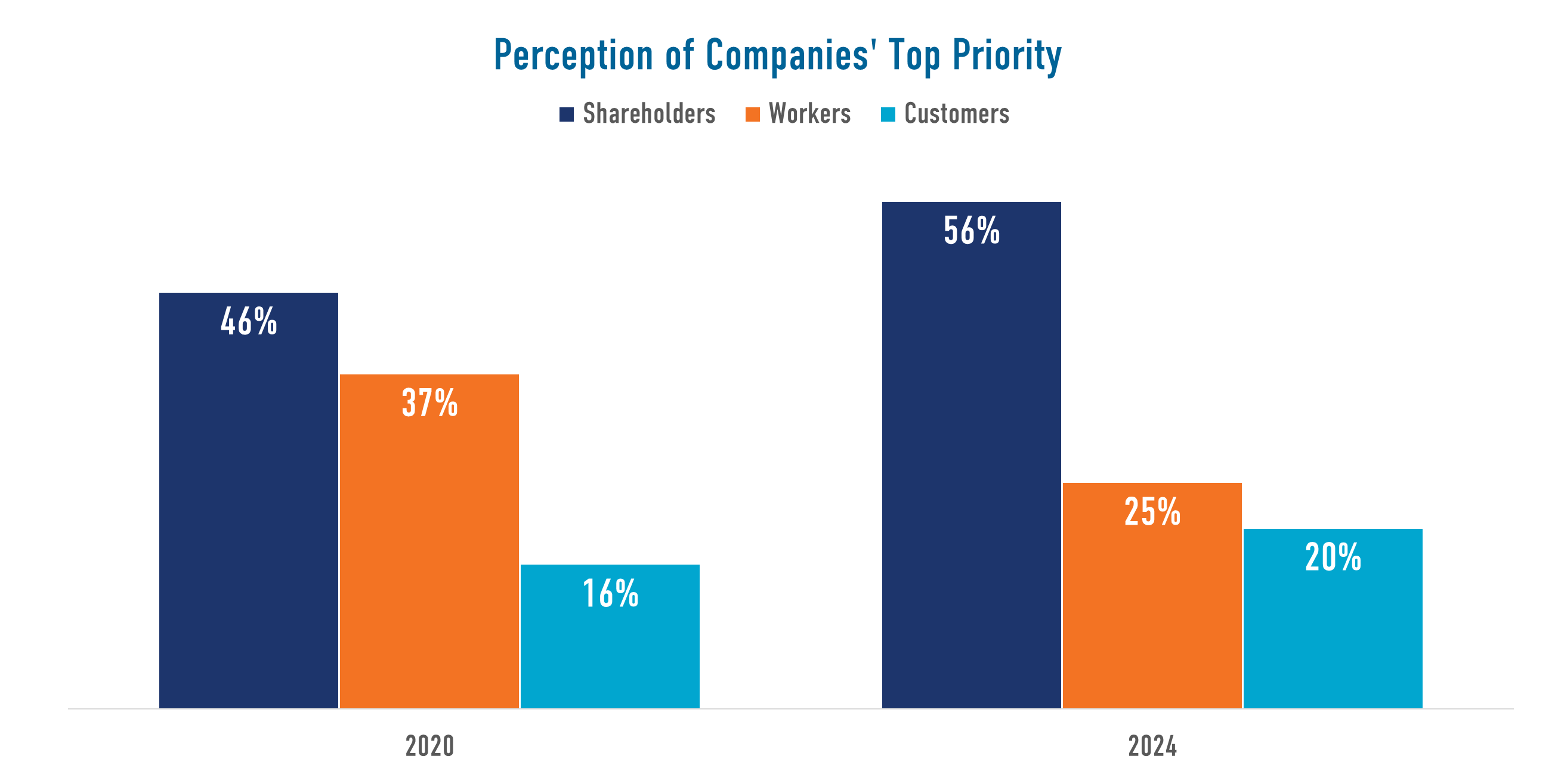
Perhaps surprisingly, these opinions are relatively consistent across political ideologies, as we see below.
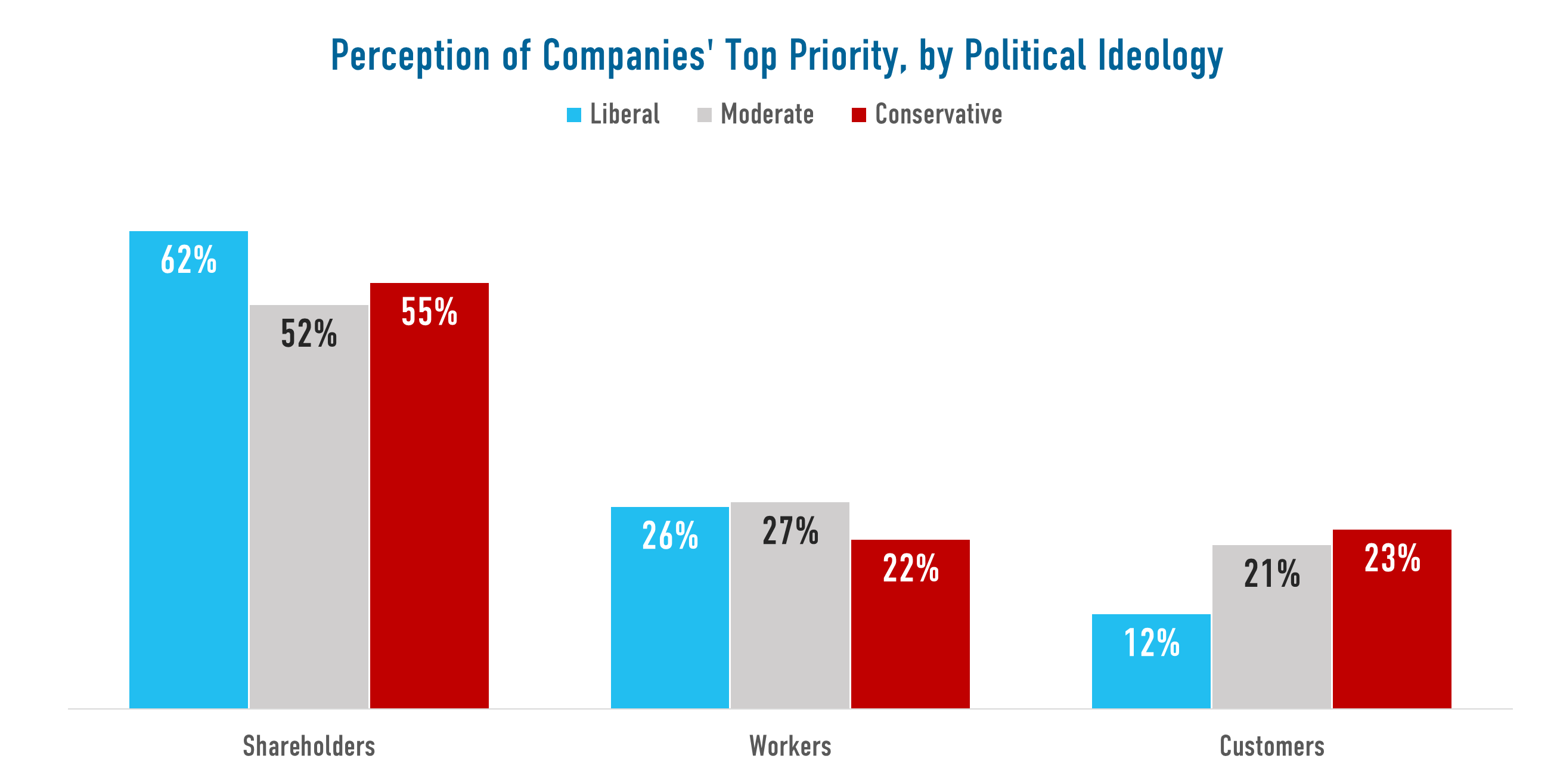
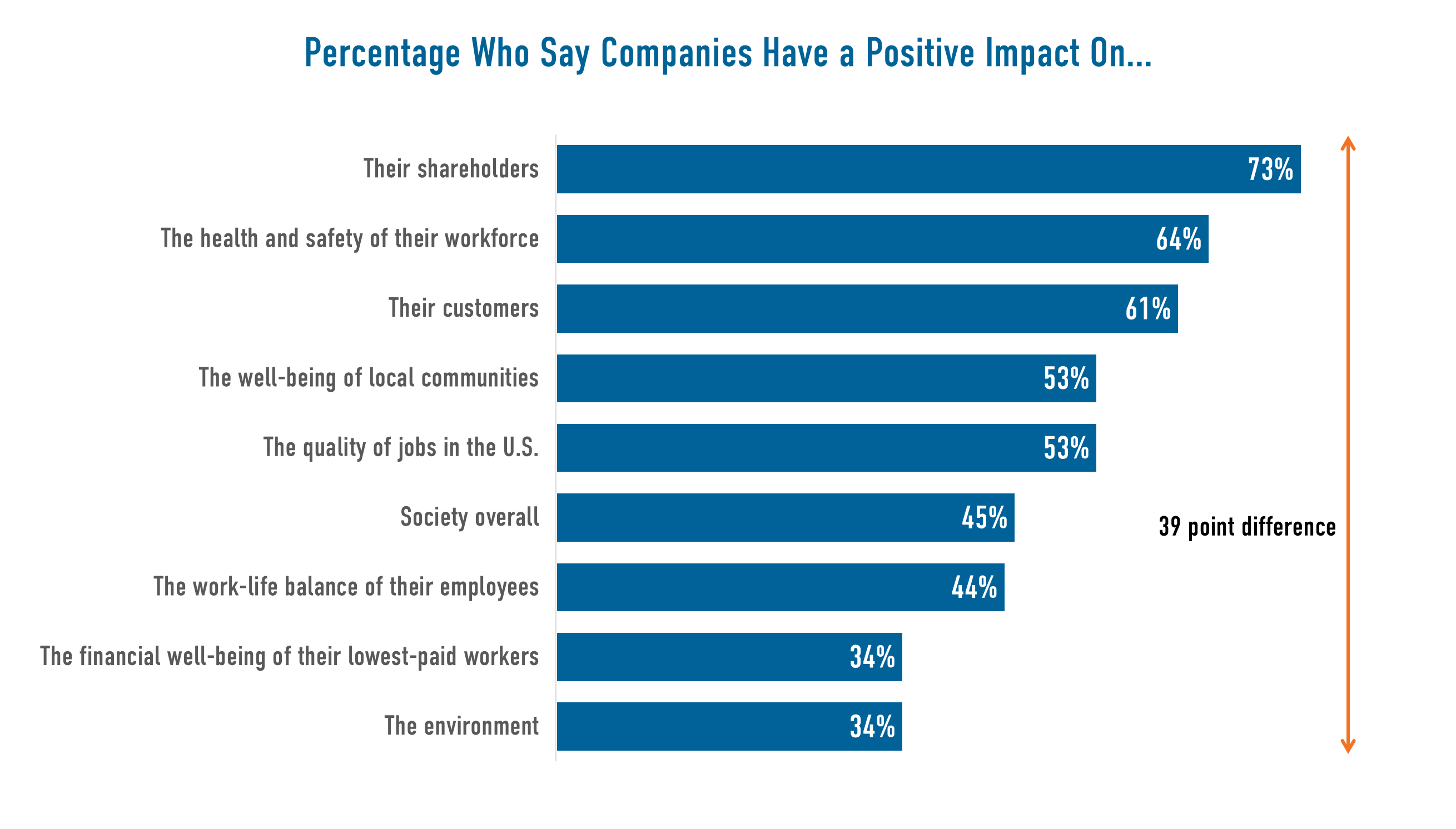
The next chart breaks this down even further. When asked which stakeholder companies are positively affecting, almost three-fourths identify a company’s shareholders. The health and safety of workers and the company’s customers also generate a lot of support. Only 34% of respondents believe that companies are having a positive impact on their lowest-paid workers and the environment, a proportion that has changed little in the four years since we started asking this question.
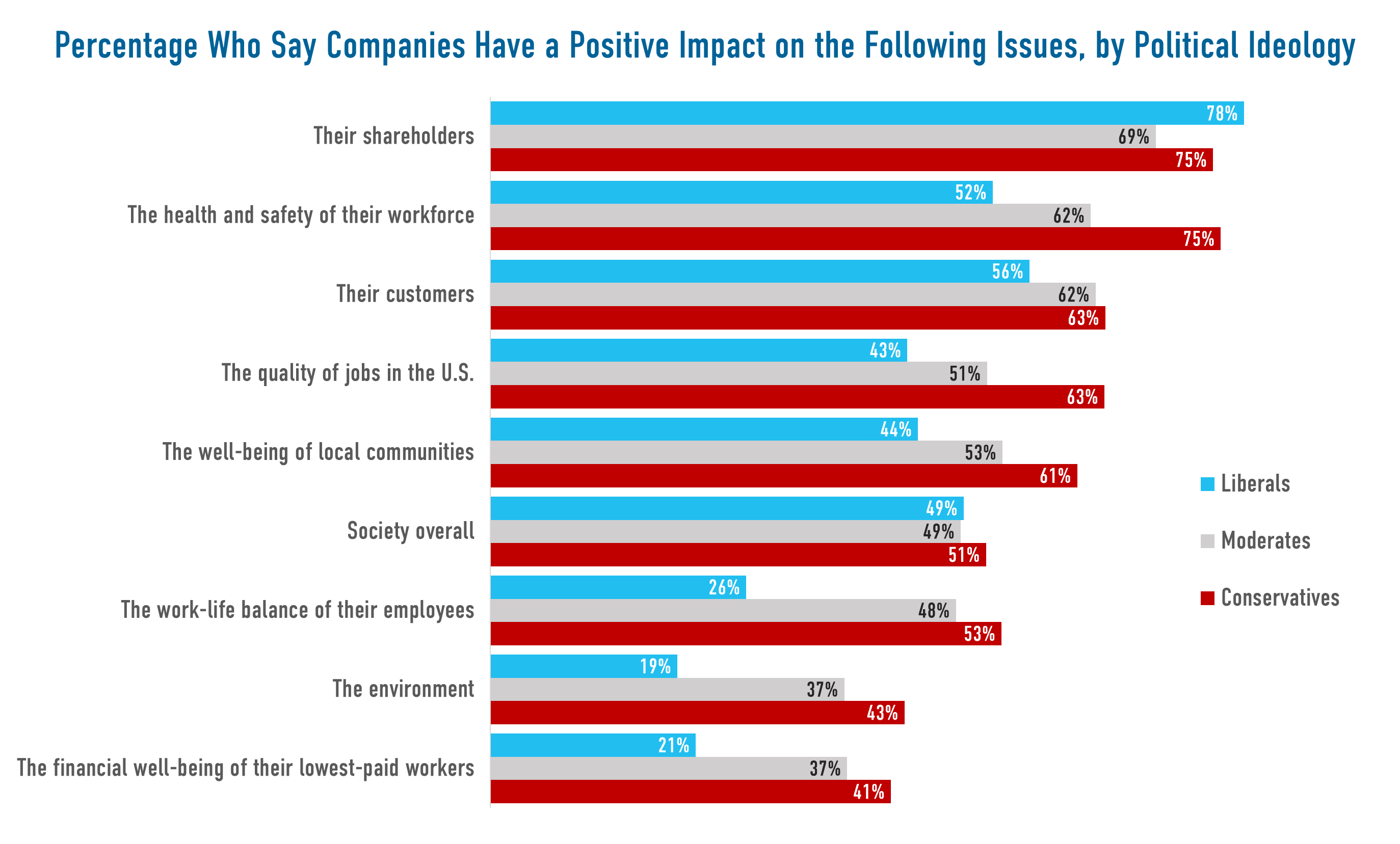
Though the percentages may be larger or smaller depending on one’s political ideology, the pattern of responses is very consistent. Liberal respondents tend to be more skeptical than conservatives that companies are having a positive effect across these stakeholder issues. Overall, though, Americans of all ideologies essentially agree that companies benefit their shareholders and are far less likely to feel companies have a positive impact on their lowest-paid workers.
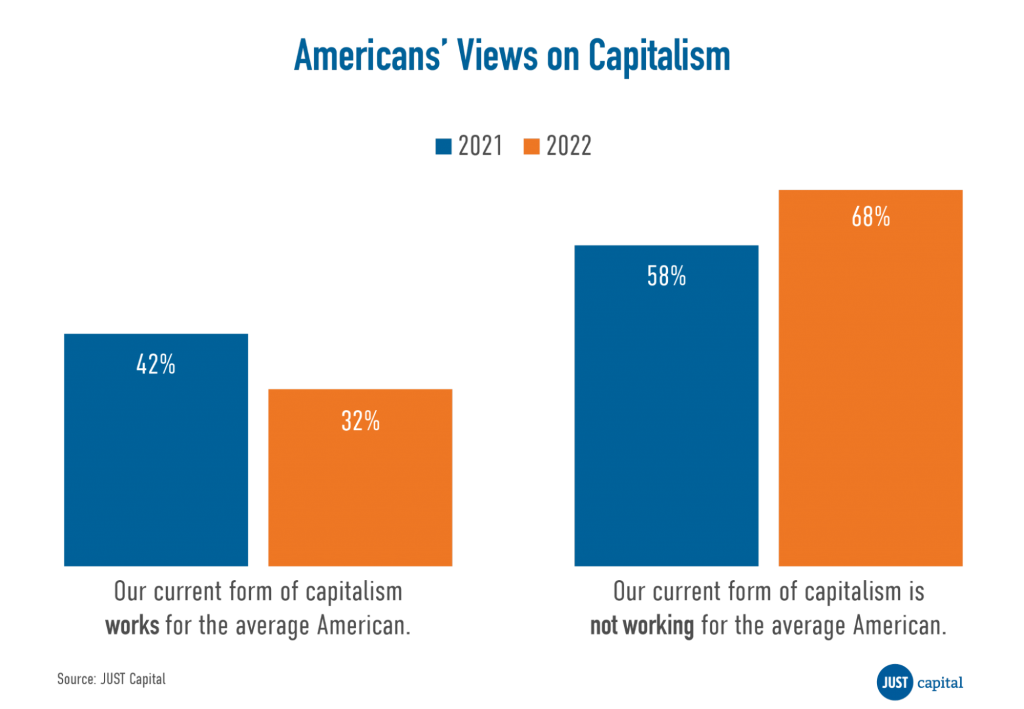
Capitalism is the means by which the American Dream becomes reality. But according to recent polling from Pew Research, only about half of Americans (53%) say that dream is still possible. Our research findings support Pew’s: When our respondents were asked whether they believe capitalism is working for the average American, only about 1 in 3 agree.
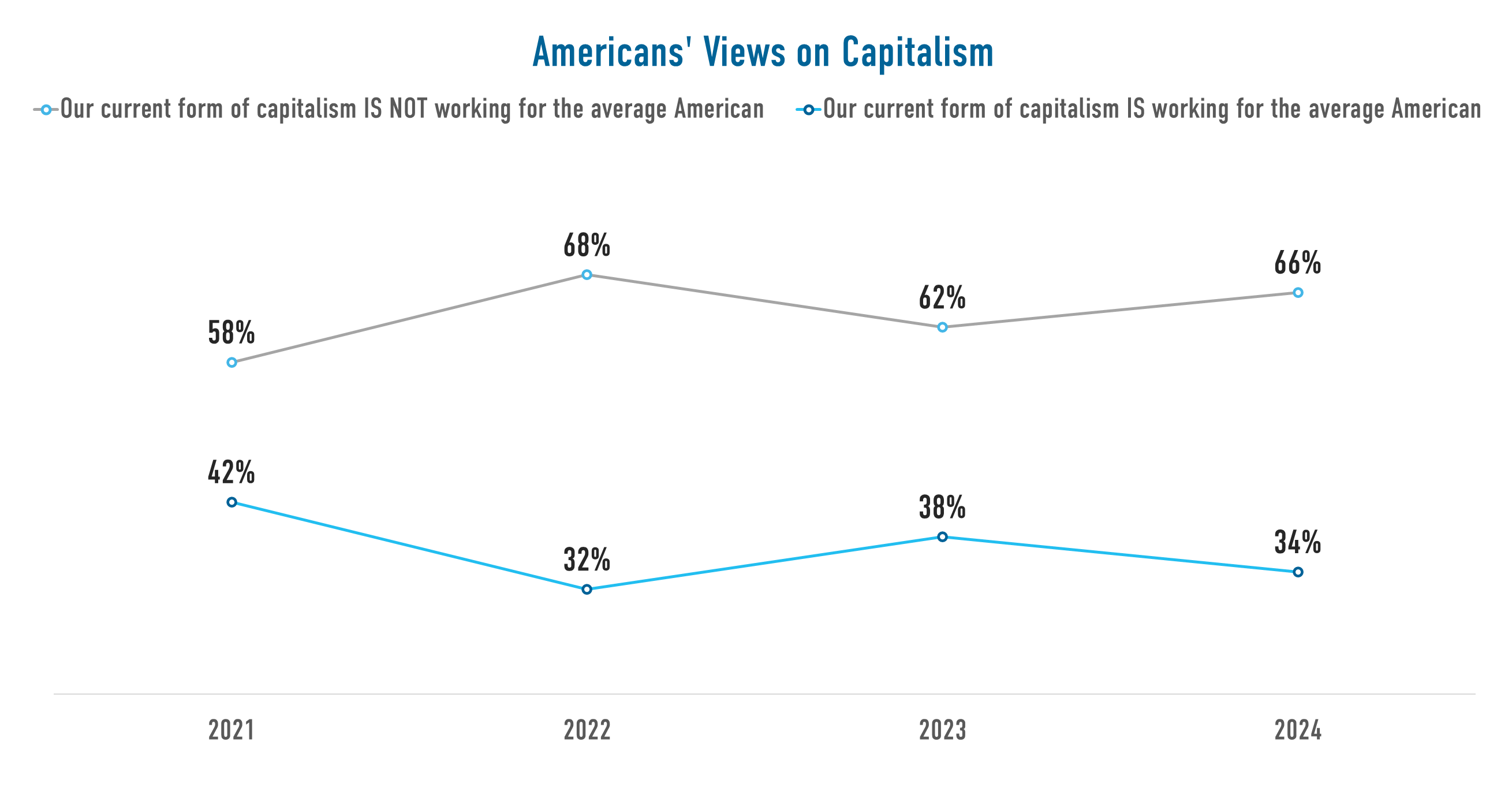
This number has stayed relatively consistent over the past three years after falling from a high of 42% in 2021, a year in which companies were redoubling efforts to respond to the needs of all their stakeholders amid unparalleled intersecting health, economic, and social crises.
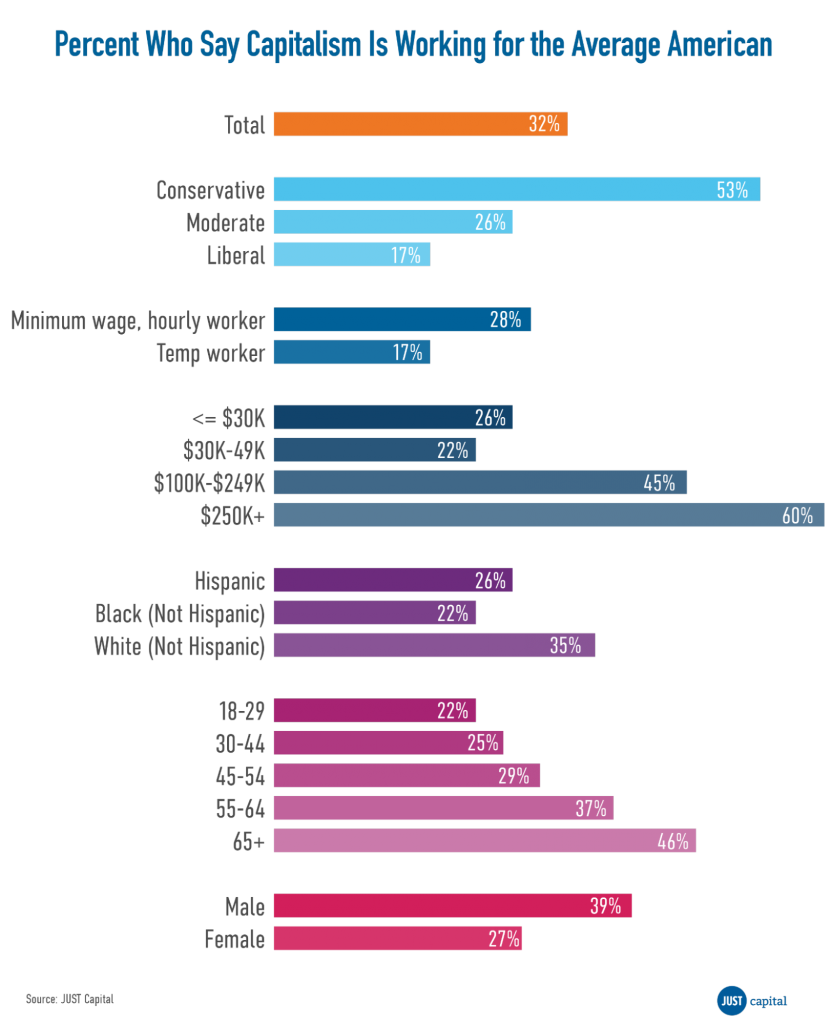
Looking at this question from a demographic perspective, the high-level takeaway is intuitive: The older you get, the more money you make, the more you believe capitalism is working for the average American. Of those making under $30,000 a year, only 28% respond positively to this question versus 40% for those making more than $250,000 annually. Likewise, a mere 25% of Gen Z say capitalism is working for the average American versus 49% of Boomers.
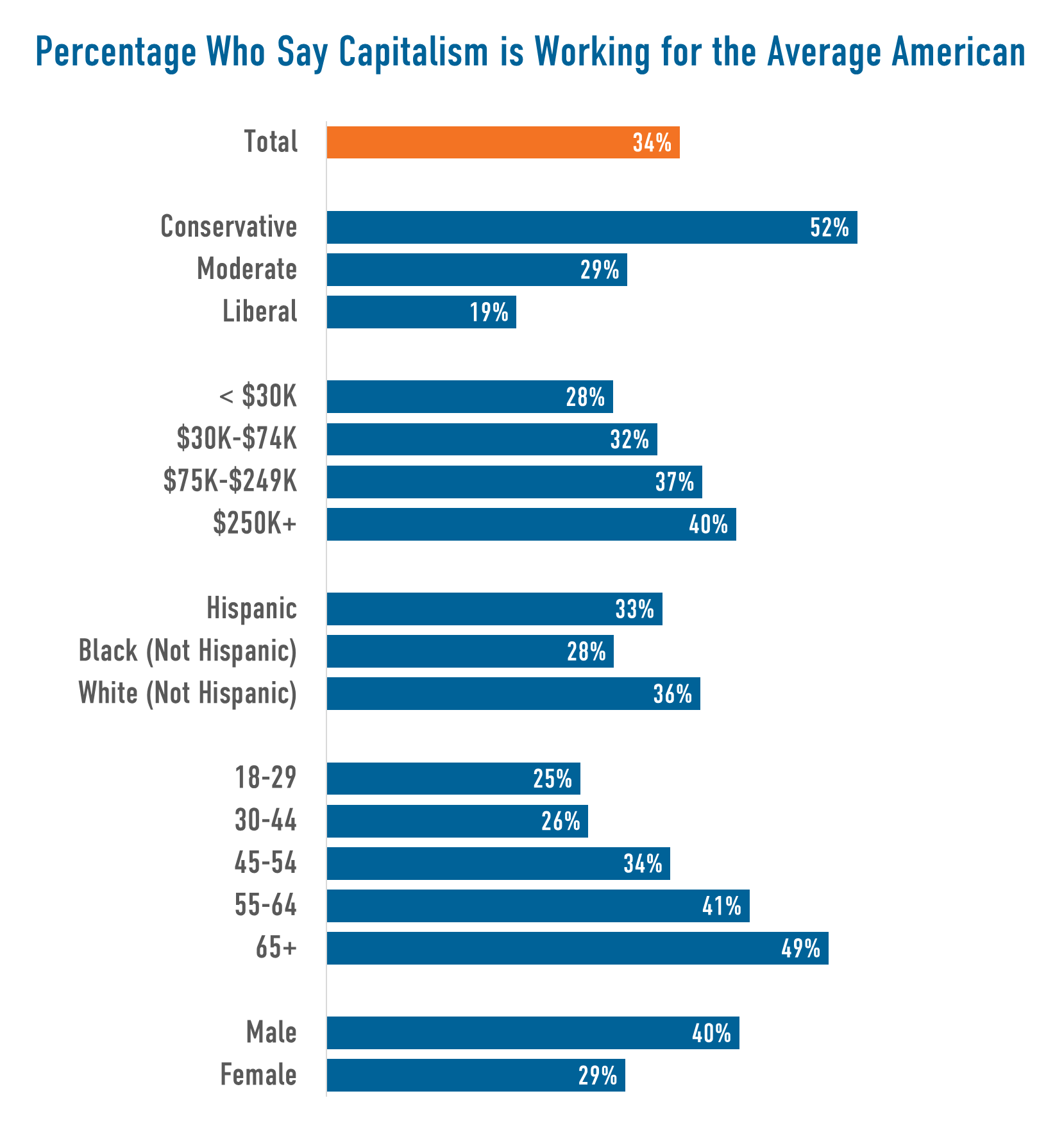
Across political ideology, however, the picture is very different, with more than half (52%) of conservatives saying capitalism is working versus only 19% of liberals.
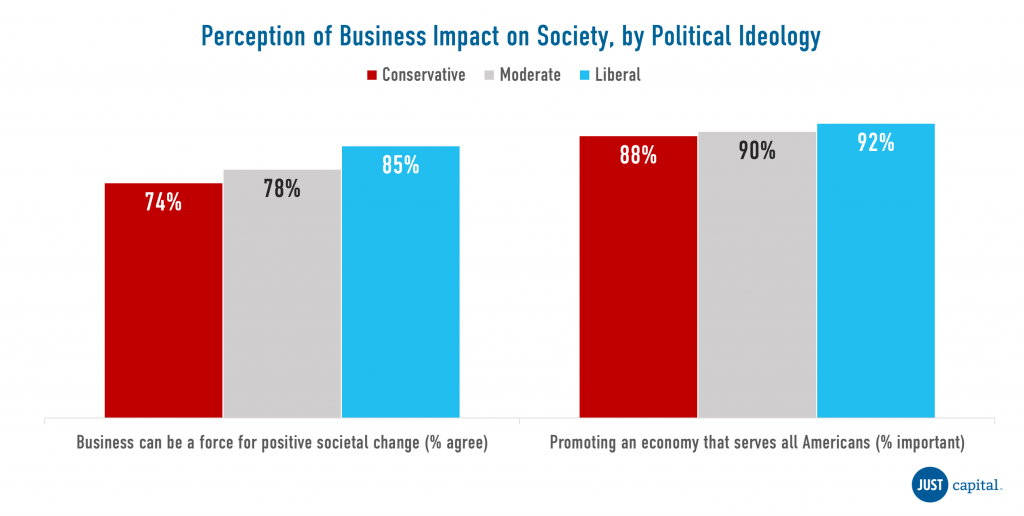
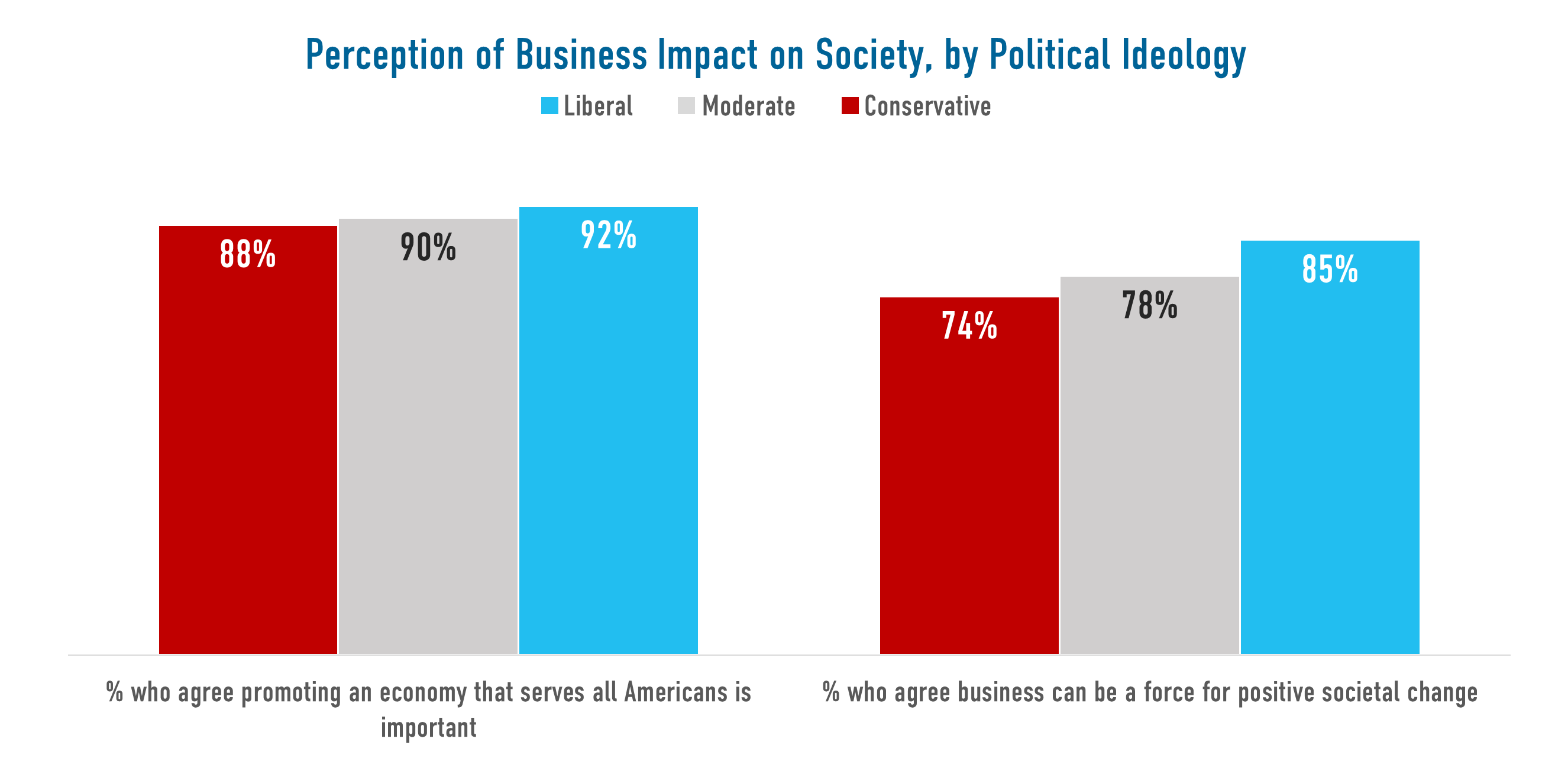
Despite their skepticism that capitalism is actually working for the average American, it is clear that a substantial majority of Americans do, in fact, believe that promoting an economy that serves all Americans is important and can be a force for positive societal change. These numbers are consistent across demographic groupings, generations, income levels, and especially, political outlooks.
We see more variance when people are asked whether companies should take a stand on important societal issues. Overall, a majority (60%) agree that CEOs of large companies do have a responsibility to take a stand – a proportion that has stayed relatively consistent since 2018.
Our focus groups delved into this issue, with one participant saying: “I feel companies reaching out and speaking about social issues is not a bad thing because they do have a stronger platform than a group of people do.” Another participant echoed this sentiment, saying the largest U.S. companies have disproportionate size and, thus, a disproportionate impact on society.
Yet others felt speaking out on issues can be polarizing, and ultimately harmful, for many companies. As one participant noted, “If you take a side … then it continues to snowball where once you start, then you can’t stop because then you’re forced to speak on everything. And what if you don’t have the time to speak on everything? Then you’re balancing all this work in PR when that’s not really your business. Your business is something else.”
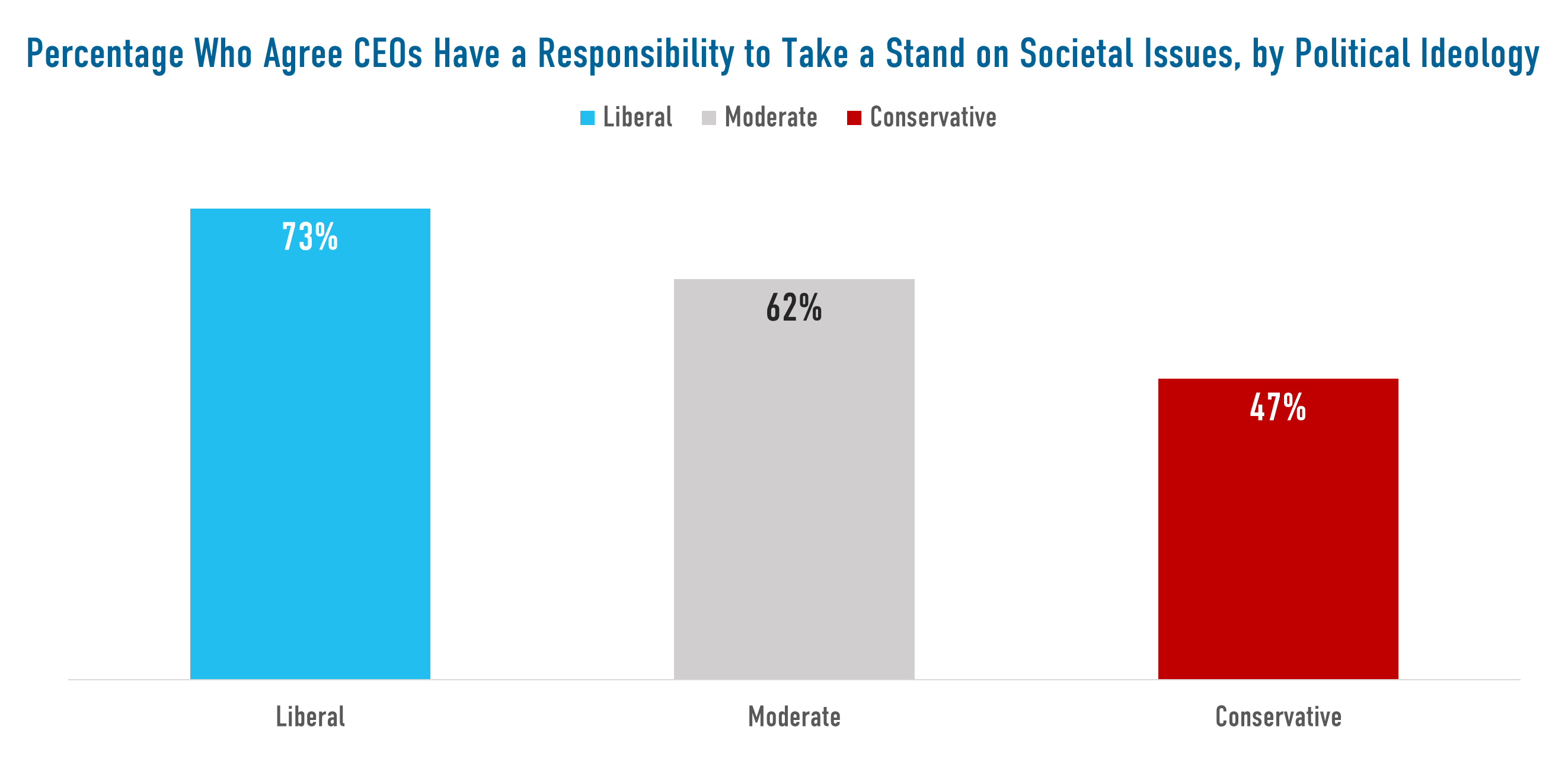
One look at how responses to this question differ by political ideology underscores this divergence. Liberals are significantly more likely to agree that CEOs should take a stand on societal issues (73%) versus moderates (62%) and conservatives (47%).
Crucially, when asked whether CEOs should take a stand about any issue versus only those issues that are related to their business operations, the public is much more likely to say “issues related to business” now than they were just four years ago.
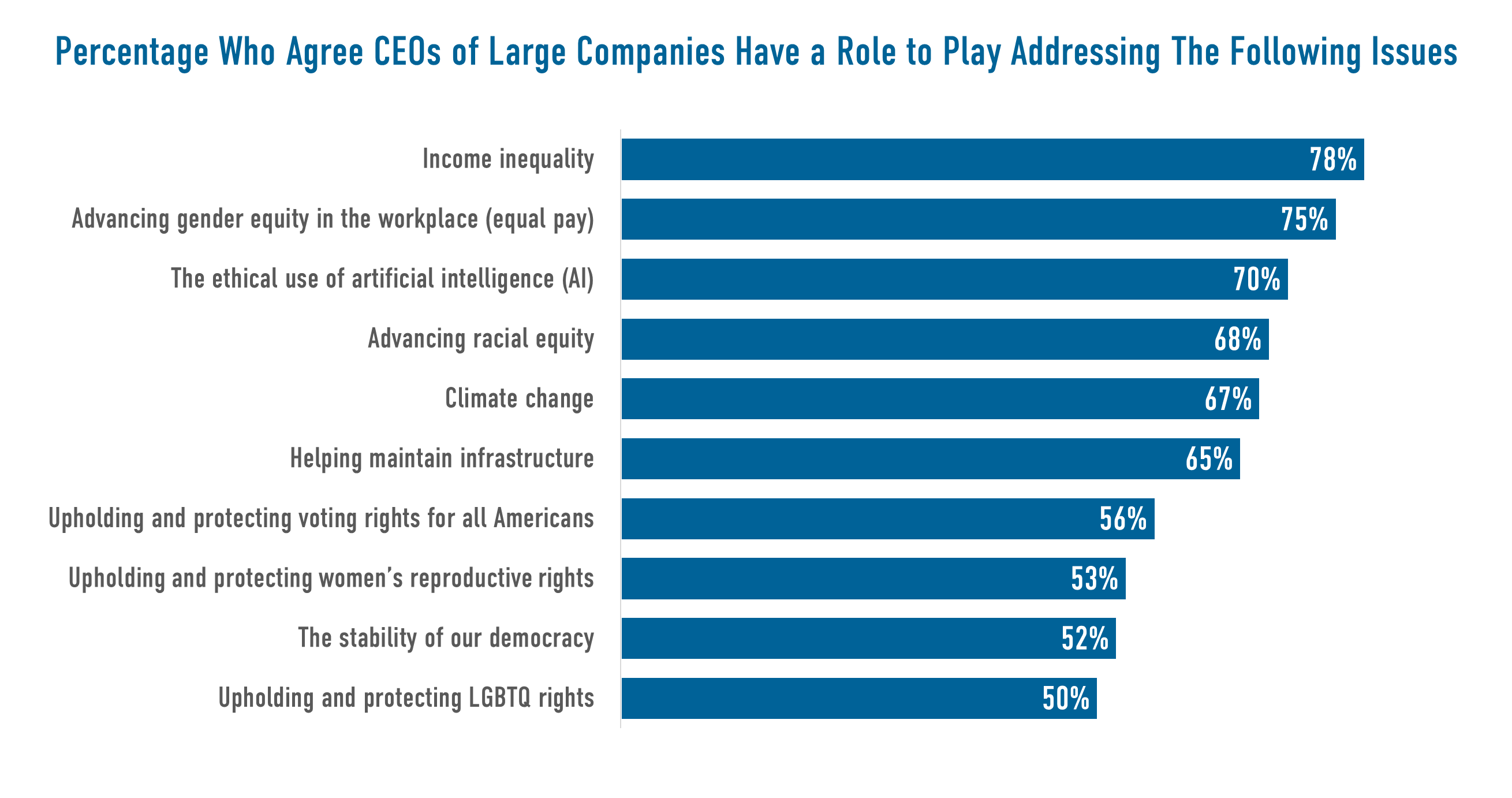
The survey results also provide guidance on which issues the public believes corporate leaders can play a role in addressing. Topping the list are tackling income inequality, advancing gender equity in the workplace (equal pay for equal work), and using artificial intelligence (AI) in an ethical way. Protecting voting rights, upholding women’s reproductive rights, supporting the stability of our democracy, and protecting LGBTQ rights garner less support.
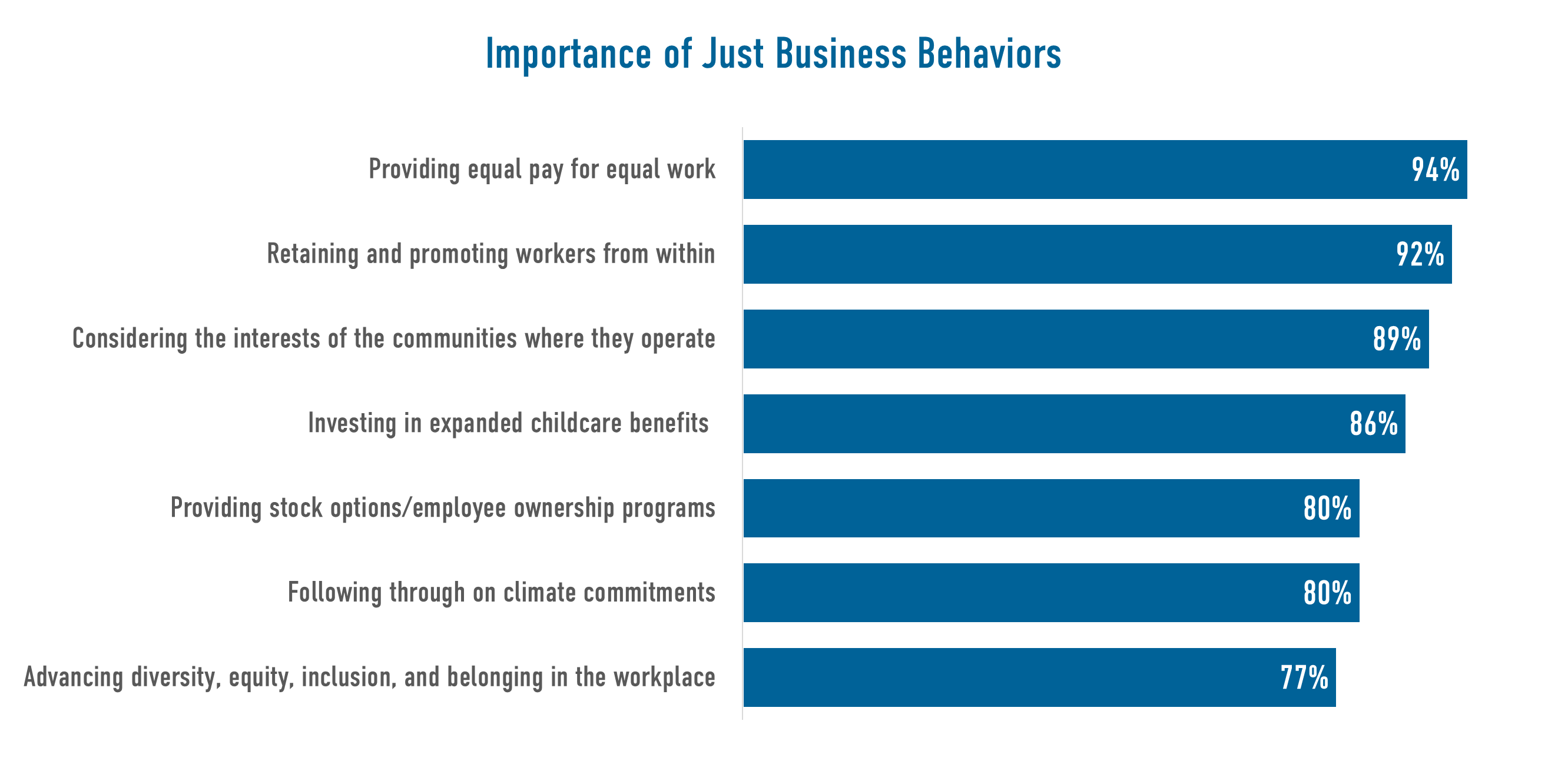
Building on the above, it is clear that in defining the idea of just business behavior, several actions enjoy near-universal support: providing equal pay for equal work, retaining and promoting workers from within, considering the best interests of local communities, and expanding childcare benefits.
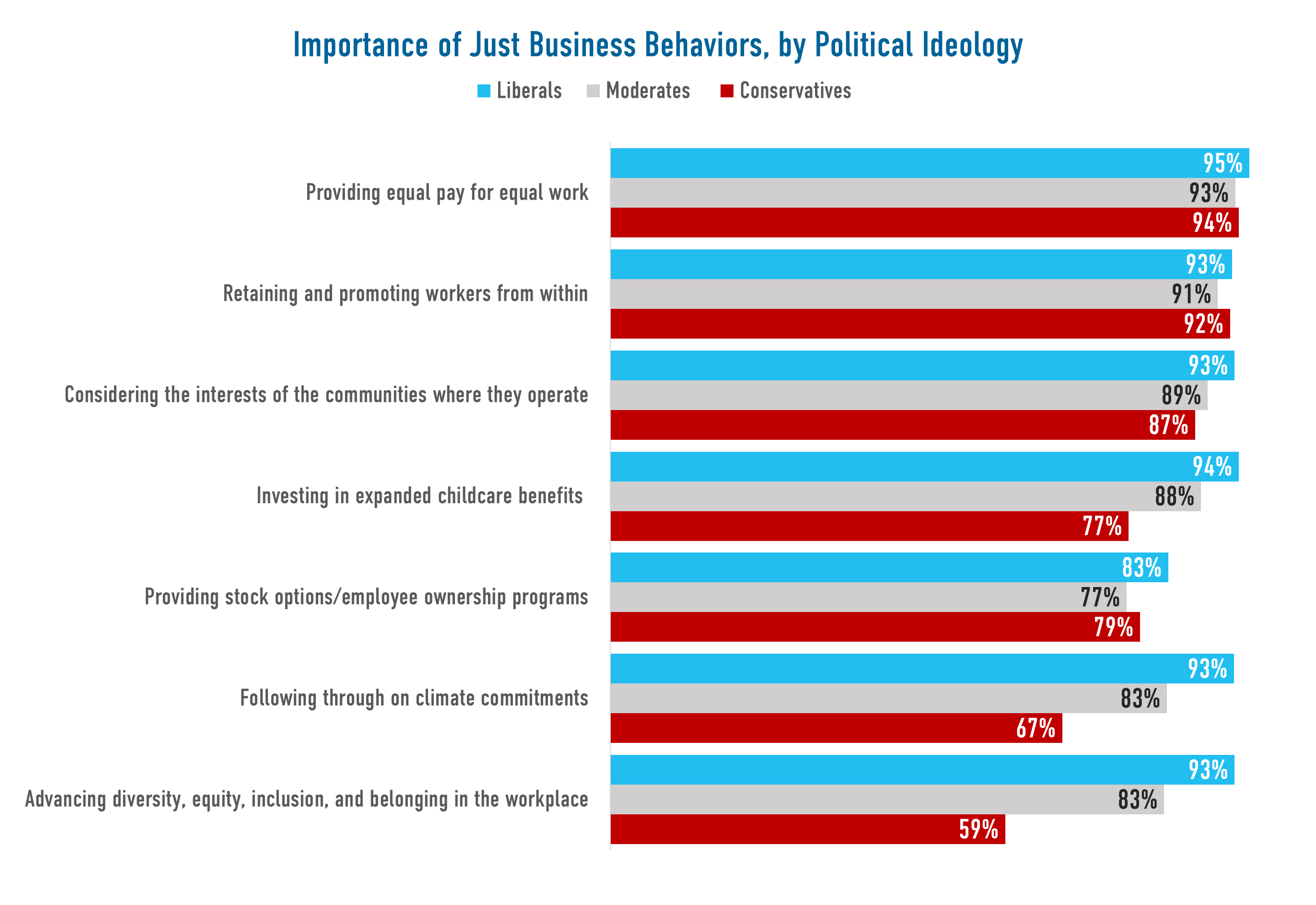
Examining this result through the lens of political ideology, we see a surprising amount of agreement. Liberals, moderates, and conservatives are seemingly in lockstep in believing that the issues of equal pay, investing in workers (including via ownership programs), and supporting communities are essential to just business behavior today.
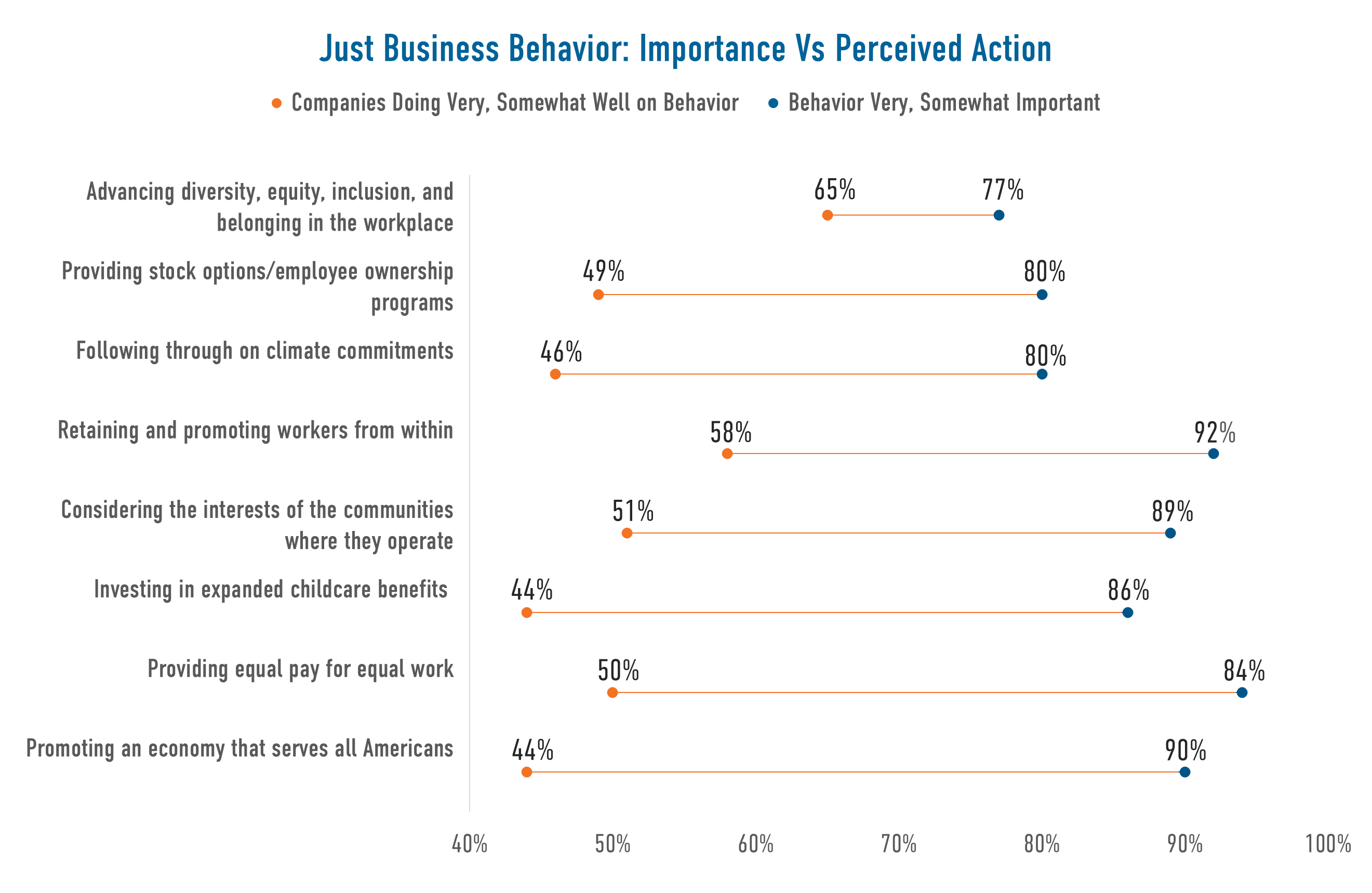
For business leaders, this identifies some clear common ground where actions can be taken with the least risk of backlash. Moreover, in mapping the disparities between the public’s perceived importance of an issue and their opinions on the level of corporate action on that issue, we also shed light on where there are the greatest opportunities to demonstrate authentic leadership. Notably, “promoting an economy that serves all Americans” is the issue with the greatest perceived distance between importance and action (46 percentage points).
Americans continue to want more information on the steps companies are taking on key business and societal issues. Here are a few illustrative quotes from this year’s focus groups:
“I tend to think favorably upon companies that are transparent and open and honest. And even if the data is lackluster or disappointing, I think being transparent and open and honest is a favorable trait. And the real kicker is when it’s combined with positive efforts and the reporting is that they’ve done some good things.”
“[Companies should] try to become transparent and more free with their information. Because at this point, I don’t see it, and that’s why there’s a lot of distrust for myself with a lot of big organizations.”
“I think we should be able to expect transparency. Whether we can, or whether we’ll get it or not, that’s to be debated, but I think we should be able to expect it.”
The chart below highlights that public demand for more corporate transparency increased across all disclosure categories from 2023 to 2024.
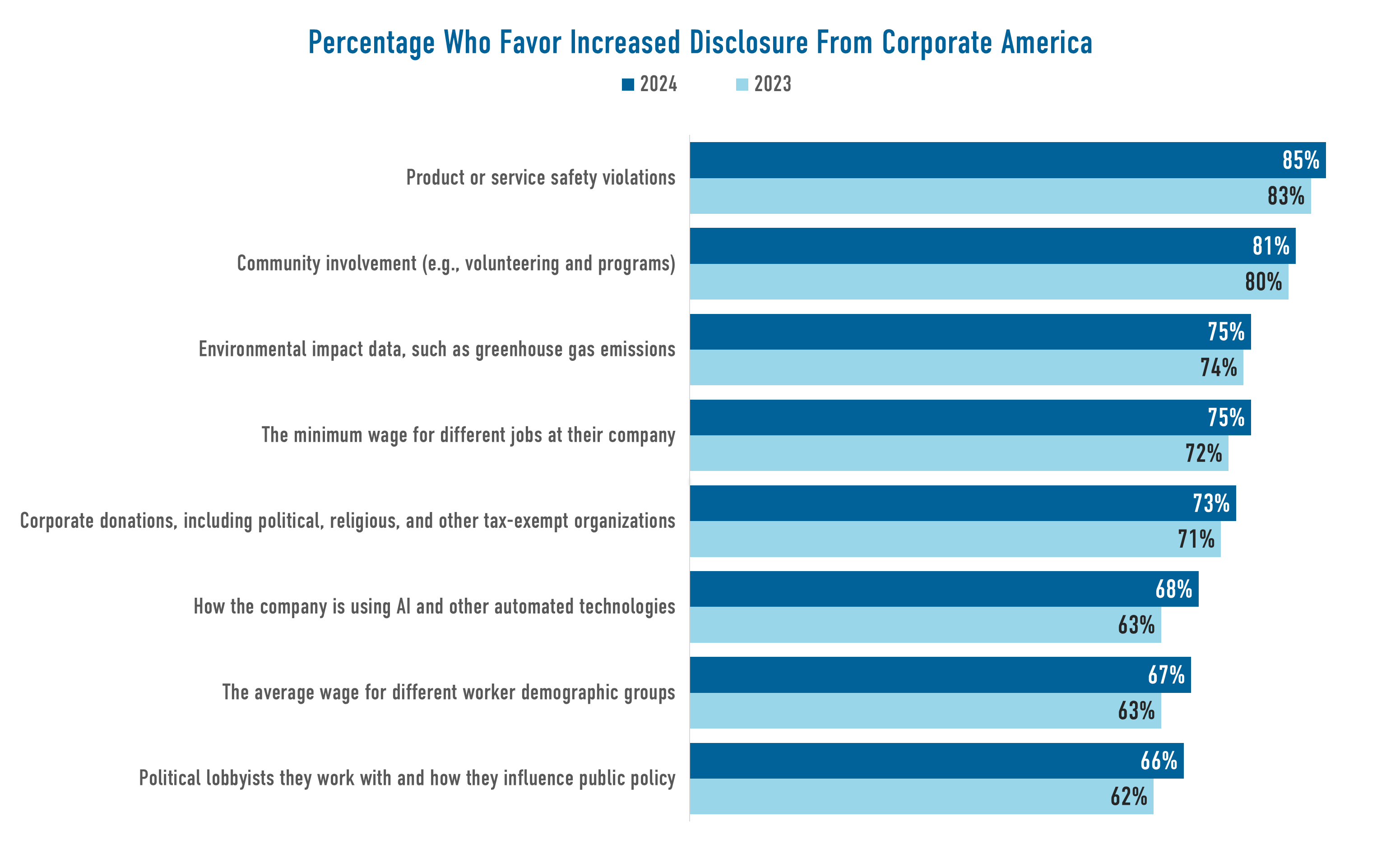
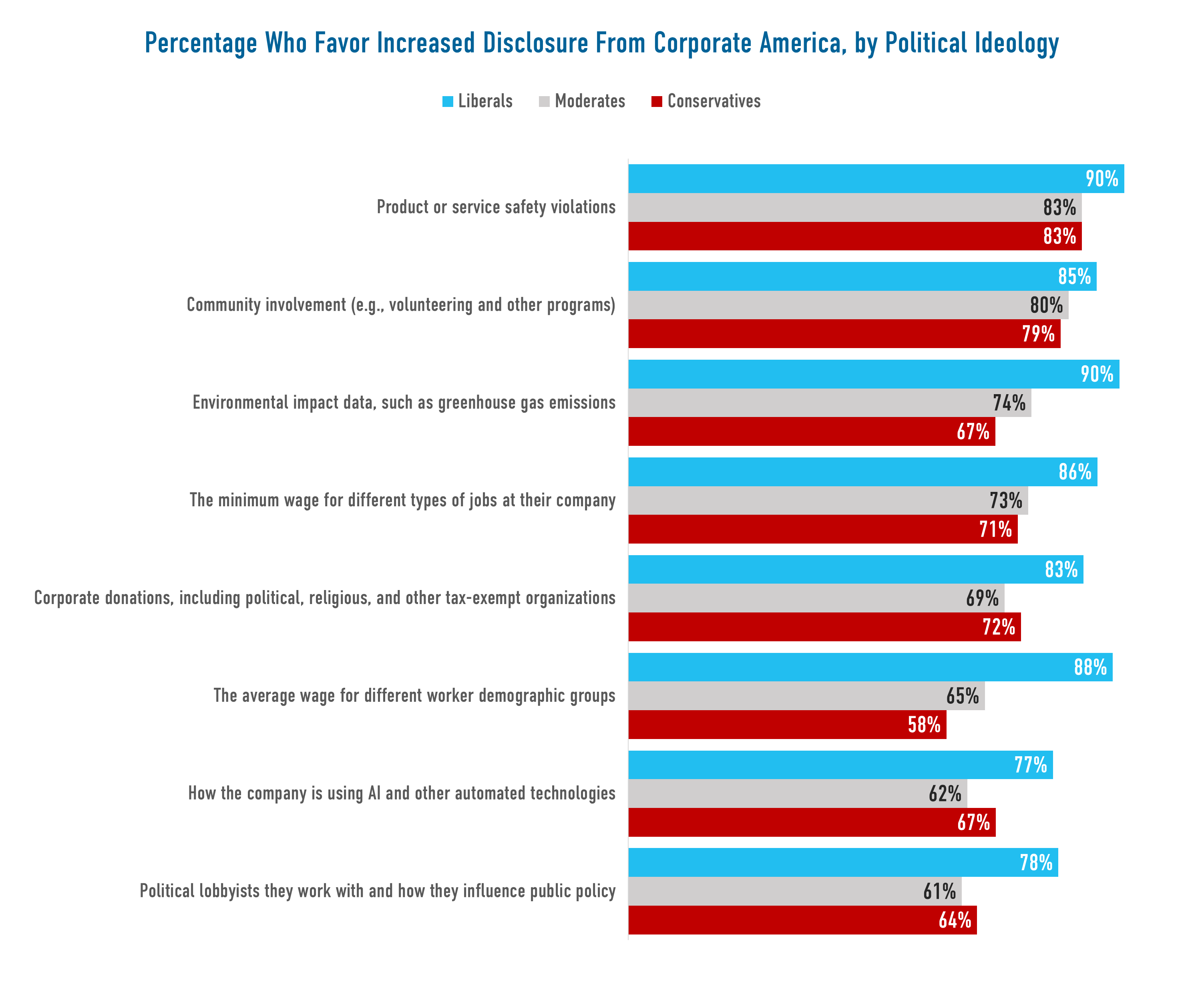
For many issues, the demand for greater disclosure also transcends political ideology. Specifically, product and safety violations, community involvement, corporate donations, deployment of AI, and (to a lesser extent) minimum wage and political involvement are all areas where we see cross-party alignment on the need for more transparency. Disclosure on environmental impacts and demographic wage information are the areas where political opinion is most divided.
This year’s Americans’ Views on Business Survey makes it clear that Americans want corporate leaders to get back to the basics of just business operations: focus on creating value for all stakeholders by concentrating on those areas where positive impact dovetails with positive business performance.
Later this year, we will be releasing The People’s Priorities, a companion report that details what Americans believe are the actions and behaviors of just companies. Together, the data and insights from these reports will support corporate leaders in understanding how they can take action on the public’s priorities and create more value for both shareholders and society at large.
Since 2015, Just Capital has surveyed more than 182,000 Americans on a fully representative basis to assess how well they think companies are doing when it comes to creating value for all their stakeholders and building a more just economy that truly works for all. The 2024 Americans’ Views on Business Survey was fielded among 3,008 Americans – a sample representative of the U.S. adult population – between July 10 and July 16, 2024. Our quantitative research partner is SSRS, an objective, nonpartisan research institution that provides scientifically rigorous statistical surveys of the U.S. population. Our full body of survey work for 2024 also included six focus groups conducted in partnership with The Harris Poll comprising a total of 35 participants who represented a mix of demographics (e.g., age, ethnicity/race, political ideology, household income, and education).

Just Capital’s 2023 Issues Report – The People’s Priorities is by Jennifer Tonti, Managing Director, Survey Research & Insights.
In every year that we’ve been measuring which issues matter most to the public when it comes to just business behavior (what we call The People’s Priorities), the events of that year can determine which issues Americans deem more important than others, as well as the degree to which the public prioritizes each issue. The outputs of this ongoing study help provide a roadmap for companies regarding what issues they should be tracking and investing in to stay one step ahead of shifting expectations.
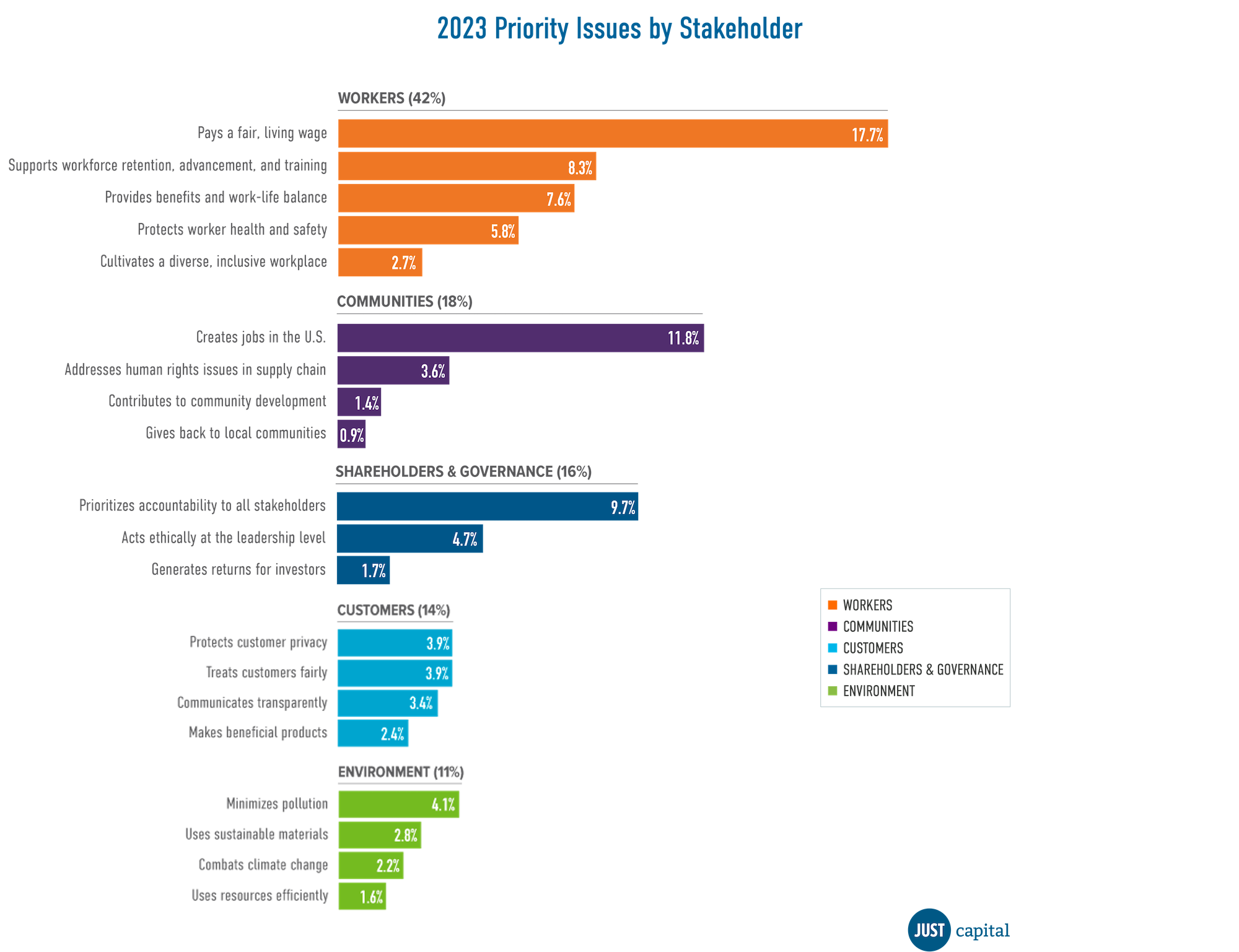
The top takeaway from this year’s polling is how enduring and consistent the public is when it comes to what they want the nation’s largest public companies to prioritize. Year after year, Americans say that companies should put workers squarely at the heart of their business practices, foremost by paying their workers a fair and living wage. Indeed, Worker Issues continue to command the highest share of priority (42%) among the 20 stakeholder-related issues we measure, with four of the five Worker Issues once again among the top six priorities of the public, with Workforce Advancement gaining in importance this year.
Even more encouraging is that despite vocal attempts by politicians to use business as a divisive wedge issue this year, Americans remain united, not divided, across political ideologies around what they want from companies today. As in years past, we found a broad consensus across demographic and political cohorts – liberal, conservative, high-income, low-income, men, women, young generations, older generations, and white, Black, and Hispanic Americans – that Workers should be corporate America’s top stakeholder priority and that paying a fair, living wage should be the number-one issue to prioritize.
Just’s annual Rankings process begins with focus group conversations with a diverse mix of Americans across the U.S., the goal of which is to understand the actions and behaviors they expect from a “just” business. Focus groups enable our research team to hear the unvarnished voice of the public speak about what issues matter most, and whether their opinions have changed over time. The polling team then distills the major themes of these discussions into statements that capture these concepts, which we call “Issues.” In 2023 (as in the past two years), this work yielded 20 Issues.
Since the public initially tells us that all of these Issues are of high importance, we then conduct a choice modeling exercise as part of our Annual Survey work, enabling us to derive the relative importance of these 20 Issues. From here, we extract a “weight” per Issue that we use as the foundation for our Rankings of America’s Most Just Companies. The weights below reflect the probability that an individual would choose that Issue as most important to defining a just company, based on a representative sample of 3,001 Americans. These weights power our analysis of corporate stakeholder performance at the country’s largest companies, including our annual Rankings of America’s Most Just Companies.
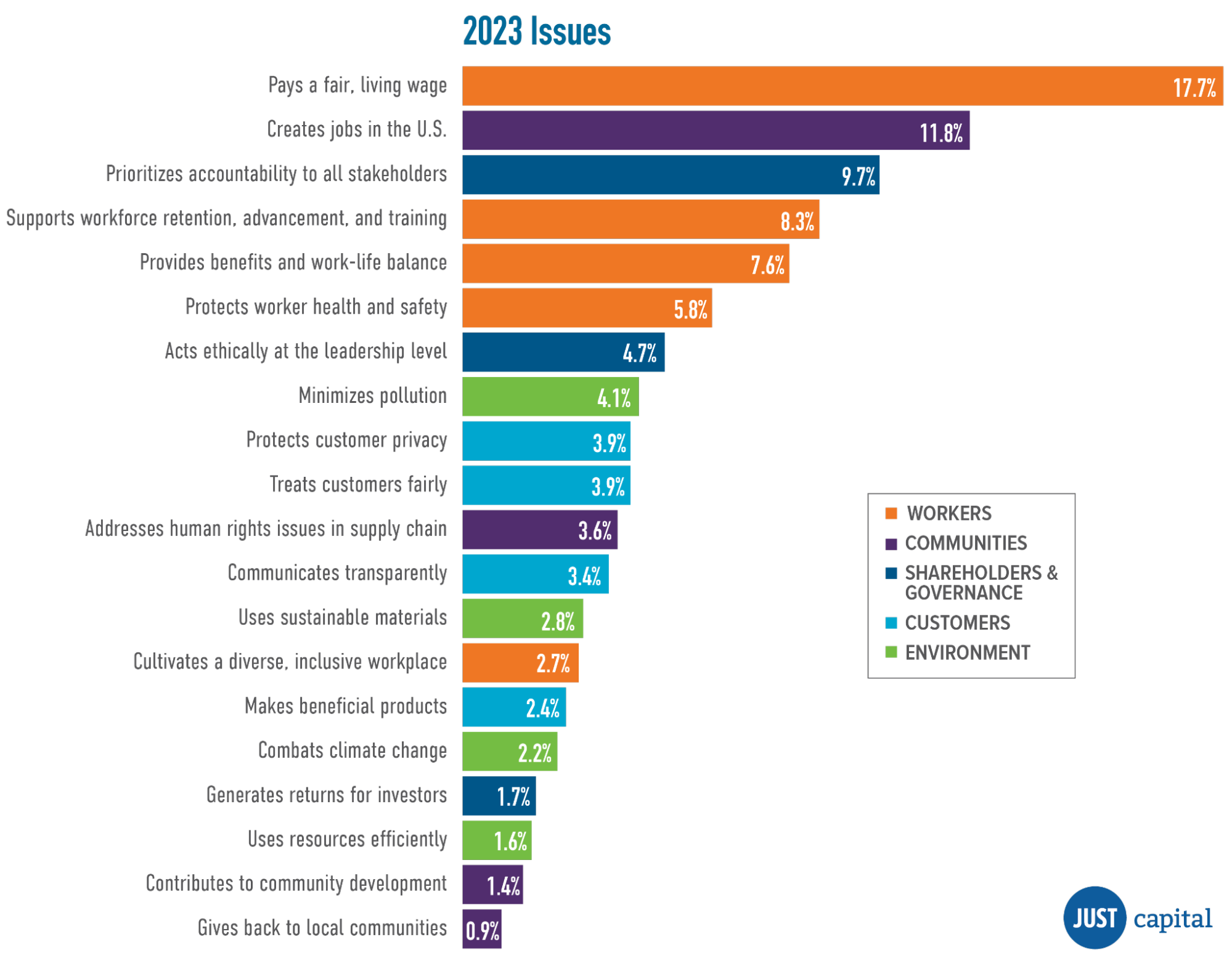
Each Issue is color-coded by the stakeholder it most impacts. While we reference the prioritization of several Issues in this report, please note that the relative importance between many of these Issues often varies by a fraction of a percentage point.
As we saw in 2022, four of the five Worker Issues are among the top six-ranked issues overall. The top-most prioritized issue, “Pays workers fairly and offers a living wage that covers the cost of basic needs at the local level” has been the number one issue for the last six years in a row, and will comprise a substantial 17.7% of companies’ scores in our upcoming 2024 Rankings. This percentage, though lower than we saw last year (21.2%), is still far-and-away the highest across all 20 issues. And the issue is ranked first among nearly every demographic cohort.
From auto to health care to entertainment, 2023 has marked a year of labor strikes across industries. Rising inflation, rapid evolution of AI technology, and the broader impacts of the pandemic on the U.S. workforce have fueled demands for better pay, working conditions, and job security. Even threats of a strike, as was the case for airline pilots and UPS workers this year, has spurred companies to raise wages and enhance benefits. Workers are no longer willing to accept pay that doesn’t allow them to provide for themselves or their families.
In 2023, “Focuses on workforce retention and employee advancement by providing training, education, and career development opportunities” comprises 8.3% of a company’s score, and now is the second highest-ranked worker issue. In the past two years, we’ve seen the issue of retention and advancement steadily increase in importance among the public. This increase occurs alongside the rapid evolution and adoption of AI and other technology by many employers. Fears of how this technology could replace, or diminish, certain jobs in part fueled strikes from Hollywood writers and actors and auto workers. As more workers fear losing their jobs, investing in growth, training, and opportunities for employees can have a positive effect on retention and send an important signal to workers that employers value them. Many companies have already started to recognize and act on this.
Benefits and Worker Health & Safety rank fifth and sixth among the public’s priorities. “Offers a quality benefits package and supports good work-life balance for all employees” comprises 7.6% of a company’s score, up from 6.2% in the previous year. “Protects the health, safety, and well-being of workers beyond what is required by law” remains one highest ranked issues at number six, but its importance has decreased from 7.6% last year to 5.8% this year as the urgency of worker health and safety slows after the height of the pandemic.
One of the obvious reasons why Worker Issues consistently get the highest prioritization among the five stakeholder groups may be attributable to the fact that at some point or another in everyone’s life, they are a worker. Thus, these issues are arguably closer to home than those that are reportedly as important overall, but come in at a lower relative priority (such as communities or the environment) in our polling. What the continued prioritization of Worker Issues across seven years of gathering this data is definitely saying is that, despite all the work companies are doing to make sure their workforce is happy and protected, there is still more to do. A recent Deloitte survey found that there is a marked discrepancy in perceptions of workforce well-being between employees and employers. The survey found that while many leaders say they’re taking accountability for workforce well-being, workers simply aren’t seeing their efforts.
There is a very clear business case for corporate leaders to focus on Worker Issues. Investing in good jobs that provide strong benefits, fair wages, and opportunities for advancement is a value generator for companies. In March, we soft launched the first iteration of the Just Jobs Scorecard and have plans to publicly launch the Scorecard in early 2024. The tool helps companies better understand their current performance on a range of job quality metrics like training and development, and how they could improve. When examining the top-scoring companies across the Scorecard’s categories, we found they outperformed their peers in 2022. Prioritizing worker issues is an opportunity for companies to lead and, in turn, boost their bottom line.
One Issue that falls under the Communities stakeholder, “Creates jobs in the U.S. and provides employment opportunities for communities that need them,” is once again second in relative importance, comprising 11.8% of a company’s score in our Rankings. Two in three respondents (66%) say that creating jobs in the U.S. is more important than last year.
Accountability to Stakeholders, an issue that falls under Shareholders & Governance, is of key importance to Americans as well. “Has an independent, diverse board that holds leadership accountable to the needs of workers, customers, communities, the environment, and shareholders” comprises 9.7% of a company’s score, and is the third most important Issue in 2023, reinforcing the fact that in the eyes of everyday Americans, companies have a broad responsibility to serve all the stakeholders that drive the long-term success of the company (not just shareholders), and that leadership should be held accountable by its board.
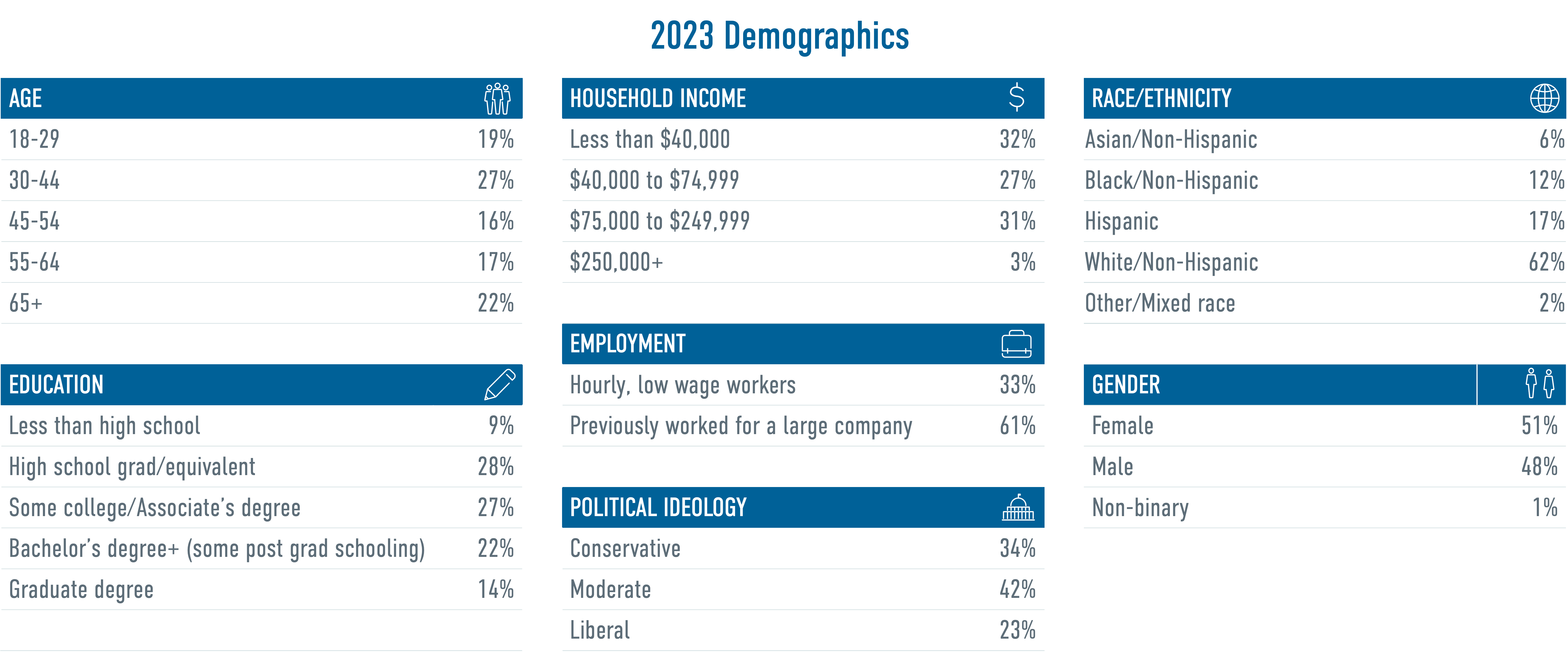
The People’s Priorities are based on responses from more than 3,000 U.S. adults, who are a full representative cross-section of Americans. This means we hear from a variety of voices, both by demographic such as race/ethnicity, gender, income levels, and age, as well as behavioral metrics such as political ideologies or whether or not respondents are active investors. What we found was, despite it being a year with increasingly divisive rhetoric in politics and in the media, the public remains remarkably consistent in what they want companies to prioritize today. Across every demographic group we surveyed, whether political affiliation, race, gender, age, or income group, Americans are united in wanting companies to prioritize Workers as the most important stakeholder and nearly all cohorts prioritize the same top three Issues: Pays a fair, living wage; Creates jobs in the U.S.; and Prioritizes accountability to all stakeholders.
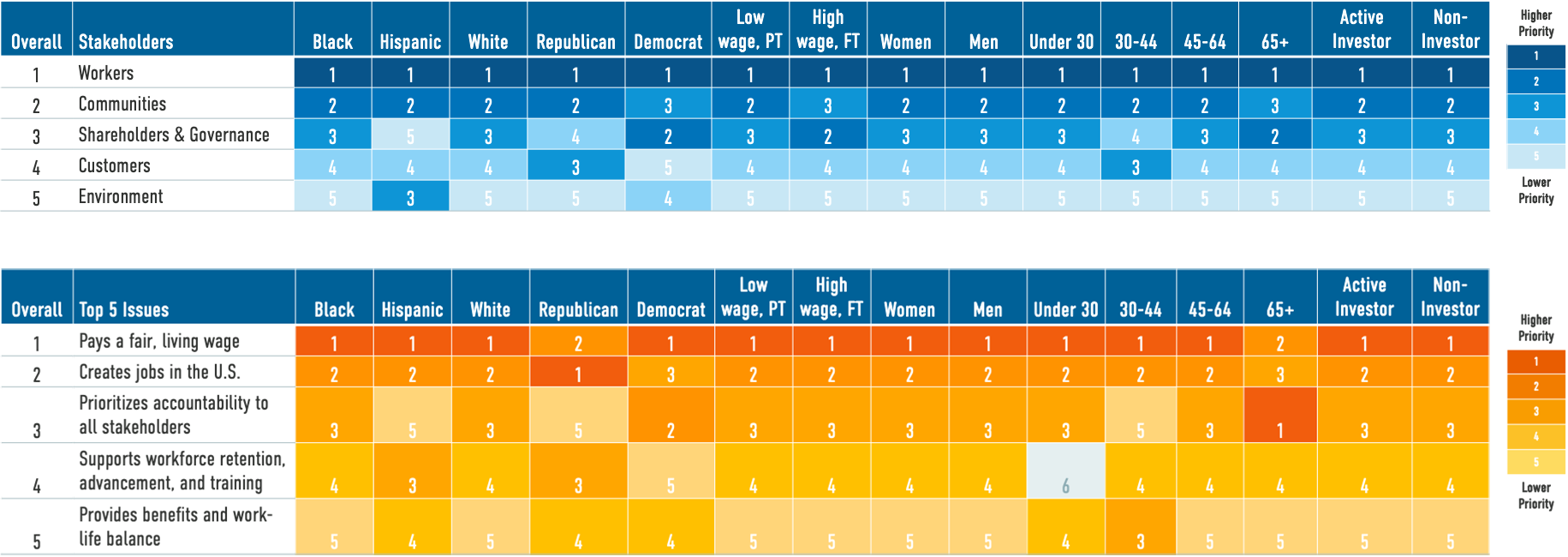
To provide further clarity around how to better balance stakeholder interests, we classify each Issue by the stakeholder it affects most, organizing the 20 Issues into five stakeholder groups: Workers, Customers, Communities, the Environment, and Shareholders & Governance.
Specifically, we assign each of the 20 Issues to the one (and only one) stakeholder it most impacts. For example: “Compels leadership to act ethically and with integrity and avoid wrongdoings” is assigned to Shareholders & Governance, whereas “Is transparent in communications with customers about its products, services, and operations” is assigned to the Customers stakeholder. The weight of each stakeholder group is calculated by summing all of its associated Issue weights.
Workers (42%)
For the sixth consecutive year, the American public prioritizes Workers as the most important stakeholder by a significant margin. The Workers stakeholder considers a company’s performance on factors related to how it invests in its employees, including (1) paying a fair, living wage; (2) supporting workforce retention, advancement, and training; (3) providing benefits and work-life balance; (4) protecting worker health and safety; and (5) cultivating a diverse and inclusive workplace.
Communities (18%)
The Communities stakeholder considers a company’s performance on factors related to how it supports its communities, including (1) creating jobs in the U.S.; (2) addressing human rights issues in the supply chain; (3) contributing to community development; and (4) giving back to local communities.
Shareholders & Governance (16%)
Issues included in this grouping explore how a company maintains good governance and delivers value to its shareholders by (1) prioritizing accountability to all stakeholders; (2) acting ethically at the leadership level; and (2) generating returns for investors.
Customers (14%)
The Customers stakeholder considers a company’s performance on factors related to how it treats its customers, including (1) protecting customer privacy; (2) treating customers fairly; (3) communicating transparently; and (4) making beneficial products.
Environment (11%)
The Environment stakeholder considers a company’s performance on factors related to how it reduces its environmental impact, including (1) minimizing pollution; (2) using sustainable materials; (3) combating climate change; and (4) using resources efficiently.
Year after year, we continue to see that the public supports a movement away from shareholder primacy toward a more stakeholder value-driven operational model of business, one that takes America’s largest companies on a journey to becoming more just. Results from this latest survey shows that the areas Americans want corporations to prioritize have not changed substantially in the past few years. The labor strikes and demands of the last year, however, have added new urgency to them.
It’s become more clear to corporate America that ignoring these priorities presents a significant risk to business. Now is the time for proactive action. And the views of the American public offer a helpful roadmap. We hope that this report once again provides clear guidance on the specific actions businesses can take today to rebuild trust in business and markets as a force for good.
A Representative Look at the Public’s Views
Since its inception, the mission of Just Capital is to demonstrate how just business – defined by the priorities of the public – is better business. Our goal is to help companies create value for all their stakeholders – their workers, customers, communities, the environment, and shareholders – by focusing on the issues that matter most to the American public. The goal is to help companies improve, and in turn, improve the lives of their workers, customers, and society writ large.
At the core of our work is a robust research program that starts with focus groups in which we ask the American public to identify the policies, practices, and behaviors companies should prioritize to be considered just, (which we call “Issues”). These Issues include fair pay and living wage; a more diverse and inclusive workplace; stronger, healthier communities; good jobs; a cleaner environment; and more. Then, based on sophisticated polling of a representative sample of Americans, we estimate the relative importance of these behaviors – in other words, how important to defining a just company each behavior is relative to others.
Since 2015, Just Capital has surveyed more than 172,000 Americans – representative of the U.S. adult population – asking them to define just business behavior. For the past two years, we have partnered with SSRS, an objective, non-partisan research institution that provides scientifically rigorous statistical surveys of the U.S. population, to survey more than 3,000 Americans on their perspectives.
Defining a Just Company
Before answering questions about the just behavior of large companies, it is important for respondents to have a clear definition of the concept. Below is the definition we have provided to our focus group and survey respondents since 2022: A just company operates in a way that serves its workers, customers, shareholders, the environment, and the communities it affects, even if it comes at a cost.
Summary of Methods
We conducted the 20 question survey online with a probability-based sample attained through the exhaustive statistical sampling methods employed by SSRS. The SSRS Opinion Panel is a nationally representative probability-based web panel, and findings are generalizable to the general adult population.
The full survey was conducted from June 23 to July 5, 2023 among a general population sample of 3,001 English- and Spanish-speaking U.S. adults 18+ years of age, with an oversample of 590 Hispanic and 411 non-Hispanic Black respondents. Panelists were sent an email invitation to take the survey online as well as up to eight reminder emails throughout the field period. The survey program was optimized so that respondents could complete it using a desktop or laptop computer as well as a mobile device. In total, 900 respondents completed the survey on a computer and 2,101 completed it on a mobile device.
The margin of error is +/- 2.2% at the 95% confidence level. Results were weighted to U.S. Census parameters for age, gender, education, race/Hispanic ethnicity, and Census Division to ensure representativeness of the U.S. population. All margins of error include “design effects” to adjust for the effects of weighting.
To identify the priorities of the public, we calculate for each Issue the probability that an individual would choose that as most important to defining a just company. As such, there are 20 probabilities calculated from the 20 Issues. These probabilities can be referred to as weights as each represents the relative importance of one Issue versus another. To illustrate more explicitly, the Issue “Creates jobs in the U.S.” was assigned a weight of 11.8% as there is a 1.18 in 10 chance that a respondent chosen at random will identify this Issue as most important in defining a just company. By comparison, the weight assigned to “Generates returns for investors over the long term” has a 1.7% weight.
Our full body of survey work for 2023 also includes six focus groups conducted in partnership with The Harris Poll.

What makes a good job? It’s a question that’s driving many conversations today – from picket lines with auto employees and Starbucks baristas to C-suites and boardrooms across the country.
At CNBC’s 2023 Workforce Executive Council Summit this week, Just Capital President Alison Omens joined moderator CNBC editor Susan Caminiti and multiple company executives for a panel discussion focusing on that very question.
A C-suite leader from a major retailer explained that every company needs to deliver on fundamentals for workers, by providing a living wage, benefits, and safety. But she said there’s “much room for leadership” on something else workers want – opportunity. Meaning, the ability to climb the ladder from an hourly position to a salaried one, or the chance to start a strong career without necessarily having a college degree.
Our polling, which Alison discussed, supports that insight. JUST’s research shows that Americans want three main things: a job that pays fairly and offers a local living wage; protects their health and well-being; and supports advancement, upskilling, and training – or as the retail company leader dubbed it, “opportunity.”
Nearly two-thirds of U.S. adults do not have a college degree – and so for millions of Americans, these “opportunity” investments from business leaders can mean the difference between living paycheck to paycheck or a stable, middle-class life.
There’s much happening in this area. Just this month, IBM announced new skills training in climate technology for students in vulnerable communities. Visa launched new upskilling programs. Amazon highlighted the success of its apprenticeship programs. And Microsoft partnered with a local technical college to offer new training courses.
Workforce opportunity is critical to our partnerships with companies and our mission overall. We’ll be tracking it closely.
Be well,
Martin
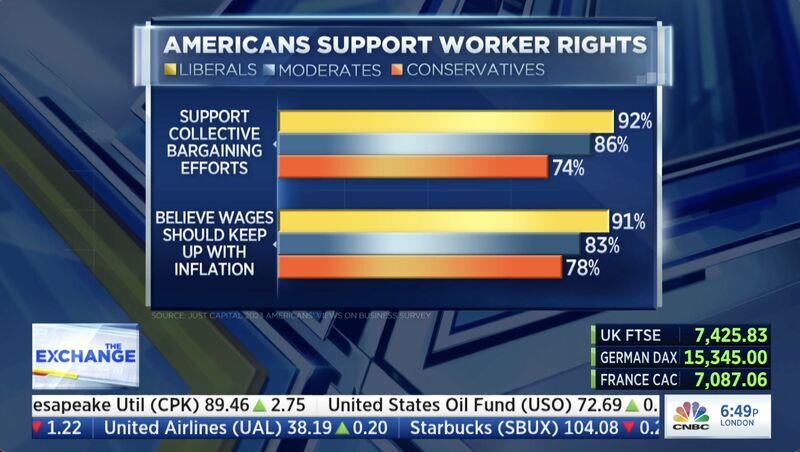
In an on-air segment, CNBC’s Pippa Stevens covers JUST Capital’s 2023 Views on Business Survey Report. The report finds that Americans are increasingly skeptical of corporate America’s promises to do better. For example, when it comes to promoting an economy that serves all Americans, 91% of Americans agree it is important, but only 38% agree companies are doing well – a 53 percentage point divide.
Just Capital’s investor team pens an interesting analysis that finds that among negative earners in the Russell 1000, JUST leaders have outperformed laggards by almost 40% since January 2020.

“What we’re really eager to see next year is does the decline in wage growth translate to lower inflation? There was the idea that the labor market was going to be a continuing source of fuel for higher inflation. [But] wage spiral doesn’t seem evident at all in this data. The concern is that maybe things start to stall out on the inflation side. And luckily, we haven’t seen that yet.”
Fortune reports that Bill Gates believes everyone will have an AI personal assistant in five years, and that it will fundamentally change the way people live and work. Gates sees this evolution in AI as going beyond pure productivity-boosting, saying that these “agents” could help generate a business plan or answer employee questions in a meeting.
SAG-AFTRA has officially released the details of its latest union contract, and those around AI performers are particularly interesting. Rolling Stone reports that companies must request consent before making digital replicas of actors and must disclose how the replica will be used. Not everyone is pleased with this deal. Some, like Justine Bateman, who was an AI advisor to the actor’s union, think that the deal leaves far too many loopholes that would allow studios to slowly push out real actors.
Airbnb has acquired GamePlanner.AI, its first acquisition as a public company, to help design full bespoke trips and stays for users based on previous interests.
Honda and Hyundai have joined Toyota in raising wages for their U.S. workers and cutting down on how long pay increases take, fearing that union strikes will soon push past the midwest and into foreign auto manufacturers.
CNBC reports that union workers at GM ratified the UAW’s new contract with the automaker. Union workers at Ford and Stellantis are expected to ratify the new contracts as of Thursday early evening – though the votes have been closer than expected. NPR digs into why some union workers are voting ‘no’ on the deal.
A new Deloitte report highlights a significant disparity between C-suite leaders’ perceptions of worker well-being and the actual experiences of workers. Employee well-being has worsened across a number of dimensions, including physical, mental, social, and financial well-being, the report finds.
According to a new Bloomberg Intelligence survey, 89% of investors believe using ESG metrics is now mainstream, despite the political pushes to do away with them, and C-suite executives feel they help shape a “more robust corporate strategy.”
The Washington Post reports that the latest National Climate Assessment paints a grim picture: weather-driven disasters are happening far more frequently and are costing the U.S. about $150 billion each year, on average.
The Wall Street Journal reports that thousands of unionized Starbucks workers have gone on strike for ‘Red Cup Day’, the company’s largest promotion every year, in order to progress labor talks.
Citigroup CEO Jane Frasier announces the company’s first wave of layoffs on Wednesday, working from middle management down to the rank-and-file employees by February in a bid to try and pull the company out of a stock slump.
The Harris Poll (in conjunction with EdAssist) found that 77% of Americans believe other forms of education like certifications and online courses are more useful than a traditional college degree, and that upskilling at a job is becoming a far more attractive benefit for many younger workers.

One of the most revealing charts from our 2023 Views on Business Report shows what issues Americans want corporations to tackle, and if they see companies following up. Most importantly, while 91% of Americans want companies to push for an economy that serves all Americans, only 38% agree companies are doing well. Explore more of the results here.
This report was written by Jill Mizell, Director of Survey Research.
Against the backdrop of ongoing economic uncertainty, the American tech sector – long a bastion of growth, innovation, and prosperity – has been rolling out waves of layoffs over the past year, with companies including Microsoft, Amazon, Meta, Salesforce, and more letting go an estimated 168,000 tech workers in 2023 alone, already surpassing the total number of tech jobs cut in 2022 (161,000). And while the labor market is still holding strong, with 10.8 million jobs open in the U.S. today, tech layoffs could signal further economic complications, including job cuts across other industries, and even be a harbinger of recession.
With companies increasingly turning to layoffs as a cost-cutting measure, it’s expected that tens of thousands more workers will be impacted. Layoffs are, it seems, an inevitability for many of America’s knowledge workers, and the question on the minds of corporate leaders and workers alike is: can layoffs be “just?”
As part of Just’s ongoing work to understand how the public defines just business behavior, we turned to Americans to get their take on what it means to conduct ethical and just layoffs – and whether that is even possible. As we forge ahead in an increasingly unpredictable job market, the public’s views can offer critical insight for business leaders looking to consider the full impact of forthcoming and potential layoffs.
Key findings from Jusr Capital’s survey include:
With ongoing mass tech layoffs continuing to make headlines, it’s no surprise that Americans are in the know. When we asked respondents whether they were familiar with this issue, a large majority (85%) shared that they have heard about recent mass job cuts in the tech industry, and one-third (33%) told us they’ve heard a lot about the job cuts.
Beyond just being familiar with the latest news, large percentages of Americans also believe layoffs could have been avoided – in particular, strong majorities of younger respondents and those who have heard about the most recent waves of layoffs, as well as Democrats and Independents.
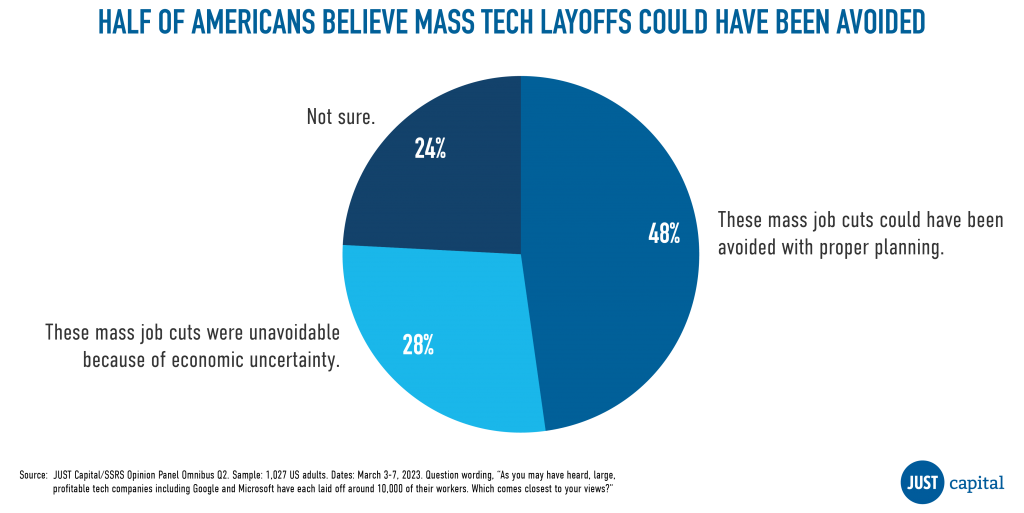
Overall, half of Americans (48%) believe these mass job cuts in tech could have been avoided with proper planning, while 28% believe they were unavoidable due to economic uncertainty and 24% aren’t sure whether the job cuts were avoidable or not.
Among those that told us they’ve heard a lot about recent tech layoffs, respondents are more likely than others to say these job cuts could have been avoided (55%, compared to 45% of people who have heard a little about tech layoffs and 43% of people who have not heard about the tech layoffs).
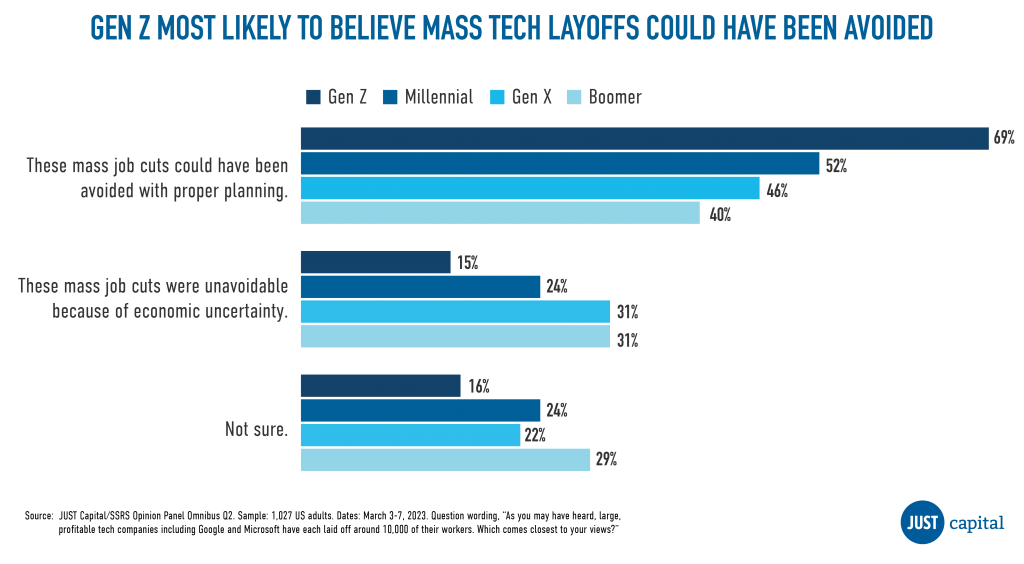
Younger cohorts are significantly more likely to believe layoffs could have been avoided. 69% of Gen Z respondents (people aged 18-26) believe these tech layoffs were avoidable with proper planning, compared to 52% of Millennials, 46% of Gen X, and 40% of Boomers. Nearly a third of Boomers (31%) and Gen X (31%) say the mass layoffs in tech were unavoidable, making them twice as likely as Gen Z to say so (just 15% of Gen Z respondents believe the layoffs were unavoidable).
We also see a stark contrast when we look at responses by political party. While 50% of Democrats and 55% Independents believe recent mass layoffs in tech could have been avoided, just 36% of Republicans see them as avoidable.
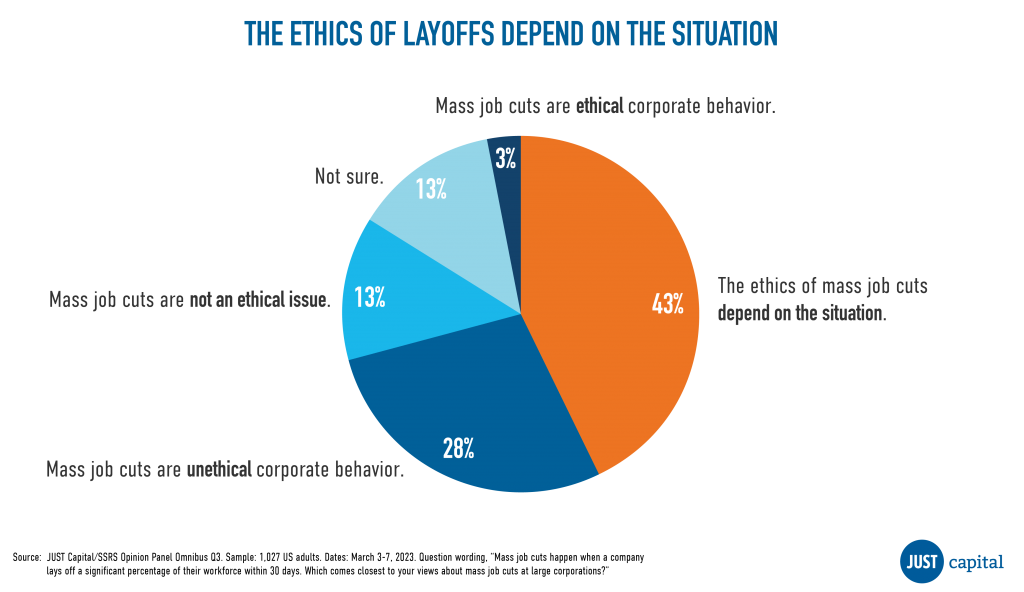
With mass layoffs ongoing, the question of ethics is an inevitable one, and we turned to the public to ask them whether they believe mass layoffs can be ethical. A plurality of 43% believes that the ethics of mass job cuts depends on the situation, while 28% believe mass layoffs are unethical corporate behavior. Just 3% of Americans believe job cuts are ethical corporate behavior, and 13% believe layoffs are not an ethical issue.
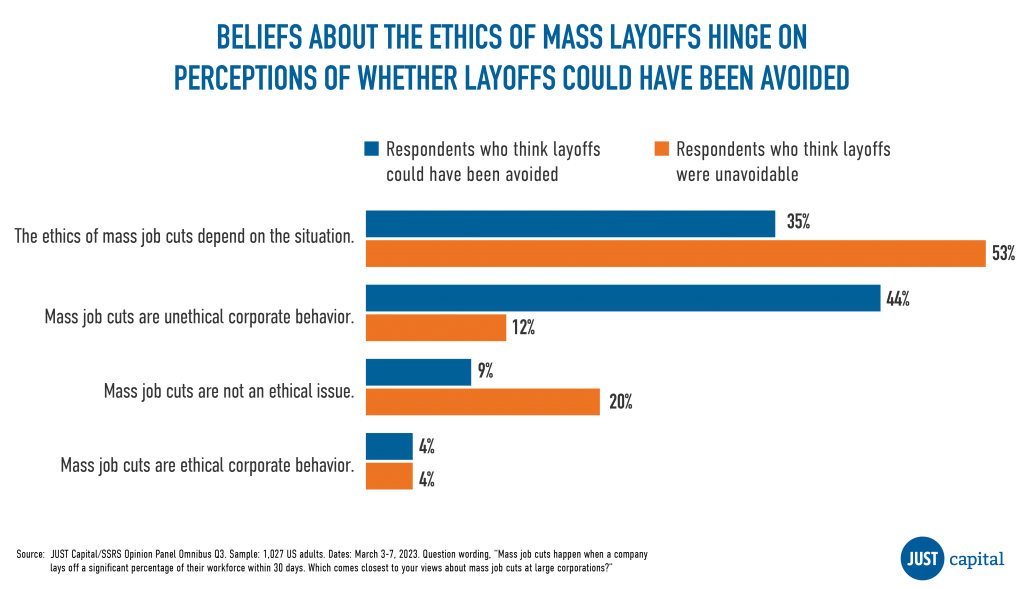
Whether a respondent believes these layoffs could have been avoided or not plays a significant role in their perception of corporate ethics around layoffs. People who believe these layoffs were avoidable are more than three times as likely to say mass layoffs are unethical corporate behavior than those who believe the layoffs were unavoidable (44% vs. 12%).
On the flip side, people who felt the layoffs were unavoidable are twice as likely to say that mass job cuts are not an ethical issue at all compared to those who believe the layoffs could have been avoided (20% vs. 9%). People who think the layoffs were unavoidable are also more likely to say that the ethics of layoffs depend on the situation compared to those who believe the layoffs could have been avoided (53% vs. 35%).
Regardless of the public’s perspectives on avoidability and ethics, layoffs show no immediate sign of stopping. We asked respondents what companies should consider in order to conduct layoffs in as just and ethical a way as possible. Americans agreed that, for corporations to conduct layoffs in an ethical way, they must give workers advance notice in a respectful manner (69%); provide generous severance packages to workers including pay and health care coverage (61%); provide access to job finding services at no cost (52%); and reduce the number of jobs to cut by decreasing other costs as much as possible (52%).
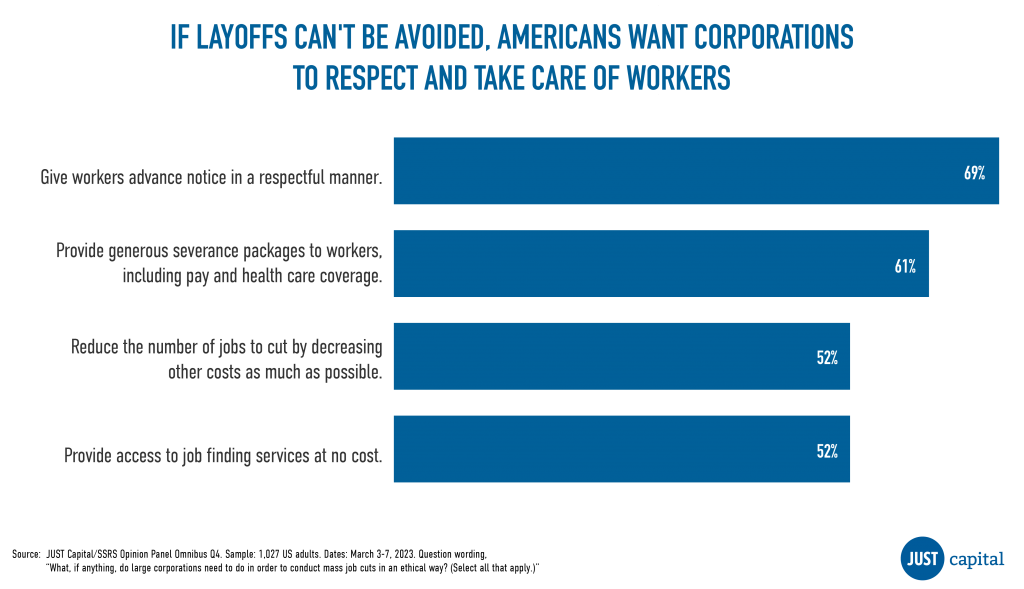
When it comes to severance packages specifically, there is significant divergence between respondents with differing political views. 46% of Republicans believe companies conducting mass layoffs should provide generous severance packages, compared to 75% of Democrats and 63% of Independents.
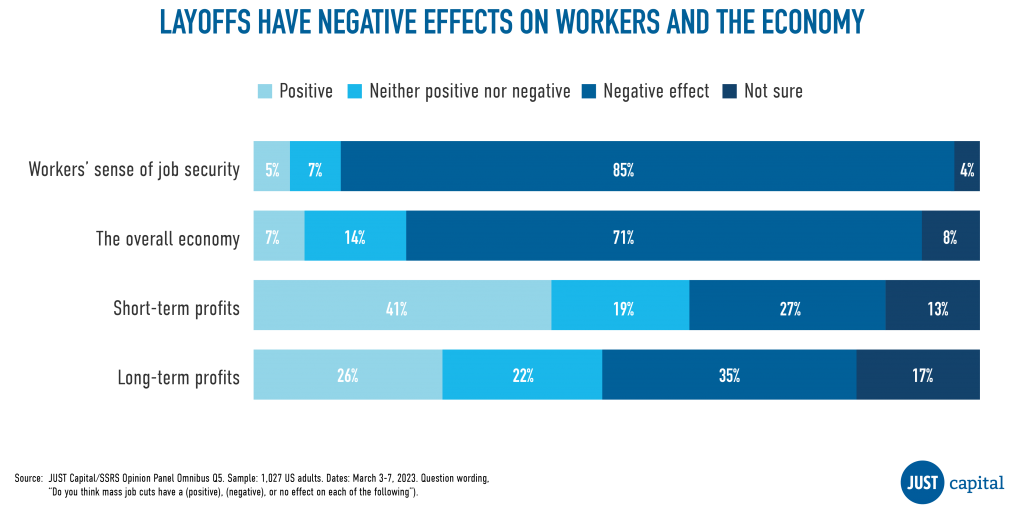
When we asked the public what they think the short- and long-term impacts of mass layoffs might be, strong majorities shared that they believe mass layoffs have a negative impact on workers’ sense of job security (85%) and the overall economy (71%).
A plurality of 41% believes that mass layoffs will have a positive effect on short-term profits, while 27% believe layoffs will have a negative impact and 19% believe layoffs do not impact short-term profits either way.
When it comes to long-term profits, a plurality of 35% believe layoffs will have a negative impact on long-term profits, while 26% believe layoffs will have a positive impact and 22% believe layoffs do not impact long-term profits either way.
As Americans weather the ongoing storm of economic uncertainty, it’s likely that layoffs will continue to unfold in the tech sector and spread to other industries, as we are already seeing in media and manufacturing – and this week, with McDonald’s closing its headquarters in anticipation of job cut announcements. Corporate leaders will continue to face difficult decisions on how to cut costs – and while mass tech layoffs may or may not have been avoidable, they are happening now, and Americans are watching closely to learn whether companies are conducting these layoffs in a way that is ethical and just, and that minimizes negative impacts. It’s not yet clear how widespread these layoffs could become, or to what extent they will impact that broader job market, but as corporate leaders prepare for what to come, the voice of the public provides crucial guidance on how to navigate this challenging time in as just and ethical a way as possible.
This survey was conducted online and by phone in both English and Spanish within the United States by SSRS on behalf of Just Capital. The survey fielded from March 3 to March 7, 2023. SSRS interviewed a representative sample of 1,027 U.S. adults (age 18 or older) for this survey from among its multi-mode Opinion Panel, a nationally representative, geographically diverse and probability-based panel reaching respondents in all 50 states.
The margin of error is +/- 3.6% at a 95% confidence level. Results were weighted to U.S. Census parameters for age, gender, education, race/Hispanic ethnicity, Census Division and specifically surrounding party identification in order to ensure representativeness of the U.S. population. All margins of error include “design effects” to adjust for the effects of weighting. Explore the topline results, question wording, and demographic breakdowns by question here. For complete survey methodology, including weighting variables and subgroup sample sizes, please contact jmizell@justcapital.com.
The Americans’ Views on Business Survey was written by Jennifer Tonti, Managing Director of Survey Research & Insights.
As 2022 draws to a close, Americans are faced with a number of uncomfortable economic challenges, including fears over job security and layoffs, stubbornly high inflation, a looming recession, and a political climate rife with rancor and division. Suddenly, the already precarious path to prosperity for tens of millions of people seems even more out of reach.
Such is the backdrop to our Annual Survey on the Priorities of the Public, in which we poll Americans about their Views on Business – specifically, whether they think America’s largest companies are moving toward creating a more just economy and society. Since 2015, Just Capital has surveyed more than 160,000 Americans on a fully representative basis. This survey not only gives us unique and critically important insights into how Americans think about business today, it also gives us a pulse on their hopes and fears, and – when viewed in the context of our previous seven years’ of polling – how each have shifted in time.
In our 2022 Issues Report –The People’s Priorities we found that that across every demographic group, whether political affiliation, race, gender, age, or income group, Americans are united in wanting companies to prioritize Workers as the most important stakeholder and Paying a fair, living wage as the most important business Issue today.
In this companion survey, we find that Americans consistently believe that companies remain firmly wedded to the shareholder primacy model and that there continues to be a basic mismatch between what the public wants companies to prioritize (their workers) and what they perceive companies are actually prioritizing (their shareholders).
We also find that perceptions on whether capitalism is working for the average American plummeted 10 percentage points this year, with a stark difference between those who think capitalism is working (high-income workers, older Americans, Conservatives), and those who do not think capitalism is working (lower-income and hourly workers, Black and Hispanic Americans, younger Americans, and Liberals).
As Edelman saw in its new study, “The Changing Role of the Corporation in Society,” Americans believe businesses and CEOs have a role to play in addressing societal issues, agreeing most when it comes to tackling issues like gender equity in the workplace (equal pay), income inequality, and advancing racial equity. CEOs may experience more pushback when taking a stand to address issues like protecting LGBTQ rights, women’s reproductive rights, and climate change, as the political polarization around those issues is high.
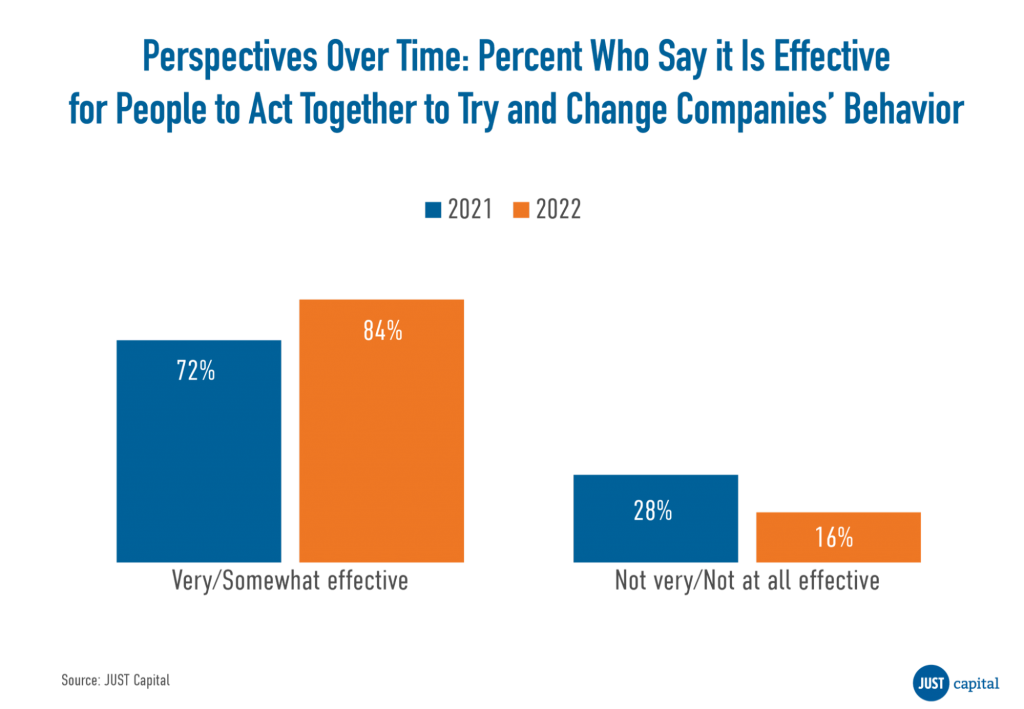
Despite an uptick in positive impressions during the first year of the COVID-19 pandemic that companies were stepping up to take care of stakeholders, Americans are now less likely to think companies are following through. They also expect business to talk less and act more. The good news: 81% of Americans believe that business can be a powerful force of societal change and 84% believe people can be effective when they act together to try to change companies’ behaviors. Americans are also willing to support change and help companies transition toward a just economy by paying more for just products and even accepting less pay to work for just companies.
In this year’s survey, we unpack these trends in detail, seeking to understand what matters most to Americans today, against the backdrop of our shifting economic and societal climate, and what corporate leaders should prioritize to live up to the expectations of the public. Let’s take a deeper look at the data.
More than two in three Americans (68%) say that “our current form of capitalism is not working for the average American,” a 10-point increase in negative sentiment from just one year ago. In its recent survey on how Americans perceive capitalism, Pew Research similarly finds modest declines.
In a recent talk, PayPal CEO Dan Schulman discussed why capitalism needs an upgrade, warning, “To many people who are left out of the system, who struggle to make ends meet and don’t believe in the American dream anymore, they tend to radicalize to the far left or far right. So how do we strengthen our democracy by thinking more broadly?”

When we look across demographic breaks, we find substantial differences in Americans’ opinions of whether capitalism is working. Lower-income and hourly workers, Black and Hispanic Americans, temp workers, younger Americans, and Liberals are all far less likely to agree that “our current form of capitalism works for the average American” than white Americans, older Americans, those in high income households, and Conservatives.
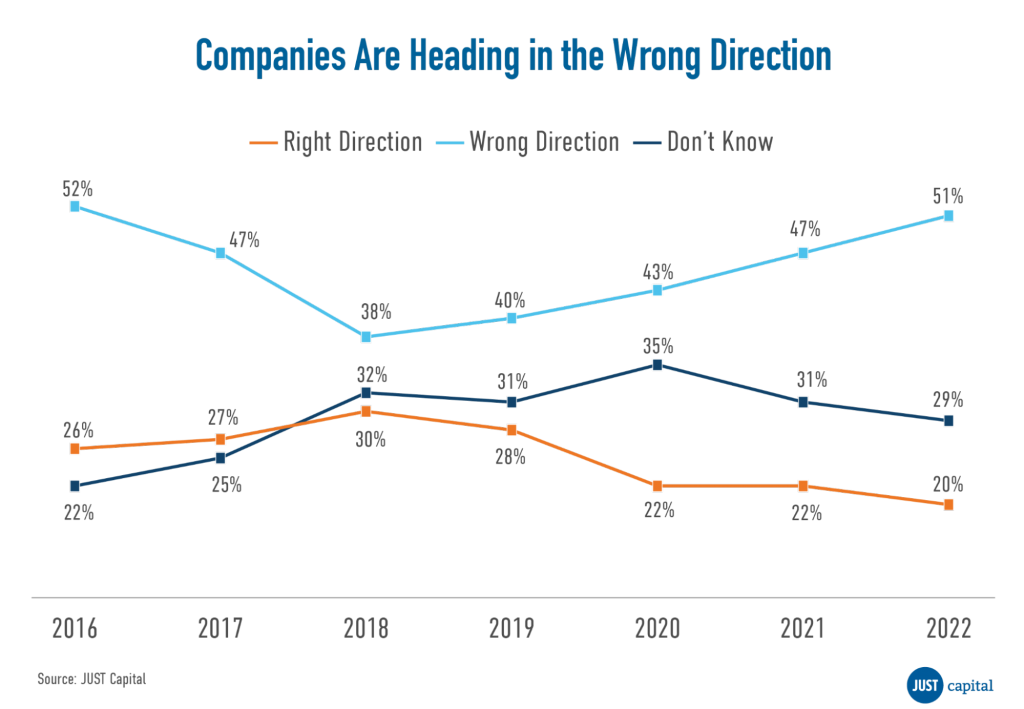
Americans agree that companies are on the wrong path, with just 20% agreeing that they’re heading in the right direction – a downward trend from a high of 30% in 2018. What’s more, over half of Americans (51%) now say companies are headed in the wrong direction, a steady trend upward, and a 13 percentage point increase, since 2018.
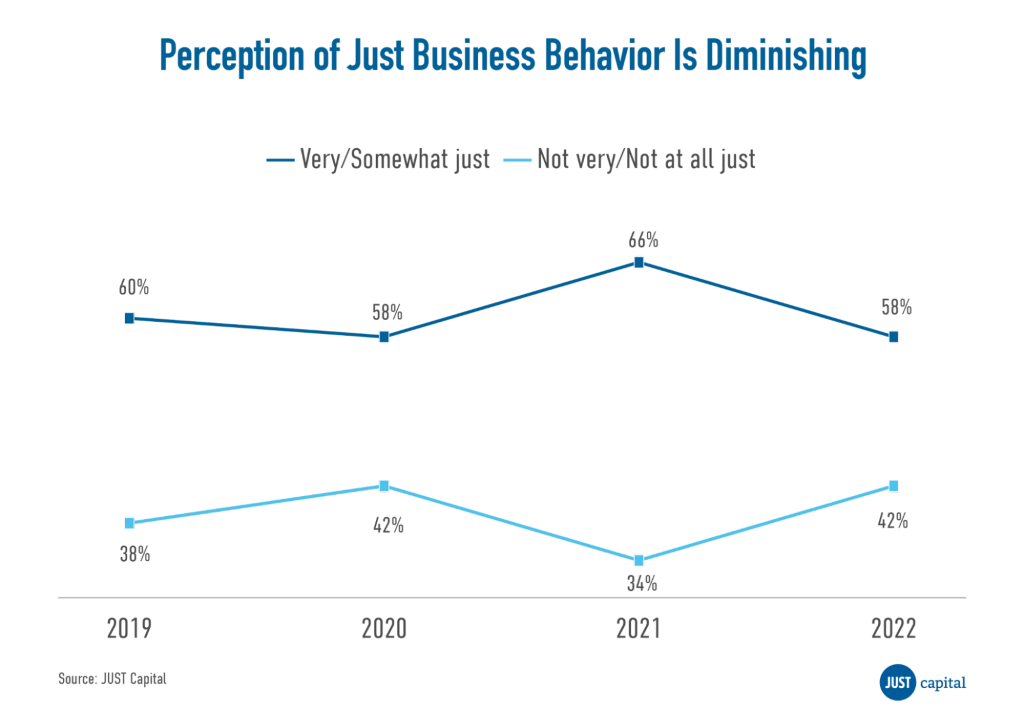
With regard to just business behavior specifically, more Americans (58%) say that companies are very or somewhat just than say they are not very or not at all just – however, that number is down from a high of 66% in 2021.
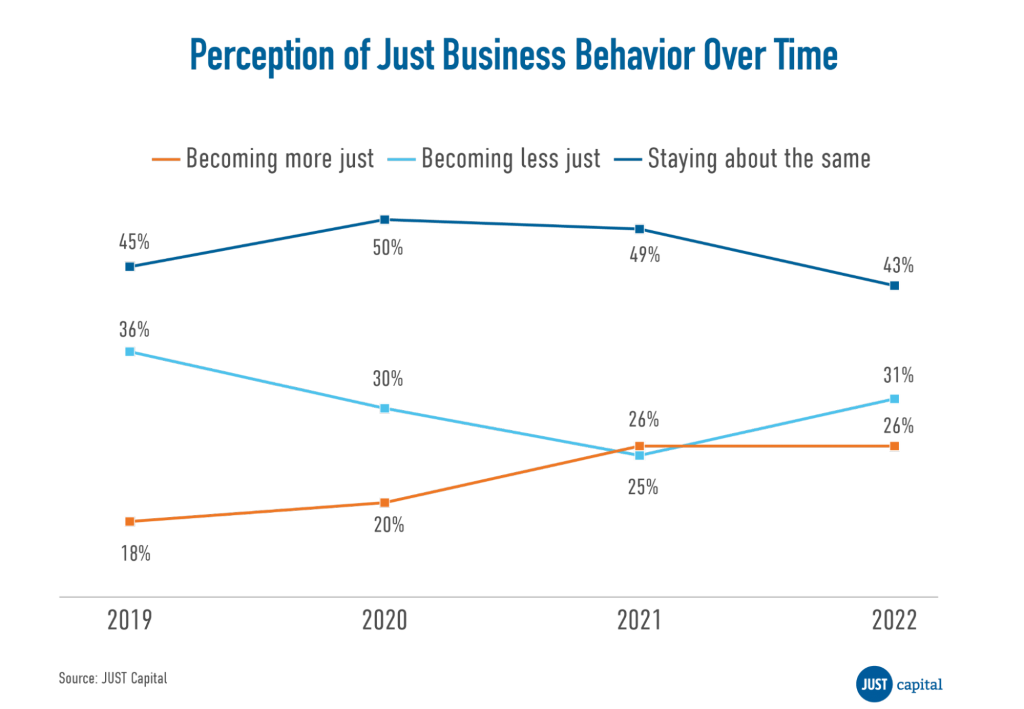
When we ask the public whether they think companies are becoming more or less just over time, even though a plurality say that they have stayed about the same, the percentage 0f respondents who say companies are becoming less just has grown in the past year, from 26% in 2021 to 31% in 2022.
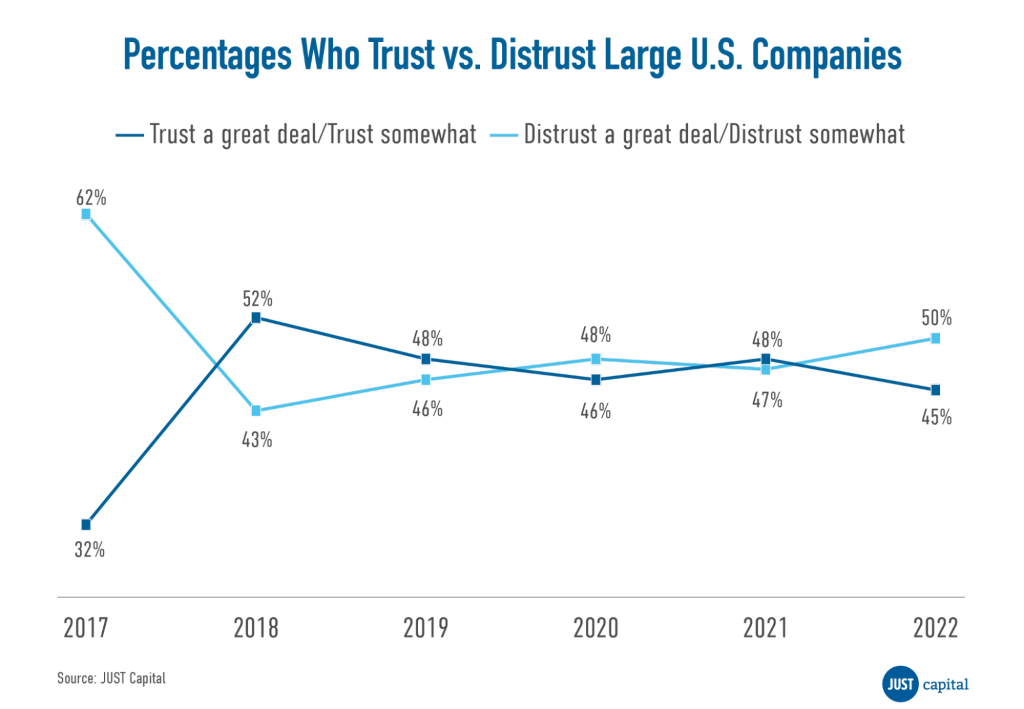
The proportion of Americans who trust versus distrust large U.S. companies had been roughly the same over the past few years, but in 2022 that changed, with more Americans now saying that they distrust companies (50%) than trust them (45%).
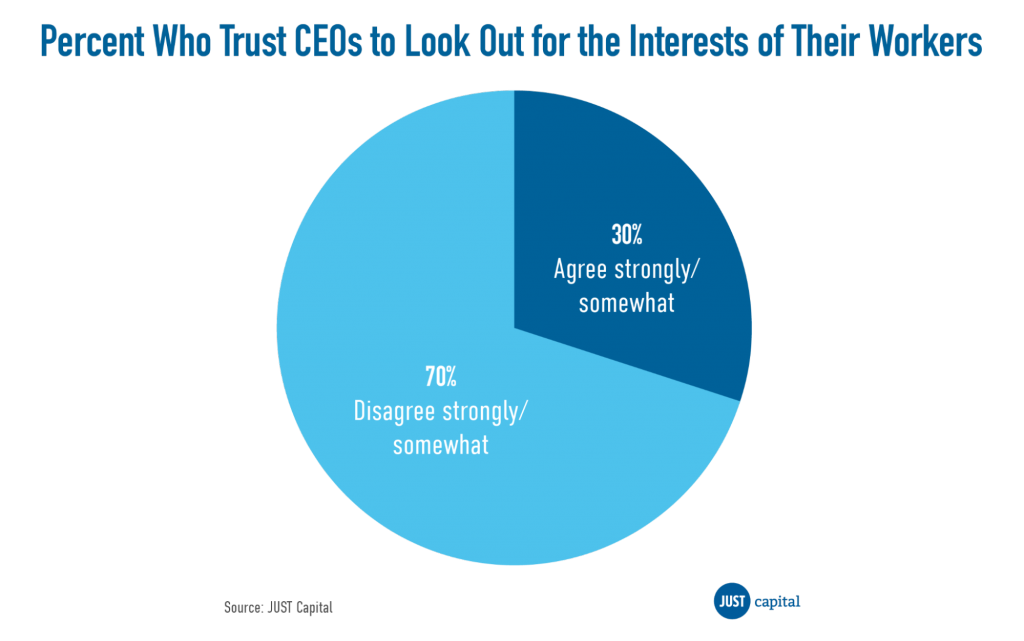
We see these findings further confirmed by a new question we asked this year – if people trust CEOs to do right by their employees – and only about one in three agreed that they “trust CEOs to look out for the interests of their workers.”
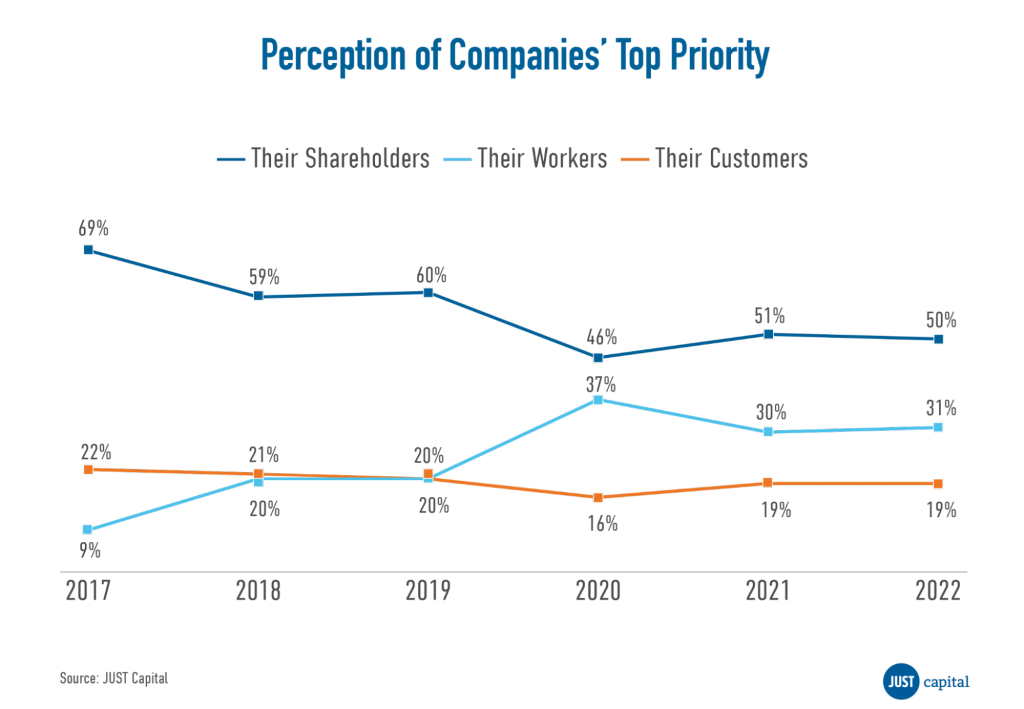
A key question in our Americans’ Views on Business survey asks the public’s thoughts about which stakeholder – shareholders, customers, or workers – they think companies prioritize most. For six years running, and by a significant but varied margin, half of Americans say that shareholders are the top priority in companies’ eyes, versus 31% who say workers and 19% who say customers. When comparing these responses to what the public said in our Annual Survey six years ago, we see two major changes over time.
First, while the percentage who say employees are the top priority has grown substantially, from 9% to 31%, the uptick in this view has now waned since 2020. And second, while the degree to which the public believes shareholders are the top priority has diminished – from 69% in 2017 to 50% in 2022 – it has actually risen since the challenges of 2020. Overall, this paints a picture of an opportunity perhaps lost – or at least not fully captured – by companies to show they are placing workers’ interests at least on par with shareholders’.
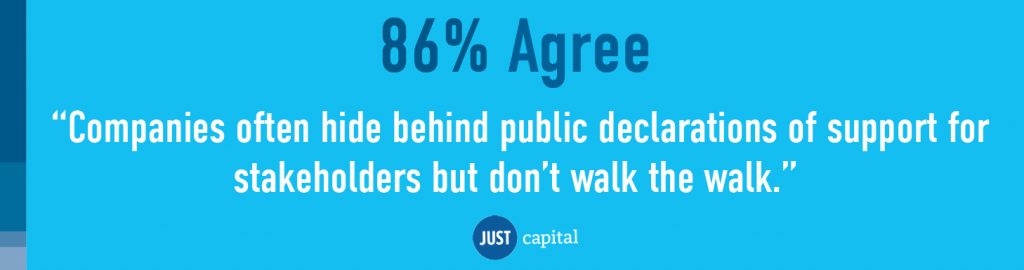
In keeping with these findings, the public also agrees that companies are not living up to their commitments to take action on critical societal challenges. In the two years since the Business Roundtable announced a movement away from shareholder primacy, our data show that the public remains skeptical on whether America’s largest companies are actually following through on their commitments to a stakeholder model, with 86% agreeing that companies “often hide behind public declarations of support for stakeholders but don’t walk the walk.”
The following chart shows that the public believes that companies have the most positive impact on their shareholders (75%) at a greater margin than other stakeholders, including customers (65%), the health & safety of their workforce (64%), quality jobs (56%), and local communities (55%).
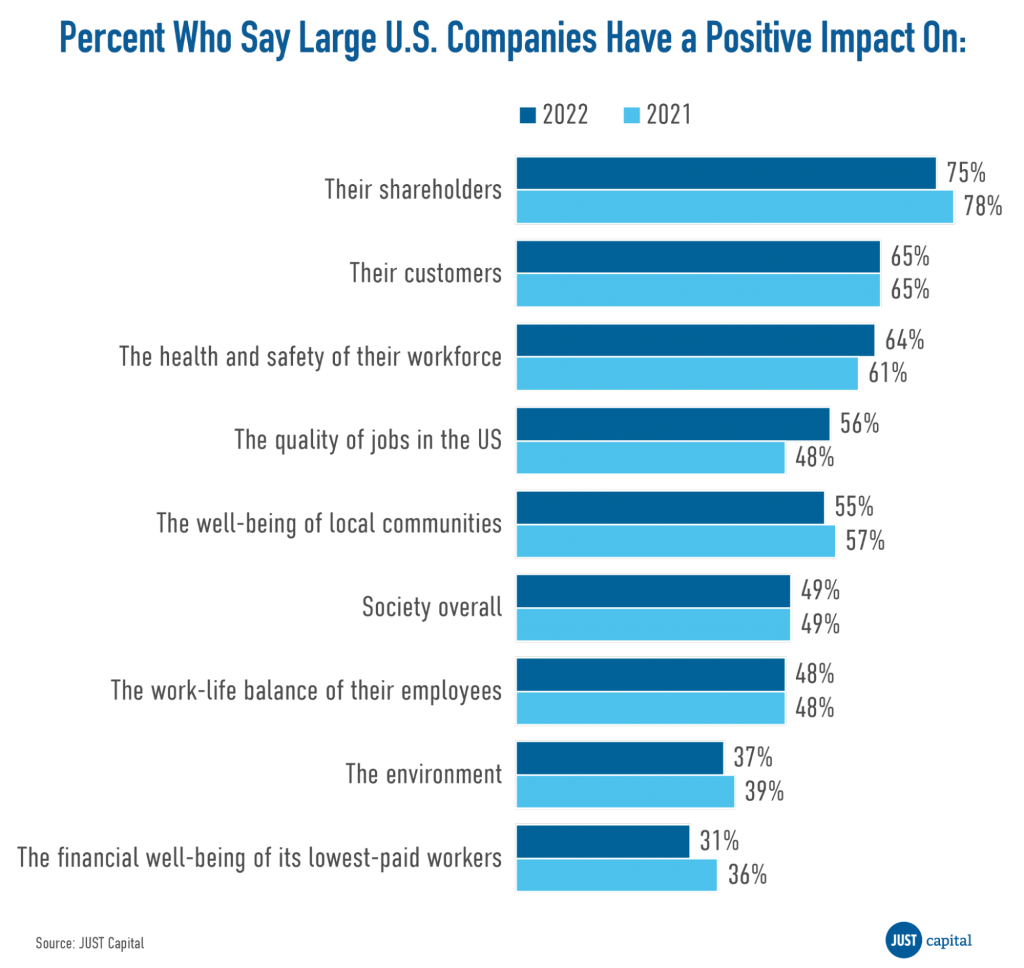
Far fewer say that the environment and low-wage workers are positively impacted by the behavior of large companies. Compare the one in three Americans who say companies have a positive impact on the “financial well-being of their lowest-paid workers” to nearly twice as many who say “their shareholders” in the chart above.
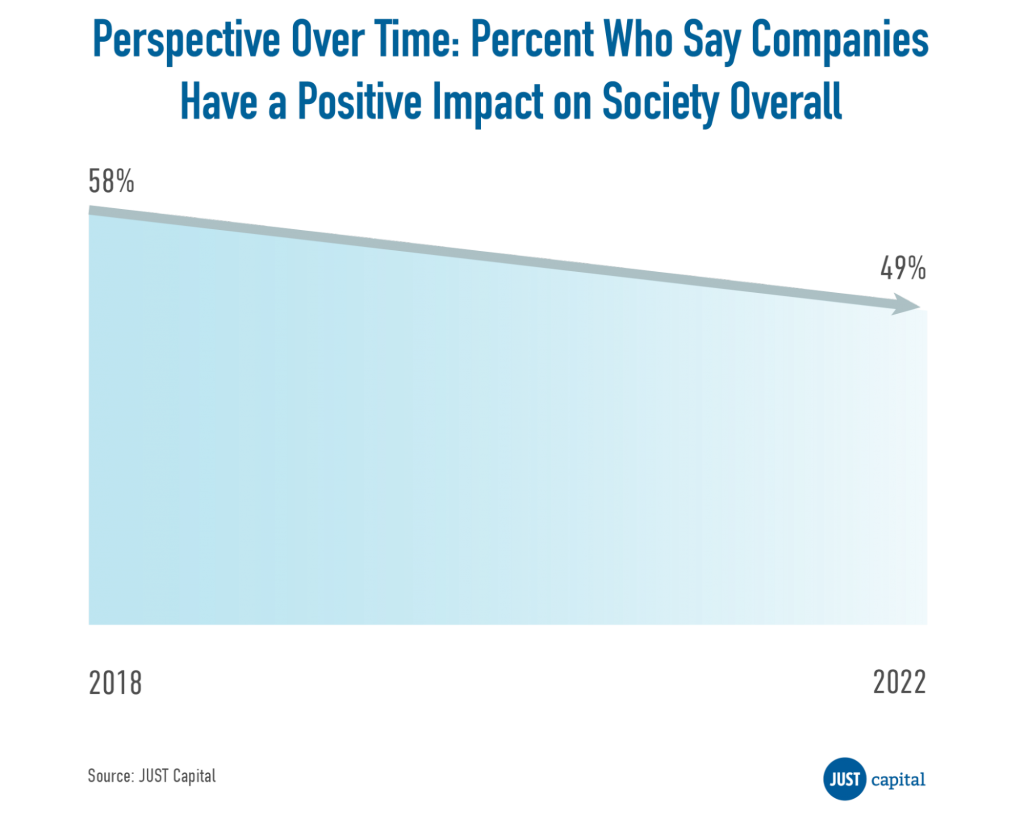
Looking at positive impact measures over time, the public’s perspective is that companies are moving in the wrong direction. For example, the percentage who say companies have a positive impact on society overall has fallen from a high of 58% in 2018 to just 49% of Americans in 2022.
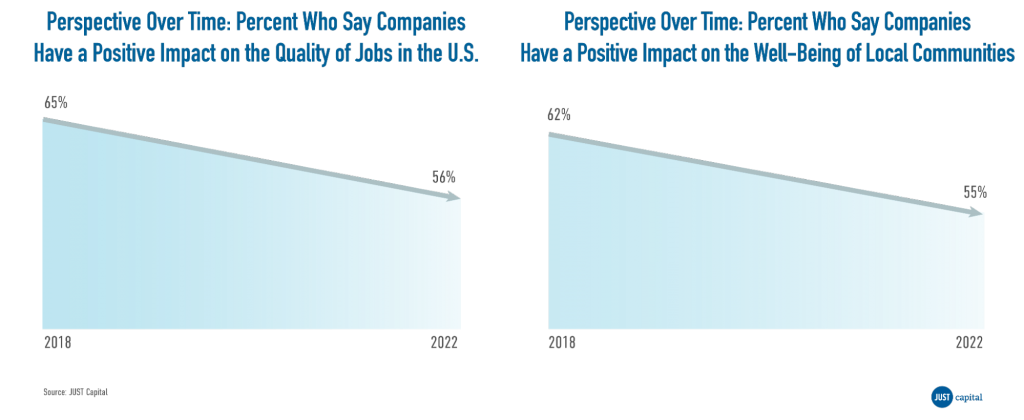
There are similar dips in the percentage of Americans who say companies have a positive impact on the quality of U.S. jobs and the well-being of local communities.
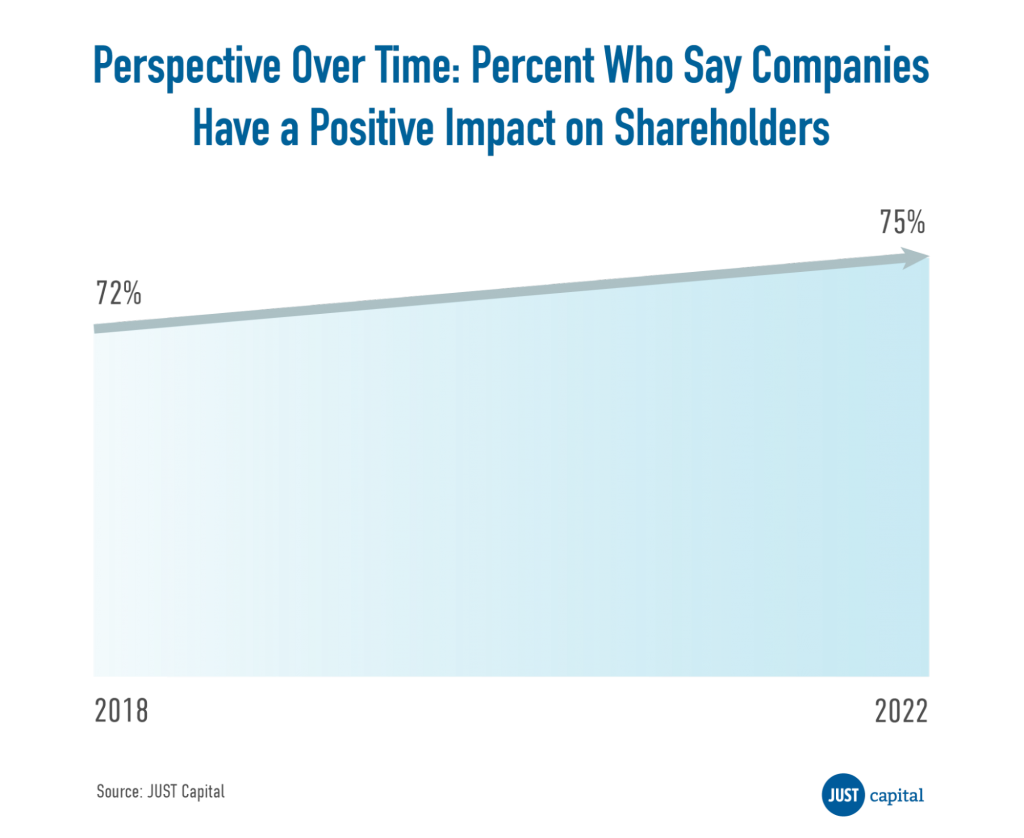
Yet the percentage who say companies have a positive impact on shareholders is substantially higher, and even increases slightly over the past five years.
Workers are the engine of a company, and from our recent survey on workers and wages, it is clear that Americans firmly believe that companies that invest in their workers by paying a living wage are more competitive in their industries, better for the economy overall, and more profitable in the long term. In this survey, we find that Americans again agree that the focus of a just company should be its workforce, with majorities agreeing with the following statements:
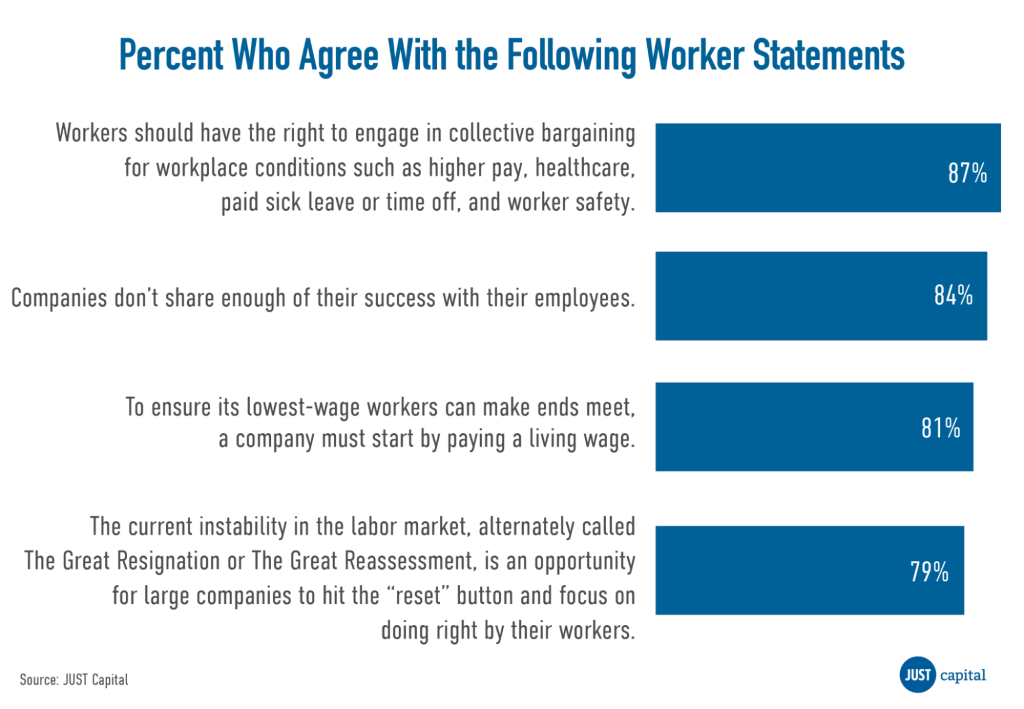
What’s more, there is remarkable consensus on these issues when looking across political divides, suggesting that, despite sentiment that the right and left are polarized when it comes to issues like a living wage or even forms of collective bargaining, liberals and conservatives are more aligned than we might think.
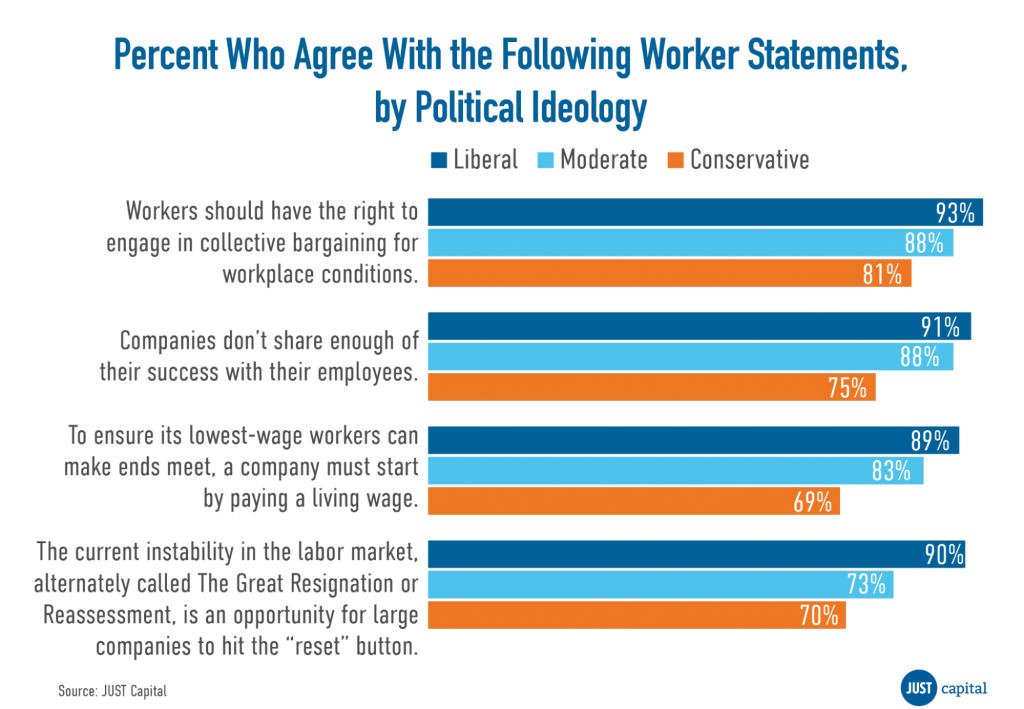
To protect workers’ right to fair treatment, almost nine in 10 say that workers should have the right to collectively bargain for pay and other protections. This strong agreement on collective bargaining tracks with public pollster Gallup, which finds that Americans’ approval of labor unions is at its highest point since 1965.
What’s more, we find that support for unionization of the workforce is consistent across all political ideologies. Consider what Amazon union leader Chris Smalls said at a hearing on Amazon’s labor practices in May of 2022:

Companies looking to stave off unionization trends should assess their workers’ financial wellness to ensure all employees are able to make ends meet. In this survey we heard that more than 80% agree that companies need to pay their lowest-paid workers a living wage – something we’ve seen reinforced with strong agreement from the public in our survey on workers and wages, which found that 84% agree that large companies should pay employees enough to make ends meet. Our 2022 People’s Priorities Survey also echoed this sentiment, with “Paying a fair, living wage” as the #1 Issue for the public, gaining more than 20 percentage points in importance over the last two years.
Inflation and an impending recession are already impacting the lives and pocketbooks of most Americans, meanwhile the lowest-wage workers in the U.S. unfortunately bear the brunt when wages don’t keep up with inflation.

In an effort to better understand the state of corporate America when it comes to paying a living wage, Just Capital has also refined its measurement of this issue for our upcoming 2023 Rankings. Among our initial findings? About half of Russell 1000 employees do not make a family-sustaining living wage.
With job quits rates hovering at about 4 million between August 2021 and August 2022, the phenomenon alternately called The Great Resignation and The Great Reassessment could flourish. To that end, a large majority of Americans think this was a key moment for worker power: 79% agree that The Great Resignation is an opportunity to hit the reset button and focus on workers.
Finally, when it comes to a company’s profits, Americans say that workers are not getting their fair share of the pie: 84% agree that companies don’t share enough of their success with their workers. With profits surging 35% last year, 2021 was the most profitable year for American corporations since 1950. And while employee compensation rose 11%, the so-called labor share of national income – the portion that’s paid out as wages and salaries – fell back to pre-pandemic levels. It’s clear that American workers aren’t sharing in the prosperity they are helping companies create.
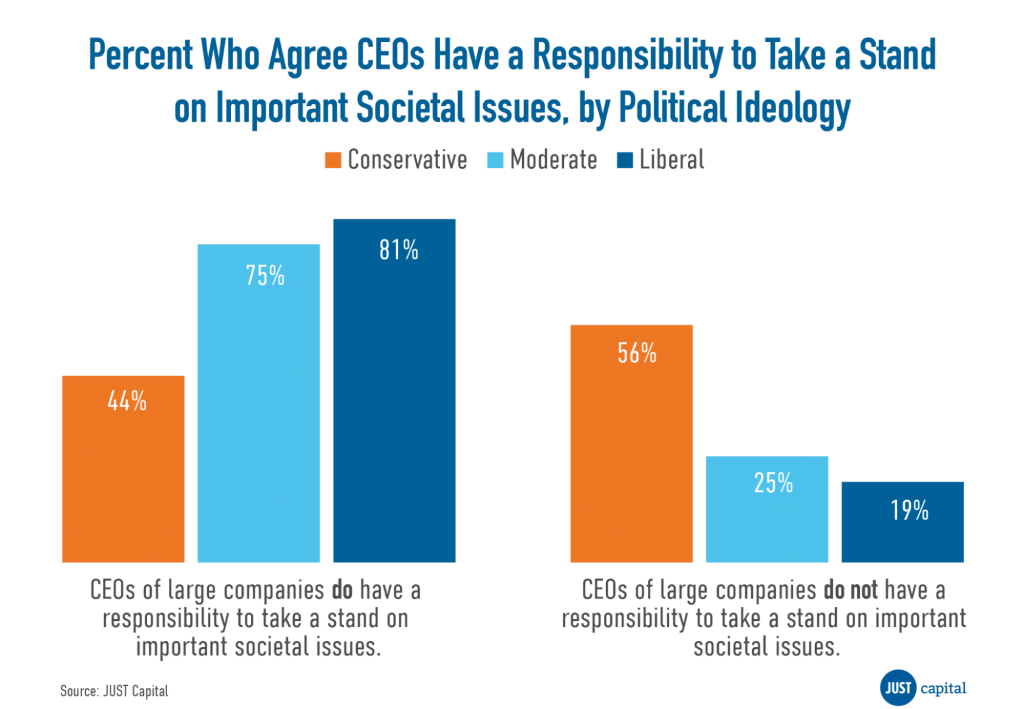
In recent years, CEOs have found themselves in the position of needing to speak out on both critical and contentious issues, and the landscape is becoming more challenging to navigate as more politicians attempt to bring companies into culture war issues as the election cycle heats up. To help corporate leaders understand public expectations during these tumultuous times, we’ve asked Americans each year for the last five years if they believe the CEOs of large companies have a responsibility to take a stand on important societal issues. This year, two-thirds of Americans overall – a number that has remained relatively stable in our years of polling – believe CEOs of large companies have a responsibility to take a stand.
There are, however, significant differences in the degree of agreement when looking at this question across political breaks: with far fewer Conservatives agreeing CEOs have a responsibility to take a stand (44%) compared to their Liberal (81%) or Moderate (75%) peers.
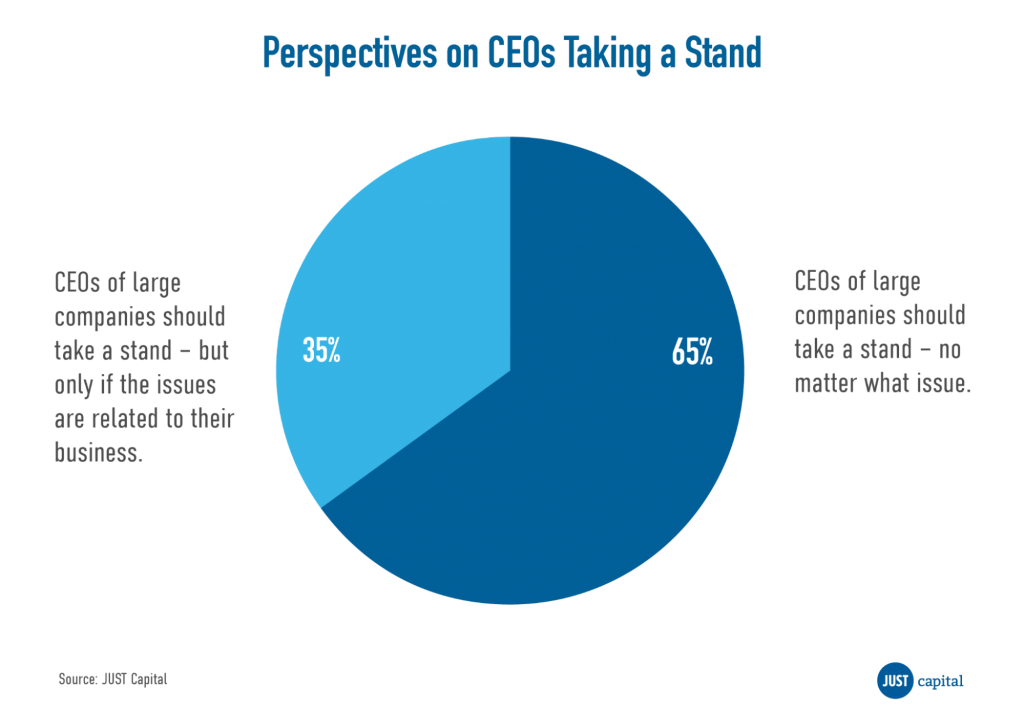
Of the almost two-thirds who say that CEOs have a responsibility to take a stand, another two-thirds of that group says they should do so no matter the issue, rather than focusing solely on issues that directly impact their business.
With a majority of Americans saying that CEOs should take a stand on issues, the question then becomes which societal issues should they address. In response to this year’s survey, a substantial proportion of the public says corporate leadership has a role to play in addressing all of the following issues, with income inequality and gender and racial equity receiving the highest levels of support (77% or more).
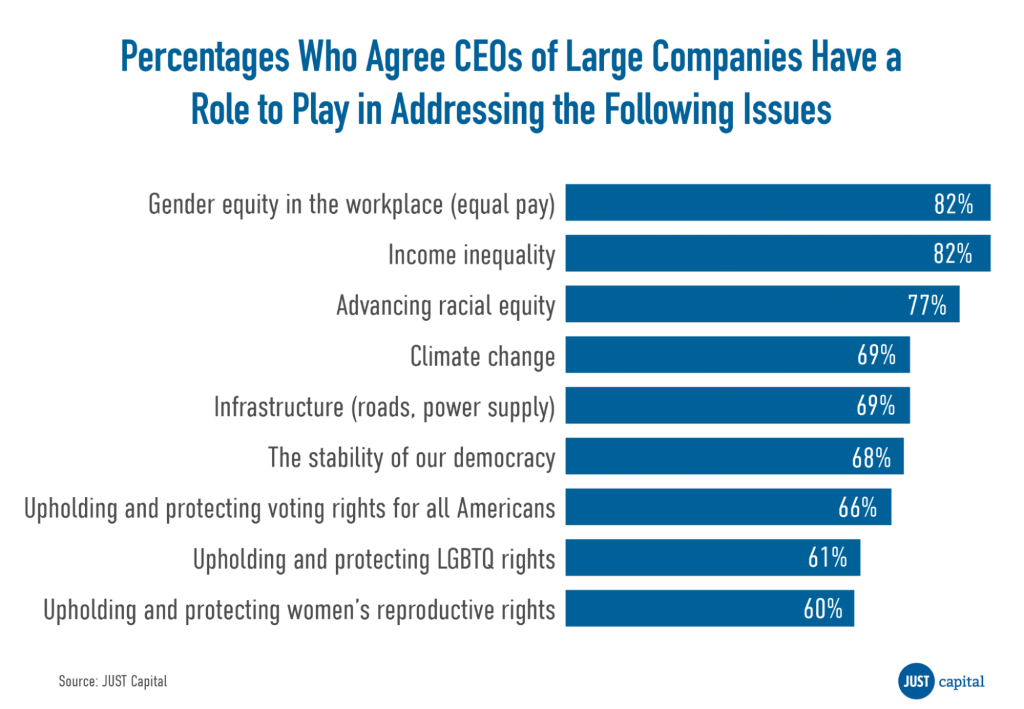
And although majorities say CEOs have a role to play in these issues, there is less consensus when looking across political breaks, with Conservatives less in support of CEOs taking a stand on these specific issues than their Moderate or Liberal counterparts. There is particularly low support from Conservatives when it comes to LGBTQ rights, women’s reproductive rights, and climate change (45% or less).
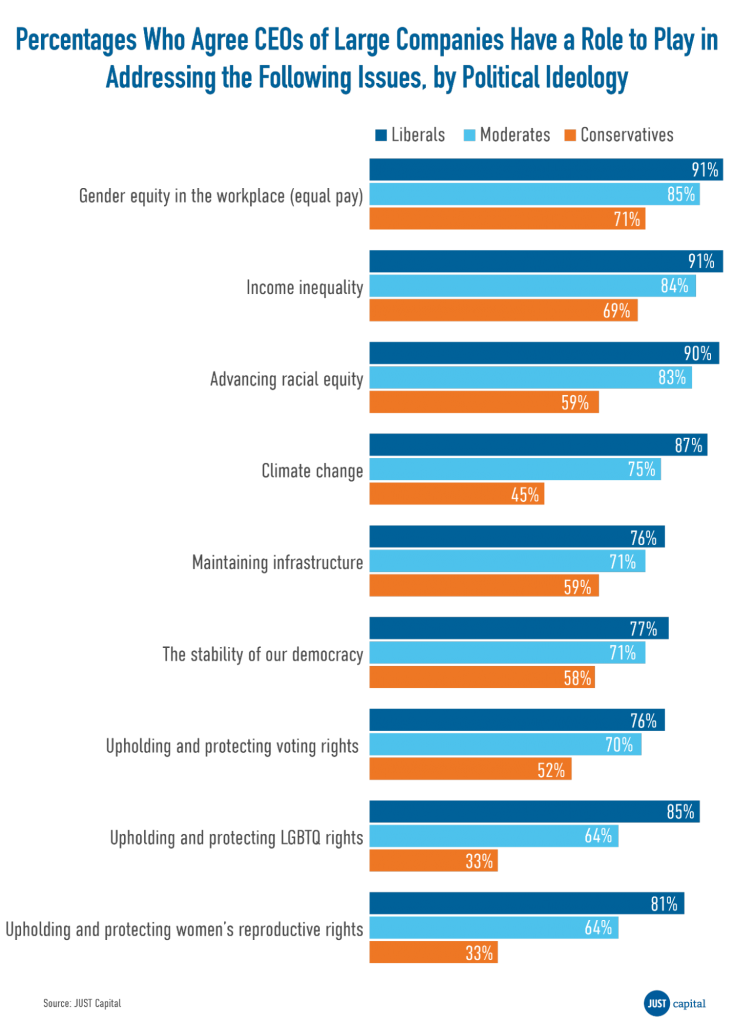
However, for the question of upholding our democracy – an issue that has become increasingly politically divisive – majorities of all three political ideologies agree that CEOs have a role to play in protecting both democracy and voting rights. Those numbers are bolstered by the 72% of Americans who say corporate America has a responsibility to protect the democratic process by promoting free and fair elections.
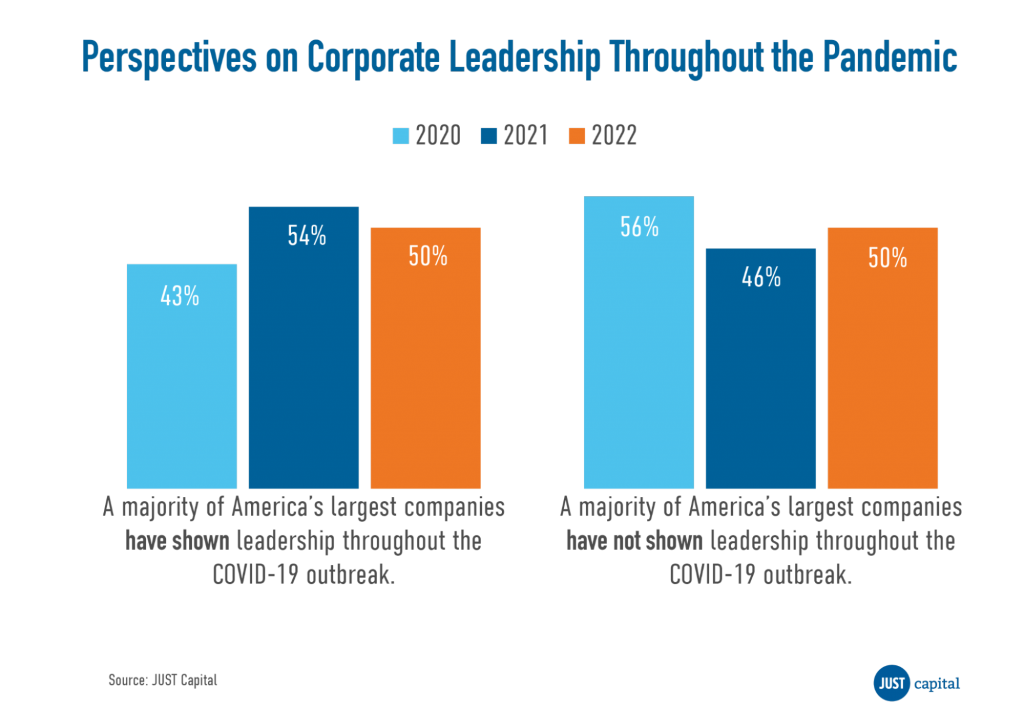
Positive assessments of corporate behavior are also informed by the public’s views on how companies have weathered recent events, including the COVID-19 pandemic. In 2022, half of Americans say companies have shown leadership throughout the pandemic, down from a high last year of 54%.
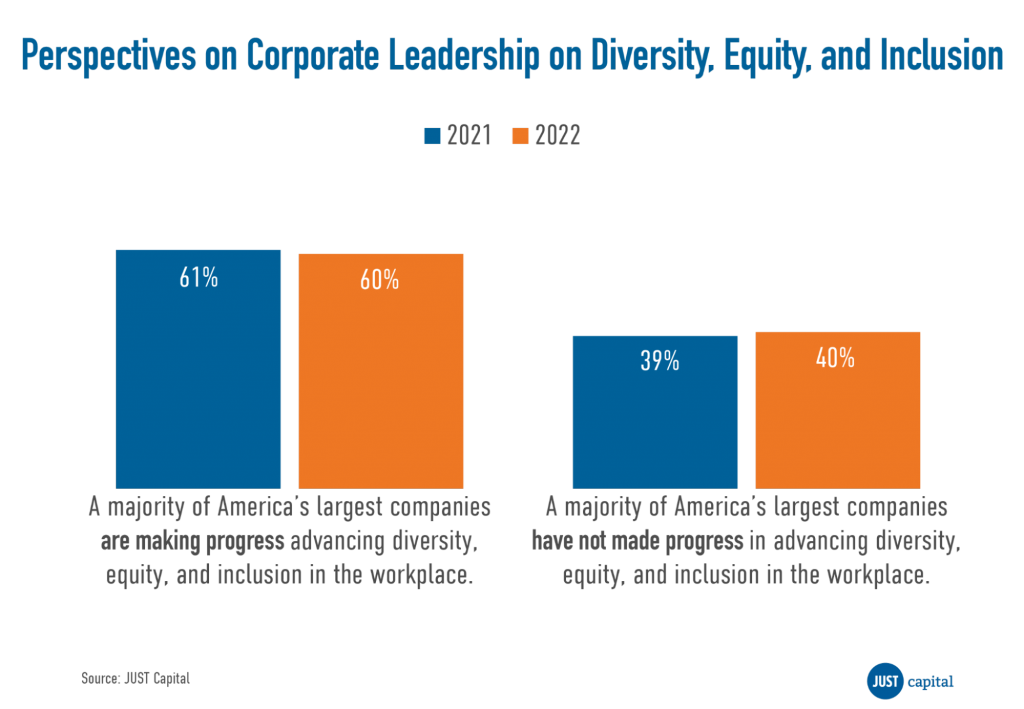
When we look at another pressing social issue – advancing racial equity – a higher percentage (60%) of Americans say companies are doing well demonstrating a commitment to diversity, equity, and inclusion in the workplace, a number that has stayed steady over the two years that we’ve tracked views on this issue.
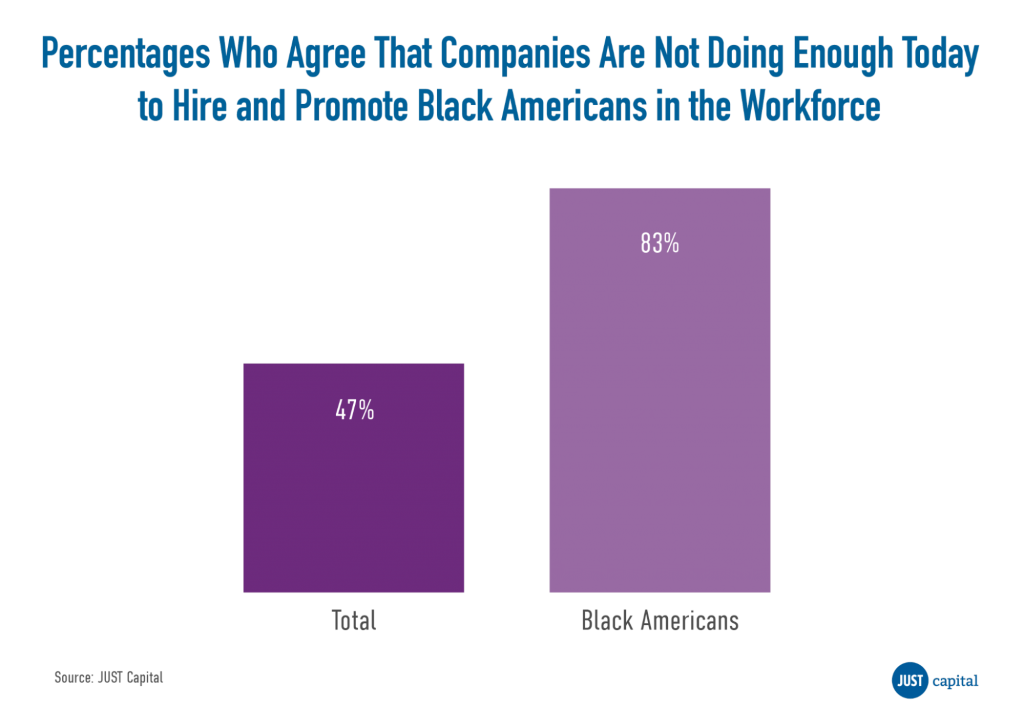
Still, there is ample room to improve: almost half (47%) of Americans agree that companies are not doing enough today to hire and promote Black Americans in the workforce. That number rises to 83% among Black Americans.
Action on these issues have lasting impact for the public, with a large majority of Americans saying they will remember the companies that took missteps in their response to the COVID-19 pandemic (68%) as well as those that took missteps on issues related to racial injustice (67%).
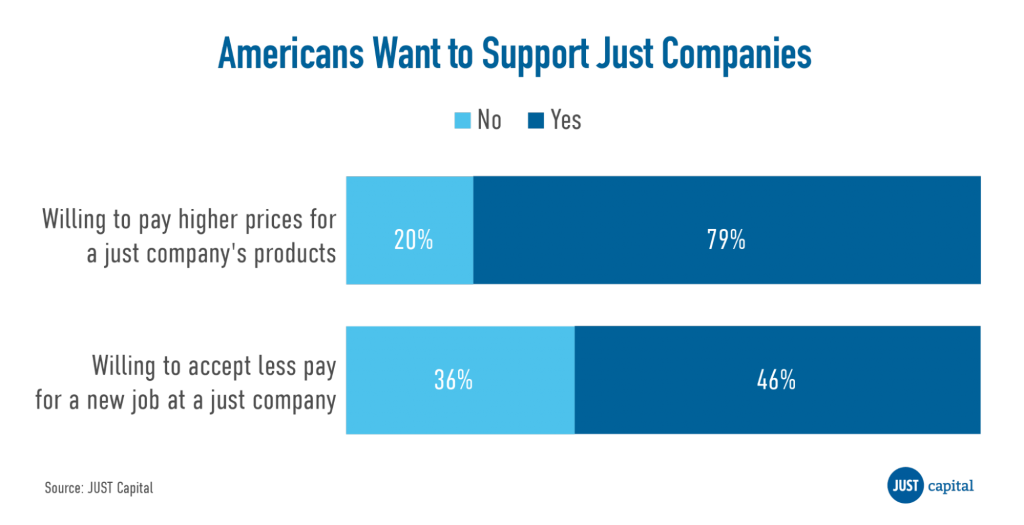
The good news? Americans are willing to support change and help companies transition to a just economy. We asked Americans to tell us whether they would take positive action in supporting companies that are more just, and two-thirds or more said that they would either accept less pay in a new job at a just company, and/or pay more for a product made or sold by a just company.
This comes at no surprise when we see that a whopping 84% of Americans believe that their own actions can shape the future: a level double-digits higher than when we first asked this question in 2017 (71%).
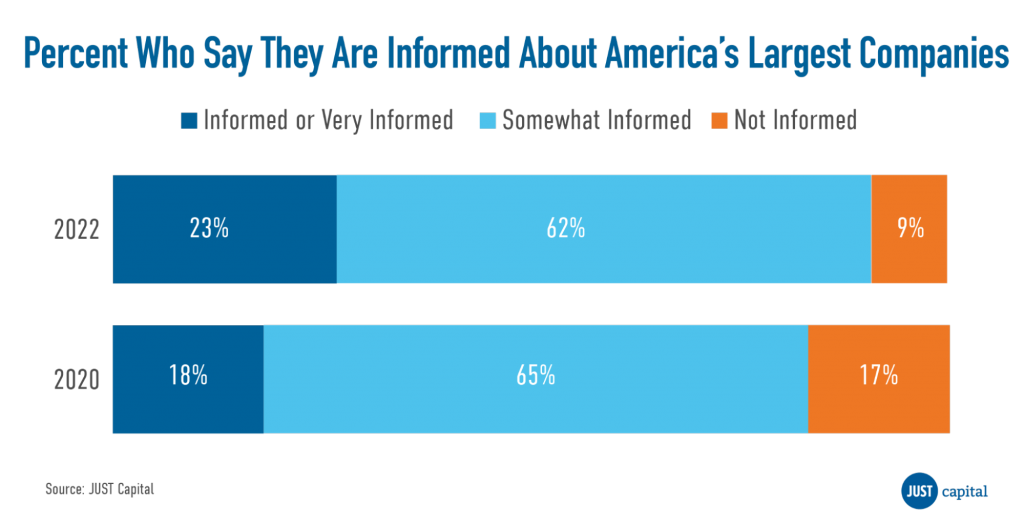
That Americans have strong opinions about large U.S. companies may be attributable to the degree to which the public is informed about corporate activities and behavior (in 2022, 23% say they are Informed or Very Informed, up from 18% in 2020).
While this year’s Americans’ Views on Business survey shows an overall less optimistic perspective on how companies are faring in transitioning from shareholder primacy toward a more just and equitable economy, our 2022 Issues Report – The People’s Priorities and full slate of polling reports from the last year, provide a clear, consistent, and unified message from Americans about how to turn the tide, and that is to put workers at the heart of business strategy.
For companies that are looking for solutions to everything from political polarization to the rise in unionization, or losing talent to competitors, the answers lie in listening to the voice of the public, and most importantly, to your workers. They will tell you, as they’ve told us for the last seven years, to focus on paying a fair, living wage, protecting their health and safety, supporting their development through training and upward mobility, providing good benefits and work-life balance, and more. The pandemic catalyzed a fundamental shift in expectations for workers, with many reevaluating what’s most important to them.
As we discussed in a recent Fortune editorial with the Ford Foundation, “Now is the time for employers to listen to their workforce and collectively ensure our economy delivers on the promise of the American Dream for everyone.” Business leaders are increasingly faced with complex economic, social, and political headwinds, but investing in workers is a powerful North Star to use to chart the path forward.
For additional resources on where to get started, visit:
We conducted this survey online with a probability-based sample attained through the exhaustive statistical sampling methods employed by SSRS. The SSRS Opinion Panel is a nationally representative probability-based web panel, and findings are generalizable to the general adult population.
The full survey was conducted from June 22 to July 11, 2022 among a general population sample of 3,002 English- and Spanish-speaking U.S. adults 18+ years of age, with an oversample of 540 Hispanic and 460 non-Hispanic Black respondents. Panelists were sent an email invitation to take the survey online as well as up to eight reminder emails throughout the field period. The survey program was optimized so that respondents could complete it using a desktop or laptop computer as well as a mobile device. In total, 1,063 respondents completed the survey on a computer and 1,939 completed it on a mobile device.
The margin of error is +/- 2.2% at the 95% confidence level. Results were weighted to U.S. Census parameters for age, gender, education, race/Hispanic ethnicity, and Census Division to ensure representativeness of the U.S. population. All margins of error include “design effects” to adjust for the effects of weighting.
