
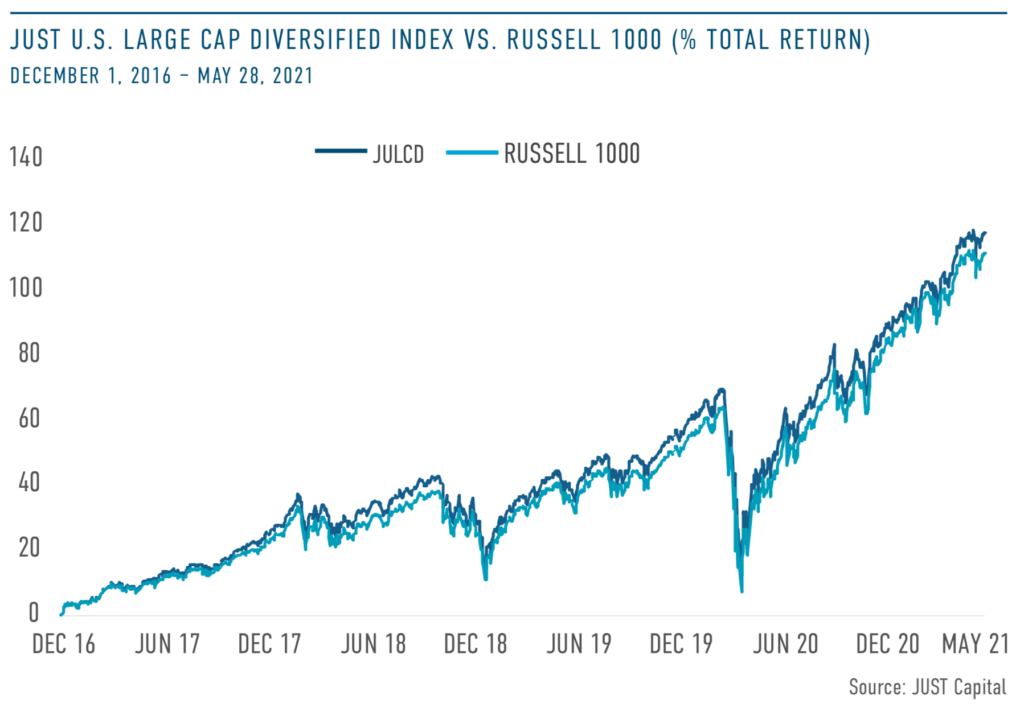
This week’s chart is timely as the Goldman Sachs JUST U.S. Large Cap Equity ETF (JUST ETF) recently hit its three-year anniversary on June 13, 2021. The fund, which began trading on the NYSE Arca in 2018, seeks to track the JUST U.S. Large Cap Diversified Index (JULCD), constructed and managed by JUST Capital and composed of the top 50% of Russell 1000 companies in each industry, based on JUST Capital’s annual Rankings.
Looking at the JULCD Index that the ETF seeks to track, we see it has outperformed the Russell 1000 cumulatively by 6.17% since inception in the 4.5 year period ending in May (Dec. 1, 2016 to May 28, 2021). Additionally, over the past year, the tracking error of the JULCD index relative to the Russell 1000 is 1.54. This indicates the benchmark is closely tracking the returns of the Russell 1000 to provide market beta, but sees additional alpha on a cumulative basis from JUST Capital’s Annual Rankings and methodology.
Given the JUST ETF anniversary and the past year’s surge of flows to ESG funds, we wanted to resurface a speech that JUST Capital’s Co-Founder and Chairman, Paul Tudor Jones, gave at the 2019 Inside ETFs conference. In his keynote, Jones highlights that the companies working to build a more just and equitable economy are also those that continue to deliver lasting value to shareholders. You can watch the full talk below:
Furthermore, companies in the JULCD are driving positive change on the issues our polling shows the American public expects a response to,including worker pay and well-being, customer treatment and privacy, environmental impact, job creation, and investing in communities.Compared to Russell 1000 companies excluded from the Index, 2021 JULCD constituent companies on average:
As the JUST ETF continues into its fourth year, we have seen the fund reach $238 million in assets under management (AUM), be named the Best New ESG ETF and a finalist for ETF of the year from ETF.com, and receive a Morningstar Analyst Rating of Bronze in December 2020.
The Investor Solutions team at JUST Capital continues to expand the suite of products tracking our in-depth company research and polling of the American public. We firmly believe that together we can create a more just and equitable marketplace that works for all Americans. Please reach out using the link below if you have an interest in partnering with us to launch the next stakeholder-driven strategy.
If you are interested in supporting our mission, we are happy to discuss data needs, index licensing, and other ways we can partner, please fill out our request form to answer a few questions, and someone from our Investor Solutions team will reach out to you within two business days.

This week, Emmanuel Faber, one of the world’s foremost proponents of stakeholder capitalism, lost his job as CEO and chairman of Danone. The easy reaction would be to see this as a blow for proponents of the stakeholder cause. That would be a mistake.
Faber invested heavily in sustainable products and packaging, and acquired France’s legal qualification of a purpose-driven company and B-Corp status for Danone North America. Ultimately, however, it appears activist investors pushed Faber out not because he was so committed to sustainability, but because he wasn’t delivering returns. For the past couple years, Danone’s share price has underperformed both Unilever and Nestlé – two companies, it is important to note, that have also embraced bold ESG initiatives.
Engine No. 1’s battle with ExxonMobil is an interesting parallel; except here, the activist is pushing for stronger climate related investments. What both cases have in common is that they are ultimately about the pathway to greater shareholder returns – where they differ, is on the means to get there.
This focus on long-term value generation is foundational because it knits together everything. Take diversity, equity and inclusion for example. Former Xerox CEO Ursula Burns, speaking on CNBC this week, frames her championing of gender and race/ethnicity equity within companies in terms of performance, and as a way to attract and retain top talent and better serve customers. We took a close look at that topic this week ourselves, with a thorough analysis of the current state of diversity at companies that disclose, and a look at the momentum behind releasing EEO-1 Reports.
It also ties back to the SEC, and their big news this week. In a presentation hosted by the Center for American Progress, acting SEC Chair Allison Herren Lee said that, “Climate and ESG are front and center at the SEC,” noting it’s “precisely because” that’s what investors are interested in right now. She announced the agency has opened a public commenting period on what should be included in upcoming mandatory climate disclosures, and whether those should be part of a broader ESG framework.
Corporate commitments to ESG and stakeholder performance must at some point translate into both strong financial performance and real outcomes on the underlying societal issues at stake. In fact, that is the whole point. Our polling supports this, and business leaders understand it intuitively.
Be well,
Martin Whittaker
Amalgamated Bank becomes the first major U.S. bank to endorse legislation calling for a federal commission to study the lingering effects of slavery – and the merits of reparations.
Bank of America and JPMorgan Chase condemn racism against Asian Americans in memos to staff.
BlackRock releases new guidelines pushing companies to protect the environment from deforestation, biodiversity loss, and pollution of the oceans and freshwater resources.
Goldman Sachs announces that, over the next decade, it will invest $10 billion in businesses that benefit Black women.
JPMorgan Chase updates its bylaws to eliminate any gender designation.
Nike launches its Purpose 2025 Targets, a broad range of sustainability goals encompassing the company’s environmental, social, and governance commitments.
Slack launches a six-month apprenticeship program to help formerly incarcerated people find skilled jobs and succeed in tech.
Starbucks plans to make its green coffee carbon neutral, as well as to halve its water usage in green coffee processing by 2030.
Wendy’s hires its first diversity chief amidst a growing industry push to hold corporate restaurant executives accountable for the diversity of their employees, from the top down.
With workforce demographic disclosure on the rise, JUST examines the underlying EEO-1 data underpinning these disclosure efforts in The State of Gender and Racial Representation at America’s Largest Companies. Our analysis finds that women are still largely underrepresented when compared to the U.S. civilian workforce, and that there are stark differences at the intersectional level, with specifically non-White and non-Asian groups most underrepresented.
JUST Chief Strategy Officer Alison Omens explains how the obscure EE0-1 Report became the “gold standard” for disclosure and what lessons this has for people pushing for increased ESG disclosure more broadly.
Alison – along with Rachel Korberg from the Ford Foundation – explores in a new Fast Company editorial featuring insights from our latest survey how, if we are to rebuild equitably coming out of the pandemic, corporate leaders must double down on workplace health and safety.
Insider profiles how PayPal took big steps to increase wages and cut healthcare costs for employees, as well as their collaboration with JUST to create the Worker Financial Wellness Initiative and formalize a plan for other companies to follow.
With ETFs and mutual funds helping to democratize ESG, JUST Director of Business Development Charlie Mahoney discusses why the future of ESG will be customized, personalized, and values-driven, and uses our latest investor product collaboration with Seeds as an example of this emerging trend.
The Neuroscience Institute looks back one year after COVID through the lens of organizational learnings, culture shifts, and brain science, featuring JUST’s research.

(Investment Adviser Association)
“Investors have been demanding this information [around political spending] for a very long time. … When over 1 million investors speak, the SEC needs to listen.”
“The conversation has been all over the place…but the good news is that it wasn’t a singular financial conversation. You know – how do we fill the supply chain, cut costs? All those things. It has become a much more complete around the employee, around the safety of the employee, and around the responsibility of the companies to their employees but also society as a whole. It’s become a different kind of rhetoric than what you would normally see.”
“I have long suspected that stakeholderism can easily become a bit of a smokescreen, especially in Europe, for management to ward off awkward shareholder questions about performance, in terms of share price and operating profits.”
New data from Stop AAPI Hate, released on Tuesday hours before the Georgia shootings that killed eight people – including six women of Asian descent – shows that businesses are the primary site of discrimination (35.4%) and that women report hate incidents 2.3 times more than men. Additional data and resources on anti-Asian violence can be found here.
The Brookings Institute explores how CEOs can advance racial equity within their regional economies, showing data for most large metro areas on what representation looks like for management, tech jobs of the future, as well as in supplier ecosystems.
A New York Times editorial explains how artificial intelligence technology for hiring may exacerbate racism and sexism and further bake bias into the hiring process.
The Financial Times reports that over half of the FTSE 100 companies link executive pay to ESG goals, a marked step forward from the past decade.

This week’s chart is drawn from a Wall Street Journal article, released on Wednesday, that explores the recent tidal wave of ESG funds and dives into the average expense ratios of U.S. equity ETFs.

(Dean Mouhtaropoulos/Getty Images)
The campaign by activist investors Engine No. 1 and CalSTRs to push ExxonMobil to embrace a clean energy future is one we have been tracking closely. The oil major is coming off one of its worst years ever, and announced during its Monday earnings call that it would be building a $3 billion low carbon solutions business over the next five years.
Yet CalSTRs called the announcement “minor” and “inadequate,” rejected a new director proposal, and said the energy giant’s $22 billion loss “demonstrates the continued erosion of shareholder value and that incremental changes are not enough to restore investor confidenceand position the company for the global energy transition.”
Why is this so important? Because it illustrates perfectly what our friend George Serafeim of Harvard Business School recently wrote about, namely, that “investors are becoming sophisticated enough to tell the difference between greenwashing and value creation.”
With ESG investing growing at such a breathtaking pace, this issue is only going to get bigger. Morningstar reported that global sustainable fund assets climbed 29% in Q4 to $1.65 trillion, with net flows to U.S. ESG funds setting a new record of $51 billion in 2020, more than double the total for 2019 and nearly 10 times more than in 2018. (Most of these funds outperformed their benchmarks during the pandemic.)
Just yesterday, Moody’s forecasted that global issuance of sustainable bonds would also hit a new record of $650 billion this year, up more than three-fold from last year and representing 8-10% of total global bonds issued in 2021.
Even the SPAC (special-purpose acquisition company) market is getting in on the act. We found that roughly 45 sustainability-oriented SPACs launched over the past year, ranging in size from $100-400 million, with several now having a market cap above $1 billion.
All of this money, and all the money that flows after it, is eventually going to ask the question, what impact did we have? Are we actually moving the needle on underlying societal challenges, and how do we know whether ESG performance is actually being delivered?
Demonstrating real authenticity of social and environmental impact is finally becoming the basis on which ESG investment products compete.
Be well,
Martin Whittaker
Amazon warehouse workers in Alabama will decide next week if they want to be the company’s first U.S. employees to unionize. Amazon goes on the offensive in response.
Darden Restaurants announced it will offer paid sick leave for employees to receive the COVID-19 vaccine.
Google will pay $2.6 million over claims that the firm’s hiring processes have been biased against women and Asians.
Mastercard pledges to reach a goal of net-zero emissions by 2050 – in its own operations and in its suppliers’.
Martin Whittaker joined JUST board member Alan Fleischmann on SiriusXM to talk Leadership Matters – everything from how companies have supported their workers through COVID-19, to the growing expectations Americans have for corporate America, and more. Listen here.
Martin joined JUST Board Member Dan Ariely to discuss BeWorks’ 2021 Choice Architecture Report – exploring the ways companies can use behavioral science to improve their culture.
Yusuf George joined Judy Samuelson, Founder and Executive Director of the Aspen Institute Business and Society Program, for a conversation on how intangibles, such as reputation and trust, are beginning to have a greater impact on business value – particularly in these tumultuous times.

(Paul Morigi/Getty Images)
“A level playing field will help us all. What do I mean by that? If all businesses have to abide by the moral and capitalist backbone of fairness, of employer and employee strength, of commercial strength – then we would not be faced with making these short-term choices of increasing our earnings on the backs of our employees…on the backs of our sustainability efforts.”
Ursula Burns, Former Xerox Corporation Chair & CEO, in the Rockefeller Foundation’s event “A Framework for Inclusive Capitalism”
“I think more of us are saying it’s now time to cut the bullshit and get serious about attacking these difficult and interrelated problems before it’s too late. …And that’s the context in which I see an increasing resolve in the world of sustainable finance to invest in solutions and to very strongly encourage companies to take the long view, valuing stakeholders and positioning for a just transition to a net zero economy by mid-century. It’s what we all want, and perhaps to the surprise of those not well-versed in the world of finance, this sector is clearly going to play a major role.”
Jon Hale, Global Head of Sustainability Research at Morningstar, to JUST
“The growth has been phenomenal. …. [F]rom the $110 trillion assets that are being professionally managed, we are seeing 40 percent of global financial assets with an ESG consideration. And that will only increase.”
Anne Finucane, Vice Chair of Bank of America, to the Financial Times
In the history of the Fortune 500 there have been only 19 Black CEOs out of 1,800. Fortune profiles them all here. Walgreens names Starbucks executive Rosalind Brewer as the company’s next CEO, increasing the list to 19. But Ken Frazier of Merck and Roger Ferguson Jr. have both announced retirements, leaving Brewer, Marvin Ellison at Lowe’s, and René Jones at M&T Bank as the only three Black CEOs currently leading Fortune 500 companies.
In honor of Black History Month, Business Insider shares a collection of essays and articles from Black writers for readers looking to further educate themselves about Black history and America’s history of racism.
EPI releases a new fact sheet showing how the Raise the Wage Act would benefit U.S. workers and their families. Of the 32 million beneficiaries: 31% would be African American, 26% Latino, and 59% women – many of whom have attended college (43%) and have children (28%).
Despite raising the threshold for inclusion in the 2021 Gender Equality Index, Bloombergannounced that a record number of companies disclosed data on gender equity and inclusion in their workforces, as well as improvements in the quality of disclosure.
Forbes’ Senior Contributor Jack Kelly predicts that the future of work is being able to work anywhere you want while receiving the same pay, rather than the pay cuts many firms are imposing now.

Our latest ESG Chart of the Week takes a look at how industry leaders are at the forefront of the movement to disclose EEO-1 diversity data.
When the New York Times Magazine published Milton Friedman’s essay, “The Social Responsibility of Business Is to Increase Its Profits,” 50 years ago, Friedman was six years shy of his Nobel Prize win and not quite yet on the path to becoming one of the world’s most influential economists of the 20th century. And while his various ideas had growing clout in libertarian circles, his “Friedman Doctrine,” as the Times dubbed his theory about the role of corporations, still had an air of being radical for its time.
Friedman had been an advisor to Republican presidential candidate Barry Goldwater, whose conservative ideology resulted in massive defeat in 1964 but two terms for Ronald Reagan in the ’80s; Friedman’s book “Capitalism and Freedom” (one of its chapters is the basis for the Times essay) was a flop when it was first published in ’62, but was a bestseller by the time he was advising Reagan here in the US and Prime Minister Margaret Thatcher in the UK.
There are many reasons for this transition, but as for the idea of shareholder primacy laid out plainly in the Friedman Doctrine, it grew in appeal in the ’70s as corporate profits declined and America’s trade deficit grew. Put simply, the role of a corporation that Friedman had been pushing for years was about to have its time. It’s a time that we’ve been living in for the past four decades, and one that we at JUST Capital think has lasted long enough.
Average wages have stagnated, and the level of wealth and income inequality has persisted at pre-Great Depression levels. The financial crisis of ’07-’08 awakened the majority of the country to this destabilization of our economy and society, and the pandemic has been another cruel reminder. Six years of polling the American public, including COVID-era surveys done in partnership with The Harris Poll, have shown that Americans want business leaders to play a role in tying their corporate purpose to society rather than profits at all costs, and an increasing chorus of executives, academics, and politicians are agreeing.
As we look back at the capitalism of the past 50 years, we’re considering where it needs to head to make stakeholder capitalism, the alternative, a reality. We’ve collected insights from prominent supporters for an idea of what that can look like.
In her book “Reimagining Capitalism in a World on Fire,” Harvard Business School professor Rebecca Henderson argued that the reign of shareholder primacy led corporations to treat social capital, like workers’ livelihoods, and natural capital, like the health of the environment, as “free.” Now, she wrote, as executives consider the risks posed by a climate crisis and inequality-fueled populism, they’re starting to realize that these resources are, in fact, expensive.
Both are leading more companies to recognize that they have a responsibility to the health of a society, and can’t have the extent of that be lobbying for policies that will benefit their industries.
Henderson sent JUST the following:
The most critical action we can take to “fix the system” is to change the rules. I’m a huge fan of capitalism at its best, and I think that free markets are one of the great inventions of the human race – but they only work their magic when markets are genuinely free and genuinely fair. For that to happen, prices have to reflect real costs, and at the moment, our failure to price in the harm from greenhouse gas emissions is causing immense distortions. We also know that vast disparities in education and healthcare – often in combination with continued discrimination against people of color – has meant that many people don’t have the opportunity to participate in the free market in a way that could reach their full potential.
We need to rebalance capitalism. We must remember that free markets must be balanced by democratically accountable, transparent governments and strong civil societies, if we are to build a just and sustainable future. Business must step up to make this possible. Our economies, and with it our firms, will suffer enormously if we don’t address the problems that we face. Working them is already opening up billion dollar opportunities across the economy.
The purpose of business is not maximizing shareholder value – that was only ever a means to an end. The purpose of business is to build a thriving and prosperous society. And right now, that requires taking a wider view.
Perhaps the economist most directly opposed to Friedman’s ideas on markets is fellow Nobel laureate Joe Stiglitz, of Columbia. Before I joined JUST, I interviewed Stiglitz in depth on the topic. The two knew each other, and had long debates.
Friedman believed that the “invisible hand” of market forces, as applied to competitive industries, would allow companies fixated on maximizing profit to in turn benefit all stakeholders. That is, prioritizing short-term gains leads to optimized management and capital allocation, which in turn allows the company to grow and make higher returns, when then in turn leads to more jobs, better products, and other benefits to society.
Stiglitz told me at the time that it was a rejection of the Keynesian system that had become the norm by the time Friedman was writing – and John Maynard Keynes himself noted in 1936 that the American stock market encouraged the pursuit of short-term gains benefitting investors at the expense of long-term ones benefitting society. The debate going on today is not a new one, the world has just drastically changed around it.
Stiglitz argued that Friedman’s belief “was not based on any economic theory.” Stiglitz and the economist Sandy Grossman published a paper in 1980 that stated that while market equilibrium that the invisible hand was always guiding us toward could exist in theory, it could not in reality – meaning Friedman’s theory would fall apart.
Stiglitz wrote in his 2015 book “Rewriting the Rules of the American Economy” that the Friedman Doctrine became entrenched in American business through deregulation, lower taxes, and relaxed antitrust laws, which created a climate fostering activist investors.
He wrote: “If all of this had led to more efficient and innovative corporations, that would have been one thing. But in fact, the new ‘activist’ investors pushed for seats on boards and pressured management into policies that were viewed as more ‘shareholder-friendly’ — meaning friendlier to short-term investors — including increasing dividends and buyouts.”
Proponents of Friedman’s approach will say that the way CEO pay increasingly became tied to stock performance during this time keeps CEOs accountable to their shareholders. As Stiglitz argued, it instead is “an incentive to manipulate stock prices by using company money to buy back shares in order to drive prices higher.” Stepping back, the average ratio of CEO-to-median-level-employee pay from 20-to-1 in 1965 to 295-to-1 in 2018.
BlackRock CEO Larry Fink, head of the world’s largest asset manager, helped take the pushback against the prevailing system into the business mainstream when he wrote in his annual letter to CEOs a couple years ago that his firm would only do business with companies that clearly defined their long-term business strategy and connected it to social benefits.
Fink wrote: “Without a sense of purpose, no company, either public or private, can achieve its full potential. It will ultimately lose the license to operate from key stakeholders. It will succumb to short-term pressures to distribute earnings, and, in the process, sacrifice investments in employee development, innovation, and capital expenditures that are necessary for long-term growth. It will remain exposed to activist campaigns that articulate a clearer goal, even if that goal serves only the shortest and narrowest of objectives.”
It’s critical to note that when we talk about stakeholder capitalism, we’re not talking about merely a change in rhetoric. We will need to rethink how we measure value creation if proclamations like the Business Roundtable’s revised purpose of a corporation are to mean anything substantial.
Columbia Journalism professor Nicholas Lemann (disclosure: he was dean when I attended) tracked the evolution of American capitalism over the past century in his book “Transaction Man,” which provides valuable context for today’s debate. In a comment shared with JUST, Lemann wrote that while shifts in public opinion can create an environment for change to our economic system, reforms to capitalism have always come from structural change. He wrote:
Milton Friedman may have stated the basic premise of the shareholder revolution first, but in many ways the revolution’s most important founding father was Friedman’s younger colleague Michael C. Jensen. “Theory of the Firm,” an academic paper that Jensen, as a young professor at the University of Rochester’s business school, coauthored in 1976, began to suggest a number of techniques that could be used to instantiate Friedman’s idea. Most of these tried to get managers to act like owners, by, for example, making then the actual owners (as in leveraged buyouts and private equity), or by paying them mainly in the form of stock options. Ideas become reality when there are structures to make them do so.
In thinking about the nearly century-old back and forth between stakeholder and shareholder capitalism, we tend to pay too much attention to fuzzy factors like the national ethos and the intentions of managers and shareholders, and too little to structures. The conventional wisdom about stakeholder capitalism in its post-second World War form is that it was produced by the economically secure position of American industrial corporations, and by the benign impulses of the corporate executives of the day. But this was actually a world created by government policies, beginning during the New Deal — policies that made organized labor more powerful, that put corporations under heavy government regulation, and that restrained the power of Wall Street firms. And in the 1970s, a new generation of government policies, most of them deregulating finance in a variety of ways, undergirded the shareholder revolution.
I am skeptical that the new stakeholder revolution, proclaimed last summer in a statement produced by the Business Roundtable, will not amount to much unless government is once again in the picture. It’s unlikely that the statement would have been written if there weren’t already rising and impossible to miss global political animus against big corporations. And corporations can’t practice true stakeholder capitalism unless they are legally freed of their primary fiduciary obligations to their shareholders. Look at politics in 2020, at least in the Democratic Party: you can sense the next wave of policy approaching.
Changes that would be secured in public policy can begin in the private sector. Before COVID became a global pandemic in March, one of the hottest topics in business was the future of ESG (environmental, social, governance) investing and the consolidation of ESG metrics, as “sustainability” can currently be defined at the whim of investment firms or companies themselves.
There has been progress on that front. JUST CEO Martin Whittaker, however, said in a new editorial for Business Insider that this logic must also be applied to business operations. Speaking for the Business Roundtable, GM CEO Mary Barra told Fortune that last year’s statement on purpose “was catching up with reality,” and that the CEOs who signed it had already been balancing the needs of their investors with the needs of their other stakeholders. Whittaker said that while that may be true, if the stakeholder capitalism that an increasing number of corporate leaders are endorsing is ever going to replace shareholder primacy, then total shareholder return as a guiding light is going to have to be replaced with “Total Stakeholder Return.”
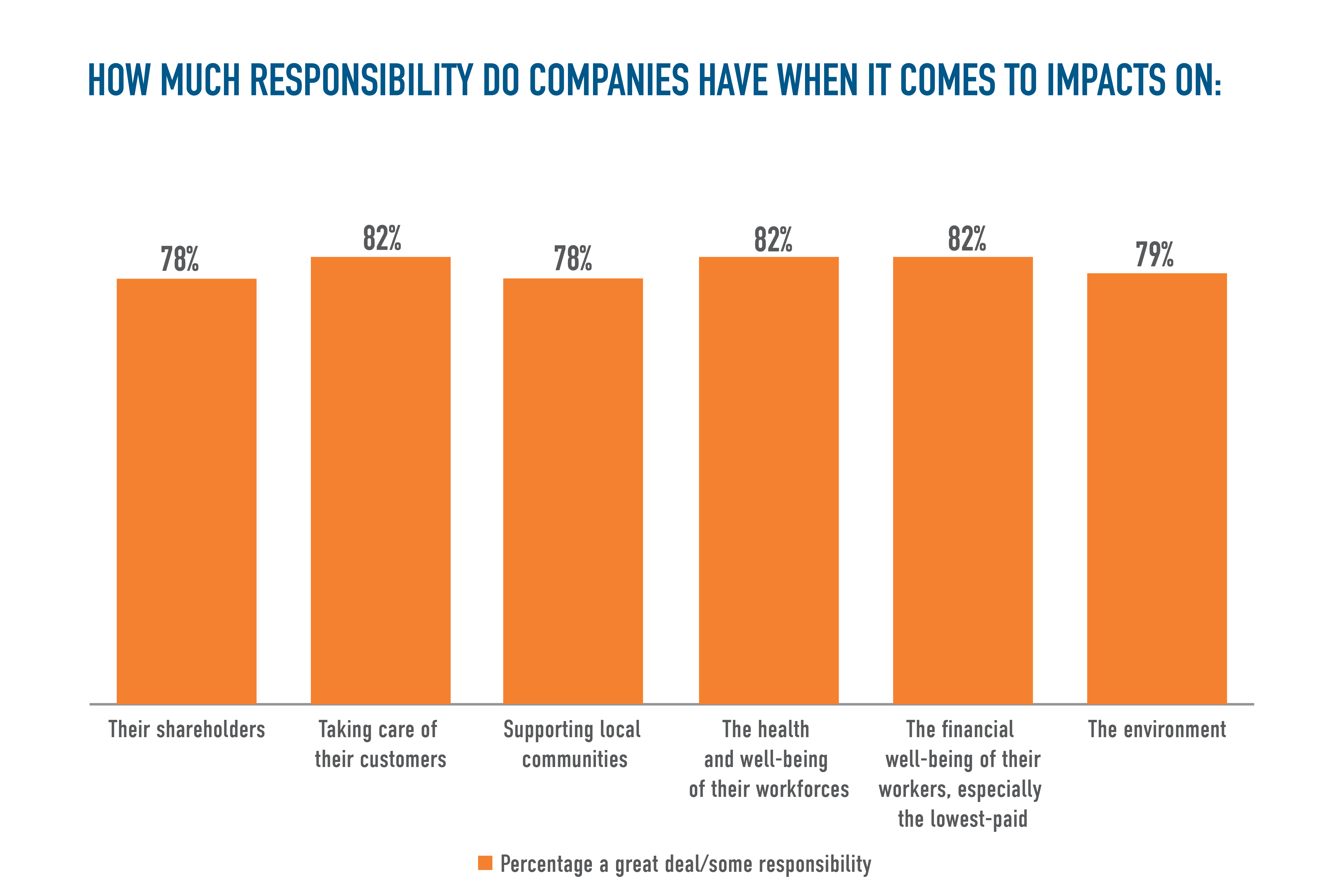
Friedman wrote in his Times essay that if CEOs allocated money in ways that did anything aside from maximize profit, they were imposing a tax of sorts on their shareholders and customers. This operates on the assumption that if a CEO were, for example, to decide to take somewhat of a hit in a quarter during a pandemic to provide robust worker benefits, they were cheating their investors and the people who buy their products and services. But it does not take into account the future value of these investments – a healthy, financially secure workforce is a more productive and stable one for the duration of that pandemic – or, as JUST has shown for the past six years, what the public actually wants.
As Whittaker wrote in the editorial mentioned above:
Our polling, done in tandem with The Harris Poll, suggests that a substantial majority of the public — regardless of background, age, location, or political ideology — supports the idea of companies creating value for all their stakeholders. Last year, our survey respondents prioritized key stakeholder issues with the following order of importance: workers (35%), customers (24%), communities (18%), environment (11%), and then shareholders (11%). (Percentages reflect relative prioritization of these stakeholder categories based on representative survey populations.)
To be clear, this does not mean that the stakeholder necessitates sacrificing your company’s financial performance for a perceived moral good, or otherwise cloaking profit maximization beneath a soft, PR-friendly mask; on the contrary, our research suggests companies that lead in meeting the needs of all their stakeholders have outperformed the laggards by almost 30% over the past four years — and by double-digit margins throughout the pandemic. They also have lower risk profiles, decreased market volatility, shallower drawdowns, and greater profitability.
Companies are recognizing this. It was remarkable to see, for example, how many corporations responded to the George Floyd protests against police brutality and racial inequity this summer with significant investments in diversity and inclusion efforts within their own organizations, as well as through sizable charitable donations.
JUST and The Harris Poll found that the large majority of Americans either somewhat favored or strongly favored CEOs responding to the protests with a statement about ending police violence (84%), promoting peaceful protest (84%), elevating diversity and inclusion in the workplace (78%), condemning racial inequity (75%), and condemning police killings of unarmed Black people (73%). It’s important to remember that before this year, most corporations would want to steer clear of such hot topics. But Americans, in their roles as workers, customers, and shareholders, are considering businesses in a way that would be anathema to Friedman.
As Ford Foundation president Darren Walker told CNBC in June, “More is going to be demanded of corporations, and more should be demanded, because they have a tremendous influence on how we live our lives.”
Friedman was right to point out that many CEOs couching their actions in moral rhetoric were being deceptive – and anyone who follows ESG investing knows all too well about “greenwashing.” If a company was investing in a community it operated in, Friedman argued, it was doing so because it could strengthen their business, not because of a moral imperative.
What’s interesting is that corporate leaders are not contesting Friedman’s point, but rather countering it. For example, JPMorgan Chase has, over the past decade, made significant investments in communities, but embrace rather than hide the way it is benefitting their business. Peter Scher, JPM’s head of corporate responsibility and chair of its mid-Atlantic region, wrote to JUST:
This year has provided a stark reminder of why business must play a proactive and deliberate role in supporting and rebuilding our communities.
With the COVID-19 pandemic exacerbating longstanding economic and racial disparities around the world, it is critical for business to step up and play a major role in creating opportunity and level playing field for dramatically more people. It’s not only the right thing to do, but it’s an economic imperative and good for the future of business. This is the new definition of capitalism. It is no longer just about a company’s short-term bottom line, it now includes businesses responsibility to society – how we support our employees and how we invest in the communities, especially those who have struggled and been underserved for decades. We, as business leaders, must step up to help solve systemic problems, and use our capital and other resources to do so, because that is in the long-term interests of our companies and our shareholders.
JPMorgan Chase is using our business expertise, policy ideas and philanthropic investments to help create an inclusive recovery and racial equity. We’re doing this in four major areas: skills development and careers, financial health, neighborhood development, and small business. And through our JPMorgan Chase PolicyCenter, we are advancing policies that remove barriers to economic opportunity, including second chance opportunities for those who have been part of our criminal justice system.
Detroit’s continued turnaround provides a good example of how business can collaborate with local government and community organizations to help those who have struggled for decades. JPMorgan Chase, along with other companies, have worked closely with Detroit and Michigan’s leaders to provide capital, jobs, training, technology, and a host of other resources to help Black Detroiters and many of the city’s neighborhoods recover and rebuild. We’ve done business in Detroit for 85 years: a long-term investment in its revitalization is not only good for Detroiters, it also makes very good business sense.
Businesses have a collective responsibility to lift up the communities that we serve and invest in the future – for our shareholders, customers, employees, and communities. When our communities thrive, we all thrive.
It’s easy to see how the same logic applies across the board.
For workers, Zeynep Ton, president of the Good Jobs Institute, has shown in her work how neglecting workforce investments for the sake of cost-cutting and profit-maximization has resulted in “bad jobs” that destabilize a business. Employees that are trusted with “good jobs” and rewarded fairly are more motivated and productive, which results in a better customer experience and, in time, better shareholder returns.
It also makes sense why companies like Microsoft and Apple boldly embracing green energy. Former Vice President Al Gore’s firm, Generation Investment Management, showed this year in its annual Sustainability Trends Report that in two-thirds of the world, wind and solar power are the cheapest forms of energy during the coronavirus crisis. As our ESG team put it, “That means companies here in the United States have an opportunity to cut costs, reduce carbon emissions, and maximize operating efficiency.”
At the World Economic Forum’s annual meeting in Davos in January, Microsoft CEO Satya Nadella said, “The fundamental source of all value in capitalism still comes from the planet and the people who live on the planet, and if the planet is in danger, what happens to capitalism?”
Friedman railed against any implication that businesses should exist as charities. Proponents of stakeholder capitalism agree with him – it’s just that the past 50 years have given us an excellent case study on what a singular focus on profits yields, and the evidence suggests a stronger alternative is possible. Profits enable companies to grow and benefit all of their stakeholders. But when corporate leaders and investors can capture the value, short- and long-term, of investments across workers, customers, communities, and the environment, in addition to shareholders, they can make decisions that strengthen their business for many years.
And that means a stronger economy, and a stronger country.
Last month, the Department of Labor released a proposal that would effectively keep all ESG (environmental, social, and governance) investing out of ERISA retirement plans.
“As Private employer-sponsored retirement plans are not vehicles for furthering social goals or policy objectives that are not in the financial interest of the plan,” Labor Secretary Eugene Scalia wrote, and called out ESG funds specifically.
We disagree with the way ESG is characterized in the proposal and think that implementing it would crush significant momentum for assessing companies based on the value they add to all stakeholders, including shareholders. It’s why we submitted the following comment to the DOL. Thursday is the final day the public can weigh in.
We are writing in response to the Department of Labor’s proposed rule, “Financial Factors in Selecting Plan Investments” (RIN 1210-AB95) (the “Proposal”).
JUST Capital is a nonprofit with a mission to build an economy that works for all Americans by helping companies improve how they serve all their stakeholders – workers, customers, communities, the environment, and shareholders. Uniquely, JUST Capital engages the American public to determine what matters most to them when it comes to just business behavior. We then define metrics that map to those issues and track and analyze the companies in the Russell 1000. The analysis helps companies benchmark and improve stakeholder performance, and incentivizes a “race to the top” through our high-profile Rankings with Forbes, as well as investment products like Goldman Sachs’ JUST ETF, which tracks our JUST U.S. Large Cap Diversified Index (JULCD), and has $137 million AUM.
The Department makes claims about the growth and role of “ESG” investing and its appropriateness in the context of ERISA plans, and then proposes to put ERISA sponsors in the fiduciary box with a rigid understanding of the relationship between “financial” and “nonpecuniary” factors. We respectfully request that the Proposal be withdrawn.
Thoughtful long-term allocators of capital are committed to considering the corporation’s role in meeting its obligations to other stakeholders, such as the Business Roundtable’s statement of August 2019, and moving beyond Milton Friedman’s iron-clad view that shareholders are the only stakeholder that deserves consideration, which the proposed rule the Department seeks to codify. Over the past six years, we have also surveyed over 100,000 Americans on this matter, and there is overwhelming and widespread support for stakeholder and ESG considerations in business and financial decision making.
We believe the proposed rule will ultimately result in lower risk-adjusted returns for ERISA plan holders, the same American people the rule is intended to protect. Research supports that long-term, risk-adjusted shareholder value is maximized when companies have good governance and managerial leadership aligned around maintaining a productive, safe workforce to serve customer needs in the context of the health of the social and physical environment in which they operate.
The Department states, “There is no consensus about what constitutes a genuine ESG investment, and ESG rating systems are often vague and inconsistent, despite featuring prominently in marketing efforts.” We submit that the investment community is coalescing around a definition of “ESG” that means, broadly, analyzing a company’s environmental, social, and governance characteristics, and incorporating those externalities into company valuations as part of a broadly diversified investment portfolio.
Ever since Graham and Dodd defined the field with their seminal Security Analysis text, financial analysts have gone beyond a company’s financial statements, which can only ever be backwards-looking, to investigating the company’s product offerings, its managerial quality, its social and economic environment, its relationships with suppliers and workers, and a host of other potential cues about its likely future prospects. Additionally, as companies have shifted from fixed to intangible assets, understanding how businesses are managing their human capital and market relationships with customers and suppliers takes on even more salience, and traditional accounting has failed to keep up with this shift. Taking this additional information into account gives analysts the capacity to build that forward-looking view.
And financial analysts since Graham and Dodd have been estimating – and disagreeing about – company valuations ever since. Those disagreements are what “make the market” as new information is impounded into security prices.
Thus, “ESG” is part of traditional company valuation analysis and has been for decades. These considerations have been with us since the dawn of modern financial analysis, and in this regard deserve no special consideration from the Department.
We also acknowledge the Department’s interest in preserving the fiduciary duty of sponsors to provide plan participants with “financial, rather than ‘nonpecuniary’ benefits.” In this regard, the evidence is mounting that companies that perform better on management of “ESG” issues certainly do not underperform their peers, and may even outperform them.
Our extensive public polling has identified with great specificity what the American public thinks the priorities of U.S. companies ought to be. We find that since we began this work, the companies that are most aligned with the priorities of the American people actually outperform the broader market.
Our experience is not unique. The evidence from years of experience suggests that investors in equity investment funds with “ESG” or “sustainable” goals do not need to sacrifice risk-adjusted returns. The notion that investors cannot maintain financial prudence while considering non-financial measures of performance is simply a false choice.
Given the evidence that “ESG” funds offer risk-adjusted performance in line with their peers, we believe they pass the “all things being equal” test and are entirely consistent with fiduciary duty as part of a well-diversified QDIA offering. As with consideration of any investment in this context, care must be given to the quality of the investment manager, the fund’s stated investment strategy and holdings, their investment process, and expected returns net of fees.
The American people are the ultimate beneficiaries of American companies, through their ownership in ERISA-sponsored plans, other retirement plans and ownership vehicles, and the final taxation and regulatory power of the U.S. Government. Americans can express their will as voters, but their capacity to effect change at corporations, even as the beneficial owners in an ERISA-sponsored plan, is limited given the proxy voting process.
Our polling tells us what the American people want from corporations: They want them to build loyal, stable, continually-learning workforces and pay them fairly; establish good relationships with the communities where they operate; provide safe, honest products and services to their customers, and leave the physical environment in which they operate in the same condition or better for their being in it.
Denying ERISA plan participants access to investment vehicles that incorporate “ESG” considerations would be closing off access to important non-financial information that affects company, and investment, valuations. It could leave sophisticated investors the fruits of deeper analysis, while relegating ERISA participants to the crumbs of underperformance. The evidence is strong and growing that “ESG” considerations are critical factors in evaluating long-term company performance and future prospects. Incorporating those and all relevant factors in a thoughtful valuation process is the core of achieving superior risk-adjusted returns, and fiduciary duty demands that we deliver the highest available risk-adjusted returns to the American people in their ERISA-sponsored plans.
Thank you for considering these comments.
Last month, the Department of Labor (DOL) proposed a new investment duties rule that would essentially keep ESG funds out of retirement accounts and kill ESG momentum if enacted. Everything I’ve seen throughout my career shows that such a move would hurt investors. The comment period closes this Thursday.
While the DOL states “the rule is intended to provide clear regulatory guideposts for plan fiduciaries in light of recent trends involving environmental, social and governance (ESG) investing,” the context they provide shows a lack of understanding of ESG. This will affect everyday American’s access to modern day investment strategies, which take into account the way businesses treat stakeholders. With the update, the DOL seeks to clarify requirements for plan fiduciaries, stating that ERISA plan fiduciaries cannot invest in ESG vehicles when they “understand an underlying investment strategy of the vehicle is to subordinate return or increase risk for the purpose of non-financial objectives.”
The crux of the problem with the proposed rule is that it rests on the outdated belief that ESG funds subordinate financial objectives to environmental, social or governance objectives, and will therefore underperform. In fact, just the opposite is true. JUST Capital launched the JUST US Large Cap Diversified Index (JULCD) on November 30, 2016, the index underpins the Goldman Sachs JUST U.S. Large Cap Equity ETF (JUST ETF), which launched in 2018. At 2Q 2020 the JULCD represented 447 of the top companies in the Russell 1000, by industry, according to our rankings. The Index provides broad exposure to companies that do right by their stakeholders: workers, customers, communities, the environment, and shareholders. Since inception through 2Q 2020, the index returned 13.73%, outperforming both the Russell 1000 and the S&P 500, which returned 12.43% and 12.53% over the same period.
External studies have also shown that ESG funds generally outperform conventional peers. An April Morningstar report by Jon Hale, PhD, CFA found that from 2014 through 2019, sustainable funds showed strong performance in both up and down markets relative to conventional peers. Per Hale, “when markets were flat (2015) or down (2018), the returns of 57% and 63% of sustainable funds placed in the top half of their categories. When markets were up in 2016, 2017, and 2019, the returns of 55%, 54%, and 65% of sustainable funds placed in the top half of their categories.”
Our work at JUST Capital over the last six years centers on elevating the voice of the public to align their priorities for just business behaviors with corporate action. Coupled with that, we seek to highlight the relationship between the financial outperformance of just companies and how well they serve all stakeholders – the results show a clear connection between the two, debunking the myth that ESG investments are doomed to underperform.
Amidst the COVID-19 pandemic, JUST Capital has doubled efforts to look under the hood to evaluate how companies are treating their stakeholders during the crisis and highlight the outperformance of just companies. What we’ve found is that companies with strong corporate governance lead the market in a downturn. We did this analysis on Russell 1000 companies by looking at the data points related to corporate governance within the JUST Capital rankings model.
In this exercise, we noted that top quintile companies have significantly outperformed the market in the past year by 3.0% relative to the fifth quintile performance during the past year. With regard to social issues, we found in particular that companies that have prioritized their workers during the pandemic have continued to outperform. Looking at the performance of each quintile year-to-date as of 5/31, we see the top quintile (Q1) outperforming by 6.26% relative to the bottom quintile.
Earlier in my career, I worked as an ETF product manager for private wealth clients. A critical part of my role was evaluating the holdings, investment strategies, and performance of ETFs and determining whether they were acceptable offerings for our clients. This meant I needed to take the time to carefully evaluate the funds. What was driving performance? Did the holdings match the fund’s stated investment objective? How did the fund compare with peers in its asset class?
That experience leaves me confident that the DOL proposal would do a disservice to all investors, but particularly millennials, who are overwhelmingly inclined towards making ESG investments and whose 401 (k) plans represent a large portion of their savings. In the most recent “Better Money Habits® Millennial Report” Bank of America found that “of millennials with savings, three-quarters are saving for retirement.” And a recent Morgan Stanley report found enthusiasm for sustainable investing at an all-time high, with 52% of the general population and 67% of millennials taking part in at least one sustainable investing activity, such as investing in companies or funds that target specific environmental or social outcomes. The report goes on to state that “investors want products that match their interests; 84% want the ability to tailor their investments to their impact goals, 90% among millennials.”
To be clear, the work we do at JUST is in complete harmony with the stated mission of the DOL, which is “to foster, promote, and develop the welfare of the wage earners, job seekers, and retirees of the United States; improve working conditions; advance opportunities for profitable employment; and assure work-related benefits and rights.” With institutional investors increasingly investing in ESG leaders and moving away from ESG-risky companies, our concern is that the general public will be left owning companies in their 401 (k) plans that face high downside risks as a result of poor environmental, social, and governance performance.
Adding hurdles such as documentation requirements for fiduciaries choosing between “truly economically ‘indistinguishable’ investments” could work to disincentivize plan sponsors from adding ESG investment options, which many end investors are interested in, and eventually make 401(k) plans a haven for companies rated as ESG laggards.
We hope to see more firms add their voice to the discussion so that investors can choose from best in class companies in their retirement plans, companies who look after their stakeholders, ensuring a better future for all.
