
The following story was originally published on Jan. 8 and last updated on Jan. 14.
On Wednesday, Jan. 6, a mob of Trump supporters, motivated by the President to try to stop the certification of Joe Biden’s victory, stormed into the U.S. Capitol. Members of Congress were evacuated, and by that Friday, four rioters and a Capitol police officer had died. By the time the National Guard was finally called in to clear the scene, the country’s foremost business leaders had joined other influential voices across all sectors of life to decry the actions.
Before anyone even began marching to the Capitol, groups like the Business Roundtable and U.S. Chamber of Commerce released statements against Republicans challenging the certification of the election on grounds already dismissed by the courts, and a collection of CEOs had a private call where they discussed how they were reconsidering withholding further financial support of any politician involved.
In the week that followed, dozens more CEOs weighed in, Big Tech removed Trump and groups connected to the riot from their platforms, and corporations placed holds on – or even abandoned for good – political spending.
We’ve collected actions and statements from America’s most influential voices in business in response to the attack on the Capitol and the claims that led to it. In a time when we have gotten used to CEOs and corporate publicity teams weighing in on current events, we should not lose sight of the fact that this particular type of response is unprecedented.
We will continue updating the list.
The Wall Street Journal reported that in response to the opposition to the transition of power, but before the Capitol break-in, three dozen CEOs – including the heads of Accenture, Merck, and Walt Disney Co. “discussed divisions in the country, efforts to thwart the presidential transition and what voice they thought business should have in politics.”
The Journal then reported on Jan. 10 that JPMorgan Chase and Citigroup are pausing all PAC donations to both Republicans and Democrats for six months. Blue Cross Blue Shield and Marriott International are pausing donations to any Republican lawmaker who pushed against the certification of Joe Biden’s victory.
It was reported on Jan. 11 that American Express would also suspend support for Republicans who fought the certification. On Jan 12th Popular Information reported that Dow, AT&T, Amazon, AirBnb, Deloitte, Comcast, Verizon, Best Buy, and Mastercard were also suspending PAC donations to any member who fought the election certification. Hallmark, in addition to pausing all PAC donations, is asking for refunds from Senators Josh Hawley and Roger Marshall.
Charles Schwab announced on Jan. 13 it was dissolving its PAC and no longer making political donations, and that funds remaining in the PAC would be donated to the Boys & Girls Clubs of American and historically Black colleges and universities.
Facebook: On Jan. 6, Facebook took down Trump’s video message to the rioters who broke into the Capitol, in which he told them to go home but also said he “loved” them and once again validated the idea that the election was stolen, in addition to other rallying statements that the company deemed dangerous. The next day, CEO Mark Zuckerberg announced that Trump’s Facebook and Instagram (a Facebook subsidiary) accounts were blocked “indefinitely,” and until at the least Biden’s inauguration is complete, due to using Facebook’s platform “to incite violent insurrection against a democratically elected government.”
Reddit: On Jan. 8, Reddit banned the subreddit “r/DonaldTrump,” an unofficial fan page, on account of violating the prohibition against “content that promotes hate, or encourages, glorifies, incites, or calls for violence against groups of people or individuals.”
Snapchat: The company locked Trump’s account on Jan. 6 because it determined that his rhetoric violated its prohibition against “hate speech, incitements or glorification of violence,” and “the spread of misinformation that could cause harm.”
Twitch: Trump’s account was removed on Jan. 6 to “prevent Twitch from being used to incite further violence,” the company said.
Twitter: On Jan. 6, Twitter locked President Trump’s account for 12 hours following a series of tweets the company said represented “repeated and severe violations of our Civic Integrity policy.” On Jan. 8, Twitter permanently suspended @realDonaldTrump “due to the risk of further incitement of violence” and deleted new posts from the president to the @POTUS account. That same day, Twitter also permanently banned Michael Flynn, Sidney Powell, and other Trump supporters who promoted Q Anon conspiracy theories on the website on account of “Coordinated Harmful Activity.”
YouTube: On Jan. 6, YouTube also removed Trump’s video message to rioters. The next day, it announced that, “Due to the disturbing events that transpired yesterday, and given that the election results have now been certified,” any video uploaders who spread misinformation about the election will have their video taken down and receive a “strike.” A strike comes with a temporary suspension and an account with three strikes within 90 days is permanently removed. YouTube took down thousands of related videos, including from the president’s attorney, Rudy Giuliani.
In addition, Big Tech companies cut off support for Parler, the social media app that was used extensively by those who attacked the Capitol and who continued to spread conspiracy theories and plan further violence. On Jan. 9, Apple and Google removed Parler from their app stores for not policing content used to incite violence, and then Amazon Web Services told Parler it was terminating Parler’s account the next night, which it did.
GoFundMe: Following reports that Capitol rioters used GoFundMe’s fundraising platform, the company announced on Jan. 11 that it would ban fundraisers for likeminded people looking to travel to inauguration events with the intent of inciting violence. It is also banning pages used for promoting related misinformation.
PayPal:closed an account that was used to send rioters to the Capitol On Jan. 7, the company the day prior, and on Jan. 11 closed an account for a similar group.
Shopify: The company took down the Trump campaign’s and Trump organization’s online stores on Jan. 8 because “Shopify does not tolerate actions that incite violence.”
Stripe: On Jan. 10, Stripe decided to no longer process payments for Trump’s campaign website due to violating policies against inciting violence.
“The country deserves better,” declared the Business Roundtable, chaired by Walmart CEO Doug McMillon, in an initial statement released during the attack on the Capitol, and followed up on Thursday to say that, “As businesses who operate in and employ millions of people in all 50 states…our support for the democratic process and the peaceful transition of power must be unequivocal.”
The National Association of Manufacturers decried the violence as “chaos,” and an act of “sedition” in a statement calling for the invocation of the 25th Amendment and affirming that, “This is not the vision of America that manufacturers believe in and work so hard to defend.”
The U.S. Chamber of Commerce impressed that these attacks against “our democracy must end now” in a short note from its CEO thanking law enforcement officials.
“Our elected leaders must stand together to support democracy, accept this free and fair election and bring to justice the perpetrators of today’s violent assault on our country. As Americans we must stand in support of our democratic values and the leaders who uphold them.” – Julie Sweet, CEO of Accenture
“The lawlessness and violence occurring on Capitol Hill today is the antithesis of democracy and we strongly condemn it.” – Sundar Pichai, CEO of Alphabet
“I am deeply saddened by the events that took place in Washington, D.C. yesterday. … The U.S. democratic process and the rule of law must not be allowed to be disrupted.” – Bob Bradway, CEO of Amgen
“I have faith that our democratic institutions and the principles upon which they were founded will prevail and that we will get through this together.” – Stephen J. Squeri, CEO of American Express
“It’s especially when they are challenged that our ideals matter most.” – Tim Cook, CEO of Apple
“We applaud all those who stood strong to thwart an appalling insurrection bent on blocking the peaceful transfer of power following a free and fair election.” – John Stanley, CEO of AT&T
“We must move forward together peacefully, respectfully and with a singular, shared focus on our American ideals.” – Brian Moynihan, CEO of Bank of America
“I condemn in the strongest possible terms the violence at our Capitol today. This is an assault on our nation, our democracy, and the will of the American people.” – Larry Fink, CEO of BlackRock
“Our company has a long history of working with elected officials over many years. In the spirit of bipartisanship, we encourage them to work with President-elect Biden to unify our nation.” – David Calhoun, CEO of Boeing
“The violent attacks and protests that occurred at the U.S. Capitol and several states yesterday marked a dark and sad day for our country and served to threaten the foundation of the nation’s democracy.” – Mike Mahoney, CEO of Boston Scientific Group, and Wendy Carruthers, SVP of Human Resources at Boston Scientific Group
“Today is a sad day. The scenes at the United States Capitol building this afternoon were, frankly, sickening and an embarrassment to the country.” – CBRE
“We call for the peaceful transition of the U.S. government. The violence in Washington, D.C. tarnishes a two-century tradition of respect for the rule of law. We look forward to engaging with President-Elect Biden and his administration to move the nation forward.” – Chevron
“As citizens of our great nation, all of us have a responsibility to speak out against and condemn in the strongest terms the violence and display of demagoguery we witnessed in our nation’s capital yesterday. This is not who we are as a nation and our democracy must be protected.” – Evan G. Greenberg, CEO of Chubb
“We’ll get through this challenging time in our history if we stay true to the values that have guided our nation since its beginning. The peaceful transfer of power is one of those values.” –David Cordani, CEO of Cigna
“The United States has long served as a beacon of democracy, and today we are reminded of both its importance and fragility.” – Chuck Robbins, CEO of Cisco
“I have faith in our democratic process and know that the important work of Congress will continue and that people will be held accountable for their actions.” – Michael Corbat, CEO of Citi
“Cognizant CEO, Brian Humphries, joined fellow members of the Business Roundtable in support of a peaceful transition of power.” – Cognizant
Cummins Inc. shared the Business Roundtable statement.
“This attempted subversion of our democracy is an attack against us all, and we must stand together, united, in the defense of our values and our country.” – Michael Dell, CEO of Dell Technologies
“The US is stronger than the abhorrent actions of those who engaged in this conduct.” – Punit Renjen, CEO of Deloitte Global
“The events we all witnessed this afternoon, with the storming of the US Capitol, represent a sad and embarrassing moment. But our great country is far stronger than the abhorrent actions of those who engaged in this conduct.” – Joe Ucozoglu, CEO of Deloitte US, and Janet Foutty, Chair of Deloitte US
“Today’s scenes at the U.S. Capitol are an attack on democracy and not who we are as a country. Before all else, we are Americans. The challenges we face require us to come together, urgently. To those leaders upholding their oath and our nation’s ideals — we stand with you.” – Jim Fitterling, CEO of Dow
“Watching this on TV from Australia evokes memories of my lived experiences in emerging economies with coups, brawls in parliament and street violence. The US is our beacon for freedom and democratic principles. It’s tragic to see what’s happening now.” – Andrew N. Liveris, former CEO of Dow
“The shocking events of the last 24 hours clearly demonstrate that President Donald Trump intends to use his remaining time in office to undermine the peaceful and lawful transition of power to his elected successor, Joe Biden.” – Mark Zuckerberg, CEO of Facebook
“We commit to working together, with respect and empathy, to uphold core American values…” – Jim Farley, CEO of Ford Motor Company
“The peaceful transition of power is a cornerstone of American democracy, and regardless of politics the violence at the U.S. Capitol does not reflect who we are as a nation.” – Mary Barra, CEO of General Motors
“Recently, we have squandered that goodwill at an alarming pace, and today’s attack on the U.S. Capitol does further damage. It’s time for all Americans to come together and move forward with a peaceful transition of power.” – David M. Solomon, CEO of Goldman Sachs
“Growing up in Spain, I know firsthand that the world has always looked at the United States as a beacon of freedom and democracy … Today’s chaos in our nation’s capitol violates the very idea on which America was built.” – Enrique Lores, CEO of HP
“May we all quickly find a way for a peaceful dialogue and a better way forward. Our country is better than this.” – Antonio Neri, CEO of HPE
“IBM condemns today’s unprecedented lawlessness and we call for it to end immediately.” – Arvind Krishna, Chairman and CEO of IBM
“A peaceful transfer of power is an essential part of democracy, and there is no justification for the use of violence to undermine free elections. We all deserve better.” – Francis deSouza, CEO of Illumina
“At Intel we condemn all acts of violence and attempts to unlawfully disrupt a democratic process that has long been a model for the world.” – Bob Swan, CEO of Intel
“On a day which should have seen a step in the peaceful transfer of power in the United States, we were instead confronted by disturbing images of violence and hate, stoked by divisiveness and disinformation.” – Philippe Krakowsky, CEO of Interpublic Group
“As an American, as a colleague to tens of thousands of Johnson & Johnson employees in the country, and as a U.S. military veteran who served overseas to protect our democracy, I’m devastated by this assault on what our country has stood for since its founding: free, fair and peaceful elections.” – Alex Gorsky, Chairman and CEO of Johnson & Johnson
“This is not who we are as a people or a country. We are better than this.” – Jamie Dimon, CEO of JPMorgan Chase
“Earlier today, the U.S. Congress certified the election results, a powerful symbol of the value of free, fair and peaceful elections that are so central to the fabric of America. Yesterday’s violence at the Capitol building in Washington — the very symbolic place that’s meant to preserve it — runs counter to the ideals that America was founded on.” – Michael Miebach, CEO of Mastercard
“For those of us in the United States, regardless of our political affiliations, all of us must work to protect our democracy and do what we can to bring our country together as we move forward from this moment.” – Brian Tyler, CEO of McKesson
“As someone who has benefitted immensely from the freedoms we enjoy in the United States, I am deeply troubled by the images today from our nation’s capital. We all deserve better than the chaos we are seeing in Washington, D.C. – as a society and as a nation.” – Geoff Martha, CEO of Medtronic
“We are shocked to witness the events at the U.S. Capitol, and deeply disappointed by the misleading claims that incited these actions.” – Micron Technology
“This is a day to speak up for our Constitution and its values. We are proud to be a member of the Business Roundtable.” – Brad Smith, President of Microsoft
[Following election victory certification.] “Congratulations to the 46th President of the United States, Joe Biden! Today is a beautiful moment for democracy. Now we must move through the dark times our country has faced and toward a brighter, more unified future.” – David Kenny, CEO of Nielsen
“I urge leaders from both sides of the aisle to take a stand and call for the violence to end. Now, more than ever, we need to foster an environment of inclusion and healing.” – Dan Schulman, CEO of PayPal
“Now is the time to come together, find ways to understand our differences and solve the problems we face constructively.” – Albert Bourla, CEO of Pfizer
“The violence that occurred at the Capitol yesterday must be condemned in the strongest possible terms. There is no room for nuance. Democracy depends on the peaceful transition of power – period.” – Marc Lautenbach, CEO of Pitney Bowes
“The violence and lawlessness that took place in Washington today was disgraceful and un-American, and has no place in our democracy.” – Charles F. Lowrey, CEO of Prudential
During a webcast to employees, PwC US Chairman Tim Ryan emphasized, “I think it is safe to say that this is a surreal day that will go down in our country’s history.”
“I am deeply troubled by the events we saw unfold at the U.S. Capitol in an attempt to thwart the democratic process that has defined our nation since its founding. … We must begin the process of healing, unite in the common goal of addressing division in our society and restore civility.” – Doug Peterson, CEO of S&P Global
“Our leaders must call for peace and unity now. There is no room for violence in our democracy.” – Marc Benioff, CEO of Salesforce
“SAP stands with the leaders of the Business Roundtable – we need to end violence and focus on a peaceful transfer of power.” – Christian Klein, CEO of SAP SE
“Much like our need to model leadership in safety, it is just as important to be a model for our values and support our democratic ideals — the same ideals that underpin a prosperous and free nation for all.” – Jeffrey W. Martin, CEO of Sempra Energy
“Yesterday’s acts left us with heavy hearts. Today we can look forward with hope, to a more peaceful transition. Let’s now lead, unite, and pledge to leave our world better than we found it. Together we can accomplish so much.” – Bill McDermott, CEO of ServiceNow
“We condemn the disturbing and horrifying storming of the U.S. Capitol. With President-elect Joe Biden rightfully certified as the 46th POTUS, we call on all Americans to persevere and move forward with a peaceful transition of power.” – Jim Loree, CEO of StanleyBlack&Decker
“The dangerous, violent actions perpetrated by an unlawful group of domestic terrorists at the U.S. Capitol undermines the very essence of what we stand for as a nation. It is time to do away with division and animosity and forge ahead together to create a better future for all.” – Tom Fanning, CEO of Southern Company
“We condemn the recent violence, hate and attack on our democracy. Progress begins when we stand up and speak out. We must hold each other accountable to build a more hopeful and just future, together.” – Starbucks
“What we are witnessing does not reflect who we are as a nation, nor does it reflect the values our country holds sacred. Today more than ever, all voices deserve to be heard, but this must happen in a peaceful and lawful manner.” – Margaret Keane, CEO of Synchrony
“What happened in Washington, D.C. is an offense to the ideals of American democracy.” – The Coca-Cola Company
“Our society and economy are built on the foundation of a strong democracy, which thrives when we come together with mutual respect and a focus on the greater good.” – Chris Swift, CEO of The Hartford
“We are appalled by the lawlessness and violence that unfolded at the U.S. Capitol and strongly condemn the actions of those individuals who participated in the illegal activities that destroyed property and cost lives.” – Carol Tomé, CEO of UPS
“We condemn any type of senseless violence and rioting that we saw yesterday. It’s just unacceptable.” – Hans Vestberg, CEO of Verizon
“We at Visa stand 100% behind the results of the election and the collective voices of the citizens of this country.” – Alfred F. Kelly, Jr, Chairman and CEO of Visa
“America is at its best when we are unified, working as one nation. There is nothing good about the violent and unlawful protests in DC. I’m praying today for a peaceful transition of leadership.” – Pat Gelsinger, CEO of VMware
“We are in full support of Business Roundtable’s position and believe in peace and unity as we move forward in upholding democracy.” – Aneel Bhusri, CEO of Workday
“If this were a Black crowd, if this was a Latino, Mexican, any kind of shaded crowd, they’d be dead,” – Ursula Burns, former CEO of Xerox
As we close out 2020 and look to the Biden-Harris inauguration, a key question has begun to emerge: will business leaders continue to take a stand on the critical social issues of our time?
While social leadership is not new for corporate America, the last several years have seen an unprecedented rise in CEO activism, coalescing around the Business Roundtable’s 2019 statement that the purpose of a corporation is to create an economy that serves all Americans. C-suite leaders have become increasingly outspoken in recent years – during which the American people have witnessed growing and vast economic inequality, social unrest, and the impacts of climate change. As President-Elect Biden prepares to usher in a Democratic administration, speculation has emerged around whether CEOs will continue the trend and both speak out and engage on the biggest societal issues of the day.
Over the course of this year, Just Capital has surveyed the American public to get their take on the role they believe companies – and their leaders – must play in addressing the myriad of social crises of our time, from the COVID-19 pandemic to our nation’s reckoning with racial injustice to the challenges to democracy emerging from the recent election.
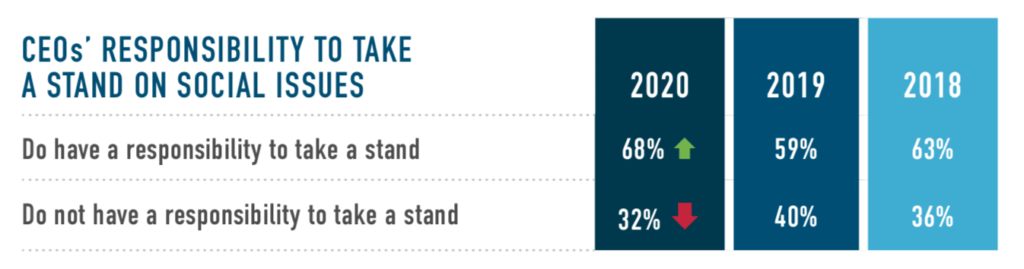
Across the board, we’ve found that Americans agree that companies have a role to play, and that they see corporate leaders as societal leaders. Specifically, when we ask Americans whether they think CEOs have a responsibility to take a stand on key social issues, more than two-thirds of respondents told us that they do, an increase over the last two years:
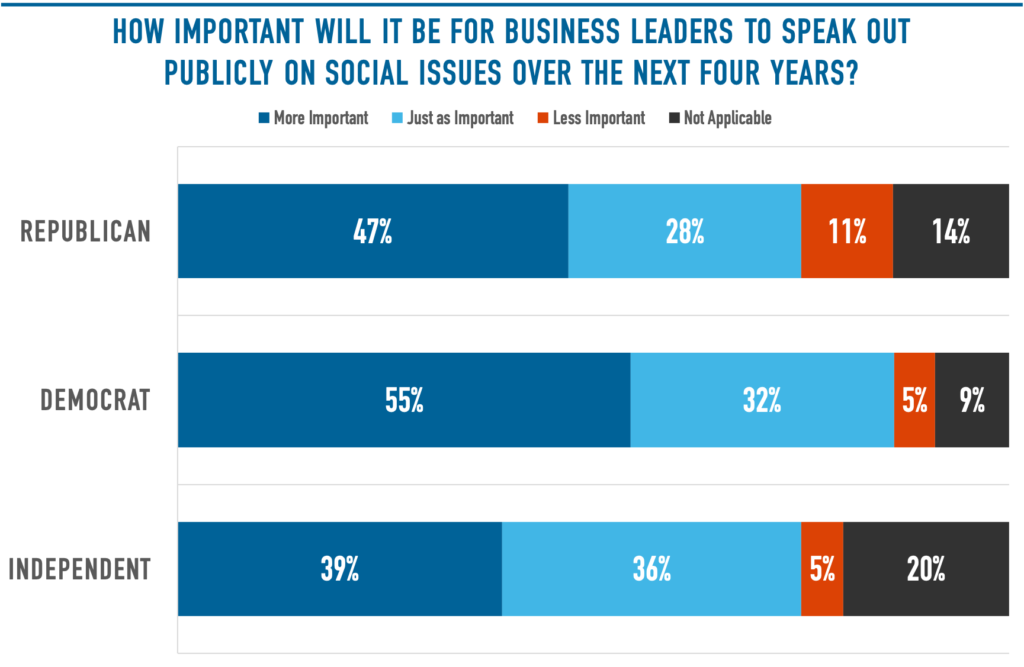
And as we look forward to the next four years under a new administration we recently asked the public whether they think it will be more or less important for corporate leaders to speak out on social issues. An overwhelming 79% of Americans say it will be just as important, or more important, for corporate leaders to speak out publicly on social issues over the next four years, compared to today. Only 8% believe it will be less important over the next four years. 47% of respondents believe it will be even more important, while 32% believe it’s just as important. 14% think the question is not applicable because they do not think it is important for business leaders to speak out on social issues.
Across party lines, there is agreement overall that it will continue to be as important, or more important, for corporate leaders to speak out over the next four years, though Democrats seem to most firmly hold this belief. 87% of Democrats see continued corporate activism as more, or just as, important, while 75% of both Republicans and Independents share this view.
It’s early days, but already we’re seeing corporate leaders begin to engage with the incoming administration on core stakeholder issues. 40 companies – including Microsoft, Citigroup, Walmart, and Ford – sent a letter to the transition team earlier this week, urging the U.S. to rejoin the Paris Climate Accord. And last month, Microsoft president Brad Smith shared his thoughts on the election, calling for “bipartisan collaboration and government and industry cooperation” on issues core to its business, from new data privacy laws to nationwide internet accessibility. Meanwhile, President-Elect Biden has signaled that workers will be central to its efforts over the next four years, promising to help create “an economy that gives every single person across America a fair shot and an equal chance to get ahead.”
As our nation transitions to the Biden-Harris administration, Just Capital will continue to track these efforts, looking not only at how corporations act but at what the American public believes is most important. Stakeholder capitalism will no doubt remain in focus as both government and business leaders begin to align on what comes next.
In last week’s Chart of the Week, we evaluated company performance against the estimated percentage of employees making a living wage. This week, we’re again considering the relationship between workers’ financial stability and their company’s performance, this time based on our “Pays a Fair Wage” metric. This offers some insight into how companies’ wages differ across various job titles when compared to industry peers.
Whether or not a corporation pays a fair wage to their employees based on job level, qualifications, and experience is the most important issue to the American public according to JUST Capital’s polling on just business behaviors – and that makes it the highest weighted issue when compiling our Rankings.
When we consider the fair pay scores for the companies in our Rankings during the current economic downturn, those that scored in the top quintile on this metric returned 6.5% relative to their industry peers. Those that scored in the bottom quintile saw a -3.0% return relative to their industry peers.
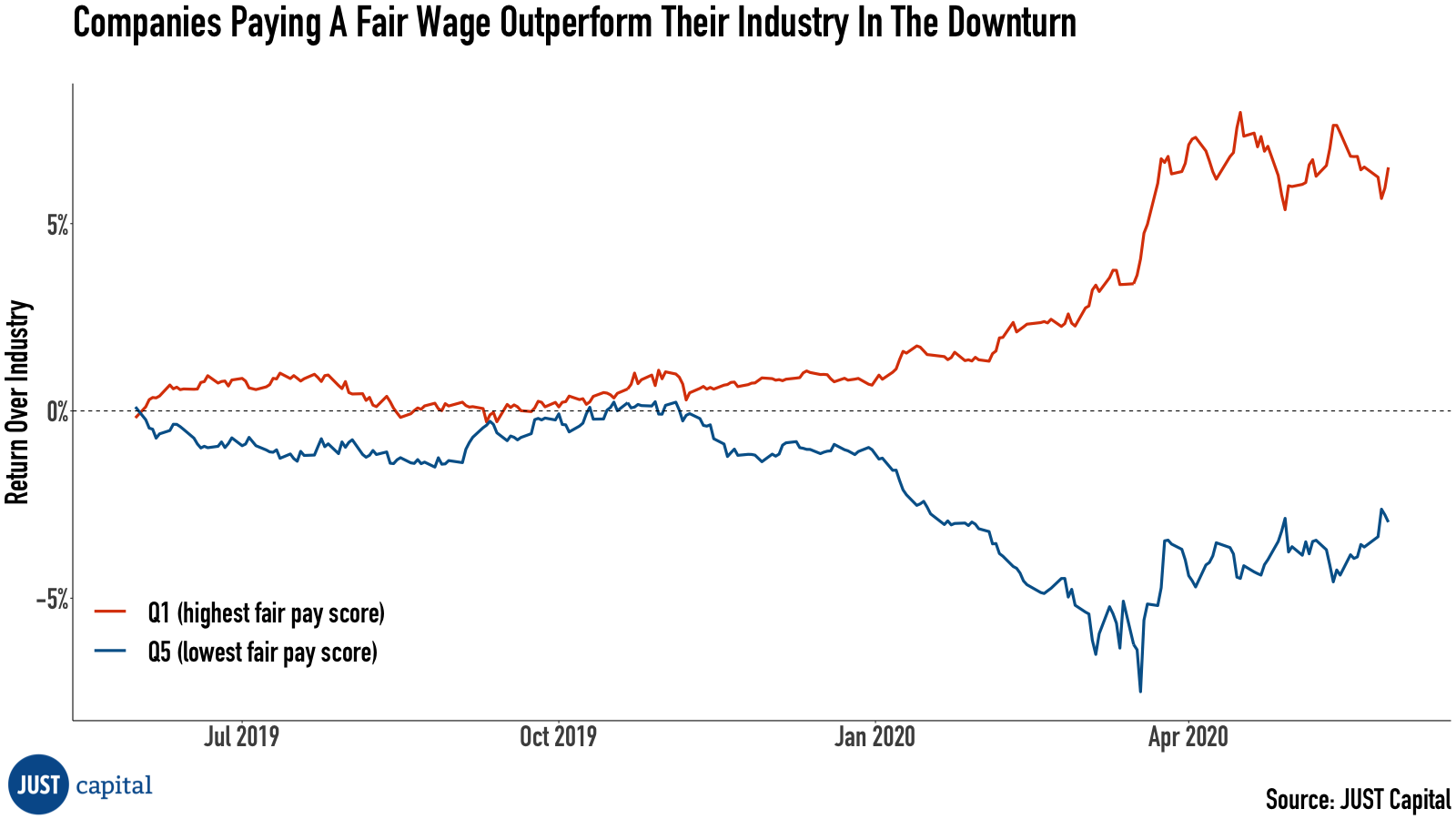
The Fair Pay Score metric that we used in the chart above is a comparison of a company’s wages to industry peers’ wages by job title. This means that companies that pay a high wage to all their workers relative to their industry receive a higher score than those that don’t. Unlike the concept of a living wage, this metric is relative.
As the Financial Times reported this month, raising pay for your employees during a crisis can provide long-term benefits, further substantiating our results above. While firms continue to cut costs on office space, travel, sponsorship, and advertising, they are presented with a unique opportunity to reset the way their employees are incentivized and strengthen the relationship with their workforce. As we show above, there’s evidence this is yet another case of a win-win for both employers and employees.
If you are interested in supporting our mission, we are happy to discuss data needs, index licensing, and other ways we can partner. Please reach out to our Director of Business Development, Charlie Mahoney, at cmahoney@justcapital.com to discuss how we can create a more JUST economy together.
If you have questions concerning the underlying analysis, please reach out to our Senior Manager for Quantitative Research, Steffen Bixby, PhD, at sbixby@justcapital.com.
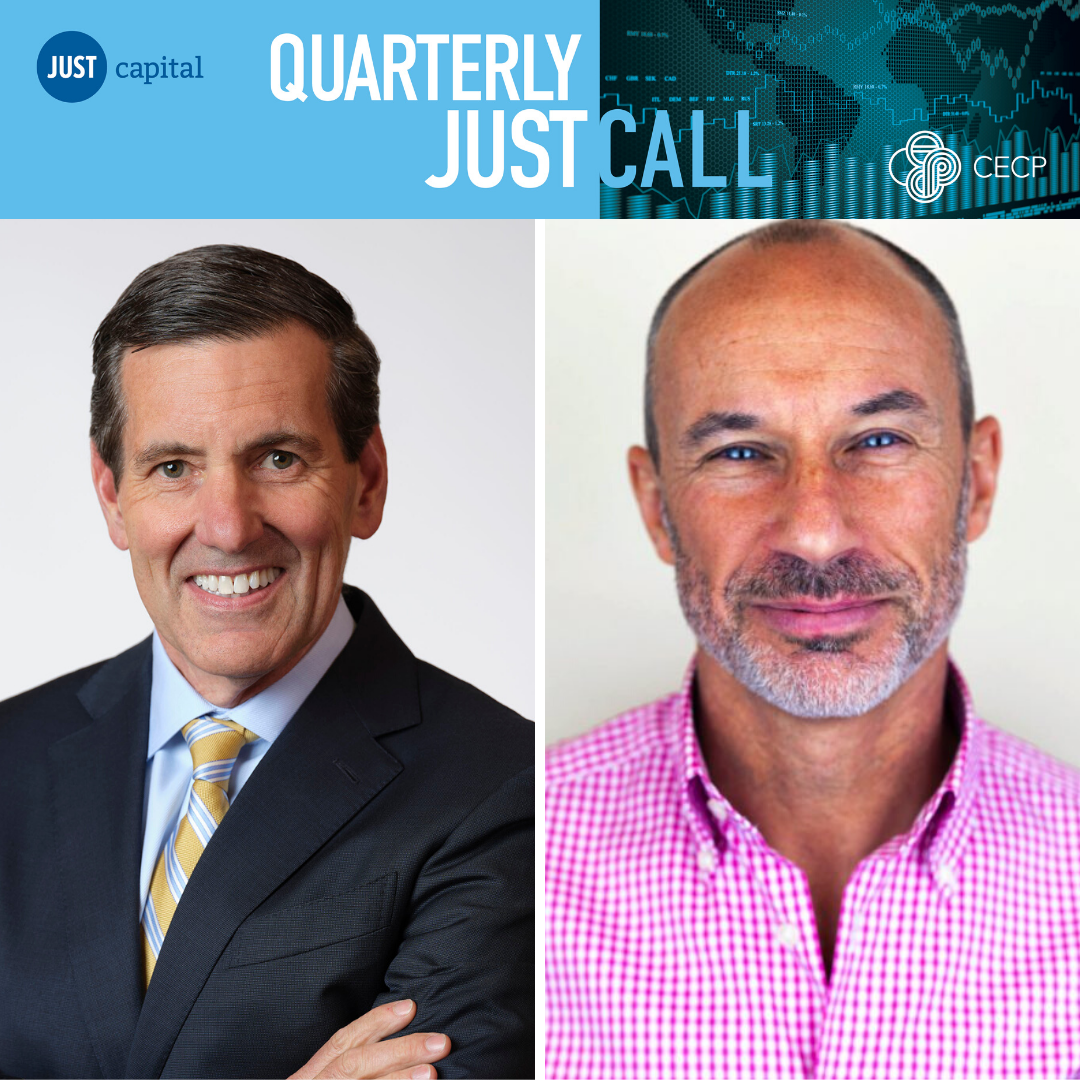
JUST Capital and Chief Executives for Corporate Purpose (CECP) invite you to join us on Friday, July 24, for our latest Quarterly JUST Call featuring Bruce Broussard, CEO and President of Humana.
Tune into an interview with Andrew Ross Sorkin on CNBC Squawk Box in the 7:15-8AM EST window followed by an interactive webcast where we’ll unpack Humana’s stakeholder performance, long-term plan for sustainable value creation, response to COVID-19, and more.
The Quarterly JUST Call builds on the traditional quarterly earnings call, providing a platform for CEOs to speak directly with investors about the ways in which they are creating value for all their stakeholders – workers, customers, communities, the environment, and shareholders – over the long term. Specifically, it taps into growing demand for investors interested in long-term value creation through the lens of ESG and sustainability, even amidst the crisis.
For the first time, this Quarterly JUST Call is being produced in partnership with CECP’s CEO Investor Forum to strengthen C-suite communications about their long-term strategies to create sustainable value creation for both investors and other key stakeholders.
The Humana Quarterly JUST Call Schedule for July 24, 2020:
Humana
Humana Inc. is committed to helping our millions of medical and specialty members achieve their best health. Our successful history in care delivery and health plan administration is helping us create a new kind of integrated care with the power to improve health and well-being and lower costs. Our efforts are leading to a better quality of life for people with Medicare, families, individuals, military service personnel, and communities at large. To accomplish that, we support physicians and other health care professionals as they work to deliver the right care in the right place for their patients, our members. Our range of clinical capabilities, resources and tools – such as in-home care, behavioral health, pharmacy services, data analytics and wellness solutions – combine to produce a simplified experience that makes health care easier to navigate and more effective. More information regarding Humana is available to investors via the Investor Relations page of the company’s web site at www.humana.com.
Chief Executives for Corporate Purpose® (CECP)
CECP is a CEO-led coalition that believes that a company’s social strategy – how it engages with key stakeholders including employees, communities, investors, and customers – determines company success. Founded in 1999 by actor and philanthropist Paul Newman and other business leaders to create a better world through business, CECP has grown to a movement of more than 200 of the world’s largest companies that represent $6.6 trillion in revenues, $21.2 billion in social investment, 14 million employees, 23 million hours of employee engagement, and $15 trillion in assets under management. CECP helps companies transform their social strategy by providing customized connections and networking, counsel and support, benchmarking and trends, and awareness building and recognition.
JUST Capital
The mission of JUST Capital, an independent nonprofit, is to build an economy that works for all Americans by helping companies improve how they serve all their stakeholders – workers, customers, communities, the environment, and shareholders. We believe that business and markets can and must be a greater force for good, and that by shifting the resources of the $19 trillion private sector, we can address systemic issues at scale, including income inequality and lack of opportunity. Guided by the priorities of the public, our research, rankings, indexes, and data-driven tools help measure and improve corporate performance in the stakeholder economy. To learn more about how data-driven insights are creating a more just future for capitalism, visit: www.JUSTCapital.com.
The past few months have been incredibly challenging. Between the devastating impacts of coronavirus and economic fallout, Americans have faced unprecedented unemployment, the threat of illness, and profound loss. And in the past weeks, the deaths of George Floyd, Ahmaud Arbery, and Breonna Taylor have prompted a renewed reckoning with our nation’s history of systemic racism – specifically historic, daily discrimination and violence against Black and Brown Americans – that has thrown into even starker relief the disproportionate impacts the virus has had on the health and financial security of the Black community.
At JUST Capital, we believe that corporations have the power to influence profound social change around racial justice and equity, and this week, several business, finance, and civil society leaders have reached out to us with questions on how to do just that. In that spirit, we’ve synthesized our latest our Diversity & Inclusion work below.
Note that, in our analysis, we have primarily looked at whether companies have disclosed diversity, equity, and inclusion policies or targets, as well as whether they have disclosed demographic details about their workforces. These represent initial steps companies can take toward tackling these issues, but there is more much work to be done to support Black Americans specifically, as well as other racial and ethnic groups.
First thing first: If you want ideas for immediate actions you or your company can take in this moment, we recommend these timely features:
Corporate America: Speaking Up On Systemic Racism Is Only The First Step. Now Let’s Act.
This Forbes byline from Managing Director of Corporate Engagement Yusuf George showcases three concrete steps that corporate leaders can take to support Black employees.
As CEOs Face a Legacy-Defining Moment, We Are Providing a Blueprint for Their Role in Achieving Racial Equity The public is demanding CEOs help create a more equitable society.We teamed up with FSG and Policy Link to provide a definitive blueprint for CEO’s looking to move past statements and enact real change at their companies.
What Companies Can Do to Combat Systemic Racism Against Black Colleagues in the Workplace
Sarah Vieux – Senior Manager for Communities and Human Rights – candidly shares her take on the impacts of this time on Black Americans, and digs even deeper on what companies can do to address systemic racism in corporate America.
Our Corporate (Shared) Responsibility for Justice
Also by Yusuf, this piece highlights specific resources for how to support Black communities within your own company, or outside of it.
Providing a diverse and inclusive workplace with equal opportunity and pay without discrimination has been one of the top issues in our polling when it comes to what just business behaviors matter most to the public.
Despite its importance, however, corporate America is woefully behind when it comes to transparency on this issue. We’re never going to drive systemic change if companies don’t increase disclosures and hold each other accountable. Despite EEOC’s recent decision to delay data collection requirements until 2021 because of the COVID-19 pandemic, now is time for companies to be bold, honestly share where they are on their journey, incentivize action, and work together on solutions. Specifically, companies can and should disclose their EEO-1 data as a signal of their underlying commitment to equity. Transparency is the first step in setting a benchmark for meaningful change.
Following our 2020 Rankings, Kavya Vaghul took an in-depth look at workforce demographic disclosures and targets across the Russell 1000, to understand the state of play on this issue in corporate America. Much of it was sobering – including this key chart:
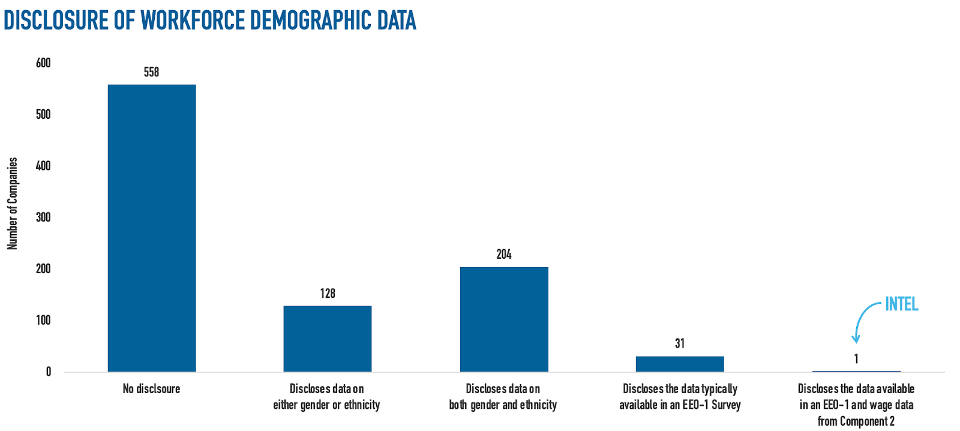
Out of the 922 companies we tracked in our 2020 Rankings, more than half did not disclose any workforce demographic whatsoever; just 31 companies disclosed detailed demographic data as part of their EEO-1 Survey; and only one company – Intel – disclosed wage data by demographics, an exceptionally transparent move.
If you’d like to delve further, here are links to each company’s EEO-1 survey, which we collected for the 2020 Rankings as of August 2019:
Apple, Accenture, Adobe, Alphabet, Bank of America, The Bank of New York Mellon, Boston Scientific, Chipotle, Cisco, Citrix, Costco, Ebay, Facebook, F5 Networks, General Motors, Hewlett Packard Enterprise, Hewlett-Packard, Intel, Intuit, Juniper Networks, Lyft, MDU Resources, Merck & Co., Microsoft Corporation, Nvidia, Palo Alto Networks, PayPal, Salesforce, ServiceNow, Splunk Technology , Twitter, Uber
In light of this, we wrote an piece explaining why disclosing workforce demographics is the next, and most important step for actually achieving diversity and equality in Corporate America.
In addition to pushing for more EEO-1 data, we also looked at representation among Black and Brown employees at 17 of America’s largest employers, to see who is actually leading on diversity, equity, and inclusion.
Lastly, we closed 2020 by taking a deeper look at how EEO-1 disclosures had evolved over the course of the year, revealing. few notable insights, including the fact that tech companies reveal far more about their demographics than nearly any other sector.
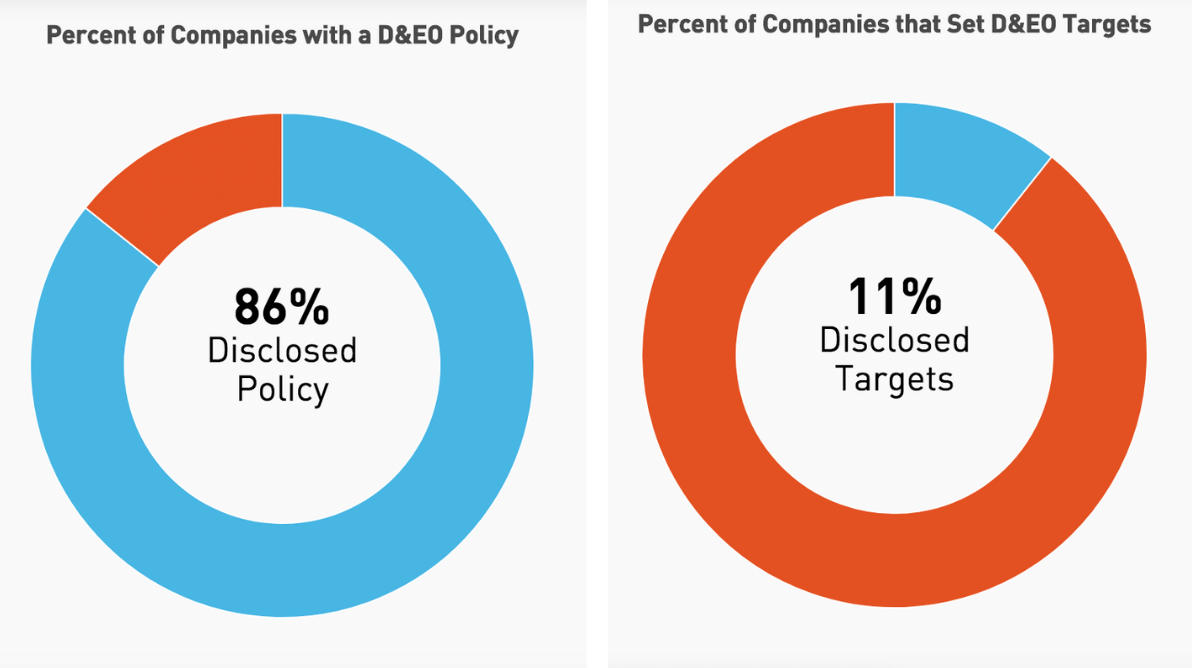
Last year, we looked at the state of corporate disclosure across nine specific worker issues – from paid parental leave to pay equity to Diversity & Inclusion. All the issues we analyzed are critical for just business behavior – according to the American public – but our analysis on Diversity & Inclusion was particularly revealing. Of the 890 companies we evaluated, 86% disclosed having Diversity & Inclusion policies, but only 11% published measurable D&I targets – showing that corporate America has a ways to go in regards to taking and disclosing its actions to support more diverse workforces.
In 2015, Intel announced a bold 2020 goal to reach full representation of women and underrepresented minorities in its U.S. workforce, and impressively, the company met that target two years ahead of schedule in 2018.
The Catalytic Power of Transparency in Creating a Diverse Workforce
We spoke to Barbara Whye, the Chief Diversity Officer at Intel, to hear how the company achieved its audacious goal, and share what other corporate leaders can learn from their journey.
Our Quarterly JUST Call with Intel CEO Bob Swan
This Monday, June 8th, we’ll be speaking with Intel’s CEO on our latest JUST Quarterly Call, diving deep into their diversity policies, particularly in the wake of this past week. Sign up to join this timely conversation here.
At JUST Capital, we have always worked to engage corporate America in our mission of building a more inclusive, stakeholder-driven economy. That mission becomes simultaneously more clear and more complicated as the depths of the inequity in our economy are put on stark display.
This week, we had an in-depth discussion with JUST Capital board members Xavier De Souza Briggs, distinguished visiting professor at NYU and senior fellow at Brookings Institution, Dan Hesse, former Sprint CEO, and Alison Omens, our Chief Strategy Officer. Together, they unpacked key insights from the Forbes Corporate Responders List, which used our data to highlight what “good” can look like in dire times, and came up with ways we might just be able to emerge from this crisis with a more just and equitable economy for all.
You can view the full video below: