
Investing in human capital is one of the essential elements of business leadership today.
Business Insider’s look at how childcare benefits boost retention – some companies saw positive returns on investment of up to 425% – and a report by Investment News on how companies like DoorDash are experimenting with new financial wellness benefits for gig workers are two recent examples of this in action.
However, without a comprehensive set of metrics and a clear definition of what good actually looks like, it’s very difficult to measure performance on a consistent basis let alone know where to invest in order to improve. Enter JUST Capital’s newest offering – the JUST Jobs Scorecard.
The new tool, funded by the Bill & Melinda Gates Foundation, provides a unique view into how companies are performing and what they can do to improve on 31 distinct data points across six job quality topics, scoring companies on a scale of 0-4, with 4 being the highest. The final score is determined against research-backed thresholds, which range from “no disclosure” to “leading practice” on the issues that JUST tracks. Topics cover the key worker priorities as identified by the public:
Top performers include JPMorgan Chase & Co, Hewlett Packard Enterprise, Dayforce, Starbucks, Union Pacific, and American Electric Power Company.
We offer these scorecards as a resource to anyone interested in improving human capital performance in business. To use the Scorecard visit the tool or get involved by contacting corpengage@justcapital.com.
Be well,
Martin

(Photo courtesy of Dayforce)
“We are collectively redefining how we work – including virtual, hybrid, and the gig economy – resulting in a boundless workforce that is fluid, always-on, and borderless. To keep pace with this rate of change, organizations need to prioritize investments in their people to create an agile and skills-based culture that fosters an engaged and thriving workforce.”
Rob Marsh, our AI Advisor, took to LinkedIn to discuss the future impact of “virtual robots”, AI-powered entities capable of performing a wide range of tasks and even operating autonomously in certain contexts. Read the whole post here.
An artificial intelligence-powered chatbot created by New York City to help small business owners is under scrutiny for sharing bizarre advice that misstates local policies and advises companies to violate the law, the AP reports.
A New York Times article dives into the debate economists are having around how much more efficient AI will make companies in the short term.
A new report by The Financial Times explores new financial products that could incentivize countries to preserve biodiversity and natural resources.
Axios reports on a new study that shows for most employers, childcare benefits pay for themselves through reduced absenteeism and lower rates of attrition. Check out the study here, and then learn more about our own Corporate Care Network initiative.
The EPA releases new, strict emissions standards for heavy-duty trucks in a bid to curb carbon emissions. The Associated Press has the story.
The Wall Street Journal takes a look at how Gen-Z is eschewing colleges and white collar jobs for trade schools and working with their hands, seeing it as a safer, more fulfilling path in a world where the value of a degree is plummeting and AI seems poised to make sweeping job changes across many industries.
Google will delete billions of Chrome browser records in the wake of a lawsuit saying the company was being deceiving by still tracking user activity while in Incognito mode. The New York Times explains.
A new study by Deloitte and Tufts University finds that the large majority of professional investors globally have put in place ESG investment policies over the past several years. These firms cite factors including regulatory requirements, improved performance and talent attraction. ESG Today has the story.
A Wall Street Journal article takes a close look at just how far $100 goes at your local grocery store today after five years of persistent food inflation, a top concern for consumers. Take a look here.
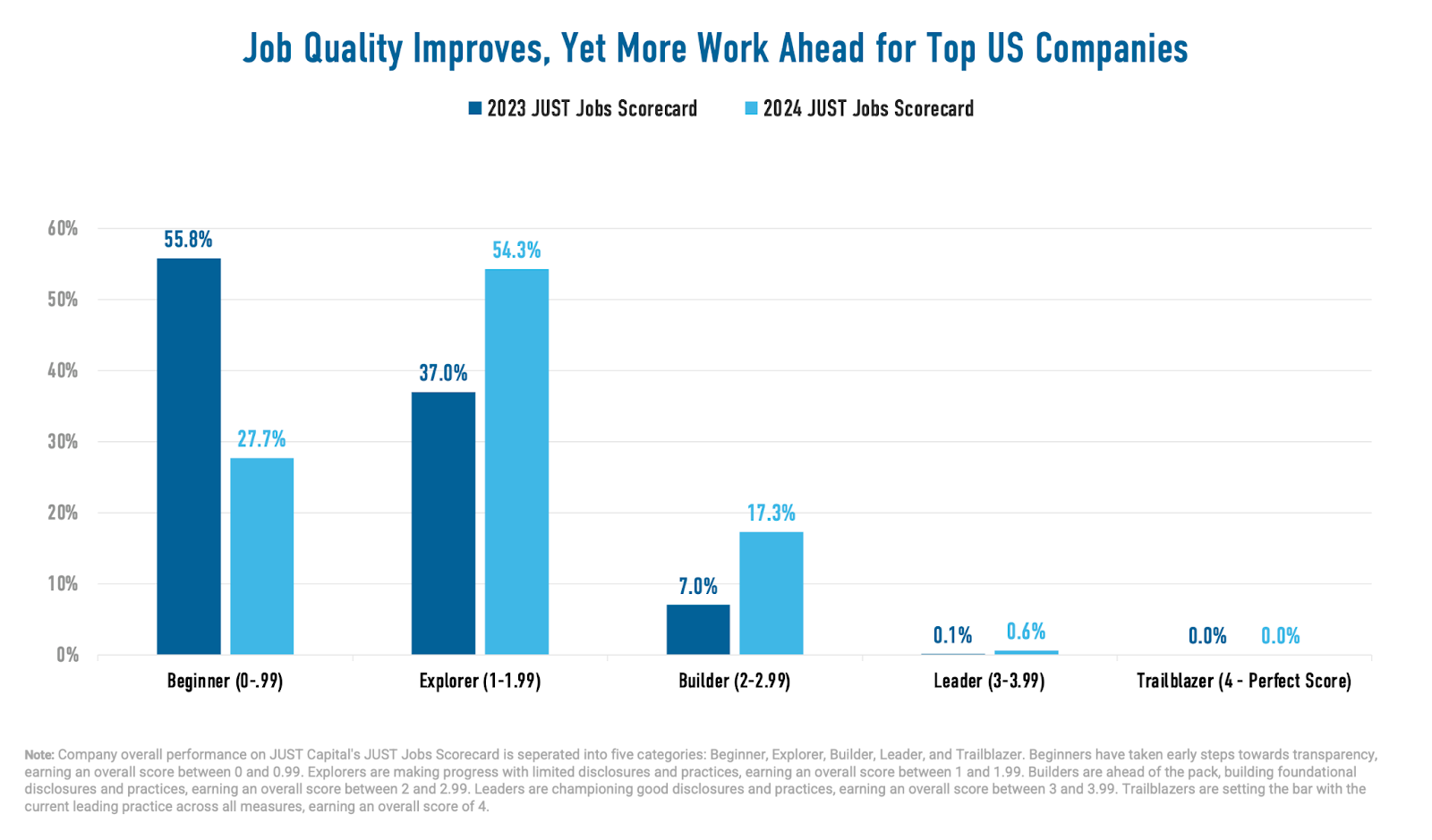
This week’s chart comes from our newly released JUST Jobs Scorecard. While America’s largest companies have more work to do to improve transparency around some key job quality data points, overall performance on the 2024 JUST Jobs Scorecard speaks to noticeable improvement since the 2023 pilot version of this tool. More than one fourth of companies (256 companies, or 27.3% of all scored companies) have moved from the Beginner category (taking early steps towards transparency, overall scores between 0 and 0.99) into the Explorer category. Explore deeper insights here.
NEW YORK – Today, JUST Capital released the second edition of the JUST Jobs Scorecard, a data-driven interactive tool for companies to measure performance and gauge transparency on key job quality practices and worker policies.

The new tool, funded by the Bill & Melinda Gates Foundation, provides a unique view into how companies are approaching one of their most critical stakeholders – their workers – and helps demonstrate how investing in their people can benefit both companies and workers alike. Overall, the Scorecard suggests that actual performance, as well as disclosure and transparency, are all on the rise, and that there is much room for future improvement.
Top performing companies include JPMorgan Chase & Co, Hewlett Packard Enterprise, Dayforce, Starbucks, Union Pacific, and American Electric Power Company. To use the interactive tool and dive into these leading companies’ scorecards, visit https://justcapital.com/the-just-jobs-scorecard/.
“The JUST Jobs Scorecard shows that companies are making steady progress on investing in the American worker,” said JUST Capital CEO Martin Whittaker. “We know from our polling that across demographics and political affiliations, this is what the public wants. And we look forward to continuing our work with companies to help them do this as effectively as possible.”
The Scorecard assesses 31 distinct data points across six job quality topics, scoring companies on a scale of 0-4, with 4 being the highest. The final score is determined against research-backed thresholds, which range from “no disclosure” to “leading practice” on the issues that JUST tracks. Topics include:
After assessing performance and disclosure across all data points, JUST calculates each company’s overall average score in order to categorize their overall performance. Overall performance categories provide a quick snapshot of how far along a given company is on the journey toward transparency on job quality metrics. The following table outlines how companies are increasingly disclosing information related to job quality, but also have room to improve across the board.
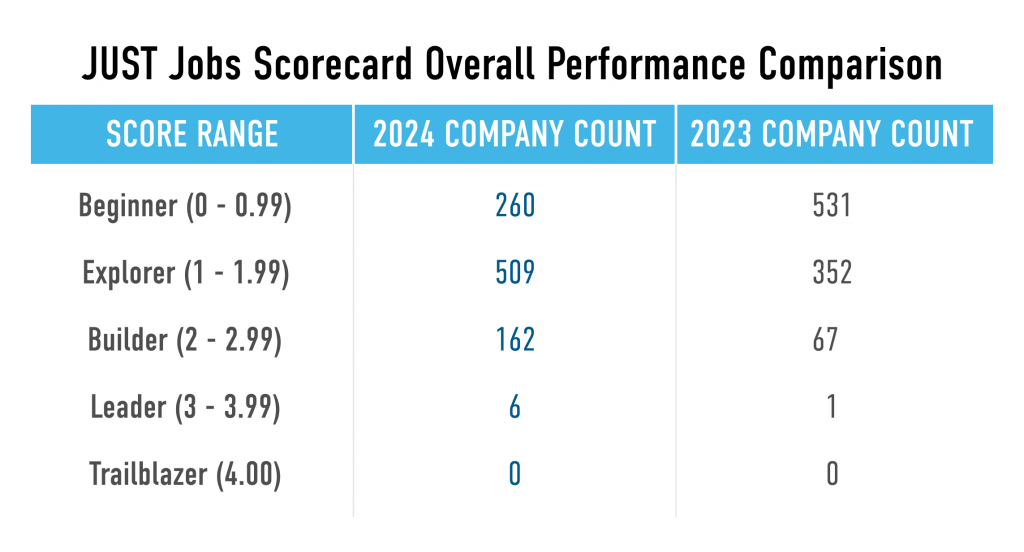
The JUST Jobs Scorecard follows the release of the JUST 100. It is important to note the key ways in which this resource differs from the annual JUST Rankings, both in approach and intended use case. Unlike our annual Rankings, which assess a company’s performance relative to other companies, the Scorecard provides an individual measure of a company’s current standing on job quality disclosure and performance relative to minimum, common, and leading practice standards.
JUST Capital’s 2024 Rankings spotlight the corporations who are performing best on the business issues most valued by the American people. These rankings are determined by scoring performance across the full range of criteria and comparing companies head to head. For the annual Rankings, JUST Capital collects and analyzes corporate data to objectively evaluate the 1,000 largest public U.S. companies across 20 Issues identified through comprehensive, ongoing public opinion research on Americans’ attitudes toward responsible corporate behavior. JUST Capital has engaged more than 170,000 participants, on a fully representative basis, since 2015.
JUST Capital is an independent nonprofit that demonstrates how just business – defined by the priorities of the public – is better business. JUST’s process is objective, data driven and non-political. Its rankings consistently demonstrate that the companies that score best on the Issues Americans care about most also outperform their peers financially.
For more information, please reach out to marketing@justcapital.com

In his widely-read annual letter to investors, BlackRock CEO Larry Fink focused on the world’s aging population and their severe economic woes. He outlined a retirement crisis, noting that people are living longer, that the system set up to support elderly adults is not robust enough, and that 4 in 10 Americans don’t have $400 in emergency savings. According to the Aspen Institute and Morningstar, there are even more significant disparities across gender and race lines, even controlling for salary and tenure.
Helping workers prepare for their financial futures is a major JUST issue. And it’s not only a problem for older working Americans. Indeed many Gen X and Millennial adults in the workforce today worry about the costs associated with both caring for their parents as well as their children.
Investing more in workers during their careers – through better financial planning, stock ownership and profit sharing, higher wages, training and better care options, for example – is now becoming a defining aspect of corporate leadership today. The benefits are clear. Companies participating in our Worker Financial Wellness Initiative (WFWI) – Chipotle, PayPal, Prudential, and others – have helped employees go from living paycheck to paycheck to owning a house and more; and as of 1/31/2024, our worker-focused index has outperformed the Russell 1000 Equal Weighted Index by 103.75% since 1/1/2018. A new study from BCG and Moms First underscores the clear business value in supporting childcare benefits.
Lastly, I see that an initiative we featured back in January – InvestAmerica – is also gaining momentum across corporate America (including among many high-ranked JUST companies) for the idea of creating an investment account at birth for children of employees that is seeded by the government and matched by corporations. Call me an optimist, but perhaps the gears of capitalism are beginning to shift in favor of American workers at every stage of life.
Be well,
Martin
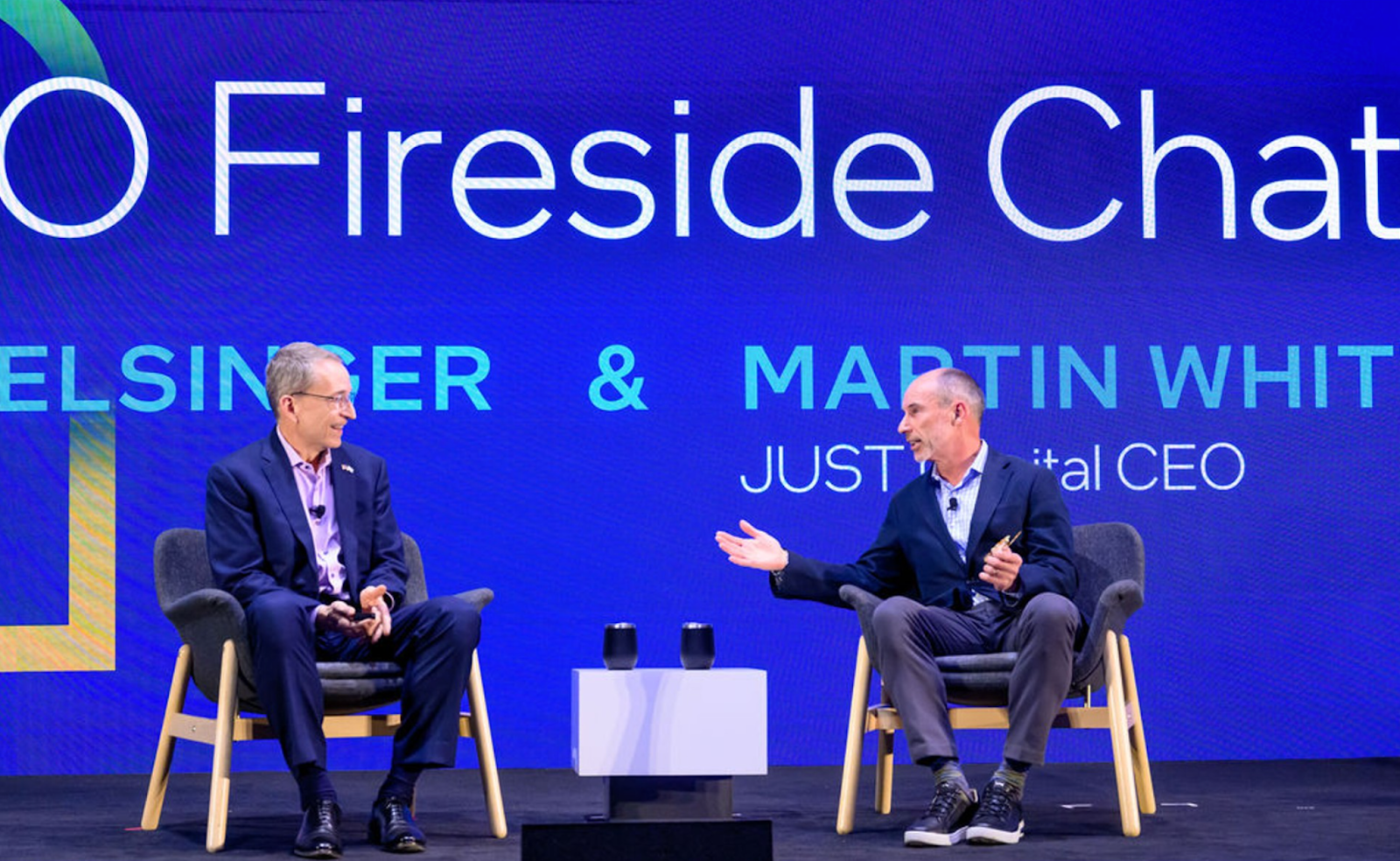
Photo: Courtesy of Intel
“Solving climate change is becoming way more important. It’s becoming increasingly important. Maybe the only more exciting thing than solving climate change is AI, but it’s right up there on the list, it’s about how we’re leaving the world a better place for the next generation. As semiconductors become more important, what we do for sustainability in the semiconductor industry will become more important … We’re seeing energy consumption levels rise to power our big data centers to power AI. It really does matter at the end of the day.”
JUST Capital highlights the Top Companies for Women in 2024 in a new report.
Board Member Dan Hesse chats with David Rubenstein, co-founder of The Carlyle Group, on what he’s learned about leadership from interviewing many of the world’s greatest leaders.
The International Business Times talks to Carol Cone about how businesses can bring greater success by aligning purpose with employee well-being.
The Biden administration rolls out new rules around the Federal government’s use of artificial intelligence, USA Today reports.
Vox weighs the claim of some economists that an AI explosion could cause unheard-of economic growth – 20-30% a year – or if that idea is a pipe dream.
Morningstar reports that, over the past 4 years, the lowest earners have actually seen the highest wage growth of any workers, with a 12.1% wage increase, adjusted for inflation.
Per the Washington Post, Boeing’s CEO and several other top executives will step down by the end of the year amidst the company’s current airplane quality control crisis. In the meantime, other companies are stepping up to try and revive supersonic planes for commercial travel.
The Securities and Exchange Commission now faces a deluge of lawsuits after issuing its climate disclosure rule earlier this month. Experts argue the proposed disclosure laws are consistent with global trends in disclosure, ESG Dive reports.
The Department of Justice is suing Apple over its “iPhone monopoly,” claiming that to keep consumers buying iPhones, Apple moved to block cross-platform messaging apps, limited third-party wallet and smartwatch compatibility, and disrupted non-App Store programs and cloud streaming services. CNBC has more of the story.
The New York Times highlights an FTC report showing that large grocery chains took advantage of the pandemic, using supply chain shortages and pricing distortion to get suppliers to favor them over the competition.
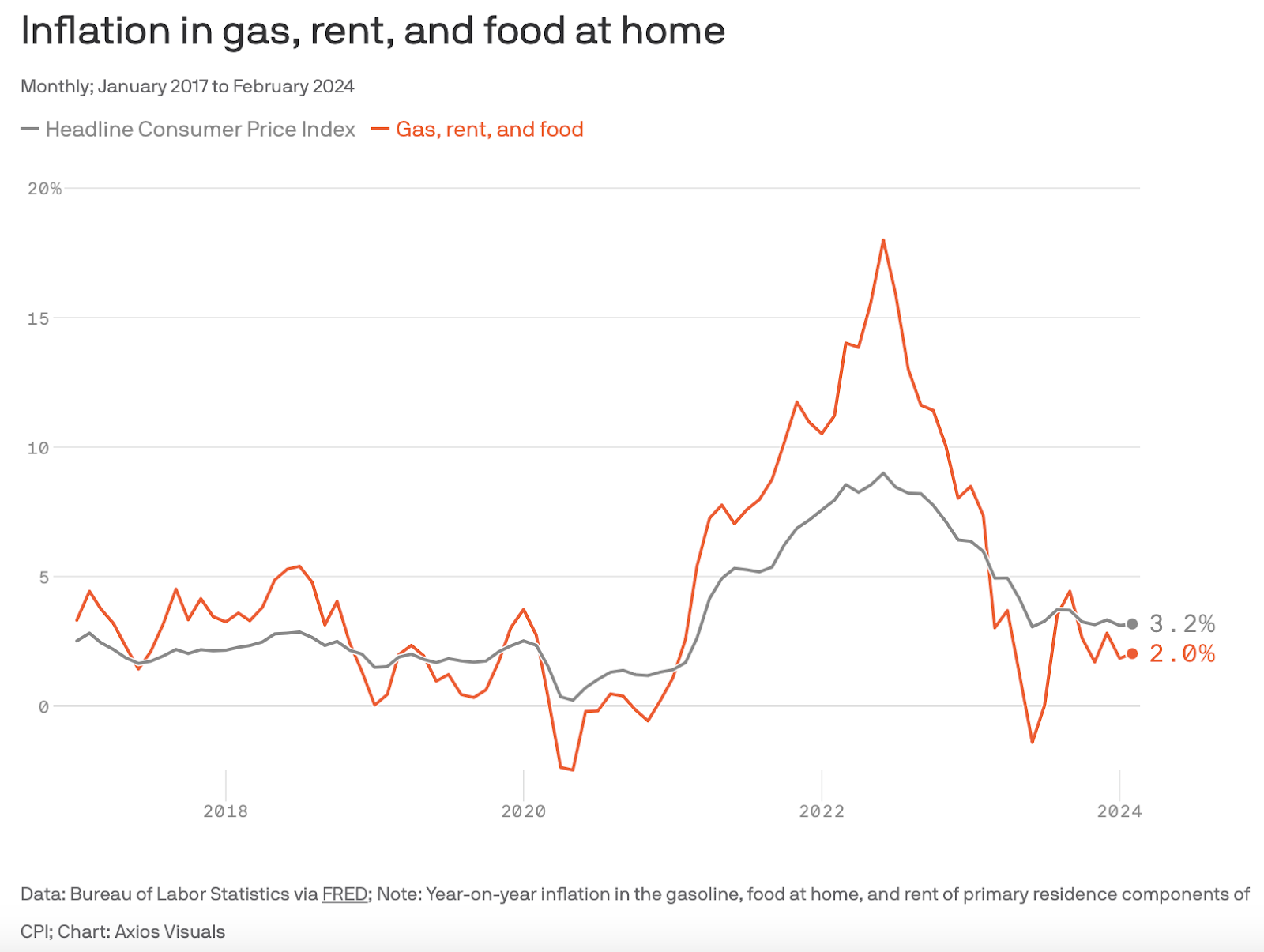
This chart comes from Axios, and explains what many pundits have been struggling to grasp why many Americans think the economy is bad. The chart shows how the cost for basic items often not accounted for in CPI reports – like rent and grocery items – skyrocketed over the past several years. More inside.
With the price of everything from gas to food remaining stubbornly high – February’s Consumer Price Index numbers released earlier this week showed inflation actually speeding up slightly – workers struggling to make ends meet seem set for further economic pain.
There may be more people in this boat than you think. New analysis co-produced by JUST Capital and Revelio Labs, a workforce intelligence company that we routinely partner with,
found that just over 36% of all U.S.-based Russell 1000 workers are not making a family-sustaining living wage. That means about 6.1 million full-time workers at big publicly-traded corporations do not make enough in the counties where they live (a living wage is location-dependent) to support a family, assuming another full-time working adult and two children. Almost 20% do not earn enough to meet their own basic needs, meaning, a living wage for one full-time employee without dependents.
Solving for every American to get by, and get ahead, is obviously a complex issue with multiple interrelated causes and many (often contested) potential solutions. One thing we know for sure though, is that big employers can make a difference. Increasing wages is part of it, and over the years we’ve engaged hundreds of companies that have done just that. But it’s not the only solution. Lowering the cost of benefits; providing pathways for stock ownership and profit sharing; helping employees with credit support and loan facilities; advancing financial literacy and management skills; even engaging workers on the issue, can all help.
This is what the companies in our Worker Financial Wellness Initiative are focused on, and how many of the companies we rate highly on Workers in our rankings (firms like Cigna, Dayforce, and Ally Financial, for example) approach the problem. There’s also a powerful business case. Our Workers Index, which tracks market performance of our top performing companies on Worker issues overall has outperformed the Russell 1000 by 14.1% over the period from Dec 31 2021-July March 11 2024.
Be well,
Martin

“We want to be a company that attracts top talent to build long-term careers. We do this by not only helping our employees grow professionally, but also supporting their well-being. The Worker Financial Wellness Initiative will cement us as a benefits leader and help us continue to enhance our programs and resources.”
In a new analysis with Revelio Labs, JUST reports that 36% of Russell 1000 workers don’t make a family-sustaining wage.
The Washington Post reports that thanks to the AI boom and the push for more clean-tech across the country, our electric grid is being stressed further than it has ever been, and regulators are looking for ways to increase power and improve our aging grid.
According to Fortune, after being out of the public eye for several months, a photo of Kate Middleton with her family is raising eyebrows for potentially being fabricated by AI, bringing more concern to the power of the technology and those using it.
Boeing is overhauling their pay structure following the safety failures around their 737 Max planes, tying more of their employee and executive incentive pay to safety. Meanwhile, a major story this week is that John Barnett, the whistleblower who was first to raise safety concerns with these aircrafts, was found dead the day after he testified in a deposition, NPR reports.
Business Insider reports that starting April 1, restaurant chains that have at least 60 restaurants nationally will be required to pay workers in California at least $20 an hour — 25% higher than the state’s general minimum wage. The question on everyone’s mind: Will local mom & pop coffee shops and eateries also have to raise prices to compete, and will they be able to?
The Tik Tok ban bill has officially passed the House vote and now goes to the Senate. The Washington Post has the story.
The Wall Street Journal reports that Dollar Tree will be eliminating 1,000 stores nationwide thanks to rising inflation, store theft, and merger woes.
In only a few short days since its announcement, the SEC’s landmark climate rule already faces litigation from across the political spectrum. The Verge has the details.
The anti-poverty nonprofit Oxfam America, the nonpartisan Pre-Distribution Initiative, and the philanthropic investment firm Omidyar Network publish a new report on how investors can foster a more inclusive form of capitalism.
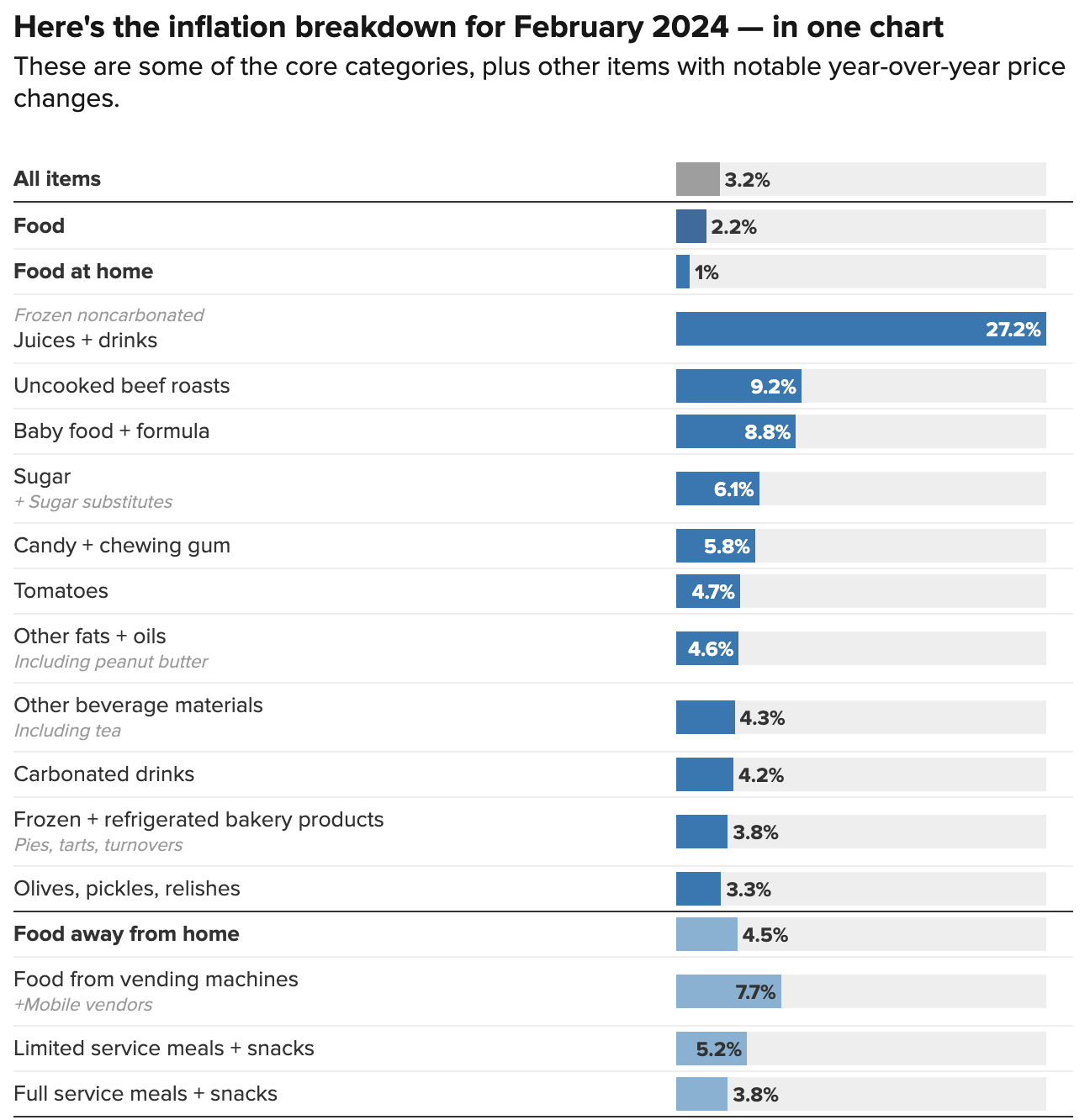
This snapshot of a longer chart from our media partner CNBC details which goods and services saw the most price hikes. As JUST’s Martin Whittaker discusses above, consumers are grappling with higher costs on everything from care insurance to childcare, a harsh reality for many workers as our recent report with Revelio Labs finds that over one third of Russell 1000 workers do not make a family-sustaining living wage. Explore the full chart here and the report here.
By Aleksandra Radeva, Lisa Simon, and James Enright
Americans care that companies pay a fair, living wage. In fact, JUST Capital’s report “2023 Issues Survey – The People’s Priorities,” which measures the business issues most important to the public, found that paying a fair, living wage was the highest priority for a fourth consecutive year, garnering widespread support as the top issue across almost every demographic group. In a year marked by high inflation and increasing cost of living around the country, the focus on living wages – or a wage rate that allows workers to meet basic budgetary needs – comes as no surprise.
To gain deeper understanding of wages at Russell 1000 companies, JUST Capital continued its partnership with Revelio Labs, a workforce intelligence company that provides data and insights on employment at any company by using advanced techniques in machine learning.
This year’s results of the joint analysis show that among all U.S.-based Russell 1000 workers, 36.3% of workers are not making a family-sustaining living wage. That’s about 6.1 million full-time workers who are not making enough to support a family with another full-time working adult and two children. The analysis further estimates that about 19.2% of Russell 1000 workers do not earn enough to meet their own basic needs – or a living wage for one full-time employee without dependents.
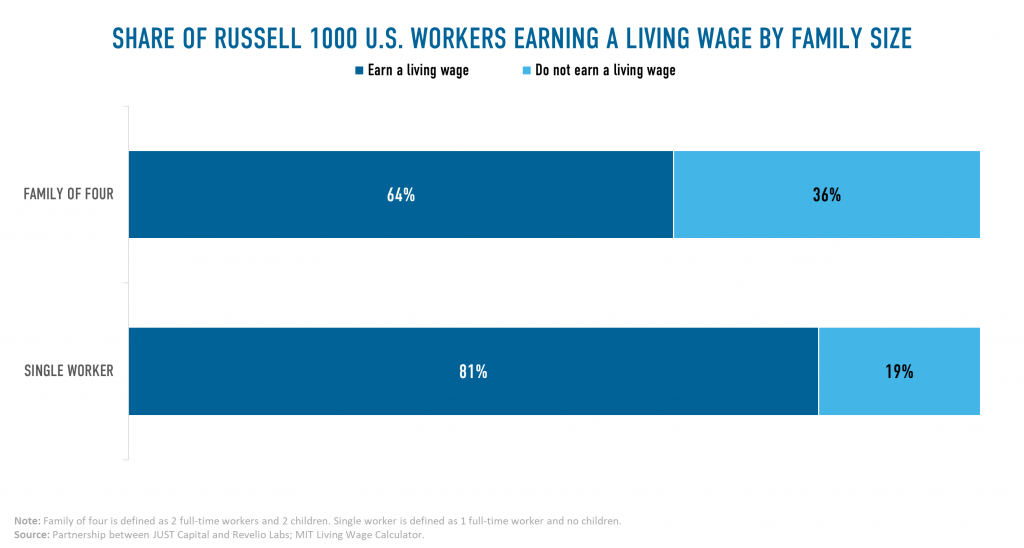
These estimates are generated through the cutting-edge modeling techniques deployed by Revelio Labs. By absorbing and standardizing hundreds of millions of public employment records, Revelio Labs is able to infer employment compositions at any company, like how many people work at a company, the composition of workers in terms of roles and backgrounds or demographics, where a company’s workers live, and what those workers earn. In collaboration with JUST Capital, Revelio produces estimates for three data points used to measure performance on wages across America’s largest companies. To learn more about how these estimates are derived and how they feed into JUST Capital’s annual ranking of America’s Most JUST Companies, read our methodology summary or dig deeper into our full methodology.
Russell 1000 companies are the highest-performing public companies – and their workers, who make up around 10% of the U.S. workforce, earn more on average than other workers. In 2023, the median worker in the US earned $58,084 annually, according to the Bureau of Labor Statistics, while the median Russell 1000 worker earned 26.2% more – or $73,305. Russell 1000 workers also enjoyed higher wage gains in 2023, compared to average workers, which provided them with a slight advantage when weathering cost of living increases in 2023.
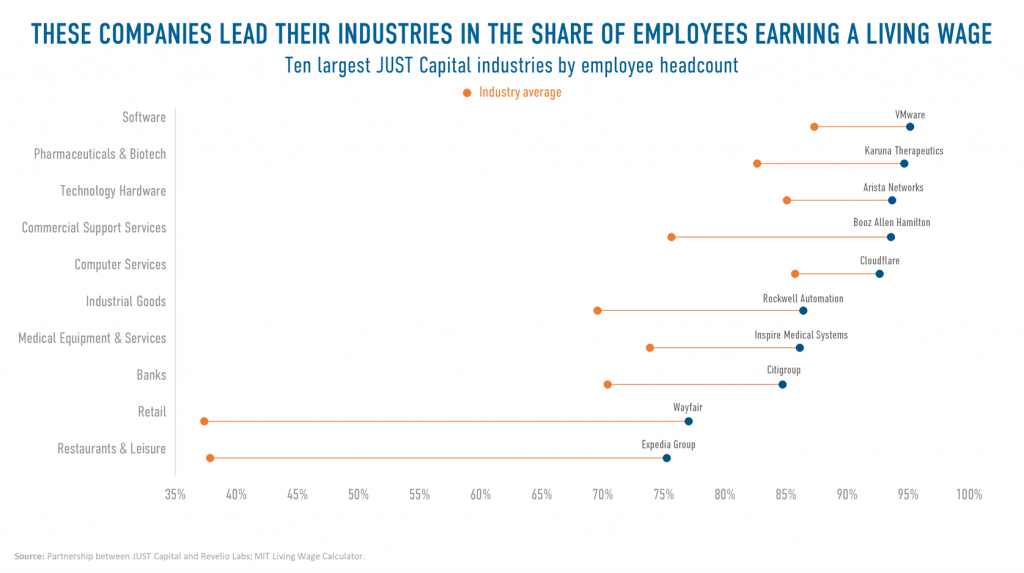
Industries naturally vary by their share of workers earning a living wage, depending on their composition of high-wage and lower-wage earners. Software and Biotech tend to have very high living wage scores, for example, as they typically employ many high wage earners and fewer workers in roles such as production or retail, which tend to be lower paid. Nevertheless, large variation in the share of workers earning a living wage exists within industries as well. This intra-industry range is evident in the chart below, which shows the difference between the average and highest shares of employees earning a living wage for a selection of industries. In the Industrial Goods industry, the difference is particularly striking – on average only 70% of workers in the industry are estimated to earn a living wage, but Rockwell Automation is estimated to pay almost 90% of its workers a living wage. Wayfair and Expedia also far outperform their industry average because their employee composition and core business differ from their industry peers, more closely resembling Tech companies than Retail and Restaurant and Leisure companies, respectively.
Last year, we compared all Russell 1000 worker salaries to one population-weighted national living wage threshold, no matter where a worker lives and works. This geographically generalized approach creates some unfair comparisons two ways: The relatively higher wage rates of workers in high-cost-of-living areas were being compared to a national cost-of-living threshold that was much too low compared to the cost those workers actually face. For example, the regional threshold for a two-adult, two-children household in the metropolitan area of New York City is $30.79 – 23% higher than the average national living wage threshold in 2023, $25.02. On the other hand, workers in low-cost areas of the country were being held to a much higher threshold than locally necessary. This year, Revelio Labs and JUST Capital decided to adopt a localized approach and compare worker salaries to the living wage threshold in their metropolitan area – a more ‘just’ comparison for everyone.
Interestingly, the difference in methodology makes little difference in the average share of workers earning a living wage. Under the national threshold, 65.4% of workers make a living wage, as opposed to 63.7% in the local threshold. The slightly lower share under the local threshold suggests that relatively more Russell 1000 workers live in high-cost areas. Comparing their wages to a local threshold makes it harder to meet the threshold.
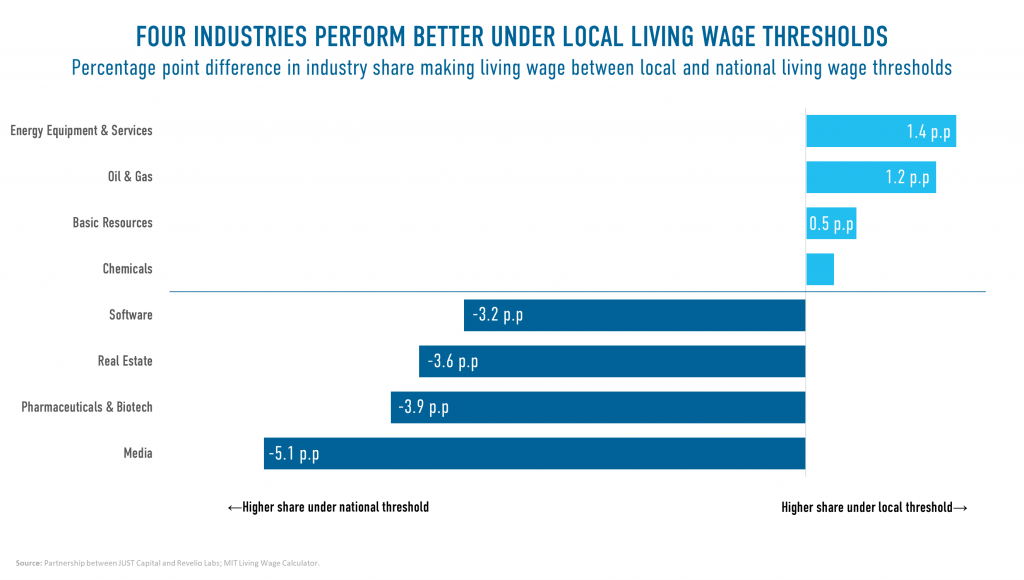
This is not true across all industries. Some industries fare better using local thresholds, while most industries do slightly worse. The industries with higher shares of workers earning a living wage using geographically-specific thresholds are those with high concentrations of workers living in low-cost-of-living areas. Energy, Big Oil, and Chemical industries saw the greatest positive shift in the share of workers making a living wage. Media companies, on the other hand, have a higher share of workers in high-cost metropolitan areas, and their performance falters with the application of the correspondingly higher local living wage thresholds.
In the coming weeks, we’ll use further insights from these wage models to explore how America’s largest companies align with the increasing priority Americans place on creating equitable and just jobs.
We invite you to continue learning about the power of a living wage and its important role as a corporate threshold in this explainer co-authored by JUST Capital and MIT Living Wage Calculator. You can explore what prioritizing employees’ financial wellness looks like through the stories of companies participating in the Worker Financial Wellness Initiative, implemented in partnership with PayPal, Financial Health Network, and Good Jobs Institute. And if you’d like to participate in JUST Capital’s growing network of corporate leaders committed to advancing worker wellbeing, please reach out at impact@justcapital.com to request more information or a conversation.
If you would like to learn more about the methodology behind JUST Capital’s and Revelio Labs’ wage models or your company’s performance in them, please reach out to our corporate engagement team at corpengage@justcapital.com.
If you would like more information or access to company workforce data, including salaries, headcounts, or employee composition to benchmark your company to your peers, please reach out to info@reveliolabs.com.
Lisa Simon is the Chief Economist and James Enright is a Research Analyst at Revelio Labs.

The business case for investing in workers is surely watertight at this point. Strengthening career pathways, training, wages, work schedules, health benefits and all-round workforce culture is associated with greater employee engagement, higher productivity, increased retention and other advantages, all of which contribute to superior competitive performance, higher shareholder returns and more. As an aside, our worker-focused index outperformed the Russell 1000 Equal Weighted Index by a massive 103.75% from 1/1/2018 through the end of January this year.
Worker issues also present opportunities for corporations to demonstrate their own unique brands of leadership. As an example, we’re excited to report that the energy company Avangrid (NYSE:AG) – a 2024 JUST 100 member ranking 12th overall and #1 in the utilities industry – announced this week it is joining our Worker Financial Wellness Initiative. Co-founded in partnership with PayPal, the Financial Health Network and Good Jobs Institute, the Initiative supports companies in advancing worker economic wellbeing and is a key part of our Corporate Impact Lab, where we help companies collaborate to take concrete actions in key stakeholder areas.
Looking down the list of companies that top their industry on worker issues in our 2024 Annual Rankings you might see some names that surprise you: Zillow, Amazon, Peloton, Cummins, Disney, Nike, Trane, Keysight Technologies, eBay, RTX, Hasbro, and QuantumScape (Automobiles and Parts in case you were wondering). Each leads in its own way. And their policies, ranging from industry-leading wages to flexible working schedules and sick leave, are exactly the kind of thing the public wants to see. Interestingly, in a survey of 600 C-Suite and HR leaders released this week, improving child care benefits was voted the most important major work benefit priority in 2024. Happily, we track that too.
Be well,
Martin
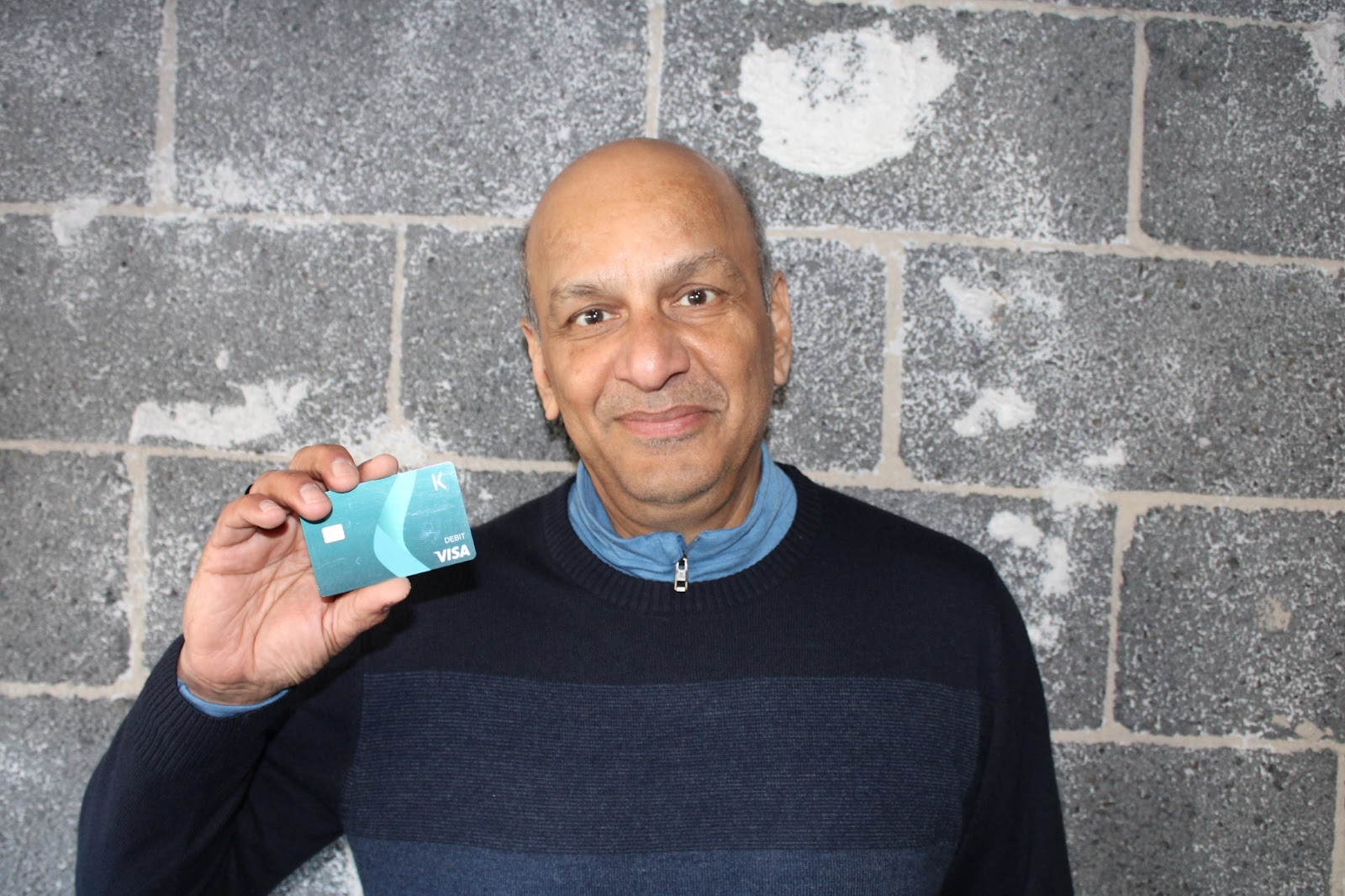
“Modern consumers want to do good. They don’t just want to buy a product – they want their product to have a story and create a positive impact. But how do they know if a company is truly aligned with their values or just greenwashing?
The Karma Wallet Card, launching spring 2024, will directly integrate JUST Capital’s ratings into every transaction – alongside 40+ other data sources, allowing cardholders to see the ethical score of the companies they purchase from in real-time … Knowledge is power – and when consumers are provided with actionable knowledge, they can make better choices.”
– Jayant Khadilkar, CEO and Co-Founder of Karma Wallet.
Avangrid joins JUST Capital and PayPal’s Worker Financial Wellness Initiative. Check out the company press release here.
Karma Wallet announces a partnership with JUST Capital, using our data to help consumers align their spending with their values.
The corporate rush for A.I. dominance is causing a major increase in many company’s carbon footprints as data farms balloon and more energy is needed for processing power. The New York Times has the full story.
CNBC speaks to an engineer who is worried that Microsoft’s Copilot Designer app is not safe for its “E for everyone” rating, saying that the app can create incredibly violent images with the right prompts.
The Securities and Exchange Commission this week adopted rules to enhance and standardize climate-related disclosures by public companies. As The Wall Street Journal explains, the disclosures are slightly watered down from what was proposed by not including Scope 3 requirements, but many companies could find themselves facing pressure from investors and other countries to track them anyway.
The Washington Post reports that the JetBlue and Spirit Airlines merger has been killed in the wake of antitrust objections to the deal. The merger would’ve created the 5th largest airline company in the world.
Bloomberg reveals that 56% of America’s largest companies are boosting childcare perks in 2024, with the rising cost of childcare becoming a consistent pain point for their employees. In a similar vein, JUST 100 company AT&T recently highlighted their investment into fertility and family planning support, another area companies are putting resources in.
A number of investors in Apple issued a joint statement raising concern over the company’s approach to unions after retail employees accused the company of “intimidation tactics to deter organizing”, claims denied by Apple. Apple has agreed to commission a third-party report on its union-related activity, The Financial Times reports.
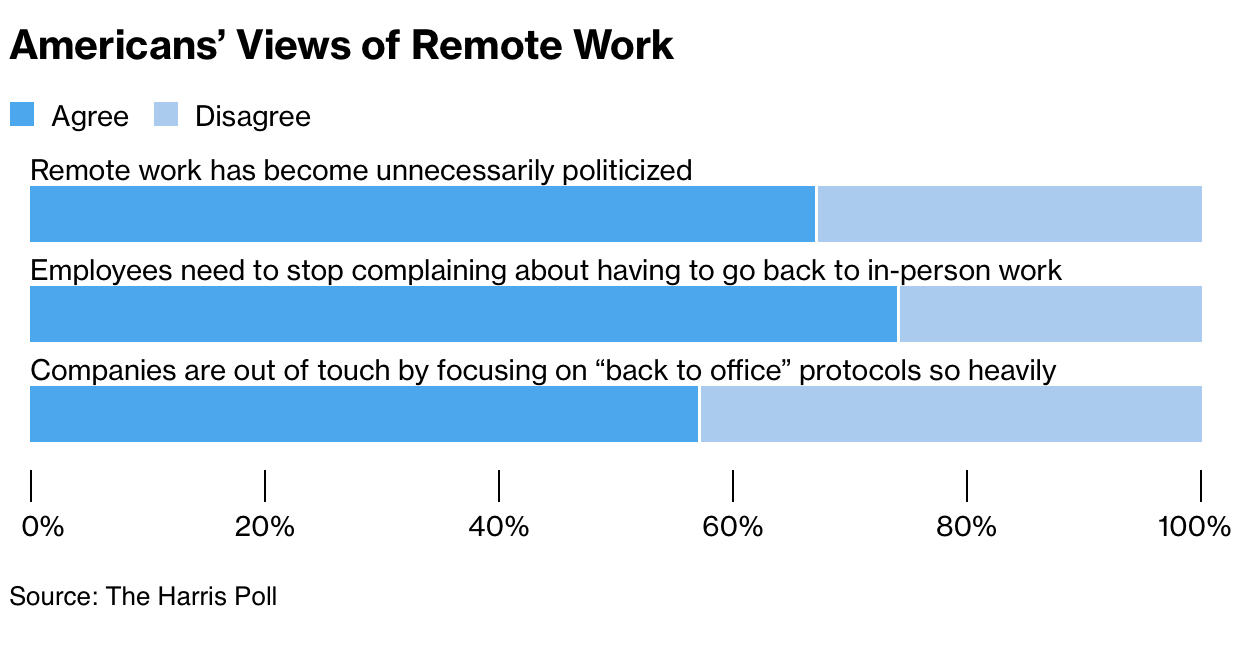
Bloomberg dives deep into recent Harris Poll data on how Americans’ views of remote work are changing. Interestingly, while a majority of Americans believe remote work has become unnecessarily politicized, they also believe that employees need to stop complaining about having to go back to in-person work. Look at all the data here.
