
(MoMo Productions/Getty Images)
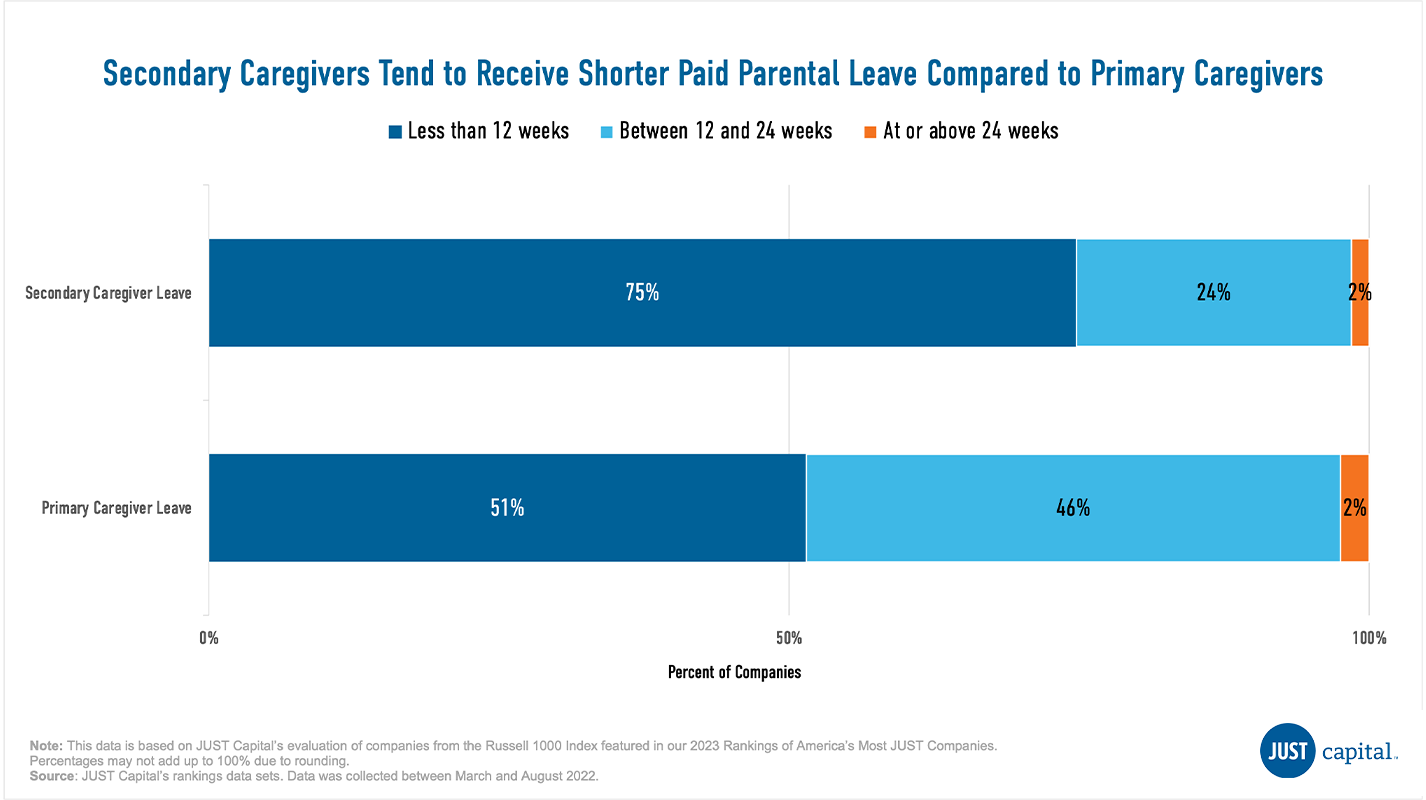
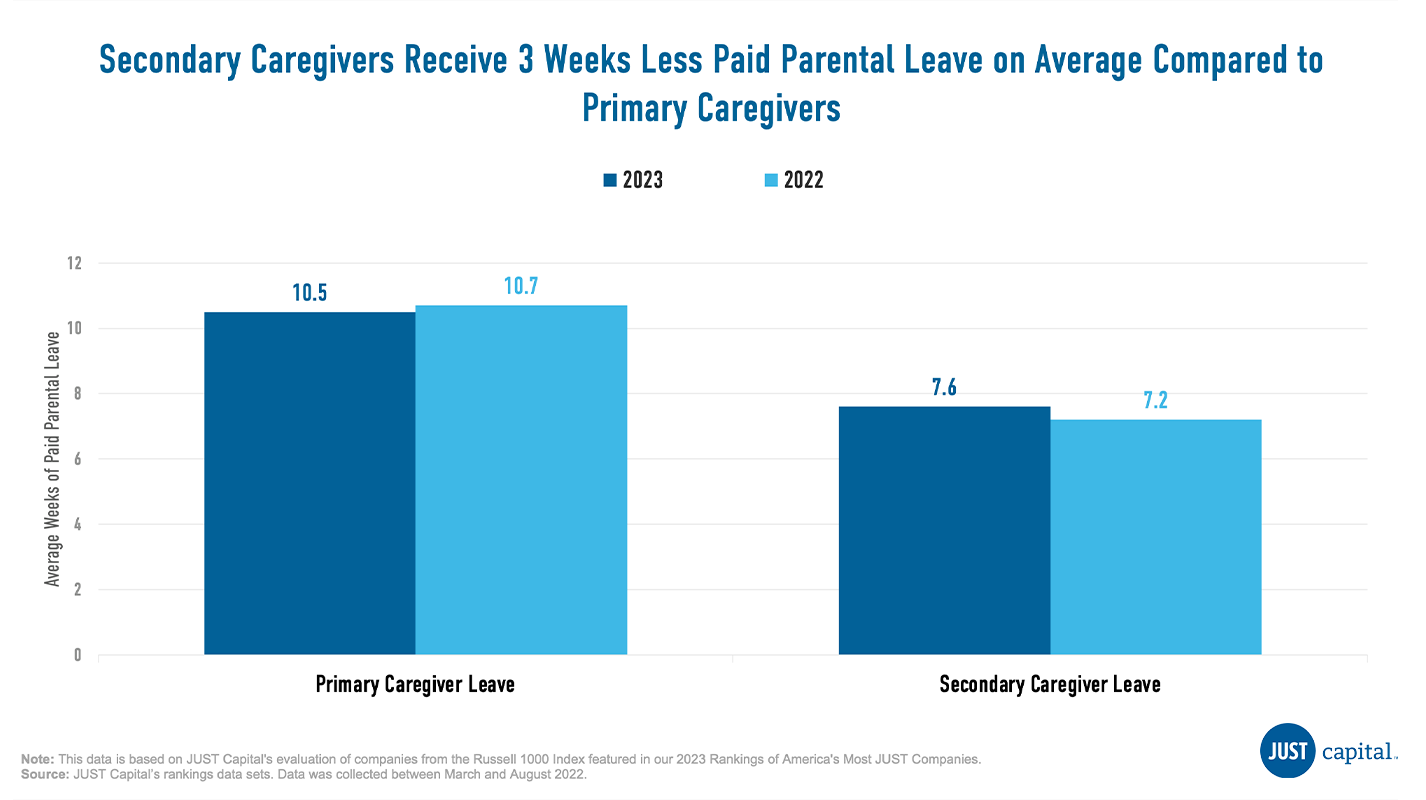 Looking more closely at the length of leave, we found that the average Russell 1000 company offers 7.6 weeks to secondary caregivers in 2023, a slight increase from 7.2 weeks in 2022. In contrast, primary caregivers on average received 10.5 weeks of paid leave over the same period. In other words, the average secondary caregiver receives three weeks fewer than primary caregivers, perpetuating the norm that child rearing is a primarily female responsibility.
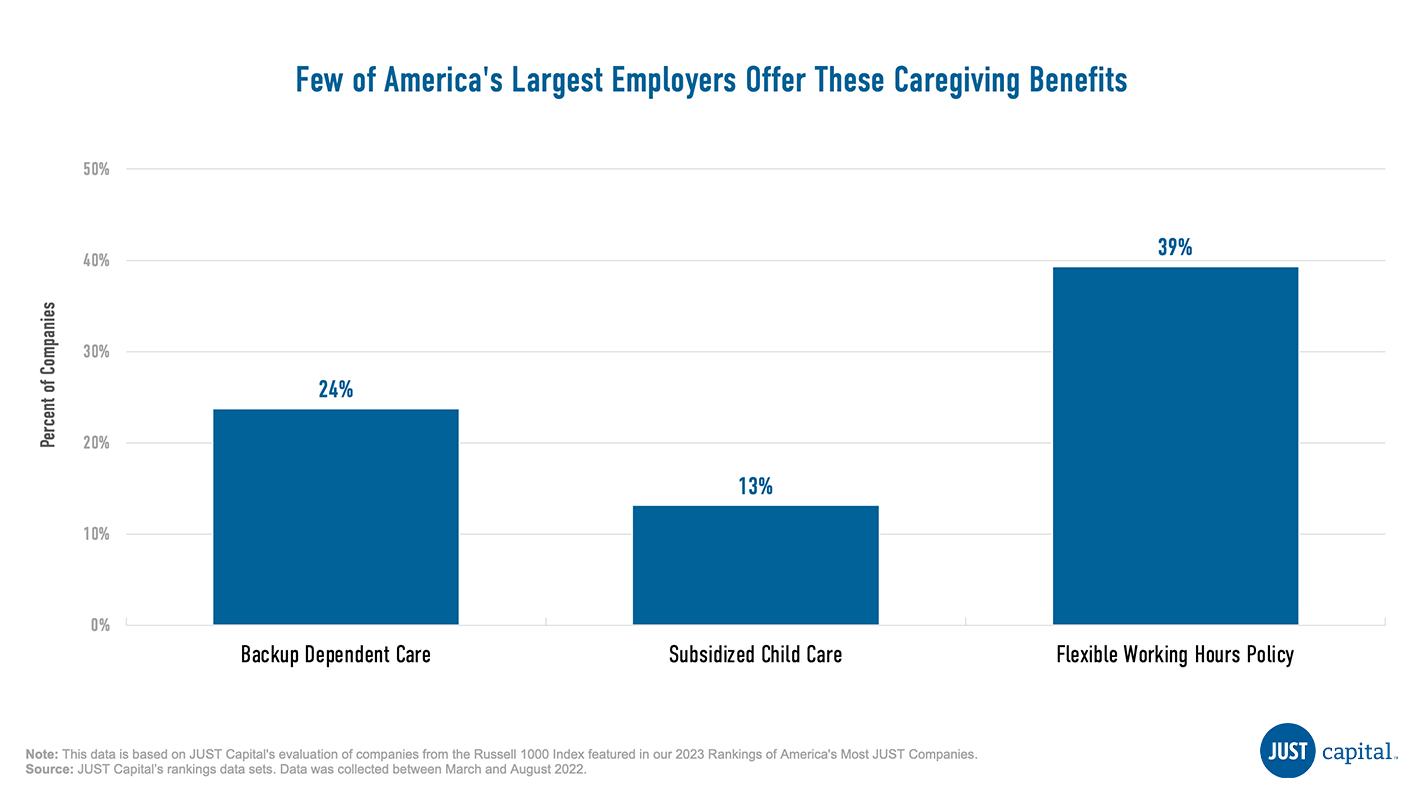
Despite the generally lower length of leave for secondary caregivers, paid parental leave is a fairly common benefit, with 41% of companies offering some paid time off for working dads to welcome a new child. Meanwhile, 24% of companies disclose a backup dependent care policy, and just 13% offer subsidized child care benefits. Flexible working hours are more common, with 39% of companies offering this benefit.
Looking more closely at the length of leave, we found that the average Russell 1000 company offers 7.6 weeks to secondary caregivers in 2023, a slight increase from 7.2 weeks in 2022. In contrast, primary caregivers on average received 10.5 weeks of paid leave over the same period. In other words, the average secondary caregiver receives three weeks fewer than primary caregivers, perpetuating the norm that child rearing is a primarily female responsibility.
Despite the generally lower length of leave for secondary caregivers, paid parental leave is a fairly common benefit, with 41% of companies offering some paid time off for working dads to welcome a new child. Meanwhile, 24% of companies disclose a backup dependent care policy, and just 13% offer subsidized child care benefits. Flexible working hours are more common, with 39% of companies offering this benefit.
 For working parents, there is a clear need to have access to all of these benefits, but we found that just 6% offer all three. When we add paid parental leave to the mix, the pool of companies that have comprehensive offerings shrinks further – with just 1.5% of companies offering all three benefits and 12 weeks or more of paid parental leave to fathers – signaling the need for corporate America to do more to support working dads.
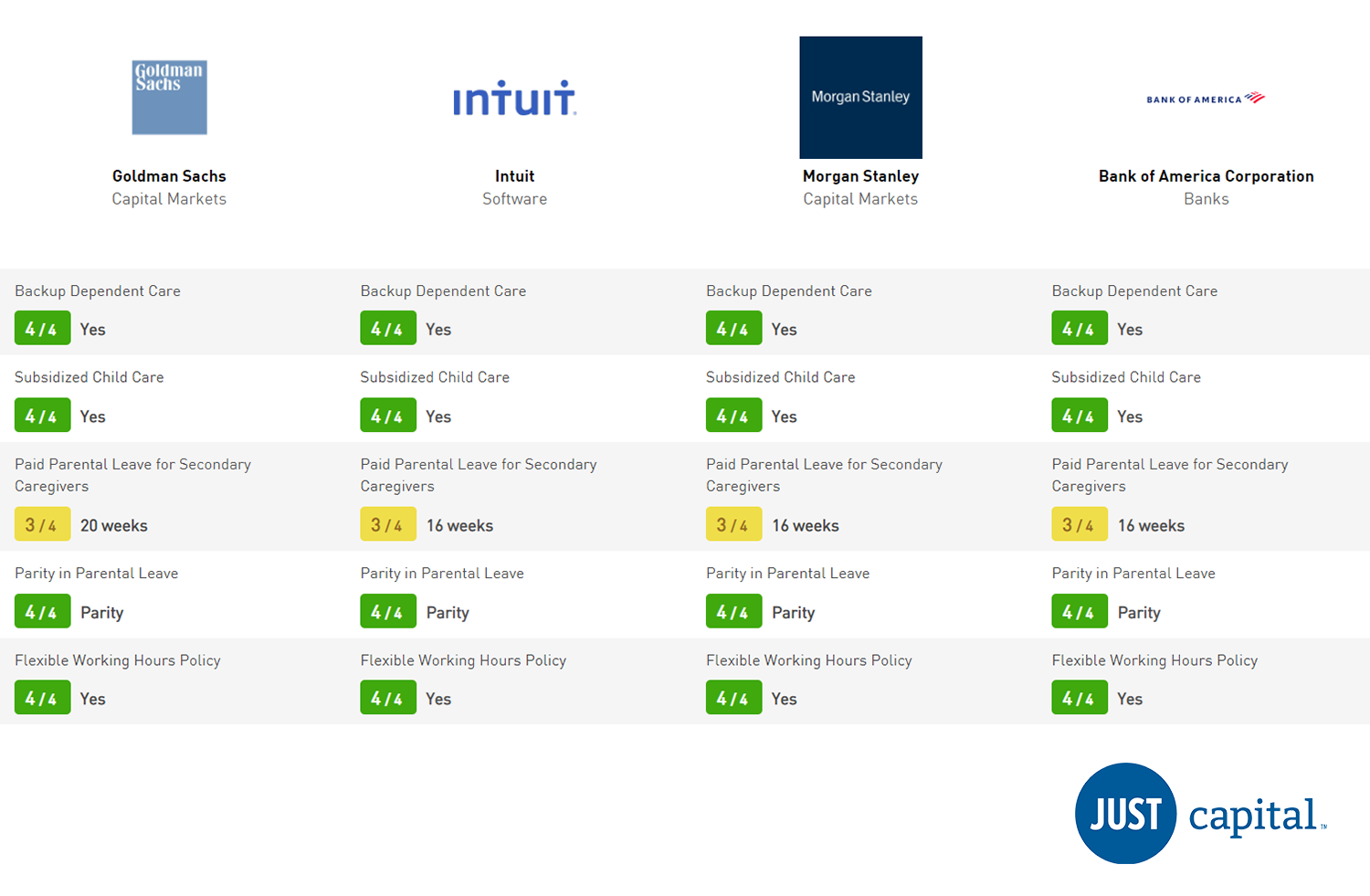 Each of these leading companies:
As this year’s Earth Day approaches, the world continues to stare down massive global consequences if governments, businesses, and other institutions do not take ambitious climate action. Released last month, the IPCC’s 2023 Climate Change Report signals that a vast reduction in fossil fuel use is urgently needed to slow global warming and ensure a livable, sustainable future.
Following last year’s SEC proposal to require public companies to disclose climate metrics, it seemed that corporate America was poised to be held accountable for its contributions to climate change. One year later, the rule is still not finalized with the SEC potentially easing requirements for companies following its public comment period.
Our survey research has shown that 86% of Americans, on both sides of the political aisle, are in favor of federal climate disclosure requirements. And with proposed requirements still uncertain, it remains in the hands of corporate leaders to determine what action to take and how it should be disclosed. Transparency will be crucial in the decades to come, and our analysis has shown that corporate leaders across industries are already paving the way.
To shine a light on these leaders and show what “good” looks like, we’re unpacking the efforts of the 36 companies that topped their industries on environmental issues in our 2023 Rankings of America’s Most JUST Companies. Many of these companies, regardless of their sector, have set ambitious emissions targets in an effort to mitigate the climate crisis, going beyond standard disclosure practices to focus their sustainability efforts on elements most material to their business models. And some also appear in our round-up of the top 10 companies leading on environmental performance overall in our Rankings.
Read on to explore how these 36 industry leaders are taking action.
Bank of America
Industry: Banks
Overall Rank: 1
As one of eight companies in its industry to make a Net-Zero commitment, Bank of America leads its industry on Resource Efficiency and Pollution Reduction. Notably, Bank of America boasts high percentages of renewable energy use, tying for first on this metric, both in its industry and overall. Additionally, Bank of America offers lending to customers for renewable projects and is a member of the Glasgow Financial Alliance for Net-Zero.
Accenture
Industry: Commercial Support Services
Overall Rank: 4
Accenture leads its industry on Pollution Reduction and Resource Efficiency. One of four Commercial Support Services companies to have a verified 1.5-Degree Science-Based Target, Accenture is committed to reaching Net-Zero by 2025. Accenture engages with its suppliers to achieve its ambitions, requiring 90% of suppliers to disclose emissions reduction plans and providing sustainable value chain strategies focused on circularity.
Hewlett Packard Enterprise
Industry: Computer Services
Overall Rank: 7
Hewlett Packard Enterprise is the only company in the Computer Services Industry with a verified 1.5-Degree Science-Based Target. First in its industry on Pollution Reduction, Sustainable Materials, and Climate Commitments, HPE has set multiple ambitious sustainability targets. HPE requires the adoption of science-based emissions reduction targets for its supply chain and is an early adopter of the reporting recommendation guidelines from the G20 Financial Stability Board’s Task Force on Climate-Related Financial Disclosures (TCFD).
Apple
Industry: Technology Hardware
Overall Rank: 8
Apple is one of three companies in the Technology Hardware Industry to have a verified 1.5-Degree Science-Based Target and has set a near-term target to achieve carbon neutrality by 2030. Thanks to these ambitious commitments, Apple ranks first in its industry for Climate Commitments. Apple is also first in its industry for having the highest percentage of renewable energy usage.
Intel
Industry: Semiconductors & Equipment
Overall Rank: 9
Intel has disclosed a 2040 Net-Zero Commitment, aiming to achieve 100% renewable energy in all of its global operations by 2030. Tied for first in its industry for having high percentages of renewable energy usage, Intel maintained 100% renewable energy usage within its U.S.-based operations in 2021.
T-Mobile
Industry: Telecommunications
Overall Rank: 20
T-Mobile is first in its industry on Pollution Reduction, Climate Commitments, and Resource Efficiency. Setting a verified 1.5-Degree Science-Based Target to achieve Net-Zero by 2040, T-Mobile has already achieved its 2021 goal to source 100% of its electricity usage from renewable sources.
Ecolab Inc
Industry: Chemicals
Overall Rank: 21
Ecolab’s verified 1.5-Degree Science-Based Target aims to halve the company’s emissions by 2030 and achieve Net-Zero by 2050. Ecolab is one of two companies within its industry to have a verified Science-Based Target and is working to achieve its goals by electrifying fleet vehicles, committing to 100% renewable energy in global operations, and engaging with its supply chain. Ecolab also ties for first in its industry on Sustainable Materials, conducting Life Cycle Assessments on its products to assess their environmental impacts.
Mastercard
Industry: Transaction Processing
Overall Rank: 22
Mastercard has a verified 1.5-Degree Science-Based Target, aiming to reduce Scope 1 and 2 emissions by 38% and Scope 3 emissions by 20% by 2025. One of only three Transaction Processing Companies to have a verified commitment, Mastercard is focusing on the decarbonization of its operations and supply chain.
Elevance Health
Industry: Health Care Providers
Overall Rank: 30
Elevance Health’s approach to sustainability is divided into four targets: carbon-neutral operations, 100% renewable energy procurement, science-based emissions reduction targets set by suppliers, and support to individuals challenged with economic insecurity. One of just two Health Care Providers that have committed to a Net-Zero Target, Elevance Health achieved carbon neutrality in 2021.
Workday
Industry: Software
Overall Rank: 33
Workday ranks first for Environment across all industries. Leading the competitive Software Industry on Pollution Reduction, Sustainable Materials, and Resource Efficiency, Workday has invested $1 million in carbon removal, discloses a verified 1.5-Degree Science-Based Target, and is going a step further to mitigate all historical carbon emissions. Through this ambitious effort, Workday will become one of the first companies to have a lifetime negative carbon footprint.
Avangrid
Industry: Utilities
Overall Rank: 45
Tied for first in its industry for Climate Commitments, Avangrid is one of just two Utilities companies to have set a verified 1.5-Degree Science-Based Target. Avangrid is seeking to achieve carbon neutrality, committing to 100% renewable energy in its corporate buildings by 2030. Avangrid is also tied for first in its industry for having high percentages of renewable energy usage.
General Motors
Industry: Automobiles & Parts
Overall Rank: 50
General Motors is one of just two companies in the Automobiles & Parts industry to have set a verified 1.5-degree Science-Based Target. The company’s Climate Action Framework is centered around creating an equitable transition to electric vehicles and improving the overall sustainability of its current products. Tied in its industry on the Sustainable Materials Issue, General Motors also ranks first overall for Pollution Reduction.
Lockheed Martin
Industry: Aerospace & Defense
Overall Rank: 54
As part of its 2025 Sustainability Plan, Lockheed Martin set a 2030 target to reduce Scope 1 and 2 emissions by 70%. One of nine Aerospace & Defense companies to set an emissions reduction target, Lockheed Martin has pledged that, by 2025, it will offset 100% of carbon emissions from business travel as well as continue to invest in and install carbon removal technologies.
McCormick & Co
Industry: Food, Beverage, & Tobacco
Overall Rank: 57
McCormick & Co has set a verified 1.5-Degree Science-Based Target to reach Net-Zero by 2050, one of only six companies in its industry to do so. Tied for first in its industry for Climate Commitments, McCormick is also working to reduce its carbon footprint by adopting more sustainable packaging practices.
Cummins
Industry: Commercial Vehicles & Machinery
Overall Rank: 67
Cummins’ Planet 2050 sustainability strategy aims to reduce Scope 1 and 2 emissions by 50% and Scope 3 emissions of newly sold products by 25%. Also by 2050, Cummins pledges to reduce absolute water consumption by 30%. Cummins is one of just two companies in its industry to have a verified 1.5-Degree Science-Based Target and is tied for first in its industry on Climate Commitments.
Akamai
Industry: Internet
Overall Rank: 78
Akamai leads its industry with five main sustainability targets for 2030, including 100% renewable energy to power global operations, a 50% more energy efficient platform, 100% mitigation of operational emissions, engagement with suppliers to set their own emission reduction targets with results evident by 2030, and recycling 100% of e-waste. Through these initiatives, Akamai has committed to reaching Net-Zero emissions by 2030.
Ball Corp
Industry: Industrial Goods
Overall Rank: 87
Ball Corp has set a verified 1.5-Degree Science-Based Target to achieve Net-Zero by 2050 and continues to improve the sustainability of its products, aiming to source 100% of its aluminum from certified sustainable sources. First in its industry for Sustainable Materials, Ball Corp is working with its supply chain to ensure that the aluminum used in its cans and bottles are, on average, 85% recycled content.
Owens Corning
Industry: Building Materials & Construction
Overall Rank: 96
With a 2030 pledge to reduce Scope 1 and 2 emissions by 50% and Scope 3 emissions by 30%, Owens Corning ties for first in its industry for Climate Commitments, also setting a verified 1.5-Degree Science-Based Target – one of only two companies in its industry to do so. Owens Corning is a member of the Better Plants Program, a Department of Energy initiative to improve and advance energy efficiency in commercial and industrial buildings in the U.S.
Nike
Industry: Clothing & Accessories
Overall Rank: 97
Nike’s Move to Zero initiative has demonstrated the company’s commitment to emissions reduction. With a verified 1.5-Degree Science-Based Target, Nike has set three 2025 targets centered around reducing emissions by prioritizing sustainable materials, using recycled waste in Nike products, and reducing fresh water consumption by 25%. Nike leads its industry on Pollution Reduction, with the highest percentage of renewable energy usage among its peers.
Johnson & Johnson
Industry: Pharmaceuticals & Biotech
Overall Rank: 101
First in its industry for Pollution Reduction and Sustainable Materials, Johnson & Johnson is finding innovative ways to reduce the environmental impacts of its products through multiple sustainability-focused partnerships. Johnson & Johnson also has set a verified 1.5-Degree Science-Based Target and is committed to reaching Net-Zero by 2045.
Edwards Lifesciences
Industry: Medical Equipment & Services
Overall Rank: 104
First in its industry for Climate Commitments, Edwards Lifesciences is one of just two Medical Equipment & Services companies with a verified 1.5-Degree Science-Based Target to reach carbon neutrality by 2030. Additionally, Edwards Lifesciences has set 2025 targets to reduce both waste generation intensity and water withdrawal intensity by 10%.
eBay
Industry: Consumer Services
Overall Rank: 103
In 2021, eBay achieved carbon neutrality in its Scope 1 and 2 emissions. With a verified 1.5-Degree Science-Based Target to achieve Net Zero by 2030, eBay is also working to increase its renewable energy use and reduce its water consumption and waste generation. eBay is first in its industry for Pollution Reduction, Sustainable Materials, and Climate Commitments and is the only Consumer Services company with a 1.5-degree climate commitment.
Procter & Gamble
Industry: Personal Products
Overall Rank: 106
First in its industry for Pollution Reduction and Resource Efficiency, Procter and Gamble has set a verified 2-Degree Science-Based Target to reach Net-Zero by 2040. Disclosing a comprehensive Climate Transition Action Plan, the company is investing in renewable energy and is tied for first in its industry for the highest percentage of renewable energy usage.
Hasbro
Industry: Household & Leisure Goods
Overall Rank: 113
Second in its industry for Sustainable Materials, Hasbro is working to improve the sustainability of its products, using plant-based or recyclable materials in its toys, continuing its global toy recycling program, and implementing sustainable packaging principles. Hasbro is also setting a Net-Zero target for 2050, one of only four companies in its industry to do so.
CVS Health
Industry: Food & Drug Retailers
Overall Rank: 120
First in its industry for Climate Commitments, CVS has set a verified 1.5-Degree Science-Based target to reach Net-Zero by 2050 and a 2030 goal of achieving carbon neutrality. CVS has a three-tiered climate action plan focused on enabling sustainable operations, adopting new climate policies, and promoting animal welfare. CVS has also set a 2030 target to reduce plastic use in its operations by 50% and is tied for first in its industry for its commitment to using Sustainable Materials.
Ameriprise Financial
Industry: Consumer & Diversified Finance
Overall Rank: 124
Ameriprise Financial leads its industry on Sustainable Materials and Resource Efficiency. By implementing sustainable practices in its operations, including increasing building energy efficiency and reducing paper waste, Ameriprise Financial has lowered its Scope 1 and Scope 2 emissions.
Goldman Sachs
Industry: Capital Markets
Overall Rank: 131
Leading its industry on Climate Commitments, Goldman Sachs has set a 2030 Net-Zero target. Goldman Sachs also boasts high percentages of renewable energy use and has a 2025 goal of procuring 100% renewable energy for its global electricity consumption.
Principal Financial Group
Industry: Insurance
Overall Rank: 138
Principal Financial Group has set both near- and long-term climate targets, including a 2035 goal to reduce emissions by 40% and a 2050 goal to reach Net-Zero. Year-over-year since 2018, Principal Financial Group has consecutively reduced greenhouse gas emissions. Tying for first in its industry for Pollution Reduction, approximately 61% of Principal Financial’s energy consumption in the U.S. is from renewable resources.
Marathon Petroleum
Industry: Oil & Gas
Overall Rank: 173
Marathon Petroleum has set reduction targets across all three scopes of emissions, including a 30% reduction of Scope 1 and 2 by 2030 and a 15% reduction of Scope 3 Category 11 emissions by 2030. First in its industry for Sustainable Materials, Marathon Petroleum conducts biodiversity assessments and has set a 2025 target to integrate sustainable vegetation and habitat management into 50% of the areas surrounding pipelines.
FedEx
Industry: Transportation
Overall Rank: 178
FedEx has set a goal to achieve carbon neutral operations through the electrification of its fleet vehicles and the adoption of sustainable fuels. FedEx is also engaging with consumers and suppliers to offer carbon-offset shipping and sustainable packaging options.
Weyerhaeuser
Industry: Real Estate
Overall Rank: 205
Weyerhaeuser has set a verified 1.5-Degree Science-Based Target, pursuing Net-Zero by 2050. The company also launched the Forest to Frame Alliance to engage its entire supply chain in its Net-Zero ambitions. First in the Real Estate Industry in Pollution Reduction and Resource Efficiency, Weyheauser is second in its industry for high percentages of renewable energy usage.
Las Vegas Sands
Industry: Restaurants & Leisure
Overall Rank: 291
Las Vegas Sands has committed to a verified 2-Degree Science-Based Target, aiming to reduce greenhouse gas emissions by 17.5% by 2025. The company is implementing energy efficiency within its operations to undergo a low-carbon transition, as well as focusing on water stewardship by reducing water consumption.
Williams-Sonoma
Industry: Retail
Overall Rank: 331
Tied for first in its industry for Climate Commitments, Williams-Sonoma has a verified 1.5-Degree Science-Based Target and a near-term target of carbon neutrality by 2025. The company is first among Retail companies for having the highest percentage of renewable energy usage, as well as first in Sustainable Materials, thanks to its efforts to increase the circularity of its products.
International Paper
Industry: Basic Resources
Overall Rank: 408
Ranking first in its industry on Pollution Reduction, International Paper discloses the highest percentages of renewable energy use compared to peers. International Paper is also one of just two companies in its industry to have a verified 2-degree Science-Based Target, with a commitment to reduce 35% of absolute emissions across all three scopes by 2030.
News Corporation
Industry: Media
Overall Rank: 589
News Corporation is one of two companies within the Media Industry to have a verified 1.5-Degree Science-Based Target. Tied for first for Climate Commitments, News Corporation discloses an entire Net-Zero Transition Plan and has committed to reducing fuel and carbon emissions by 60% by 2030.
Enviva
Industry: Energy Equipment & Services
Overall Rank: 729
Enviva has made a 2030 Net-Zero commitment, along with five other companies in its industry. With efforts to sustainably source wood and invest in the conservation and restoration of forests, Enviva is first in its industry for Pollution Reduction and second for Climate Commitments.
To unpack your company’s environmental performance in the 2023 Rankings and gain insights into how to improve on the issues that matter most to the American public, please reach out to corpengage@justcapital.com.

The “E” in ESG remains a core focus for corporate leaders – along with regulators and lawmakers. Some state and federal legislators continue to challenge companies’ environmental actions. At the same time, companies are grappling with new sustainability disclosure requirements coming out of the EU and what’s to come from the SEC‘s rule on climate-related disclosures.
Amid these moves, and as this week marks the 53rd annual Earth Day, we took a look at how America’s largest employers are stepping up to manage their environmental impact.
A majority of Americans (88%) JUST Capital surveyed in partnership with Ceres and Public Citizen agree large companies have a responsibility to reduce their environmental impact. An additional 87% said it is important that large companies publicly report data about their impact on society regarding climate. Climate also remains high on the agenda of investors, making up a majority of ESG-related shareholder proposals this proxy season.
To see how companies are measuring up against these expectations, we evaluated the 10 companies with the best environmental performance in our 2023 Rankings of America’s Most JUST Companies. All 10 of these companies have set a Net-Zero target and we also found that these leaders are outpacing the remainder of the Russell 1000:
Read more about how these companies – some of which also appear in our round-up of industry leaders on environmental performance – are taking action. The Top 10 are listed below in ranked order on environmental performance based on the 2023 Rankings.
Ranked 33rd in America’s Most JUST Companies
Software company based in Pleasanton, California
Workday is the top-performing company on the Environment stakeholder, placing first in the overall Rankings and its industry. At Climate Week 2022, JUST CEO Martin Whittaker discussed with Workday’s Erik Hansen the company’s ambitious verified climate commitment, a 1.5-degree Science-Based Target, to reach Net-Zero emissions within its operations by 2030. Workday is also mitigating its historical emissions, becoming one of the first companies to achieve a lifetime net carbon footprint of zero. Additionally, Workday is tied for first within its industry for having the highest percentage of renewable energy within its overall energy use portfolio.
Ranked 7th in America’s Most JUST Companies
Computer Services company based in Spring, Texas
Hewlett Packard Enterprise‘s (HPE) verified 1.5-degree Science-Based Target contains near-term and long-term goals to achieve Net-Zero emissions by 2040, including an absolute reduction of all scope emissions by 90%. Through innovative technology, HPE is increasing the energy efficiency of its products and lowering the environmental cost for consumers. These efforts earned HPE a tied-for-first spot on the Sustainable Materials Issue in our Rankings, within the Computer Services industry. HPE is also tackling its supply chain emissions, and through direct collaboration with suppliers, has set a goal for 2030 that 80% of HPE product suppliers have their own Science-Based targets.
Ranked 78th in America’s Most JUST Companies
Internet company based in Cambridge, Massachusetts
Akamai is working toward a 2030 Net-Zero Target through clean energy projects, engagement with suppliers, and creating a 50% more energy-efficient platform. The company is aiming to achieve a goal of 100% of its global operations utilizing renewable energy by 2030 through partnerships with its data center providers. Akamai also ranks first in its industry for pollution reduction and resource efficiency.
Ranked 3rd in America’s Most JUST Companies
Software company based in Redmond, Washington
Microsoft has consistently positioned itself as a leader in sustainability and has pledged to go beyond Net-Zero, committing to being carbon negative by 2030. This ambitious commitment includes removing more carbon than the company emits by 2030 and, by 2050, removing all of the company’s historical emissions. Microsoft is also committed to becoming water positive by 2030, through collaborating with nonprofits and focusing on habitat restoration. Microsoft is investing in circularity by setting a target of zero waste by 2030, creating more sustainable products for consumers to eliminate waste, and optimizing waste diversion practices within its data centers and campuses.
Ranked 106th in America’s Most JUST Companies
Personal Products company based in Cincinnati, Ohio
Procter & Gamble’s (P&G) approach to sustainability includes four tiers – climate, waste, water, and nature. Procter & Gamble’s climate-focused initiatives include achieving Net-Zero by 2040, disclosing a Climate Transition Action Plan to track progress, and maintaining accountability to achieving its goals. The company’s reducing waste with a target to use all recyclable or reusable packaging for consumer products by 2030. P&G also aims to help build a water-positive future, focusing first on high water-stressed areas where the company operates. The company’s nature-centric goals also include engaging suppliers to source more ethical products and a commitment to no deforestation as a result of souring its palm, pulp, and paper packaging.
Ranked 1st in America’s Most JUST Companies
Bank based in Charlotte, North Carolina
Bank of America’s Approach to Zero strategy includes a commitment to reaching Net-Zero by 2050. The company achieved carbon neutrality in 2019, in addition to reaching its goal of using 100% renewable electricity. To achieve its Net-Zero goal, the company is leveraging its position as a financial institution and mobilizing $1 trillion by 2030 to accelerate its own climate transition. Bank of America’s Environmental Business Initiative has lent $200 billion toward sustainable business activities, including targeting industries essential to achieving the environmental transition such as transportation and clean energy.
Ranked 48th in America’s Most JUST Companies
Computer Services company based in Armonk, New York
IBM has disclosed 21 climate-related goals, including reaching Net-Zero across its operations by 2030. IBM also is focused on the conservation and preservation of biodiversity, pledging to source more sustainable materials and reduce water withdrawals in areas identified as high risk. Within its supply chain, IBM is building on its 2010 goal of all firsthand suppliers maintaining their own environmental management systems, and requiring suppliers in emission-intensive sectors to set scientific emission reduction targets aligned with a 1.5-degree warming scenario.
Ranked 101st in America’s Most JUST Companies
Pharmaceutical & Biotech company based in New Brunswick, New Jersey
Johnson & Johnson’s approach to sustainability is grounded in climate change as a global health crisis. The company’s targets include decarbonization in its operations and supply chain, providing more sustainable products to consumers, and furthering environmental health equity. Johnson & Johnson’s Net-Zero Target aims to achieve carbon neutrality by 2030, with the ultimate goal of reaching Net-Zero across its entire value chain by 2045. The company’s environmental health equity strategy is a part of a larger company initiative launched in 2020, “Our Race to Health Equity,” which identifies solutions to eliminating health inequality for individuals that are a part of at-risk communities.
Ranked 4th in America’s Most JUST Companies
Commercial Support Services company based in Chicago, Illinois
Accenture has a commitment to reaching its own Net-Zero Target by 2025 and is working with companies to assist in helping them achieve their own Net-Zero ambitions. Accenture is taking advantage of its unique position to further sustainability in a range of industries. The company works with C-suite executives to set Science-Based targets, procure renewable energy, and implement new sustainable business models. Accenture has also made progress on its 2025 zero waste target, committing to purchasing only reusable or plastic-free items for its global operating locations.
Ranked 87th in America’s Most JUST Companies
Industrial Goods company based in Broomfield, Colorado
Ball Corp has a Climate Transition Plan, which includes reaching Net-Zero prior to 2050 and reducing carbon emissions by 55% by 2030. Ball Corp ranks first in its industry on the Environment stakeholder, disclosing multiple plans to achieve its sustainability goals dependent on the decarbonization of aluminum. The company is embedding circularity in its product development, through a global recycling roadmap, working with suppliers to achieve 85% recycled content in its cans, and investing in green infrastructure. Through these efforts, Ball Corp leads Industrial Goods companies in our Rankings on the Sustainable Materials Issue.
To unpack your company’s environmental performance in the 2023 Rankings and gain insights into how to improve on the issues that matter most to the American public, please reach out to corpengage@justcapital.com.
Over our years of polling the public, we’ve heard time and again that Americans agree it is important for companies to make workers their top priority. They want to see companies pay their workers a fair, living wage, create jobs in communities that need them, and establish diverse and inclusive workplaces that provide opportunities for all employees to succeed. When companies take concrete action to invest in diversity, equity, and inclusion (DEI) in the workplace, they demonstrate not only a commitment to advancing racial equity, but also to investing in their employees overall. By taking actionable steps – from conducting pay equity analyses to offering key benefits like paid parental leave to setting workforce diversity targets – corporate leaders are setting a higher standard for the treatment of all workers everywhere.
In our 2022 survey taking the pulse of the public on key diversity, equity, and inclusion issues, we found that a significant 92% of Americans agree it is important to promote racial equity in the workplace, but a strong majority (68%) say that corporations have more work to do. The public agreed that companies should take concrete steps toward advancing racial equity – including by conducting annual pay analyses (89%) and disclosing workforce demographics (76%).
With DEI representing an integral element of quality jobs, it appears as a core theme in our upcoming JUST Jobs Scorecard – an online interactive tool we will be releasing in the coming months, which highlights corporate disclosure on seven key topics around job quality, identifies leading practices, and demonstrates corporate pathways for improvement. Just under half of all the data points featured in the Scorecard are directly related to creating inclusive and equitable workspaces.
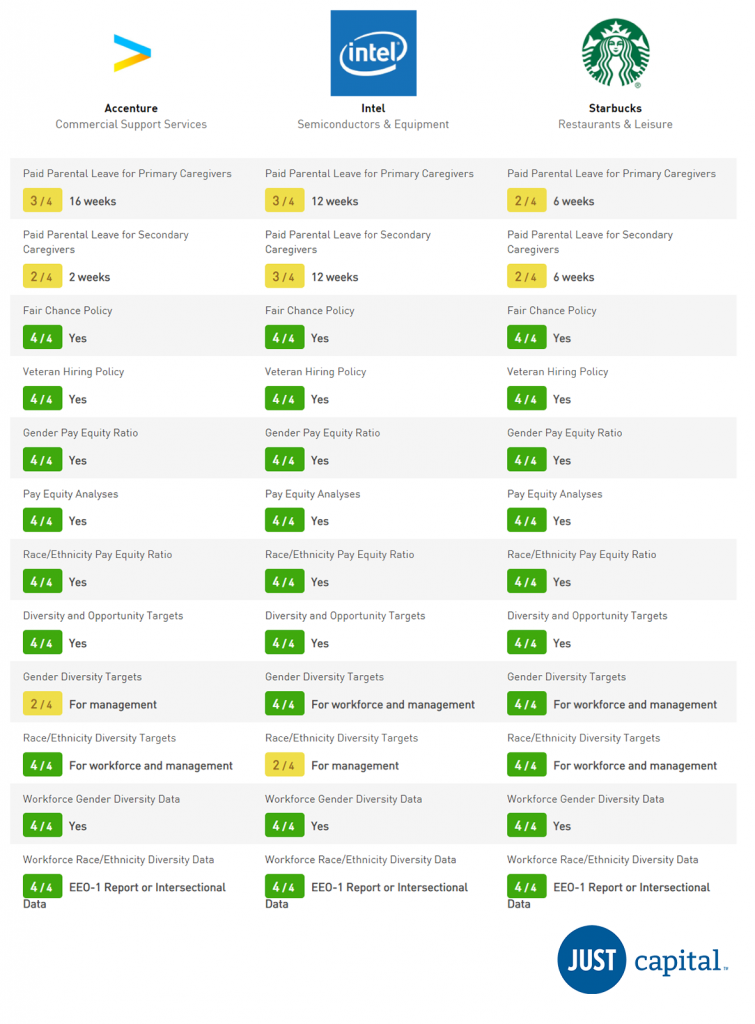
In an effort to showcase what strong DEI disclosure looks like, we’ve analyzed a subset of key data from our Rankings and new JUST Jobs Scorecard analysis and identified three companies with the highest scores – Starbucks, Intel, and Accenture.
Each of the leading companies:
Below, we explore the key actions these companies have taken that drive their strong outperformance.
Based in Seattle, Washington
As part of its efforts to increase diverse representation of workers in both retail and corporate roles, Starbucks has committed to reaching ambitious gender and race/ethnicity diversity targets. With pledges to fill 50% of corporate roles with women, as well as to have at least 30% BIPOC representation at the corporate level by 2025, Starbucks is setting meaningful goals to establish a more diverse workplace.
Starbucks also provides detailed disclosure of its workforce demographic data, broken out by gender and employment category, in its latest EEO-1 report. In 2018, Starbucks demonstrated its commitment to creating an equitable workplace by achieving 100% pay equity for workers of all genders and races in the U.S. Starbucks has maintained this achievement in 2022.
Additionally, Starbucks is a signatory of the White House’s Fair Chance Business Pledge, creating pathways for employment for veterans, formerly incarcerated individuals, and young people who face systematic barriers to education and employment.
Based in Santa Clara, California
Intel has made inclusivity in the workplace a pillar of its 2030 RISE Strategy and has already exceeded some of its initial milestones. In terms of gender diversity targets, the company has doubled the number of women in leadership positions and surpassed its goal of having 10% representation of Black/African American employees in senior, director, and executive roles, reaching 11% representation in 2022. Additionally, Intel has set a goal to increase accessibility in its workplace and aims to increase the number of workers who self-identify as having a disability to 10%.
Beyond increasing representation, Intel is also committed to creating an equitable workplace by offering 12 weeks of paid parental leave for all new caregivers. Intel’s commitment to DEI is evident in the public release of its comprehensive EEO-1 report, which also contains highly detailed information about workers’ pay broken down by race/ethnicity, job category, and salary band. Finally, Intel promotes hiring veterans and discloses detailed data tracking its yearly progress on veteran hiring.
Based in Chicago, Illinois
Accenture PLC conducts annual pay equity analyses by gender and race/ethnicity for its workforce and publicly discloses the findings. Using the information collected during these analyses, Accenture has been able to make informed future commitments to increasing diversity in its workplace for 2025. Accenture achieved 100% pay equity by race and gender in 2022 and is taking its commitment a step further, committing to achieve full gender parity at all levels by 2025, with 50% of its board seats and 45% of revenue-producing roles held by women.
In addition to disclosing detailed information about workforce demographics in its EEO-1 report, Accenture discloses other DEI metrics such as the number of workers who are veterans or self-identify as disabled or LGBTQ+. Accenture seeks to create opportunities for all individuals to thrive in the workplace, evidenced by its 16 weeks of paid parental leave offered to primary caregivers. Accenture also has a partnership with Goodwill to provide formerly incarcerated individuals with VR technology so they can participate in mock interviews, increasing their chances of finding employment.
Here’s a snapshot from our upcoming JUST Jobs Scorecard “compare” tools, showing how Starbucks, Intel, and Accenture are performing on these issues.
To unpack your company’s DEI performance in the 2023 Rankings and gain insights into how to improve on the issues that matter most to the American public, please reach out to corpengage@justcapital.com.

On Monday, March 13 top corporate, investment, and sustainability leaders gathered for the JUST Leadership Summit – an annual event, now in its 8th year, to celebrate corporate leadership and spotlight action from investors and American companies to help build a more just economy. We discussed the broad state of play with Deloitte, why employee stock ownership is a winning strategy with KKR, how JUST jobs build better companies with Two Sigma, and recognized the achievements of this year’s JUST 100, the leaders topping our 2023 Rankings of America’s Most JUST Companies.
Explore the full video from Monday’s event below for insights into how corporate leaders can navigate today’s shifting ESG landscape, put workers first, and create more JUST jobs. A description of each panel, including timestamps, can also be found below.
Welcome Remarks | starts 0:50
An invitation to consider the challenges facing both American workers and corporate leaders today, and an introduction to the Summit’s panels.
Speakers
Driving Stakeholder Value Creation Through a Shifting Landscape | starts 10:10
In the current climate of imminent regulatory shifts and noisy political rhetoric, there are myriad unknowns about what the future of ESG and corporate sustainability strategies will require. Partner Kristen Sullivan shared insights into how Deloitte is advising clients and helping them navigate this moment with intelligence devised to accelerate JUST business practices and create value for investors.
Speaker:
Sharing the Wealth: A Fireside Chat with Pete Stavros | starts 26:40
Pete Stavros sat down with CNBC’s Dominic Chu to talk about today’s investing landscape and how he thinks the innovative strategies being deployed by the organizations he leads – KKR and Ownership Works – can not only improve the lives of millions of workers but also transform strategic business practices in America in the process. Includes a short video on the impacts of Ownership Works.
Speakers:
JUST Jobs Build Better Companies | starts 53:40
JUST Capital previewed our new innovative tool – the JUST Jobs Scorecard – that helps business leaders assess how companies are performing on job quality today and why we should all be investing in JUST Jobs to build better companies.
Speaker:
The Value of Listening to Your Workers | starts 1:01:20
There are multiple approaches to measuring job quality but perhaps no greater tool than listening to the workers themselves. In this session, we discussed how to unlock business value by using cutting edge survey tools and other strategies to engage with and respond to your workforce – an approach well-paired with the disclosure and performance thresholds available in JUST’s new Scorecard in determining where to make workforce investments.
Speakers:
Worker Voice | Chipotle starts 1:19:19 | Verizon starts 1:22:13
We hear directly from two JUST 100 employees – Eddy Caballo, Field Leader at Chipotle and Edwenna “Eddie” Ervin, Senior Engineer Project Manager at Verizon – about the impact their companies’ workforce investments have made in their lives.
JUST Jobs in Practice | starts 1:25:20
High-quality metrics, assessments, and benchmarks are key to understanding JUST Jobs, but then it’s time to put the insights into practice and make strategic investments in your workforce. In this session, we heard from C-suite leaders about specific actions taken and challenges overcome that generated transformative impacts for their workers and business outcomes for their companies.
Speakers:
JUST 100 Industry Leaders Spotlight | starts 1:53:00
JUST 100 Industry leaders are helping to shift norms and scale change across corporate America by influencing their respective sectors to do more in a continuous race to the top. They demonstrate through practice that an integrated stakeholder approach – where climate, sustainability, and equity are inextricably connected – leads to long-term impact and financial outperformance.
Speakers:
The U.S. fixed income (bond) market rivals the U.S. equity market in valuation, with total issuance of $49.1 trillion, and $10 trillion, or 20% of that is corporate debt. In this piece, we’ll investigate the corporate debt market, looking both at how opportunities in debt compare to those in equities in this moment, and how companies that prioritize all their stakeholders as represented in the JUST Rankings enjoy better credit ratings.
After the 2008 global financial crisis, the Fed and other central banks engaged in unprecedented quantitative easing, suppressing global interest rates. While low interest rates supported equity and other asset (including bond) prices, they were a challenge for retirees and other savers needing current income. More recently, renewed inflation accompanying the emergence from the economic disruptions of COVID forced the Fed to increase rates in response, leading to declines across both stocks and bonds in 2022.
As investors consider what’s next for interest rates, economic growth, and prospective returns from different asset classes, the natural, evergreen question of “Where should I invest now?” is front of mind. One broad comparison worth looking at is the expected earnings yield on equities versus the available yield on bonds. At a macroeconomic level, investors choose between earning the yield from bonds in coupon payments, or the income yield from stocks. In the chart below, the corporate earnings yields are the actual realized earnings for S&P 500 companies in that year divided by the S&P 500 index value at the prior year’s end. The value for 2023 is based on consensus 2023 earnings estimates.
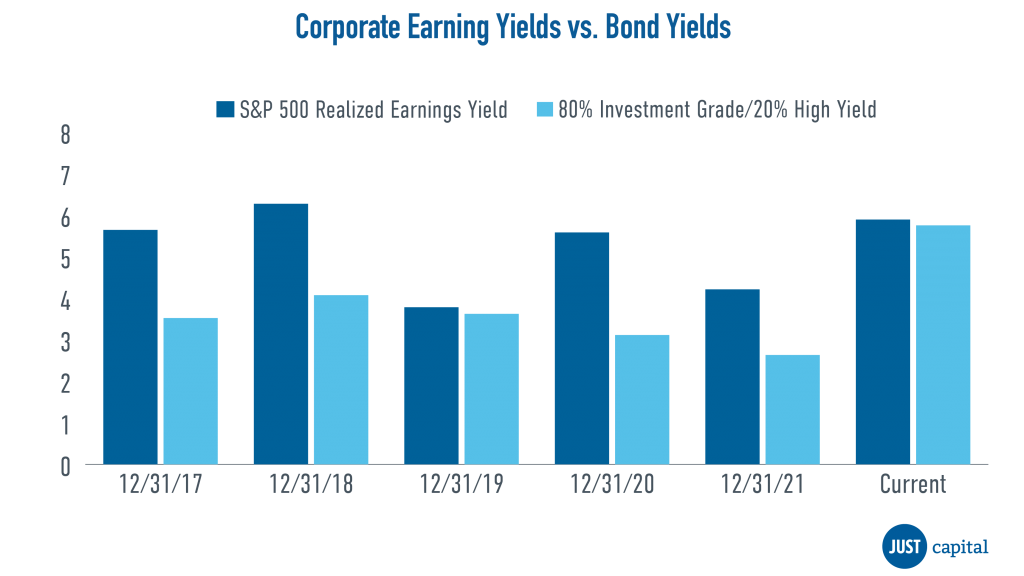
We generally see the S&P 500 earnings yield handily outperforming the available yield from corporate bonds over this period. The exception, of course, came in 2020 when earnings collapsed during COVID. However, a portfolio of corporate investment grade and high yield bonds now offers an attractive prospective yield compared to equities, suggesting that the time to invest in corporate debt may be upon us. While the asset price adjustment of 2022 was painful for both equity and debt holders, an era of more normal interest rate policy in a pro-inflationary economy will offer opportunities for investors to diversify risk across the economic cycle.
JUST Capital tracks companies in the Russell 1000, and we’ve observed a strong relationship between a company’s placement in our Annual Rankings of America’s Most JUST Companies and its long-term credit rating. Companies that succeed in prioritizing their workers, customers, communities, shareholders, and the environment – as reflected in the JUST Rankings – also enjoy the advantage of better credit ratings and lower borrowing costs.
The chart below shows the mean JUST 2023 rank within each S&P long-term credit rating category at December 31, 2022. (Of the Russell 1000, 27 ranked companies with a “Not Rated” credit designation and 251 ranked companies with no credit designation were excluded. The “spikes” on the edges of the chart, at ratings AA and CC, are due to the small numbers of companies in those categories.)
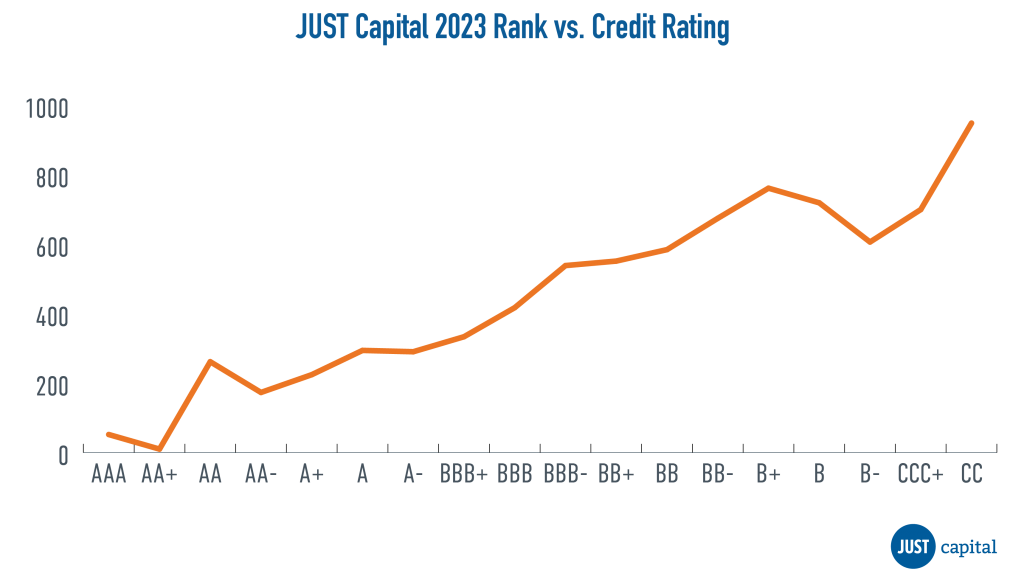
This correlation should not be surprising. Although credit ratings focus on financial measures of strength and JUST Rankings are based largely on non-financial measures of corporate stakeholder performance, they both distinguish companies on management quality and how they manage the balance of risks and opportunities.
Building on this finding, we’ll be further exploring the debt markets and the relationship between JUST Rankings and corporate bonds further throughout this year.
