On Monday, February 5, JUST Capital and CNBC unveiled the 2024 JUST 100. The comprehensive list spotlights America’s Most JUST Companies by analyzing how companies comprising the Russell 1000 perform across the 20 Issues the American public believes corporations should prioritize in their business practices.
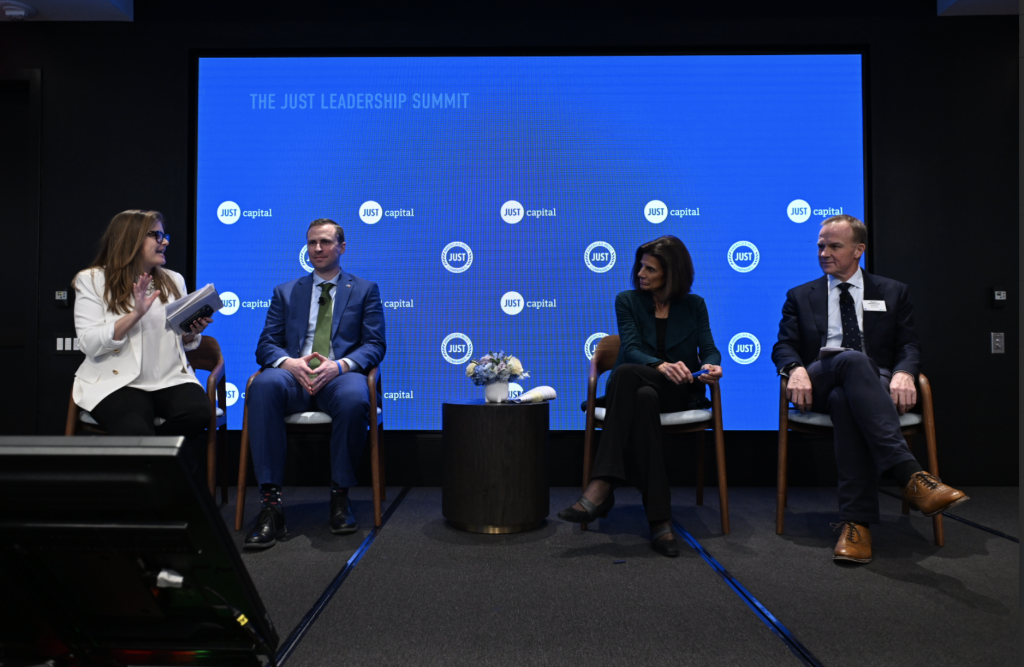
The event, which took place at the NASDAQ MarketSite and was sponsored by the Stakeholder Impact Foundation and BCG, opened with introductory remarks from JUST Capital CEO Martin Whittaker and a speech from Sushmita Banerjee, Senior Partner and Managing Director at Boston Consulting Group (BCG). Two panel discussions followed. The first featured a macro-level conversation between JUST Capital co-founder Paul Tudor Jones II alongside Hewlett Packard Enterprise (HPE) CEO Antonio Neri, moderated by CNBC’s Andrew Ross Sorkin. JUST Capital’s President Alison Omens then moderated the second panel with HPE Board Chairman Patricia Russo, Avangrid CFO Justin Lagasse and Accenture’s Northeast Market Unit Lead Stuart Henderson where they discussed in further detail what just business behavior actually looks like, what are the challenges and tradeoffs that companies face.
Banerjee set the tone for evening speaking about what she has seen working with some of the most successful companies in the world. “Just companies – in my experience – have leaders who exercise their responsible, ethical muscles every day, versus waiting for their grand moment where they could prove to the world they are doing something great,” she said.
Just actions, Banerjee said, lead to something every business needs to thrive: trust. She highlighted BCG’s Trust Index as an example of how companies can measure and decode trust among stakeholders by focusing on four dimensions: competency, fairness, transparency and resilience.
The companies that top JUST’s rankings prioritize building trust across stakeholders and their business performance benefits. ”When we look at the top 100 companies in JUST’s database, what we see is that they generate 2.5x more value than comparable businesses—their valuation multiples are also up to 47% higher,” Bannerjee said.
Sorkin kicked-off the first panel conversation by prompting Jones to reflect on how far the conversation around stakeholders in American business has come over the last decade.
“If you rewind to 2014, no one would even know what stakeholder business meant,” Jones told the panel. “There was nothing but shareholder governance at that point in time. Of course that was why business was very narrowly focused on nothing but profits. That is one of the reasons why we started JUST Capital.”
Turning to Neri, Sorkin gave the HPE CEO an opportunity to speak on why his company was able to secure the number-one spot in JUST’s 2024 rankings. This year is HPE’s first time at the top of the list after being recognized as a JUST 100 leader every year from 2018 through 2024.
“Our job is to create value and my measure of value is not just shareholder value,” Neri said at JUST’s 2024 Leadership Summit on Monday. “It’s about value for the people who participate in the ecosystem where we deliver business results or other types of outcomes for our customers and employees. Ultimately, stock price is a reflection of how you do things and what you deliver. One of the sayings we have at the company is ‘you have to win the right way.’”
The discussion delved into the correlation between this inclusive approach, business success, and positive societal impact. Additionally, Jones emphasized the need for other companies to adopt a similar mindset, underlining the significance of leadership in today’s dynamic economic and social landscape.
The second panel focused on the strategic investments C-suite leaders have undertaken that have led to top-ranking performances. HPE Board Chairman Patricia Russo, Avangrid CFO Justin Lagasse and Accenture’s Northeast Market Unit Lead Stuart Henderson gave practical examples to illustrate how they approach prioritizing stakeholder value to achieve business success.
“It’s really important that boards have clarity around what a reasonable timeframe is and I want to use an example from Merck,” Russo said. “There was a time when Merk’s TCR was not competitive with other pharma companies, because Merck had decided–as a company committed to science–that they were not going to cut back on R&D in order to get their profits up, they were going to continue to invest in medicines. And today, Merck has the largest cancer drugs on the planet as a result of what they invested in and their stock is now trading at $126 a share. So there is a time-horizon around when value creation for shareholders is the natural follow-on to all the other good things you’re doing for people, customers and communities.”
By aligning their strategies with the values prioritized by all of their stakeholders, these leaders exemplify the potential for businesses to thrive while making meaningful contributions to society. The emphasis on stakeholder value creation showcased the alignment between business success and ethical decision-making, reinforcing that a just approach is morally sound and strategically advantageous in the long run.
When asked what their advice would be to other companies, the panelists each provided their own poignant perspective. Henderson encouraged leaders to steer clear of politics and lean into the business case for transparency, diversity and sustainability, which would deliver good outcomes for shareholders and stakeholders. Lagasse rounded out the panel with a reminder to keep it simple—over-complicating how to empower and enable stakeholders to thrive is where the disconnect comes from. Russo emphasized the importance of focusing on managing human capital just as well as financial capital.
“I don’t get into debates about DEI,” Russo said. “I think the pushback is based on a myth of what it is. If you have a conversation with someone who is rational and intelligent, and you say, ‘Do you believe that different perspectives lead to better discussions?’ the answer will be yes. ‘Do you believe in a work environment where people feel like they can come to work and they can be their best selves because they are part of a team and valued?’ Absolutely. ‘Do you believe we should pay people fairly and the same for the same work?’ Oh, absolutely. Okay, well that’s DEI.”
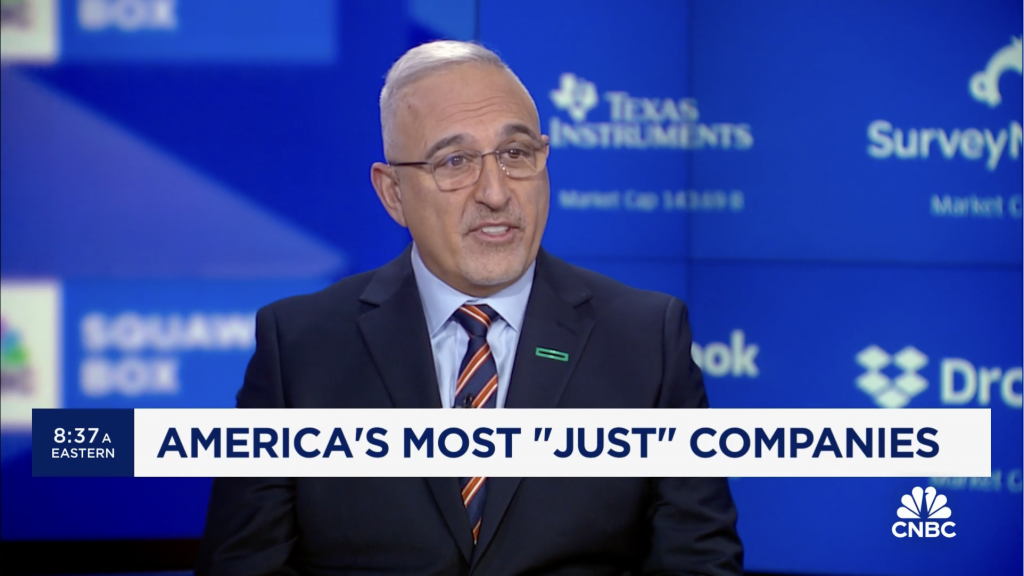
On Monday, JUST Capital and CNBC announced that Hewlett Packard Enterprise (HPE) took the 2024 title for America’s Most Just Company. For HPE CEO Antonio Neri, the recognition is evidence of his team’s meticulous work to deliver positive outcomes on worker, environment, community, and other issues Americans care most about. Neri underscored it’s all about results.
“Our job is to create value and my measure of value is not just shareholder value,” Neri said at JUST’s 2024 Leadership Summit on Monday at the NASDAQ. “It’s value for the people who participate in the ecosystem where we deliver business results or other types of outcomes for our customers and employees. Ultimately, stock price is a reflection of how you do things and what you deliver. One of the sayings we have at the company is ‘you have to win the right way.’”
HPE blazed past its peers and other industry leaders in JUST’s rankings of the Russell 1000 (approximately 937 companies when you account for mergers, acquisitions, and delistings). While HPE has been in the JUST 100 every year from 2018 through 2024, this is HPE’s first time in the top spot.
The company’s standout leadership on issues like fair pay, climate change, and offering apprenticeship programs, such as its Cyber Career Reboot program, helped propel its performance. Other notable data points include the following:
“I take great pride in HPE’s recognition as a leader by JUST Capital on the issues vital to Americans,” Neri said in a previous statement. “Our purpose is to advance the way people live and work, which is evidenced in our commitment to reducing environmental impacts throughout our value chain, supporting our team members with exceptional benefits and talent programs, and investing in our communities and supply chain.”
During a panel discussion on Monday, Neri and JUST Capital co-founder and chairman Paul Tudor Jones responded to questions about the recent pushback against ESG, and underscored that stakeholder issues aren’t about politics, but about promoting better long-term business practices.
“I differentiate between just behavior and ESG, because they do overlap in part, but they are really different,” Jones said. “What we’re doing with our rankings is reflecting what the American public says.”
Neri said he plans to continue investing in areas that JUST Capital ranks, saying it’s good for shareholders, as well as other stakeholders.
That assumption is buoyed by real financial data. The JUST 100 Index has beaten the Russell 1000 Equal Weighted Index by 38.5% since inception and 3.1% YTD. And JUST’s worker-focused index – meaning companies that rank most highly on worker issues – has outperformed the Russell 1000 Equal Weighted Index by 103.75% since 1/1/2018.
“It starts with a purpose,” Neri said on Monday. “What is our purpose? Why do we come to work every day? That purpose is to enhance the way people live and work. And how do we do that? By engineering an experience that will unlock your full potential, whether you are a business, shareholder or employee.”

In our 2024 Rankings of America’s Most JUST Companies, we remain committed to capturing companies’ commitment to all of their stakeholders. We also recognize the importance of addressing the whole of each stakeholder, which in a practical application can mean the entirety of a company’s workforce – including workers who aren’t legally or technically considered employees.
Prior to last year’s 2023 Rankings, we employed an “Under Review” designation for companies that meet two criteria: business models that center gig workers and self-identification as members of the Flex Association. This amounted to three companies in our Russell 1000 universe: Uber, Lyft, and Doordash.
Beginning with last year’s 2023 Rankings, we reached out to the same qualifying companies to more accurately capture the experience for gig workers and to ensure that these companies’ scores are more reflective of their entire workforce. In our outreach to Uber, Lyft, and DoorDash, we requested public company sources with information about the share of gig workers in their workforce population and the benefits/policies that are accessible to them. Using the information provided, we proportionately discounted the scores of these companies across our Workers stakeholder data points when there was no evidence that gig workers are covered by the benefits or workplace policies that are tracked in our model.
We recognize that our work in capturing the workplace experience of the many Americans who work in the gig economy, or more broadly as contractors, remains in progress, but we believe that continuing this approach is a step in the right direction. Our team will work to further refine our methodology to ensure that we best capture companies’ commitment to all their workers.
With confidence in the economy still feeling elusive for many people and layoffs dominating the headlines – particularly in the tech and banking sectors – it was a nice surprise to see prominent workforce investments by multiple large employers this week.
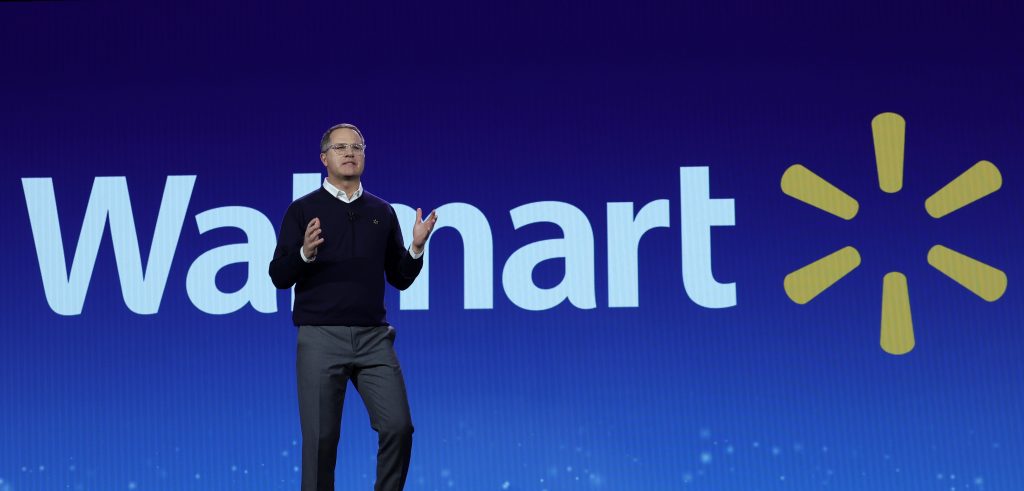
After raising starting wages for store employees in 2023, Walmart announced that store managers will see annual base pay and bonuses increases this year. Walmart’s leaders specifically note how vital frontline managers are when it comes to winning over their store employees and customers alike.
Chipotle also announced this week that it is seeking to recruit 19,000 new employees in the spring – a target up about 27% from a year ago. The effort will launch alongside multiple benefits incentivizing financial health and savings for employees – including a match of up to 4% of a worker’s salary through contributions to a worker 401(k) if they make student loan payments. It also dovetails with the company’s focus on prioritizing employee advancement from within – over 90% of restaurant managers at Chipotle were promoted internally, per 2023 data – and helping workers go from hourly to salaried jobs.
Regular followers of JUST will know such moves are very much in keeping with the goals of our Worker Financial Wellness Initiative (of which Chipotle is a founding member) not to mention American public opinion on just business behavior. At a time of increasing pushback on ESG and so-called “woke” business practices, investing in American workers is surely something we can all agree on.
Be well,
Martin

“I’m a full-throated, red-blooded, patriotic, unwoke, capitalist CEO … I’m not woke anything.”
Fortune reports on an MIT study that finds that AI is too expensive to replace most human jobs, at least right now. Meanwhile, employees are increasingly looking to their employers to help in AI upskilling.
Nasdaq reports that Walmart will raise the annual average salary and bonus for its U.S. store managers beginning Feb.1, with the average salary for store managers increasing from $117,000 to $128,000 a year.
Layoffs continue. This week, Macy’s announced they would be eliminating 2300 jobs, Ebay announced they were slashing nearly 9% of their workforce, Microsoft cuts 1,900 jobs in their gaming division only a few weeks after their historic merger with Activision-Blizzard. Media outlet Business Insider is cutting 8% of its newsroom, and the Los Angeles Times is laying off 115 reporters.
Safety issues remain in the news as well. Johnson & Johnson will pay $700 million to settle its talcum-based baby powder investigation, and problems escalate for Boeing as more incidents of faulty aircrafts continue to be reported.
Fortune takes a deep look at the country’s seemingly intractable inflation, revealing that nearly half of price increases over the past year were a result of excess profits–driving 53% of inflation during the second and third quarters of 2023.
The New York Times examines the contrasting approaches companies are taking to the challenges against corporate DEI programs – from reportedly eliminating, hiding, or conversely, doubling down on them.
The US Sustainable Investment Forum explores the impact of the anti-ESG legislation that was drummed up in 2023, finding that much of it was “all talk, no walk.” More inside.
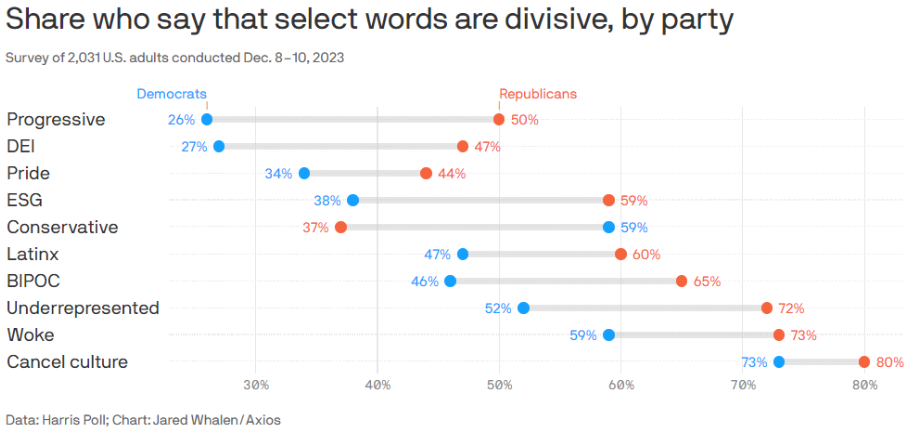
This chart from The Harris Poll and Axios shows that, in the wake of DEI pushback, the level of divisiveness certain terms holds across Republicans and Democrats, and between generations. The point? Companies need to define what DEI is to them, as well as the messaging they have around them, before others do it for them. Learn more here.

If you ever get tired of the endless negativity, division, and cynicism dominating the airwaves, I urge you to check out American Optimist. Joe Lonsdale’s interviews never fail to shake me out of my torpor. One episode brought to my attention this week struck a particular chord because it spotlighted a market solution to one of the greatest challenges facing America: the wealth gap.
The program in question – called InvestAmerica – is championed by investor Brad Gerstner, founder of Altimeter Capital. The basic idea is that a private investment account seeded with up to $1,000 from the government is created every time a kid is born in the U.S. Parents or private companies would then set up a 401(k) match and contribute up to $2,000 tax free each year. A similar concept was advanced by Sen. Cory Booker under his proposed American Opportunity Accounts Act a few years ago.
Regardless of what you think about these specific initiatives, they represent the kind of directional thinking private sector leaders who want to leverage the power of markets to help build a more just America can embrace.
Our 2023 Views on Business Report echoes this. Some 62% of respondents believe “our current form of capitalism is not working for the average American.” According to a recent Harris Poll with U.S. News & Global Report, Americans feel that good, honest, solutions-oriented leaders are in short supply, and 86% are “largely disappointed” by leaders in society. As Gerstner notes, “we have increasing frustration, disenchantment, [and] a growing gap between capitalism and democracy.”
The chief of the U.S. Chamber of Commerce, Suzanne Clark, alluded to the leadership gap in a different way on Thursday. “If the business community isn’t out there telling the real story — the American story — of opportunity and progress in this country, then no one should be surprised when people believe it’s as bad as the headlines and the political ads say it is,” Clark said.
We agree with this point. In fact, we’re actively working with many companies and corporate leaders to not only implement just practices, but to spread the word too. If you’d like to share ideas on how business, markets and capitalism can work better for more Americans, please reach out and we’ll try to feature a few from time to time.
Be well,
Martin
JUST Advisor Carol Cone pens an article in Fast Company explaining how purpose will be a beacon for business leaders in 2024. She highlights “the four Cs” – colleagues, communications, collaboration, and courage” – and how they will shape the corporate landscape.
JUST Capital CEO Martin Whittaker speaks at a private virtual event “How Capitalism Should Tackle Income and Wealth Inequality” for The Council on Foreign Relations.

“We help our customers live their financial lives every day and so it’s so important to us that our teammates, especially as you mentioned those in the lower compensation categories, that they have more than a living wage. We want them to make sure that they feel comfortable and that they can take care of their families.”
The Guardian examines the pushback from some business experts and academics against the increasing use of algorithmic monitoring of workers, like the number of bathroom breaks a person takes, and are calling for stronger standards.
CEO Daily highlights a series of quotes from Corie Barry, CEO of Best Buy, on how she sees AI transforming business and people’s lives over the next 10 years. Barry highlights how AI and humanity will continue to merge together, and how business leaders need to ensure this melding happens in fair, safe, and responsible ways.
OpenAI parent company ChatGPT is reportedly in discussions with media firms CNN, Fox Corp. and Time to license their work, Bloomberg News reports. This comes as OpenAI and its financial backer Microsoft face multiple lawsuits accusing them of using copyrighted works to train AI products.
Tech layoffs persist. Amazon is laying off hundreds of jobs across it’s content division, with Twitch in particular losing an additional 500 employees after the 300 of last year. Meanwhile, Xerox is cutting 15% of its workforce in an attempt to “overhaul its operational model.” And Google cuts hundreds of jobs in its engineering division.
The Wall Street Journal reports on the continued pushback against ESG. Some companies are doing away with the acronym while still progressing on its goals under a different banner – typically under the idea of “responsible business.”
Axios reports that the past two years have seen shareholder activism reach record highs, with 464 activist campaigns being launched against major publicly traded companies – and the amount of activist challenges is expected to grow.
The fallout from the Boeing aircraft that lost its escape hatch mid-flight continues. The Washington Post reports that Alaska Airlines is canceling all Boeing 737 Max 9 flights for the week so that each plane can undergo a rigorous reinspection. This is happening while lawmakers are investigating the incident.
High-paying job openings are in ample supply, but they might not come with much flexibility. Fortune reports that less high-paying jobs are allowing for a hybrid work schedule.
The U.S. Securities and Exchange Commission plans to adopt 25 rules in 2024, Reuters reports, including measures on increased climate change disclosure, regulation of special purpose acquisition companies (SPACs), enhanced disclosures on environmental, social, and governance practices, among others.

With our 2024 Rankings of America’s JUST Companies dropping in a few short weeks, JUST Capital wanted to show you what the priorities of the American people are, per our most recent 2023 research, and how they influenced the ratings this year. The chart above breaks them down by stakeholder category, but you can dive deeper into the data in our full report here.
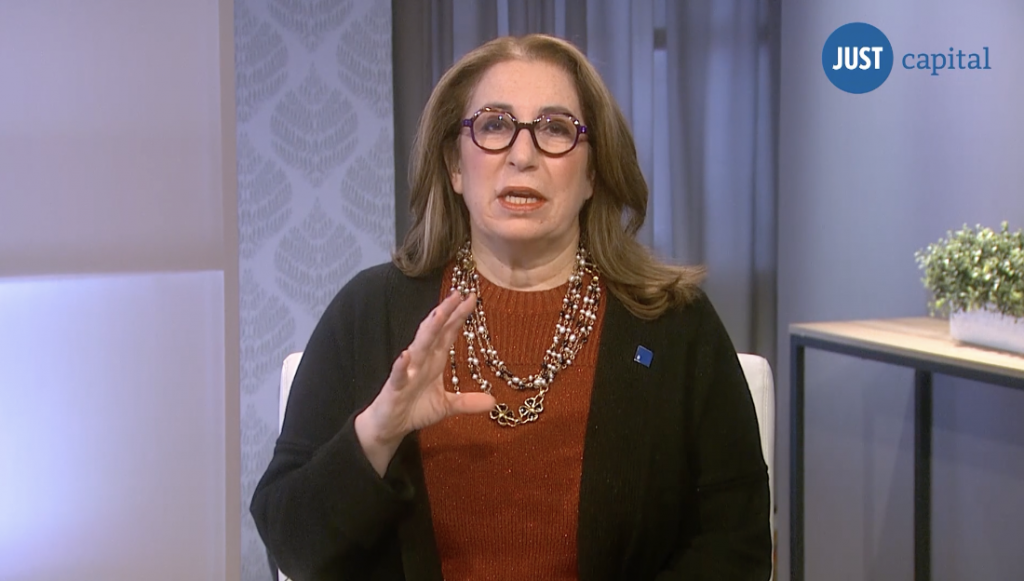
The past year has put workers squarely in the spotlight for corporate America. Whether it was return-to-office plans, strikes, or the impacts of AI, corporate leaders have needed to turn their attention to their workforce in 2023. JUST Capital’s own polling reflects that, with worker issues once again topping the American public’s priorities when it comes to just business behavior.
As the year winds down, we turned to the leader on the Workers stakeholder in our 2023 Rankings – Bank of America – for insight into its workforce investment strategy, which includes the industry-leading move to recently raise its minimum wage.
In a recent episode of our ongoing LinkedIn Live interview series, “JUST Better Business,” Bank of America Chief Human Resources Officer Sheri Bronstein spoke with JUST Capital CEO Martin Whittaker about how the company approaches its people strategy and why it’s been a boon for business. To Bank of America, the number-one overall company in our 2023 Rankings, prioritizing workers is part of operating sustainably, Bronstein said. Watch the full interview below and read on for our key takeaways from the conversation.
Bronstein emphasized that data is the foundation for all of Bank of America’s HR decisions, from raising wages to expanding mental health support to investing in diversity, equity, and inclusion (DEI) practices. “I have an incredible data and analytics team that really sits behind all of our HR processes and services and products and helps us analyze and make sure that we’re using every dollar of that investment in the best way possible,” she said.
When it comes to DEI, Bank of America has disclosed its EEO-1 data since 2013 and uses it to guide practices and policies. “Here in the U.S., we really look like the communities and the customers that we serve,” she said of the bank’s 18% Hispanic and 13% Black employees. Data also grounds its work to advance women’s leadership in the company. Women make up over 50% of employees at Bank of America, with women comprising almost 40% of its management team and over 40% of those at the top levels of the company, she said. Bronstein also pointed to Bank of America’s own research that found that S&P 500 companies with at least 25% women executives saw higher returns on equity than the overall index.
Data from employee feedback also plays a role, Bronstein said using the company’s investments in mental health resources and support as another example. Following company-wide surveys conducted a few years ago, Bank of America began enhancing its benefits around mental health care and working to break down stigmas around mental health using the voice and influence of its leadership. It’s something that Bronstein said she’s grateful the company prioritized before the pandemic hit, because of the input of its employees.
While Bank of America employs over 210,000 individuals, Bronstein often considers the impact of the company’s decisions beyond its immediate workforce. “We help our customers live their financial lives every day and so it’s so important to us that our teammates, especially as you mentioned those in the lower compensation categories, that they have more than a living wage. We want them to make sure that they feel comfortable and that they can take care of their families,” she said of the company’s decision to raise its minimum wage to $25 per hour by 2025.
Since 2010, Bank of America has raised its minimum wage by 121%, and for over a decade hasn’t raised healthcare costs for employees earning under $50,000 per year. It’s employees’ families that motivate Bank of America to do right by their workers, Bronstein said.
“Every day we come in and we think about our 210,000 plus employees, but we also take care of their families. It’s almost a million people that I have the honor every day to think about – ‘how do we help them live their personal lives, their professional lives?’” she said.
This mindset has also played a role in the company’s DEI work. As part of Bank of America’s $1.25 billion commitment to advancing racial equity, the company has invested in low-moderate income communities in the 90 markets it operates in across the country. In partnership with nonprofits and Bank of America’s market leadership, the company ensures that whether it’s investing in private equity, jobs programs, or health care systems, that these investments serve the needs of low-moderate income communities and embrace diversity, Bronstein said.
For Bank of America, investing in its workforce has led to higher employee satisfaction and lower turnover, Bronstein said, noting that she believes 2023 will see record-low turnover for the company. Part of that stems from its commitment to providing training and re-skilling programs that promote long-term growth at the company. Bank of America tries to bring in talent at the entry level, Bronstein said, and help them build skills and learn over time.
The company does this through Pathways – its community hiring and development program – The Academy – its internal learning and development platform – and its college recruiting process. “Helping people build skills and be able to choose many different careers over the course of a lifetime, that is something that we think has really helped us continue to invest in women and our diverse talent in particular, but all of our employees,” she said.
Bronstein sees Bank of America as a company that’s always valued its teammates, a mindset that has become increasingly valuable through the labor market shifts of the last few years and will surely continue to be through 2023 and beyond.
