Note: This op-ed was previously published by Fortune on February 19, 2026.
Today’s CEOs could be the most consequential corporate leaders in American history. The decisions they make will go a long way to determining whether the most powerful technologies ever developed strengthen the foundations of American capitalism or undermine them. It’s not an exaggeration to say the stability of the modern socio-economic system on which markets and business depend is at stake. Fortunately, executives have access to greater magnitudes of data and computing power than ever before in order to get this transition right.
Two realities define the leadership challenge ahead. First, company leaders know they have no choice but to embrace new technologies fully, at speed and with unprecedented levels of investment in order to remain competitive. Second, they understand that the transition to an AI-powered economy will reverberate widely, reshaping jobs, income models, communities, and the role of business in society in ways that are very difficult to predict. We’re already seeing the decoupling of economic growth and labor outcomes begin to play out. What happens if the value of labor drops to effectively zero?
Technological disruptions have happened throughout history. The problem is that this time it is unfolding faster, on a grander scale, and with greater implications, than any before. Whereas previous technological leaps forward were measured in years, with agentic AI, automation, quantum computing, and humanoid robotics, the adaptation time has been compressed to months. This gives leaders little time to experiment, adjust, and course-correct. If they are perceived as being behind the curve or investing incorrectly, the consequences are swift and severe. For society, and those who govern, the transition is felt almost daily. When you have near zero adjustment time, it’s akin to flying blind.
The warning signs are visible in Just Capital’s research. In our latest polling, only 35% of Americans say the current form of capitalism is working for the average person. In our AI-specific surveys, 48% of the American public predict AI will replace workers and eliminate many jobs and a majority is most worried about AI’s impact on social stability and safety.
From my frequent conversations with global business leaders, they are acutely aware of the challenge. Concerns for the future of capitalism continue and recently, executives debated whether the greater threat to the economy and society is artificial intelligence or the continued concentration of wealth and opportunity.
No one is arguing against the need for technological progress. Breakthroughs in healthcare, education, productivity gains, and innovations we cannot yet imagine are now closer than ever. Some predict all of that may in fact create new jobs; others foresee a “blood bath”. Capturing the benefits of transformation while preserving broad participation in economic growth will take new approaches by leaders on how technology is deployed, how the gains and disruptions are managed, and how companies are structured and run.
Forward-thinking business leaders understand that at its core, our capitalist system is built on the shared belief that economic growth creates opportunity, that effort and participation are rewarded over time, and that when businesses create value for all their stakeholders, they thrive financially and competitively.
Putting this into practice is the trick. The era of stakeholder management defined by broad frameworks, generalized commitments, and aspirational language is over. For too many, stakeholder considerations became a compliance exercise that proved to be too imprecise to guide real tradeoffs, withstand scrutiny, or serve as a source of genuine strategic insight.
Today’s hyper-competitive business environment necessitates the opposite: precise, decision-grade data and intelligence rigorous enough to help leaders make higher-confidence choices about strategic planning, capital allocation, workforce design, community engagement, and technology deployment in real time. And all on a company-specific basis. A retailer trying to balance customer satisfaction, supply chain automation, and a frontline workforce has very different priorities than a software company competing for top AI talent while trying to evaluate their footprint on communities.
Understanding the causal relationships between stakeholder investments and core business outputs is central to this. Mapping performance against peers and best practices, identifying areas where operational or reputational risks may be lurking, and pinpointing unseen organizational strengths that can be maintained, elevated, and leveraged are also vital.
Above all, leaders must clearly understand how specific investments in talent, consumer engagement, community resilience, and environmental stewardship translate into total returns. That clarity will drive both business success and societal value creation. While AI raises the stakes for this work, it also makes it possible.
The future of American business and that of its people are inexorably intertwined. As the country approaches the 250th anniversary of its founding, it feels like the next three years will shape the next 3 generations at least.
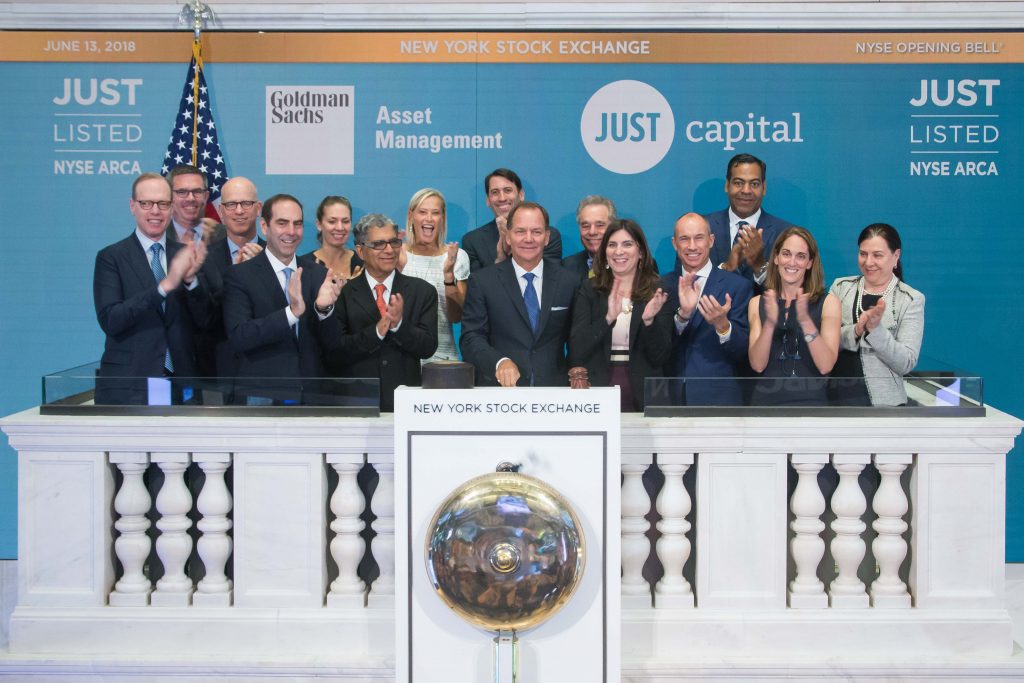
Five years ago I stood on the balcony of the New York Stock Exchange alongside Just’s chair and co-founder Paul Tudor Jones to ring the exchange’s opening bell and, together with representatives of the Just team and board, our friends and partners from Goldman Sachs and FTSE Russell, and many other donors and investors, celebrate the launch of the Just ETF (NYSE: JUST). It was a defining moment for our organization that put us firmly on the map as a force for change.
The Just ETF, and the index on which it is based – the Just U.S. Large-Cap Diversified Index (JULCD), which tracks the top 50% of companies ranked by Just Capital across all industry sectors – have since delivered both competitive risk-adjusted returns and concrete, measurable impacts that better the lives of millions of everyday, hard-working Americans. To the best of my knowledge, the funds supported by Just Capital (including the Just ETF, the Sustainable Impact Investing UIT with SmartTrust and Argus Research, Natixis AIA Racial Equity Direct Index Fund, and a suite of SMAs alongside USA Financial) remain the only publicly traded investment products available today that are expressly designed and built around the priorities of the American people. Five years ago, this seemed like a radical idea. In today’s world – where divisions seem to define us and where the future of capitalism itself appears to be in doubt – I believe it offers a beacon of hope.
Why? Let’s start with performance. Every investment product needs to deliver financially. Inception-to-date, the JULCD Index has outperformed the Russell 1000 by 8.78% since it launched in December 2016. This puts to bed the notion that companies focused on creating value for stakeholders do so only to the detriment of their shareholders.
In fact, we’ve found the opposite is true. Maximizing stakeholder value maximizes shareholder value. And it’s not just the Just ETF where we see that happening. The JUST 100 (JUONE) Index, which comprises the top 100 companies in our ranking overall, has outperformed its benchmark by 0.25% since its launch in March 2019 through June 26, 2023. Similarly, our thematic index concepts – which feature the companies scoring in the top 20% of our Rankings on key stakeholder issues issues from wages to job creation to climate change – have consistently outperformed the Russell 1000, with alpha ranging between 3.6% to 19.1%.
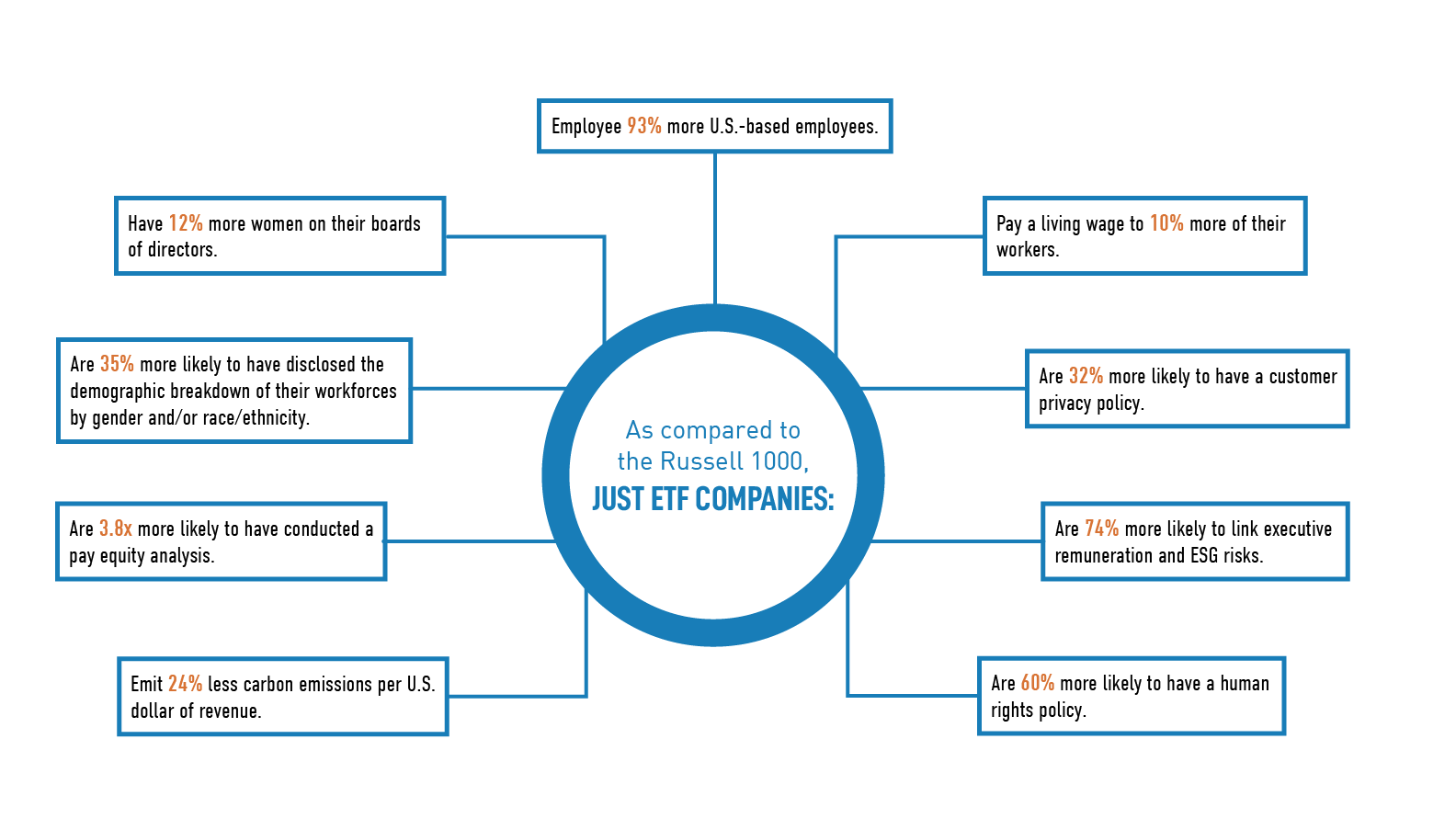
Second is impact. The companies included in the Just ETF outperform their peers in tangible, measurable ways on things like paying a living wage, creating more jobs in America, and providing critical benefits like paid parental leave. They support local communities by prioritizing local sourcing and second chance hiring. They invest more in employee training, engagement, and representation. They are further ahead on managing environmental impacts. They are generally better governed and better managed. This is not a matter of subjective opinion or black box evaluations. It’s what the data shows. And since we don’t pretend to have everything measured perfectly, and are constantly seeking to improve, we make everything fully transparent so you (and the companies we track) can see everything for yourselves.
This latter point is crucial. One of the keys to the success of Just’s work, I believe, has been the level of interaction we have with the companies we cover. In producing the current 2023 Rankings, for example, we connected with 573 of America’s largest corporations (up 296% since 2017) and had 350 companies review their data via our online portal (up 373% since 2017). For a small nonprofit, this is an extraordinary achievement.
Finally, there’s the voice of the public. When we first conceived of the Just Rankings, we decided – against some not-inconsiderable skepticism – that we would take a leap of faith and ask the public (on a fully representative basis) to determine what criteria constitute just company behavior, and how those criteria should be weighted when comparing companies head-to-head. They didn’t let us down. For not only are the issues identified rooted in authentic, kitchen-table themes that strike to the very heart of our national identity, we find tremendous agreement again and again across demographic, political, economic, and regional lines. Expanding this approach to other countries and regions would provide a fascinating insight into how public interest and business behavior can truly align.
Put all this together, and you have the makings of a system that delivers growth, generates strong returns for investors, and creates value for all stakeholders on a sustainable basis. It is the way businesses today compete and win – a North Star, if you will, by which CEOs and Boards navigate the complexities of the present and future business environment. In the Business Roundtable’s parlance, it is the purpose of a corporation. More than all of this, it represents a serious vision for cutting through broken politics to restore faith in the belief that business and free market capitalism can in fact function in greater service of the populations that they serve.
-Martin
The Investor Solutions team at Just Capital continues to expand the suite of products tracking our in-depth company research and polling of the American public. We firmly believe that together we can create a more just and equitable marketplace that works for all Americans. Please reach out using this request form below if you have an interest in partnering with us to launch your next innovative large-cap public equity or fixed income strategy.
Note: Tracking Error of Just ETF vs Just U.S Large Cap Diversified (JULCD) Index is 0.1 as of March 31 2023 over 1 year.
The information contained herein is for informational purposes only without regard to any particular user’s investment objectives, risk tolerances or financial situation and does not constitute investment advice, nor should it be considered a solicitation or offering to investors residing outside the United States. Just Capital makes no representation as to the advisability of investing in any investment fund or other vehicle. Shares of JUST are made only by prospectus. The addition, removal, or inclusion of a security in any Just Capital index is not a recommendation to buy, sell, or hold that security, nor is it investment advice. The Just Parties do not in any way sell, sponsor, support, promote, or endorse any securities based on the JULCD, or have any involvement in their operations or distribution. Prospective investors should not make a decision to invest in any investment fund or other vehicle based on the information contained in this website, and Just Capital shall not be responsible or liable for any advice given to third parties or decisions to invest in any investment fund or other vehicle by you or third parties based on the information. Index performance does not reflect the deduction of any fees or expenses. Past results of the JUST U.S. Large Cap Diversified Index are no guarantee of future performance.
The Just US Large Cap Diversified Index is calculated and maintained by FTSE Russell using the Russell 1000 Index as a starting universe, and aims to reflect the performance of a Just Capital Foundation Inc. methodology. FTSE Russell does not sponsor, endorse, sell, or promote any investment vehicle that is offered by any third party that seeks to provide an investment return based on the performance of any index. It is not possible to invest directly in an index.
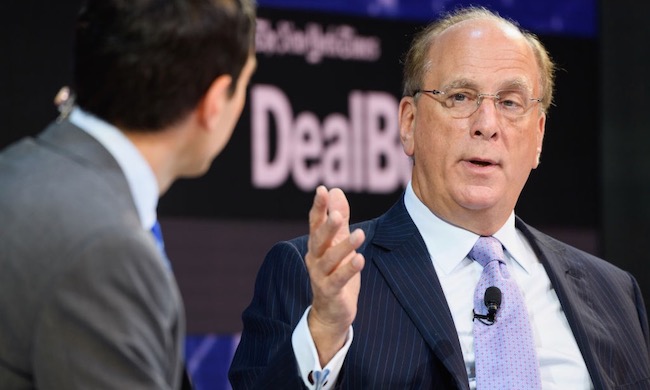
The 2022 Edelman Trust Barometer and BlackRock CEO Larry Fink’s annual CEO letter, both released Monday, are essential reading and together echo everything we at JUST know to be true: That corporate success today depends on how much value you create for all your stakeholders, not just your shareholders; that prerequisites for such value creation are engagement, accountability, transparency, and trust; and that business can and should do more on our most intractable challenges – inequality, social mobility, health and wellbeing, climate change – not out of some sort of political social agenda, but out of enlightened self-interest.
Early in Fink’s letter he writes, “Stakeholder capitalism is not about politics. It is not a social or ideological agenda. It is not ‘woke.’ It is capitalism, driven by mutually beneficial relationships between you and the employees, customers, suppliers, and communities your company relies on to prosper.”
We agree: It is not “woke” to pay people fairly. It isn’t woke to provide good jobs, good benefits, and good training. And it certainly isn’t woke to want businesses to give back to the communities where they operate, to promote better health, or to provide pathways to opportunity for every American regardless of color, gender, or creed. It’s just better business.
This notion of a better form of capitalism presents a powerful force that seven years of polling all around the country has made plain the vast majority of Americans support.
It also represents that most elusive of things: a shared vision that unites more than it divides.
This is something we desperately need. The “vicious cycle of distrust around the world, fueled by government and media” that Edelman highlights in its report represents a five-alarm fire for democracy and free market enterprise.
It is reflective of a society addicted to what Richard Edelman calls a “junk-food” diet of social media and fake news, mistrustful of pretty much any information that doesn’t support existing beliefs, and struggling in a vortex of cynicism, division, and political dysfunction.
Breaking the death grip of mistrust is surely the defining challenge of our generation.
In Peter Goodman’s “Davos Man,” the problem lies with the likes of Salesforce CEO Marc Benioff, corporatist elites, billionaire philanthropists, and stakeholder capitalism. “What capitalism lacks is an inherent mechanism that justly distributes gains,” he notes in a piece adapted from his book. To Goodman, and like-minded writers before him, the answer presumably lies in some form of tax system overhaul and greater government intervention.
It is true that government has a role to play, and that people want more corporations to pay their fair share of taxes – we’ve seen this in our polling. It is also true that the pandemic has accelerated already-vast wealth disparities and other inequities in the U.S. and around the world. However, the Edelman findings, like our own, suggest that it is to business, not government, that most Americans turn when they think about how to create a better future for themselves, for their communities, and for the planet.
For one thing, nearly half of Edelman’s respondents view government as a divisive force in society. “My Employer” and “Business” are both significantly more trusted than government. Moreover, Edelman says, “We now see business as the stabilizing force delivering tangible action and results on society’s most critical issues.”
The key to all this is accountability. For the market to truly hold corporations to account for their performance on stakeholder value creation, it must have a way to gauge performance accurately and openly. It must be able to evaluate whether companies are doing what they say they’re doing, to trust in the information being provided, and to act upon it. In true stakeholder capitalism, the mechanism for the just distribution of gains becomes the market itself.
Workers, consumers, investors, and communities hold more power than ever before to push companies towards greater stakeholder value creation. The good news is that this has never been more aligned with business success and shareholder returns. Through the vision of Messrs Benioff and Fink, and the hard work of their employees, both Salesforce and BlackRock are named in our 2022 JUST 100 Rankings for doing exactly this. They and others working to shift capitalism onto a more just, stakeholder-oriented trajectory should be recognized for their leadership, not attacked.
Placing trust, data, and accountability at the center of the stakeholder model offers a viable path forward anchored in action over rhetoric, and tangible solutions over perpetual struggle. It will also build a virtuous cycle of trust that puts the country on a better path forward.
(Editor’s Note: Martin is a senior adviser to Edelman Impact.)

The last two years have required America’s corporations to confront an unrelenting series of large-scale, complex, and interrelated new challenges. Many have done so with aplomb (as our work at JUST Capital has showcased) and with financial indices setting new records, you’d be forgiven for thinking all is well in the world.
For the American worker, however, things aren’t so straightforward. The Omicron variant of the coronavirus has led to cases climbing across the country, with businesses temporarily shutting down, companies scrapping or delaying return-to-office plans, schools going remote, and flights being grounded. Supply chain disruptions, inflation, political infighting, ongoing social and cultural division, climate chaos, and, of course, an unprecedented labor market dislocation have all piled on the pressure.
Many workers continue to grapple with staff shortages at their companies. The Department of Labor recently reported that more than 4.5 million people voluntarily left their jobs in November, yet another record, with hospitality and other low-wage sectors seeing especially high quit rates. These numbers don’t yet reflect the impact of Omicron but, as its effects unfold, workers are clearly at the end of their rope. Their message to companies is clear: Do more!
At JUST Capital, this accords with what we’ve heard from the American public over the last seven years. Since 2015, we’ve been asking Americans to identify what issues matter most when it comes to just business behavior. Their responses form the basis of our annual Rankings of America’s Most JUST Companies, with our 2022 edition to be released next week with our partner, CNBC.
Each and every year the Americans we poll have been consistently united across demographics – liberal and conservative, high-income and low-income, men and women, millennials and boomers – in wanting companies to put workers first.
This is the case once again. As companies battle through what you might call the “Great Reset,” and with seemingly no end in sight to the pandemic and its economic and political ramifications, the good news is that the American public stands firm and united on what they believe companies should prioritize.
In our latest Issues Report, the foundation of our annual Rankings weighting, Americans chose “Pays a fair, living wage” as the year’s most important Issue, representing over 15% of our model for scoring companies’ stakeholder performance. This is followed by “Creates jobs in the U.S.,” making up 13% of our scoring model. This Issue rose from the number eight spot in last year’s report, reflecting the hemorrhaging of jobs from the U.S. economy in the early stages of the pandemic – and, now, a reconsideration of what jobs workers are willing to take. Rounding out the top three Issues is “Prioritizes accountability to all stakeholders,” which comprises over 10% of companies’ scores and is up from the number 11 spot in last year’s report.
This jump in importance for accountability aligns with findings from our latest annual survey results, which hint at a growing frustration among the public with corporate America’s perceived lack of action.
Only 49% of those we polled believe companies are having a positive impact on society. Respondents were also more than twice as likely to believe that companies are having a positive impact on their shareholders (78%) than on the financial well-being of their lowest-paid workers (36%). Just 22% said they believe business is heading in the right direction.
Americans appear to be losing patience with corporations’ willingness to act on their priorities. For example, to attract workers in a tight labor market, many employers have raised starting wages, but it remains unclear if recent wage hikes are part of a larger investment in long-term worker financial security – what JUST polling has shown Americans are looking for from companies – or merely short-term expediencies.
Companies participating in our Worker Financial Wellness Initiative – including Chipotle, PayPal, Prudential, and Verizon – are showing what this long-term leadership looks like through holistic assessments of workers’ financial security, and continuous peer-to-peer learning. At the same time, the concept of a “JUST Job” is emerging: One that allows for not only financial security for workers, but for opportunity, training and advancement; that prioritizes diversity, equity, and inclusion as core tenets; and that allows workers to protect their own health and safety and that of their families.
Underpinning all of this is trust and accountability. It should be no surprise that holding executives accountable to the interests of all company stakeholders finished so high on the list of priorities. Of the Americans we surveyed this year, 84% agreed that companies “often hide behind public declarations of support for stakeholders but don’t walk the walk.” Greater transparency and disclosure can help here. For example, if raising wages is the company’s stated priority, then sharing more information on the current company minimum wage and how it relates to local living wages will help. If prioritizing retention is the goal, companies should disclose more on internal promotion rates. Sharing information like this is an important part of the trust-building process.
At the end of the day, it’s only by showing genuine progress on the issues that matter that companies can build and maintain trust. We know what those issues are, and we know what leadership looks like. With financial markets hitting all-time highs, the onus is now on corporate America to act.
With our 2022 Rankings of America’s Most JUST Companies, we’ll be highlighting the country’s largest employers that are taking action on these issues. Join us next week to learn how those that are leading the way are helping shape a new definition of corporate success and, ultimately, forge new trust with their stakeholders.
In 2014 I became CEO of the nonprofit JUST Capital, with a mission of harnessing the power of corporate America to address systemic social, environmental, and economic challenges. From the beginning, we knew that every dollar donors put into JUST had the potential to generate enormous philanthropic return. As our co-founder and chair, Paul Tudor Jones, wrote for The Economist in 2015, “If only 1% of capital begins to flow in a more just direction, that would mean more than $600 billion a year going towards firms that pay a living wage, provide great benefits, make products that enhance society, protect human rights and the environment, and more.”
Philanthropists tackling the root causes of our biggest problems know they’re often fighting an uphill battle if they don’t create a “force multiplier effect” by using their donor dollars to stimulate private capital and market forces more broadly. This stands to reason. At $18.1 trillion, the private sector is 4.6 times the size of the public sector and 38.5 times bigger than the charitable giving market. Not only that, but big companies can be extremely efficient at solving real human problems at scale, provided the right incentives are there.
This is the key to JUST’s strategy.
System change doesn’t happen overnight. But after seven years, we asked ourselves: How are we doing? Are we making a difference? Is our strategy working?
Here’s what we found.
First, it’s clear that change is happening.
Now, we obviously don’t claim to be the main reason why these and other changes are happening. Pinpointing cause and effect in system change is a fool’s errand, and we are all too aware that we are but a small part of an ecosystem of organizations and individuals each driving change on these issues in their own way, sometimes collectively, sometimes alone.
But we’re sure we’re playing a role.
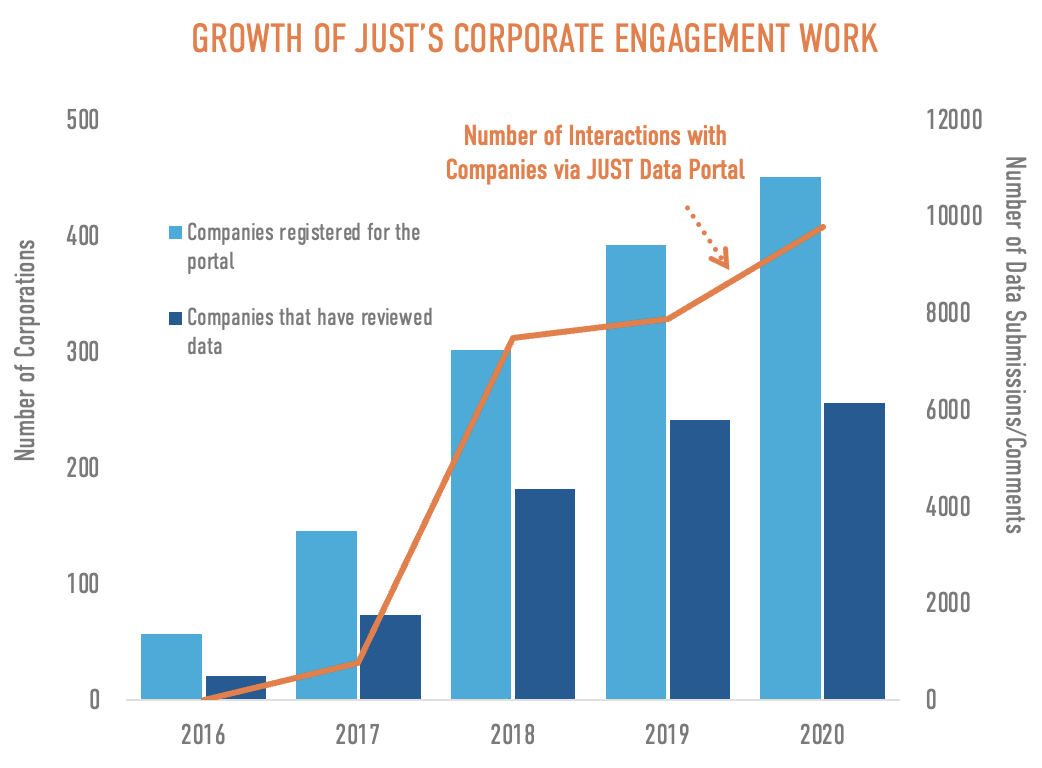
For one thing, we’re engaging with these companies all the time on these very issues. In fact, a key part of our strategy is working openly and transparently with the companies we’re tracking. No money changes hands because we want to preserve our independence. But the number of Russell 1000 companies directly engaging with JUST through our Rankings and/or our program work has grown by almost 800% in five years – from 57 in 2016 to over 450 last year.
Not only that, the number of companies that reviewed their data through our corporate portal has jumped from 21 in 2016 to 256 in 2020, and the volume of interactions between companies and our analyst team, one of the KPIs we track to measure engagement, has skyrocketed from nearly 800 in 2017 to almost 10,000 last year. To put this into perspective, in the space of a single month last summer (July 2020) our team engaged with corporations collectively employing over four million workers on their race and ethnicity diversity data.
The time and effort we’ve invested in building relationships, credibility, and trust with companies and other organizations and institutions working in our field is also helping us create specialized programs that drive change on specific issues.
Over the past 12 months, we’ve launched two such programs, to advance racial equity and prioritize worker financial wellness. Companies committing to assess the financial wellness of their employees as part of the Worker Financial Wellness Initiative include PayPal, Chobani and Prudential, with more to be announced soon. Collectively, these programs will directly impact policies and practices at some of America’s largest corporations, and affect the lives and livelihoods of hundreds of thousands of workers.
The second thing that’s clear is that the conversation on the future of capitalism and the role of business in society has shifted dramatically from when we started.
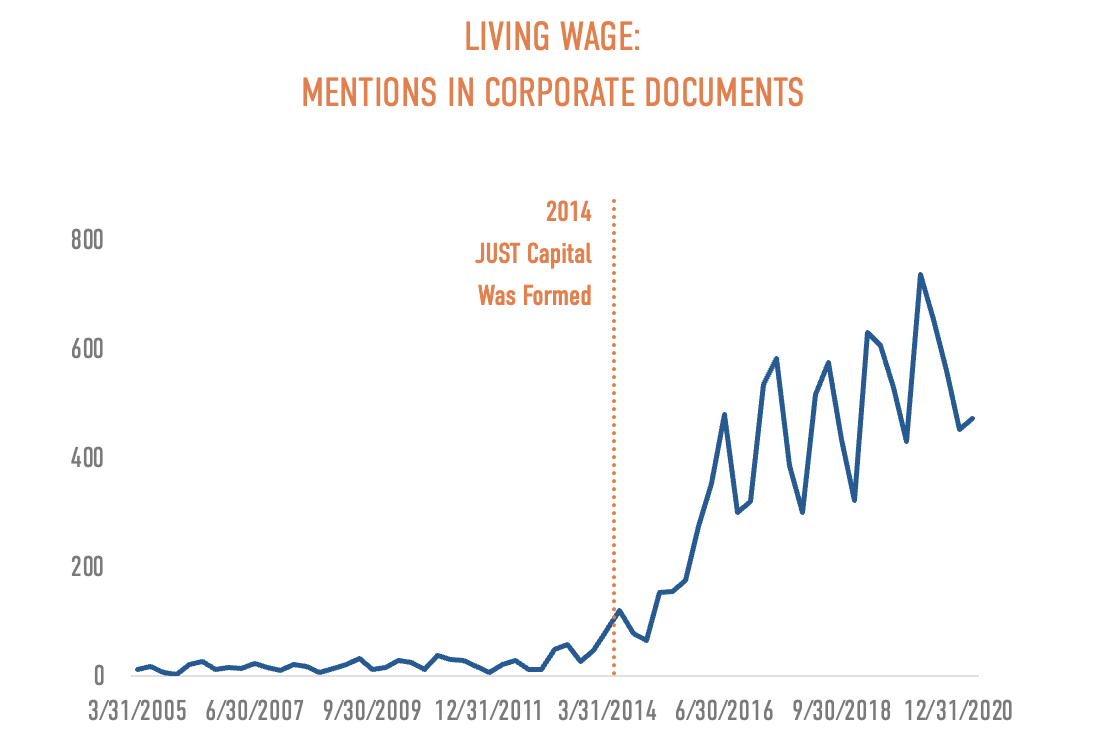
Since we first began discussing providing a “living wage” as a critical element of corporate justness, mentions of the term in corporate documents have increased 390%, from 121 quarterly mentions in June 2014 to 472 quarterly mentions in March 2021.
Likewise, since we introduced the five-stakeholder model in the summer of 2019, a few short months before the Business Roundtable embraced the same approach in its updated statement of corporate purpose, “stakeholder capitalism” has become arguably the central topic of debate in U.S. financial markets. Last year, S&P’s CEO Doug Peterson said that JUST has become “a driving force behind the stakeholder capitalism movement.”
Again, we know we’re not the sole reason why these things are happening. But we’re confident we’re driving the conversation forward. Over the last year, JUST’s website views and audience reach has grown dramatically: 284 press highlights, an 83% YOY increase; 197 editorial bylines, a 126% YOY increase; 1.7 million pageviews, a 186% YOY increase. And thanks to our work with Forbes, CNBC, and others, our COVID-19 Corporate Response Tracker, Corporate Racial Equity Tracker, and CEO Blueprint for Racial Equity have reached audiences in the tens of millions.
Couple this with our polling work, where we are lifting up the voices of hundreds of thousands of Americans on everything from how to define just business behavior to the role of business in protecting democracy, and we can feel good about the role we’re playing in changing the narrative around how markets can better serve society.
Finally, we looked at the extent to which investor capital has shifted over the last 5-7 years in support of a more just economy. Here, the story is remarkable. Over the last few years, ESG-oriented funds have become more attractive than ever for U.S. fund investors. For the fifth calendar year in a row, sustainable funds set an annual record for net flows in 2020. Per Morningstar data, in 2016, 2017, and 2018, annual flows hovered around $5 billion per year with modest increases each year. Then in 2019, flows increased fourfold to $21.4 billion, a record that was promptly and easily eclipsed in 2020 as flows reached $51.1 billion, higher than the previous four years combined.
This was happening way before JUST Capital showed up, but again, we are playing our part here, too. Building off the success of the JUST ETF launch with our partners at Goldman Sachs Asset Management in 2018 – which at the time, was the single largest ESG ETF launch in history – we’ve expanded our investor partnerships beyond index licensing to include ESG data licensing. We can now count aligned asset managers such as Natixis, Invesco, Uncommon Giving, and SmartTrust as partners, generating real revenue for the organization via licensing agreements.
In total, we have over $300 million and counting in direct assets under Influence in just-oriented funds. Our JUST Alpha and Chart of the Week research has been featured in Barron’s, WSJ, CNBC, and Bloomberg. And we’re working directly with some of the largest American pension funds on critical just issues relating to human capital, racial equity disclosure, and more.
The leverage effect in the JUST model is clear. With an average annual budget of around $10 million, we’ve lifted up the voices of over 100,00 Americans, helped drive changes at hundreds of corporations that are benefiting millions of workers across the country, and had a material impact on the national conversation around the future of capitalism and the role corporate America plays in building a better future.
The key now is to build on this early success, hone our approach, and expand our platform. This means increasing the number of companies we track; building more effective programs that tackle the thorniest issues; lifting up the voices of millions of Americans; growing our assets under influence; extending our media presence; and becoming the market’s most trusted source of data, research, and analysis on corporate stakeholder performance.
It also means growing our audience and donor network. If you’d like to support us, and join the JUST community, you can do that here. I’d be incredibly grateful. We’ve even formed an amazing group of professionals promoting and advancing our work, our JUSTGen network, to help lead that charge.
I’m so proud of this organization and what we’ve accomplished – and I’m incredibly excited about where we can take it. But none of it is possible without the support of all our donors, followers, partners, collaborators, and friends. By leveraging the private sector to build a more just economy, I continue to believe we offer one of the highest-return philanthropic investments there is.
We have an opportunity to build a better economy. The question is whether we will seize it.
The COVID-19 pandemic has not only wrought untold human tragedy, it has laid bare the fault lines and fundamental brittleness of our global economic system. By the time we beat back the virus, trillions of dollars in market value will have been wiped out, we’ll face a mountain of debt the likes of which we have not seen since World War II, and – in the United States, at least – we’ll have tens of millions unemployed, hundreds of millions of livelihoods impacted, and a tax revenue base grossly undercut by weaker demand.
History teaches us that crises of this magnitude always leave their mark on society. In this case, I believe permanent change will come to the way we practice capitalism. Not because of some newfound human idealism, though that might happen, but out of sheer necessity. For it’s only by building a more resilient, inclusive, and just economy, where business drives value for all stakeholders, where long-term systems thinking supplants short-term opportunism, and where as many people as possible have a stake in the recovery, that we can generate the breadth and scale of wealth creation now required.
The post-WWII boom of the 1950s and ‘60s was perhaps the greatest period of wealth creation in history. John Maynard Keynes, whose legacy made him the most influential economist of the time, summed up the prevailing wisdom: “prioritizing short-term gains through profit maximization comes to the detriment of long-term value creation, which in turn yields weaker companies that contribute less to society.” This thinking helped to establish the American middle class and drive tremendous gains in productivity and innovation. Annual GDP growth across the OECD averaged 4-5%. Economically speaking, this level of growth is what we must return to.
Business as usual won’t cut it. To have a hope of building the economic engine we now need, the reign of shareholder primacy must end. Milton Friedman’s exhortations to focus corporate purpose solely on shareholders’ needs addressed the problems in the markets in the 1970s and brought much needed discipline to capital allocation. But it is no longer fit for purpose. Even before the coronavirus crisis, we needed a course correction. The U.S. had reached levels of income and wealth inequality last seen in the 1930s. Productivity from 2010-2018 has been merely 0.9%, down from 2.3% from 1990-2008. The costs of continuing down this path are too high.
What coronavirus has done is reset the economy. It has accelerated the need for a new, better operating system that gives more Americans the incentives and, in many cases, the opportunities they need to create broad-based prosperity.
That system is stakeholder capitalism. A system that shares the spoils of victory with those who make it possible. A system that motivates capital to focus on long-term value creation; that promotes disclosure and performance measurement on issues society cares about; that fosters systems thinking and mutual resiliency; and that captures for all time the incredible spirit of community that has characterized corporate America’s response during the crisis itself.
Cynics, of course, will have their say. But those who dismiss the stakeholder approach as either a “publicity stunt” or “window dressing,” or as some sort of backdoor socialist takeover designed to limit market freedoms and redistribute wealth, are either lazy in their thinking or blinded by ideology. We don’t have time for those debates any longer. The jury is not only in, the case is closed and the court has been dismissed.
One by one, over the past few years, we’ve seen stakeholder capitalism gain high-profile champions. The CEOs of the Business Roundtable reversed years of commitment to shareholder primacy to embrace it. The World Economic Forum has put it front and center. The heads of the world’s largest asset management companies, like BlackRock’s Larry Fink and State Street’s Cyrus Taraporevala, have called on CEOs to look past profits at all costs, and the leadership teams of the JUST 100, among others, have answered. Wall Street titans like JUST’s founder and chairman Paul Tudor Jones and Bridgewater founder and chairman Ray Dalio have declared we need to reimagine capitalism. Executive directors of massive pension funds, like the Washington State Investment Board’s Theresa Whitmarsh, have said shareholder primacy destroys long-term value.
In fact, I am hard pressed to come up with any credible defenders of shareholder primacy at this point. Will anyone call for a return to the status quo? I seriously doubt it.
Let this be the moment when all of this talk manifests into reality. For what is plain now is that companies that come out of our current crisis in the best shape will be those that have the strongest relationships with the people who make them flourish. These companies will have a renewed sense of value for the employees and contractors who managed to keep the lights on in our darkest hour. They will have taken steps to support their suppliers – especially the smaller, private businesses that collectively represent the backbone of the U.S. economy. They will have supported the communities where they operate, and bent over backwards to make sure their customers were properly cared for.
The JUST COVID-19 Corporate Response Tracker is capturing and recording all of this, and we have already seen corporations like Target, Starbucks, PepsiCo, and Microsoft taking swift action to ensure the health and financial well-being of their stakeholders through policies like paid leave and community support. It is business at its best.
Needless to say, all of this is also better for shareholders. Research from Morningstar indicates that, in fact, sustainability-led funds are outperforming their peers at this time, as they have in previous crises. The emphasis on quality companies that invest for long-term impact combined with lower ESG risk validates the argument for sustainability as a hedge during down-markets. We are seeing this firsthand as our own JUST Index is outperforming the S&P 500 in this same period. Almost all of the investors we talk to believe that the crisis will accelerate interest in ESG strategies, as well as influence the underlying strategies themselves, mostly by emphasizing the “S” – the social factors that are currently so critical.
The struggle against the coronavirus has often been likened to wartime. It’s an unfortunate but apt comparison, and one that enables us to see our way through to society’s full recovery. We will get there, but the world won’t look the same. JUST Capital, and the network of organizations we work with, will do what is necessary to guide us on this journey.
This article was originally published at Forbes.com.
