
This report was co-authored by Rachael Doubledee and Daniel Krasner.
Today, when it comes to disclosing comprehensive data around gender when it comes to workers, board members, and suppliers, the results are varied. Of the 951 Russell 1000 companies that JUST Capital analyzed and ranked in 2023, approximately 79% disclosed data on how many women are in the workplace, 99% reported having at least one woman on their board, but only 5.6% disclosed spending on women-owned businesses
In combing through different company data and policy disclosures, JUST Capital identified four companies leading the pack in terms of publishing data around women in their workforces, on their boards, and with women-owned businesses in their supply chains – Citigroup, Accenture, General Mills, and The Hartford. These leaders are also innovating on programs to increase those numbers. Each had women representation in their workforce at or near 50%, had above 40% women representation on their boards, and disclosed how much they spend with women-owned suppliers.
During the pandemic, women were more vulnerable to layoffs than men, were more likely to work in industries that suffered (hospitality, service sector), and were more likely to exit the workforce to care for their families.
But economic data shows a promising turning point. Women’s current labor force participation — that is, the percentage of women working or looking for work — is around 57.4% as of July 2023, almost back to the February 2020 number, 57.9%, per February government data.
Building a more resilient economy means building inclusion across industries for women, and makes the economy stronger and better able to weather future crises. According to JUST Capital polling, most Americans believe that women leaving the labor force is bad for the economy (66%), and bad for women’s equality (59%). JUST’s recent work on promoting inclusion in the workplace has also focused on the policies and practices that companies can and should implement including supporting paid family leave and equal pay.
In a 2022 analysis, JUST found that the share of companies publicly disclosing workforce demographic data by race, ethnicity, and gender by standardized job categories in their EEO-1 Report – the gold standard for workforce demographic disclosure – or similar intersectional data has more than tripled between 2021 and 2022, from 11% to 34%. Companies with 100 or more employees are already legally required to submit these reports to the U.S. Equal Opportunity Commission and Department of Labor, meaning that the data has already been collected, but not all companies make it publicly available. For example, 79% of the Russell 1000 disclose women’s representation within their workforce, but 21% do not. In a companion analysis exploring the business and investor case for increased disclosure, we found that the companies that disclose EEO-1 or similar intersectional data outperform those that don’t by 7.9% over the trailing one-year period ending in 2022.
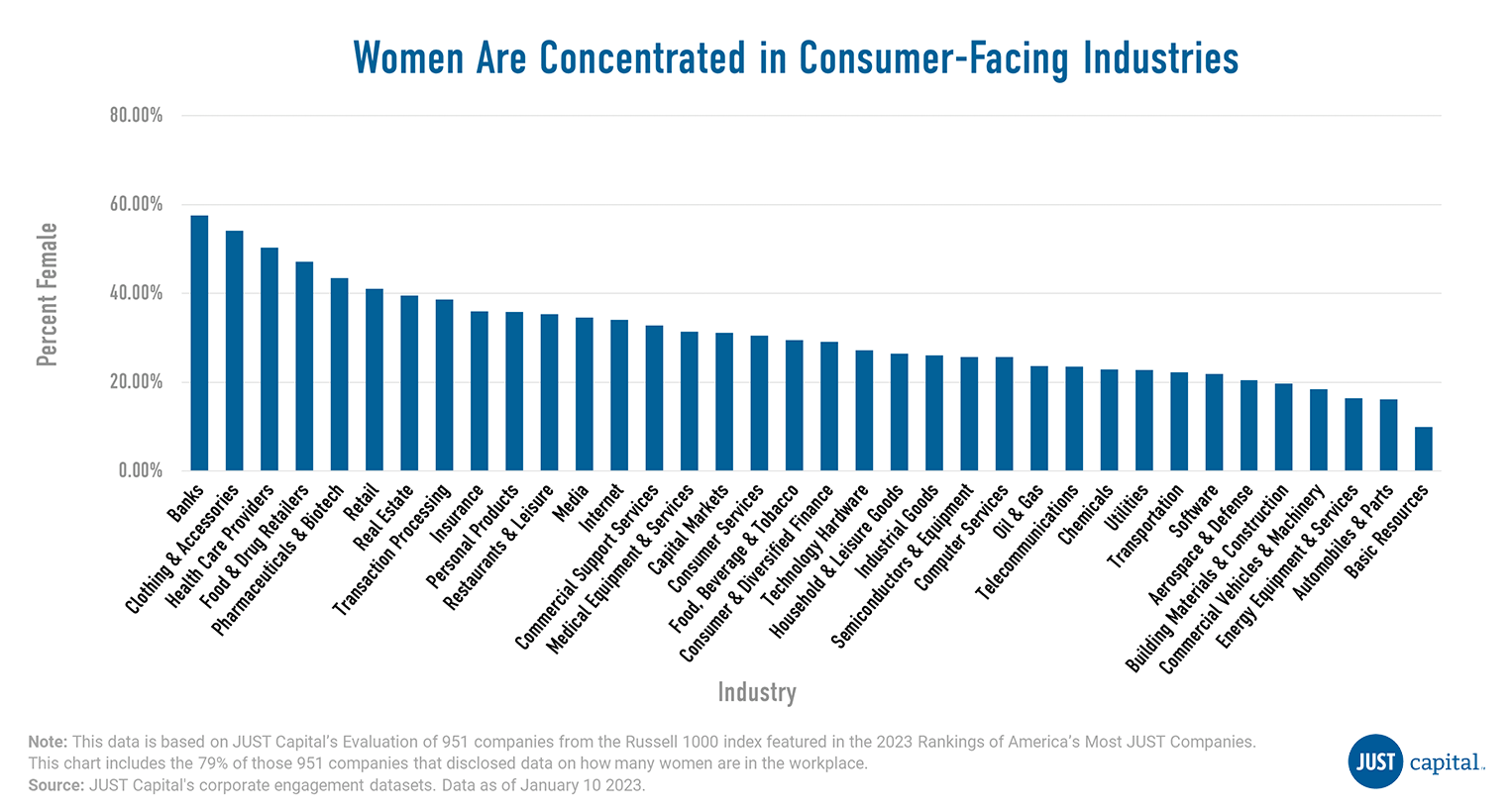
Women have historically turned to customer-facing industries with more flexible hourly roles like accommodation, retail, and food services to meet the dual demands of work and caregiving. These industries were some of the most vulnerable to pandemic job losses. Our own analysis of companies in the Russell 1000 that disclosed workforce data demonstrated higher female representation persists in industries like clothing and accessories, and lower representation remains in industries related to energy and technology.
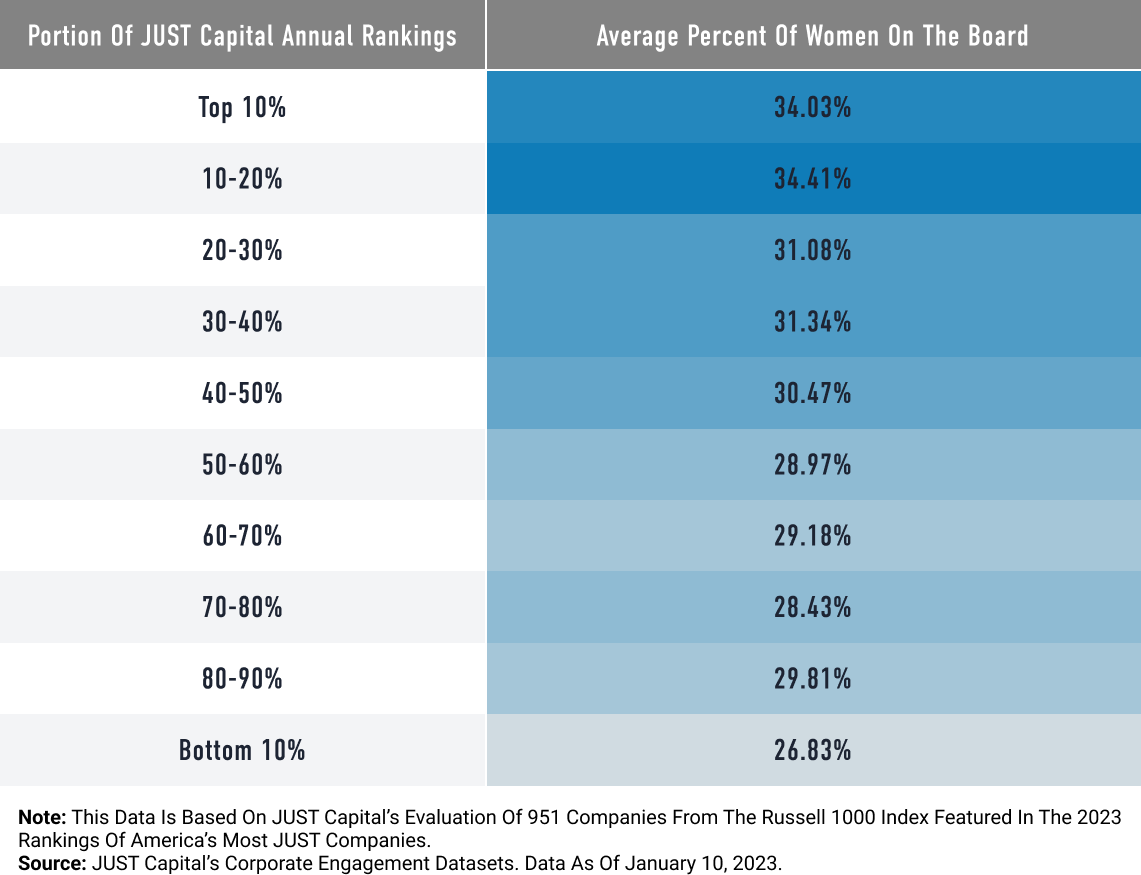
Company data within each decile shows that higher representation is taking place at the top of our rankings in board diversity. On average, the higher one’s rank, the higher one’s percent women on boards. Out of the 54 companies that disclosed spend on women-owned supplier businesses, companies in the top decile were also most likely to have disclosed, and 53% of all companies who disclosed their spend on women-owned suppliers were represented in the top 20% of JUST Capital’s rankings.
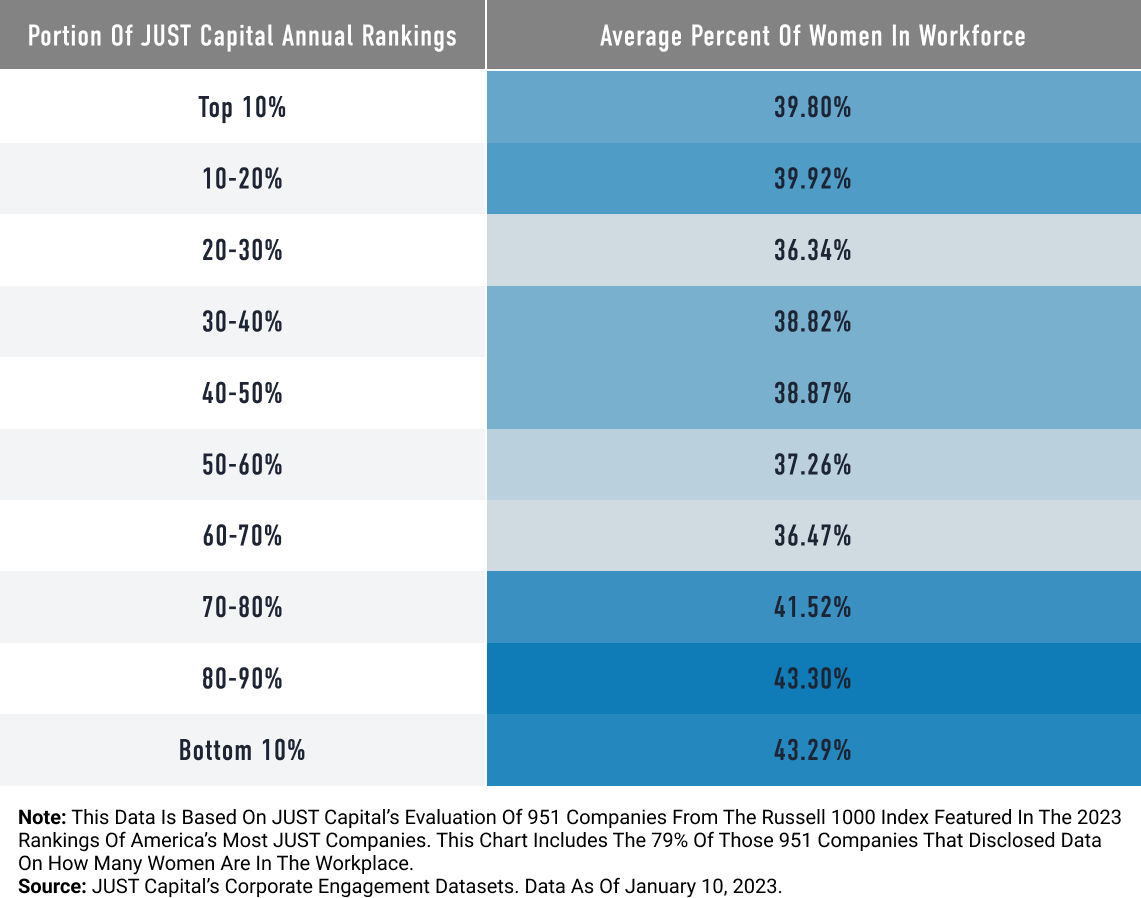
For the workforce, trends aren’t as clear. Women’s average representation varies slightly between 36.47% and 43.3% throughout the rankings. At first thought, industry could be a driver for further analysis; for example, if industries with higher representation of women in the workforce are ranking lower, that could explain the slight variation. But upon evaluation of where companies aren’t disclosing, a likely driver is that the slightly higher percentages at the bottom of the ranking are due to companies not disclosing their workforce.
In the top 10%, only 1 company does not disclose its representation of women in the workforce, while at the bottom 10%, 42 companies do not disclose, contributing to the seemingly higher representation of women in the bottom 10% of the rankings. With less companies disclosing, there are less inputs when averaging. This is why no matter the level of female representation in the workforce, it is imperative companies disclose the demographics of their workforce for us to fully understand the breadth of women’s representation in Russell 1000 companies.
The four leaders in our analysis all had women representation in their workforce at or near 50%, had above 40% women representation on their boards, and disclosed spending with women-owned suppliers. Here are additional details on how they are advancing more comprehensive policies and practices:
As part of its Global Diversity Strategy, Citigroup has made bold strides in addressing women representation through hiring, promoting from within, and retention strategies with 53% women representation. As part of the 30% Club, Citigroup has outperformed many of its peers in the banking industry, and discloses 50% women board representation.
Citigroup stands out from peers in its supplier practices, including increasing supplier capacity, supplier-business mentorship, and supplier engagement, many of which are women-specific initiatives. In 2021, Citigroup spent $172M with Tier 1 Women-Owned Suppliers. In 2020, Citi set a goal to increase spending with certified diverse suppliers to $1 billion annually.
Accenture provides detailed disclosure of women representation across its operations and at varied levels within the organization. With women representing 50% of the board of directors, and 47% of their workforce, Accenture stands out as the only company in its industry with Board parity by gender.
Accenture leverages its supply chain to support its efforts to achieve gender parity. In FY21, it spent $95,194 with women-owned suppliers – about 18% of its total diverse supplier spending. Accenture is also invested in supplier success, and it outlines global efforts to engage and support women suppliers.
General Mills discloses high women board representation for its industry at 45%, and clearly discloses 50% workforce representation for women. It also provides a disaggregated view of women’s representation at multiple levels of seniority (Officer, Director, Manager, etc.) throughout the company.
It has disclosed spending of $122.9M on women-owned suppliers and has set time bound targets and goals to increase diverse supplier spending. Importantly, General Mills is focused on increasing certification for diverse suppliers through funding and consulting support. This process can be laborious and expensive and is important in consideration of problems with access to capital often faced by women and minority-owned businesses.
The Hartford clearly discloses board women representation at 40%, a standout in the insurance industry. Workforce representation is not unusual in the industry, but is disclosed at 61% women. It has also disclosed spending $15M with women-owned suppliers and provided an update on their pay equity goals.
The Hartford has robust supplier practices, including engagement with diverse suppliers to increase bid success rate, transparent disclosure of supplier industries, and disaggregated supplier categories and the spend associated. The level of detail allows them to estimate job multipliers to track direct and indirect job creation and impact in communities.
While these four companies stood out within their industries in terms of gender diversity, companies should do more to illustrate their commitment to closing the gap in women representation in boards, the workforce, and supply chains. We wanted to call special attention to the subject of diverse supplier spending. Each of the four companies demonstrated the following areas as best practices:
1. What and how much. Disclose how much spend is attached to each category of diverse supplier (e.g., women, veteran, minority, small/local business), Supplier Tier, and an overall Supplier Spend Amount. See Accenture, General Mills (page 54).
2. Community impact. Track supplier industry to estimate local impact factors and demonstrate community impact, as well as support of high and low wage industries. See The Hartford.
3. Equitable engagement. Detail a supplier engagement strategy that is easy to understand, and reduces certification cost pressures on suppliers who often have access to less capital, such as women-owned businesses. See Citi and General Mills (page 54).
4. Progress evaluation roadmap. Set milestones, and evaluate progress frequently and clearly with planned and easy to follow updates on progress and challenges to reaching goals. See Citi.
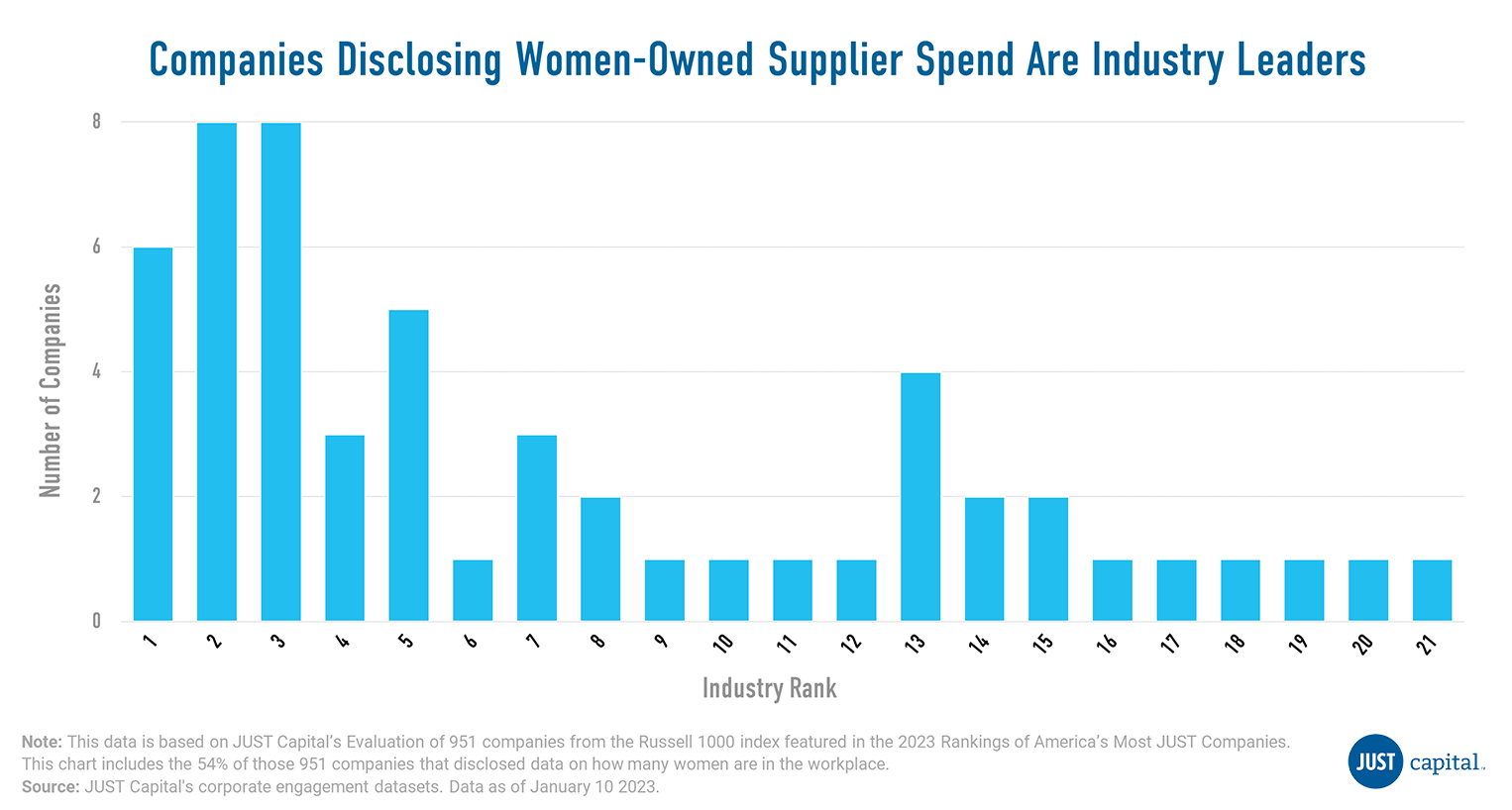
Additionally, we found that many of those leading their industry rankings were well positioned to demonstrate best practices to their peers in disclosure practices. Of the 54 companies that disclosed their spending on women-owned businesses, 69% ranked in the top 10 in their respective industry rankings.
Women’s representation in business leadership and the country’s overall workforce is an important issue to the American public. To demonstrate their commitment, more companies should go beyond public statements and select statistics, and demonstrate leadership through action, follow-through, and greater transparency through reporting.
To unpack your company’s gender equity performance in the 2023 Rankings and gain insights into how to improve on the issues that matter most to the American public, please reach out to corpengage@justcapital.com.

As the nature of the COVID-19 pandemic has shifted over the last three years, so has its impact on America’s working women. Lockdowns, closures, and restrictions hit more women-heavy industries, like education, health care, retail, and hospitality, with job losses. While remote classes remained the norm for schools across the country, many women also found themselves shouldering the burden of childcare as well. As a result, women had been lagging behind men in re-entering the workforce.
Now, the latest data shows that women are now outpacing men in returning to work. Women’s employment has recovered to pre-pandemic levels, with rising costs and a tight labor market among possible factors contributing to this growth. The subset of women driving this shift, however, are those college-educated and aged 25-54. Women with less income and education and women of color face ongoing and compounded challenges to workforce re-entry and retention.
In light of these numbers, companies can, and should, turn their attention to how they can provide jobs that will attract and retain women.
In our 2022 polling, majorities of Americans acknowledged a range of problems that continue to plague women in the workforce, with three-quarters (76%) recognizing that access to childcare and workplace harassment are problematic. The gender wage gap (70%), equal opportunities for advancement (66%), and access to paid family leave (62%) were also cited as problems. Among those that say these issues are a problem for women in the workplace, 59% say closing the wage gap between men and women and access to childcare are big problems. Nearly the same amount (54%) said the same about access to paid family leave.
In an effort to showcase which companies are leading when it comes to how they are supporting women in the workplace, JUST analyzed a subset of key metrics from our Rankings and our upcoming JUST Job Scorecard to identify four companies with the highest scores based on their disclosures – Bank of America, NVIDIA, Intel, and Intuit.
Each of the leading companies:
Below, we explore the key actions these companies have taken that make them leaders in supporting women in the workplace.
Bank of America
Ranked 1st in America’s Most JUST Companies
Based in Charlotte, North Carolina
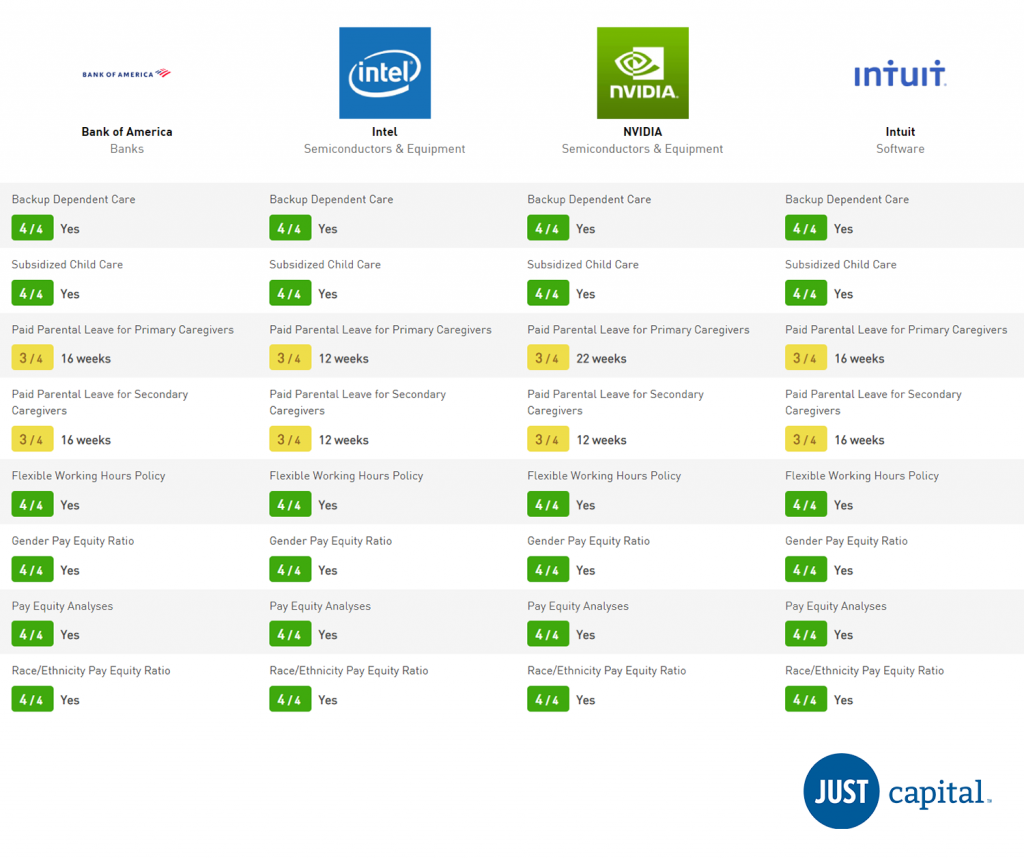
Bank of America conducts annual gender pay equity analyses and discloses the results. The company’s latest analysis found that women make 99% of every dollar earned by their male colleagues. The bank leads on best practices when it comes to caregiving policies as well. Both primary and secondary caregivers it employs receive 16 weeks of paid parental leave. Last year, Bank of America increased its emergency backup dependent care policy to cover 50 days of backup care for adults and children per year.
In addition, the company offers a monthly subsidized child care policy to help working families cover the cost of child care. Bank of America’s employees also have access to flexible working options, including compressed work weeks and reduced hours. The company is working to ensure its leadership reflects gender diversity as well, and reports that five of the 16 members of its board of directors identify as women.
NVIDIA
Ranked 2nd in America’s Most JUST Companies
Based in Santa Clara, California
NVIDIA prioritizes pay parity and carries out annual gender pay equity analyses. Its latest revealed a gender pay ratio of .99:1.00, with women earning 99% of what their male colleagues make. The company also invests in parental leave for its employees, offering a comprehensive maternity leave policy that provides 22 weeks of paid leave for primary caregivers. Employees considered secondary caregivers receive 12 weeks of paid parental leave.
NVIDIA supports working families with access to a 10% discount on the cost of full- or part-time child care as well. The company allows for flexible workforce scheduling and, if needed, offers its employees 15 days for emergency backup dependent care. NVIDIA also discloses the gender makeup of its board of directors, with 23% of its board currently identifying as women.
Intel
Ranked 9th in America’s Most JUST Companies
Based in Santa Clara, California
Intel is a leader on gender pay equity. The company conducts annual gender pay equity analyses and discloses the results – notably, it has achieved global gender pay equity as of 2019. Parents working at Intel have access to 12 weeks of paid leave, whether they are a primary or secondary caregiver, after the birth, adoption, or foster of a new child. To further support working families and caregivers, Intel provides subsidized child care and emergency backup dependent care for employees.
Intel prioritizes flexible scheduling for its workforce, offering the option to work a compressed week, during different times of the day, and in a hybrid environment. Intel is also committed to advancing gender diversity in its leadership and reports on the gender breakdown of its board of directors. Currently, 41% of Intel’s board members identify as women.
Intuit
Ranked 65th in America’s Most JUST Companies
Based in Mountain View, California
Intuit prioritizes equal pay – conducting and disclosing the results of its annual gender pay equity analyses. In addition, the company’s latest analysis found that women earn, on average, $1.02 for every dollar earned by men. Intuit provides 16 weeks of paid parental leave for both primary and secondary caregivers it employs. Supporting working families beyond this initial period, the company offers a backup dependent care policy and subsidized child care.
Intuit employees have access to flexible work arrangements, with options to work remotely or in-person. The company also reports on the gender makeup of its leadership, disclosing that currently one-third of its board members identify as women.
Here’s a snapshot from our upcoming JUST Jobs Scorecard “compare” tool, showing how Bank of America, NVIDIA, Intel, and Intuit are performing on these issues.
To unpack your company’s gender equity performance in the 2023 Rankings and gain insights into how to improve on the issues that matter most to the American public, please reach out to corpengage@justcapital.com.
Over our years of polling the public, we’ve heard time and again that Americans agree it is important for companies to make workers their top priority. They want to see companies pay their workers a fair, living wage, create jobs in communities that need them, and establish diverse and inclusive workplaces that provide opportunities for all employees to succeed. When companies take concrete action to invest in diversity, equity, and inclusion (DEI) in the workplace, they demonstrate not only a commitment to advancing racial equity, but also to investing in their employees overall. By taking actionable steps – from conducting pay equity analyses to offering key benefits like paid parental leave to setting workforce diversity targets – corporate leaders are setting a higher standard for the treatment of all workers everywhere.
In our 2022 survey taking the pulse of the public on key diversity, equity, and inclusion issues, we found that a significant 92% of Americans agree it is important to promote racial equity in the workplace, but a strong majority (68%) say that corporations have more work to do. The public agreed that companies should take concrete steps toward advancing racial equity – including by conducting annual pay analyses (89%) and disclosing workforce demographics (76%).
With DEI representing an integral element of quality jobs, it appears as a core theme in our upcoming JUST Jobs Scorecard – an online interactive tool we will be releasing in the coming months, which highlights corporate disclosure on seven key topics around job quality, identifies leading practices, and demonstrates corporate pathways for improvement. Just under half of all the data points featured in the Scorecard are directly related to creating inclusive and equitable workspaces.
In an effort to showcase what strong DEI disclosure looks like, we’ve analyzed a subset of key data from our Rankings and new JUST Jobs Scorecard analysis and identified three companies with the highest scores – Starbucks, Intel, and Accenture.
Each of the leading companies:
Below, we explore the key actions these companies have taken that drive their strong outperformance.
Based in Seattle, Washington
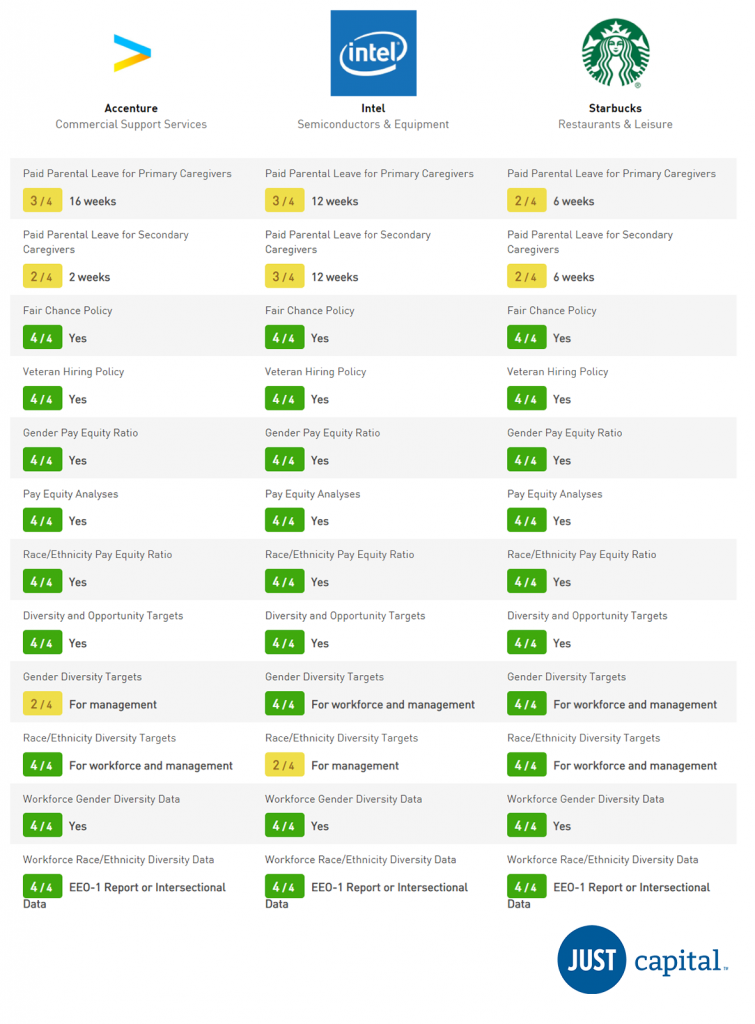
As part of its efforts to increase diverse representation of workers in both retail and corporate roles, Starbucks has committed to reaching ambitious gender and race/ethnicity diversity targets. With pledges to fill 50% of corporate roles with women, as well as to have at least 30% BIPOC representation at the corporate level by 2025, Starbucks is setting meaningful goals to establish a more diverse workplace.
Starbucks also provides detailed disclosure of its workforce demographic data, broken out by gender and employment category, in its latest EEO-1 report. In 2018, Starbucks demonstrated its commitment to creating an equitable workplace by achieving 100% pay equity for workers of all genders and races in the U.S. Starbucks has maintained this achievement in 2022.
Additionally, Starbucks is a signatory of the White House’s Fair Chance Business Pledge, creating pathways for employment for veterans, formerly incarcerated individuals, and young people who face systematic barriers to education and employment.
Based in Santa Clara, California
Intel has made inclusivity in the workplace a pillar of its 2030 RISE Strategy and has already exceeded some of its initial milestones. In terms of gender diversity targets, the company has doubled the number of women in leadership positions and surpassed its goal of having 10% representation of Black/African American employees in senior, director, and executive roles, reaching 11% representation in 2022. Additionally, Intel has set a goal to increase accessibility in its workplace and aims to increase the number of workers who self-identify as having a disability to 10%.
Beyond increasing representation, Intel is also committed to creating an equitable workplace by offering 12 weeks of paid parental leave for all new caregivers. Intel’s commitment to DEI is evident in the public release of its comprehensive EEO-1 report, which also contains highly detailed information about workers’ pay broken down by race/ethnicity, job category, and salary band. Finally, Intel promotes hiring veterans and discloses detailed data tracking its yearly progress on veteran hiring.
Based in Chicago, Illinois
Accenture PLC conducts annual pay equity analyses by gender and race/ethnicity for its workforce and publicly discloses the findings. Using the information collected during these analyses, Accenture has been able to make informed future commitments to increasing diversity in its workplace for 2025. Accenture achieved 100% pay equity by race and gender in 2022 and is taking its commitment a step further, committing to achieve full gender parity at all levels by 2025, with 50% of its board seats and 45% of revenue-producing roles held by women.
In addition to disclosing detailed information about workforce demographics in its EEO-1 report, Accenture discloses other DEI metrics such as the number of workers who are veterans or self-identify as disabled or LGBTQ+. Accenture seeks to create opportunities for all individuals to thrive in the workplace, evidenced by its 16 weeks of paid parental leave offered to primary caregivers. Accenture also has a partnership with Goodwill to provide formerly incarcerated individuals with VR technology so they can participate in mock interviews, increasing their chances of finding employment.
Here’s a snapshot from our upcoming JUST Jobs Scorecard “compare” tools, showing how Starbucks, Intel, and Accenture are performing on these issues.
To unpack your company’s DEI performance in the 2023 Rankings and gain insights into how to improve on the issues that matter most to the American public, please reach out to corpengage@justcapital.com.

As diversity, equity, and inclusion (DEI) becomes an increasingly urgent priority in the U.S., the expectation is growing for corporate leaders to take meaningful action to advance racial equity in the workplace. Our survey research shows that DEI Issues remain a key element of just business behavior, with 92% of Americans saying that it is important for companies to promote racial equity in the workplace and 76% agreeing that reporting workforce demographics is a critical step toward doing so. With 68% of Americans agreeing that companies have more work to do on these issues, we are seeing that – when it comes to demographic disclosure – more and more companies are in fact stepping up to the plate.
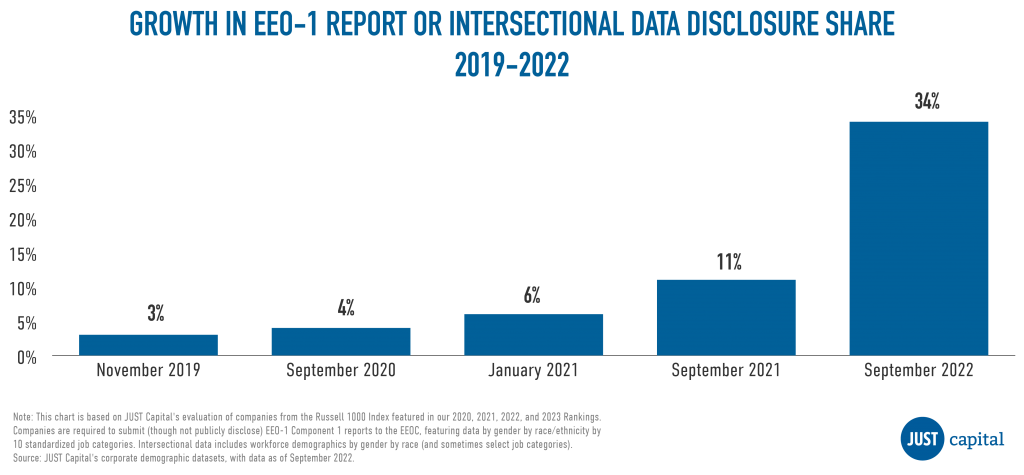
In our own recent analysis, we found that the number of Russell 1000 companies that publicly disclose intersectional data detailing gender, race, and ethnicity by job category from their EEO-1 reports or equivalent – has grown substantially, from 3% in 2019 to 34% in 2022.
In addition to the American public, investors want to see more of this kind of action as well. Public disclosure of EEO-1 data can promote transparency and accountability, and help investors understand how much progress companies are making in their commitments to increase representation at all job levels. NYC’s Comptroller’s Office and New York City Retirement Systems (NYCRS) have been on the forefront of a successful three-year campaign to push companies to make disclosure of EEO-1 reports the norm. (Watch this video featuring JUST Capital, NYCRS, CalSTRS, and Bloomberg discussing that work). In the last three years, shareholders have endorsed proposals at nine companies to increase diversity and EEO-1 reporting with an average of 54% support, nearly double the general average support for social proposals of 29%.
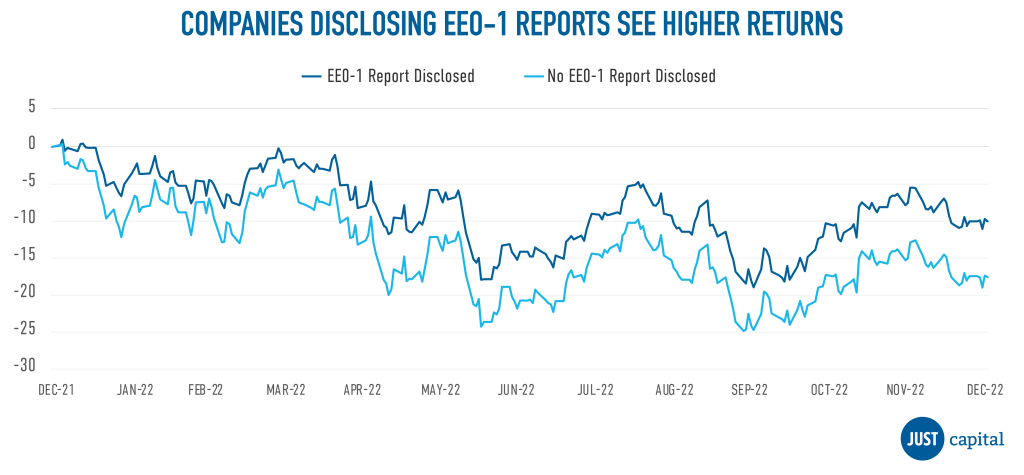
To build the business and investor case for tracking workforce diversity data we looked specifically at the subset of companies that disclose EEO-1 or equivalent data, and found that they delivered higher returns than those that didn’t disclose an EEO-1 report or equivalent, outperforming by 7.9% over the trailing one-year period ending in 2022.
By encouraging companies to disclose their EEO-1 reports, investors can help promote transparency and accountability around workplace diversity and inclusion. Doing so benefits workers, communities, and society as a whole, but also crucially helps investors make more informed decisions about which companies to invest in, as research has shown that companies with diverse workforces and leadership teams tend to perform better financially.
Companies are heading in the right direction, with more and more disclosing demographic data each year. But with just one-third of America’s largest companies publishing their EEO-1 reports, there’s still a long way to go. Investors play a key role in incentivizing corporate leaders to prioritize demographic disclosure – helping to build a just and inclusive economy that truly works for all.
If you are interested in supporting our philanthropic mission by licensing our unique data, we are happy to discuss data needs, index licensing, and other ways we can partner. Please reach out to Manager, Investor Market Solutions, Michael Wirtz, at mwirtz@justcapital.com.
This report was co-authored by Matthew Nestler, Aleksandra Radeva, and Ian Sanders.
Over our years of tracking and incentivizing just business practices at our nation’s largest companies, we’ve seen corporate America take significant strides in one area in particular: disclosing workforce diversity data. This is in part thanks to campaigns by institutional investors and a recent swell of shareholder proposals pushing for demographic disclosure – showing that, even in the midst of rising backlash against ESG and “woke” capitalism, investors consider DEI to be an issue critically material to business.
The public also agrees – in our 2022 survey asking Americans how and whether corporations should focus on these issues, 92% of respondents told us that it is important for companies to promote racial equity in the workplace. What’s more, 76% agree that disclosing demographic data, in particular, is an important step toward advancing racial equity.
JUST Capital has been working to incentivize corporate behavior change on DEI issues overall across a range of initiatives – from documenting progress on a slate of DEI measures in our Corporate Racial Equity Tracker to providing guidance to companies building equitable practices in the CEO Blueprint for Racial Equity, as well as our ongoing financial analyses demonstrating the business case for action on DEI issues. And we’re beginning to see the collective impact of all these efforts.
In this most recent analysis, JUST found that the share of companies publicly disclosing workforce demographic data by race, ethnicity, and gender by standardized job categories in their EEO-1 Report – the gold standard for workforce demographic disclosure – or similar intersectional data has more than tripled between 2021 and 2022, from 11% to 34%. Companies with 100 or more employees are already legally required to submit these reports to the U.S. Equal Opportunity Commission and Department of Labor, meaning that the data has already been collected – just not made publicly available by the majority of companies.
In a companion analysis exploring the business and investor case for increased disclosure, we found that the companies that disclose EEO-1 or similar intersectional data outperform those that don’t by 7.9% over the trailing one-year period ending in 2022.
Our findings are reinforced by other research in this area. Studies from Deloitte, McKinsey, Boston Consulting Group, and many others have shown how diverse workforces and inclusive cultures are more productive, have lower turnover, yield greater customer satisfaction, and ultimately drive higher profitability.
With an increasingly bright light shining on demographic disclosure, we explore our full slate of findings below – including the types of disclosure we’re seeing from Russell 1000 companies, a close look at how different industries measure up, and the changes we’ve seen since we began tracking this data in 2019.
Because companies do not publicly disclose their workforce race and ethnicity data in a single standardized way, since 2019 JUST Capital has collected 23 granular data points around worker racial and ethnic identity. We then use these data points to construct three different categories in addition to no disclosure, in order from least to most detailed: (1) overall people of color, (2) detailed race/ethnicity data, and (3) EEO-1 report or intersectional data.
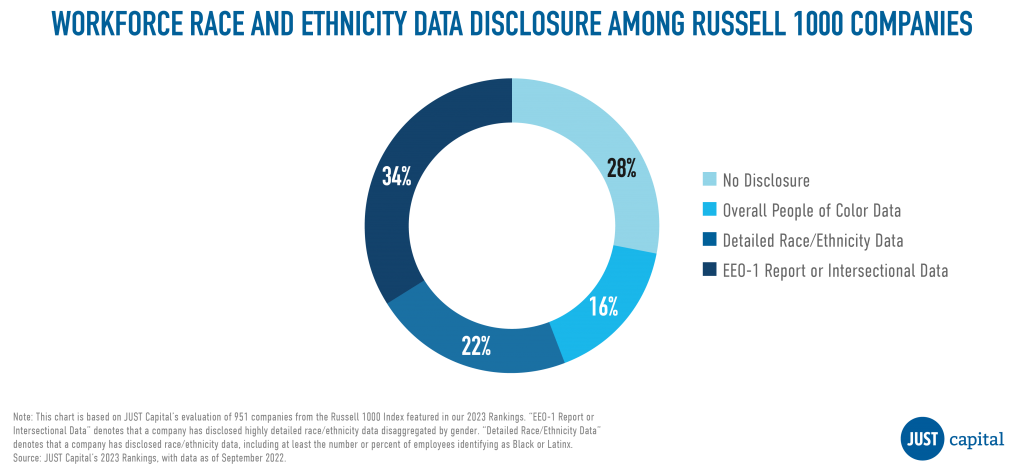
Though as of September 2022, 28% of the Russell 1000 companies we rank, or 269 companies, do not disclose any race and ethnicity data, nearly three-fourths disclose some form of data. What is more, the percent and number of companies disclosing data increases as the form of disclosure becomes more detailed. Whereas 16%, or 152 companies, provide the lowest level of disclosure (overall people of color – or “non-white” or “minority”) we find that 22%, or 207 companies, disclose more detailed data about specific racial and ethnic categories, such as Black or Latinx. Finally, 34%, or 323 companies, disclose highly disaggregated data, including that contained within the gold standard of the EEO-1 Report.
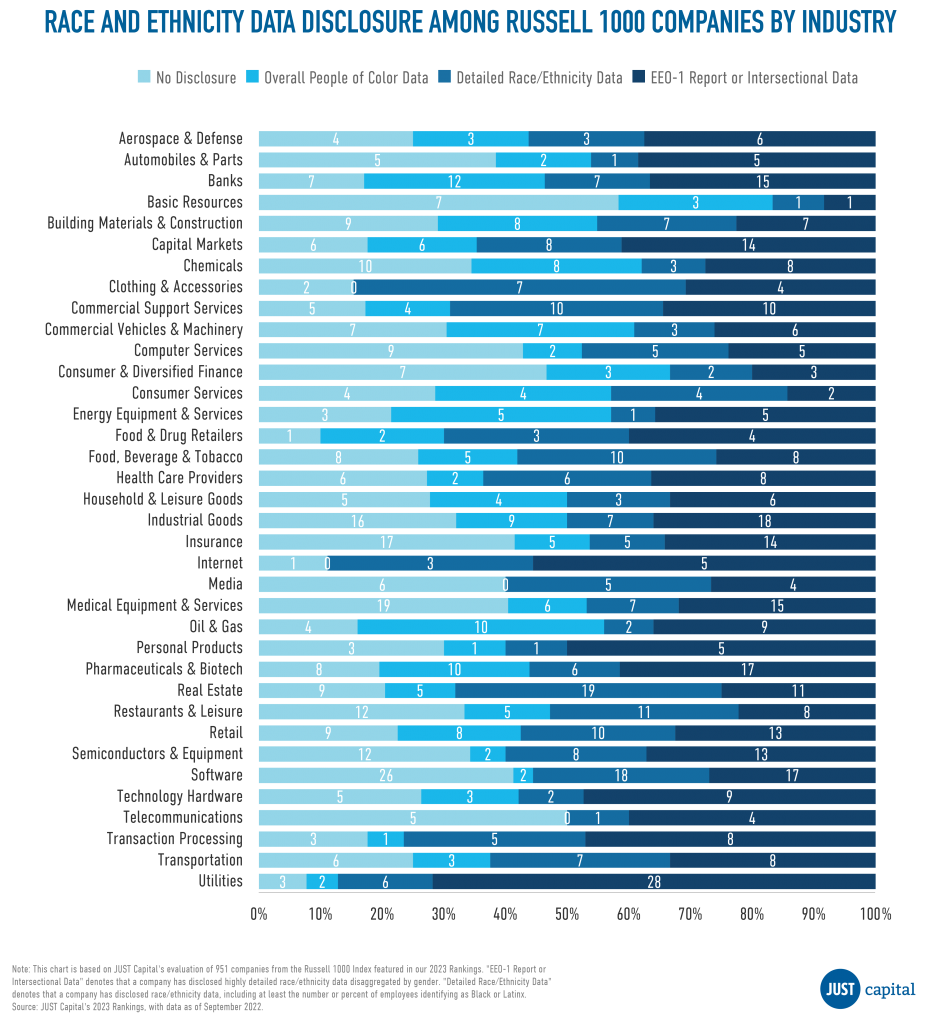
The majority of companies across almost all industries disclose some form of workforce diversity data. The Utilities industry stands out with the lowest share of companies with no demographic data disclosure, as 92% (36 companies) release some information about the racial and ethnic composition of their workforce. And it is leading all sectors with nearly three quarters of companies disclosing an EEO-1 Report or similar intersectional data. Internet is another industry with nearly 90% disclosure and a very high share of companies (56%) disclosing an EEO-1 Report or similar intersectional data.
Basic Resources and Telecommunications are the only two exceptions where half or more of the companies do not disclose any form of race or ethnicity demographic data. Basic Resources is also the industry with the fewest companies that meet the highest disclosure threshold, as only 8% of companies disclose an EEO-1 Report or Intersectional Data. Interestingly, while the Telecommunications industry is on par with Basic Resources on non-disclosure, it exhibits a different trend when it comes to highly detailed disclosure: 40% of Telecommunications companies are leading by disclosing their EEO-1 Report or similar intersectional data.
While all forms of disclosure can be seen across almost all industries, the disclosure type distribution shows that there is mainly a tendency towards more detailed forms of disclosure (Detailed Race/Ethnicity Data and EEO-1 Report or Intersectional Data) when workforce diversity data is available.
Over the past year, companies across the Russell 1000 have made great strides toward improving disclosure of racial and ethnic workforce demographic data. In September 2021 when we last conducted this analysis, over 45% of companies had no disclosure whatsoever. In September 2022, our latest data shows that number has fallen to just 28%, indicating that over 150 companies have newly published some form of demographic disclosure in the past year. Per our 2023 Ranking of America’s Most JUST Companies, 72%, or almost three-quarters of the companies we rank, now publish some form of race and ethnicity disclosure data.
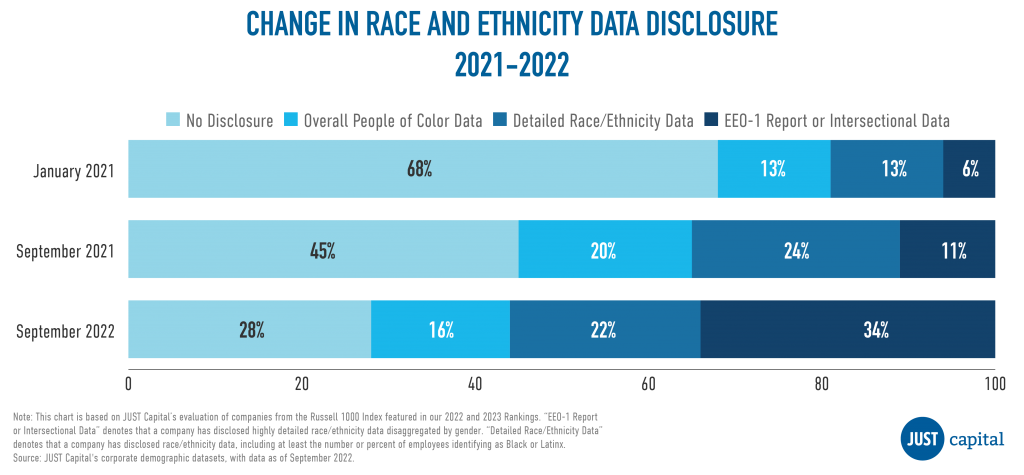
It is worth noting that the majority of increased race and ethnicity data disclosures can be observed in the most detailed category of EEO-1 or Intersectional Data. This suggests that many companies that have never previously disclosed race and ethnicity data have begun releasing highly detailed demographic data for the first time or that companies with previously less detailed disclosures are adopting the leading practice of disclosing EEO-1-level data.
The most notable shift in race and ethnicity data disclosure has been the unprecedented increase in EEO-1 or Intersectional Data reporting. This highly detailed form of demographic data disclosure, which provides the exact makeup of a company’s workforce by race, ethnicity, and gender by standardized job categories, has become a central tool for measuring race and ethnicity data in the matter of only a few years.
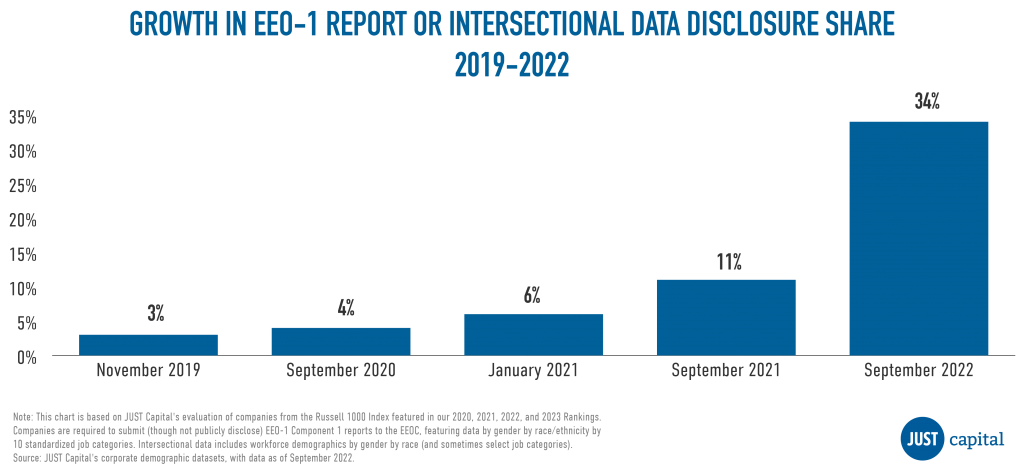
In our latest analysis from September 2022, 323 companies, or 34% of our ranked universe, disclose an EEO-1 Report or similar Intersectional Data. This is triple the value from just a year earlier when 104 companies had this form of disclosure. Even more exceptional, over the span of three years since our first analysis in November of 2019, the number of companies disclosing this most disaggregated demographic data has risen by 31 percentage points, from only 3% to 34%.
Publicly disclosing demographic data represents a critical initial step for companies looking to build more diverse workforces, as well as stronger returns. It holds corporate leaders to account on their DEI goals and signals commitment to advancing racial equity. And while companies have made remarkable progress in this area, there is still a long way to go, with just one-third of America’s largest companies disclosing the most detailed level of race and ethnicity data.
Because large companies are already legally required to submit their EEO-1 Reports to the federal government, the form represents a clear path to public disclosure of intersectional demographic data. Corporate leaders looking to take meaningful steps toward advancing racial equity should publish their companies’ EEO-1 Reports – a form they are already obligated to complete but not publicly disclose. The story the Report tells may not be a perfect one, but disclosure is a crucial first step in holding companies accountable to change.
From there, to ensure lasting progress on DEI, corporate leaders must ultimately go beyond demographic disclosure and measure and disclose the outcomes of their DEI efforts, including whether C-Suite compensation is tied to DEI-related progress, what resources are directed toward DEI efforts, how they drive impact in local communities, and more. By disclosing workforce demographics as a first step on their longer-term journey toward advancing racial equity, companies are poised to better serve not only their workers but their shareholders, too. More equitable, inclusive, and just business is within reach – and JUST Capital will continue to incentivize corporate progress on key issues like demographic disclosure, working to create an economy that truly works for all.
To unpack your company’s DEI performance and gain insights into how to improve on the issues that matter most to the American public, please reach out to corpengage@justcapital.com.

This was a big year for JUST Capital when it comes to how we show up in the world and the impact we drive – arguably our biggest yet.
Two fundamental developments spurred that growth. As the United States began to mostly move on from COVID-19 pandemic restrictions, inflation simultaneously rose to a 40-year peak, the labor market remained tight, and companies had to determine new ways to recruit and retain talent. We also saw – with the combined forces of a war that upended energy markets, a midterm election, and a Securities and Exchange Commission with an ambitious agenda – ESG (environmental, social, governance) investing and the related stakeholder capitalism movement rise into mainstream political culture wars.
Both of these issues are, of course, incredibly complex, but we remained centered on the polling of the American public that defines our work. Our top articles, collected below, include the analysis, reports, Rankings, and interviews that positioned JUST Capital as the champion of pragmatic and popular business leadership.
1. JUST Capital and CNBC Release the 2022 Rankings of America’s Most JUST Companies
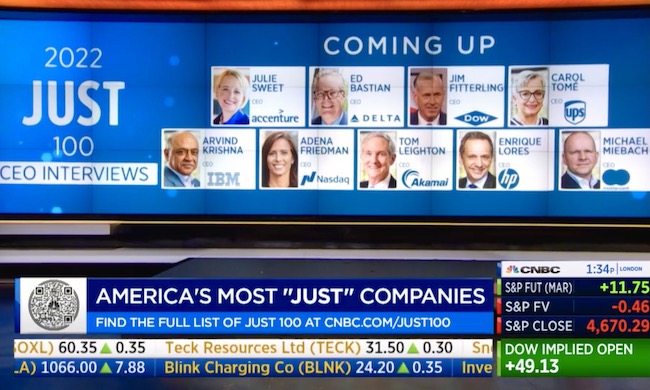
We kicked off the year with our biggest Rankings launch yet, with our new media partner CNBC. Alphabet took the No. 1 spot this year.
2. The 2022 Corporate Racial Equity Tracker
We checked in on how America’s largest companies are doing when it comes to their racial equity commitments of the past two years, with a more robust version of the Tracker we launched last year.
3. The Top Five Companies Leading on Paid Parental Leave in 2022

As the COVID recovery progressed, we took a look at the companies that offered a wide array of parental benefits, including six months of paid leave for two parents.
4. JUST Capital’s 2022 Workforce Equity and Mobility Ranking
With support from the Annie E. Casey Foundation, we identified the companies that are offering their employees not just good wages, but access to opportunities for growth in an inclusive way.
5. America’s Top 10 Companies for Environmental Performance in 2022

This year’s ESG debate was largely driven by the question of whether companies should be mandated to disclose environmental policy information, and to what degree. Regardless of how that plays out, these companies are already showing what’s possible.
6. How Companies Are Responding to Russia’s Invasion of Ukraine
When Russia invaded Ukraine in February, it threw the world’s political dynamics and economies into a frenzy. We quickly began tracking how the largest U.S. companies, many with business ties to Russia, responded.
7. The 2022 Top 100 U.S. Companies Supporting Healthy Families and Communities
With support from the Robert Wood Johnson Foundation, we ranked the companies that are having positive impacts on the communities in which they operate.
8. Just Over Half of the Largest U.S. Companies Share Workforce Diversity Data as Calls for Transparency from Investors and Regulators Grow
The SEC indicated last year that it would consider mandating enhanced reporting of human capital metrics as the largest institutional investors increasingly call for that information. We took a look at the state of play.
9. America’s 32 Industry Leaders for Environmental Performance in 2022
In honor of Earth Day, we showcased the companies leading their industries in transparent and ambitious climate policies and sustainable business practices.
10. Bank of America’s Head of Diversity & Inclusion Explains How Its Hiring and Retention Practices Prioritize Equity and Upward Mobility for Workers
Bank of America scored well on our 2022 Workforce Equity and Mobility Ranking (link above), and to discuss the policies behind that performance, we reached out to Cynthia Bowman, the bank’s head of DEI.
11. SURVEY ANALYSIS: Americans Want to See Greater Transparency on ESG Issues and View Federal Requirements as a Key Lever for Increasing Disclosure
At this point, a broad interpretation of what ESG means is now solidly part of America’s culture wars, but in February we found that large majorities of Americans support more transparency around how companies are impacting society, and even support federal reporting guidelines.
12. The 5 JUST 100 Companies Leading on Gender Board Diversity
Companies prioritizing gender equality do so at all levels of the organization, and we found that the average representation of women on Russell 1000 boards rose from 23.8% to 28.2% between 2019-2021. These are the JUST 100 corporations that stood out.
13. JPMorgan Chase’s Head of Corporate Responsibility Breaks Down 4 Lessons From Overseeing the Firm’s $2.5 Trillion Sustainability Initiative
We spoke with JPM’s Demetrios Marantis, who was put in charge of the bank’s highly ambitious $2.5 trillion sustainability initiative, and whose team has brought transparent updates on it into the firm’s annual ESG report.
14. In 2022, These 3 Companies Are Leading the Way for Women in the Workplace
As part of our partnership with CNBC, we determined the companies that excel on the women’s issues our polling found Americans value most, including access to childcare, equal pay, and paid family leave.
15. State Street Global Advisors’ CEO and Head of Asset Stewardship Talk Proxy Season, the State of Energy Amid Ukraine War, and the Future of ESG
State Street, as one of the Big Three institutional investors, holds significant influence over the fate of ESG investing, and we discussed SSGA’s “Value, not values” philosophy with then-CEO Cyrus Taraporevala and Benjamin Colton.
