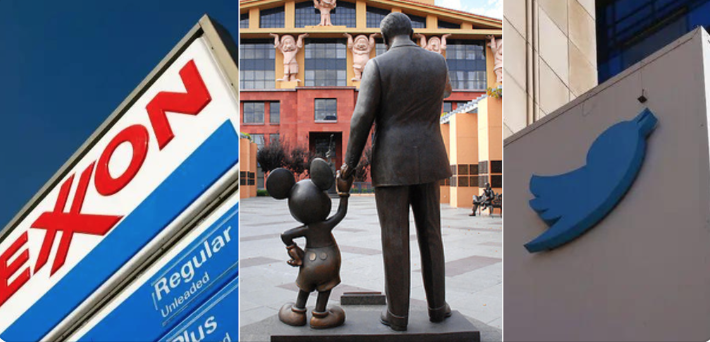
(Exxon, Disney, Twitter)
This past week saw three high-profile examples of why it’s so important for corporate leaders to understand what makes their stakeholders tick when making decisions involving complex societal issues.
First, Disney’s handling of its response to Florida’s “Parental Rights in Education” law, also referred to as the “Don’t Say Gay” bill, where CEO Bob Chapek managed to upset both Disney employees and state Republicans. The company is now challenging the state’s decision to strip Disney World of its longstanding tax exemptions, and the business consequences could be significant.
Next up is ExxonMobil, which created a new policy against “external position flags” that, among other implications, will prohibit the previously flown LGBTQ rainbow flag from appearing outside its offices during Pride month in June. Members of its LGBTQ employee resource group told reporters that they were unhappy with the decision and were never consulted. While the company’s specific motivations remain unclear, it’s hard to square with good stakeholder leadership.
Finally there’s Elon Musk’s deal to buy Twitter. Here the issues revolve around freedom of speech, the concentration of power, and the fate of the Twitter platform and its employees. Teslahas not scored well in our Rankings on worker-related issues or good governance, although product performance has been strong.
A defining question in all this is whether and how companies should take a stance on divisive, complex issues. Clearly it is not without risk. Our recent focus groups and polling suggest that the majority of Americans strongly support companies in speaking up, although support for this view is much higher for liberals than for conservatives, and it does vary by issue. Respondents also make it clear that if companies do take a stand on an issue, they better back it up with action.
Silence, as Bob Chapek learned, is not really an option.
Be well,
Martin Whittaker

Deloitte announces a $1 billion investment in its global Sustainability & Climate practice.
Delta decides to pay flight attendants during boarding, a first for a U.S. flight carrier, amid unionization pressures.
Google teams up with the United Nations to provide verified climate information in search results. When users search for “climate change,” they will find authoritative information from the UN in 12 languages.
PayPal releases its annual Global Impact Report, illustrating its ESG strategy and how the company supports its stakeholders, including our work together on the Worker Financial Wellness Initiative.
ServiceNow ties executive compensation to DEI and ESG targets.
With climate-related proposals making up a majority of proxy season resolutions and the SEC moving ahead with proposed new rules for climate-related disclosures, the need for robust environmental reporting has never been greater for corporate America. Our research team took a deep dive into the current state of environmental data disclosure across all 954 companies we rank. The key finding? Even though the “E” of ESG data is much further along in terms of historical data, aligned standards, and best practices, disclosures remain quite low across the board. Currently 35% of Russell 100 companies do not disclose any of the 13 data points we measured, and only one company discloses all 13. Dig into the comprehensive report here.
Martin joins Insider’s “Financing a Sustainable Future” event on May 10th to discuss how stakeholder capitalism and ESG can create broad-based economic prosperity alongside leaders from Bank of America and Dow. Register to join the conversation here.
JUST board member Dan Hesse joins the Purpose 360 podcast to discuss the lessons he learned implementing purpose-driven business strategies while CEO of Sprint Nextel.

(Secretary of the Treasury Office)
“We have developed supply chains that are extremely efficient and serve to lower costs. But as we discovered during the pandemic, and more recently now with Russian invasion of Ukraine. Our supply chains are not secure and are not resilient. I think that’s something in terms of long-term risk to the U.S. and to other countries that is a threat that needs to be addressed.”
“We know that the growth and success of our organization comes from our people. By putting employees first and investing in their wellness, including their financial well-being, we can build the financial health of our employees and their families and communities, expand opportunity, reduce inequality and better serve our customers and our shareholders. Prioritizing the financial health and security of our global colleagues strengthens our employees’ capacity to meet the evolving needs of our customers and communities throughout the world.”
“We can’t confidently make controlled policy changes or external commitments such as ‘we will not use X data for Y purpose.’ And yet, this is exactly what regulators expect us to do.”
Brookings examines pay practices at 22 of the largest U.S. companies employing over 7 million frontline workers to see if companies have shifted away from shareholder primacy, discovering that the vast majority fell short. During the pandemic, the companies’ shareholders grew $1.5 trillion richer, while workers received less than 2% of shareholders’ gains, and are still struggling to get by.
Bloomberg reports on a study showing that 70% of U.S. businesses have increased wages in Q1 of this year. Despite this, Rick Wartzman writes in Capital & Main that many workers remain far from making a living wage.
Fast Company examines how the current talent war is causing a pay gap between existing employees and new hires as companies expand salaries and hiring bonuses to lure new workers.
Insider reveals that Gen Z workers are most likely to quit when office returns are enforced. The Wall Street Journal shares stories of workers who quit during the Great Resignation and now have regrets.

This chart comes from our latest report – The Current State of Environment Disclosure in Corporate America: Assessing What Data Russell 1000 Companies Publicly Share – which provides an in-depth look at which industries are leading and lagging on disclosures, how members of the Business Roundtable perform compared to the rest of the Russell 1000, and what sets companies leading the pack in environmental disclosures apart. Explore the detailed findings here.

David Shaw
Managing Partner of Black Point Group
JUST Capital Advisor
JUST Capital Advisor, David Shaw, is the CEO and Founder of Black Point Group. As a CEO and board member, Shaw has helped build more than a dozen successful technology companies in healthcare and other science-based industries. Shaw’s career has also included extensive public service in science, arts, conservation, and public policy.
David recently spoke at the E-Capital Summit at the EarthX conference in Dallas on the significant increase in interest in ESG and impact investing over recent years. Here is a recap of his presentation.

(Anna Moneymaker/Getty Images)
Inflation hit its highest level since 1981 in March (8.5%). Its causes and effects are starting to force some difficult conversations on core ESG and stakeholder priorities.
Take climate change, for example. The urgency of tackling climate risks by reducing greenhouse gas emissions is widely accepted, yet there is a clear need to lower gas prices and reduce dependence of foreign oil and gas.
President Biden, who identified transitioning to a clean economy as a pillar of his presidency, is now compelling energy companies to drill for more oil, allowing more gasoline with ethanol to be produced this summer (which is dirtier than regular gasoline), and releasing more oil from the strategic petroleum reserve than ever before.
Such realities make prognostications about a just transition of the energy complex all the more important, as the leaders of two of the world’s largest investment managers, Cyrus Taraporavala from State Street Global Advisors and from BlackRock’s Larry Fink, have noted. Bloombergreported that there are even indications that energy producing countries and fossil fuel companies are going to be given more clout at the UN’s COP27 in the fall (a big shift from last year)
Whatever your views on this, it hasn’t stopped many companies from acting. A research piece we released this week identifies what the components of a clearly communicated long-term climate transition plan look like and which companies are leading the way.
The effects of inflation are also affecting the relationship between America’s biggest employers and their workers. We see this show up recently in the organized labor movements at Amazon, Starbucks, and elsewhere. We heard about it on our workers panel at Nasdaq last week, where all three panelists (Chipotle, Intel, Prudential) emphasized the importance of listening to workers. And we read about it in Amazon CEO Andy Jassy’s first shareholder letter: “We’ve researched and created a list of what we believe are the top 100 employee experience pain points and are systematically solving them.”
Real talk about how we overcome these and other challenges is critical to building a stakeholder economy. You can rely on us to bring it to you.
Be well,
Martin Whittaker
Activision-Blizzard is converting 1,100 QA jobs to full-time positions and raising base pay. However, these QA workers do not include those planning to unionize at Raven studios.
Disney sets aside 80 acres in Florida for low-cost housing.
Thousands of Etsy sellers are striking this week over the company’s seller-fee increases.
Google unveils its plan to be 100% carbon free in its data centers by 2030. The company also announces a $9.5 billion investment in U.S. offices and data centers and expectations to create 12,000 new full-time jobs by the end of the year.
Intel announces plans to achieve Net Zero greenhouse gas emissions by 2040 and begins hiring thousands through workforce development programs for new facilities.
Walmart raises its truck drivers’ starting wages to $95 – 110K a year to combat labor shortages.
With women accounting for about 70% of job losses in the U.S since the start of the pandemic, we worked with our survey research partner SSRS to ask Americans what our nation’s largest companies can do to support women’s return to the labor force. Read the findings here. To see what leadership looks like today on gender equity issues, we recently profiled three companiesleading on several key issues, and five companies leading on paid parental leave.
In March, the SEC voted to propose new climate reporting standards, and with corporate America soon facing new reporting requirements, we revisited our analysis from last December, which identified key criteria for how to best disclose emissions data. This week, we break down these four criteria – that climate commitments be understandable, comprehensive, innovative, and achievable – with details on which corporations can serve as models for their peers preparing to disclose.
Paul Polman and Andrew Winston feature the JUST 100 in their latest article in HBRshowcasing solutions – including to price the unpriced, adopt a true long-term mindset for investment decisions, and think in systems – for getting past flawed mental models that are holding ESG back.

(Ceres)
“We’re talking about a risk that is likely to be larger or greater than the subprime meltdown, clearly worthy of our attention.”
“It’s employees’ choice whether or not they want to join a union. We happen to think they’re better off not doing so. … Regardless of how it all pans out, the one thing we won’t compromise is the customer experience.”
“These numbers change so little and so slowly. What it tells me is that this institutional disparity based on race seems to be built into American society.”
The Wall Street Journal takes a look at the history of companies trying to give their employees ownership stakes, showing how these attempts have failed in the past and considering new approaches for the future.
Pensions & Investments looks at the recent success of shareholder proposals for racial equity audits, and what the next big push is going to be.
The Welcome.US CEO Council – featuring CEOs from Google, Accenture, Bank of America, Adobe, and more – launches a new commitment to resettle and upskill newcomers from Ukraine and Afghanistan.
Former Unilever CEO Paul Polman and his “Net Positive” coauthor Andrew Winston explore the ways companies need to think more broadly about ESG – including in recognizing the benefits of paying living wages – in an editorial in the Harvard Business Review.
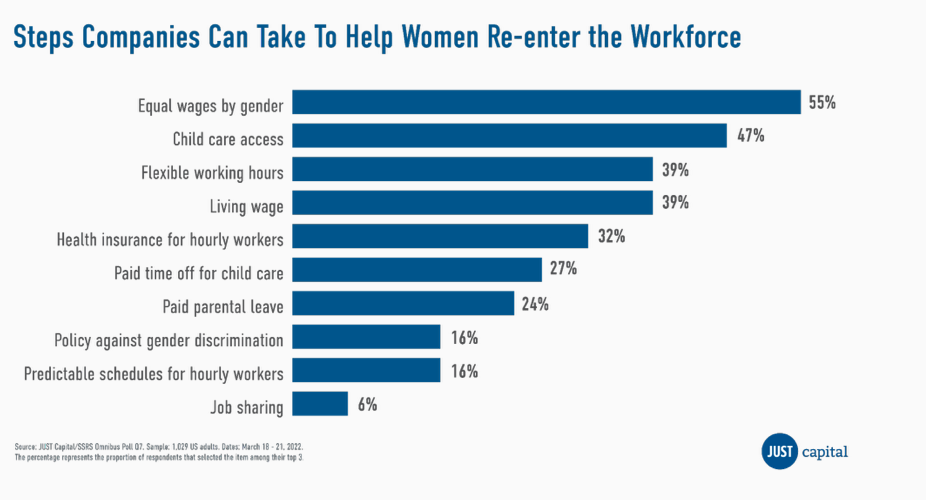
When we asked Americans what steps companies can take to support women returning to work, they identified pay equity, access to child care, flexible working hours, and a living wage as the top four. Read the detailed survey insights here.

Jennifer Grancio
CEO, Engine No. 1
JUST Capital Advisor
JUST Advisor Jennifer Grancio, CEO of Engine No. 1, was recently interviewed by Time as the firm was named to its 2022 TIME100 List of Most Influential Companies.Grancio details how Engine No. 1 is engaging with major companies on key ESG issues and building on momentum from its victory in lobbying for change with ExxonMobil last year.
“Our point of view is these are public companies, and we own the public companies. If we care about workers and wages on the social side, and if we care about environmental impact, we should be holding these companies and working with them very aggressively as investors to get them to the right outcome,” she said.
Hear more from Grancio on ESG investing from our event, “The Strategic Imperative of the ‘S’ of ESG,” last week.
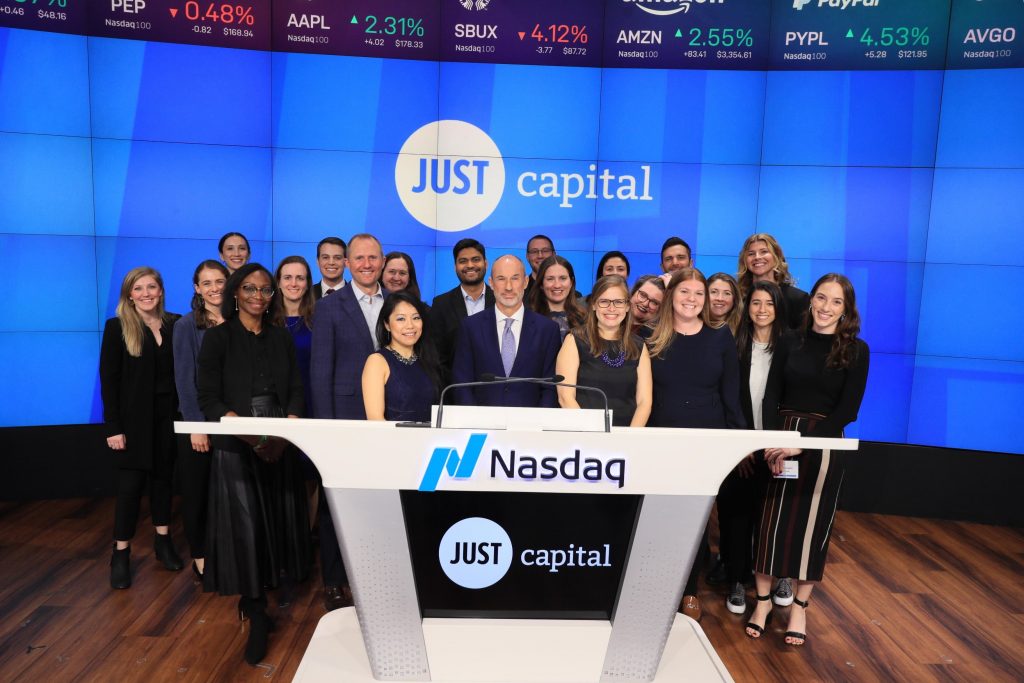
Monday was a monumental day for JUST and our mission. Ringing the Nasdaq closing bell to celebrate the JUST 100 was a major milestone on the road to a more just economy and a chance to both thank all those who’ve helped us get this far and reflect on where we’re going.
After the bell, and with the help of Nasdaq, our event sponsors, and media partner CNBC, we hosted “The Strategic Imperative of the ‘S’ of ESG,” an in-depth discussion among company leaders on the human element of business. Some personal highlights:
I also noted the hunger for more open and honest talk about some of the challenges of ESG, how leaders have handled failure and made tough choices, how companies can act with greater authenticity and accountability, and how the stakeholder approach connects to the future of free market enterprise and democracy itself. You can watch the entire conversation here.
On the walls of Nasdaq’s amazing event space hang pictures of notable IPO and bell ringing moments from the past, from Amazon to United Airlines. The images capture companies in a singular moment of transition, for them and perhaps in some cases for the market itself. I like to think Monday marked a similar moment of transition for all those who see just business behavior as the future.
Be well,
Martin Whittaker
GM CEO Mary Barra says that remote work actually allowed the company to make faster progress on its electric vehicle fleet.
JPMorgan Chase CEO Jaimie Dimon releases his annual letter to shareholders, declaring that the American economy is still strong, but that the inflationary environment and Russia-Ukraine War will require bold leadership.
Starbucks returning CEO Howard Schulz scraps planned stock buybacks to invest more into their workers amidst growing unionization efforts.
Synchrony becomes the newest company to join our Worker Financial Wellness Initiative and make the financial health of their employees a C-suite priority. For information on how your company can participate, go here.
Our director of corporate equity, Ashley Marchand Orme, was quoted in this article on tracking the racial equity and diversity investment promises corporations made in 2020.
CNBC compared our Rankings of America’s Most JUST Companies with LinkedIn’s “Best Companies to Work For” to discuss how different methodologies produce wildly different outcomes in these lists, particularly around Amazon.

(Christopher Galluzzo)
“First and foremost, it is about putting food on the table. So, to them, are the wages competitive? But then how do you create a pathway to economic mobility and growth? And for us, it really is about level access to education. We introduced debt-free degrees back in 2019, where it is that pathway for our employees to really thrive, but then pursue their passion whether it’s here as a leader or in the world as a leader.”
“It’s about taking leadership now and presenting guidelines that might help investors and others in the community understand what you’re doing. Prior to our rule, about 25% of the S&P 500 disclosed their board diversity, now over 60% have disclosed – and that’s in a year.”
“I don’t think ESG will ever be 100% of the decision-making of buy and sell. It just won’t. But five years ago, was it 5%? Today, is it 15-20%? Will it be 35-40%? Yes. Will that be an indicator of better culture, better long-term growth, more innovation? Yes.”
The United Nations’ IPCC released its latest report on the state of global climate change and progress toward mitigating it. It’s a giant report, but the Panel provides key findings and a breakdown by sector, and if you want just the most top level data, Bloomberg Green has a handy briefing. One takeaway: “Left unchanged, the world’s current emissions trend could result in warming of more than twice the target limit set forth in the 2015 Paris Agreement.”
The Wall Street Journal released an analysis of CEO pay, finding that it is on track to hit a new historic high, with the ratio of CEO pay to median worker pay up from the year before the pandemic, despite the tight labor market and inflationary environment.
The New York Times reported on what went on behind one of the bigger news stories of the week, Tesla CEO and notorious tweeter Elon Musk buying a controlling share of Twitter and joining its board – a move that could set the tech platform on a new course.
Fortune reports on new research that shows managers with business degrees are more likely to disproportionately distribute profit gains among leadership, instead of equitably across the workforce.
Note: If you’re looking for the 2023 version of this list, click here.
This year, Women’s History Month also coincides with another milestone: the two-year mark of the COVID-19 pandemic. Over that time, the impact of the pandemic on women’s labor participation and career trajectories has been stark. Women have yet to recoup pre-pandemic employment rates, and are seeing declines in workforce participation as of late, while men inch closer to pre-COVID numbers.
Mothers who have worked throughout the pandemic have also experienced stalled growth and lower pay among other negative career impacts. A recent survey from CNBC and Momentive found 29% percent of women with children under 18 say their career has taken a setback in the last 12 months, compared to 18% of their peers with older or no children. The strain working mothers have come under during the pandemic has also prompted the U.S. Equal Opportunity Employment Commission to issue new guidance warning that discrimination against caregivers in the workplace may be unlawful.
The challenges working parents face are exacerbated by the ending of pandemic-era policies like the child tax credit and the lack of a national paid parental leave policy in the U.S. In the absence of federal policy, it is incumbent on corporate America to support working families and a more resilient workforce. Parental leave policies that are gender neutral and allow for an equal amount of paid time off for both caregivers are considered expert-recommended best practice. In addition to helping shift cultural norms to encourage working fathers to take paid leave, such policies can help support child development, women’s participation in the workforce, and family financial well-being, and serve the needs of LGBTQ parents.
Yet, the majority of the largest public U.S. companies don’t disclose that they have a paid parental leave policy. We took a look at disclosures among the 954 companies we analyzed for our 2022 Rankings and found 53% do not disclose and 47% do disclose a paid parental leave policy. In addition, 8% disclose a paid parental leave policy of at least 12 weeks for both primary and secondary caregivers.
Among those that do disclose, only five – HPE, Etsy, Dropbox, Netflix, and Lululemon Athletica – offer six months or more of paid leave for both primary and secondary caregivers. Read on below to explore additional details on their disclosures.
Ranked 2nd in its industry and 75th overall
Computer Services company based in Houston, Texas
A leader in its industry, HPE supports its working parents through its HPE Work That Fits Your Life policy. The policy includes 24 weeks of paid parental leave for both primary and secondary caregivers. The company also offers its employees the option to work part-time for 36 months after the birth or adoption of a child and has launched a return-to-work program to help parents and others who have been out of the workforce for at least one year.

Ranked 7th in its industry and 102nd overall
Retail company based in Brooklyn, New York
A consistent leader on gender equity, Etsy’s paid parental leave policy covers 26 weeks for both primary and secondary caregivers. Etsy’s policy gives employees the flexibility of taking this leave over a two-year period. The company also offers financial assistance with costs associated with adoption or surrogacy.
Ranked 15th in its industry and 246th overall
Software company based in San Francisco, California
Dropbox provides 24 weeks of paid parental leave for its global workforce, an industry-leading policy that applies to all parents whether they are birthing, non-birthing, or adoptive. The policy also offers employees the flexibility to return from leave on a part-time schedule to ease the transition back to work.
Ranked 4th in its industry and 142nd overall
Media company based on Los Gatos, California
Netflix offers the highest amount of paid parental leave of all Russell 1000 companies JUST ranks, at 52 weeks for both primary and secondary caregivers. The company also supports the family journeys of its workforce through its global family forming benefit, which provides fertility, surrogacy, and adoption assistance for employees and their partners regardless of marital status, sexual orientation, or gender.
15th in its industry and 543rd overall
Household goods and apparel company based in Seattle, Washington
Lululemon’s policy covers up to six months of paid parental leave for all levels of its workforce, with total paid time off determined by each employee’s tenure with the company. The policy is also gender neutral, and applies to maternity, paternity, and adoption leave.
Ian Sanders is a JUST Capital Research Intern, focusing on workers and wages.
For last year’s Women’s History Month, we worked with The News with Shephard Smith to shine a light on the challenges of the “she-cession” and spotlight companies that were leading on issues that would help create a more equitable recovery on the other side of the pandemic.
Since then, more women have rejoined the workforce, but recent analysis by the National Women’s Law Center shows that while men have completely recouped pandemic employment losses, there are still 1.1 million fewer women participating in the labor force than in February 2020. Most recently: only 39,000 women over 20 joined the workforce in January 2022, compared to 1 million men, and while the economy gained 467,000 jobs, just 40% of those went to women.
In a recent survey conducted with SSRS we asked Americans what they think are key challenges relating to women’s experiences in the workplace and 76% of Americans identified access to childcare, while 70% noted equal pay, and 62% noted access to paid family leave as key challenges for women in the workplace. Clearly more is needed from corporate America to help women to thrive in the workforce. Last year’s analysis looked at how America’s largest companies were performing across five key performance indicators that support women in the workplace – including board gender diversity, pay equity, dependent care, parental leave, and paid time off. Just five companies hit those five thresholds: Bank of America, Etsy, General Mills, HPE, and Starbucks.
In 2022, that list grew to eight companies, including Bank of America, Edwards Lifesciences, Etsy, Goldman Sachs, Merck & Co, SVB Financial Group, Synchrony Financial, and The Estee Lauder Companies. Because of more stringent performance criteria this year, three companies – General Mills, HPE, and Starbucks – that appeared in our 2021 analysis dropped out of the 2022 list of top performers.
In order to learn which companies stood out from this group, we refined our metrics further, looking at whether companies:
Based on these expanded criteria, three companies stand out as leading the way – Merck & Co, Synchrony Financial, and Etsy. Read on to explore additional details and links to their disclosures:
Ranked 1st in its industry and 26th overall
Pharmaceuticals & Biotech company based in Kenilworth, NJ
As part of its extensive benefits package, Merck recently implemented a 12-week minimum global paid parental time off program for employees. Furthermore, the company has displayed its commitment to advancing the careers of women in its workforce by conducting regular internal reviews to ensure pay equity, as well as by promoting a “Women in Leadership” program to push for greater female representation in Senior Leadership positions.

Ranked 5th in its industry and 54th overall
Commercial Support Services Company based in Stamford, CT
Synchrony Financial stands out within its industry when it comes to supporting its employees’ families. In addition to offering 12 weeks of paid parental leave, Synchrony has created an after school program for children of employees to receive tutoring, extracurricular activities, and wellness support.
Ranked 7th in its industry and 102nd overall
Retail company based in Brooklyn, NY
As a leading company that has stood out on these issues year after year, Etsy goes above and beyond in supporting its employees by offering 26 weeks of fully paid gender neutral parental leave alongside globally available childcare services. Additionally, Etsy continues to lead in Board Gender Diversity, with 50% of its board comprised of women.

(David McNew/Getty Images)
On the face of it, the SEC’s proposed rule requiring companies to disclose emissions and other climate information, announced Monday, gives the market exactly what it’s been asking for.
It helps to address concerns over greenwashing and the haphazard nature of ESG data. It brings greater consistency, validity, and meaning to climate risk disclosures, so the free market can make more informed choices over capital allocation.
It tracks what many companies are already doing. JUST’s analysis shows a majority of companies (57%) currently disclose Scope 1 and Scope 2 emissions (up from 42% in 2021); 30% report Scope 3 emissions from travel; 10% report Scope 3 emissions from use of their products (mostly utilities); and over 100 companies from our universe have set net zero targets of one kind or another.
It gives big asset managers – BlackRock, State Street, and Vanguard – and pension funds what they say they want.
Finally, it accords with our recent polling, in which 87% of Americans, including 74% of Republicans, agree that public companies should disclose their risks from climate change; and 90% say it is important that there is a common, standardized reporting structure for companies.
That said, the rule will undoubtedly encounter some resistance. It comes at a time when world events are fundamentally destabilizing the U.S. economy and pushing the historical balance of energy reliability, affordability, and cleanliness to its limit. Pressure to increase domestic fossil fuel production is intensifying. In a meeting with President Biden on Monday JPMorgan Chase CEO Jamie Dimon called for a “Marshall Plan” for domestic natural gas.
The politicization of ESG and climate is also a factor. Speaking on CNBC’s Squawk Box Thursday morning, Republican Sen. Dan Sullivan of Alaska – a proponent of more domestic oil and gas investment – implied that legislation to curtail the power of big asset managers to vote their shares on ESG issues may be in development.
Tackling climate change and transitioning to a clean energy economy has the support of a majority of Americans but it will be a long and contentious process.
Be well,
Martin
AEP completes its largest wind farm and sets the course to rapidly increase renewables in an effort to hit net zero goals.
Delta is giving all of its workers a 4% pay raise, their first since the start of the pandemic.
Disney held a town hall dedicated to LGBTQ+ issues, with some workers staging a walkout to demand more action – including ceasing political donations to several Florida lawmakers.
MetLife announces $2.5 billion in DEI commitments, including spending with diverse suppliers and advancing diverse-owned firms.
Starbucks and Volvo partner to bring EV-charging stations to 15 Starbucks locations as part of a pilot program to help scale charging infrastructure.
Target tests its first net zero prototype store in California, which is planned to deliver a 10% energy surplus each year.
BONUS CLIP: Our interview with Cyrus Taraporevala of State Street is now available on our website to watch in its entirety, but the conversation continued for several minutes afterward. In this newsletter-only clip, Cyrus discusses the increasingly problematic fact that public companies have to play by a different set of environmental disclosure rules than private ones. Watch the clip here.
Join JUST Capital as we run in the NYC Marathon and raise money for a more JUST economy. Info here!
Join us in shaping the new standards for corporate action on racial and economic equity! Please join JUST and our colleagues at PolicyLink and FSG to provide feedback on new corporate performance standards we have been developing together for racial and economic equity. By sharing your insights, you can help ensure that what we develop is comprehensive, actionable, and has the power to set new norms for equity in the private sector. We’ll hope you’ll join us and share your feedback!

(Andrew Toth/Getty Images)
“We wanted to amplify a conversation about this crucial issue facing parents and caregivers within the private sector and shed light on why paid family leave is imperative to get millions of women back into the workforce. Men have already recouped pandemic employment losses, while 1.1 million fewer women are participating in the labor force than the previous year. At this rate, we are looking at a timeline that reverses decades of progress for women’s participation in the workforce.”
“Excited to announce that I’m going to lead the building of a new business at ExxonMobil focused on the (very) large scale decarbonization of the industrial economy. We’ll be significantly moving the needle toward net zero in the most hard-to-decarbonize industries, in an economically viable way, and with urgency.”
“The Russian war is going to prompt companies and governments worldwide to re-evaluate their dependencies and re-analyze their manufacturing and assembly footprints – something that Covid had already spurred many to start doing.”
The Hill features a new Oxfam study showing that nearly one-third of U.S. workers make less than $15 an hour. The demographic inequities are stark: 40% of women earn less than $15, compared to 25% of men, while 46% of Hispanic/Latinx and 47% of Black workers earn less than $15, compared to 26% of white workers.
The Wall Street Journal highlights data from the Atlanta Federal Reserve showing that women are starting to regain lost ground when it comes to wage increases, versus one year ago.
Bloomberg reports which S&P 100 companies are disclosing EEO-1 forms, the “gold standard” of workforce race data and reveals what companies are making progress – and falling behind – when it comes to increasing diversity among their ranks.
NPR shows that Black business ownership is actually 30% higher now than pre-pandemic.
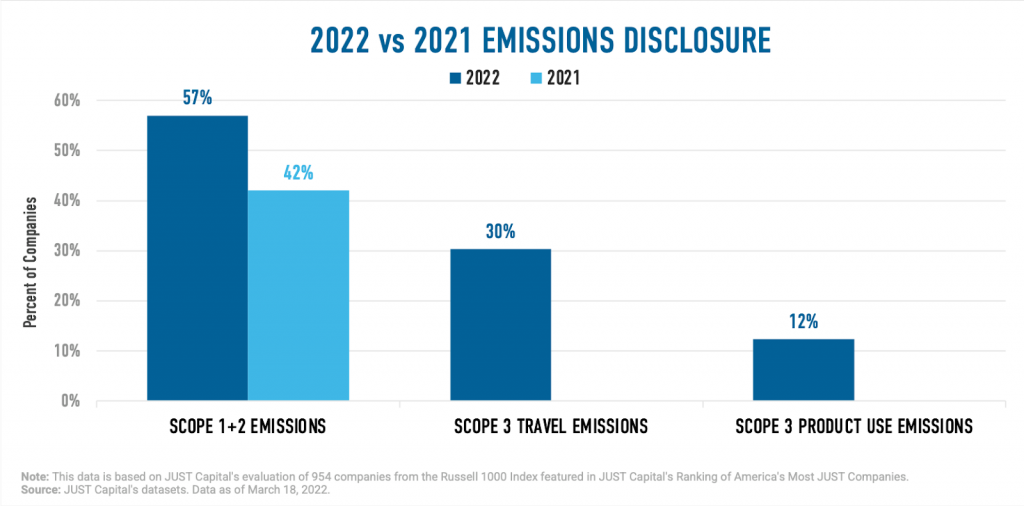
This chart comes from our latest analysis on the state of corporate GHG emissions disclosure in light of the new SEC proposal and shows that currently nearly 43% of America’s largest companies are not disclosing Scope 1 and 2 emissions, and far less have tackled reporting on Scope 3 emissions. Learn more here.

Annette Nazareth
Senior Counsel, Davis Polk & Wardwell
JUST Capital Board Member
Annette Nazareth is an experienced financial markets regulator, former SEC Commissioner, and recognized authority on financial markets regulatory issues. Annette has been a key player in financial services regulatory reform for much of her career, and worked in various posts at the SEC for a decade, serving as a Commissioner from 2005-2008.
Currently, Annette serves as the Co-Chair of the Board for the The Integrity Council for the Voluntary Carbon Market, an independent governance body for the voluntary carbon market. “To secure a liveable future, we urgently need to ensure that every tool available to us is working as effectively as possible to reduce and remove greenhouse gas emissions,” she said, speaking on the Council’s planned global standards for carbon credit quality. “The voluntary carbon market has a critical role to play in accelerating a just transition to 1.5 degrees centigrade, but it can only succeed if it is rooted in high integrity.”
