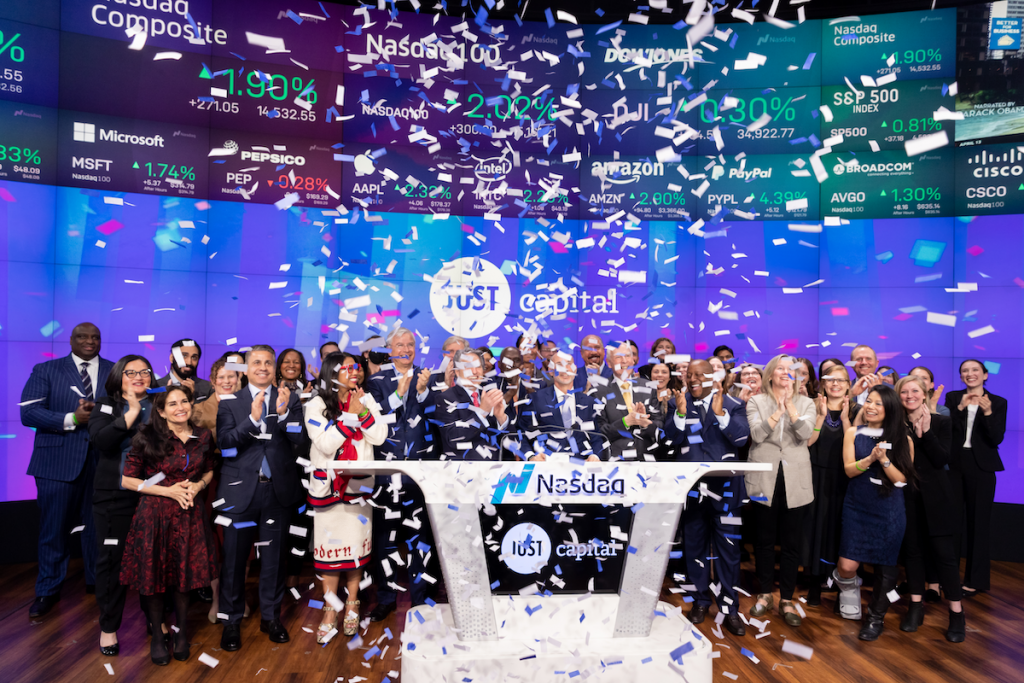
This was a big year for JUST Capital when it comes to how we show up in the world and the impact we drive – arguably our biggest yet.
Two fundamental developments spurred that growth. As the United States began to mostly move on from COVID-19 pandemic restrictions, inflation simultaneously rose to a 40-year peak, the labor market remained tight, and companies had to determine new ways to recruit and retain talent. We also saw – with the combined forces of a war that upended energy markets, a midterm election, and a Securities and Exchange Commission with an ambitious agenda – ESG (environmental, social, governance) investing and the related stakeholder capitalism movement rise into mainstream political culture wars.
Both of these issues are, of course, incredibly complex, but we remained centered on the polling of the American public that defines our work. Our top articles, collected below, include the analysis, reports, Rankings, and interviews that positioned JUST Capital as the champion of pragmatic and popular business leadership.
1. JUST Capital and CNBC Release the 2022 Rankings of America’s Most JUST Companies
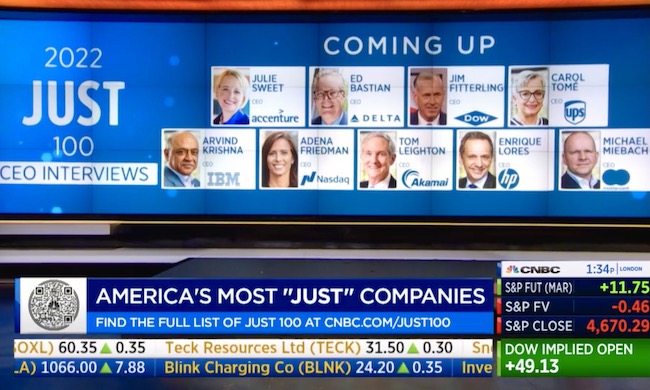
We kicked off the year with our biggest Rankings launch yet, with our new media partner CNBC. Alphabet took the No. 1 spot this year.
2. The 2022 Corporate Racial Equity Tracker
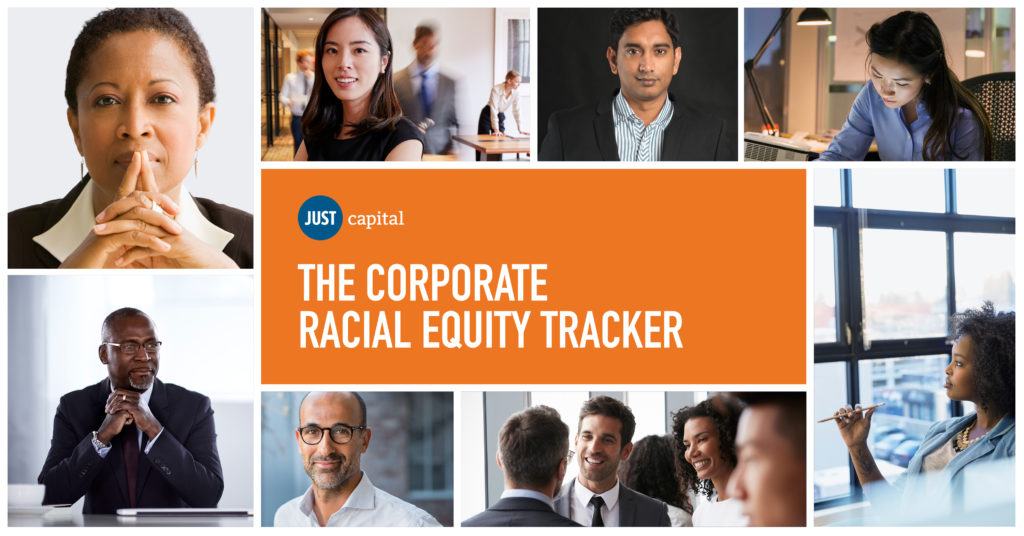
We checked in on how America’s largest companies are doing when it comes to their racial equity commitments of the past two years, with a more robust version of the Tracker we launched last year.
3. The Top Five Companies Leading on Paid Parental Leave in 2022

As the COVID recovery progressed, we took a look at the companies that offered a wide array of parental benefits, including six months of paid leave for two parents.
4. JUST Capital’s 2022 Workforce Equity and Mobility Ranking
With support from the Annie E. Casey Foundation, we identified the companies that are offering their employees not just good wages, but access to opportunities for growth in an inclusive way.
5. America’s Top 10 Companies for Environmental Performance in 2022

This year’s ESG debate was largely driven by the question of whether companies should be mandated to disclose environmental policy information, and to what degree. Regardless of how that plays out, these companies are already showing what’s possible.
6. How Companies Are Responding to Russia’s Invasion of Ukraine
When Russia invaded Ukraine in February, it threw the world’s political dynamics and economies into a frenzy. We quickly began tracking how the largest U.S. companies, many with business ties to Russia, responded.
7. The 2022 Top 100 U.S. Companies Supporting Healthy Families and Communities
With support from the Robert Wood Johnson Foundation, we ranked the companies that are having positive impacts on the communities in which they operate.
8. Just Over Half of the Largest U.S. Companies Share Workforce Diversity Data as Calls for Transparency from Investors and Regulators Grow
The SEC indicated last year that it would consider mandating enhanced reporting of human capital metrics as the largest institutional investors increasingly call for that information. We took a look at the state of play.
9. America’s 32 Industry Leaders for Environmental Performance in 2022
In honor of Earth Day, we showcased the companies leading their industries in transparent and ambitious climate policies and sustainable business practices.
10. Bank of America’s Head of Diversity & Inclusion Explains How Its Hiring and Retention Practices Prioritize Equity and Upward Mobility for Workers
Bank of America scored well on our 2022 Workforce Equity and Mobility Ranking (link above), and to discuss the policies behind that performance, we reached out to Cynthia Bowman, the bank’s head of DEI.
11. SURVEY ANALYSIS: Americans Want to See Greater Transparency on ESG Issues and View Federal Requirements as a Key Lever for Increasing Disclosure
At this point, a broad interpretation of what ESG means is now solidly part of America’s culture wars, but in February we found that large majorities of Americans support more transparency around how companies are impacting society, and even support federal reporting guidelines.
12. The 5 JUST 100 Companies Leading on Gender Board Diversity
Companies prioritizing gender equality do so at all levels of the organization, and we found that the average representation of women on Russell 1000 boards rose from 23.8% to 28.2% between 2019-2021. These are the JUST 100 corporations that stood out.
13. JPMorgan Chase’s Head of Corporate Responsibility Breaks Down 4 Lessons From Overseeing the Firm’s $2.5 Trillion Sustainability Initiative
We spoke with JPM’s Demetrios Marantis, who was put in charge of the bank’s highly ambitious $2.5 trillion sustainability initiative, and whose team has brought transparent updates on it into the firm’s annual ESG report.
14. In 2022, These 3 Companies Are Leading the Way for Women in the Workplace
As part of our partnership with CNBC, we determined the companies that excel on the women’s issues our polling found Americans value most, including access to childcare, equal pay, and paid family leave.
15. State Street Global Advisors’ CEO and Head of Asset Stewardship Talk Proxy Season, the State of Energy Amid Ukraine War, and the Future of ESG
State Street, as one of the Big Three institutional investors, holds significant influence over the fate of ESG investing, and we discussed SSGA’s “Value, not values” philosophy with then-CEO Cyrus Taraporevala and Benjamin Colton.
One of the most striking things about the disagreements I see around the stakeholder model is that the protagonists frequently agree with the basic idea that creating value for and investing in a company’s stakeholders is the best way to build and run a great business.
Speaking at our event on the future of capitalism in West Palm Beach last week, Thomas Peterffy, founder and chairman of Interactive Brokers, expressed deep skepticism about stakeholder capitalism before making the point that if a company doesn’t take care of its workers, then its consumers and shareholders will suffer. Ken Langone, a staunch critic of ESG and the stakeholder approach, is a champion of investing in employees, including giving them ownership interests in the companies he’s been involved with (Home Depot, most notably). A new case study from the MIT Sloan School of Management on PayPal, conversely an ardent supporter of stakeholder capitalism, centers this in its overall business strategy.
And I’m pretty sure that as he builds the asset manager Strive, Vivek Ramaswamy – perhaps the fiercest critic of all things ESG, stakeholder, and “woke” – is going to be looking to do right by his employees, pay them fairly, and provide good benefits.
My point is I think there’s more we agree on than meets the eye. Bob Eccles’ excellent interviewwith ExxonMobil board member Greg Goff, published in Forbes this week, is a great example. Goff, a Republican and career energy executive, expresses concerns over climate risks, talks convincingly about the importance of an energy transition, and believes oil and gas companies “definitely need to balance the impact of the change on all their key stakeholders.” It’s a narrative many proponents of the stakeholder model would agree with.
Looking ahead to 2023, we would do well to not just engage those who we think we disagree with, but understand where they’re coming from and find common ground.
Be well,
Martin Whittaker
Workers vote to unionize at an EV battery plant co-owned by General Motors, marking the first formal union at a major U.S. electric car, truck, or battery cell manufacturing plant not owned entirely by one of the Big Three automakers.
HSBC announces it will no longer fund new oil and gas fields, following growing scrutiny from investors and environmental activists over its Net-Zero pledge and fossil fuel ties.
JetBlue shifts its sustainability strategy, choosing to focus on the increasing viability of green aviation fuel rather than carbon offsets.
Microsoft tops the Wall Street Journal’s list of the best-managed companies of 2022, taking the top spot for the third year in a row.
Uber has filed a lawsuit to block a proposed pay rise for drivers in New York City, arguing the increased costs would be passed along to riders and “risk permanent loss of business.”
The Financial Times asks the thorny question and explores insights and answers relating to “How to pay executives in the age of stakeholder capitalism,” including JUST polling data on how the public thinks about CEO pay and quotes from Martin.
Martin also joined Reuters for a short interview on ‘What’s Next for Sustainable Finance,’ sharing why “the future of climate action is probably dictated by the future of finance” and addressing climate change should create value for business.
“I think Covid was a big wake up call for all businesses. You’ve never seen the kind of competition, especially at the front end, for employees that you’ve seen in the world. And I think in some ways it was a massive equalizer in terms of power and wages. Every board that we’re sitting on front-end has seen extraordinary pressure on wages, and frankly even at the higher end, just because of the competition for talent, and you’re seeing that you’re not gonna be competitive unless you’re responding to those pressures.”
Gartner publishes a new survey on the relationship between human-centric work models and employee performance. When workers are seen as people versus resources, “they are 3.8 times more likely to be high performing.”
One-in-four U.S. parents report struggling to put food on the table or pay their rent and mortgages in the past year. The Pew Research Center published a new survey highlighting the burden placed on families amid recession fears and rising inflation.
The New York Times explores what might be driving Starbucks CEO Howard Schultz’s opposition to unionization efforts by employees.
In the face of a tight labor market, the Wall Street Journal reveals that employers like UPS, Home Depot, and Gap are dropping interview requirements to expedite the hiring process.
As layoffs mount at large tech firms, Fortune writes about the expected shift toward “green collar” jobs. More than 300 million jobs are expected to emerge in the sector by 2050 as traditional employment becomes more vulnerable due to climate change.
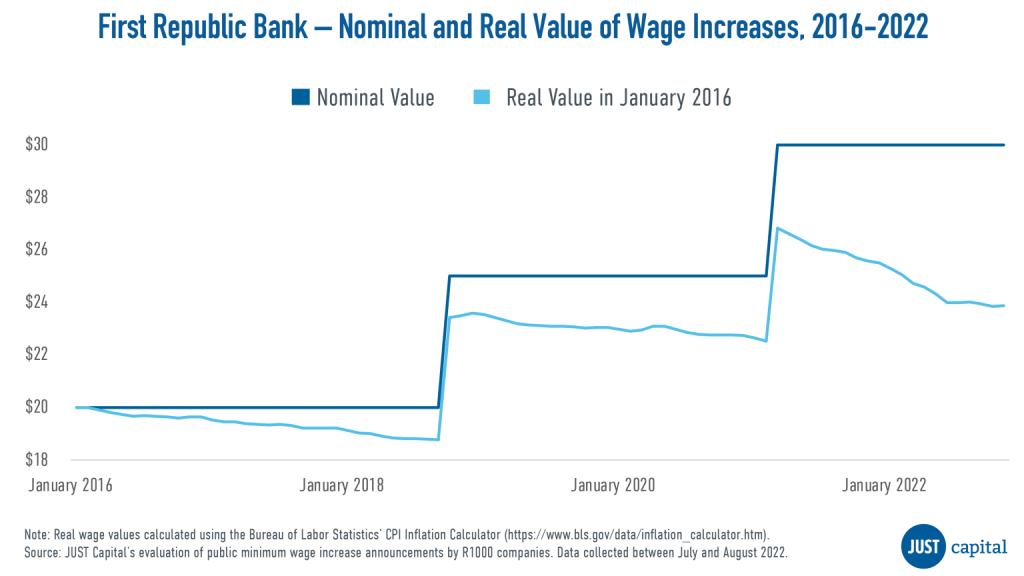
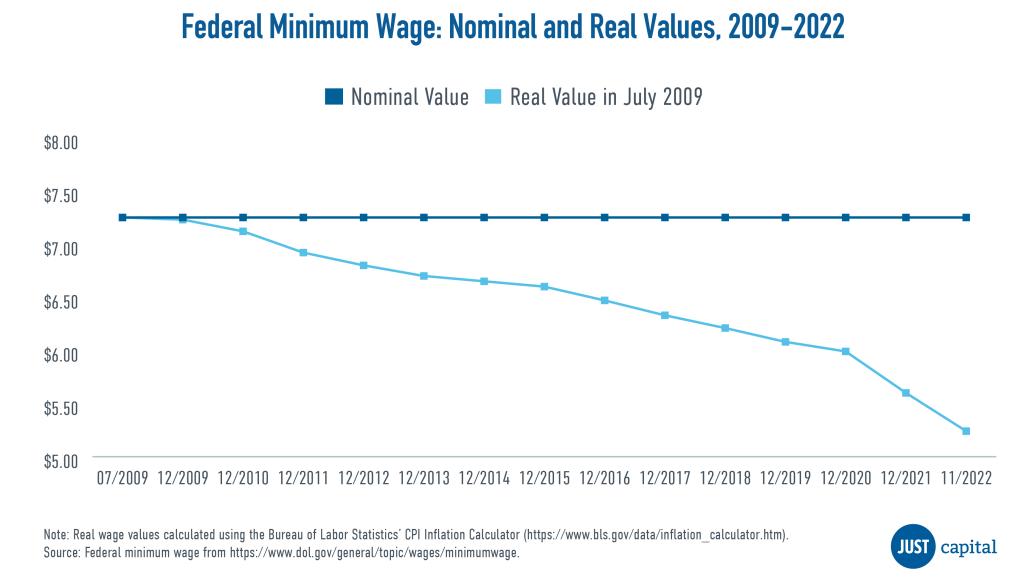
This chart comes from our latest article explaining why companies should raise wages to match inflation. Nowhere is the difference between nominal and real values in wages more stark than with the minimum wage, which has had a 28% reduction in purchasing power since 2009.
JUST Capital’s polling of the American public and current policy debates continue to emphasize the importance of inflation and worker wages. We recently featured new data analysis showing low disclosure among the Russell 1000 companies on minimum wage rates and public minimum wage increase announcements resulting in real wage gains, and we also wrote a Fortune editorial dispelling the wage-price spiral myth and making the case that companies can unlock business value by regularly raising employee wages to match inflation.
This week, the Bureau of Labor Statistics reported that the headline CPI in November increased 7.1% year over year, and the core CPI – excluding food and energy – increased 6%. These were both lower than the figures for October and suggest that inflation is cooling, though price pressures remain throughout the economy. In turn, the Federal Reserve slowed the rate of increase in the federal funds rate to 0.5%, down from 0.75% in previous meetings.
Another highlight from this week is that even though real wages grew from October to November, they still declined year over year – they fell 1.9%, on average, despite nominal wage growth. However, some in the media continue to imply that workers’ nominal wage increases are the main driver of inflation and need to be reduced to lower inflation. This is despite empirical research from the International Monetary Fund showing that nominal wages can continue to increase while inflation declines, allowing real wages to eventually grow, and Federal Reserve Bank of San Francisco President Mary Daly saying last month there is no evidence of a wage-price spiral. In addition, household debt has reached multi-year highs, and the personal savings rate has dropped precipitously to its lowest since 2005.
Only time will tell if the Federal Reserve is able to achieve a “soft landing” or if it will push the economy into a recession. It is worth emphasizing, however, that even though inflation will likely decline further in 2023, it will remain above the Fed’s 2% target, which will continue to negatively impact family budgets if real wages continue to decline.
Within this context, to help investors, companies, and workers understand the relationship between inflation and wages, we are presenting three charts to concisely show how inflation reduces the purchasing power of wages and causes pay cuts for workers over time.
1. Inflation Reduces Purchasing Power
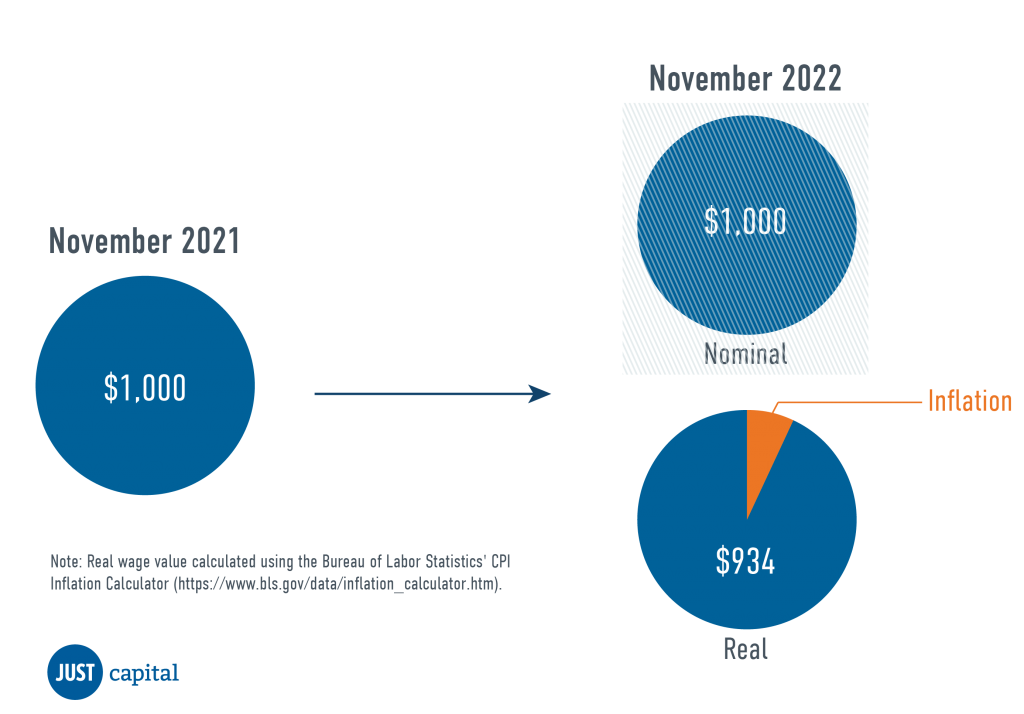
Imagine the following scenario. You have $1,000 in cash in November 2021. You don’t spend it, so you still have $1,000 in cash in November 2022. But because annual inflation was 7.1%, that money is really worth $934 in November 2021 dollars. $1,000 is the nominal value, and $934 is the real, and the real value is what matters for workers and companies.
2. Without Wage Increases, Inflation Causes Pay Cuts for Workers
We can see how inflation affects wages by looking at nominal and real values over time. When wages are not increased, their real value, or purchasing power, declines. Because the federal minimum wage has not been raised since July 2009, when it was set at $7.25 per hour, its real value has dropped, and in November 2022 it had a purchasing power of $5.24 in July 2009 dollars. This means that a worker earning the federal minimum wage has effectively received a 28% pay cut over the past 13 years due to inflation.
3. Even With Wage Increases, Inflation Causes Pay Cuts for Workers in the Period Between Each Increase
Even when wages are adjusted upwards by wage increases, inflation causes the real value of wages to decline in the periods between wage increases. First Republic Bank offers the highest publicly announced minimum wage rate among the R1000 companies at $30 per hour, and it has granted three wage increases since January 2016. But as can be seen, inflation causes a pay cut for workers in the periods between each increase, and the real value of wages is one of peaks and valleys due to inflation. In addition, that pay cut is amplified when the inflation rate is higher (i.e., compare the steepness of the curve from March 2021 to November 2022 compared to the previous two periods between wage increases when inflation was lower).
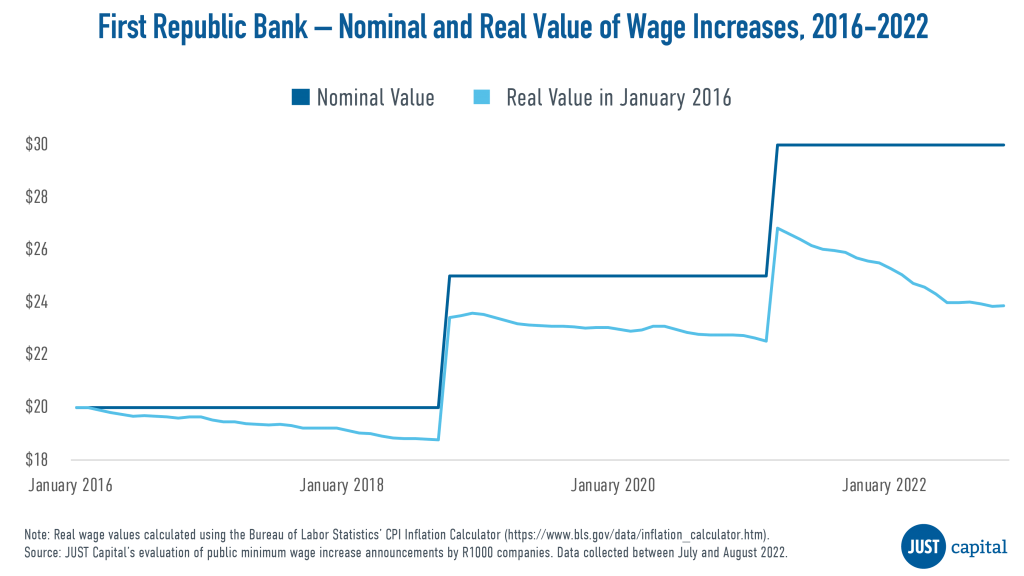
These charts show how inflation reduces the real value of wages over time. This hurts American workers, who effectively receive pay cuts, as well as American companies, which potentially face lower employee satisfaction, retention, and productivity. Regardless of how successful the Federal Reserve will be in achieving a “soft landing” in 2023, businesses can unlock value by understanding this relationship between inflation and wages and regularly raising employee wages to match inflation, benefitting workers, companies, and the U.S. economy at large.
(Scott Olsen/Getty Images)
When we asked them what makes a company just, the American public – across all demographics, including political affiliation – prioritizes fairness in compensation, in its broadest sense, above all else. And as our Senior Manager of Workplace Policies Research, Matthew Nestler, writes in Fortune this week, 87% of those we survey believe it’s a company’s responsibility to increase wages to keep up with the rapidly rising cost of living (including 93% of Democrats and 76% of Republicans).
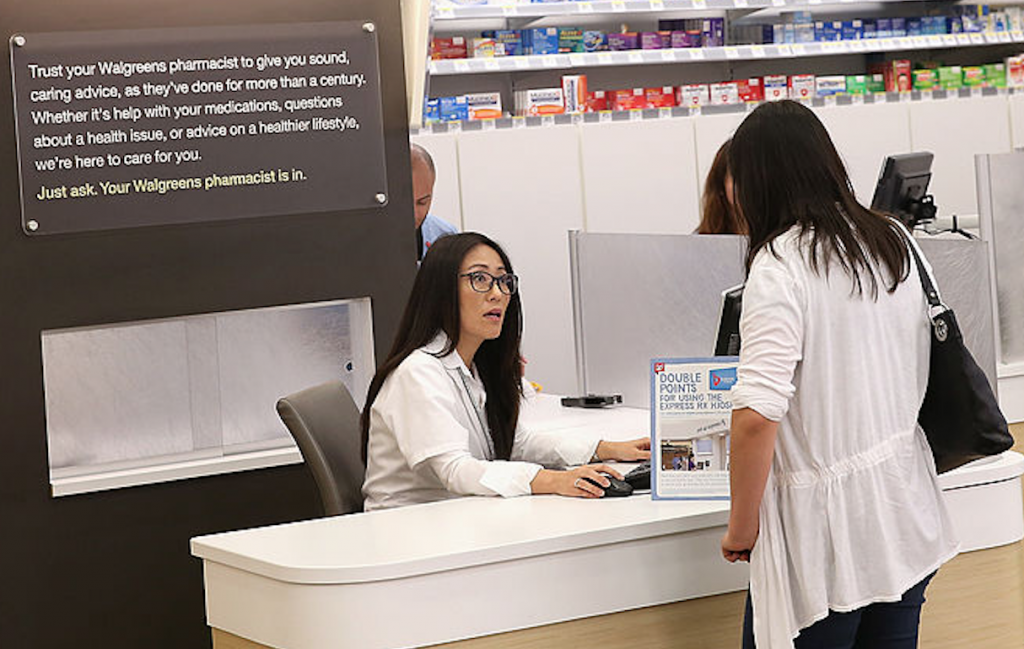
Research from JUST and others has highlighted how relevant wage strategy is to business performance. A new survey report from Mercer found that 48% of retail and hospitality workers surveyed were considering leaving their jobs, and 59% of those said it was because their pay was too low. Yet we also know from our latest disclosure research that while Walgreens and VailResorts announced large real wage increases for their workers, and US Bancorp and Costco have announced multiple wage increases over time, most companies have not been transparent about their approach to pay.
Years ago when we were launching JUST, I remember the CEO of a large bank told me in no uncertain terms that there was “no chance” companies would ever be transparent about wages. Certainly, disclosure about wages overall remains very poor. Only 13% of America’s largest companies disclose some data about their employees’ hourly wages, and a mere 9% disclose the exact value of the minimum wage paid to their U.S. workforce. But mindsets are definitely changing. As the business case for “fair” wages becomes more compelling, and as companies themselves seek to build trust in their leadership on worker issues overall, expect more and better wage data to be forthcoming.
Be well,
Martin Whittaker

Amazon receives orders from a judge in the Eastern District of New York that it must stop retaliating against employees engaging in unionization efforts on Staten Island.
DoorDash announces layoffs for 1,250 corporate employees after growing too quickly during the pandemic.
HP cuts up to 6,000 jobs as computer sales fall and dampen the company’s outlook.
Rolls-Royce tests the first hydrogen-fueled aircraft engine, an important step to decarbonize flying.
Vail Resorts achieves its 100% renewable energy goal and stays on track for a net-zero operating footprint by 2030.

(Fortune)
Martin sat down Wednesday with Fortune’s Finance Deputy Editor Lee Clifford at the Fortune Impact Initiative on Thursday to talk about how companies need to move from “Rhetoric to Reality” to make sure capitalism works for more people and restore faith in business and markets.
Bruce Simpson and Talia Varley feature JUST in a worthy read in Harvard Business Reviewabout how companies can partner with nonprofits to improve their capabilities on critical issues like stakeholder performance and product innovation.
JUST Board member Peter Georgescu has an editorial in Forbes on lessons learned around how capitalism needs to, and is currently evolving, through the passion and commitment of emerging new leaders. And JUST advisor Hubert Joly discusses in Fortune why, despite challenging headwinds, this should be business leaders’ “finest hour” to connect their purpose with innovative growth opportunities.

(Chip Somodevilla/Getty Images)
“I view empathy as a hard skill. It’s not soft. This isn’t about being nice. This gives you a competitive edge. Empathy in our workforce has enabled us to attract and explore and retain an extraordinarily diverse group of people in our organization. We’ve become an employer of choice. People want to work here because of the positions that we’ve taken.”
– Jane Fraser, CEO of Citigroup, speaking on Fortune’s Leadership Next podcast on making empathy a key initiative at a U.S. bank.
“Real wages on average are falling, not rising. We don’t have one of the fundamental ingredients of a wage-price spiral, which is wages rise with inflation and it’s a vicious cycle upward. We don’t see that.”
– Mary Daly, President of the Federal Reserve Bank of San Francisco, speaking to reporters about wages as a cause of inflation.
“I think more venture capital money will be going into decarbonization. It’s not going to go to all this stuff that provided us good utility to get food quicker, or find a taxi sooner. I think it will be much more hard science, and require a lot more technical understanding.”
– Larry Fink, CEO of BlackRock, speaking at the New York Times’ DealBook Summit, on the future of venture capital post-FTX.
Late yesterday, the senate approved a bill enforcing a railroad labor agreement ahead of the strike deadline, without the paid leave provision.
The New York Times reports on the shift toward stakeholder capitalism-focused curriculums at some of America’s most elite business schools. Wharton and Harvard are among campuses introducing MBA majors in DEI and ESG.
The need for a college degree is coming into question at companies such as Alphabet, Delta, and IBM. A tight labor market has pushed employers to hire candidates with relevant skills and experience rather than higher education credentials. U.S. job postings requiring at least a bachelor’s degree were at 41% in November, down from 46% at the start of 2019.
While potential job opportunities are opening up for some workers, demand for remote work is outpacing supply. The Washington Post reports on the drying up of the work-from-home economy and the continued push and pull between companies and job seekers in the post-pandemic labor market.
As layoffs mount for the tech giant, contract employees at Meta worry about their futures. Forbesreports on the workers who provide auxiliary services to the company and the instability they face without the same benefits afforded to full-time employees.

Despite the fact that our polling shows 89% of Americans favor the release of minimum wage rates for frontline and entry-level workers, only 9% of companies in our latest analysis disclose the exact value of the minimum wage paid to their U.S. workforce. The good news? Transparency is on the rise as evidenced by the chart above. Explore our latest wage analysis.
Dr. Amy Glasmeier
Professor of Economic Geography and Regional Planning and Founder of the Living Wage Calculator, MIT
JUST Advisor
Dr. Amy Glasmeier is professor of Economic Geography and Regional Planning at MIT’s Department of Urban Studies and Planning (DUSP). She also runs LRISA, the lab on Regional Innovation and Spatial Analysis, in DUSP. Amy is also a Founding Editor of the Cambridge Journal of Regions, Economy and Society, a journal which publishes multi-disciplinary international research on the spatial dimensions of contemporary socio-economic-political change.
Amy developed the Living Wage Calculator at MIT, a tool employers and others can utilize to determine local living wage rates, in 2004. The Calculator and Amy’s expertise and research has supported the Worker Financial Wellness Initiative. She recently co-authored a JUST Jobs Explained piece with the JUST team, breaking down what a living wage is and why it’s an important compensation benchmark for businesses.

(Mario Tama/Getty Images)
I’ve spent much of the week talking to business leaders about what Tuesday’s election results could mean for corporate stakeholder leadership. The answer – like the outcome of a few key races – is not yet clear, although with the balance of power in the House and the Senate certain to be evenly distributed it’s unlikely there’ll be any fundamental shifts in company strategy required.
The general sense is that if a thin Republican political majority does materialize as expected in the House, hearings on the anti-ESG agenda are likely and CEOs would be summoned to testify. The business case for stakeholder leadership will therefore come under the spotlight – and perhaps that’s not a bad thing. Our research shows the case is pretty clear. A divided Congress also means CEOs will continue to be more cautious of making public statements on divisive issues, and may even embolden some to oppose ESG regulation. On climate, support for domestic fossil fuel production will increase, although a lack of governing majority means that “the policy status quo (on clean energy) remains fundamentally intact for the next two years,” as Goldman Sachs notes. Efforts to regulate ESG disclosure may come under closer scrutiny.
Perhaps the biggest takeaway, however, is that voters on both sides are concerned mostly about core inflation and economic issues. This year’s Americans’ Views on Business Survey, out this week, supports this view, along with our 2022 Issues Survey that focused on kitchen table issues like fair wages and good jobs. It is the most powerful bridge there is, and one where business can really lead by example. Suzanne P. Clark, President and CEO of the U.S. Chamber of Commerce, put it this way in a statement on the election results: “It has never been more important for elected officials to address our nation’s challenges by bridging divides and forging durable solutions – just like business leaders across this country do every day.”
For companies the best approach for now would therefore seem to stay focused on the thing that we know really matters: supporting their workers’ economic well-being.
Be well,
Martin Whittaker

Home Depot workers voted against forming its first store-wide labor union in Philadelphia.
Macy’s plans to invest $30 million into minority-owned businesses over the next five years.
Meta lays off 11,000 workers, or nearly 13% of its staff, and will extend its hiring freeze into Q1 2023.
Salesforce lays off hundreds of employees on Monday after demand lightens in some countries and industries.
Stripe lets go of 14% of its staff, but is praised by HR professionals for its humane approach, especially compared to other companies like Twitter.
This week we released our in-depth 2022 Americans’ Views on Business Survey Report, which provides unique and critically important insights into how everyday Americans think about business today, and when viewed in the context of our previous seven years of polling – how it has shifted over time. For instance, perceptions on whether capitalism is working for the average American plummeted 10 percentage points this year, with a stark difference in demographics. Peter Vanham at Fortune covered the report this week in the new Impact Report newsletter.
Martin joined Leslie Norton and John Hale from Morningstar on Twitter Spaces to discuss the election results and what they mean for ESG, as well as his thoughts on COP27. (The conversation starts at 4:40 in the recording.)
The data on the impact of human capital management is paltry. That’s why we’ve teamed up with the Ford Foundation and have opened up a request for grant proposals focused on advancing human capital management research and accessibility. Help us improve our collective understanding of how companies manage and support their workforces, and how it impacts their bottom line. Submit your proposal now through December 9!

(Fortune)
“This is about driving those four constituents [customers, employees, shareholders, and the larger community] in a way that aligns capitalism to what society needs from us. So that people see the value of capitalism.”
“With the talent wars so strong, we’ve needed to find other good avenues for recruiting folks. And guess what? We already have that with our veterans pipeline. They have great transferable skills, plus they bring additional skills of leadership, flexibility, dedication and all the other intangibles that veterans bring. So in 2021 and 2022, we’re up almost 400% in veteran hiring, versus 2020 and earlier years.
“Government targets, supporting policies and transition plans can provide clarity, predictability and the competitive landscape to encourage more businesses to take action and to make transition-aligned investments.”
Joe Nocera explores in NYT DealBook what the midterms results could mean for business, and the Financial Times describes how U.S. companies are preparing for a potential wave of congressional hearings to investigate businesses’ environmental and social positions.
Al Gore and David Blood of Generation Investment Management pen an editorial in the Wall Street Journal explaining why ESG investing is consistent with fiduciary duty, and Leslie Nortonat Morningstar builds a strong case for why ESG and sustainable investing won’t be stopped and will survive the current demonization and backlash.
Axios reports that to the extent that layoffs are underway, it’s currently largely contained to one sector – tech. Fortune and leadership consultant Scott Monty take a closer look at what Twitter(and others) could learn from how Stripe handled their layoffs.
Gizmondo reports on Microsoft’s push to create more climate-smart workers, finding that at most companies, “60% of sustainability team members joined without expertise in the field.”
The Wall Street Journal creates a compendium of all of its ESG coverage over the last several years.
Forbes counts down the Best Employers for Veterans.

With U.S. midterm elections dominating the news cycle, we’re showcasing one of the many charts from our 2022 Americans’ Views on Business Survey Report, which shows that even across political affiliation, Americans are more aligned than we may think when it comes to how they want companies to be supporting their workers. Explore the insights here.


Team JUST Capital had a blast running the New York City Marathon and raising $35k ($10k over our goal!) to create a more JUST economy. Here are some pictures from the day – and feel free to check out our Team JUST Capital fundraising page if you still want to donate.
The Americans’ Views on Business Survey was written by Jennifer Tonti, Managing Director of Survey Research & Insights.
As 2022 draws to a close, Americans are faced with a number of uncomfortable economic challenges, including fears over job security and layoffs, stubbornly high inflation, a looming recession, and a political climate rife with rancor and division. Suddenly, the already precarious path to prosperity for tens of millions of people seems even more out of reach.
Such is the backdrop to our Annual Survey on the Priorities of the Public, in which we poll Americans about their Views on Business – specifically, whether they think America’s largest companies are moving toward creating a more just economy and society. Since 2015, Just Capital has surveyed more than 160,000 Americans on a fully representative basis. This survey not only gives us unique and critically important insights into how Americans think about business today, it also gives us a pulse on their hopes and fears, and – when viewed in the context of our previous seven years’ of polling – how each have shifted in time.
In our 2022 Issues Report –The People’s Priorities we found that that across every demographic group, whether political affiliation, race, gender, age, or income group, Americans are united in wanting companies to prioritize Workers as the most important stakeholder and Paying a fair, living wage as the most important business Issue today.
In this companion survey, we find that Americans consistently believe that companies remain firmly wedded to the shareholder primacy model and that there continues to be a basic mismatch between what the public wants companies to prioritize (their workers) and what they perceive companies are actually prioritizing (their shareholders).
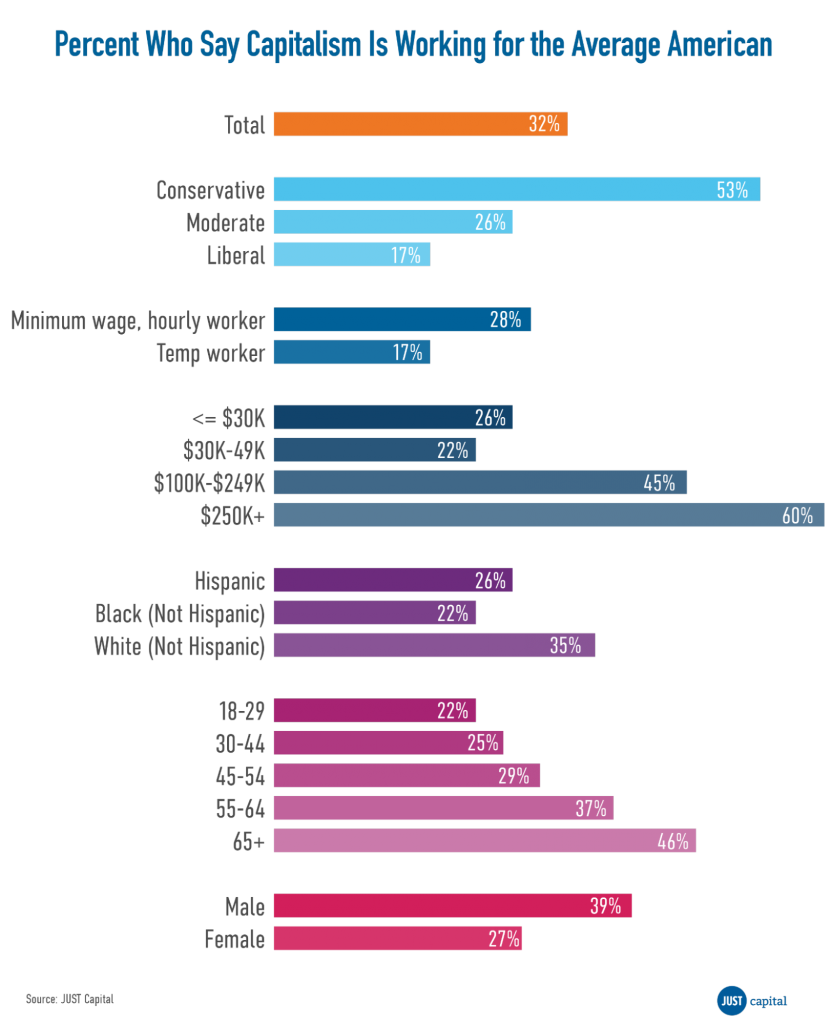
We also find that perceptions on whether capitalism is working for the average American plummeted 10 percentage points this year, with a stark difference between those who think capitalism is working (high-income workers, older Americans, Conservatives), and those who do not think capitalism is working (lower-income and hourly workers, Black and Hispanic Americans, younger Americans, and Liberals).
As Edelman saw in its new study, “The Changing Role of the Corporation in Society,” Americans believe businesses and CEOs have a role to play in addressing societal issues, agreeing most when it comes to tackling issues like gender equity in the workplace (equal pay), income inequality, and advancing racial equity. CEOs may experience more pushback when taking a stand to address issues like protecting LGBTQ rights, women’s reproductive rights, and climate change, as the political polarization around those issues is high.
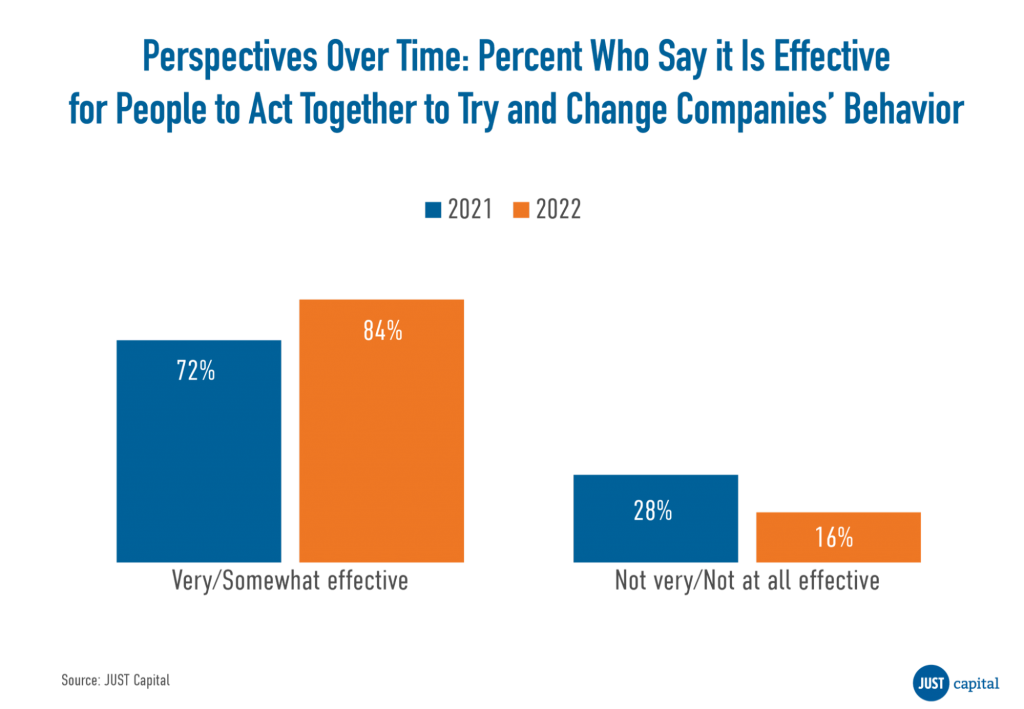
Despite an uptick in positive impressions during the first year of the COVID-19 pandemic that companies were stepping up to take care of stakeholders, Americans are now less likely to think companies are following through. They also expect business to talk less and act more. The good news: 81% of Americans believe that business can be a powerful force of societal change and 84% believe people can be effective when they act together to try to change companies’ behaviors. Americans are also willing to support change and help companies transition toward a just economy by paying more for just products and even accepting less pay to work for just companies.
In this year’s survey, we unpack these trends in detail, seeking to understand what matters most to Americans today, against the backdrop of our shifting economic and societal climate, and what corporate leaders should prioritize to live up to the expectations of the public. Let’s take a deeper look at the data.
More than two in three Americans (68%) say that “our current form of capitalism is not working for the average American,” a 10-point increase in negative sentiment from just one year ago. In its recent survey on how Americans perceive capitalism, Pew Research similarly finds modest declines.
In a recent talk, PayPal CEO Dan Schulman discussed why capitalism needs an upgrade, warning, “To many people who are left out of the system, who struggle to make ends meet and don’t believe in the American dream anymore, they tend to radicalize to the far left or far right. So how do we strengthen our democracy by thinking more broadly?”

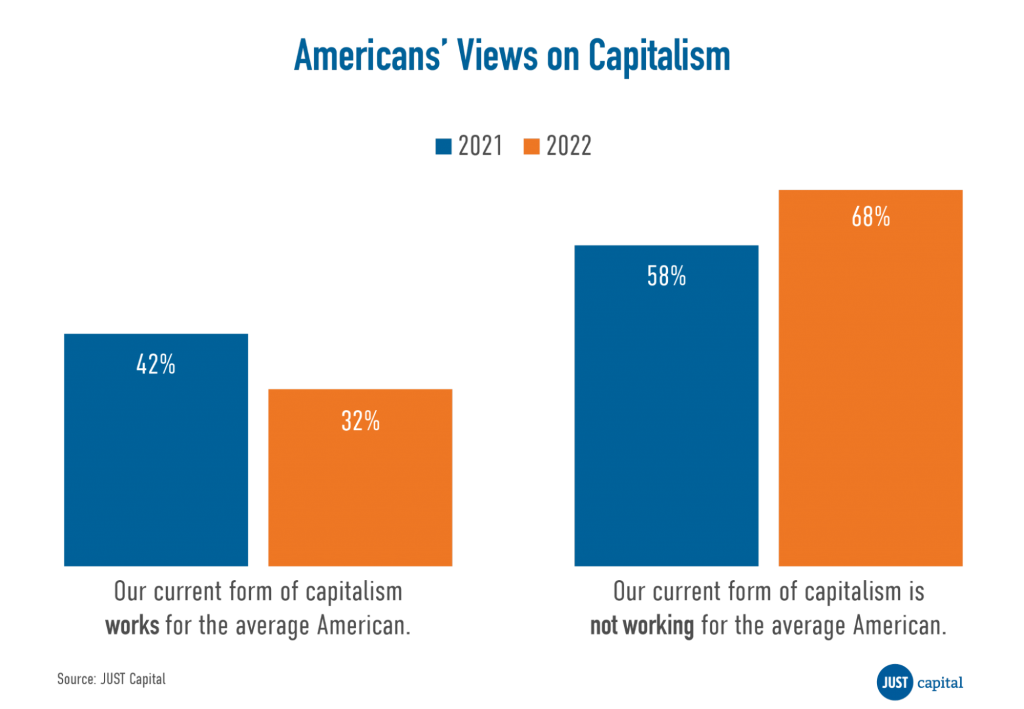
When we look across demographic breaks, we find substantial differences in Americans’ opinions of whether capitalism is working. Lower-income and hourly workers, Black and Hispanic Americans, temp workers, younger Americans, and Liberals are all far less likely to agree that “our current form of capitalism works for the average American” than white Americans, older Americans, those in high income households, and Conservatives.
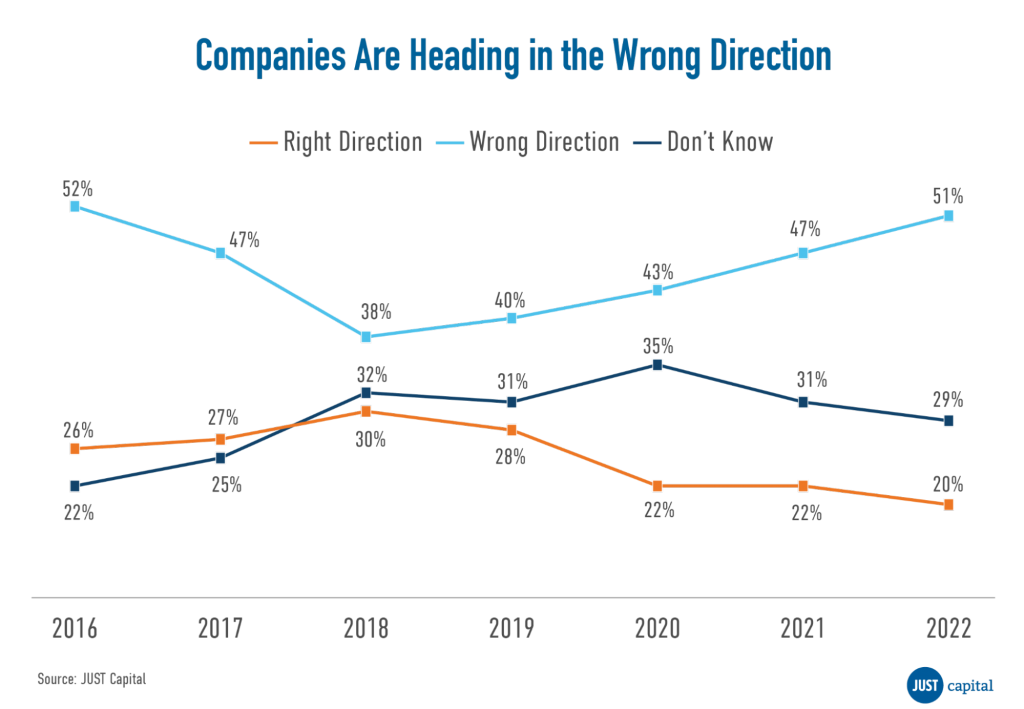
Americans agree that companies are on the wrong path, with just 20% agreeing that they’re heading in the right direction – a downward trend from a high of 30% in 2018. What’s more, over half of Americans (51%) now say companies are headed in the wrong direction, a steady trend upward, and a 13 percentage point increase, since 2018.
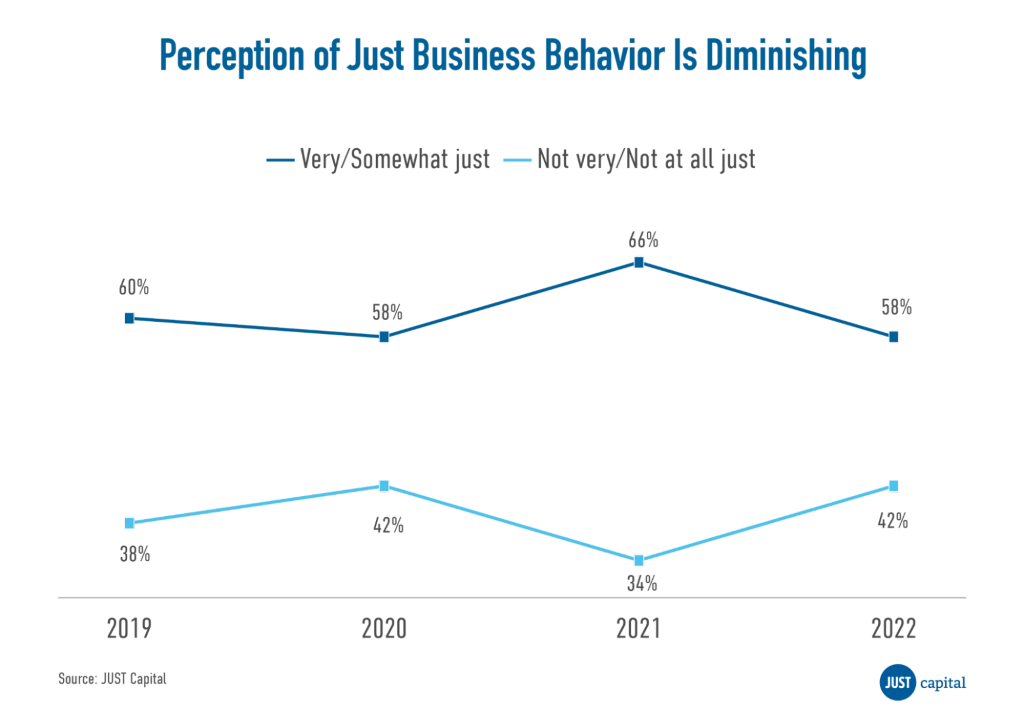
With regard to just business behavior specifically, more Americans (58%) say that companies are very or somewhat just than say they are not very or not at all just – however, that number is down from a high of 66% in 2021.
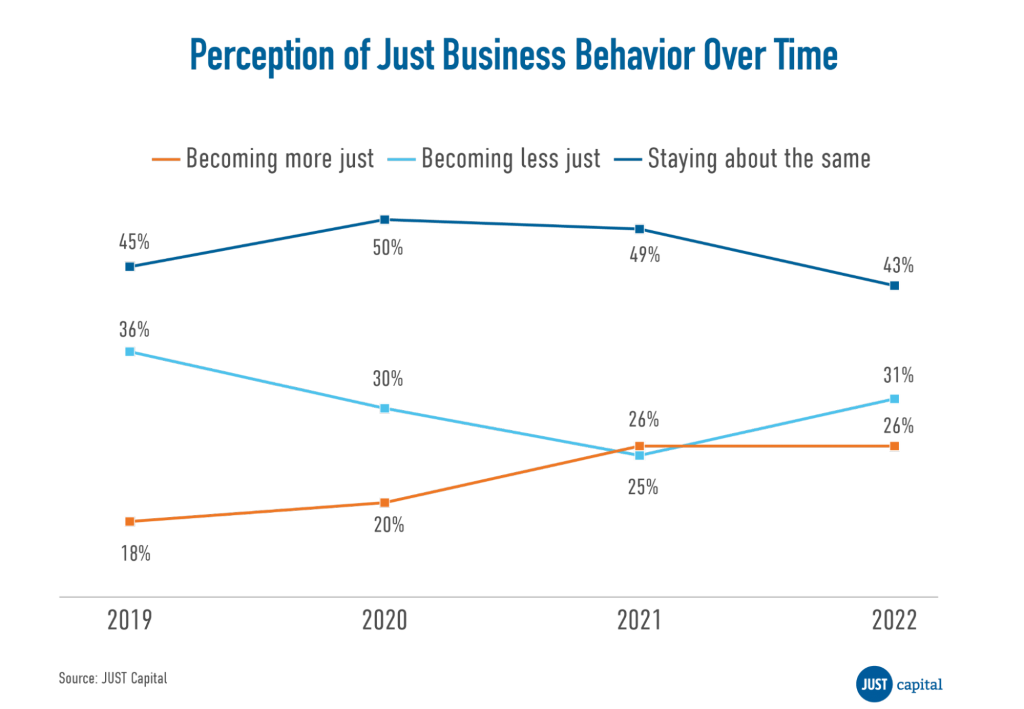
When we ask the public whether they think companies are becoming more or less just over time, even though a plurality say that they have stayed about the same, the percentage 0f respondents who say companies are becoming less just has grown in the past year, from 26% in 2021 to 31% in 2022.
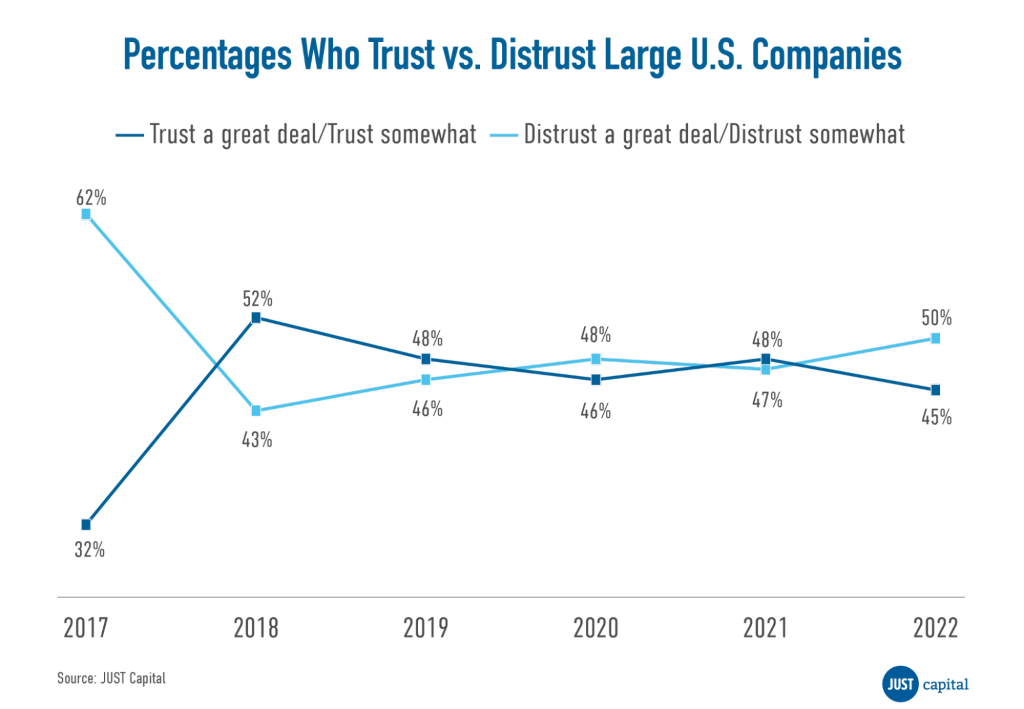
The proportion of Americans who trust versus distrust large U.S. companies had been roughly the same over the past few years, but in 2022 that changed, with more Americans now saying that they distrust companies (50%) than trust them (45%).
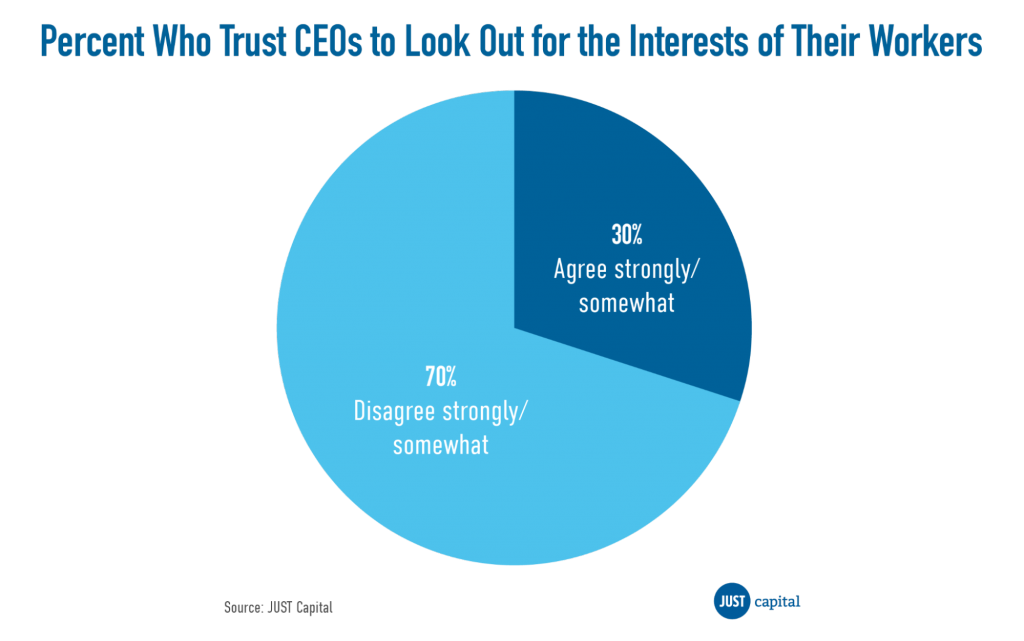
We see these findings further confirmed by a new question we asked this year – if people trust CEOs to do right by their employees – and only about one in three agreed that they “trust CEOs to look out for the interests of their workers.”
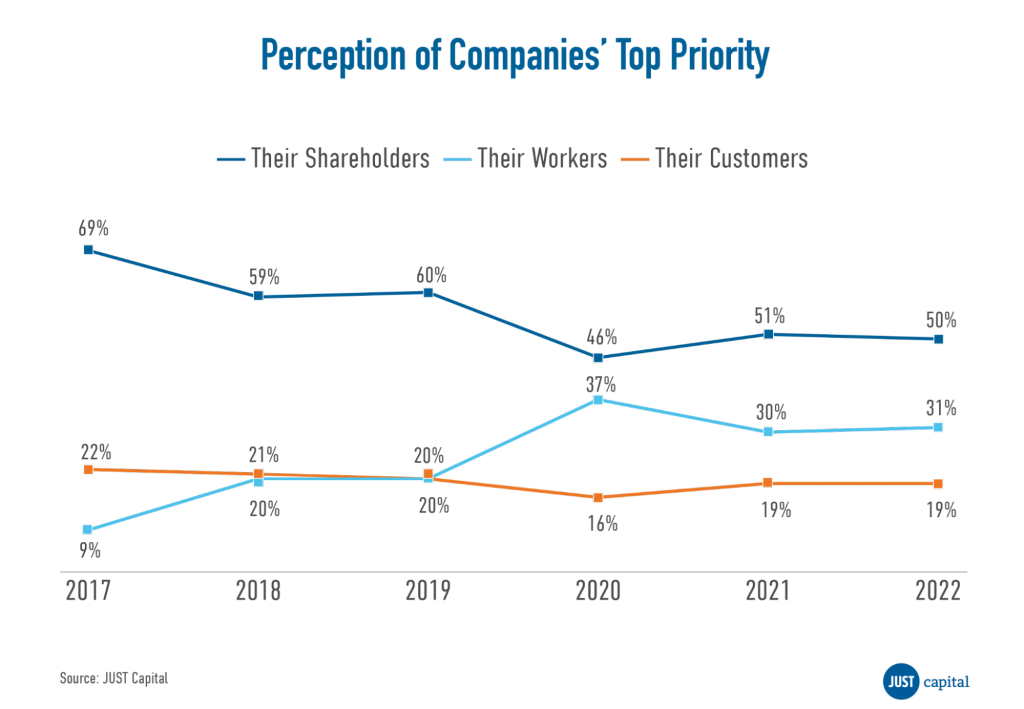
A key question in our Americans’ Views on Business survey asks the public’s thoughts about which stakeholder – shareholders, customers, or workers – they think companies prioritize most. For six years running, and by a significant but varied margin, half of Americans say that shareholders are the top priority in companies’ eyes, versus 31% who say workers and 19% who say customers. When comparing these responses to what the public said in our Annual Survey six years ago, we see two major changes over time.
First, while the percentage who say employees are the top priority has grown substantially, from 9% to 31%, the uptick in this view has now waned since 2020. And second, while the degree to which the public believes shareholders are the top priority has diminished – from 69% in 2017 to 50% in 2022 – it has actually risen since the challenges of 2020. Overall, this paints a picture of an opportunity perhaps lost – or at least not fully captured – by companies to show they are placing workers’ interests at least on par with shareholders’.
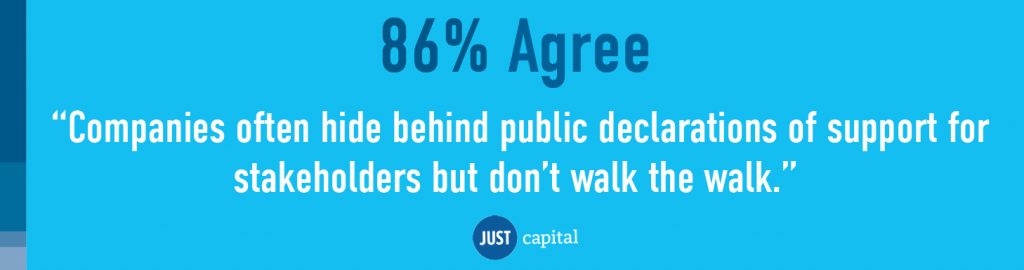
In keeping with these findings, the public also agrees that companies are not living up to their commitments to take action on critical societal challenges. In the two years since the Business Roundtable announced a movement away from shareholder primacy, our data show that the public remains skeptical on whether America’s largest companies are actually following through on their commitments to a stakeholder model, with 86% agreeing that companies “often hide behind public declarations of support for stakeholders but don’t walk the walk.”
The following chart shows that the public believes that companies have the most positive impact on their shareholders (75%) at a greater margin than other stakeholders, including customers (65%), the health & safety of their workforce (64%), quality jobs (56%), and local communities (55%).
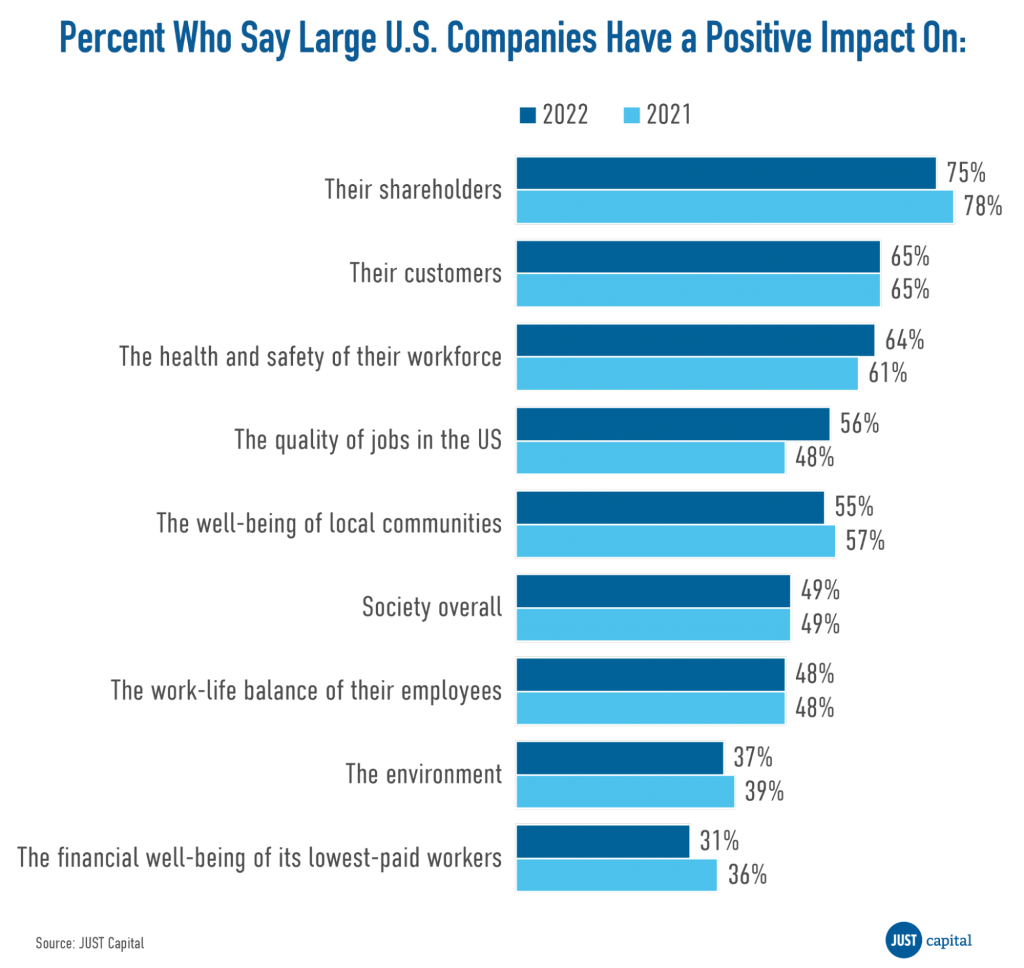
Far fewer say that the environment and low-wage workers are positively impacted by the behavior of large companies. Compare the one in three Americans who say companies have a positive impact on the “financial well-being of their lowest-paid workers” to nearly twice as many who say “their shareholders” in the chart above.
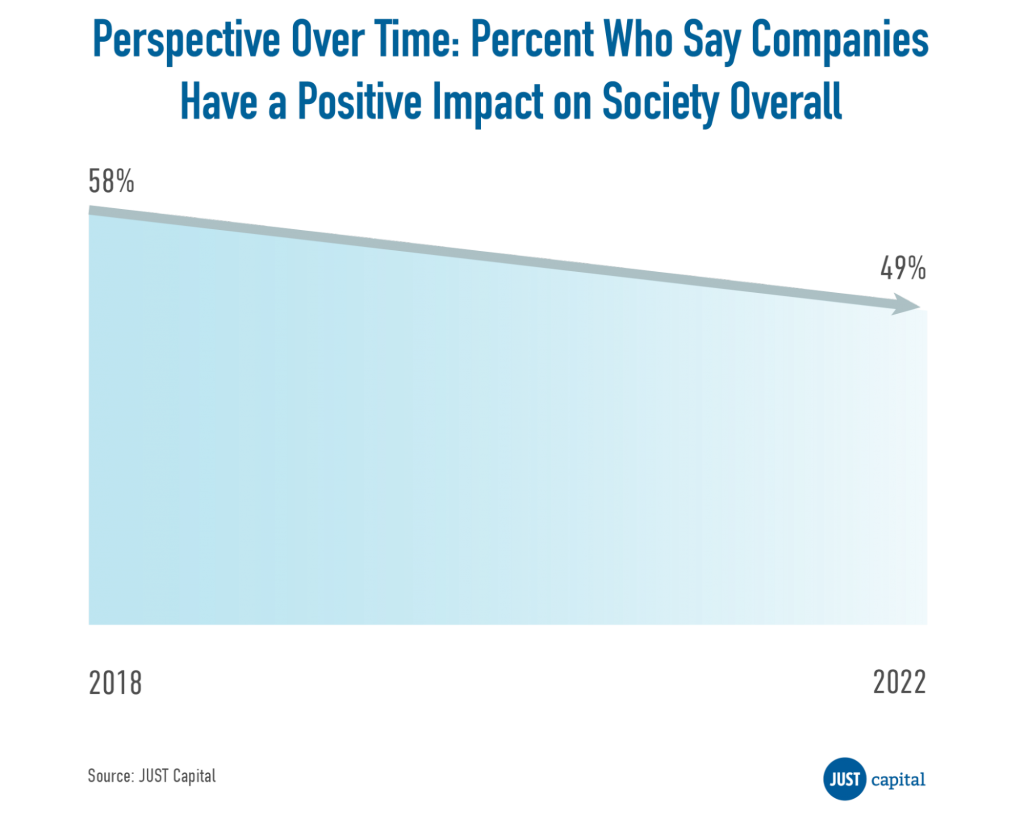
Looking at positive impact measures over time, the public’s perspective is that companies are moving in the wrong direction. For example, the percentage who say companies have a positive impact on society overall has fallen from a high of 58% in 2018 to just 49% of Americans in 2022.
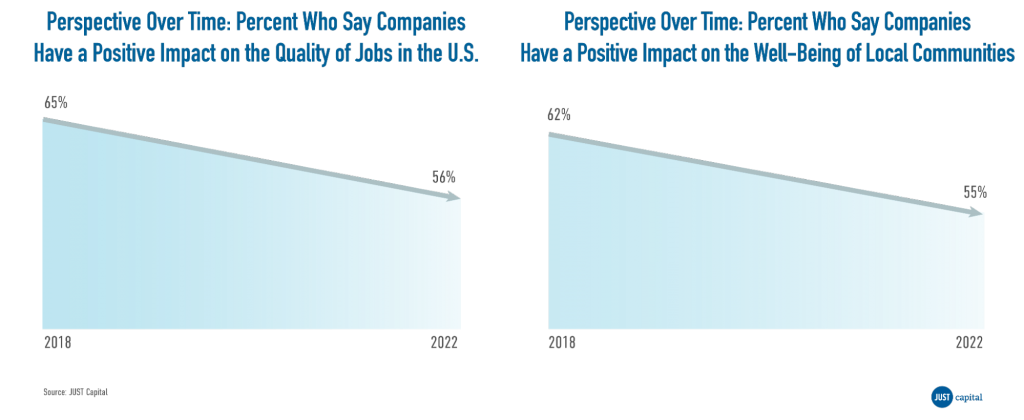
There are similar dips in the percentage of Americans who say companies have a positive impact on the quality of U.S. jobs and the well-being of local communities.
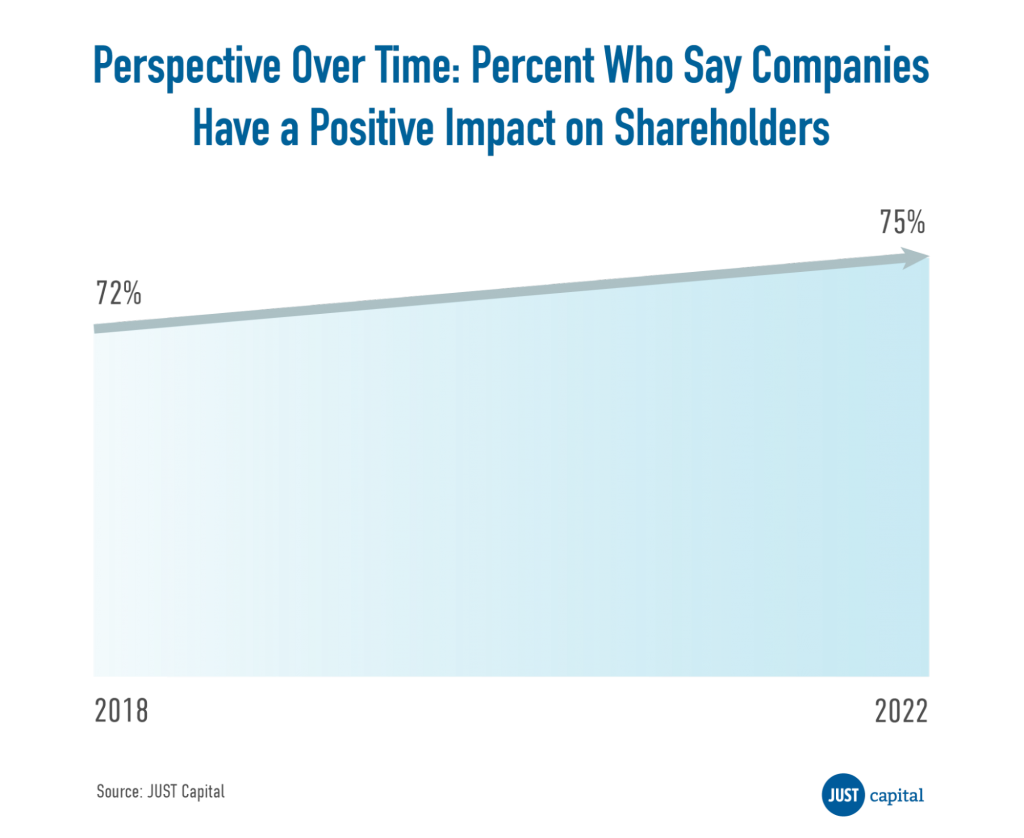
Yet the percentage who say companies have a positive impact on shareholders is substantially higher, and even increases slightly over the past five years.
Workers are the engine of a company, and from our recent survey on workers and wages, it is clear that Americans firmly believe that companies that invest in their workers by paying a living wage are more competitive in their industries, better for the economy overall, and more profitable in the long term. In this survey, we find that Americans again agree that the focus of a just company should be its workforce, with majorities agreeing with the following statements:
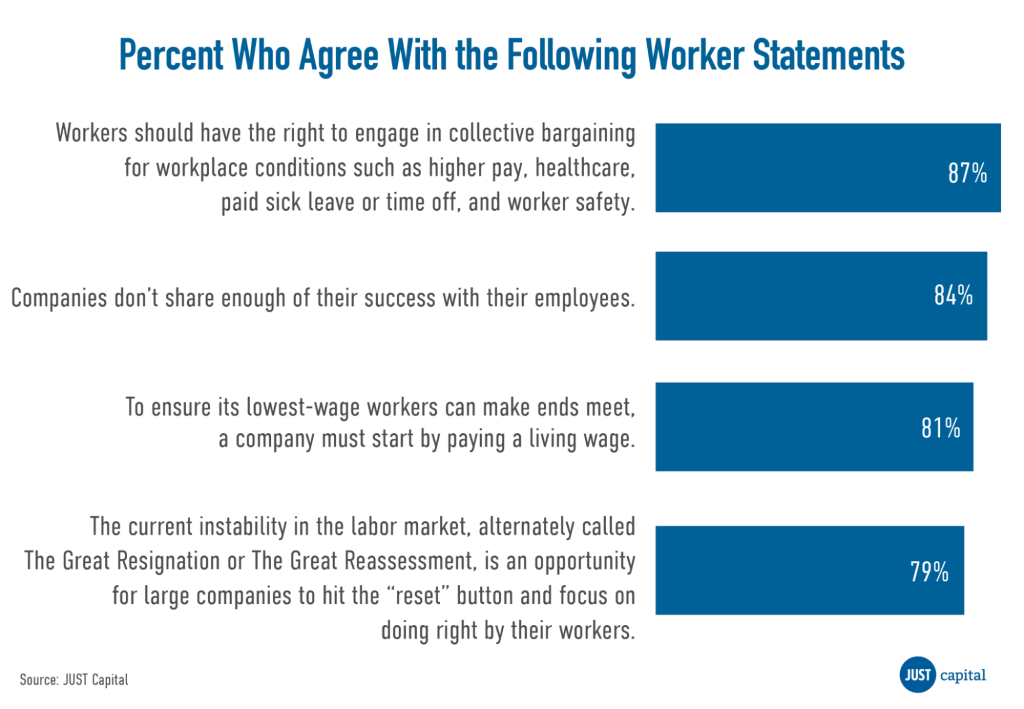
What’s more, there is remarkable consensus on these issues when looking across political divides, suggesting that, despite sentiment that the right and left are polarized when it comes to issues like a living wage or even forms of collective bargaining, liberals and conservatives are more aligned than we might think.
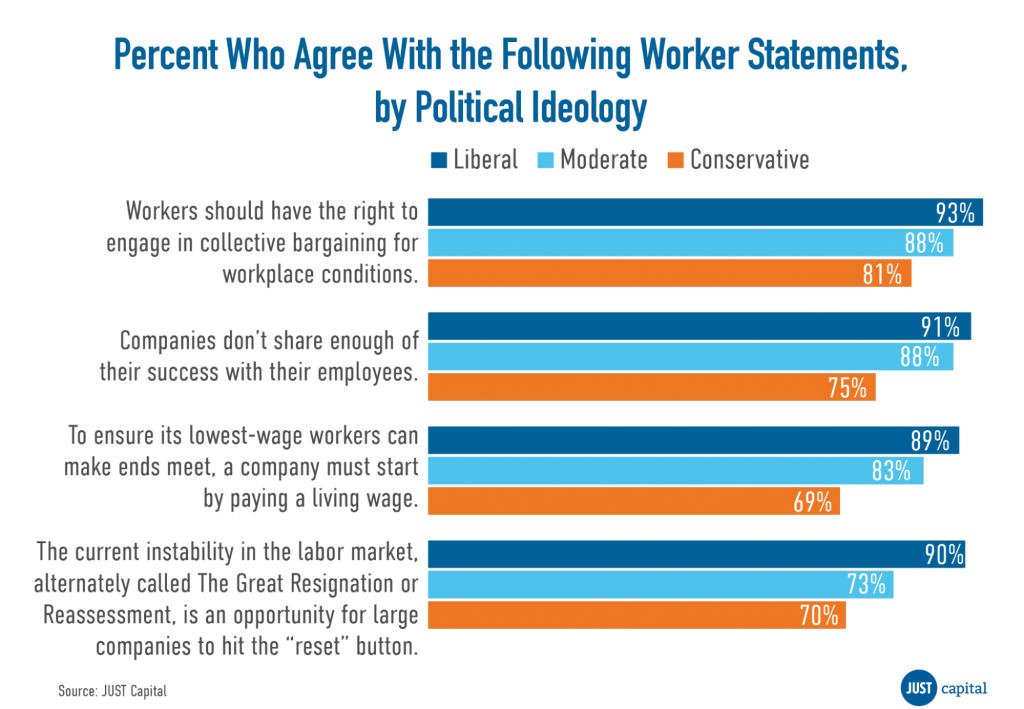
To protect workers’ right to fair treatment, almost nine in 10 say that workers should have the right to collectively bargain for pay and other protections. This strong agreement on collective bargaining tracks with public pollster Gallup, which finds that Americans’ approval of labor unions is at its highest point since 1965.
What’s more, we find that support for unionization of the workforce is consistent across all political ideologies. Consider what Amazon union leader Chris Smalls said at a hearing on Amazon’s labor practices in May of 2022:

Companies looking to stave off unionization trends should assess their workers’ financial wellness to ensure all employees are able to make ends meet. In this survey we heard that more than 80% agree that companies need to pay their lowest-paid workers a living wage – something we’ve seen reinforced with strong agreement from the public in our survey on workers and wages, which found that 84% agree that large companies should pay employees enough to make ends meet. Our 2022 People’s Priorities Survey also echoed this sentiment, with “Paying a fair, living wage” as the #1 Issue for the public, gaining more than 20 percentage points in importance over the last two years.
Inflation and an impending recession are already impacting the lives and pocketbooks of most Americans, meanwhile the lowest-wage workers in the U.S. unfortunately bear the brunt when wages don’t keep up with inflation.

In an effort to better understand the state of corporate America when it comes to paying a living wage, Just Capital has also refined its measurement of this issue for our upcoming 2023 Rankings. Among our initial findings? About half of Russell 1000 employees do not make a family-sustaining living wage.
With job quits rates hovering at about 4 million between August 2021 and August 2022, the phenomenon alternately called The Great Resignation and The Great Reassessment could flourish. To that end, a large majority of Americans think this was a key moment for worker power: 79% agree that The Great Resignation is an opportunity to hit the reset button and focus on workers.
Finally, when it comes to a company’s profits, Americans say that workers are not getting their fair share of the pie: 84% agree that companies don’t share enough of their success with their workers. With profits surging 35% last year, 2021 was the most profitable year for American corporations since 1950. And while employee compensation rose 11%, the so-called labor share of national income – the portion that’s paid out as wages and salaries – fell back to pre-pandemic levels. It’s clear that American workers aren’t sharing in the prosperity they are helping companies create.
In recent years, CEOs have found themselves in the position of needing to speak out on both critical and contentious issues, and the landscape is becoming more challenging to navigate as more politicians attempt to bring companies into culture war issues as the election cycle heats up. To help corporate leaders understand public expectations during these tumultuous times, we’ve asked Americans each year for the last five years if they believe the CEOs of large companies have a responsibility to take a stand on important societal issues. This year, two-thirds of Americans overall – a number that has remained relatively stable in our years of polling – believe CEOs of large companies have a responsibility to take a stand.
There are, however, significant differences in the degree of agreement when looking at this question across political breaks: with far fewer Conservatives agreeing CEOs have a responsibility to take a stand (44%) compared to their Liberal (81%) or Moderate (75%) peers.
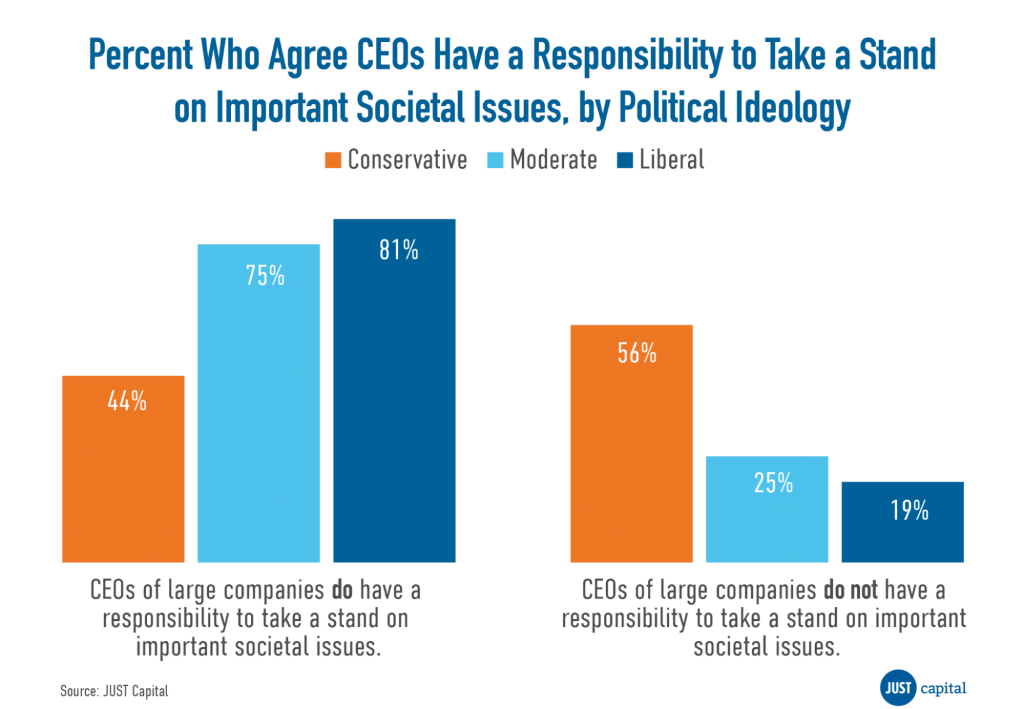
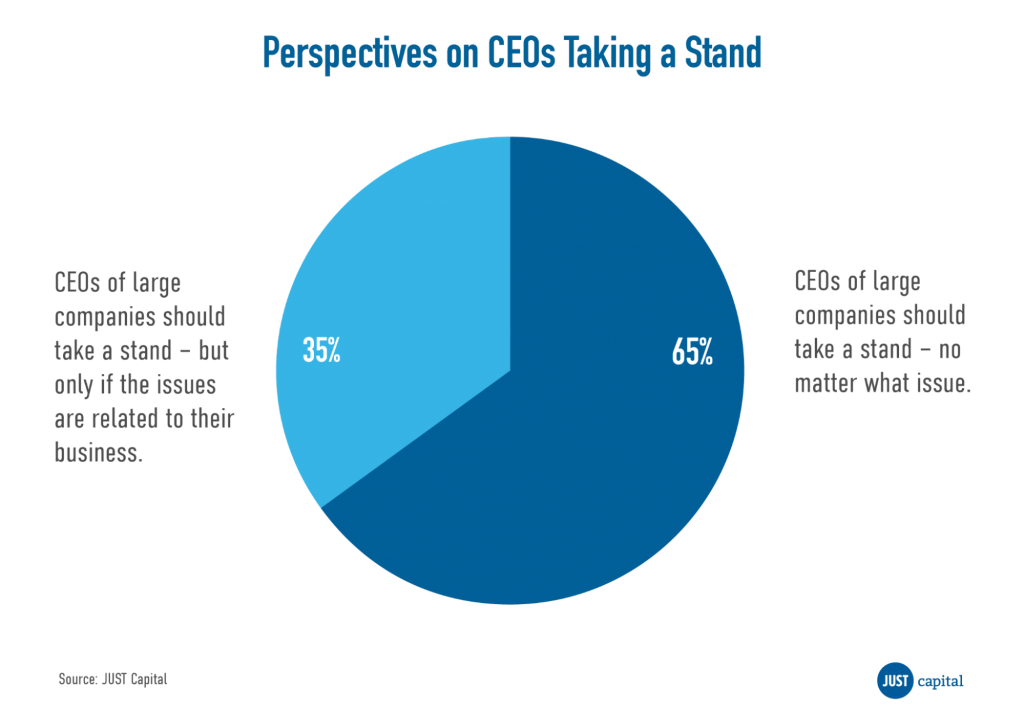
Of the almost two-thirds who say that CEOs have a responsibility to take a stand, another two-thirds of that group says they should do so no matter the issue, rather than focusing solely on issues that directly impact their business.
With a majority of Americans saying that CEOs should take a stand on issues, the question then becomes which societal issues should they address. In response to this year’s survey, a substantial proportion of the public says corporate leadership has a role to play in addressing all of the following issues, with income inequality and gender and racial equity receiving the highest levels of support (77% or more).
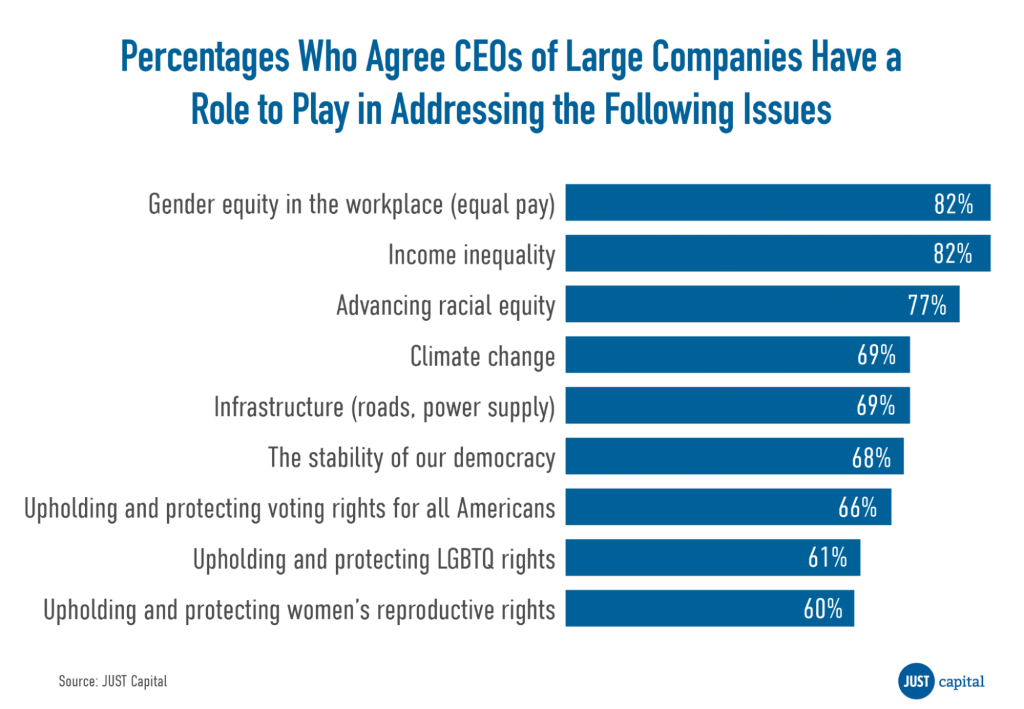
And although majorities say CEOs have a role to play in these issues, there is less consensus when looking across political breaks, with Conservatives less in support of CEOs taking a stand on these specific issues than their Moderate or Liberal counterparts. There is particularly low support from Conservatives when it comes to LGBTQ rights, women’s reproductive rights, and climate change (45% or less).
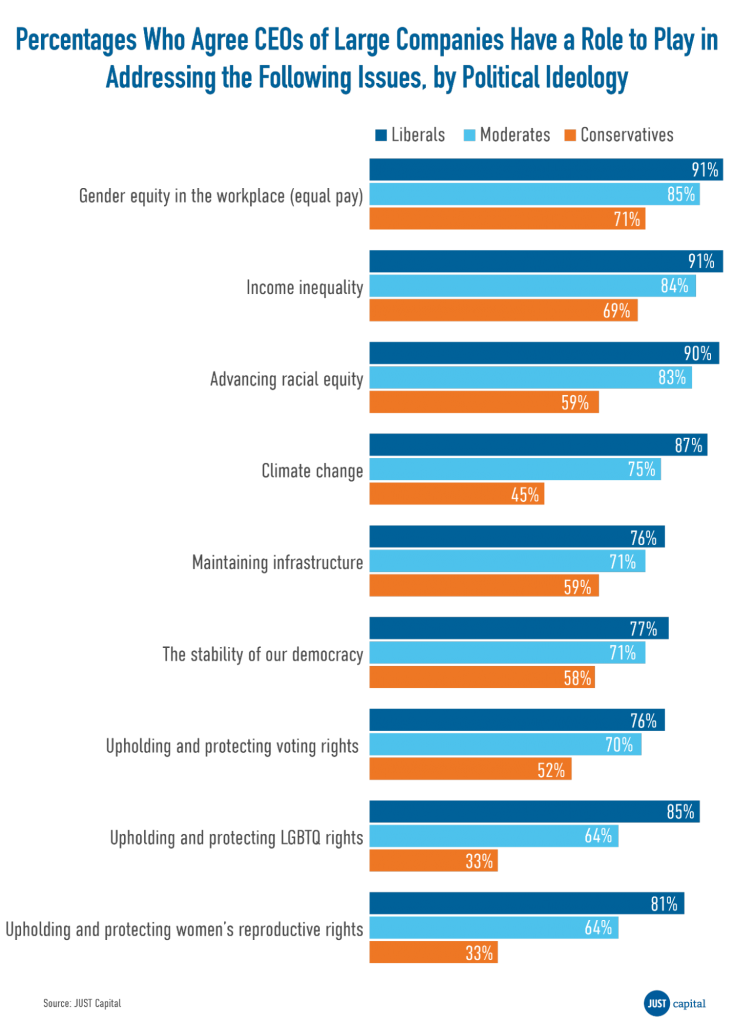
However, for the question of upholding our democracy – an issue that has become increasingly politically divisive – majorities of all three political ideologies agree that CEOs have a role to play in protecting both democracy and voting rights. Those numbers are bolstered by the 72% of Americans who say corporate America has a responsibility to protect the democratic process by promoting free and fair elections.
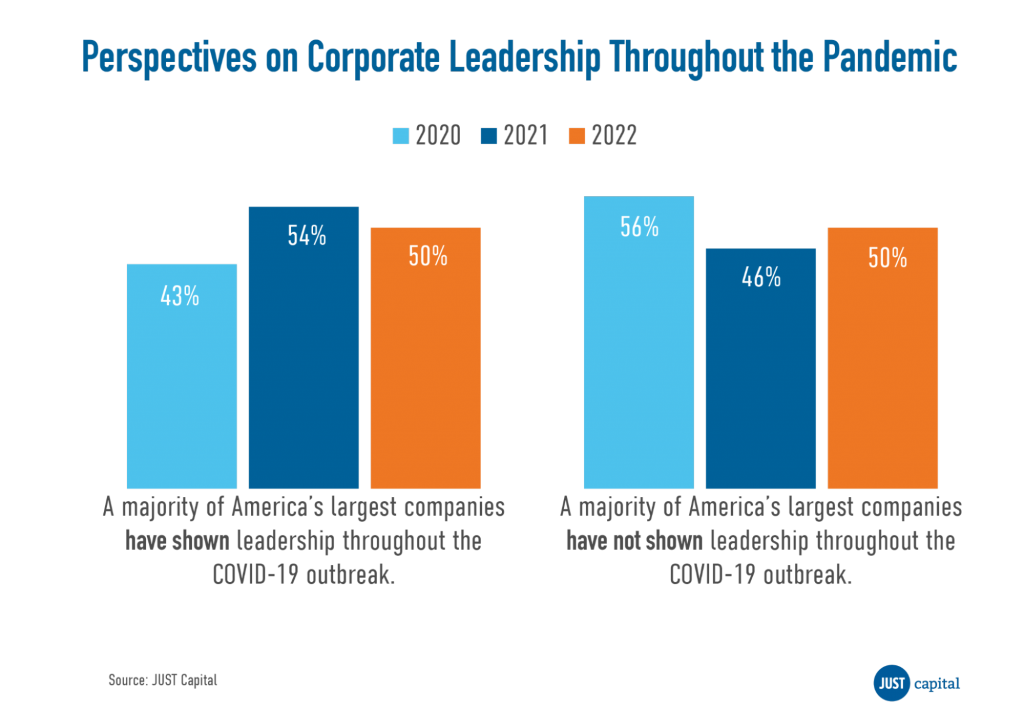
Positive assessments of corporate behavior are also informed by the public’s views on how companies have weathered recent events, including the COVID-19 pandemic. In 2022, half of Americans say companies have shown leadership throughout the pandemic, down from a high last year of 54%.
When we look at another pressing social issue – advancing racial equity – a higher percentage (60%) of Americans say companies are doing well demonstrating a commitment to diversity, equity, and inclusion in the workplace, a number that has stayed steady over the two years that we’ve tracked views on this issue.
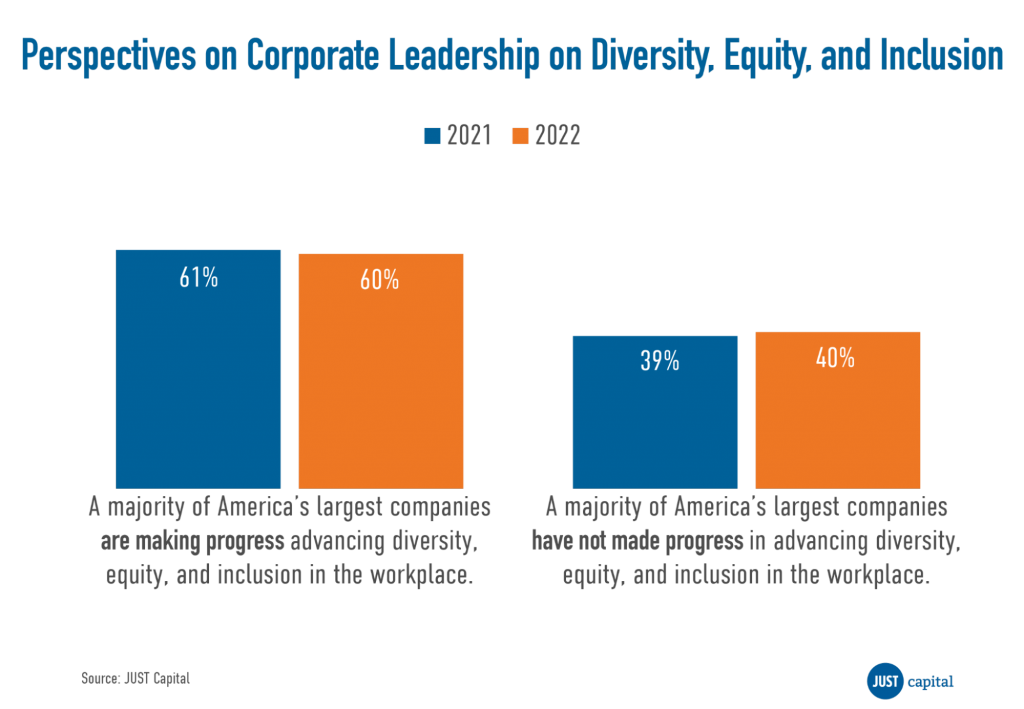
Still, there is ample room to improve: almost half (47%) of Americans agree that companies are not doing enough today to hire and promote Black Americans in the workforce. That number rises to 83% among Black Americans.
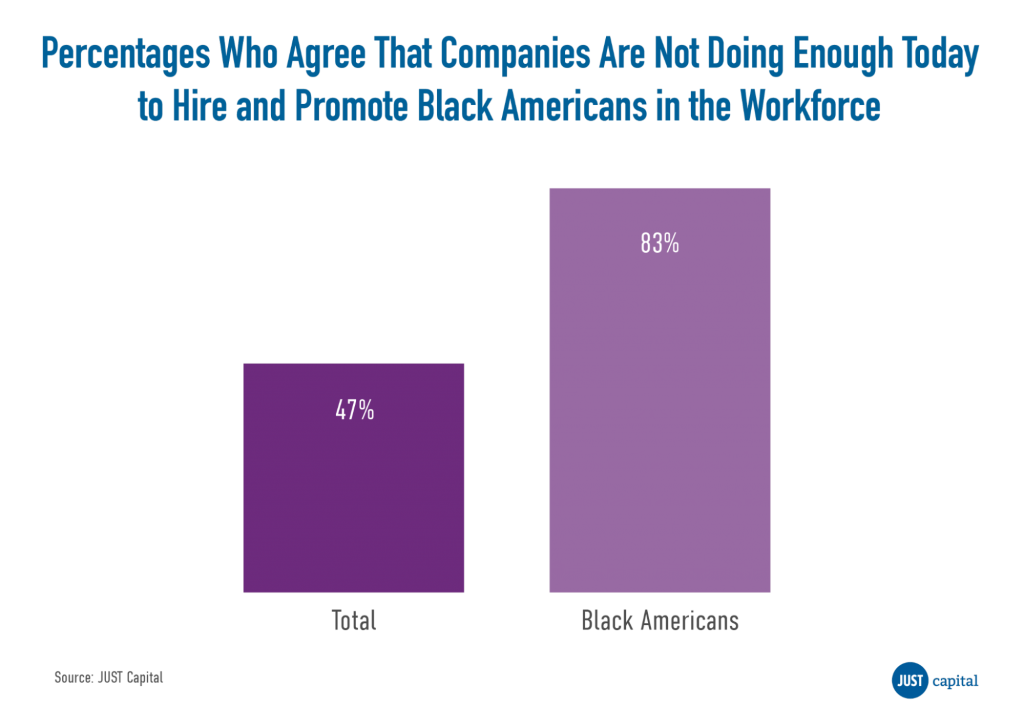
Action on these issues have lasting impact for the public, with a large majority of Americans saying they will remember the companies that took missteps in their response to the COVID-19 pandemic (68%) as well as those that took missteps on issues related to racial injustice (67%).
The good news? Americans are willing to support change and help companies transition to a just economy. We asked Americans to tell us whether they would take positive action in supporting companies that are more just, and two-thirds or more said that they would either accept less pay in a new job at a just company, and/or pay more for a product made or sold by a just company.
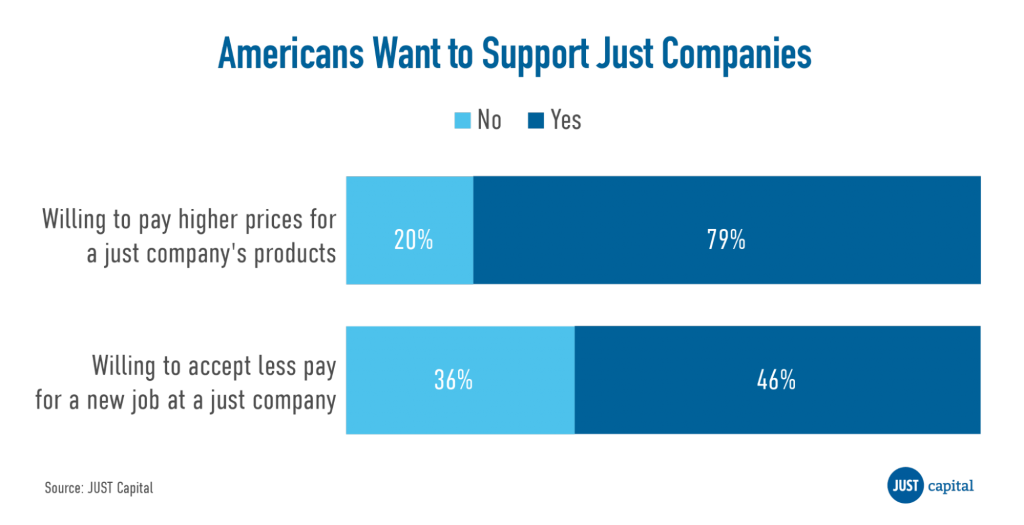
This comes at no surprise when we see that a whopping 84% of Americans believe that their own actions can shape the future: a level double-digits higher than when we first asked this question in 2017 (71%).
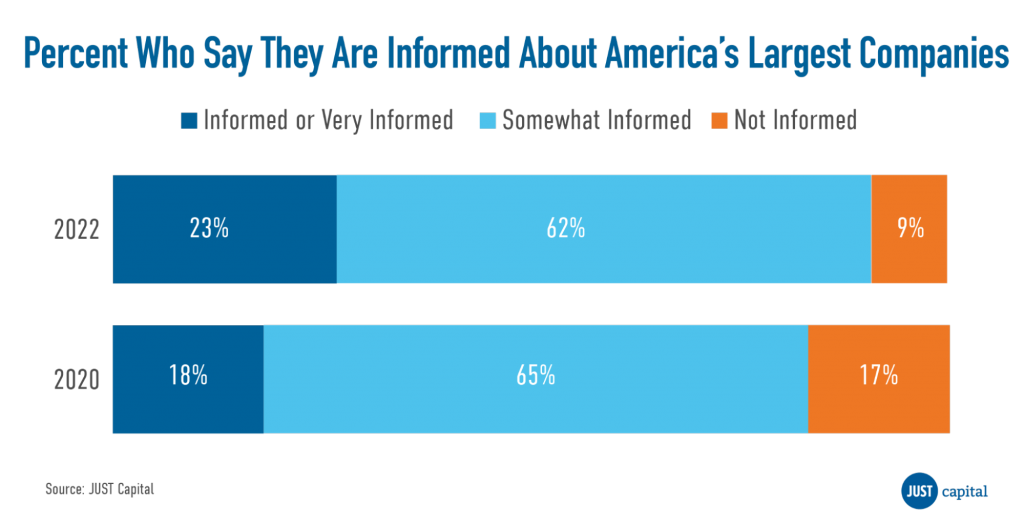
That Americans have strong opinions about large U.S. companies may be attributable to the degree to which the public is informed about corporate activities and behavior (in 2022, 23% say they are Informed or Very Informed, up from 18% in 2020).
While this year’s Americans’ Views on Business survey shows an overall less optimistic perspective on how companies are faring in transitioning from shareholder primacy toward a more just and equitable economy, our 2022 Issues Report – The People’s Priorities and full slate of polling reports from the last year, provide a clear, consistent, and unified message from Americans about how to turn the tide, and that is to put workers at the heart of business strategy.
For companies that are looking for solutions to everything from political polarization to the rise in unionization, or losing talent to competitors, the answers lie in listening to the voice of the public, and most importantly, to your workers. They will tell you, as they’ve told us for the last seven years, to focus on paying a fair, living wage, protecting their health and safety, supporting their development through training and upward mobility, providing good benefits and work-life balance, and more. The pandemic catalyzed a fundamental shift in expectations for workers, with many reevaluating what’s most important to them.
As we discussed in a recent Fortune editorial with the Ford Foundation, “Now is the time for employers to listen to their workforce and collectively ensure our economy delivers on the promise of the American Dream for everyone.” Business leaders are increasingly faced with complex economic, social, and political headwinds, but investing in workers is a powerful North Star to use to chart the path forward.
For additional resources on where to get started, visit:
We conducted this survey online with a probability-based sample attained through the exhaustive statistical sampling methods employed by SSRS. The SSRS Opinion Panel is a nationally representative probability-based web panel, and findings are generalizable to the general adult population.
The full survey was conducted from June 22 to July 11, 2022 among a general population sample of 3,002 English- and Spanish-speaking U.S. adults 18+ years of age, with an oversample of 540 Hispanic and 460 non-Hispanic Black respondents. Panelists were sent an email invitation to take the survey online as well as up to eight reminder emails throughout the field period. The survey program was optimized so that respondents could complete it using a desktop or laptop computer as well as a mobile device. In total, 1,063 respondents completed the survey on a computer and 1,939 completed it on a mobile device.
The margin of error is +/- 2.2% at the 95% confidence level. Results were weighted to U.S. Census parameters for age, gender, education, race/Hispanic ethnicity, and Census Division to ensure representativeness of the U.S. population. All margins of error include “design effects” to adjust for the effects of weighting.
