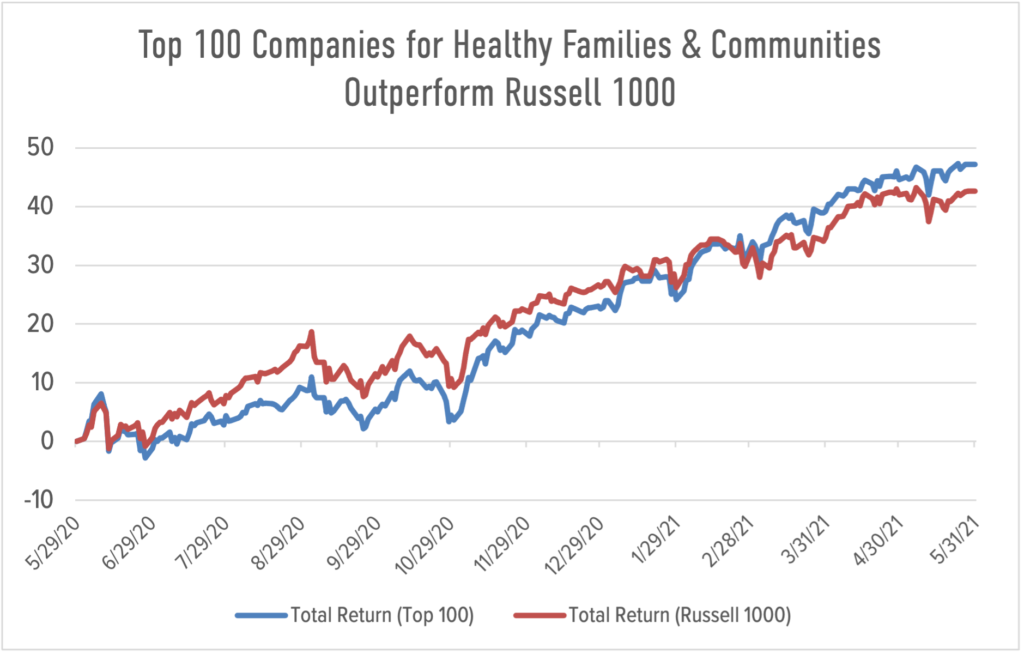
This week’s chart serves as a complement to our list of the Top 100 U.S. Companies Supporting Healthy Families & Communities published this week. Here, we examine the trailing one-year returns of the 100 leading companies from the list, relative the Russell 1000 companies we rank.
JUST Capital’s research team, with support from the Robert Wood Johnson Foundation, identified 10 key issues that determine whether companies are supporting the health and well-being of workers, their families, and the communities in which they operate.
The methodology utilized in the calculation of our 2021 list considers whether a company scores highly on the following 10 issues:
Over the time period of 6/1/2020 through 5/31/2021, the Top 100 Companies Supporting Healthy Families and Communities have outperformed the Russell 1000 Index by 4.6%. Top sector contributors were Financials, Consumer Discretionary, and Real Estate.
Top-ranked companies include NVIDIA, which offers unlimited paid sick leave, back-up dependent care, subsidized child care, and equitable paid parental leave for primary caregivers, secondary caregivers, and adoptive parents. Also included in the list are JPMorgan Chase, which is one of the few Russell 1000 companies to disclose non-white-to-white pay ratios.
Explore the rest of the list here to find out which companies continue to prioritize their stakeholders while outperforming their peers, and learn more about the list from JUST’s Chief Strategy Officer Alison Omens, who spoke on CNBC’s Closing Bell about why it’s so important for companies to focus on the health, safety, and well-being of their workers and communities.
If you are interested in supporting our mission, we are happy to discuss data needs, index licensing, and other ways we can partner, please fill out our request form to answer a few questions, and someone from our Investor Solutions team will reach out to you within two business days.

Apple ranks #10 in our Top 100 Companies Supporting Healthy Families and Communities.
(Sean Rayford/Getty Images)
In a CNBC segment on Wednesday, our head of strategy, Alison Omens, touted our new list of the Top 100 Companies Supporting Healthy Families and Communities, which we developed with support from the Robert Wood Johnson Foundation. The key moment came when Closing Bell co-anchor Wilfred Frost posed a common question – do these companies care more about the well-being of their stakeholders than serving their shareholders? Alison’s response was one for the ages: “I have to reject the premise!”
As we have spent the past six years demonstrating, it’s not a zero sum game. Shareholders do better when companies create value for all their stakeholders. Last week I wrote about how this framing underpins the activist campaigns that ExxonMobil and Chevron shareholders brought at last week’s AGMs (You can read more on that in our latest interview with Engine No. 1.) Both rested on the belief that shareholders were leaving money on the table by not embracing what we would call a stakeholder approach.
To that exact point, our Healthy Families and Communities list is led by Nvidia, Microsoft, Bankof America, Salesforce, and Intel, and each is prioritizing issues like fair and livable wages, inclusive workplaces, and community investment. Crucially, these 100 companies outperformed the Russell 1000 benchmark by 4.6% over the trailing year.
Don’t be fooled. Long-term value creation for all stakeholders is best for shareholders too.
Be well,
Martin Whittaker
Amazon, Disney, Google, Microsoft, Netflix, Salesforce, Unilever, and Workday have partnered with EDF, the UN, and WWF to create the Business Alliance to Scale Climate Solutions, which serves as a knowledge-sharing network to accelerate emission reduction efforts.
Goldman Sachs, Credit Suisse, Bank of America, and others are subsidizing employee meals in an attempt to get more to return to the office.
PayPal has invested $50 million with Black-and-Latino led venture funds, doubling a commitment that it initiated last year.
Viacom is being accused of using vast tax loopholes to fund its film projects that have cost U.S. taxpayers $4 billion.
June 24th at 1PM ET: Join JUST Capital and the Brookings Metropolitan Policy Program to discuss how private sector leaders can advance racial equity within their companies, communities, and regional economies, featuring speakers from CenterState, Cincinnati U.S. Regional Chamber, and Brookings Institute. Sign up to attend here.
Martin and Rich spoke with Engine No 1 in the wake of their historic win against ExxonMobil last week to discuss what happened as well as what’s next, building on our recent LinkedIn Liveconversation.
Yusuf penned an editorial for Crain’s Chicago discussing how accountability is impossible without real transparency, as a companion to Crain’s forum feature exploring if we are experiencing a movement or a moment as companies grapple with following through on racial equity commitments.
Our hazard pay research was featured in this Vox article on how the pandemic changed work permanently for many employees, and data from our Corporate Racial Equity Tracker was included in Pensions & Investments’ piece on debunking diversity, equity, and inclusion myths in the workplace.

(Brendan Smialowski/Getty Images)
“The thing that I always suggest that people say is when they hear an employer say, ‘I can’t find the workers that I need,’ always add the phrase ‘at the wage I want to pay.’”
“Ideally it adds to the growing list of reasons why companies need to be focused on creating investor value over the long term, which we believe includes thinking about their long-term relationship with their customers, their employees, society, and in this case, the planet.”
“If you look to get a big position in a company in hoping to turn them around, and you’re not getting a really good view of the human capital, you’re missing something very big in your evaluation. … [For example] Microsoft changed CEOs and had an amazing transformation. And if you look at that transformation, it was largely a cultural transformation, largely the transformation of how people looked at themselves, how management looked at the employees.”
Insider posits that the truth behind America’s “labor shortage” is that we’re not ready to rethink work; Quartz further unpacks that the shortage is just a wage shortage in a series of interactive charts; and The Atlantic discusses why the current economic situation is giving more workers the power to say “no” to jobs they don’t want. The New York Times economics reporters further dissect how wage growth is holding up in the aftermath of the economic crash.
The National Law Review reports that the EEOC commission has found that companies can order their employees to get COVID-19 vaccines to return to work, as long as they comply with reasonable accommodation provisions from the Americans with Disabilities Act.
The Fortune 500 broke a record this year: the number of women CEOs hit an all-time high at 41,and two of these CEOs are Black women, a first for the group.

The week’s chart shows that the Top 100 Companies Supporting Healthy Families and Communities outperformed their Russell 1000 peers. Explore the results here.
This morning, JUST Managing Director of Corporate Engagement Yusuf George joined Andrew Ross Sorkin on CNBC’s Squawk Box to discuss our Corporate Racial Equity Tracker and our latest analysis of how companies are measuring up when it comes to disclosing pay equity analyses.
“31 companies of the 100 largest that we look at disclose an analysis by race or ethnicity. 14 of those have shown us the gap,” Yusuf explained. “It’s critical companies are doing this type of analysis if they are really committed to advancing equity.” With yesterday marking one year since the murder of George Floyd, our Tracker explores the commitments companies have made over the last year, and the actions they’ve taken to advance racial equity for their workers and communities – including taking the critical step to prioritize pay equity.
Watch the full conversation below to learn why pay equity is critical to advancing racial equity, which companies are taking the lead, and why talk of commitment is not enough.
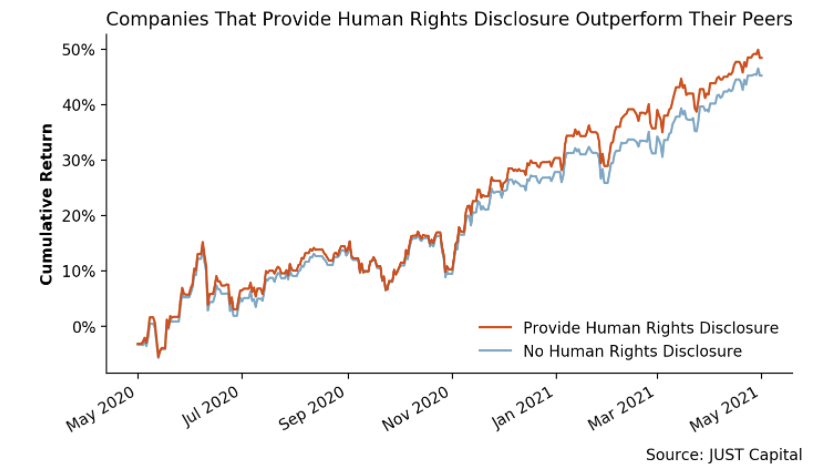
In this week’s chart, we take a closer look at corporate disclosure on human rights policies. In our 2021 Rankings, the second most important priority for corporate America – according to the American public – is to uphold human rights standards across the supply chain, and accounts for 9.2% of a company’s score. Americans want to see companies be transparent about their efforts to address child labor, forced labor, and other abuses of people in their supply chains, and require suppliers to uphold basic human rights standards.
Our analysis looks at one of the data points we use to measure a company’s performance on human rights issues – whether its Supplier Code of Conduct or Human Rights policy, as it pertains to suppliers, explicitly mentions human rights. Of the 928 companies we ranked in 2021, 458 provide this human rights disclosure and outperform those that do not by 3.2% over the trailing year.
Human rights violations within a company’s supply chain were thrust into the spotlight after the 2013 Dhaka garment factory collapse in Bangladesh, prompting organizations and governments to call for a heightened level of supplier due diligence. The World Benchmarking Alliance puts together an annual Corporate Human Rights Benchmark Report, which aims to shine a light on human rights policies by evaluating how 230 public companies across five high-risk sectors track and manage risks related to forced labor, child labor, and freedom of association and collective bargaining within their supply chains. Looking at the automotive sector, they found a “majority of automotive companies failed to demonstrate that they work with suppliers or set core expectations through contractual arrangements to verify the age of workers, prohibit recruitment fees and prevent intimidation or harassment of trade union members and their representatives.” Only one company, General Motors (#28 overall in our 2021 Rankings), provided evidence of mapping its direct and indirect suppliers.
As evidenced in our chart above, it is clear that there is a correlation between financial outperformance and the implementation of human rights supplier policies, further building the case for companies to prioritize supply chain practices. With fewer than 10 years to achieve the 17 sustainable development goals put together by the UN, corporate leaders can start by implementing a human rights supplier policy in order to begin understanding the risks in their supply chains. In turn, this will set the steps in motion to identify, address, prevent, and report publicly on human rights risks, leading to further transparency and more just business practices.
If you are interested in supporting our mission, we are happy to discuss data needs, index licensing, and other ways we can partner, please fill out our request form to answer a few questions and someone from our Investor Solutions team will reach out to you within business days.
This morning, JUST Managing Director Yusuf George joined Andrew Ross Sorkin on CNBC’s Squawk Box to discuss our latest initiative to track the efforts corporate America is making to advance racial equity in workplaces and communities across the country – the Corporate Racial Equity Tracker.
“What we’ve seen by assessing the 100 largest American companies,” Yusuf explains, “is that they’re really good at disclosing what we like to call baseline DEI policies – things like anti-harassment or Equal Employment Opportunity – but they’re not so great at showcasing actions that show accountability toward their progress. Things like pay equity data. Things like setting diverse hiring targets. So what we’re doing is we’re calling on companies to be transparent in the same way institutional investors are asking for this information.”
Watch the full interview below to learn how this work can and should be a central focus this proxy season, and explore the findings from our Tracker here.
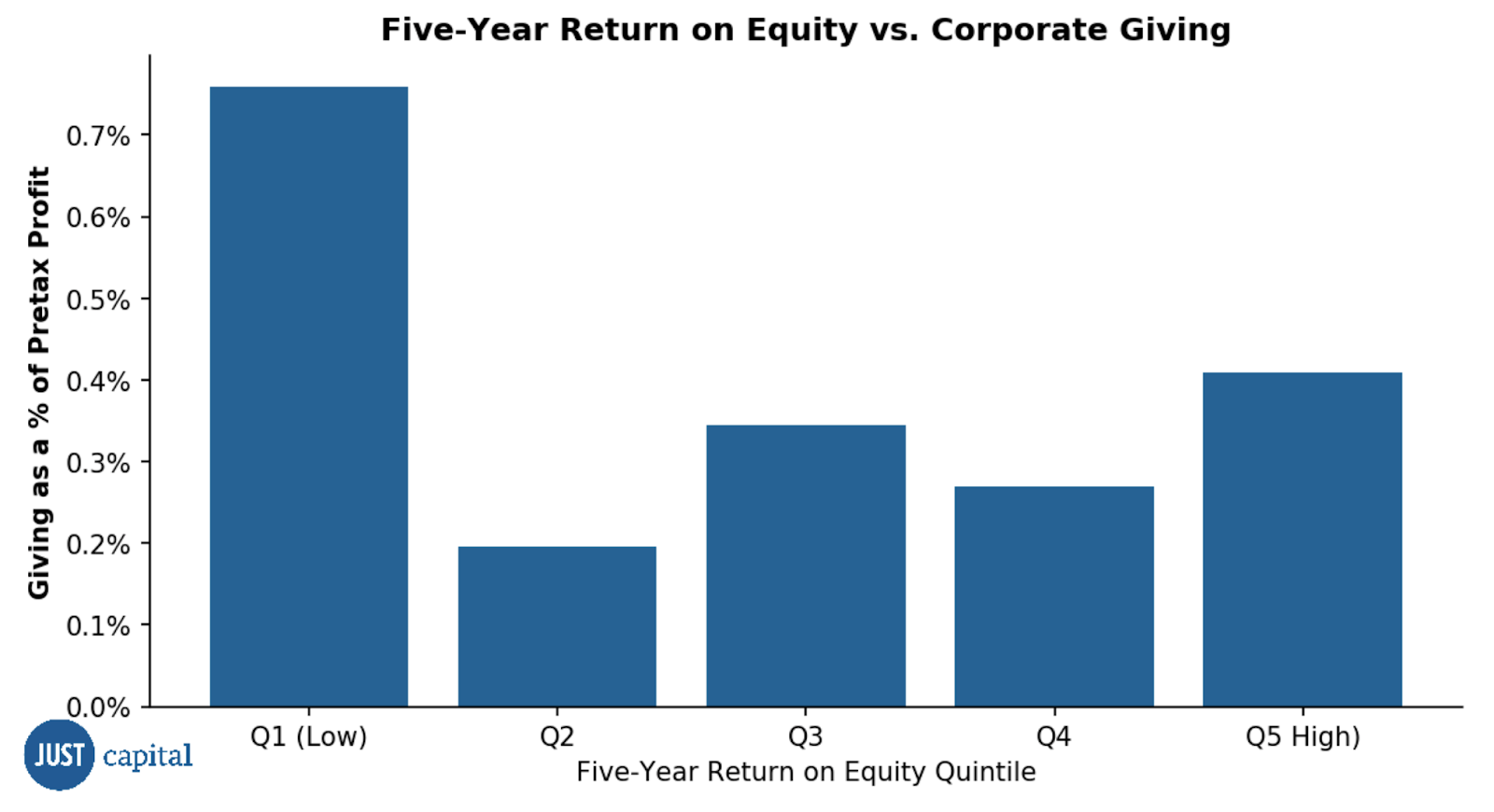
In this edition of our Chart of the Week series, we take a closer look at our charitable giving data to analyze whether there are meaningful trends around the ROE of Russell 1000 companies that prioritize generosity using a percentage of their pre-tax profits.
Breaking down the Russell 1000 companies we rank into quintiles based upon highest to lowest five-year ROE – with five being the top quintile and one being the bottom – there seems to be a strong correlation between higher ROE among companies in quintiles 2-5 and higher percentage of pre-tax profits given to charity. Analyzing the top quintile, the companies with the highest five-year ROE give double the amount of pre-tax profits to charity than the second quintile, implying that shareholders benefit when companies prioritize community support.
However, as evident in the chart below, Q1 appears as a strong outlier skewing the trendline. Looking into the data, we see two companies driving the charitable giving ratios higher than others in our rankings. These two companies, although they may underperform on five-year ROE, are producing strong financial outperformance over the trailing one year. Freeport-McMoran, ranked 103rd overall out of 928 JUST-ranked companies and first overall by charitable giving ratio, has a 323.16% total return in the trailing year as of March 31,2021. The other company driving the outlier, Horizon Therapeutics plc, is tied with Freeport-McMoran for the highest charitable giving ratio overall and has a total return of 210.74% over the trailing year. Looking to the chart below, and given the data above, there tends to be a trend among community support and profitability.
As for why this is important, CECP’s “Giving in Numbers” report on the corporate charitable giving practices of 223 companies in 2019 shows median total community investments were $23.5 million. This marks a 7% increase in median total charitable community investments for these companies from 2017. These companies saw an overall positive financial performance in terms of median revenue (+8%) and pre-tax profit (+3%) in the same period, which went hand-in-hand with an increase in the median ratio of total community investments as a percentage of pre-tax profit.
One of JUST Capital’s strategic partners, Uncommon Giving – a donor-advised fund platform – recently launched the Uncommon Generosity 50 Equity Index powered by JUST Capital’s corporate giving datasets. The index is constructed by selecting the 50 companies in the S&P 500 who score highest on charitable giving and allows all investors to incentivize companies prioritizing local community support.
Uncommon Giving’s (uncommongiving.com) platform helps to promote generosity and increase charitable giving among individuals, companies and nonprofits. We are hopeful there will be further alpha related to corporate giving and are open to creating new, differentiated stakeholder-driven investment products that drive assets to more just companies. Please reach out to us if you are interested in collaborating.
If you are interested in learning more about the Uncommon Generosity 50 Equity index, data offerings, or index licensing, please reach out to our Director of Business Development, Charlie Mahoney, at cmahoney@justcapital.com to discuss how we can create a more JUST economy together.
The information contained herein is for informational purposes only without regard to any particular user’s investment objectives, risk tolerances or financial situation and does not constitute investment advice, nor should it be considered a solicitation or offering to investors residing outside the United States. JUST Capital makes no representation as to the advisability of investing in any investment fund or other vehicle. Shares of JUST are made only by prospectus. The addition, removal, or inclusion of a security in any JUST Capital index is not a recommendation to buy, sell, or hold that security, nor is it investment advice. The JUST Parties do not in any way sell, sponsor, support, promote, or endorse any securities based on the Uncommon Generosity 50 Equity Index, or have any involvement in their operations or distribution. Prospective investors should not make a decision to invest in any investment fund or other vehicle based on the information contained in this website, and JUST Capital shall not be responsible or liable for any advice given to third parties or decisions to invest in any investment fund or other vehicle by you or third parties based on the information. Index performance does not reflect the deduction of any fees or expenses. Past results of the Uncommon Generosity 50 Equity Index are no guarantee of future performance.
The Uncommon Generosity 50 Equity Index, is calculated and maintained by S&P Global using the S&P 500 Index as a starting universe, and leverages JUST Capital’s charitable giving datasets. S&P Global does not sponsor, endorse, sell, or promote any investment vehicle that is offered by any third party that seeks to provide an investment return based on the performance of any index. It is not possible to invest directly in an index.
