
The start of the COVID-19 pandemic marked the start of a tumultuous period for working women. Now, after a disproportionate number of job losses and barriers to seeking work, women are heading back into the job market. The latest figures find that women’s employment has nearly recovered compared to before the pandemic, with the labor force participation rate for women aged 25-54 higher as of January 2023 compared to 2019.
Job numbers alone, however, don’t tell the full story of how women are faring in the workforce. Despite the spike in women returning to work, men continue to outearn them across all age groups.
In 2022, according to the U.S. Census’ Current Population Survey, the median earnings for women who are full-time hourly and wage workers was 83% of the median earnings for men. This marks a slight improvement compared to 81.5% in 2019, but little changed from 81% in 2005. Today, March 14, marks Equal Pay Day – reflecting how many days into 2023 women must work to be paid the same as men in 2022. And the markers for women of color, who are paid less than their white counterparts, are even later. Equal Pay Day this year is July 27 for Black women, October 5 for Latinas, and November 30 for Native women.
A range of factors contributes to the gap’s persistence, including gender-based discrimination in the workforce. In our 2022 polling, JUST Capital found majorities of Americans acknowledge a range of problems that continue to plague women in the workforce, with 70% citing the gender wage gap and 66% citing equal opportunities for advancement. Critically, 80% of Americans believe that paying men more than women who are doing the same job is tantamount to discrimination.
In the same survey, a majority of Americans (55%) agreed that companies should prioritize equal pay for equal work to help women re-enter the workforce. In light of that, and with a rise in women now returning to work, we took a look at disclosures among Russell 1000 companies on gender pay equity. We analyzed whether companies disclose conducting a gender pay equity analysis and, if so, report the results of the process in a women-to-men pay ratio.
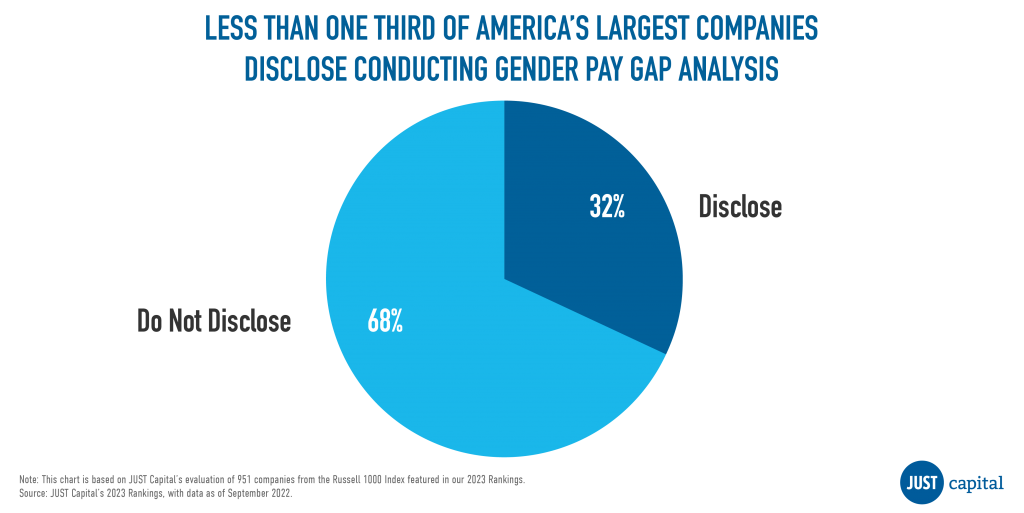
While our polling found Americans are looking for companies to prioritize gender pay equity, our analysis found that less than one-third (32% or 302) of America’s largest public U.S. companies disclose conducting a gender pay gap analysis. And only 14% of companies (130) report the results.
Read on to explore our full analysis of what companies are disclosing when it comes to the gender pay gap, including when we found companies are more likely to report their women-to-men pay ratios and how disclosures have changed over the years.
JUST Capital analyzes the issue of gender-based pay inequity by measuring adjusted gender pay gap analyses. An adjusted gender pay gap analysis analyzes the difference in median pay between men and women in the same position, controlling for factors like tenure, location, and education level, among others (as opposed to an unadjusted analysis which does not control for such factors). These internal company assessments are vital tools for evaluating and ameliorating the gender pay differences that exist at companies.
Our latest research suggests that disclosure surrounding gender pay gap analyses is still lagging among Russell 1000 companies. We found that only 32% (302 companies) of companies included in our 2023 Rankings currently disclose carrying out a gender pay gap analysis.
While disclosure on gender pay equity analysis among America’s largest companies remains generally low, our data suggests that companies are increasingly releasing this information publicly. When we conducted this analysis in September of 2021, just over a fifth of the companies we rank (23%) publicly disclosed that they conduct gender pay equity analyses. Only a year later, in September 2022 we found that roughly a third of our ranked universe (32%) disclose this information, which marks a nine percentage point increase in disclosure over the span of a year.
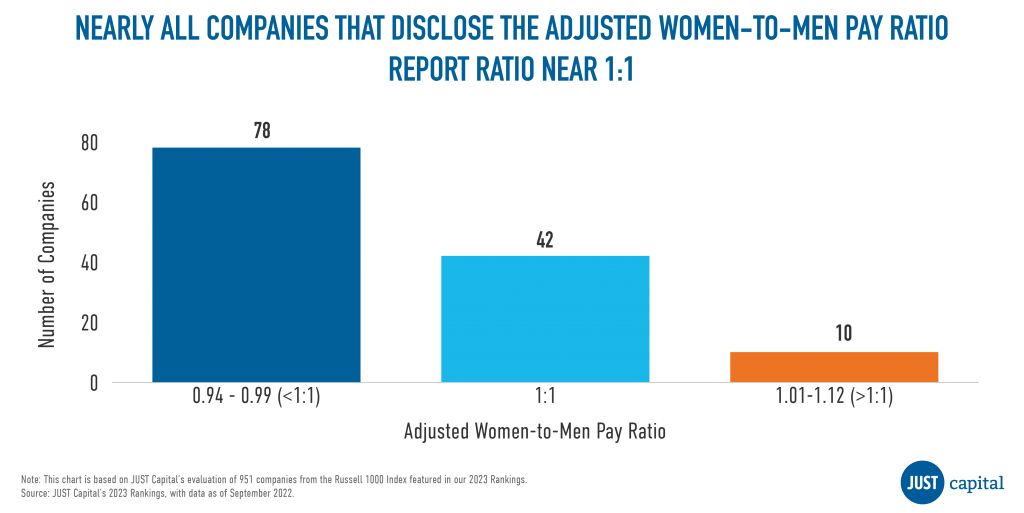
In addition to looking at company disclosures on conducting a gender pay gap analysis, we also evaluate if a company discloses the results of that analysis. Our data show that as of September 2022, 130 Russell 1000 companies, or 14%, disclose an adjusted women-to-men pay ratio, and most companies report a ratio at or near parity (1:1). Of these 130 companies, 78 (or 60%) report a ratio between 0.94-0.99 to 1, and 10 (or 8%) report a ratio between 1.01-1.12 to 1. Crucially, only 42 of these companies (32%) report parity in their adjusted pay between women and men.
Despite low disclosure of results, we noticed a similar trend of increasing transparency disclosure. In 2021, only 8% (75 companies) disclosed an adjusted women-to-men pay ratio. That rose to 14% (130 companies) in 2022, a six percentage point increase.
Though this may seem like a victory for gender pay equity, it is important to keep in mind that only 130 companies in the Russell 1000 report the adjusted women-to-men ratio, whereas 302 companies among this same group disclose conducting a gender pay gap analysis. And this does not take into consideration the 649 Russell 1000 companies that do not disclose if they conduct an analysis in the first place. We do not know what the pay ratios look like at these companies. Conducting an analysis to benchmark if and where gaps currently exist and disclosing the results, however, is key to achieving gender pay equity.
Closing the gender pay gap marks a significant opportunity for, first and foremost, women workers. By one estimate, the gender pay gap causes women to lose over $400,000 over a 40-year career, which translates into $1.6 million lost in retirement savings. It’s also costing the global economy $7 trillion, according to a new Moody’s analysis. And, crucially, companies taking action toward equal pay can help recruit and retain women at a critical juncture in their participation in the workforce.
Achieving gender pay parity involves many steps, but the first is to evaluate where a company currently stands – that means conducting a gender pay gap analysis. Our new JUST Jobs Scorecard helps companies to benchmark where they stand on gender pay equity, and other key metrics, among their peers.
To unpack your company’s pay equity performance in the 2023 Rankings and the JUST Jobs Scorecard and gain insights into how to improve on the issues that matter most to the American public, please reach out to corpengage@justcapital.com.
Last week marked International Women’s Day and, for many companies, a reminder of the importance of equal pay in advancing gender equity. As organizations sent out messages uplifting women in the workplace, a U.K.-based Twitter bot shared (using public government data) the gap between women’s and men’s earnings at these employers, noting how rhetoric doesn’t always match action in this space. Today, one week later, marks another milestone in the fight to close the gender pay gap, Equal Pay Day in the United States.
Falling on March 15 this year, Equal Pay Day signifies how far into 2022 women must work to earn what men did in 2021. The date is determined from the U.S. Census data, which shows that women working full-time earn, on average, 83% of what men are paid. This year’s is earlier than 2021’s, March 24, but the impact of the COVID-19 pandemic should also be taken into consideration.
Women’s participation in the workforce still remains below pre-pandemic levels and many have sought part-time work to balance caregiving and other domestic responsibilities, which continue to fall more frequently on women. Just this week the U.S. EEOC issued new guidance warning that discrimination against caregivers, including mothers, may be unlawful. And Misty Heggeness, an economist at the Census Bureau told Axios, “There are a lot of reasons these women aren’t back to work. Discrimination can’t be one of them.”
Women of color have been especially affected by these shifts and the time they must work to match white male earnings reflects this. This year, AANHPI Equal Pay Day falls on May 3, Black Women’s on September 21, Native Women’s on November 30, and Latina’s on December 8.
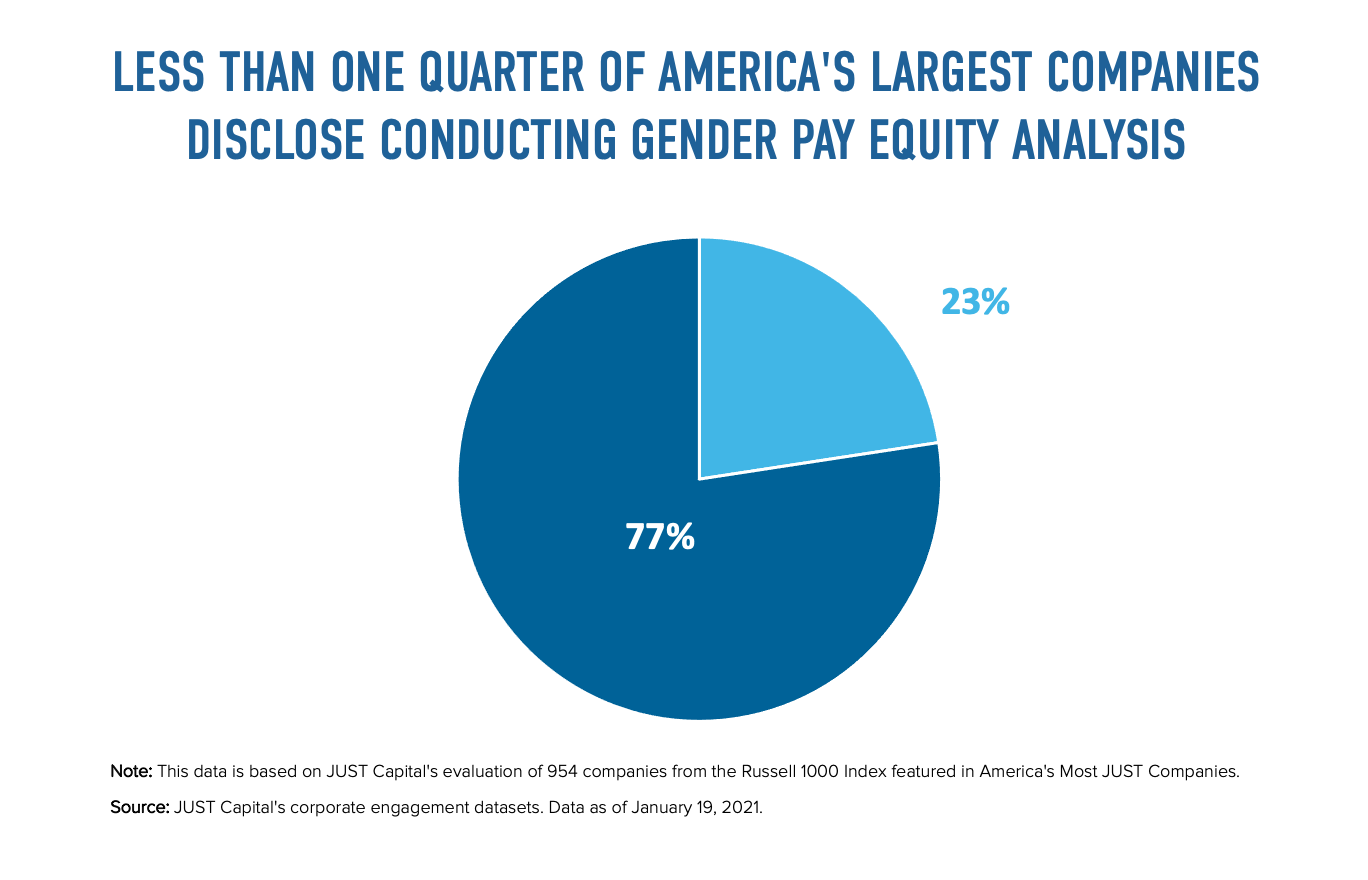
As gender pay gaps persist, JUST Capital looked at how many of America’s largest corporations disclose that they conduct gender pay analyses and which of them publicly release their results. This year, we found that just under a quarter of the 954 companies we evaluated for our 2022 Rankings, 23% (215 companies), disclose conducting a gender pay gap analysis. It’s worth noting that to arrive at this number, we only considered companies’ disclosures that specifically point to gender as a criterion in pay equity analyses and discounted statements which did not explicitly state which demographic groups said analyses focused on.
Our 2022 Rankings feature a much more granular look at pay equity disclosure, enabling us to assess which companies disclose conducting pay gap analyses by race and gender in particular. Previous years’ Rankings, featuring non-aggregated assessments of pay equity disclosure, show fairly consistent levels of disclosure – 14% of companies disclosed a pay gap analysis in 2019, rising to 22% in 2020, and dropping by one percentage point to 21% in 2021.
It’s clear that despite increased calls from employees, nonprofits, government, the American public, and some of the world’s largest institutional investors to invest in gender equity to support a more equitable recovery for women in the workplace, progress has stalled in the last three years. Corporate America has a long way to go toward transparency, and more important, performance, on this critical issue.
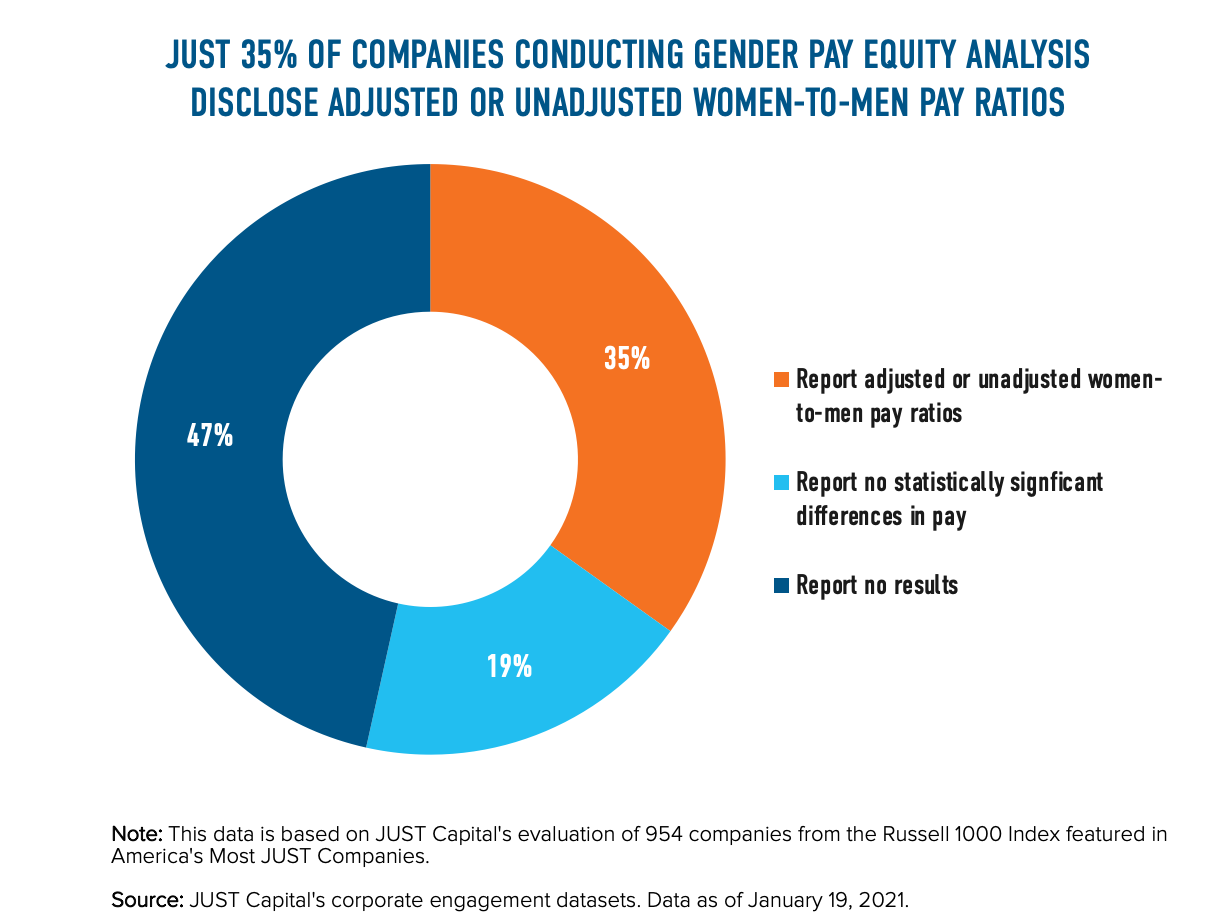
To gain a better understanding of corporate performance on pay equity, we looked at how many of the 215 companies that disclose conducting a gender pay gap analysis publicly release the results. We found that 35% of these companies (75 companies) report the exact women-to-men adjusted or unadjusted pay ratios, while another 19% share that their gender pay analyses found no statistically significant differences in pay without providing ratio details. And while over a half of the companies that disclose conducting gender pay gap analyses share some sort of results, 47% of these companies still do not release any information about their actual performance on issues of gender pay equity.
Taking a closer look at the 75 companies that disclose their women-to-men pay ratios, we found that the overwhelming majority of companies have achieved full or near-full pay parity between men and women. These figures tell us that companies continue to release information about their gender pay equity performance only when they are doing well or have achieved their parity goals. Within this group, 28 companies disclose reaching full parity, or a women-to-men pay ratio of one.
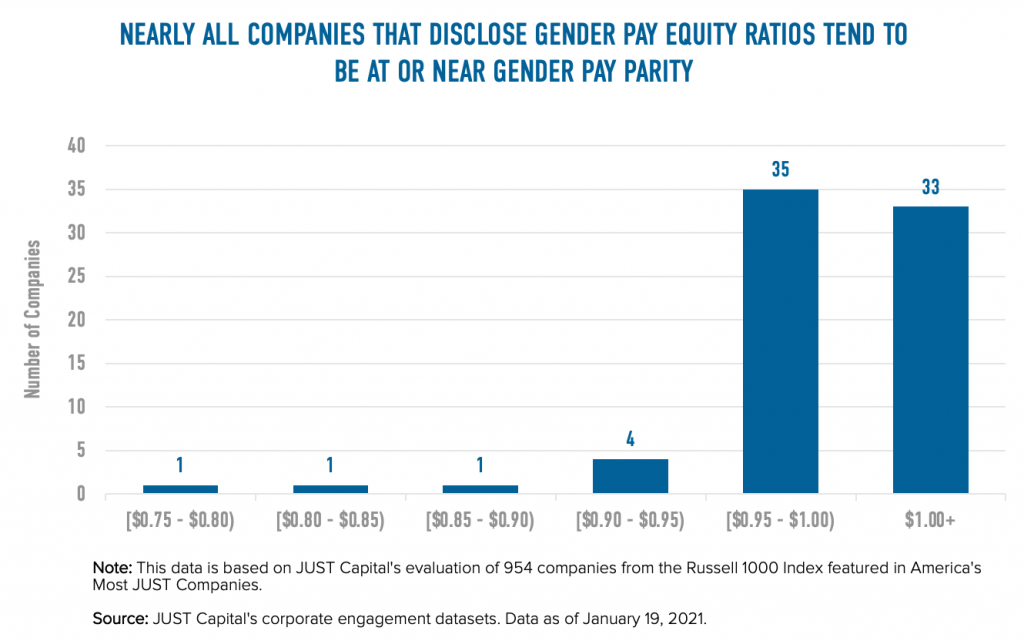
Among those disclosing the adjusted or unadjusted women-to-men ratio, 28 companies are at perfect parity at 1.00. However, the vast majority of companies which did disclose pay equity ratios show strong clustering around 1.00. A total of 67 companies have ratios of 0.95 to 1.05 (including the 28 at 1.00), indicating that these companies are close to achieving pay equity. NortonLifeLock discloses the highest women-to-men pay ratio among companies we rank, with a ratio of 1.12 across executive, management, and non-management levels. Aflac and Microsoft follow suit, reporting salary ratios of 1.01 and 1.001, respectively. Microsoft also announced that it had expanded its pay equity analysis work to examine pay for women in its five largest markets outside the U.S. Across all companies who provided the exact women-to-men pay ratio, transparent and detailed disclosure was consistent.
As the pandemic persists, its adverse impact for women is sure to persist as well. Companies could continue to face scrutiny from a range of stakeholders, including the American public, on how they’re moving from rhetoric to uplift women to action to support women – that should include analyzing and working to close their gender pay gaps.
This morning, JUST Managing Director of Corporate Engagement Yusuf George joined Andrew Ross Sorkin on CNBC’s Squawk Box to discuss our Corporate Racial Equity Tracker and our latest analysis of how companies are measuring up when it comes to disclosing pay equity analyses.
“31 companies of the 100 largest that we look at disclose an analysis by race or ethnicity. 14 of those have shown us the gap,” Yusuf explained. “It’s critical companies are doing this type of analysis if they are really committed to advancing equity.” With yesterday marking one year since the murder of George Floyd, our Tracker explores the commitments companies have made over the last year, and the actions they’ve taken to advance racial equity for their workers and communities – including taking the critical step to prioritize pay equity.
Watch the full conversation below to learn why pay equity is critical to advancing racial equity, which companies are taking the lead, and why talk of commitment is not enough.

One-third of Etsy engineers are women, which is around double the industry average. (Etsy)
Equal Pay Day this year fell on Wednesday, March 24, meaning that it would have taken until then for the average American woman to make what the average American man did the previous year. For Black, Native American, and Latina women, those dates stretch into August, September, and October, respectively. This year’s day for bringing awareness came at a moment where as a country we are taking stock of the COVID-19 pandemic’s especially severe impact on working women, particularly for mothers serving as primary caregivers for their children. As of last month, only 57% of women in the United States were working or looking for work, the lowest labor participation since 1988.
JUST Capital’s survey research from the past year has made clear that regardless of which government policies get enacted during and following the pandemic, Americans expect corporations to play their part in taking care of their workers. With that as a backdrop and Women’s History Month drawing to a close, we joined CNBC in finding and putting a spotlight on the companies that are doing best by the women in their organization.
We considered the 928 large public corporations we tracked in our 2021 Rankings of America’s Most JUST Companies, and looked at board gender diversity and pay gap analysis, along with paid parental leave, backup dependent care, and paid time off or vacation policies. Only five companies – Bank of America, Etsy, General Mills, HPE, and Starbucks – checked all the boxes.
Further, only 12% of companies have over 35% or more women on their board, 21% of companies reported conducting a pay equity analysis, 14.5% offer dependent care, and fewer than 42% offered paid parental leave.
The online marketplace Etsy rose to the top not only for its policies, but for its representation of women across the company, including its C-suite and board – it was the only company of the five to have 50% of its board be women. Raina Moskowitz, the company’s Chief Operations, Strategy & People Officer, told CNBC, “Knowing that I have the support of my company, to be proud that I’m a parent in the workplace, is something that is really special and unique to Etsy.”
You can watch the CNBC segment here, reported by Rahel Solomon for The News with Shepard Smith.
Below, we’ve highlighted board representation and key policies that benefit women at the five standout companies.
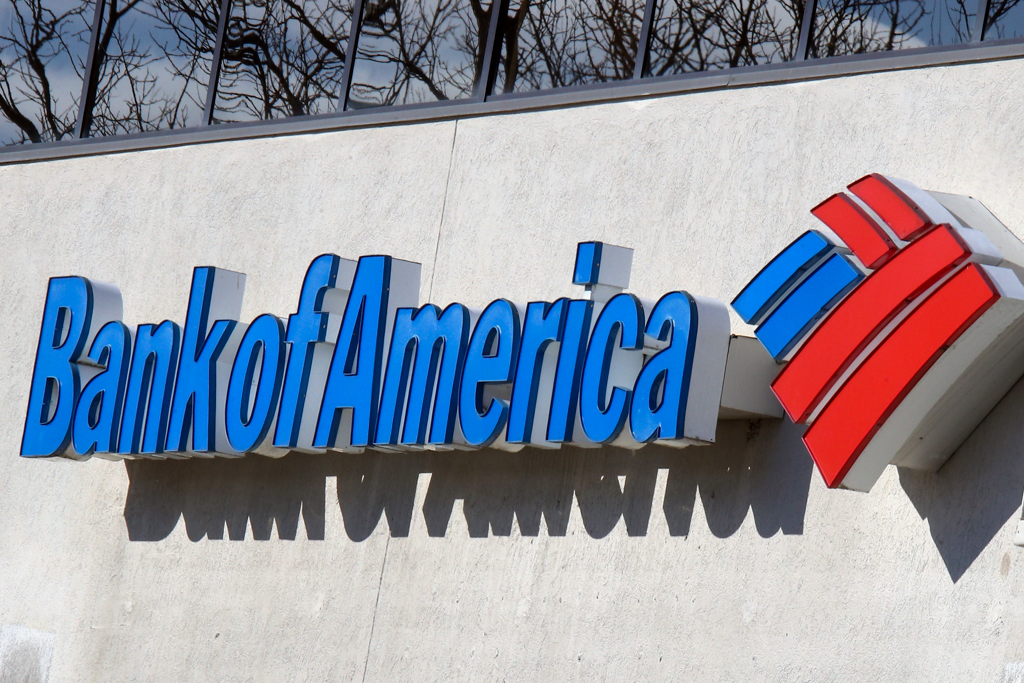
A Bank of America retail location. (Bruce Bennett/Getty Images)
As part of its commitment to supporting working families, Bank of America offers 40 days of backup child and adult care for when employees’ care arrangements fall through. The company also discloses industry-leading paid parental leave provisions. While other banks also offer 16 weeks of maternity leave, Bank of America is the only to offer 16 weeks of fully paid leave for primary caregivers, secondary caregivers, and adoptive parents.
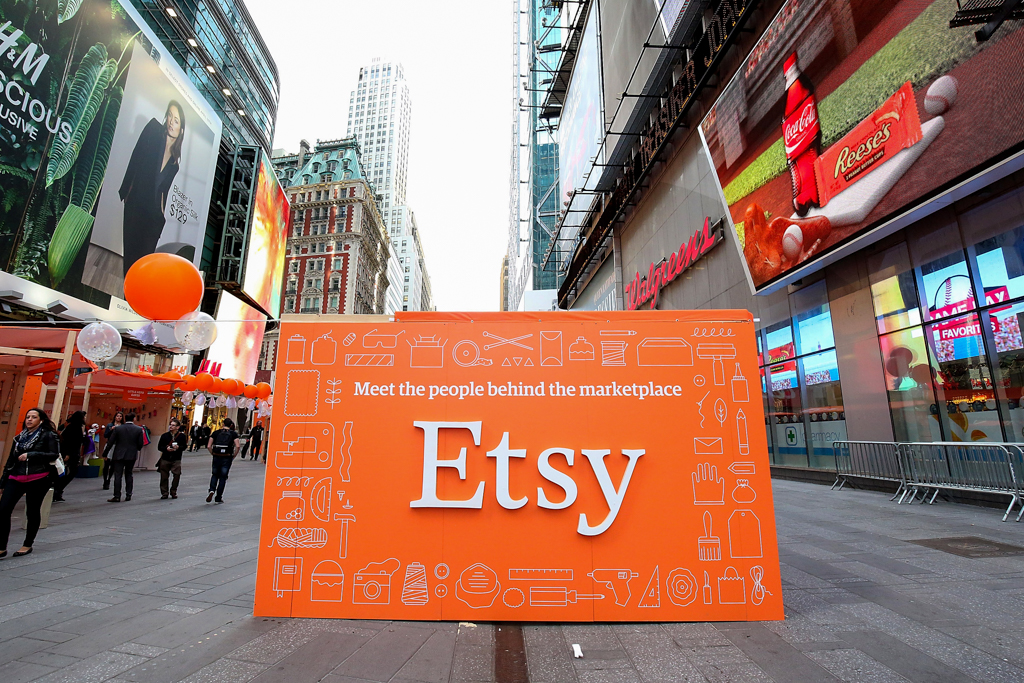
An Etsy display in Times Square on the day of its IPO in 2015. (Paul Zimmerman/Getty Images)
Etsy is another company offering industry-leading paid parental leave. The company offers 26 weeks of fully paid leave for primary caregivers, secondary caregivers, and adoptive parents, the highest amount in the retail industry and in the overall JUST Capital universe. Half of Etsy’s board of directors is female, making the company an industry-leader in board gender diversity.

Wheaties is one of General Mills’ iconic cereal brands. (Manny Carabel/Getty Images)
General Mills partnered with Bright Horizons to offer an infant care center to employees. In addition to offering paid parental leave and paid time off to employees, the company promotes gender equity by conducting regular pay equity reviews.
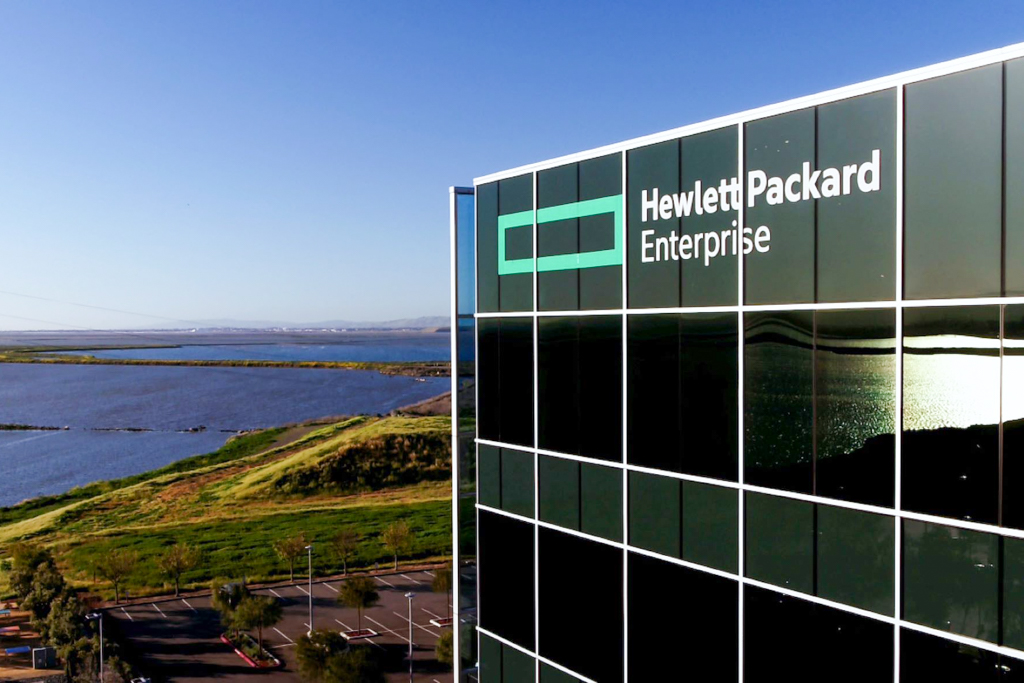
HPE’s San Jose campus. (HPE)
HPE offers the highest amount of weeks for paid parental leave in its industry, at 24 weeks for primary caregivers, secondary caregivers, and adoptive parents.
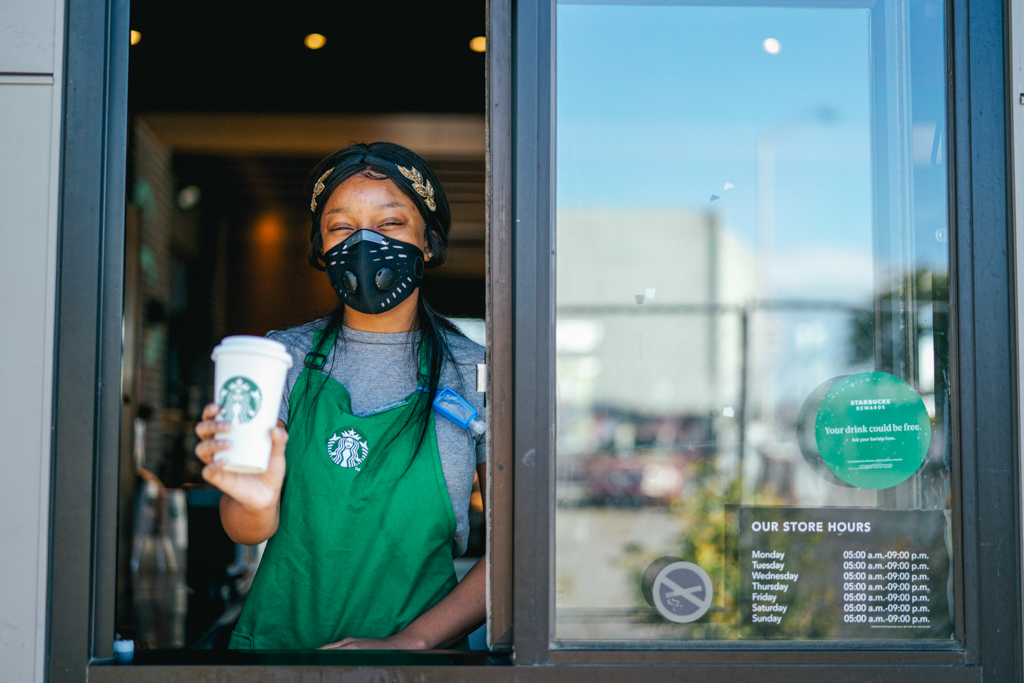
A Starbucks worker during COVID. (Starbucks)
Gender pay equity is a critical component of supporting working mothers, and Starbucks announced in 2018 that the company had reached 100% pay equity for across gender and race. The company also offers 10 days of subsidized backup dependent care through their Care@Work partnership with Care.com. Employees receive additional support with a premium membership to Care.com, and access to the platform’s digital network of care providers.
Kavya Vaghul, Sam Schrager, and Robert Marsh conducted analysis for this piece.
This year, March 24 marks Equal Pay Day for women in the United States – a date that signifies how far into 2021 women have had to work to earn what men did in 2020 alone. For many women of color, the dates are considerably starker: Black Women’s Equal Pay Day falls on August 3 this year, while Native and Latina women must work until September 8 and October 21, respectively, to earn what their white male counterparts did the year prior.
This is not a new issue, and it’s one that women grapple with worldwide. Over the past several years, JUST Capital has been analyzing what steps corporate America has taken to shrink the pay gap – particularly, whether they disclose that they’ve conducted a pay equity analysis, and further, whether they’ve published the results. Last year, we found that 22% of the 922 largest public U.S. corporations we ranked disclosed conducting such an analysis, a significant 57% increase from 2019.
Following a year roiled by the pandemic and economic recession, pay gap statistics have unfortunately not changed (women still earned just 82 cents for every dollar earned by men in 2020, as they did in 2019). We also found that an almost identical percentage of companies – 21% of the 928 we evaluated for our 2021 Rankings (198 companies) – disclosed conducting a gender pay equity analysis. While there were some methodological shifts in how we measured pay equity analysis disclosure – including assessing gender pay equity analyses and race & ethnicity pay equity analyses in separate data points – the near identical disclosure rate suggests that progress on this issue may have stalled over the past year:
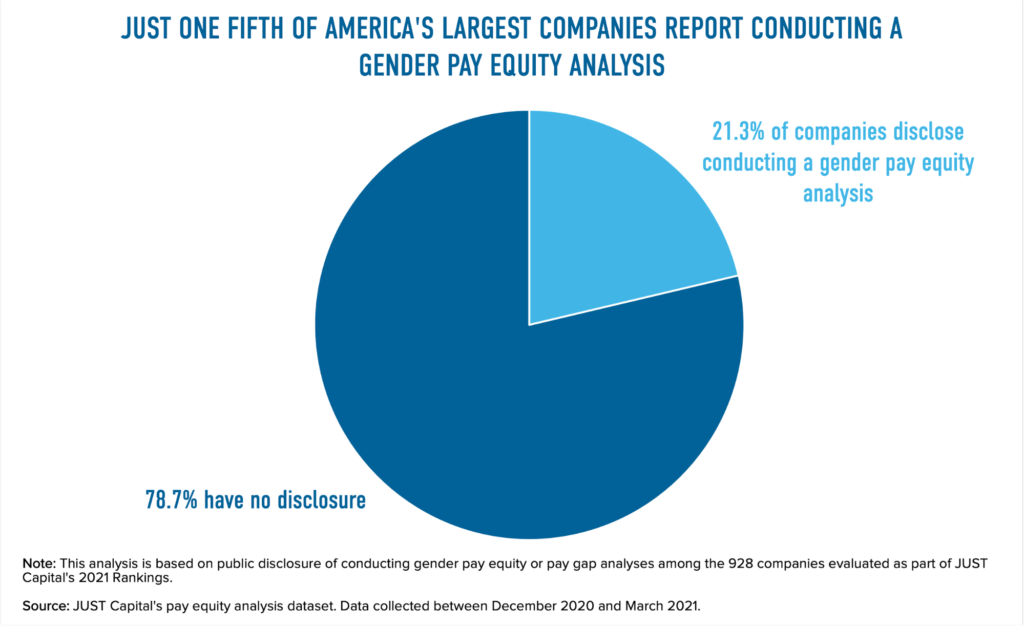
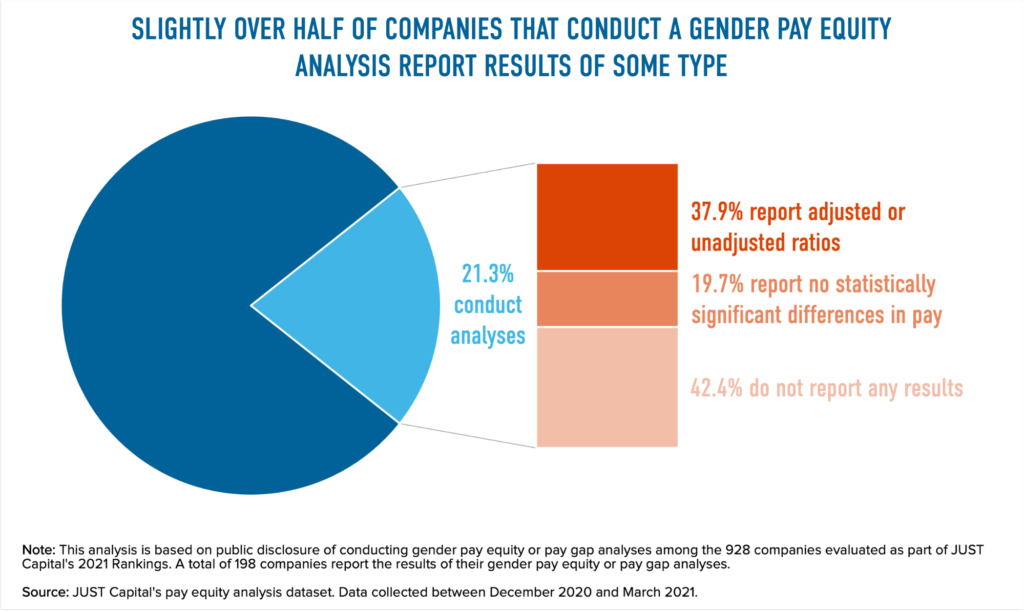
With only one-fifth of America’s largest companies again disclosing that they conducted this kind of analysis – which is a key first step to closing the pay gap in our country – it’s clear that corporate America has more work to do and that this issue must remain in focus as we build back from COVID-19. What is heartening, though, is that more companies are disclosing the results of these analyses. This year, 58% of the 198 companies we analyzed that reported conducting a gender pay equity analysis also disclosed their results, up from 39% last year (of 206 companies conducting either a gender or race/ethnicity analysis).
What companies report, however, varies: Nearly 20% that conduct analyses (39 companies) tend to report that the results of their gender pay equity analyses showed that there were no statistically significant differences in pay between men and women, while roughly 40% (75 companies) share the ratio of average pay between women and men or note that there is 100% parity.
Looking more closely at the 75 companies that disclosed ratios, we find that the vast majority of disclosures indicate that women are paid nearly the same as their male counterparts – on average, 98.26% of their earnings – suggesting, as we’ve also found in past research on gender pay equity, that companies tend to disclose on this issue when they’re able to indicate success in nearing or reaching pay parity:
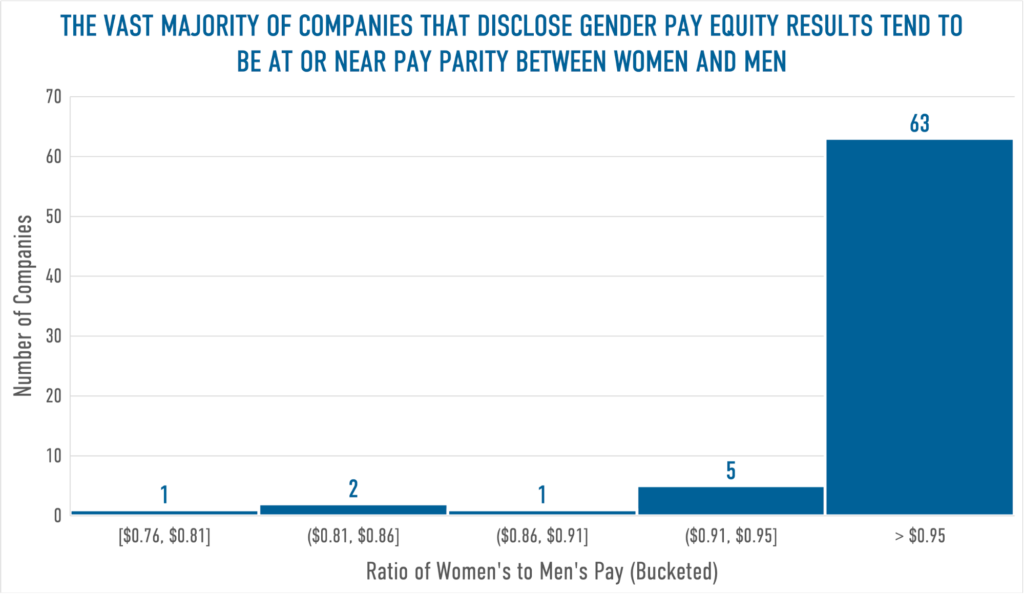
As we continue to rebuild from the COVID-19 pandemic, issues of equity become more – not less – important. Women are among the most severely impacted by job loss during the economic downturn, losing more than 5 million jobs in 2020. And based on this analysis, progress on addressing gender pay equity (particularly, conducting pay equity analyses) seems to have stalled as well. JUST Capital will continue to track the actions companies are taking to advance equity in the workplace, including how the state of gender pay equity continues to shift in corporate America in the months and years to come.
This week, Intel made a splash in the diversity and inclusion world when it released its 2019 Diversity Report, and, for the first time ever, released coveted data on its employees’ wages. The company is no stranger to releasing granular information about its workforce demographics, but it turns out that Intel is one of a handful of companies that is paving the way for transparency and disclosure around diversity.
These three graphs using data from JUST Capital’s 2020 Rankings explain why.
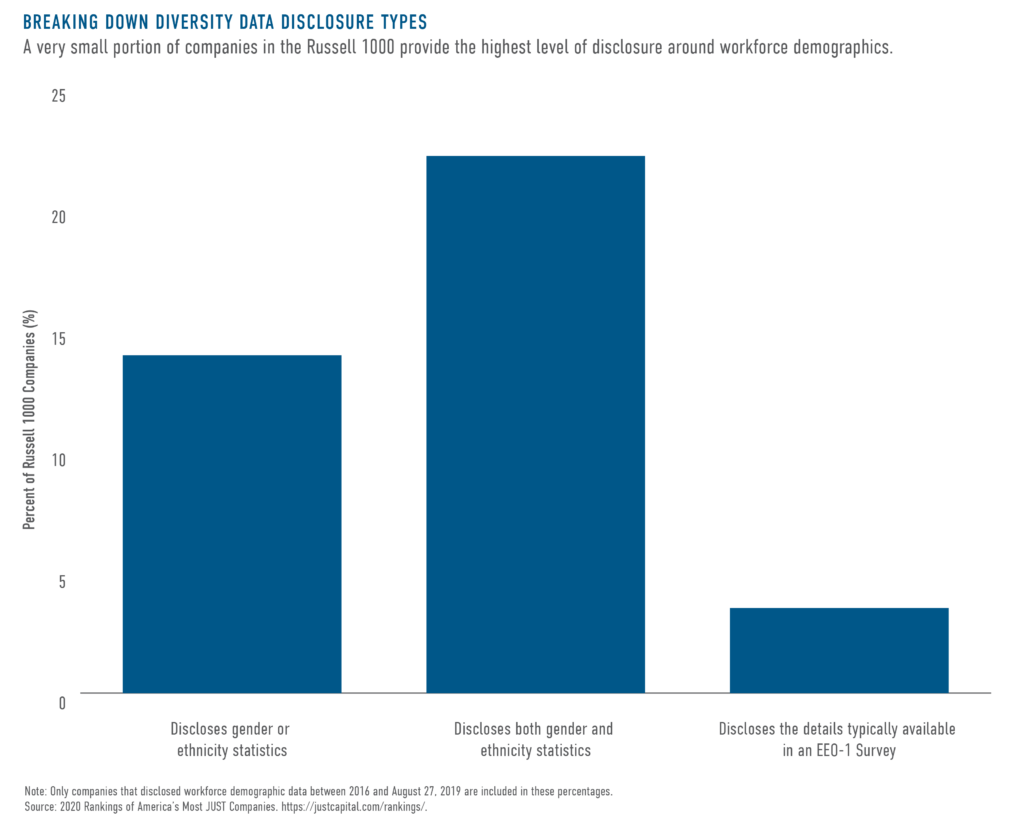
This year, JUST Capital included a new data point evaluating whether companies in the Russell 1000 Index disclosed statistics on the gender and racial/ethnic composition of their workforce. We found that overall, 40% of companies shared some information about diversity statistics. Breaking this down further, 14% disclosed gender or ethnicity statistics, 22% disclosed gender and ethnicity statistics, and 4% — just 32 companies — disclosed highly detailed data on workers’ gender and ethnicity by occupation, which is typically shared by private employees with the Equal Employment Opportunity Commission (EEOC) through the EEO-1 Survey. (See Figure 1.) To be clear, publicly disclosing an EEO-1 Survey is the gold standard.
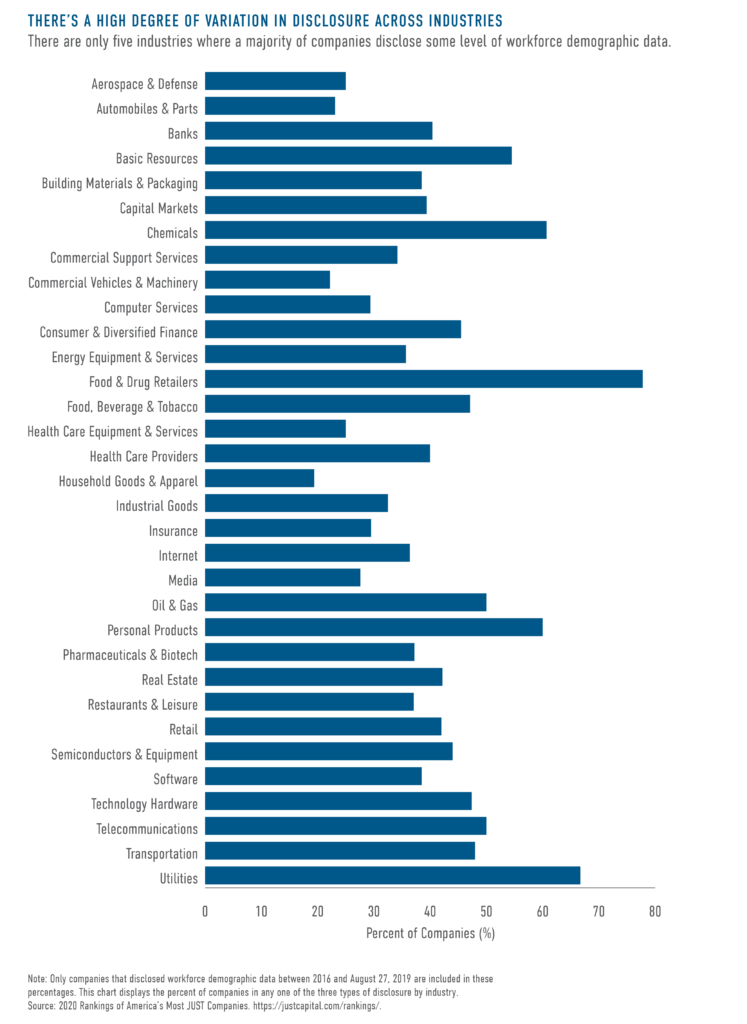
When taking a look at these trends by industry, we find that some industries have greater rates of disclosure than others. For instance, companies in the Food & Drug Retail industry and Utilities industry are more likely to share some information on their workforce demographics. Conversely, disclosure is low among companies in the Commercial Vehicles & Machinery industry and the Household Goods & Apparel industry (See Figure 2.) In only five industries, more than 50% of companies have some type of disclosure.
Overall, it’s difficult to see a pattern when looking across all types of disclosure. But, when we specifically look at companies that disclose highly detailed data on workers’ gender and ethnicity by occupation, a clear theme emerges.
Drilling down further, we ask: What types of companies are meeting the gold standard? The simple answer is Tech. Across the 32 companies who disclose highly detailed gender and ethnicity data by occupation group, 19 (close to 60%) fall into the Tech sector, which includes our Computer Services, Semiconductors & Equipment, Software, Technology Hardware, and Internet industries.
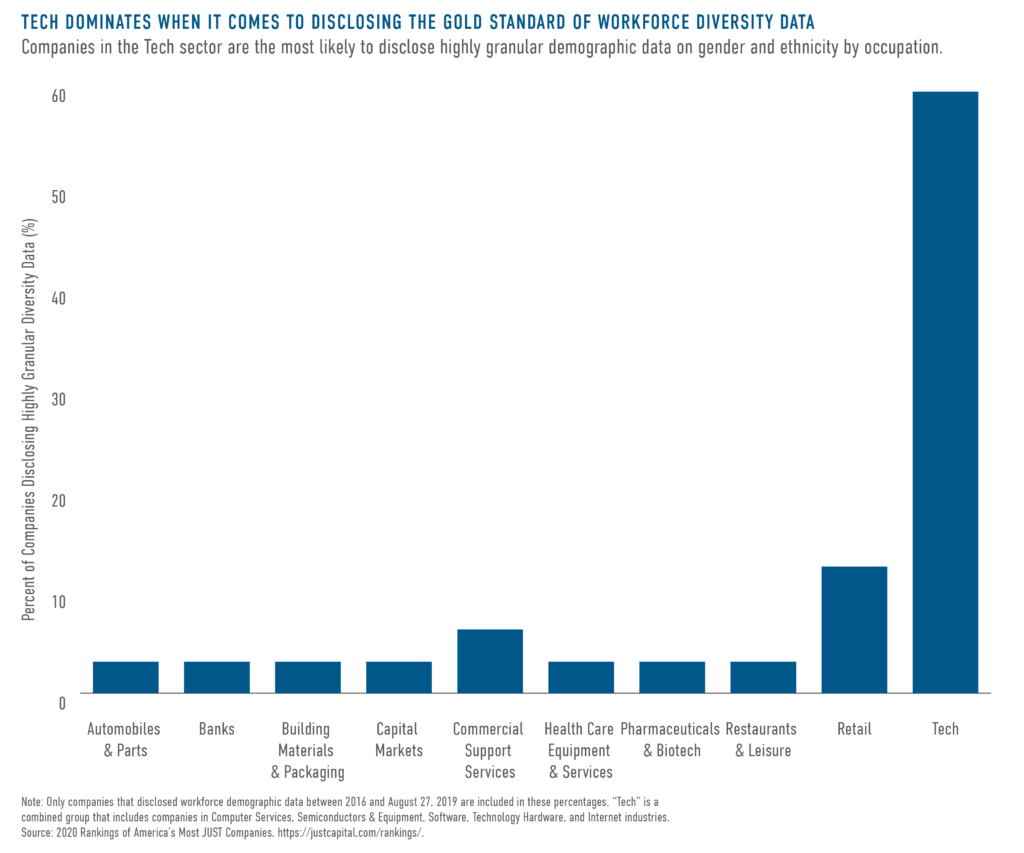
Since a call to action to release numbers 2013 in light of concerns about the leaky pipeline of women engineers, companies in Tech have increasingly been sharing their diversity statistics. While the actual data doesn’t paint a rosy picture of diversity in Tech, disclosing highly granular data is a critical step in the pathway to building more diverse and inclusive workplaces and holding these companies accountable for change.
The vast majority of companies in the Russell 1000 have a long ways to go when it comes to reaching the gold standard of disclosing workforce demographic data. But companies like Intel are pushing the envelope when it comes to disclosure by sharing employee wage band data by gender, ethnicity, and occupation — similar to what would be submitted to the EEOC in Component 2 of the EEO-1 Survey. Intel’s actions have added a new dimension to our understanding of what diversity, equity, and inclusion looks like at companies. And in the process, they are changing the disclosure landscape by setting a new gold standard. Other companies will have to follow suit.
