
Americans want paid leave. Just Capital data shows a clear and unmet demand for paid leave and parental support – 86% of Americans agree that it is important for companies to invest in expanded child care benefits, while just 44% agreed that companies are doing well on this issue. Polling shows these policies are a priority for the American public, and this election season, we saw paid leave measures advance in Nebraska, Missouri, and Alaska on the ballot. By implementing comprehensive paid leave programs, corporate leaders not only meet this expectation and support the well-being of their workers, but also deliver measurable returns through improved talent retention, enhanced productivity, and strengthened brand value.
This report makes the business case for maintaining and/or expanding paid leave policies, including:
Click on the image below to read or download the full report.
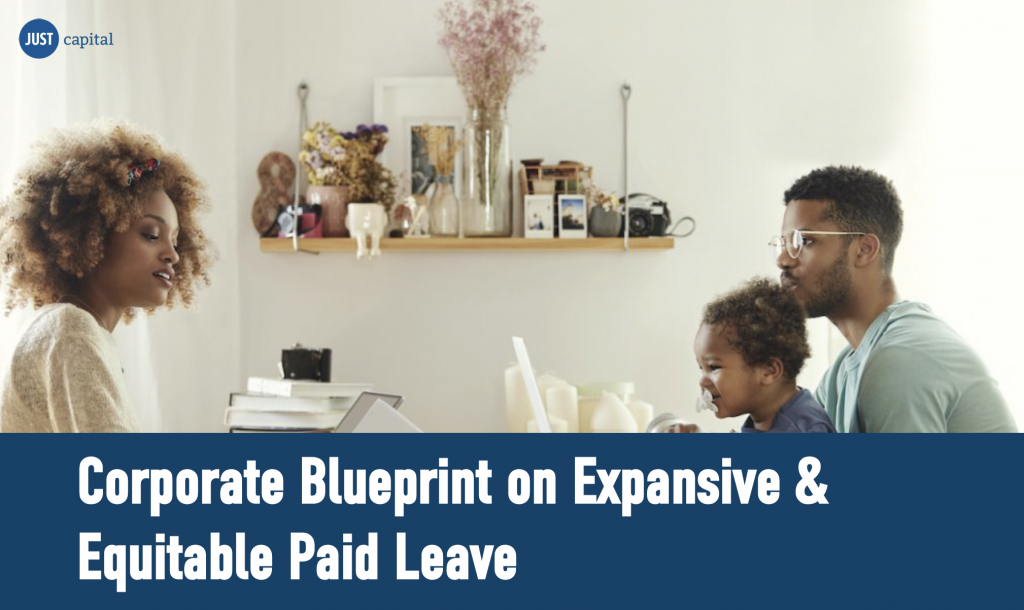

The business case to support parents is overwhelming. Policies supporting parents are critical to recruiting new – and retaining existing – workers, especially in a tight labor market, not to mention boosted worker productivity. A recent report from Moms First and BCG suggests that companies that strategically allocate resources to childcare benefits are seeing a return on investment of 90% to 425%.
Year after year the Just Capital polling highlights that the American public wants companies to prioritize their workers, specifically by providing benefits and work-life balance among the top five issues. In fact, a survey of working mothers further connects the dots between receiving more parental leave and being more satisfied at their workplace.
As a result, we see leading business executives prioritize these policies. In a Just Capital interview with Morgan Stanley Chief Medical Officer Dr. David Stark, he said paid parental leave “has low direct costs” and “a significant impact in terms of improving productivity, retention, and employee morale.”
We are also seeing companies realize the benefit of more publicly offering benefits geared towards families and caregivers. From 2023 to 2024, disclosure of paid parental leave for both primary and secondary caregivers increased by seven and eight percentage points, respectively.
So what employers lead the pack with their policies in 2024? Just Capital analyzed the policies and practices of the Russell 1000 and five came to the forefront.
You can find more information about corporate practices and policies like those elevated here in the latest version of our Just Jobs Scorecard, a data-driven interactive tool companies can use to assess their performance and transparency on key job quality practices and worker policies.
In the meantime, check out the full list, as well as NBC News’ coverage of it, below.
If you’re a corporate leader, we invite you to unpack your company’s performance in the 2024 Rankings and/or the Just Jobs Scorecard, gain insights into how to improve on the issues that matter most to the American public, and/or learn how to engage with Just to take action to support worker well-being though the Corporate Impact Lab. Please reach out to corpengage@justcapital.com.
Ranked 2nd in the Commercial Support Services industry in the annual Rankings of America’s Most Just Companies
The Benefits:
Ranked 1st in the Transaction Processing industry in the annual Rankings of America’s Most Just Companies
Ranked 2nd in the Clothing & Accessories industry in the annual Rankings of America’s Most Just Companies
The Benefits:
Ranked 5th in the Capital Markets industry in the annual Rankings of America’s Most Just Companies
The Benefits:
Ranked 14th in the Software industry in the annual Rankings of America’s Most Just Companies
The Benefits:
Methodology note: All of these companies exemplify leading practice by offering inclusive paid parental leave for 20 or more weeks to both primary and secondary caregivers, in addition to offering emergency backup and subsidized routine dependent care policies.

Sixty-four percent of Americans agree that companies should offer a minimum of 12 weeks of paid parental leave as a way to foster gender equity, and research also suggests that paid parental leave helps companies attract talent, increase retention rates, and improve employee performance.
But the Bureau of Labor Statistics estimates only 23% of workers receive paid family leave, and a mere 9% of the largest U.S. companies currently offer parity of 12 weeks or more to both caregivers, according to a recent JUST Capital report.
Hewlett Packard Enterprise (HPE) emerged as one company that demonstrated a commitment to workers – especially working parents – through its paid parental leave policy. The policy offers 26 weeks of paid parental leave for all parents for any birthing or adoption event with the option to return part time for three years following the leave.
We recently spoke with Samanntha DuBridge, HPE’s Vice President of Global Benefits, Culture, & Engagement, to learn more about how HPE implemented its paid parental leave policy and the resulting impact on workers and the enterprise as a whole. Below are key takeaways from that conversation.
Expanding benefits, inclusively
“When Antonio Neri became CEO, he talked a lot about wanting culture to be a legacy feature for him,” DuBridge said. “He made it very clear early on. He had a strong commitment to what he referred to as a ‘world class culture that was inclusive,’ and that really was built around the lives of our people.”
As the HPE team considered how to address the needs of their workforce, the “star feature” of their cultural vision was enhanced parental leave for all parents. To make the policy as equitable and inclusive as possible, “executives all the way through to our hourly workers” can access all 26 weeks of the paid parental leave benefit. A report from the Urban Institute finds that those most likely to lack access to these paid leave benefits include part-time or hourly workers, people with lower family incomes, workers who are not U.S. citizens, have less formal education, are younger or Hispanic.
Dubridge highlighted HPE’s efforts to ensure that parents received support on their return to work by offering the option to work part time for up to three years. “When we benchmarked and talked to other organizations, part of the feedback we were hearing is, there were a couple of companies that were offering two or three months parental leave, and their employees appreciated it. But then they would come back and they would go from zero to 150 in terms of the amount of work that they had.”
Driving retention, engagement, and loyalty
DuBridge shared that the returns of offering expanded care benefits outweigh the short term costs. (Researchers also recently made the business case for paid leave.)
“There is certainly a reality that in a tighter economy, economic times, some of the programs that companies put in place are harder to hold to, but you’re also making an investment,” DuBridge said. “So you need to determine sort of where you’re making those investments and investing in your people, to me is a really critical component to being a successful company.”
In a JUST Capital interview in 2020, Neri remarked on the early successes of the paid parental program. ”When we looked at the business case, this was the way to retain the best talent,” she said. For us, it was an incredible return on investment. Our attrition rate declined dramatically. And our employee engagement scores improved by 20 points.”.
After conducting research on what policies might most help their employees, HPE’s leaders drafted and announced the plan within several months. To drive buy-in from shareholders and other stakeholders, DuBridge said HPE positioned the policy change as a business opportunity.
“What we found is what we hypothesized initially when we were pitching it, which is that there’s a significant amount of loyalty with people who feel like their company has gone way out of their way during a time that was very important to them,” she said.
HPE was already offering parental leave and had systems in place, “so it was just a matter of being clear about who was eligible and the rules around it and then making some adjustments in the system and training vendors,” DuBridge said. “It wasn’t like we were starting from scratch or that we never were offering anything. If you sort of step back and walk through a process, sometimes it feels a little less daunting than when you first think about the huge variation in the program that you’re going to be offering.”
DuBridge encouraged other companies to start small. “You can always take it step by step. It doesn’t mean that you have to go from offering nothing to what we’ve done at offering six months. People can start to make some progress in that space,” DuBridge said.
For leaders considering proposing or adopting similar policies, she suggests that employers get creative with policies they could offer. “I think there’s a way for employers to offer something that gives people a little more balance and flexibility. Even if it’s just short term, like three months, for example. It could make a significant difference for someone to be able to kind of get their life back in balance.”
Prioritizing family-friendly culture
DuBridge said HPE’s paid parental leave benefits for both primary and secondary caregivers has translated into a happier and more productive workforce.
“It means that you’ve got people that are focused and dedicated. They feel like they’ve had the time that they need to make adjustments so that when they are back at work, they can really be productive,” she said.
The paid leave benefits at HPE have also drummed up significant interest from prospective employees, both those who do plan to have children and those who don’t.
“It’s a signal to all workers that this is a family-friendly environment. It signals to them that we have the right type of culture, which I think has been very helpful for us,” she said.
JUST Capital, in collaboration with partners, established the Corporate Care Network to advance the well-being of workers and demonstrate the long-term value of investment in workers. The Network is committed to driving increased access to care benefits, including paid leave and flexible work policies, and highlighting leaders in the space.
If you’re interested in gaining insights into how to improve on the issues that matter most to the American public, and learning how your company can get involved in the Network, please reach out to JUST Capital impact@justcapital.com.

As more people in the workforce enter the “sandwich generation,” caring for their own children and older parents or relatives, access to equitable leave policies is becoming more and more desirable for employees. Despite this, only 9% of the largest U.S. companies currently offer parity of 12 weeks or more of paid parental leave to both caregivers, according to a recent JUST Capital report. In fact, research suggests that the percentage of companies offering paid parental leave has actually decreased in recent years.
One company that has prioritized its leave benefits is Morgan Stanley, which doubled down on parental leave in 2021. After analyzing results of a global employee survey and benchmarking peers, Morgan Stanley increased its parental leave to 16 weeks for all caregivers and four weeks of paid leave to care for a family member with a serious health condition, among other generous policies, such as a $75,000 maximum family building benefit to assist employees with the cost of adoption, surrogacy and fertility treatments. Previously the company offered primary caregivers 16 weeks of parental leave and non-primary caregivers six weeks of parental leave. This step forward to parity is critical to cultivating both gender and racial equity in the workplace.
JUST Capital recently spoke with Dr. David Stark, Morgan Stanley’s Chief Medical Officer and Global Head of Benefits, Analytics, and Technology Strategy, to learn more about how and why Morgan Stanley implemented its enhanced paid parental leave policy, as well as the impact on its workforce and company as a whole.
You increased your paid parental leave to 16 weeks for all caregivers – what prompted you to make this level of investment?
We made this change back in 2021. So, recall that the pandemic led to the caregiving crisis. We were seeing people leaving the workforce to take care of their kids or their parents or others in the home. This is on top of, you know, the “sandwich generation” being an issue, and I’m a part of that myself. We know that women were disproportionately being taken out of the workforce to shoulder those [caregiving] burdens. We were recognizing all of that. Additionally, in 2021, we did a global employee benefits survey, which was a really detailed and eye-opening survey. Overall, the vast majority of our employees were very happy with their benefits, but paid parental leave and family support were areas that were highlighted as opportunities for improvement. In fact, paid parental leave was the top driver that could promote increased satisfaction relative to other potential design changes we were considering.
The pandemic, the external environment, and our own surveying led us to benchmark our family support benefits against our peers, and then decide to prioritize the [family support] space for focus. What we learned is that our paid parental leave benefit had fallen behind our peers.
What did the progression of planning and rolling out of this benefit look like?
Using all of the [survey and benchmark insights], we developed a multi-year roadmap to enhance our family benefits – not just parental leave, but other support benefits. We addressed paid parental leave first. We thought that was where we could have the most significant impact.
We also looked for some quick wins that we could achieve relatively easily. For example, we put in place NICU and stillbirth leaves, and we eliminated a one year of service term requirement. We did that immediately while we took a little bit more time to redesign and socialize the more extensive expansion of parental leave enhancement. We also enhanced our family building benefit. We already had a pretty generous fertility benefit ($30,000 lifetime benefit) to support fertility regardless of infertility diagnosis, but we wanted to make that benefit more holistic. We expanded the benefit to provide a $75,000 lifetime maximum to support family-building across adoption, surrogacy, and fertility.
We expanded our paid parental leave to provide 16 weeks across the board for all parents, regardless of primary/non-primary [parent] and gender. In the U.S., we provide an additional six to eight weeks of disability leave for birth parents, resulting in a total of 22 to 24 weeks of parental leave.
How did you build the case for that level of support? What hurdles did you need to overcome?
Management was generally supportive of the change. It was obviously important to socialize the change within each of our business units, since the extended duration would have distinct and nuanced impacts on their respective organizations, resulting in the need to backfill roles and potentially impacting performance measures. This was actually happening amid a broader backdrop of the “great reshuffling” or the “great resignation.” James Gorman, our CEO, made a call to his operating committee at an off-site meeting that he felt strongly that we needed to renew the social contract with our workforce. That [prioritization] led to a very holistic look across the benefits space.
The general environment was very supportive of making these changes. It was viewed as an investment in maternal and infant health, long-term retention, and productivity upon returning to work. Those [investments] were weighed very favorably against the obvious, but relatively small, short-term issue of needing to backfill [roles held by employees on leave].
How do you respond to executives who say, paid parental leave is nice, but we can’t expand benefits in this economy?
Enhancing parental leave has low direct costs. It has a significant impact in terms of improving productivity, retention, and employee morale. Anecdotally, the feedback that we get from employees who’ve had the time to bond with their child, recover from giving birth, and support their partner in recovering from giving birth, is that [access to paid time] buys loyalty. And that’s almost immeasurable relative to the cost. It’s part of long-term thinking.
Oftentimes, frontline workers are not offered the same benefits as their corporate peers. How are you supporting not only corporate employees, but hourly employees or contract employees when it comes to parental leave?
Employees who work 20 hours or more, whether they’re hourly workers or salaried, are eligible for a full suite of benefits, and that includes paid parental leave.
As a global business, how do you approach benefits across different countries and territories?
That’s the fun part. Increasingly, through the pandemic and beyond, we have felt the need to provide more consistency globally across the board. We’ve actually worked very hard to first understand: What are the policies in the 40 countries where we operate? What’s the regulatory environment across all of our markets? What are local practices? And then we worked to establish, in this case, a global minimum standard to ensure consistency. That led to the 16 weeks [of paid parental leave] as a floor for all employees, and in certain markets, where regulations or local practices allow for more leave, we do that.
As a more general matter, delivering healthcare and other benefits globally is fascinating and challenging. The United States is probably the only country where employers are the principal providers or purchasers of healthcare on behalf of their employees. In most other countries, employees top up their national healthcare benefits with employer-sponsored plans. There’s obviously a lot of unevenness to navigate. We don’t strive to be equal across the board, we strive to be equitable across the board.
What benefits have you seen in your workforce in terms of recruitment, retention, wellbeing, productivity?
We are a year in, so, perhaps a little bit early for a formal evaluation, but we are quite rigorous about how we collect data to evaluate our programs and our offerings. On utilization, what we’re seeing is all parents are taking more time off for leave. One obvious question that could come up whenever an employer changes a policy or expands a leave is: are our employees actually taking advantage of it? I’m proud that our employees are. Birth parents are taking off, on average, five more weeks (+30%, from 16 to 21 weeks); non-birth parents are taking off four more weeks (+70%, from 6 weeks to 10 weeks). Additionally, non-birth parents are now deciding to take leave, whereas in the past so-called non primary parents (traditionally, the dads) might not be taking leave. Now, adjusting for headcount changes, we’re seeing about 15% more non-birth parents opting to take leave, which is great. Another component of the leave that we introduced was flexible leave, so you can take leave in up to three chunks over the year and can even start your leave before childbirth as well. My husband and I had our third kid in January, so I took off five weeks initially and I’ll take off two other chunks. That is what worked best for my family and my work. Of the non-birth parents who are taking parental leave, about 20% of them are opting to take advantage of our “flexible” leave policy, which allows parents to split their leave in up to three separate intervals.
What advice would you give an executive who wants to lead on this issue in their own company? What should they do first? What’s something to avoid doing?
We have quite a rigorous approach, and I’m very proud of how we developed our strategy around benefits design. I mentioned the dedicated benefits survey that we did back in 2021 – that was a global survey and which 35% of our entire workforce participated in – and it was quite extensive. In addition to that, we have our annual engagement survey where we ask about whether employees feel they have the resources they need to support their health and well-being. We also hold managers accountable. In their upward feedback of their managers, employees are asked whether their manager supports their health and well-being.
We also have a Global Wellbeing Board that we developed in the last two years, comprised of 16 senior leaders across the firm, like CEOs of business divisions. The responsibility of this board is senior accountability and ownership over our health and well-being strategy. I felt that this was important, because although HR/HR benefits traditionally has the role of developing and rolling out new programs and resources, health and well-being is a business imperative. It therefore requires involvement and buy-in from across the business. That’s been an excellent additional source, not just of leadership and visibility, but actually providing input into our strategy.
Complementing that top-down structure, we have a bottom up-structure: our Global Wellbeing Influencer Network that we also launched in the last year. This is essentially a grassroots network of employees, who have already demonstrated commitment and interest in supporting well-being issues. We’re giving them resources: awareness, programming resources, access to our programs, and a community to network through, so that they can be evangelists for our benefits and provide feedback both to HR and to the Global Wellbeing Board on our benefits. We have a lot of distinct modalities for collective sentiment around benefits.
We also look at hard data utilization, claims data, external benchmarking data, and market research. That all funnels into developing our multi-year strategy. This is a long-winded way of saying that we’re quite rigorous about using data to support the business case that we develop for any change in our benefits. And then ultimately, our job is to manage population health for our 83,000 employees in 40 countries. As a Chief Medical Officer, in addition to being a Global Head of Benefits, when I speak to management about the work that we’re doing, I’m speaking with this lens as a population health leader, not just as a benefits professional. I think that helps advance our case as well.
Given your role, how do you make the connection between increased paid leave and health?
I’m a physician, a pediatric neurologist by training. I have a background in biomedical data science, and biomedical informatics, so I’m serious when I say we were quite rigorous across all of our programs. There’s essentially four types of metrics that I care about: they are utilization, costs or affordability (both for employees and for the firm), employee experience, and then ultimately, health-specific outcomes.
Over time, we can actually do observational studies, where we look at different employee groups, those who have utilized a particular benefit, and those who have not. Then we look at outcomes of interest over time, whether that’s retention, productivity measures, or other performance measures that we have. Sometimes we rely on external measures for this as well. We know supporting mental health is the right thing to do, and so I’ve strongly made the case that we’re not always going to be able to demonstrate with hard metrics and ROI behind what we do. There are certain times where we have to say, “look, we already know this is the right thing to do. The evidence is out there. It’s been proven externally. Let’s not spend time arguing over whether it’s the right thing to do. Let’s agree and deploy internally, and then follow up over time.”
JUST Capital, in collaboration with partners, established the Corporate Care Network to advance the well-being of workers and demonstrate the long-term value of investment in workers. The Network is committed to driving increased access to care benefits, including paid leave and flexible work policies, and highlighting leaders in the space.
If you’re interested in gaining insights into how to improve on the issues that matter most to the American public, and learning how your company can get involved in the Network, please reach out to JUST Capital impact@justcapital.com.

(MoMo Productions/Getty Images)
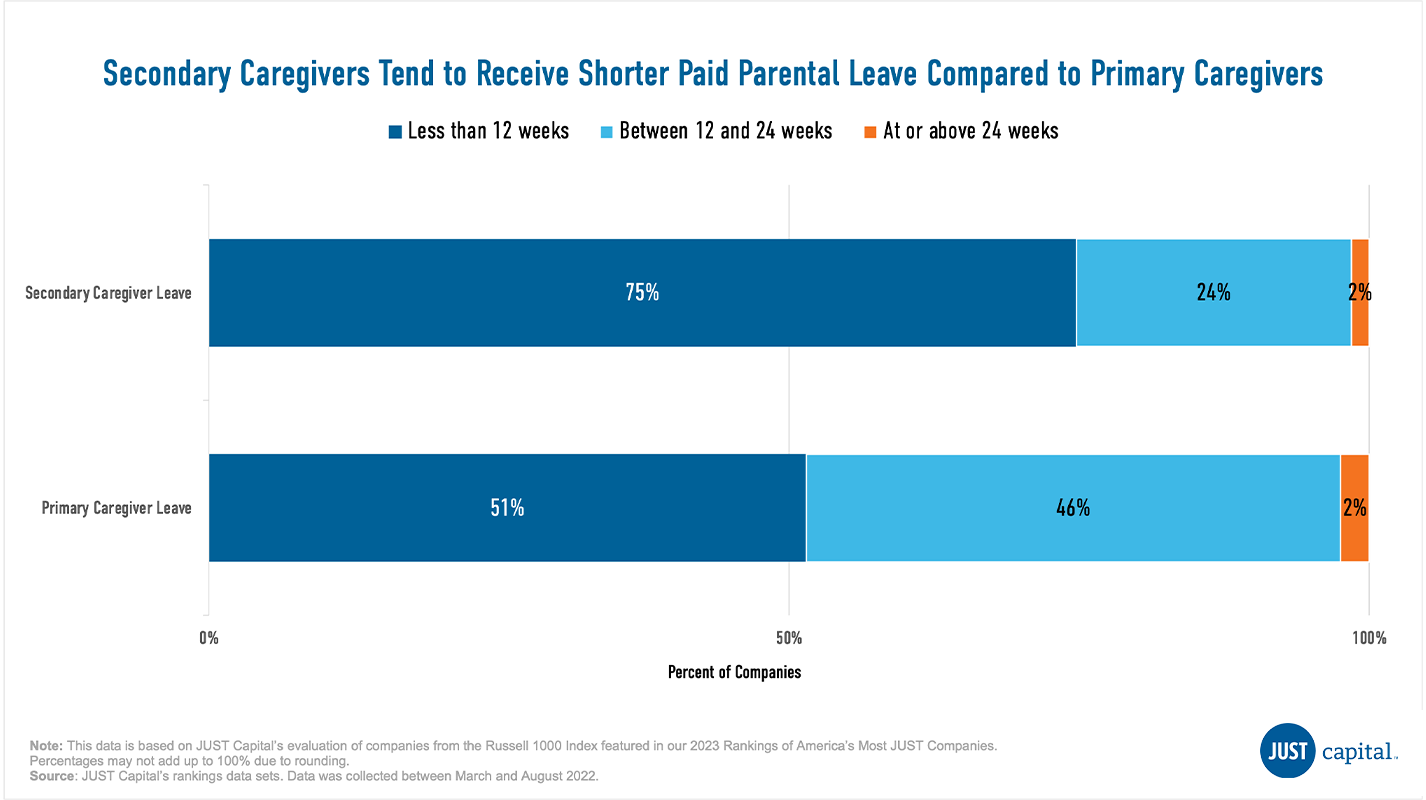
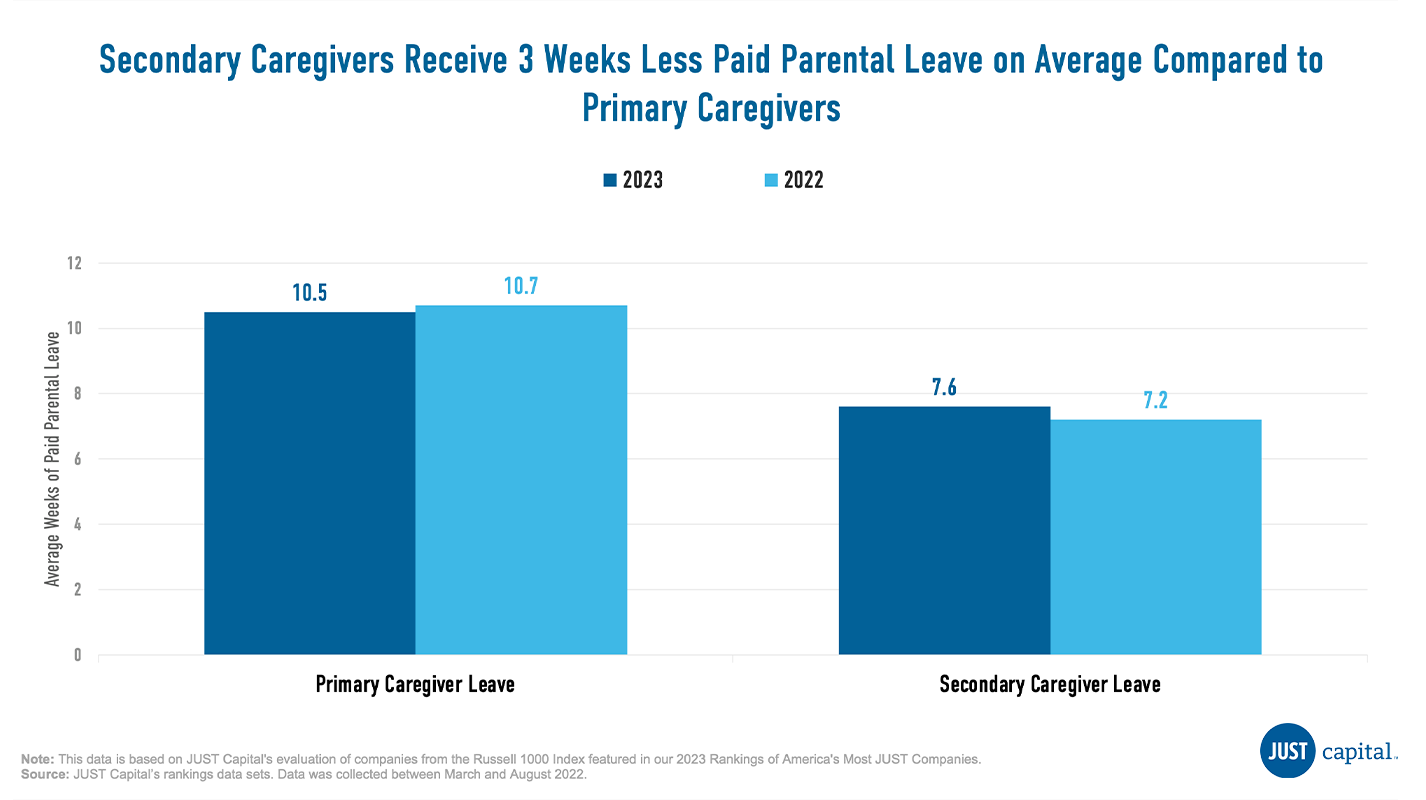 Looking more closely at the length of leave, we found that the average Russell 1000 company offers 7.6 weeks to secondary caregivers in 2023, a slight increase from 7.2 weeks in 2022. In contrast, primary caregivers on average received 10.5 weeks of paid leave over the same period. In other words, the average secondary caregiver receives three weeks fewer than primary caregivers, perpetuating the norm that child rearing is a primarily female responsibility.
Despite the generally lower length of leave for secondary caregivers, paid parental leave is a fairly common benefit, with 41% of companies offering some paid time off for working dads to welcome a new child. Meanwhile, 24% of companies disclose a backup dependent care policy, and just 13% offer subsidized child care benefits. Flexible working hours are more common, with 39% of companies offering this benefit.
Looking more closely at the length of leave, we found that the average Russell 1000 company offers 7.6 weeks to secondary caregivers in 2023, a slight increase from 7.2 weeks in 2022. In contrast, primary caregivers on average received 10.5 weeks of paid leave over the same period. In other words, the average secondary caregiver receives three weeks fewer than primary caregivers, perpetuating the norm that child rearing is a primarily female responsibility.
Despite the generally lower length of leave for secondary caregivers, paid parental leave is a fairly common benefit, with 41% of companies offering some paid time off for working dads to welcome a new child. Meanwhile, 24% of companies disclose a backup dependent care policy, and just 13% offer subsidized child care benefits. Flexible working hours are more common, with 39% of companies offering this benefit.
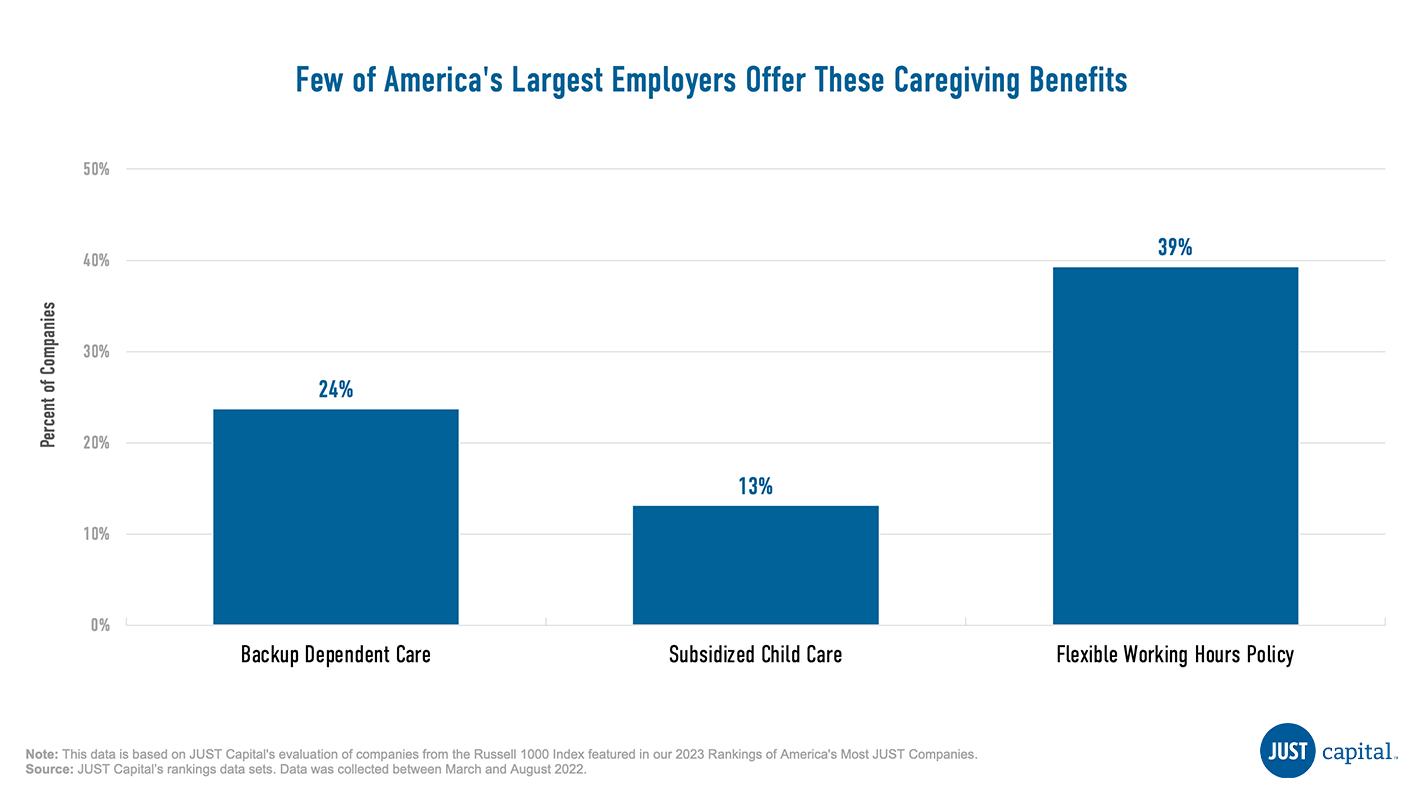 For working parents, there is a clear need to have access to all of these benefits, but we found that just 6% offer all three. When we add paid parental leave to the mix, the pool of companies that have comprehensive offerings shrinks further – with just 1.5% of companies offering all three benefits and 12 weeks or more of paid parental leave to fathers – signaling the need for corporate America to do more to support working dads.
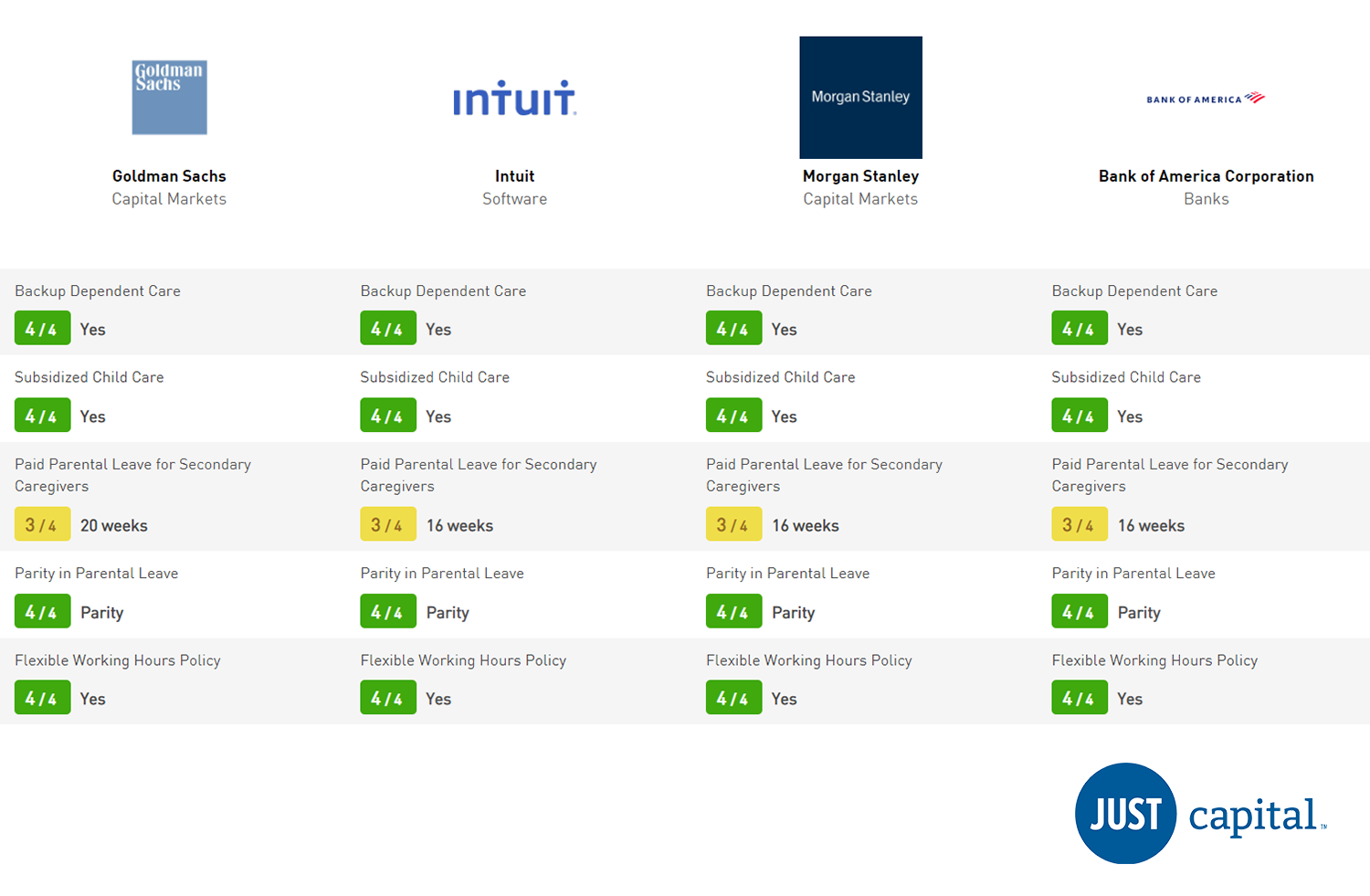 Each of these leading companies:
