As business leaders continue to transform their companies and strategies around AI, they face a new and largely unmapped set of stakeholder expectations. Calls for responsible development and deployment continue, yet leaders lack an organizing framework that objectively defines responsibility and enables consistent and comparable practice across companies. Just Capital’s ongoing AI-focused polling initiative aims to fill this gap.
In early 2026, Just Capital conducted its second quarterly survey of the American public, investors, and corporate leaders. The ongoing initiative is designed to offer a roadmap for companies looking to build trust in the AI era and a framework to begin to define what responsible business leadership in the age of AI really means. The inaugural wave of this research initiative was conducted in the fall of 2025, and quarterly surveys will continue through 2026 and beyond to track perceptions as the technology evolves.
The organization today published its second full report Spring 2026 American Public, Investor, and Corporate Leader Perspectives on Responsible AI Deployment: AI Optimism Rises but Concerns Remain. The research revealed key changes between Fall 2025 and Spring 2026:
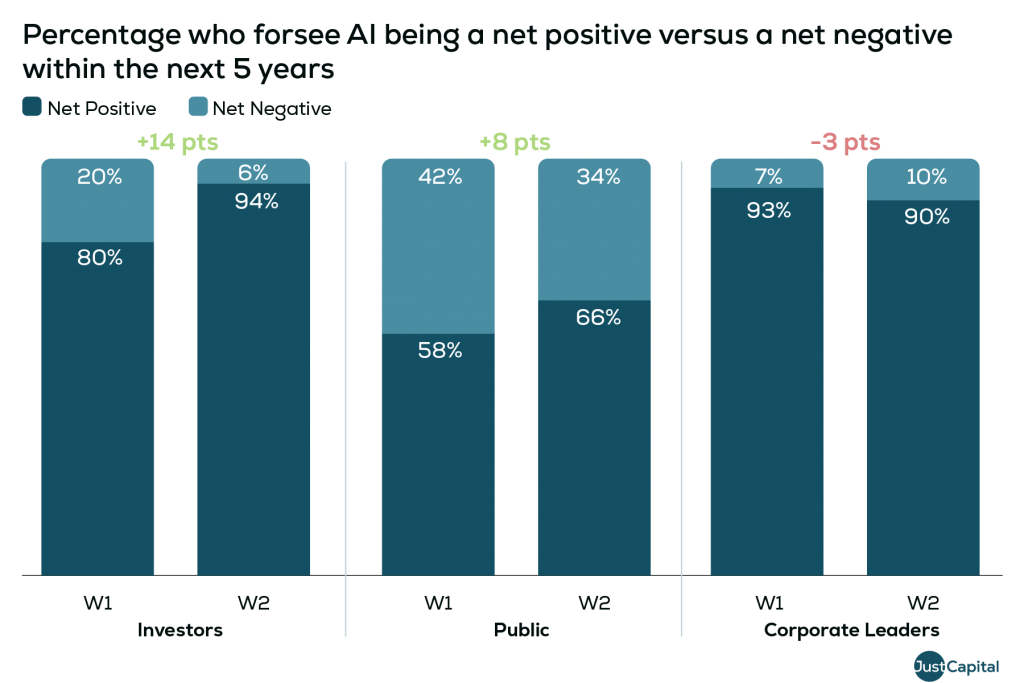
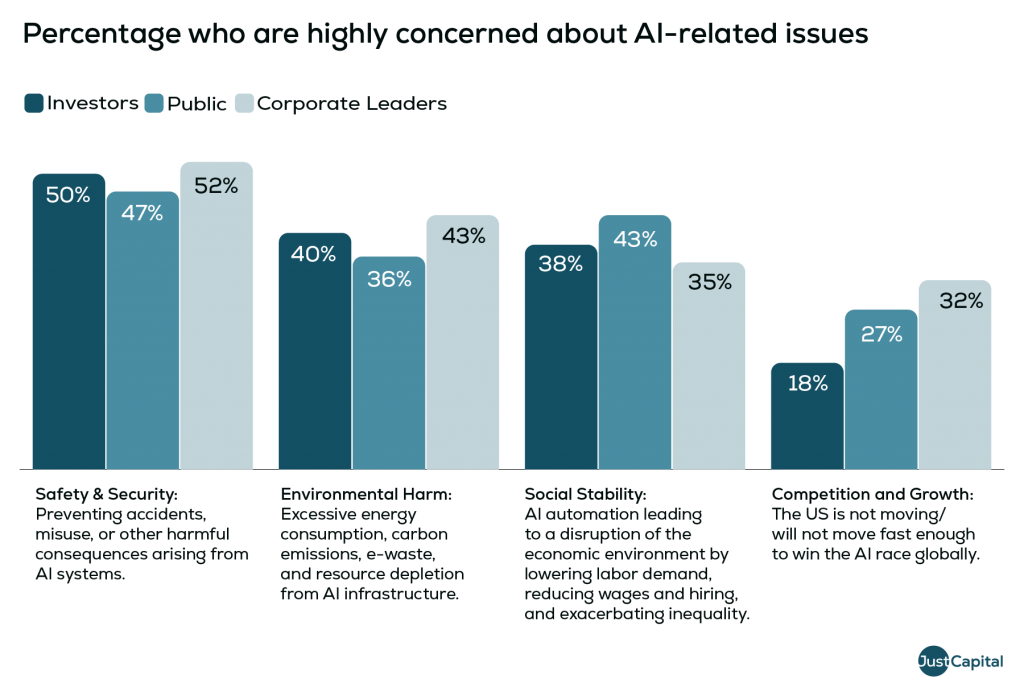
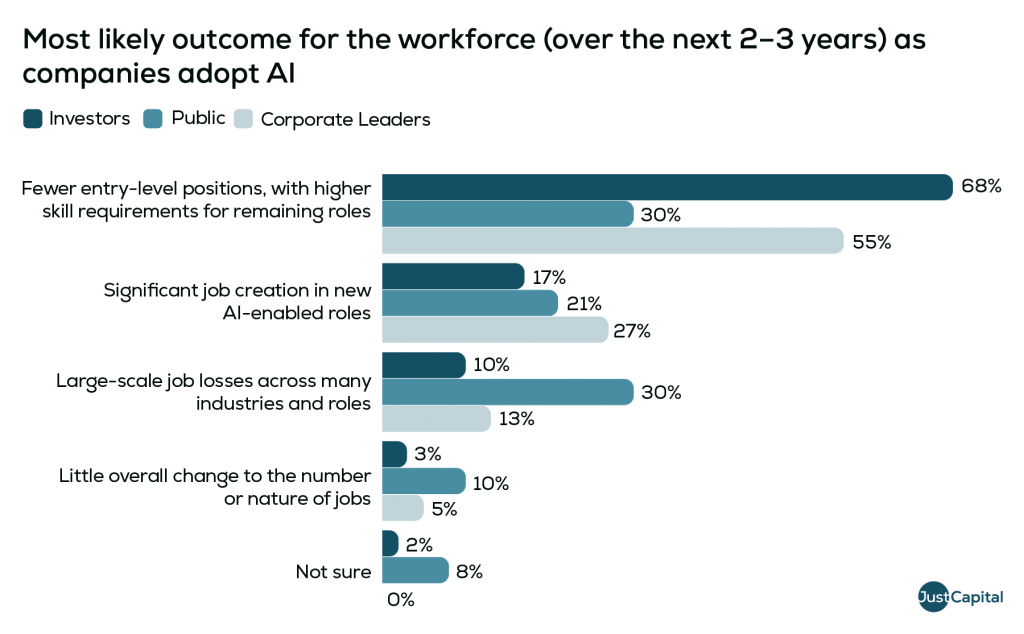

Findings from the second wave of Just Capital’s AI-focused polling suggests we are entering a period of growing confidence, but also one that demands continued focus on transparency, accountability, and broad benefit-sharing. Recent analysis from Just Capital on the state of corporate disclosure reveals that just 37% of the 110 companies analyzed disclose responsible AI principles or guidelines.
“There’s no shortage of ambition around AI, but there is a shortage of clarity on what responsible deployment actually looks like in practice. That’s a gap we aim to fill,” said Just Capital CEO Martin Whittaker. “This research is designed to give leaders a clear, data-driven starting point for building the kind of trust that earns and maintains long-term social license to operate.”
Methodology
In January 2026, Just Capital surveyed 1,000 American adults in partnership with Harris Poll, 103 corporate executives (84 c-suite executives and 19 board members or senior-level executives) in partnership with Gerson Lehrman Group, and 100 institutional investors and analysts in partnership with NewtonX. This survey was the second wave of an ongoing quarterly polling initiative.
About Just Capital
Just Capital is the foremost independent organization advancing responsible business leadership. We translate insights from public polling, performance data, and financial analysis into actionable intelligence leaders can use to drive long-term business success and shared prosperity for people across America.Our flagship product Just Intelligence is designed to offer a comprehensive view of public expectations, stakeholder performance, and sector realities in order to drive responsible decision-making. When companies make better decisions, they can create lasting value for shareholders, contribute to stronger communities, and help drive broader economic and societal progress. For more information, visit justcapital.com.
Recent research on public attitudes toward AI reflect a rising level of unease and concern about the technology and its potential impacts on the workforce, relationships, and education. A closer look at public priorities suggests the views of the public are more nuanced than other polls may indicate and the path forward for AI-focused corporate leaders is clearer than overall sentiment polling implies.
In March 2026, Just Capital prompted the American public to prioritize AI-related issues rather than measure general sentiment. The results reveal that public support for AI is not absent but conditional: it depends on whether companies can demonstrate how they are managing risk responsibly while delivering on AI’s greatest potential to improve society. An early review of corporate disclosure suggests most companies have not yet made that case clearly or consistently.
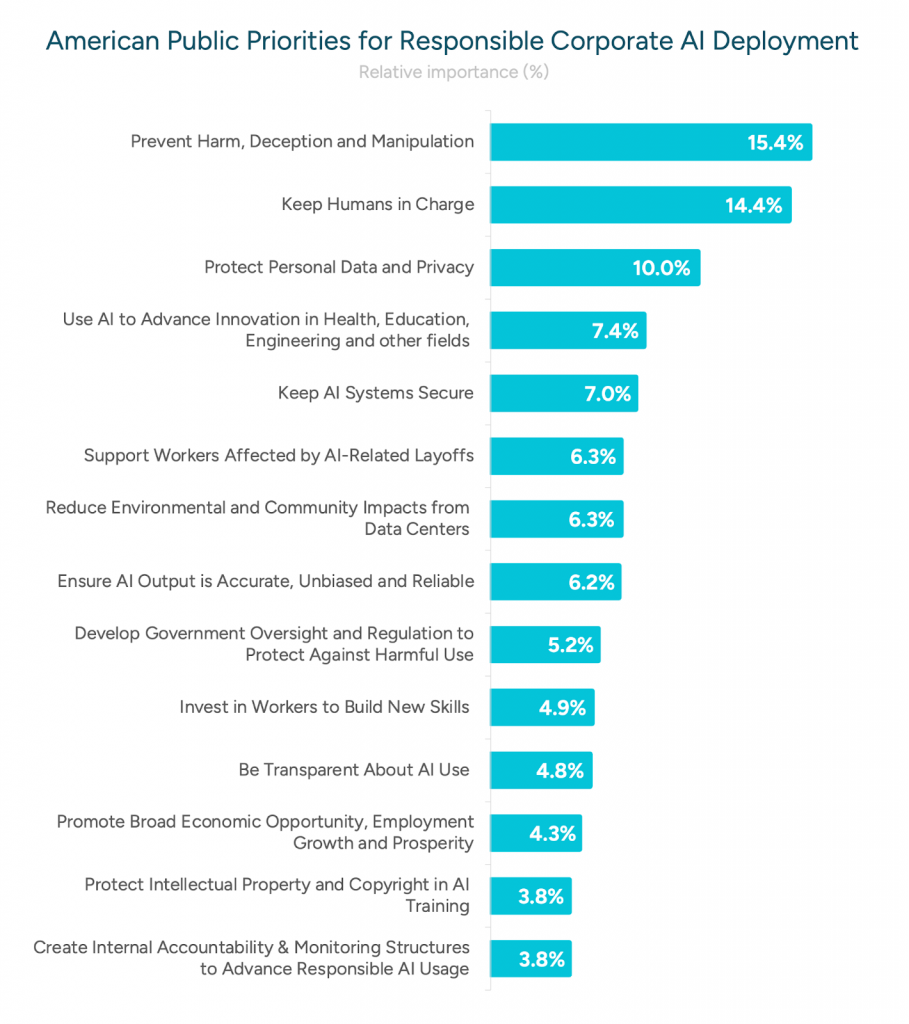
When asked to rank priorities rather than express general views, Americans reveal a more balanced perspective than headline sentiment polls suggest. They highly prioritize the use of AI to advance innovations in health, education, and engineering to solve complex societal problems, even ranking this above concerns around workforce disruption and environmental impacts.
At the same time, the three highest-ranked priorities are focused on safety concerns: preventing harm, deception, and manipulation; keeping humans in charge; and protecting personal data and privacy. This suggests public support would be bolstered by companies articulating the guardrails around the technology. Americans are watching to see whether companies can deploy AI responsibly.
We reviewed AI-related disclosures at six hyperscalers and 104 additional companies that rank highly in the organization’s measure of overall responsible business practices. Even among these 110 companies, most with strong disclosure track records across workforce, community, environment, customer, and governance issues, AI-related reporting is inconsistent and lacks common definition.
Two of six hyperscalers publish dedicated AI Transparency Reports. Fifty percent of companies disclose board-level involvement in AI risk oversight, but just 37% of the 110 companies analyzed disclose responsible AI principles or guidelines. Among those that do, disclosure is uneven on the issues Americans rank highest: only 16 companies mention preventing harm, deception, and manipulation; 27 mention human oversight; and 37 mention customer privacy and data protection.
Across Just Capital’s broader analysis of 933 public American companies, the picture is even less clear. The share of companies committing to not selling user data in any context dropped 3.5% year over year, and 3% fewer companies commit to not using user data for advertising. The average number of employee training hours fell from 24.34 per employee in 2024 to 21.96 in 2025, despite calls for more AI-focused training and reskilling opportunities. Among the smaller group of 110 companies analyzed further, 39 disclose formal AI training programs for employees.
As companies accelerate AI deployment, clearly and consistently defining responsible AI development and deployment will be a meaningful point of distinction for the American public. This analysis suggests the public will be more likely to extend trust to companies that demonstrate they are using AI to deliver genuine social benefit while protecting people from the greatest risks.
The full list of public priorities identified by Just Capital is below. These priorities are being translated into trackable metrics for ongoing analysis.
Methodology
Just Capital regularly conducts independent surveys to track Americans’ priorities, values, and expectations for corporate behavior, which serve as a foundational input into its Just Intelligence tool, rankings, and research products. Priorities weights were determined via maximum-differential (Max-Diff) to quantify the relative importance of each of the AI-related issue statements.
This survey was conducted online within the United States by Just Capital from March 12–16, 2026 among 2,012 U.S. adults ages 18 and older. Data from this survey have been weighted to align with known population parameters from the U.S. Census Bureau on key characteristics including [age, gender, geography, etc.]. While weighting adjusts for demographic imbalances, this survey is based on a non-probability sample and therefore no estimate of theoretical sampling error can be calculated. Findings should be interpreted accordingly.
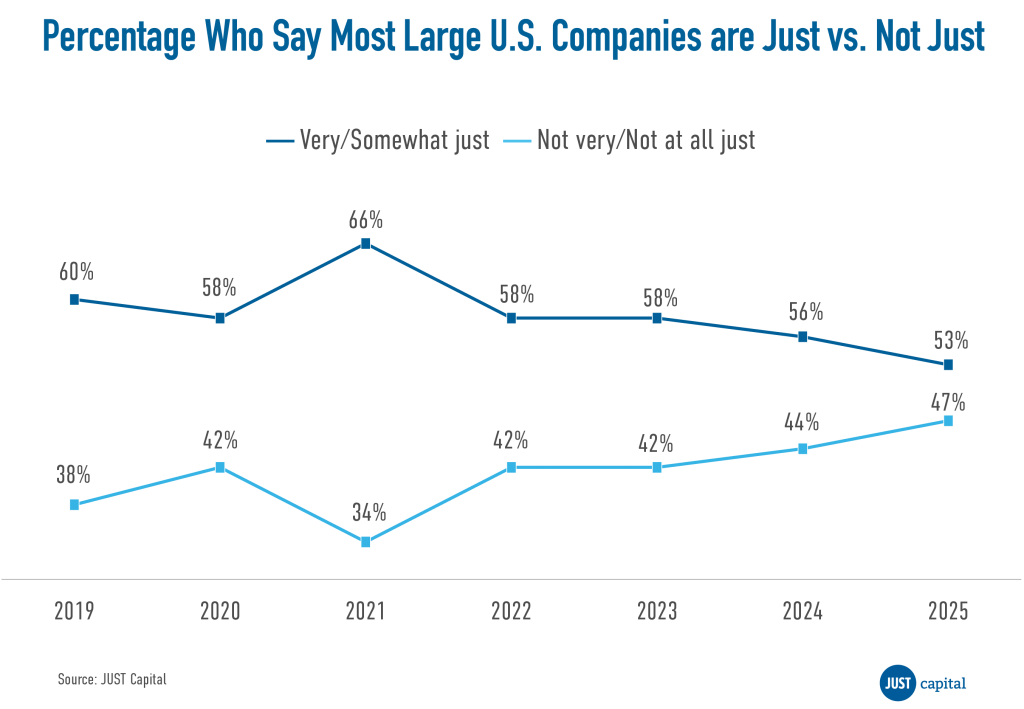
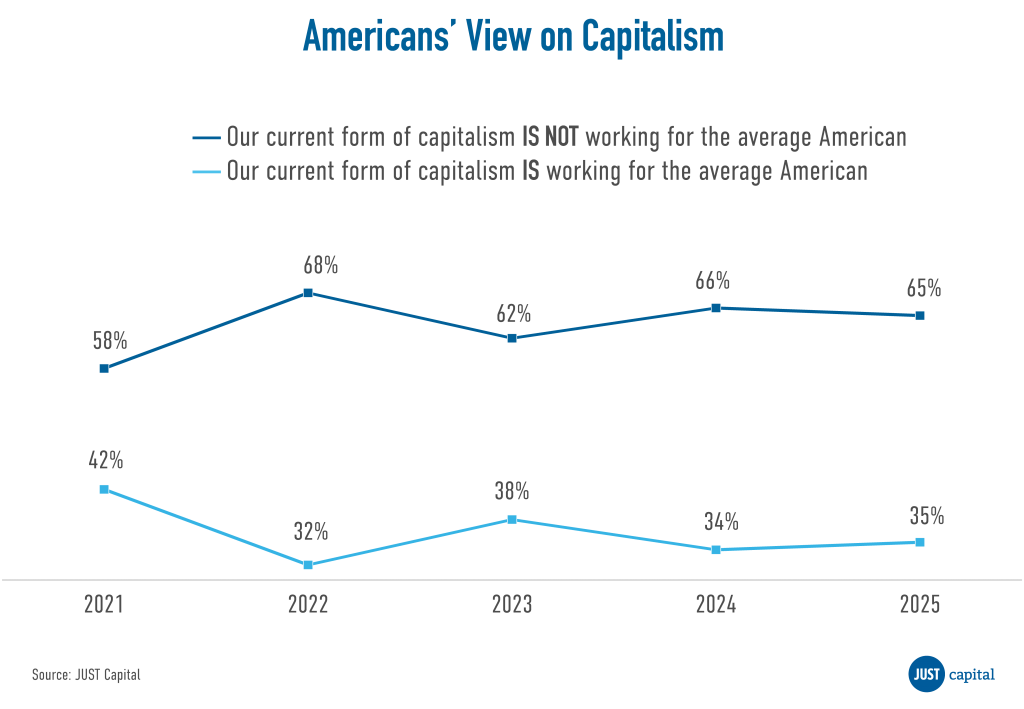
1. Only 53% of Americans believe large U.S. companies are very or somewhat just, the lowest percentage since we began this polling in 2019. Only 35% believe our current form of capitalism is working for the average American.
2. This is at odds with the expectations of the public. 80% believe business can be a force for positive social change and 89% agree it’s important that companies promote an economy that serves all Americans.
3. When we dig deeper, Americans care most about worker-related issues such as providing a fair and living wage, supporting worker well-being, and offering advancement and training opportunities, alongside employee benefits.
4. As AI and automation become even more dominant in 2026, leaders have a significant challenge ahead to innovate and grow their business while continuing to invest in and cultivate their workforce. Our recently released research on perceptions of AI amongst corporate leaders, investors, and the American public aims to help them identify key considerations for responsible AI deployment at scale.
Perceptions of performance on just business behavior peaked during the height of the Covid-19 pandemic in 2021. Since then, the gap between those who view companies as just versus unjust has narrowed to its smallest margin in seven years, suggesting declining confidence in corporate behavior.
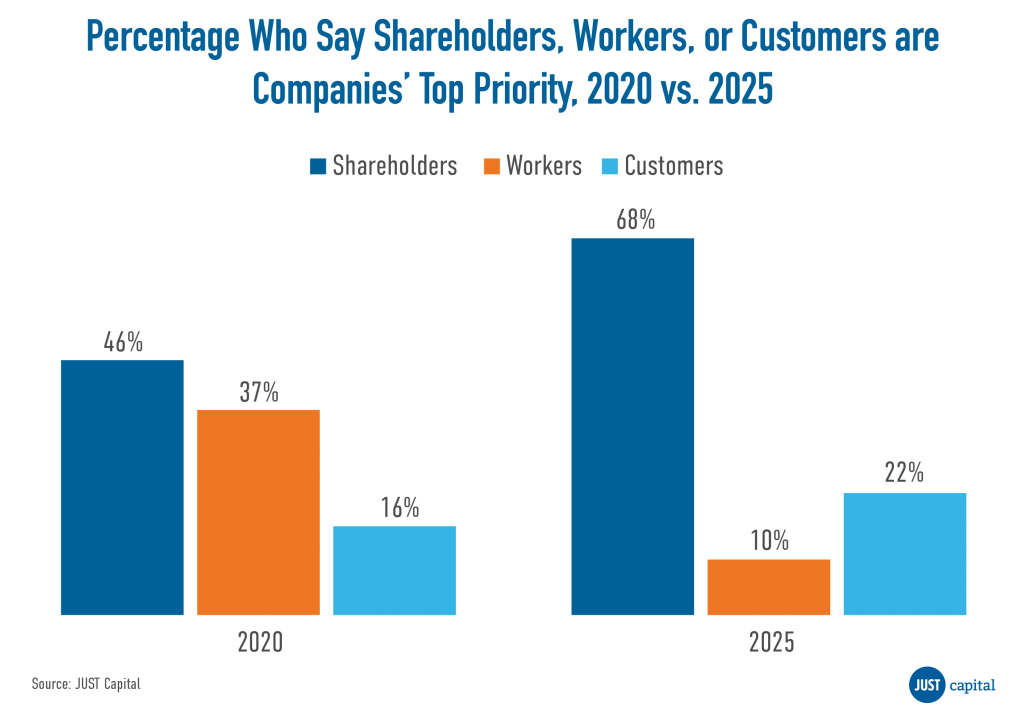
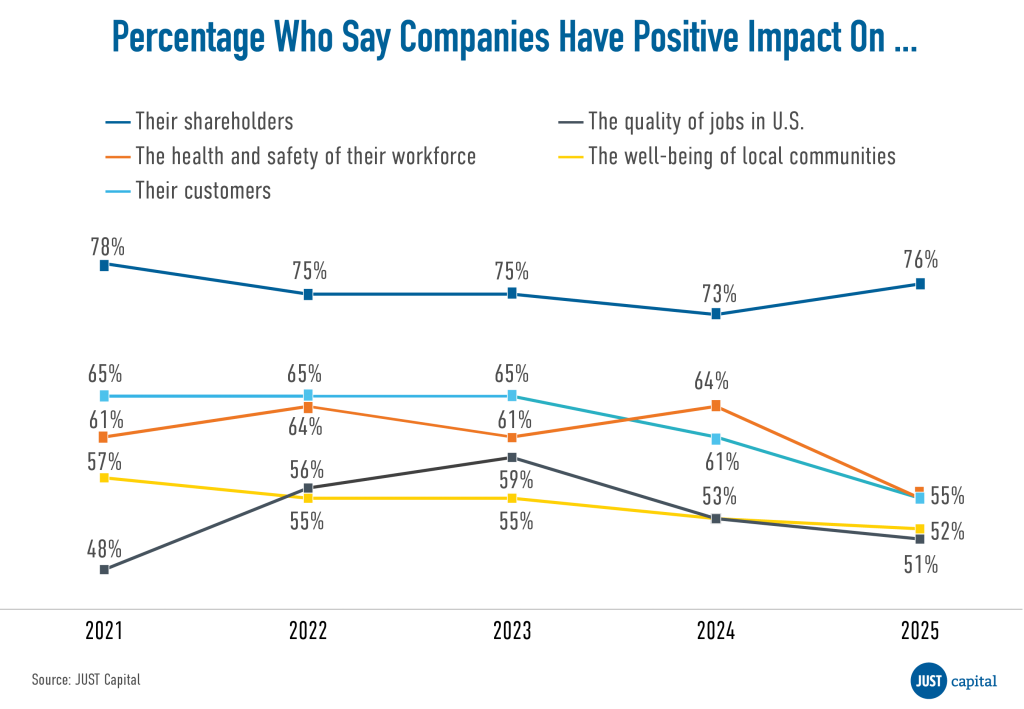
The public indicates belief that companies are overwhelmingly focused on shareholders at the expense of their workers and customers. The shift since 2020 is stark: while shareholder prioritization has remained constant or even intensified in the public’s view, they believe attention to workers and customers has languished.
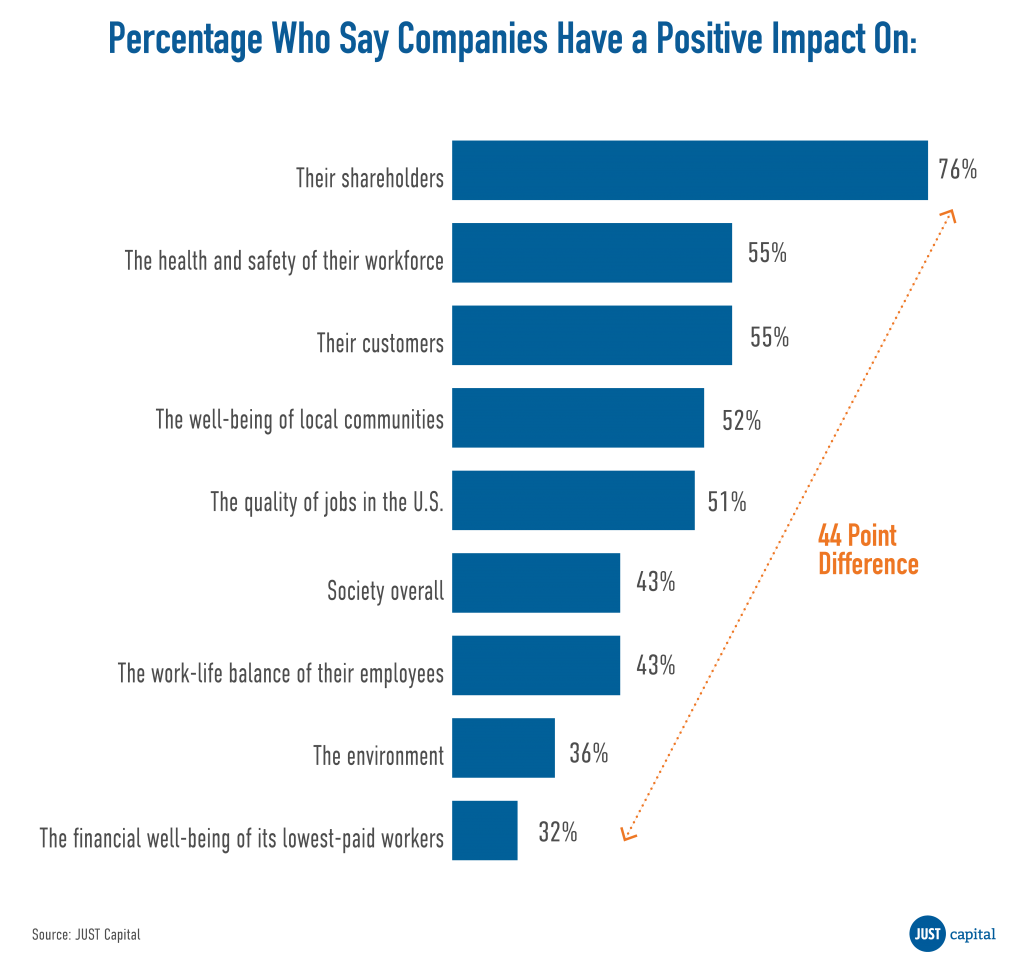
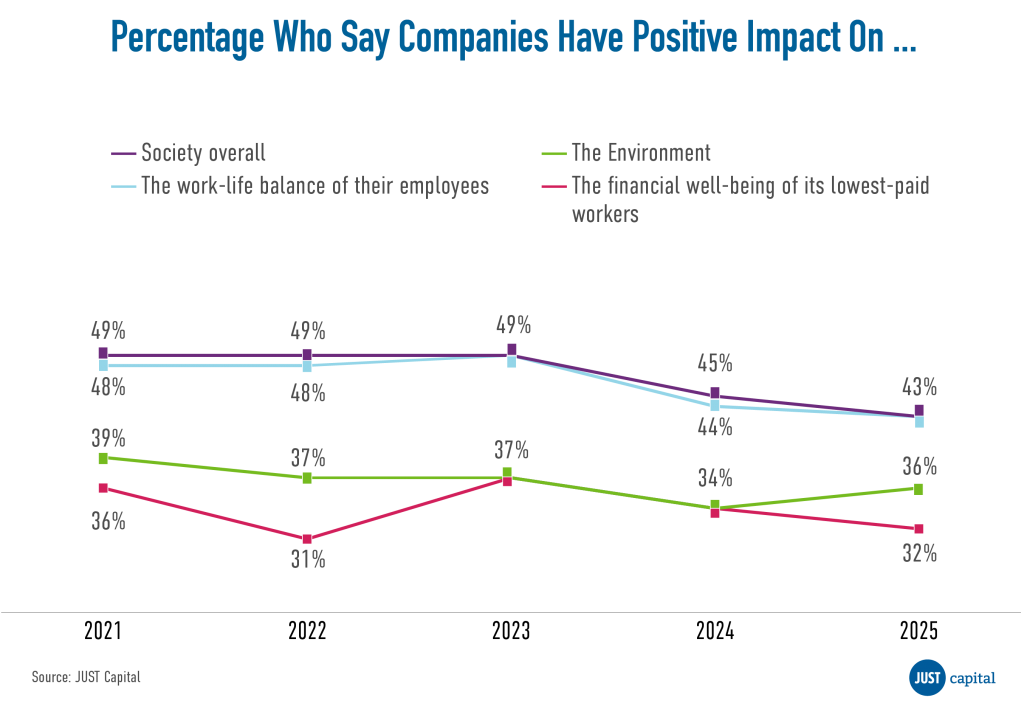
76% of Americans say companies positively impact shareholders compared to other stakeholders, to society, and even compared to quality jobs. The starkest gap appears in perceptions of impact on the financial well-being of a companies’ lowest-paid workers.
Over time, the erosion of public confidence has accelerated, with Americans increasingly convinced that companies prioritize investors to the exclusion of all other stakeholders.
When asked whether capitalism is working for the average American, the majority of respondents say no. This negative sentiment has persisted for four years, with 2021 marking the narrowest gap between those who agree and disagree that the system is working.
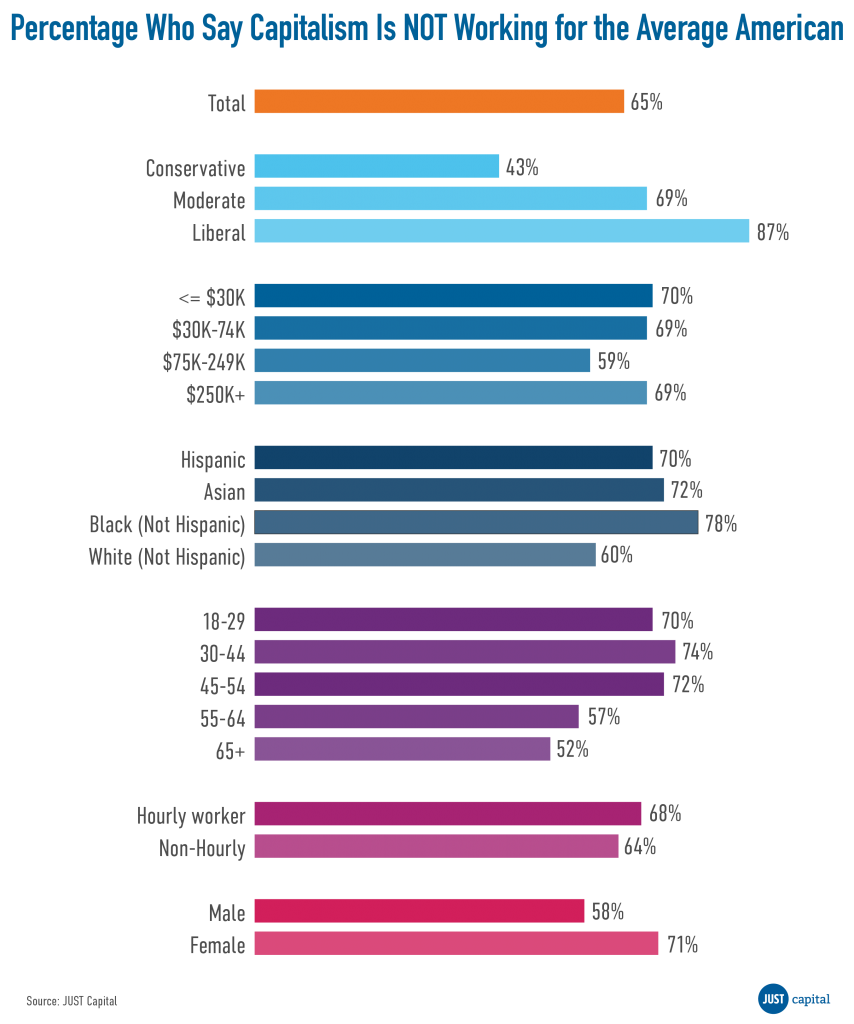
This sentiment is remarkably consistent across demographics. In nearly every group — regardless of age, income, race, or political affiliation — the majority believe capitalism is NOT working for the average American. The exception is Conservatives, who have a lower, yet still substantial share who express doubts about capitalism’s effectiveness to generate shared prosperity.
Eighty percent of Americans think that business can be a force for positive change. The public also has high expectations of corporate America across a variety of factors, such as the ethical use of AI in business operations, the relationship between transparency and trust, and the desire for companies to operationalize value creation rather than simply making public commitments. What is additionally striking is the consistent level of agreement on these sentiments across political ideologies.
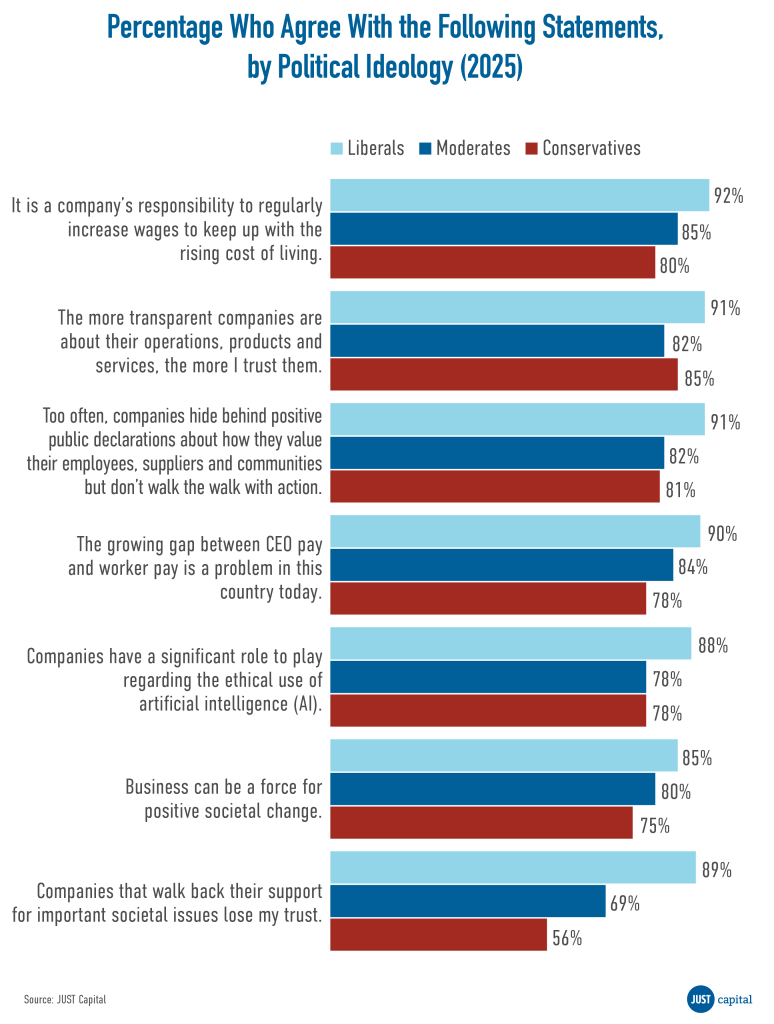
Although the public is looking for action over verbal commitment, there is an opportunity for leaders to better communicate how they are positively serving their workers, customers, and communities.
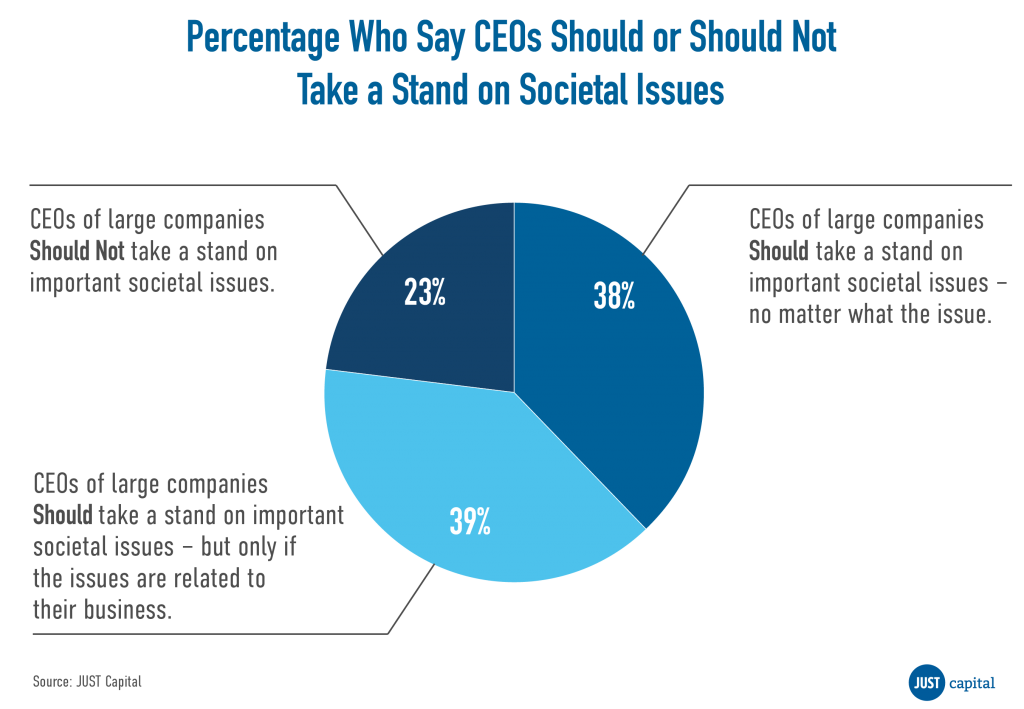
While a quarter of Americans say that CEOs should stay away from taking a stand on any societal issues, three-quarters say that they do have a role to play in societal issues, especially when they concern issues related to their business.
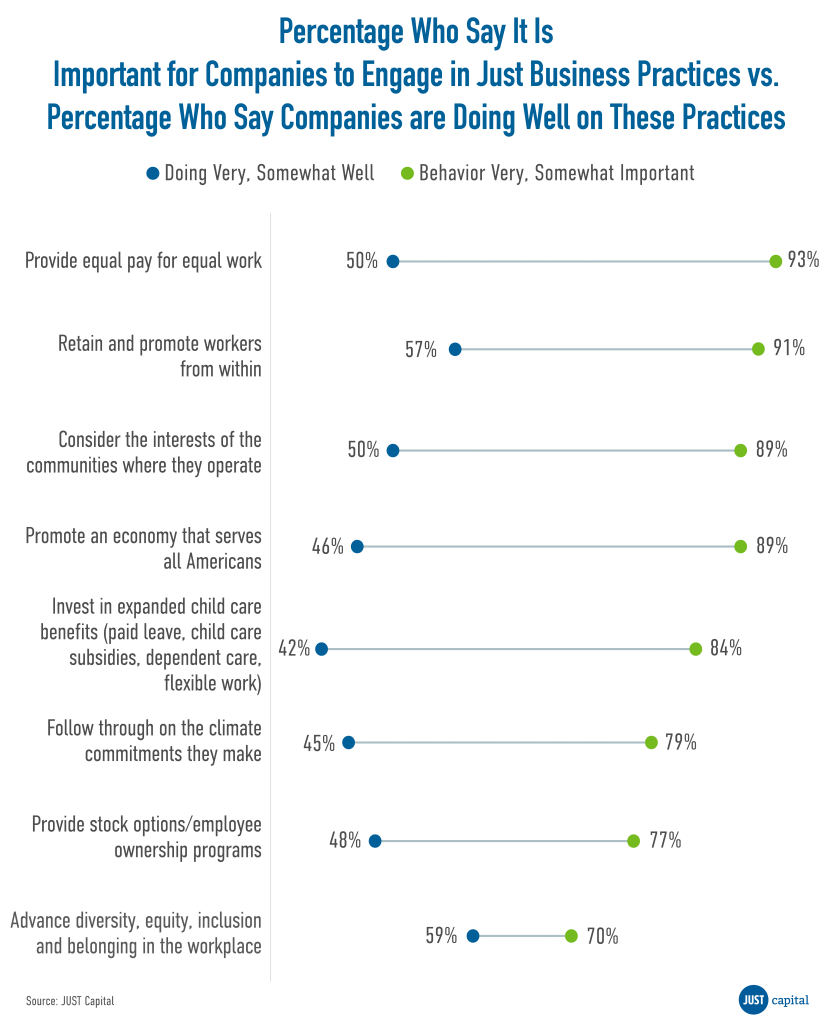
While 70 to 93 percent of Americans say it’s important for companies to engage in various responsible business practices, their evaluations of actual corporate performance indicate skepticism that expectations are being met. The largest gaps between expectation and perceived performance emerge in two critical areas: ensuring equal pay for equal work and contributing to an economy that serves all Americans.
Overall, Americans continue to prioritize worker-related issues, with four of the five worker issues ranking in the top six out of 17 total issues. Customer-related issues are also prioritized in the top 10.
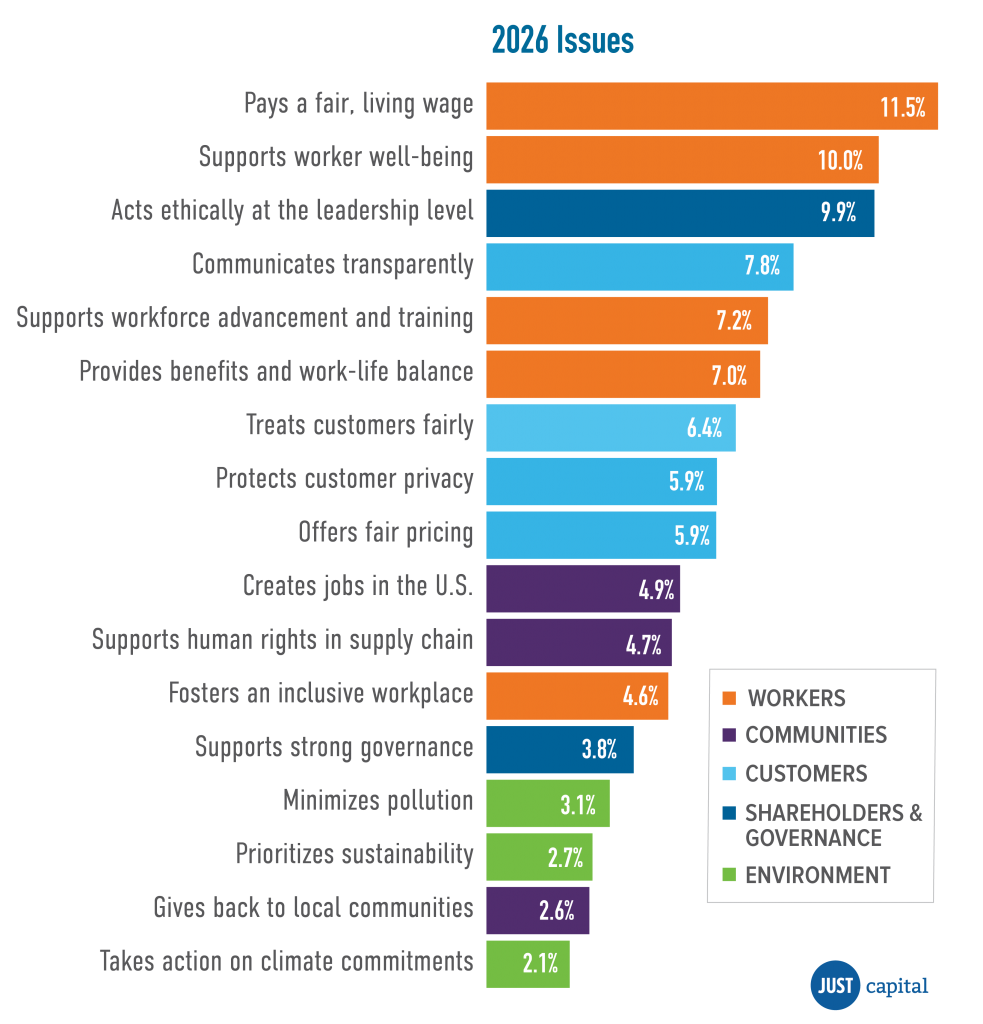
When we dig deeper, we find a remarkable consistency across demographic groups in the three highest-ranked Issues: Pays a fair, living wage, supports worker well-being, and acts ethically at the leadership level. These findings signal that the public continues to be united around the issues they want companies to prioritize.
Over the past seven years, “Pays workers fairly and offers a living wage that covers the cost of basic needs at the local level” has consistently ranked 1st across nearly every demographic cohort. At 11.5%, this issue’s weight remains relatively stable from last year, but is lower than at its peak of 21% in 2023, suggesting that while a fair, living wage continues to be fundamental to public perceptions of just corporate behavior, its degree of importance has declined in favor of other worker issues.
“Supports worker well-being and provides safe and healthy working conditions,” which rises to the second-highest ranked issue. This elevation likely reflects heightened concern about maintaining positive, supportive work environments that prioritize workers’ humanity.
Likewise, “Invests in its workforce by providing training, education, and career development opportunities” takes the #5 spot, and comprises 7.2% of the model, up from 6.9% the year before. The rise in worker training priorities likely reflects the growing desire among workers for upskilling in an AI-driven economy — a trend corroborated by findings in our AI survey.
“Conducts business ethically and honestly, and takes responsibility for wrongdoings” ranks #3 overall, followed by “Honest and transparent in communications with customers about its products, services, and operations,” at #4. Both issues made the top 4 last year, and their sustained prominence takes on new significance in the age of AI. As systems become more opaque and complex, the public’s insistence on ethical conduct and transparency suggests a fundamental demand: companies must demystify their AI practices and be accountable for decisions that affect their stakeholders’ lives.
Finally, the biggest mover this year is “Protects the privacy of customers, including their data,” which moved to #8 from #10 last year. As we found in our AI survey, the public fears that rushed AI adoption, combined with weak security protocols, could expose personal information to breaches, misuse, or unauthorized access.
The results of the survey reflect an ongoing call from the American people for a “back to basics” business approach. The public clearly defines just business behavior as companies paying fair wages, providing good benefits and training, creating safe and fulfilling workplaces, offering opportunities to advance, treating customers fairly, and supporting the communities in which they operate.
As AI and automation become even more dominant in 2026, leaders have a significant challenge ahead to innovate and grow their business while continuing to invest in and cultivate their workforce. Our recently released research on perceptions of AI amongst corporate leaders, investors, and the American public aims to help them identify key considerations for responsible AI deployment at scale.
Americans’ Views on Business Survey
Since 2015, JUST Capital has surveyed close to 200,000 Americans to assess how well they think companies are doing when it comes to creating value for all their stakeholders and building a more just economy that truly works for all. The 2025 Americans’ Views on Business Survey was fielded among 2,004 Americans – a sample representative of the U.S. adult population – between August 18 through September 2, 2025. Our quantitative research partner is SSRS, an objective, nonpartisan research institution that provides scientifically rigorous statistical surveys of the U.S. population.
The People’s Priorities Survey
Just Capital’s definition of just business behavior begins by hearing from a diverse, representative sample of Americans through small-group qualitative discussions to understand what they expect from a “just” business. This year, the major themes we translated into issues came from open-ended responses to the following question:
Q1. Think now about the largest companies in the U.S., with hundreds or thousands of employees. We would like to know what you would consider to be “just” business behavior for these companies as it relates to various groups of people. By “just” we mean “fair or good” behavior.
Before answering this question, however, we provide respondents a clear definition of the concept: A just company demonstrates a commitment to doing right by its workers, its customers, the environment, the community, its shareholders, and the business itself.
Respondents were prompted to answer this question from the point of view of one of five stakeholders (Workers, Customers, Communities, The Environment, or Shareholders).
Q1.1 For example, actions you would expect a just company to take related to its Workers
Our polling team then distills the major themes from these discussions into discrete statements, which we define as “Issues.” Subsequently, we conduct a quantitative survey of 2,000 U.S. adults in which they rank the relative importance of these 17 Issues.
We conducted the survey online with a probability-based sample attained through the statistical sampling methods employed by SSRS. The SSRS Opinion Panel is a nationally representative probability-based web panel, and findings are generalizable to the general adult population.
The survey is drawn from a probability sample, ensuring we capture diverse perspectives from a cross-section of Americans. This includes representation across demographic dimensions (race/ethnicity, gender, income, and age), as well as other characteristics such as political ideology.
The full survey was conducted from August 18 through September 2, 2025 among a general population sample of 2,004 English- and Spanish-speaking U.S. adults ages 18 and older, with an oversample of 470 Hispanic and 253 non-Hispanic Black respondents. Panelists were sent an email invitation to take the survey online as well as up to eight reminder emails throughout the field period. The survey program was optimized so that respondents could complete it using a desktop or laptop computer as well as a mobile device. In total, 610 respondents completed the survey on a computer and 1,394 completed it on a mobile device.
The margin of error is +/- 2.0% at the 95% confidence level. Results were weighted to U.S. census parameters for age, gender, education, race/Hispanic ethnicity, and census division to ensure representativeness of the U.S. population. All margins of error include “design effects” to adjust for the effects of weighting.
AI deployment has become a defining strategic priority for the private sector, promising to enhance productivity, innovation, and competitiveness. Ensuring the technology drives prosperity and progress for every American is a top national priority. As companies race to adopt AI, significant questions are emerging about what it means to pursue these new business imperatives in ways that empower American workers, strengthen local communities, create good jobs, protect consumers, and build trust in business and capitalism.
Today, Just Capital released new findings from a survey of corporate leaders and a combined report of these corporate perspectives alongside previously released surveys of investors and the American public. The inaugural American Public, Investor, and Executive Perspectives on Responsible AI Deployment report and the organization’s ongoing research initiative aim to identify key considerations for responsible AI deployment at scale.
Just Capital will conduct quarterly pulse surveys through 2026 and beyond, providing ongoing insight for corporate leaders, investors, and policy makers as perspectives continue to evolve on what exactly responsible AI deployment means and how to pursue it.
The research identified key areas of agreement between the three audiences:
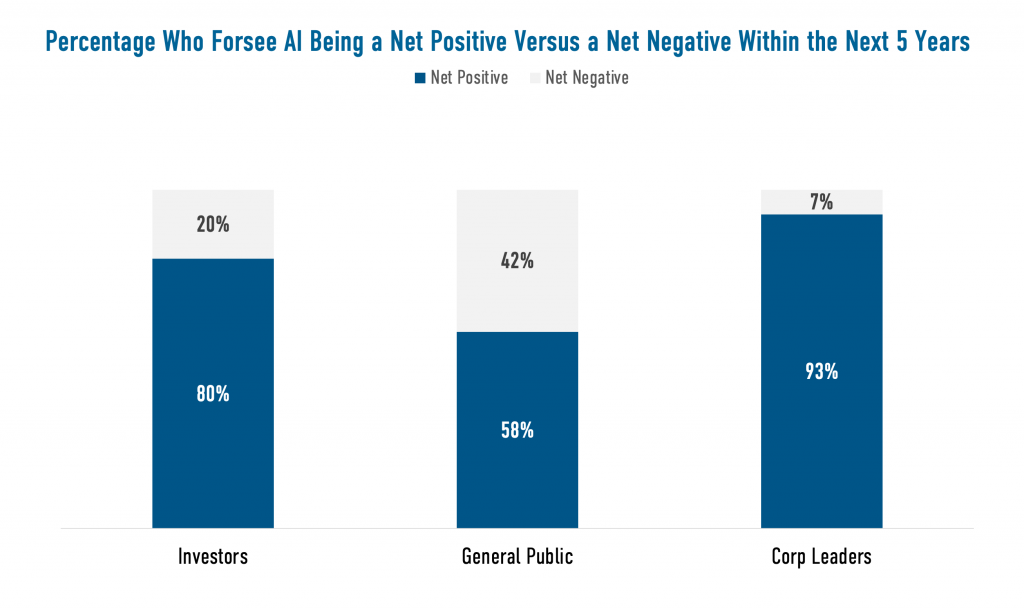
Majorities of all three groups believe AI will be a net positive for society within the next five years. Corporate leaders’ enthusiasm (93%) outpaces the general public (58%) and investors (80%).
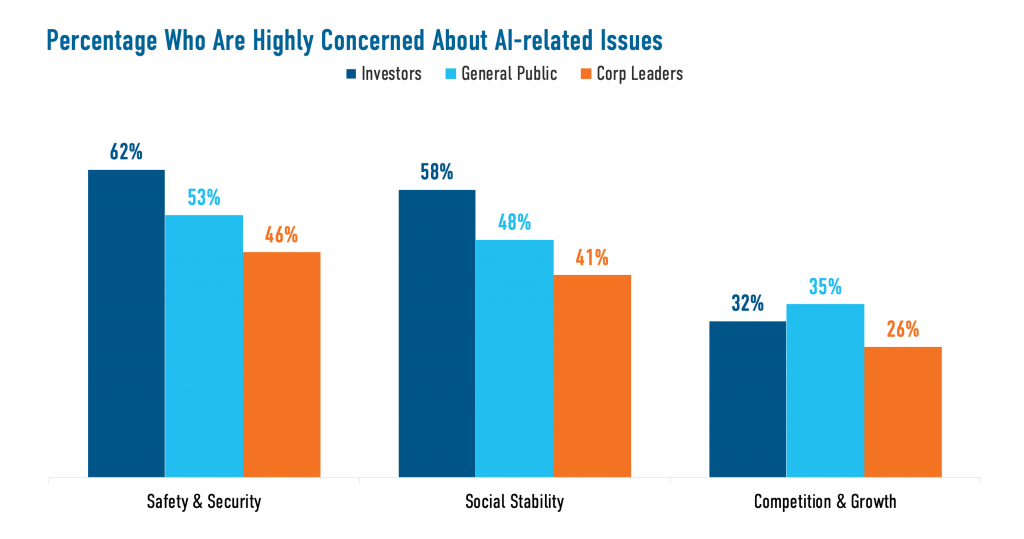
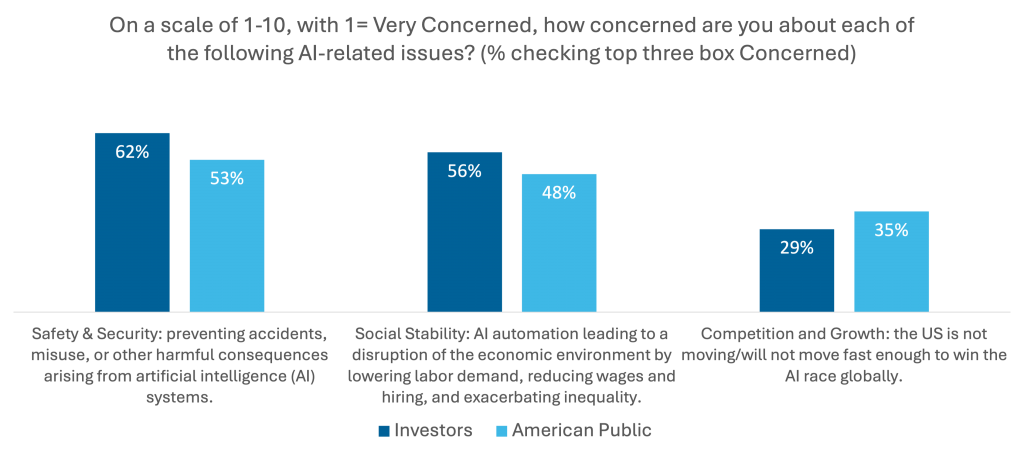
Majorities or pluralities of each group rate AI safety and security a top concern (general public: 53%, investors: 62%, corporate leaders: 46%).
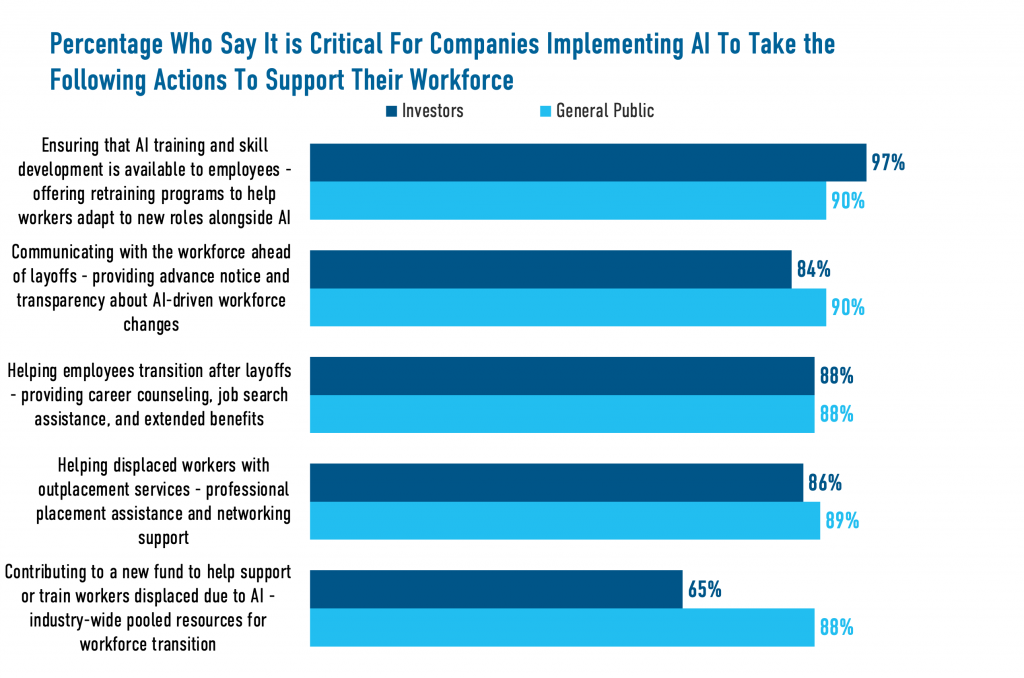
Significant majorities of the general public (90%) and investors (97%) say it is critical that companies ensure that AI training and development is available to employees, and roughly three-quarters of corporate leaders say they are planning to implement AI training to support their workers.
Some diverging views also emerged including:
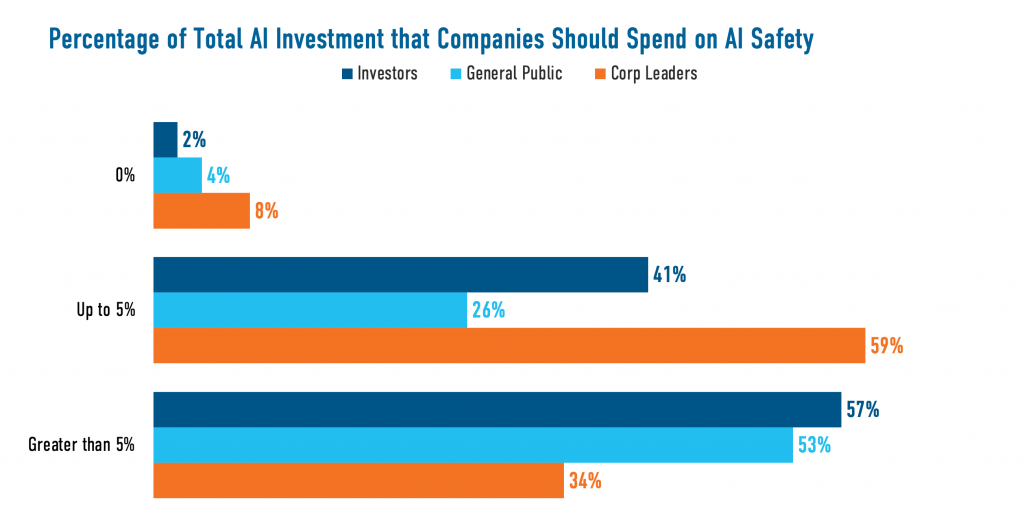
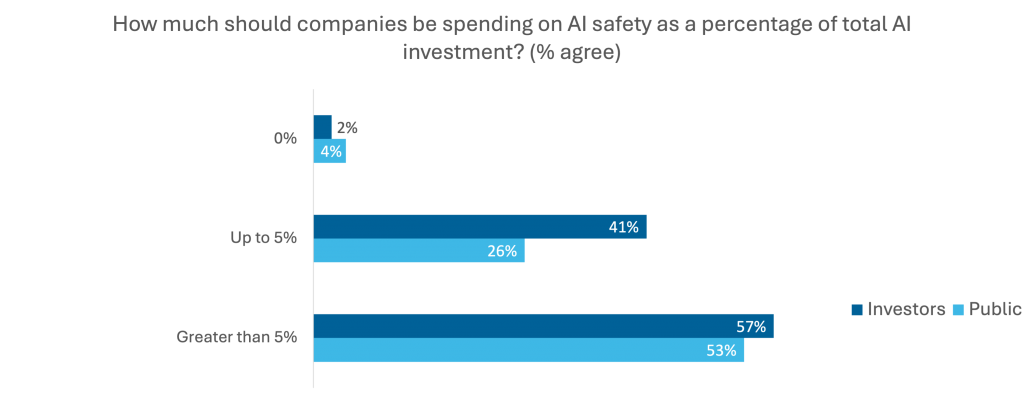
The Degree of Expected Investment in Safety and Workforce Support: Investors and the public expect companies to spend more than 5% of total AI investment on safety, while corporate leaders say they plan to allocate between 1 and 5%. When asked about how they plan to redistribute AI-related profitability gains, executives evince less emphasis on worker training efforts (17%) than on delivering gains to shareholders (28%) and reinvesting in R&D (30%).
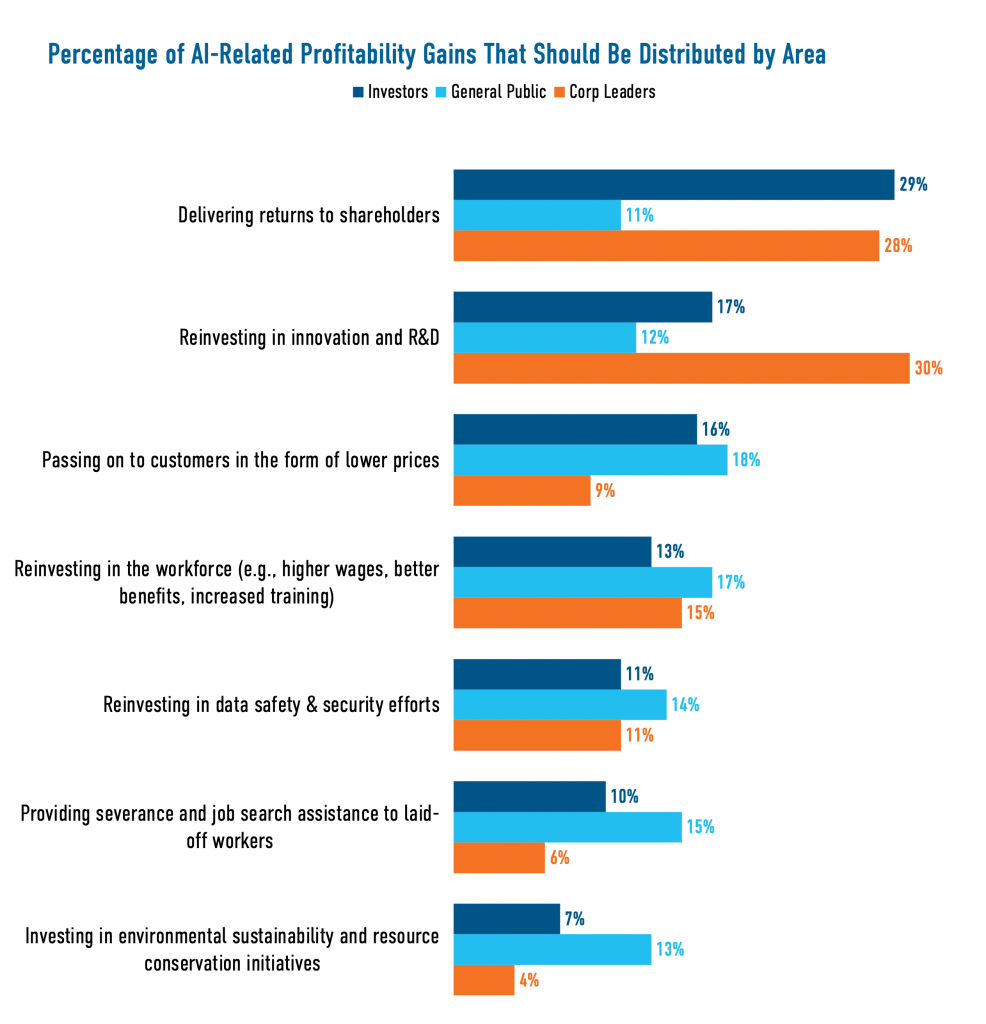
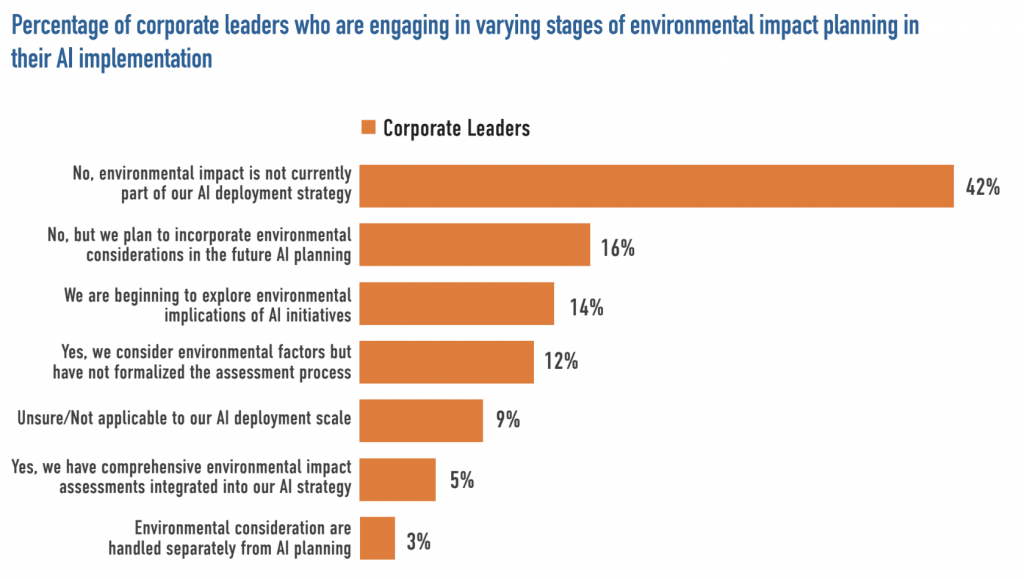
Environmental planning: Roughly a third of both the public and corporate leaders say increased corporate AI usage will have negative impacts on the environment. Currently, only 17% of leaders are including environmental impact planning in their AI roadmap, and 42% say it is not a part of their strategy.
“This is a defining period for every business leader. How to deploy AI the right way in order to create value for their companies, their shareholders, and all their major stakeholders – not to mention for society at large – is the strategic question of the moment,” says Just Capital CEO Martin Whittaker. “The insights in this initial report and the quarterly tracking we will do moving forward are designed to help leaders navigate this transformation, make responsible decisions, and ultimately win in an AI-powered economy.”
The surveys were conducted in partnership with The Harris Poll, Robinhood Foundation, and Gerson Lehrman Group. The complete report, including detailed findings and methodology, is available here.
NEW YORK, NY October 28, 2025 – As executives across industries race to deploy AI’s transformative potential, another urgent question looms: What do the people who determine a company’s success — employees, consumers, communities, and investors — actually expect from corporate AI implementation?
Today, Just Capital released new survey findings as part of a comprehensive effort to define responsible AI deployment through the eyes of the key population groups. Drawing on a decade of polling the American public, this research, conducted in partnership with The Harris Poll and Robin Hood Foundation, reveals areas of alignment and divergence across two core audiences: the American public and investors.
Just Capital will be tracking these perceptions quarterly as the technology evolves, offering leaders a real-time compass as they navigate a rapidly changing business landscape. The organization will also begin surveying business leaders this fall to compare stakeholder and corporate expectations.
“We’re at an inflection point. Every day, leaders are grappling with both the opportunities AI creates and the risks it poses at scale. What responsible AI leadership looks like is being defined in real time,” says JUST Capital CEO Martin Whittaker. “Our research aims to equip corporate leaders with additional insights to realize AI’s full promise including the business value it can unlock and the wider prosperity we all need it to deliver. If we can get this right, everyone wins.”
1. Expectations of productivity
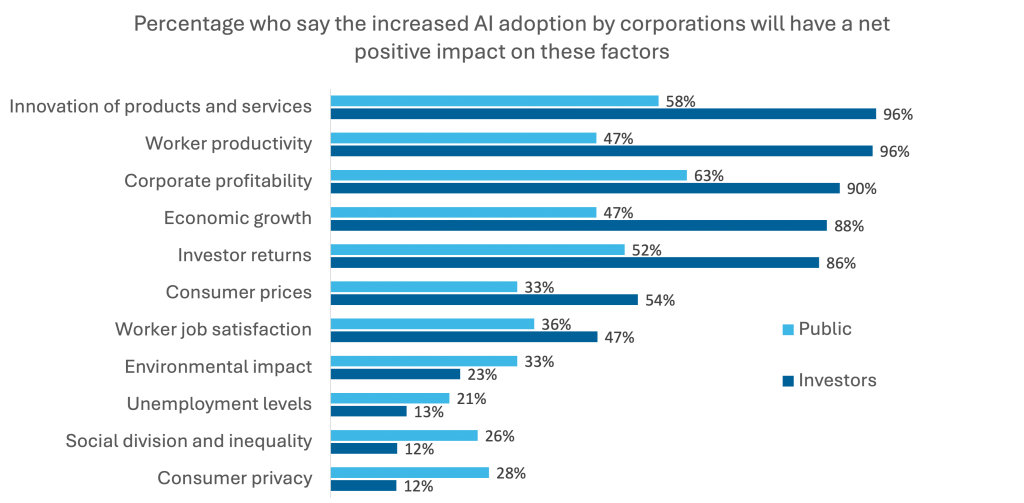
The vast majority (96%) of investors believe AI will have a net positive impact on worker productivity. However, only 47% of the public say AI will result in a net positive impact on productivity.
2. Distribution of AI-related gains
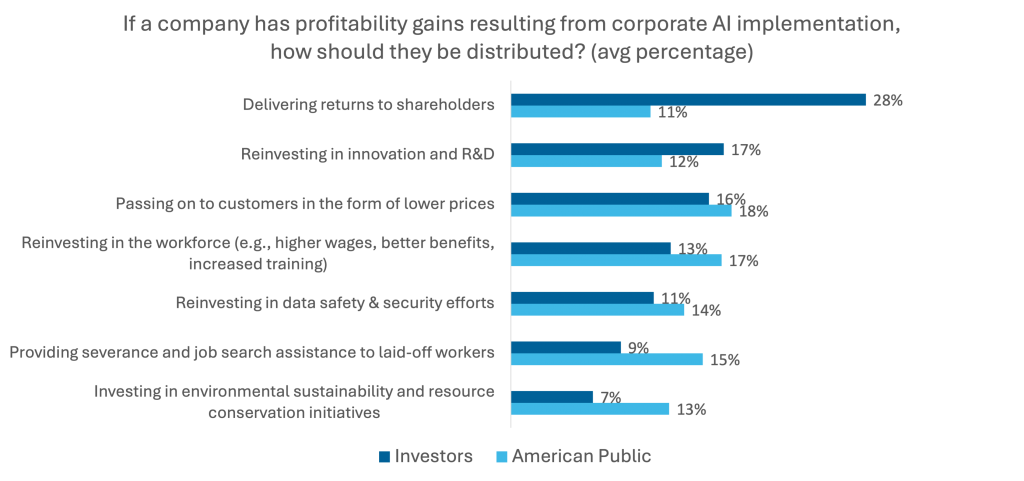
The public is in favor of distributing AI-driven corporate profits across several efforts, including lower prices for customers, workforce supports including for laid-off workers, and investments in safety and security. Investors believe the majority of gains should be allocated to shareholders, but do believe in gains going to other efforts including lower prices for customers.
1. AI safety as a top concern
Despite recent emphasis on an AI race between the United States and international rivals, both the American public and investors are more concerned about preventing accidents, misuse and other consequences of AI. Both groups also see impacts on social stability as a greater concern than U.S. competitiveness.
2. A significant amount of spend toward safety
The majority of the public and investors believe companies should be spending more than 5% of total AI spend on the safety of these tools and platforms. Given recent capital allocations to AI investments, 5% represents a dollar amount in the hundreds of billions. According to JUST Capital tracking to date, top AI developers and users have not publicly disclosed the amount spent on safety.
Are you a corporate executive? Please take our AI-focused survey here to inform how we continue to define and measure AI leadership.
Just Capital released its 8th annual Americans’ Views on Business Survey in October. The results underscored the incredibly complex stakeholder landscape facing CEOs today, but they also provided real encouragement for corporations seeking to adopt a leadership role in society going forward. Our annual People’s Priorities Report, presented here, follows the Views on Business survey with a detailed breakdown of what, exactly, the public expects of business at this point in time, which issues matter most, and where the greatest opportunities for business leadership and differentiation may lie. The issues raised by the public and their prioritization of those issues will underpin the 2025 Just Capital Rankings of America’s Most Just Companies, coming soon in Q1.
The findings of this report resonate strongly with the sentiments that drove the results of the November 2024 election cycle – Americans are concerned about their economic well-being, about how they are treated as consumers, about being able to support their families. And they appear distrustful of institutions as they repeatedly call for increased transparency, corporate accountability and leadership.
In a hyper-divided world, this report offers a playbook for understanding and addressing stakeholder demands, and provides examples of how companies can unlock competitive advantage through action. For CEOs, boards, and other business leaders seeking to make sense of things, it represents an invaluable, practical, and very timely strategic guide.
The public is unified in wanting companies to treat their workers and their customers with respect, humanity, and fairness. Of the 17 key issues we identified and evaluated, almost all of the top ten are connected to how companies act on basic worker- and customer-related factors. In addition, the desire for integrity in business leadership rose significantly in ranked importance. In contrast to four years ago, when CEOs were expected to speak out or take a stance on hot-button social issues, the public says that today leaders should direct their focus to core operational, strategic, and financial matters. Moreover, it is deeds that matter far more than words. The public is less interested in hearing about company commitments, pledges, and targets and much more focused on understanding what a company is actually doing on the issues of greatest importance.
Key findings include:
Overall, there is a tremendous opportunity for corporate America to take a leadership role in tackling some of America’s more intractable economic and societal challenges, and in doing so, to become a unifying force in the country.
Just Capital’s annual Rankings process begins with small-group discussions with a diverse and representative mix of Americans across the U.S. to understand the actions and behaviors they expect from a “just” business. Focus groups enable our research team to hear the unvarnished voice of the public speak about what issues matter most, and whether these opinions have changed over time. The polling team then distills the major themes of these discussions into statements that capture these concepts, or “Issues,” which become the foundation by which we annually track and evaluate companies in our Rankings of America’s Most Just Companies.
This year, this work yielded 17 Issues (see Fig. 1 below). Over time, we have seen that many of these Issues are evergreen, in that they are consistently mentioned year after year when we engage in conversation with the public. Since all of these Issues are deemed essential to a just business model, we conduct a follow up exercise wherein the public gives us the relative importance of the 17 Issues.
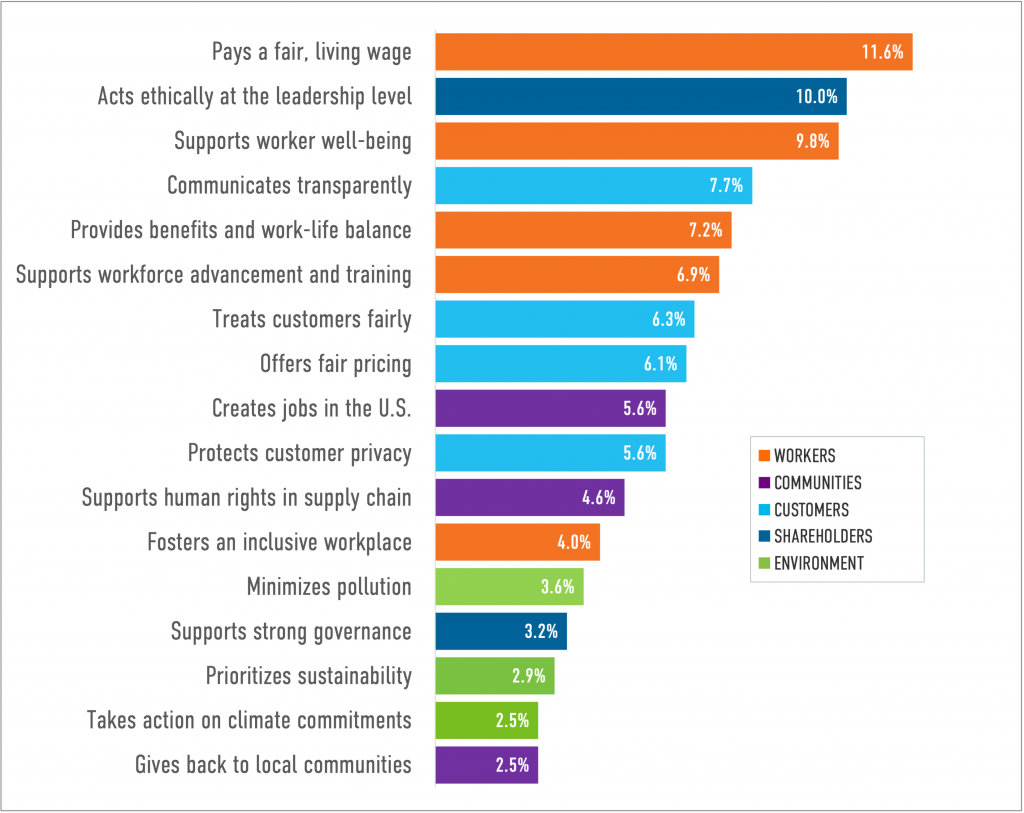
Each Issue is color-coded by the Stakeholder it impacts most. While we reference the public prioritizing several Issues in this report, please note that many of the Issues’ relative importance varies by a fraction of a percentage point.
The People’s Priorities are determined by responses to a survey of more than 3,000 U.S. adults, who are a fully representative cross-section of Americans. This means we hear from a variety of voices, both by demographic groupings such as race/ethnicity, gender, income levels, and age, and by other descriptive data such as political ideologies and whether or not respondents are active investors. We expect to see some variation in how each group ranks the 17 Issues provided, yet Figure 2 shows a remarkable consistency. Across demographic groups in the three highest-ranked Issues: Pays a fair, living wage, Acts ethically at the leadership level, and Supports worker well-being. These findings signal that the public is united, not divided, across political ideologies around the issues they want companies to prioritize.
Fig. 2: Top 5 Issues by Demographic Group

Yet there is indeed some variance in the Issues’ relative importance when comparing demographic groups. For example, “Provides benefits and work-life balance” is the #5 issue on average, Republicans and adults age 65 and older prioritized it much less, and Issues related to sustainability and the environment ranked higher among young adults and those identifying as Democrats than among their older or more conservative counterparts. But by and large, the pattern of responses is generally the same in terms of where Issues fall in relative rank and weight.
Conceptually, Americans agree on what they considered to be just business behaviors. The terminology that one group uses to express a concept can contrast with how another group interprets the issue. We will uncover those differences as we dive deeper into our data.
In every one of the eight years we have fielded this survey, the public has clearly conveyed that corporate America’s #1 priority should be its workers. For our annual survey, we categorize our 17 Issues by which core group they affect most (their main “Stakeholder”): Workers, Communities, Customers, Shareholders, or the Environment. The public generally gives Issues under the Workers Stakeholder their highest prioritization, and this year is no different – 4 of the top 6 Issues for the 2025 Rankings are related to Workers (see Fig. 1). These Issues are arguably “closest to home,” and the consistency of their placement over time signals that most Americans believe that worker treatment is fundamental to a just company.
“Pays workers fairly and offers a living wage that covers the cost of basic needs at the local level” continues to be ranked 1st across nearly every demographic cohort. However, with a weight of 11.6%, it comprises a lower proportion than it did in the 2024 Rankings (17.7%), and 2023 Rankings (21.1%). This suggests that while a fair, living wage continues to be fundamental to the public’s perceptions of just corporate behavior, wages may have risen enough in the past few years (via talent demands or rises in states’ minimum wage level) that the relative importance has decreased.
While fair pay is the most important element of just business leadership, how focus group participants interpret this issue varies. For some, fair pay means that workers are able to pay their bills, support their families, and have a bit left over to save each month; for others, fair pay means that employers are more transparent about publishing pay ranges; others still talk about fair pay in terms of wage equity: that companies pay the same amount for the same job both internally and in terms of what is fair for the market.
I am thinking about [retailer]… I really want to see their employees not seeming so stressed out at work… A wage you can actually live on. A wage that you can pay your bills and you’re not trying to take out payday loans or get extra credit cards.
– F; 45-49; Moderate; Post Grad; White; Kids; Pacific
At my current job, you can be a 25-year vet and there can be somebody who just started two years ago and you’re making nearly the same amount. It’s strange.
– M; 40-44; Moderate; Republican; HS Grad; Black/AA; Kids; South
“Supports worker well-being and provides safe and healthy working conditions” is the second highest-ranked of the Workers Issues, comprising 9.8% of a company’s score and ranking #3 in overall importance. Indeed, a recent survey from Deloitte on human sustainability underscores our own data, showing that only about half (56%) of workers feel their overall well-being is “excellent” or “good.” Over time, the public has said that this issue is an essential part of just leadership, although in the past few years, our focus group participants have spoken about this issue more broadly than companies simply providing a physically safe work environment. Almost equally often, respondents named other examples of positive worker treatment, including actions such as providing mental health support options or culture-building initiatives (such as providing sessions for employees to give leadership upward feedback).
A [company’s] responsibility to their employees? Treat them well. Safe working environment.
– F; 55-59; Moderate; Bachelor’s; White; No kids; Midwest
Good leadership is being open to feedback from the employees. You may not do everything they say, but at least you’re open to hearing them out in things that could help the job overall.
– M; 40-44; Moderate; Republican; HS Grad; Black/AA; Kids; South
Benefits ranks 5th among the public’s priorities: “Offers a quality benefits package that supports work-life balance for all workers” comprises 7.2% of a company’s score, roughly in line with the previous year (7.6%). Across demographics, the public largely agrees that a fundamental element of a competitive pay package is good benefits, but what those benefits entail can be different depending on life stage or other factors. Some mentioned flexible scheduling, paid time off, and corporate care benefits so employees can look after children or aging family members. Other mentioned monetary investments like insurance, a 401(k), and stock packages.
A good work-life balance, allowing for those that have young families to be able to take care of their children, take care of spouses, not be held just to having to work a certain number of hours.
– M, 35-39 Somewhat Liberal; Democratic Post Grad; White; No Kids, Midwest
Companies that have big stock packages [should make] both the corporate shareholder and employee shareholder benefits standardized so everyone has a stake in the company and feels like they’re part of the investment goals of the company themselves.
– M; 30-34; Somewhat Conservative; Bachelor’s; White; No kids; West
The Issue on Ethical Leadership rose 5 places this year to reach the #2 spot, driven presumably by a widespread desire to rebuild trust between institutions and the people they serve, several high-profile examples of poor ethical leadership by corporations, and a growing sense of cynicism in society overall. “Conducts business ethically and honestly, and takes responsibility for wrongdoings,” comprises 10% of a company’s score in our 2025 Rankings.
While ethics can be extremely subjective, we found there is general agreement on the interpretation in a business context: across demographics it means being open, and honest about business operations, companies doing what they said they were going to do, not misleading people or covering up unjust acts, and operating with a greater sense of corporate responsibility and good citizenship.
I think being transparent and honest, our lenses into being fair and just, I think acting with integrity and definitely with ethical behavior are further ways to provide fair and just behavior or services.
– F; 35-39; Somewhat Liberal; Post Grad+; White; Kids; West
If [companies] post record profits, but pollute a river or lake, those profits came from the public then. They didn’t come from your innovation.
– M; 40-44; FT, Somewhat Conservative; Post Grad; White; Kids; West
Relatedly, transparent communication entered the top 5 Issues, with “Is honest and transparent in communications with customers about its products, services, and operations,” rising from the #12 rank last year to #4 this year, receiving a 7.7% weight. Although this issue is generally categorized as belonging to the Consumer Stakeholder, many focus group participants talked about this issue as fundamental to ethical leadership. Respondents describe a desire for companies to engage in transparent practices, honest communication, and corporate accountability.
I think being transparent … throughout the process of what they’re doing for their employees and what they’re doing for the environment for the better would help us, I guess, trust companies more because I think there’s a big lack of trust between the consumer and the customer and the seller.
– M; 40-44; Moderate/Dem; Bachelor’s; Hispanic; Kids; South
Being ethical to consumers. So no false advertisements and such.
– M; 25-29; Moderate; Bachelor’s; Asian; No kids; West
I tend to think favorably upon companies that are transparent and open and honest. And I think to your point, even if the data is lackluster or disappointing or whatever, I think being transparent and open and honest is a favorable trait.
– F; 35-39; Somewhat Liberal; Post Grad+; White; Kids; West
Another key finding from this year’s Survey is that in 2024, Issues related to the Customers Stakeholder are prioritized to a greater degree than what we have seen in the past few years, reflecting Americans’ ongoing concerns about kitchen table issues of the economy and inflation.
To that end, a new issue arose in our focus groups: fair pricing. The events of any one year can determine which To that end, a new issue arose in our focus groups: fair pricing. The events of any one year can determine which of the 17 Issues Americans deem more important than others. “Offers quality products and/or services at a fair price” debuted at #8 in overall priority this year and commanded a 6.1% weight, at least partially as a result of the persistent perception of high prices resulting from COVID-19-related inflation.
In the America’s Views on Business Survey, 79% of respondents agreed that “it is unjust for corporations to increase profit margins by keeping consumer prices high even as the cost of materials comes down.” Indeed, focus group participants mentioned being charged higher-than-usual prices for everything from soft drinks to baby formula, signaling that rising prices has been a key pain point for Americans over the past 18 months.
It’s not that ‘maybe groceries cost $200,’ now they’re costing $300 for their family on a monthly basis just due to inflation.
– Alexis; F; 25-29; Moderate/Rep; Some College; Black/ AA; No kids; Midwest
At the same time, a few express fair pricing as the price of a good or service being in line with its value and quality.
I want to get a quality product for my money, and in my mind I kind of have a price range that I’m feeling like is fair for a certain product… I definitely don’t want to spend extra on something and then be disappointed.
– F; 45-49; Moderate; Post Grad; White; Kids; Pacific
There continues to be a persistent call from the public that a just company “Values its customers by treating them with respect and providing a positive customer experience.” To some, this means having respectful, responsive customer service that resolves issues quickly. For others, it means simply delivering on the expectations they set for the performance and value of their products and services. Regardless of interpretation, fair customer treatment rose 3 spots for the 2025 Rankings, to #7 and 6.3% of the model.
I’m patronizing your business. If I have an issue, I just want to be treated with respect and I just want the issue to be taken care of.
– F; 45-49; Very Liberal; Some College; Black/ AA; No kids; Mid Atlantic
I think when you can get through to somebody, and someone actually answers the phone… Having a more personalized experience with somebody, as opposed to the AI, or the voice recordings that you get.
– F; 50-54; Moderate/Dem; Bachelor’s; White; Kids, West
I think the chief responsibility of the company is to provide the goods and services that it has committed to provide to its customers.
– M; 45-49; Somewhat Liberal; Post Grad+; $100K-$149.9K; Asian; No kids; Mid-Atlantic
Interestingly, even on Issues where there were markedly differing opinions across political or other demographic groups, there is a surprising amount of alignment once terminology is broken down.
Our #12 issue, “Fosters an inclusive and supportive workplace culture with equal opportunity for all,” is a prime example. Although people used different words to describe what “fostering an inclusive workplace” means (liberals used terms such as “inclusivity” and “diversity,” while conservatives preferred “equal treatment of all”), there was widespread agreement that companies should ensure they do not discriminate, consciously or otherwise, among employees and that people of all backgrounds should be welcomed and given the same opportunity to succeed.
I would ask if you’re in a community that’s diverse, how do you not have people working in the company providing a product to a diverse group of people?
– M; 50-54; Somewhat Liberal; Bachelor’s; Black/ AA; No kids; Mid Atlantic
My expectation in that regard would be … to treat everybody equally. As America has always done, you try and be capitalistic in a way that’s going to benefit the community as well as yourself as a company. So you shouldn’t be so concerned about any particular group, or race, or social status, or ideology.
– M; 45-49; Very Conservative; Post Grad; Hispanic; Kids; West
Likewise, Environmental Issues are on average prioritized lower than Worker or Customer Issues, even among the demographic groups who support these issues the most (e.g. younger Americans, Democrats). Yet even among groups where the idea of climate change is not universally accepted, there was broad agreement that companies have a disproportionate influence on the environment and, therefore, have a responsibility to minimize negative impact.
Let’s say if a big corporation moves into my area. It’s probably going to boost up the economy, but should we be concerned about the pollution? How do they plan to do something else with their company’s resources? Are they dumping into the water or the rivers?
– M; 40-44; Moderate Republican; HS Grad; Black/ AA; Kids; South
A great product … shouldn’t mess up the earth. It shouldn’t make the earth worse no matter what you’re selling, what you’re promoting. It shouldn’t make our living worse. It shouldn’t make the air worse. It shouldn’t affect us in a negative way no matter what it is.
– F; 45-49; Very Liberal; Some College; Black/ AA; No kids, Mid Atlantic
Companies could use their position as a market leader to set an example for other companies. By going green, for instance. If they take the first steps in initiating something that could show how they can shrink their carbon footprint, then others would be more likely to follow.
– M; 40-44; Moderate/Dem; Bachelor’s; Hispanic; Kids; South
I do think one thing [that] is very concerning is the fast fashion. I’m trying to stay away from such brands because of the toxic environment.
– F; 35-39; Moderate Republican; Post Grad; Asian; Kids; West
To me, the main message is that whatever company it is, is it taking the appropriate action to reduce any harmful environmental impact that they might be producing?
– F; 25-29; Very Conservative; Bachelor’s; White; No kids: Mid Atlantic
A lot of the time, I’ve seen executives say things like, “We’ll talk about going green by 2030,” but that’s just an overarching statement. It’s a marketing ploy for their customers or their shareholders to say, “Hey, look what we’re trying to achieve,” without any actual goals of how they’re going to do it. And so, within a certain timeframe, if there’s not milestones and ways to achieve those goals, then it’s just fodder. Great leadership would have exact steps and processes in place on how to achieve those goals. And then in doing so, that could achieve long-term success.
– M; 40-44; Moderate/Dem; Bachelor’s; Hispanic; Kids; South
In each of the eight years since Just Capital has fielded this research, the public has consistently told us they support a movement away from shareholder primacy toward a more value-driven operational model of business. What is more, they have then connected the dots between stakeholder value improvement and long-term revenue generation. To that end, the following quotes from our focus groups reflect most participants’ agreement that positive returns are directly related to meeting the needs of key stakeholders, such as a company’s customers and workers.
I believe [companies’] chief responsibility is to churn out quality products that customers demand, but also balance that out with treating their employees right. And I think those two things can lead to shareholder profits, which I know is really their main thing.
– M; 40-44; Somewhat Conservative; Post Grad; White; Kids; West
I want to [invest] with the company that has the better [workers], but if you’re not treating them well, I may be a little apprehensive. Because it can then end up that the [workers] want to pull out, and the investors want to pull out. I don’t want to deal with that type of thing when you’re dealing with my money.
– F; 45-49; Very Liberal; Some College; Black/ AA; No kids, Mid Atlantic
Yet again, the American people have provided clear guidance on the specific actions businesses can take today to rebuild the public’s trust in business and markets as a force for good. This year’s Survey shows plainly and emphatically that regardless of demographic background or political ideology, Americans agree that companies should prioritize their workers and customers. Moreover, they are demanding more ethical leadership in the form of greater honesty and transparency about business strategy and operations.
Focusing on actions that create value for multiple stakeholders – such as encouraging a healthy environment and creating good jobs by investing in renewable energy, supporting human rights and stronger communities by enforcing ethical labor practices, and developing training and educational pathways for employees to grow their careers – is another pronounced theme. Americans do not see different stakeholders as separate business interests competing for attention; they see them as part of an integrated whole.
By recognizing and embracing the critical importance of creating value for all stakeholders, businesses can lay the groundwork for sustained growth, innovation, and excellence. Companies in turn benefit by becoming more successful in the marketplace, and society benefits by realizing impact at scale.
Since its inception, Just Capital’s mission has been to demonstrate how just business – defined by the priorities of the public – is better business. Our goal is to help companies create value for all their stakeholders by focusing on the issues that matter most to the American public. The goal is to help companies improve, and in turn, improve the lives of their workers, customers, and society.
At the core of our work is a robust research program that starts with focus groups in which we ask the American public to identify the policies, practices, and behaviors companies should prioritize to be considered just (which we call “Issues”). These Issues include fair pay and a living wage; an inclusive workplace; stronger, healthier communities; good jobs; a cleaner environment; and more. Then, based on sophisticated polling of a representative sample of Americans, we estimate the relative importance of these behaviors – in other words, how important to defining a just company each behavior is relative to others.
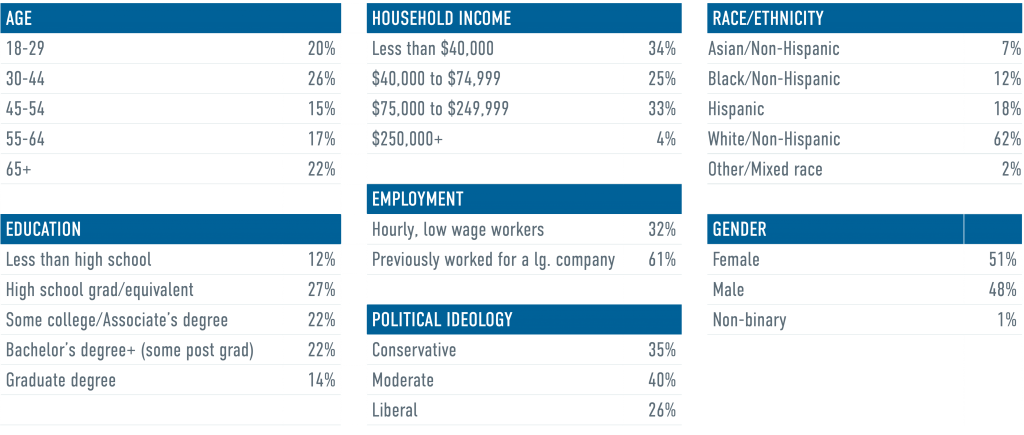
Since 2015, Just Capital has surveyed more than 182,000 Americans – on a fully representative basis – asking them to define just business behavior. For the past three years, we have partnered with SSRS, an objective, nonpartisan research institution that provides scientifically rigorous statistical surveys of the U.S. population, to survey more than 3,000 Americans annually on their perspectives (see Fig. 3 below for demographic information on this year’s survey).
Fig. 3: 2024 Annual Survey Demographics
Before answering questions about the just behavior of large companies, it is important for respondents to have a clear definition of the concept. The definition we provided to our survey respondents is as follows: A just company demonstrates a commitment to doing right by its workers, its customers, the environment, the community, its shareholders, and the business itself.
We conducted the 20-question survey online with a probability-based sample attained through the exhaustive statistical sampling methods employed by SSRS. The SSRS Opinion Panel is a nationally representative probability-based web panel, and findings are generalizable to the general adult population.
The full survey was conducted from July 10 to July 16, 2024 among a general population sample of 3,008 English- and Spanish-speaking U.S. adults 18+ years of age, with an oversample of 606 Hispanic and 407 non-Hispanic Black respondents. Panelists were sent an email invitation to take the survey online as well as up to eight reminder emails throughout the field period. The survey program was optimized so that respondents could complete it using a desktop or laptop computer as well as a mobile device. In total, 1,023 respondents completed the survey on a computer and 1,970 completed it on a mobile device.
The margin of error is +/- 2.2% at the 95% confidence level. Results were weighted to U.S. Census parameters for age, gender, education, race/Hispanic ethnicity, and Census Division to ensure representativeness of the U.S. population. All margins of error include “design effects” to adjust for the effects of weighting.
To identify the priorities of the public, we calculate for each Issue the probability that an individual would choose that as most important to defining a just company. As such, there are 17 probabilities calculated from the 17 Issues. These probabilities can be referred to as weights as each represents the relative importance of one Issue versus another. To illustrate more explicitly, the Issue “Worker well-being” was assigned a weight of 9.8% as there is almost a 1 in 10 chance that a respondent chosen at random will identify this Issue as most important in defining a just company. By comparison, the weight assigned to “Creates and maintains the conditions for the company’s long-term financial success” has a 3.2% weight.
Our full body of survey work for 2024 also includes six focus groups conducted in partnership with The Harris Poll. To learn more about how this survey data drives Just Capital’s analysis and Rankings of the largest publicly traded U.S. companies, visit the Methodology section of our website.
