
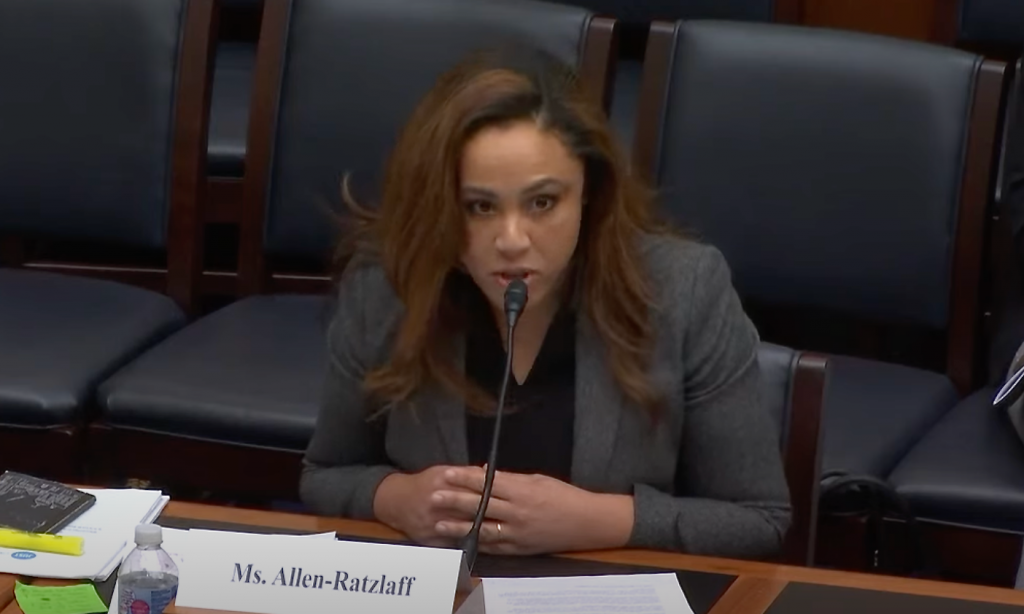
As the ESG debate heats up among lawmakers, JUST Capital is showing how our data and research prove that “when companies manage their stakeholder relationships well, shareholders also benefit.” That’s how our Managing Director and Head of Investor Strategies, Cambria Allen-Ratzlaff, put it in her opening statement on Thursday in front of the U.S. House Committee on Financial Services Subcommittee on Investor Protection, Entrepreneurship, and Capital Markets.
The topic of the hearing was “E, S, G, and W: Examining Private Sector Disclosure of Workforce Management, Investment, and Diversity Data,” with the question of potential ESG and human capital disclosure standards via the Securities and Exchange Commission (SEC) the focus. Rep. Brad Sherman, D-Calif., led Democrats on the committee calling for a robust set of standards, and Rep. Bill Huizenga, R-Mich., led Republicans arguing that such standards would be SEC overreach.
Representing JUST Capital, Allen-Ratzlaff highlighted the data that shows that it remains quite difficult to capture the human capital metrics that Americans across all demographics, as well as major investors, are calling for, and in her capacity as Co-Chair of the Human Capital Metrics Coalition, she recommended four disclosures that would benefit shareholders. Using JUST’s research, Allen-Ratzlaff avoided the argument over what’s “woke” politicking by regulation rather than votes, and instead pointed to current challenges in gathering the data the public and investors alike are asking for.
Below, you’ll find a recording of the full hearing along with text of Allen-Ratzlaff’s opening statement. At the House subcommittee’s website, you can read and download JUST’s full written testimony, filled with intricate details supporting our position.
Testimony of Cambria Allen-Ratzlaff
Managing Director and Head of Investor Strategies, JUST Capital
Co-Chair, Human Capital Management Coalition
Chairman Sherman, Ranking Member Huizenga, and Members of the Subcommittee:
Good afternoon. My name is Cambria Allen-Ratzlaff, and I am pleased to appear before you today representing JUST Capital where I am Managing Director and Head of Investor Strategies. I also Co-Chair the Human Capital Management Coalition, a group of 37 large investors representing over $8 trillion in assets.
I have brief prepared remarks and respectfully request that the full text of my oral and written statements be entered into the public record.
JUST Capital is an independent, nonprofit research organization dedicated to measuring how America’s largest public companies create competitive value for their shareholders while serving their workers, customers, communities, and the environment. Our view is that when companies manage their stakeholder relationships well, shareholders also benefit.
Every year, we survey the American public to identify the business issues that matter most to them. We then use publicly available data to quantify performance of the Russell 1000 against those priorities. The vast majority of this data is hand-collected by our research team, taking 10,000 to 15,000 hours on average. Once we have reviewed the data and assessed company performance, we build our annual Rankings. We also leverage the data we collect to understand how performance translates into investment returns.
As researchers, our work goes where the voice of the American public takes us.
Since 2015, we’ve engaged more than 160,000 Americans representative of the U.S. adult population. And we have found that Americans are remarkably united in what they want companies to prioritize: workers, wages, and jobs. This holds across every single demographic group.
Paying a fair and living wage is the most important priority across all groups, followed by creating jobs at home. Americans are also primarily concerned about health and safety, and workforce mobility and training. So much so that collectively, worker issues make up 44% of our assessment model.
Our thesis is that companies that are better at managing their stakeholder relationships tend to generate more returns for their investors. We have consistently observed this to be true:
As U.S. public companies are born from, and an integral part of, American society, it is perhaps unsurprising that what is good for workers is good for investors. Our reporting system, however, has been slow to adapt.
Consider this: The only line-item data U.S. public companies are required to disclose on their workforce is headcount. This reporting standard was set in 1973, when over 80% of the S&P 500’s market cap was property, plant, and equipment. Fast forward 50 years to today, and 90% of the S&P 500 is based on intangible assets. It’s human capital – the collective knowledge, skills, and experiences of the workforce – powering economic growth.
But as our financial reporting standards have lagged, this also means that up to 90% of company value may not be reflected in companies’ disclosed financials. And investors have taken note.
Speaking on behalf of the Human Capital Management Coalition, the Coalition has urged financial and accounting standard-setters to improve access to workforce data through a balanced approach, where principles-based disclosures are anchored by four foundational, decision-useful disclosures that apply to all companies. They are: (1) the number of full time, part-time and contingent or contracted labor directly involved in firm operations; (2) labor costs; (3) turnover; and (4) workforce diversity data sufficient to understand the company’s efforts to access and develop new sources of talent, as well as how effective these efforts are.
Without this information, investors are flying blind, unable to understand how well a company manages its workforce, and how it impacts a company’s overall business, risks and prospects, to most efficiently direct their financial capital to its highest-value use.
Today, even attempting to get this information is excessively time-consuming. When JUST Capital assessed workforce disclosure at the 100 largest U.S. employers, it took a team of two skilled data scientists over 130 hours to collect data on a discreet number of human capital metrics – or find the data completely unavailable.
If a sophisticated research organization like JUST Capital, or large, global institutions with billions of dollars in capital are unable to access decision-useful, comparable, consistent, and reliable workforce data, small retail investors are at even more of a disadvantage. And, according to JUST Capital’s polling, 85% of Americans across political affiliations agree that companies should disclose more about their business practices and impact on society.
Companies meeting the needs and expectations of the American public have proven them to be value-relevant through their performance. Simply put, companies that are best at harnessing the awesome power of their workforces are also best-positioned to generate long-term value for shareholders.
Thank you, and I look forward to your questions.
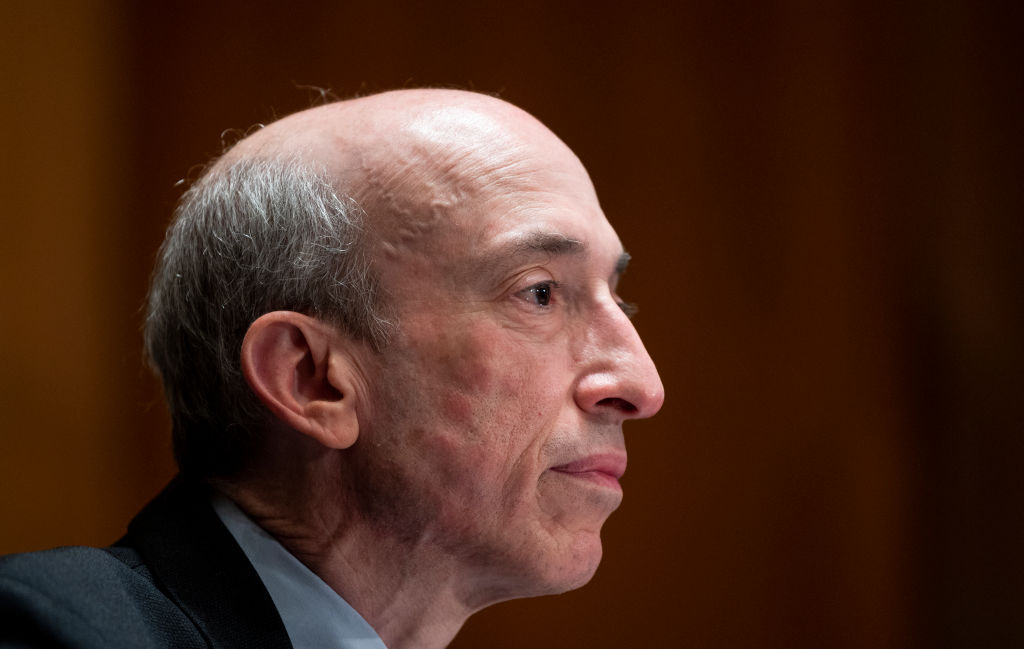
For the past two years, the Securities and Exchange Commission under chair Gary Gensler’s leadership has pursued bringing clarity to the ESG (environmental, social, and governance) investing movement as billions of dollars increasingly flowed into funds with the label, and as executives made it a go-to term in earnings calls.
Last June, the SEC took into consideration a range of factors on what standardized ESG reporting, similar to what is already in the European Union, could look like for the United States, and JUST Capital weighed in. This March, the commission finally released a robust set of disclosure standards around the “E” and voted to make them open for public comment.
At JUST Capital, we have supported the standards because, put simply, there is overwhelming demand not only from investors for such standards, but from all stakeholders. ESG has become a buzzword for companies and fund managers, but our analysis has shown the tremendous lack of transparency around these issues, and even for the companies that disclose the most, their data is often reported in a way that makes it difficult to compare. In the comment that we submitted, we point to our latest data that shows why we believe these reporting standards would benefit investors and the market as a whole.
Of course, there has also been backlash. Republican politicians have argued the SEC is overstepping its jurisdiction with the proposal, and Nasdaq came out ahead of the deadline, June 17, to argue it would be an unnecessary and costly burden on companies and investors alike.
The SEC is about to embark upon an intensive review session where it will consider both friendly and hostile critiques, in order to determine which elements of its proposal will become policy and which may be adjusted or removed. You can see where we are coming from in our submission is below, addressed to SEC Secretary Vanessa Countryman.
Dear Ms. Countryman:
JUST Capital welcomes the opportunity to comment on the U.S. Securities and Exchange Commission’s (“SEC” or “Commission”) proposed release, The Enhancement and Standardization of Climate-Related Disclosures for Investors, Release Nos. 33-11042; 34-94478 (“Proposed Rule” or “Release”). We appreciate the Commission’s ongoing efforts to modernize corporate reporting and improve the overall quality and utility of disclosures provided by issuers to the investing public, including critical information to understand and assess the risks and opportunities presented by a rapidly changing climate.
In our view, the Proposed Rule represents an appropriate step toward ensuring investors have access to high-quality, decision-useful information, consistent with the Commission’s tripartite mission to protect investors, ensure fair and efficient markets, and facilitate capital formation. Accordingly, we are pleased to support the Release and provide data and insights from JUST Capital’s work that may be productive as Commission staff finalizes the rule.
JUST Capital is an independent nonprofit, co-founded and chaired by Paul Tudor Jones, that inhabits the intersection of business, finance, and civil society to build and support a more just market that works for all Americans. As part of its efforts toward fulfilling its mission, JUST Capital has surveyed over 160,000 Americans through our annual survey to identify which issues they believe U.S. companies should prioritize. We then rank Russell 1000 companies across these issues, grouped into five stakeholder categories: Workers, Communities, Customers, Shareholders, and the Environment. As part of this process, we collect more than 250,000 data points each year across the Russell 1000 index to understand and assess how well the largest publicly traded U.S. companies perform on these criteria; the top 100 companies are featured in our annual JUST 100 Rankings. We also use the data and results to promote the investor case for just investing through our product, data licensing, and index partnerships, including powering the JUST U.S. Large Cap Equity ETF (awarded the Bronze Morningstar Analyst’s Rating in 2021) and the JUST U.S. Large Cap Diversified Index, providing data-driven interactive tools and market insights, and identifying the tangible steps companies can take to create greater, shared value for all stakeholders, including investors.
JUST Capital’s research shows clear public demand for standardized data more generally, and higher-quality climate data in particular.
The strength and stability of the U.S. capital markets system largely rests on the availability of high-quality, decision-useful information investors rely on to understand and assess a company’s business, risks, and prospects, in order to make critical decisions about how and where to direct capital. This broader allocative function ensures the efficient movement of capital to its most productive use, while lowering the cost of capital for firms that are best able to mitigate risk and seize opportunities to effectuate superior performance. It is thus critical that this information remain reliable, clear, comparable, and decision-useful.
JUST Capital believes that mandating disclosure on environmental performance through a standardized reporting structure is necessary to accurately assess the financial impact of companies’ actions on investors, including the quality of a company’s financial positions and results in light of their relative preparedness for climate change and the transition to lower-emissions energy strategies.
Data collected and published by JUST Capital in February 2022 supports this view. According to our survey research, 90% of Americans say it is important for companies to have common reporting standards, while 86% support federal requirements for corporate disclosure on climate metrics specifically that would standardize reporting and analysis across companies and/or industries. Our research found 87% of Americans agree it is important for companies to disclose greenhouse gas emissions. Further, two-thirds of Americans believe that companies can have a high or moderate impact on climate change by tracking and publicly reporting their progress on climate goals. JUST Capital’s stakeholder research further shows an increasing interest in corporate climate stewardship among the American public, with 60% of respondents stating environmental issues are more important to them in 2022 than they were in 2021.
U.S. public issuers currently report some Scope 1 and 2 data, but Scope 3 emissions disclosures remain elusive.
Despite Americans’ support of federally mandated corporate disclosure, our research shows that just companies have a long way to go. Today, only 10.6% of Russell 1000 companies have made commitments to achieving Net-Zero greenhouse gas emissions in their operations by 2050. According to our recent report detailing the state of environmental disclosure, 57% of companies currently disclose Scope 1 and 2 emissions, but only 10% report Scope 3 emissions from sold products, 30% report emissions from business travel, and less than 14% disclose criteria on air pollutants including nitrogen oxides, sulfur dioxide, and particulate matter. Of all Russell 1000 companies, more than one-third did not disclose any of the 13 environmental metrics we track.
By mandating climate disclosure, the SEC’s proposed rule will make it increasingly possible for investors and other stakeholders we serve to accurately assess whether companies are on the correct trajectory to meet their targets, ensuring that management is effective in deploying investors’ capital and that boards of directors are providing strong risk oversight to protect shareholders’ interests. In our rankings data, companies with lower environmental impacts outperform their peers: companies scoring in the top quintile realized total returns of 3.96% over the trailing year, versus -1.47% for the lowest quintile.
The lack of clear, consistent, comparable, reliable, and decision-useful issuer climate disclosures creates substantial costs for investors and other market actors, including data providers.
As noted above, JUST Capital’s mission depends on the collection of high-quality data that is used to power investable products, market insights, and index partnerships. Accordingly, JUST Capital employs a team of data scientists to collect and analyze corporate disclosures across a wide range of sources, including issuer regulatory filings, corporate social responsibility and sustainability reports, corporate websites, and other media. Still, it took a team of two skilled data analysts over 420 hours to collect data across 25 environmental metrics at 1,112 companies. Smaller retail investors may not have the resources – in time or money – to devote to finding the data, while professional investment managers may pass these costs on to clients. We believe better standardization of data could mitigate many of these transaction costs, ultimately lowering costs for investors and freeing up more capital to deploy into the markets.
We appreciate the opportunity to provide the Commission with our views. If you have any questions, or need anything further, please do not hesitate to contact us.
Sincerely,
Martin Whittaker
CEO, JUST Capital

Throughout the year, the Securities and Exchange Commission (SEC) has made clear that it would make environmental, social, governance (ESG) factors a priority.
Even before Gary Gensler was confirmed as chair in April, the acting head of the commission, Alison Herren Lee oversaw the creation of a task force to oversee ESG misconduct as billions of investor dollars flow into the space, and declared voluntary ESG disclosure wasn’t sufficient and investors demanded consistency and clarity. To remedy this, Lee announced in March that the SEC would be taking on corporate climate policy disclosure standards, and for guidance shared a list of 15 multifaceted questions for public comment.
Given JUST Capital’s expertise in the “S” of ESG, we chose to respond to the final question, regarding how climate metrics could fit into a larger set of ESG standards, particularly related to human capital metrics and diversity, equity, and inclusion (DEI). Gensler has expressed his own interest in this broader view, and we are making it clear that we are in full support of that direction and are available for further consultation. Our submission is below.
Dear Chair Gensler,
We appreciate the opportunity to respond to the U.S. Securities and Exchange Commission’s request for comments on climate change disclosures within the context of the SEC’s integrated disclosure system. We applaud the SEC exploring this critical set of issues. Below, we provide our perspective on the question regarding how to think of climate disclosures as part of a holistic ESG framework. First, though, a short description of JUST Capital.
Background on JUST Capital
JUST Capital is a nonprofit, co-founded and chaired by Paul Tudor Jones, that exists at the intersection of business, finance, and civil society to build a market that works for all Americans. To drive change at scale, JUST Capital uses a combination of data-driven research and strategic engagement to shift norms and practices in corporate America and the financial markets. Each year, JUST Capital surveys thousands of Americans to identify the key issues that matter to business behavior, and then tracks and measures how publicly-traded companies (currently the Russell 1000) perform on these criteria, identifying the tangible steps each company can take to create greater value and support for all of their stakeholders, including investors. We engage all market participants, including policymakers, investors and the general public, to drive change at scale on society’s biggest challenges. Specifically:
Request for Comment: In addition to climate-related disclosure, the staff is evaluating a range of disclosure issues under the heading of environmental, social, and governance, or ESG, matters. Should climate-related requirements be one component of a broader ESG disclosure framework? How should the Commission craft climate-related disclosure requirements that would complement a broader ESG disclosure standard? How do climate-related disclosure issues relate to the broader spectrum of ESG disclosure issues?
JUST Capital believes that the SEC has a critical role to play in addressing ESG disclosure. According to Morningstar, asset flows into U.S. sustainable open-end and exchange traded funds have reached a record $51.1 billion in 2020, up from $21.4 billion in 2019 and nearly 10 times higher than the 2018 flows of $5.4 billion. As an organization responsible for tracking ESG data disclosure, we have seen a significant acceleration both in disclosure and in demand for it. However, the lack of standardization and consistency means that there is only so much investors, researchers, and workers can understand from the publicly available data.
Climate requirements should be one part of a broader ESG disclosure framework. JUST Capital believes that it is in both the public’s and the market’s best interest for company behavior to be aligned with the public’s priorities. Therefore, since 2015, JUST Capital has surveyed more than 110,000 Americans on what they believe U.S. companies should prioritize most when it comes to just business behavior, including pay, training, health, equity, and climate policy, with issues relating to workers and communities consistently ranking among the public’s highest priorities.
From six years of data, it is clear that the public believes that corporate performance is based upon a company’s impact across all of its stakeholders, supporting a holistic view that cannot consider, for example, impact on workers and the environment in isolation. ESG measurements increasingly give stakeholders a much fuller picture of how companies create value and assess risk across their workforce, communities they operate in, and their environmental impact. We have no doubt that ESG data are financial metrics – they are simply non-traditional ones.
As the American public’s opinion prioritizes just business behavior across all stakeholders, it is clear there is interconnectivity between these ESG risks. While the United States has recently rejoined the 2015 Paris Climate Accord to limit global warming to under 2 degrees Celsius, a large aspect of the Accord is that we cannot reach that goal without a just transition. In it, all 196 parties agree to, “Taking into account the imperatives of a just transition of the workforce and the creation of decent work and quality jobs in accordance with nationally defined development priorities.” Failing to consider the social dimensions in ESG disclosure will increase the risk of delaying, diluting, or abandoning climate policy.
JUST Capital researchers take a comprehensive approach in assessing corporate performance. We consistently see correlations between financial outperformance from companies that score highly. We found in February, for example, that companies in the Russell 1000 with the most workers making a living wage had higher returns on assets over a three-year period than those that had the fewest. We also found that companies in the top quintile of Workforce Investment and Training scores outperformed the bottom quintile by 5.01% from March 2020 to March 2021. On a broader level over that same period, the average of our 100 highest ranked companies outperformed the average Russell 1000 company by 8.7 percentage points.
Looking at the Exchange Traded Fund (ETFs) industry as another example, many of the largest ESG ETFs (over $1 billion in assets under management) take a number of ESG metrics into consideration; whether they are using the UN Global Compact Principles or other standards – these investment funds look across environmental, social, and governance issues. Examples include Xtrackers MSCI USA ESG Leaders Equity ETF (USSG), a $3.6 billion fund; and Vanguard ESG US Stock ETF (ESGV), a $4.2 billion fund.
Despite investor demand for ESG performance, there continues to be a lack of consistency in company reporting of ESG data.
We recently saw this disconnect in our assessment of the largest publicly traded American companies’ pay equity data. Only 31 of the 100 largest companies, by workforce size, acknowledged ever having conducted a pay equity analysis by race and ethnicity. And only 14 of these 31 companies (45%) ever disclosed the results of their analysis. Of the 928 companies we ranked in 2020, 21.3% acknowledged conducting a pay equity analysis by gender, and less than 60% of that subsection publicly disclosed the results. Further complicating an assessment of this data is the varied reporting formats companies use. This example gets to the heart of the two-fold problem: a lack of both transparency and standardization.
Because there is a wide variety of DEI, climate, and human capital metrics that the SEC will consider, there is also a lack of consistency in what and how companies report across the range of ESG factors. This should be concretely addressed.
We supported the actions the SEC took on human capital principles in 2019, but early indications on human capital disclosure from this year show that requiring only a principles-based approach is insufficient to have comparable data on companies (additional analysis on this topic from JUST Capital is forthcoming).
Accordingly, we recommend that the SEC create a universal set of standardized ESG metrics that includes but is not limited to climate-related disclosures, which are applicable to every company, using additional principles-based disclosures depending on individual business or industry.
We are happy to share further data insights with the SEC and applaud your work on climate metrics and other ESG disclosures. We believe this represents a tremendous opportunity for investors, the market, and the country at large.
Thank you again for providing the opportunity to comment on such an important and impactful issue.
Sincerely,
Martin Whittaker
CEO of JUST Capital
