

Is public opposition to data centers as uniformly intense as it seems? Our latest polling suggests perhaps not.
It’s a critical issue. The flow of capital into building AI infrastructure is off the charts right now, and it’s fair to say the future of the US economy hinges to a large extent on there being a strong return on this investment. In May, Gallup put local opposition to data centers at 71%, apparently worse than any nuclear plant has ever polled. At that level, it’s hard to see how the AI build out can ever be successful.
Our most recent polling reveals a different picture: 47% opposed, 39% in favor, 13% undecided. Local ‘not in my backyard’ concerns don’t appear to be the main motivator. When we asked how people feel about a data center ten miles away the numbers barely shifted: 49% opposed, 37% in favor.
Interestingly, only 16% want AI development stopped outright. Forty-three percent want it slowed to only use existing data center capacity and 24% are happy to see it continue at full speed. Thirty-four percent of those opposed cite rising electricity and utility bills; 22% reference environmental impact. Perhaps most important of all, 51% of opponents say they could still change their minds. And the thing most likely to move them is direct participation in the upside.
For all those with a stake in seeing the U.S. lead the global AI race, these data points should be encouraging. Show people how they’ll benefit economically, alleviate electricity and environmental pressures, and tie it to initiatives that help tackle kitchen table affordability, employment, health and education concerns, and the path forward for data center developers becomes clearer.
I explore more of our research — and what a modern version of aligned corporate responsiveness could look like — in my latest piece for Forbes.
Be well,
Martin
This newsletter was written mostly by humans with a bit of help from AI.
69% of college students worry AI will make it harder to find a job, per a recent survey of 2,000 U.S. higher education students by Superhuman (formerly Grammarly). Read the full report here.
The Wall Street Journal explains how tech companies have actually spent $3 trillion more dollars on AI than they’re showing on their balance sheets.
Axios looks at how college students are changing their majors to try and find careers that are more insulated from the growth of AI.
Fortune speaks to Dario Amodei on the “crisis of trust” people are having with AI.
New research by Gallup reveals that only half of CHRO’s trust their managers to guide employees through an AI transition.
Harvard Business Review interviews Just Capital Chairman of the Board and current Verizon CEO Dan Schulman on business, the promises and pitfalls of AI, and more.
The AFL-CIO reveals that CEO pay has reached its highest levels ever while worker pay is falling.

Axios investigated new data on how Gen Z is feeling about the economy, the labor market, and more. Read the full piece here.

As leaders look for opportunities to successfully drive AI adoption throughout their workforce, our latest survey of employed Americans offers a practical guide.
The research revealed three kinds of AI users. Just over a third of workers (36%) were identified as “AI-enthusiastic”. This group uses AI heavily and credits it with helping them produce better work. Another 34% are “AI-burdened”. They also use AI frequently but they’re more likely to say AI doesn’t help improve their outputs and that they’re often spending their time correcting what AI produced. The remaining 30% rarely use it, in many cases because nobody has trained them. It’s worth noting that nearly half of enthusiastic users (49%) do not have a college degree, so engagement is not necessarily limited to a certain profile of worker.
The differences between these groups offer insight on how to manage AI-driven transformation in ways that benefit workers and drive business outcomes.
Let’s start with how each group uses the tools. AI-enthusiastic workers are in them constantly, with 18% logging more than 15 hours a week. By contrast, 69% of burdened workers stay in the one- to eight-hour range. Interestingly, neither group is working less as a result. Forty-five percent of enthusiasts say AI has increased their workload, as do 41% of burdened workers. Both are doing more, but only one of them feels good about it.
This leads to another key takeaway. 95% of AI enthusiasts say their manager has “some awareness” of how AI is changing their role or adding to their workload, compared to 88% of AI-burdened workers. When asked whether their manager is “fully aware”, the gap widens sharply to 69% versus 44%.
The final insight relates to engagement and loyalty. 59% of enthusiastic workers say AI makes them more likely to stay with their current employer – more than double the number of burdened workers who say the same. Nearly a quarter (24%) of the AI-burdened group report that they have already had doubts about staying or are considering leaving their jobs based on how AI is changing their role.
While companies race to build or access the best tools to compete and win in the AI-powered economy, the ROI of AI may rely just as much on the strength of the teams using it.
Be well,
Martin
70% of investors believe companies should provide AI skills training to all of their employees.
Inc. examines new polling that shows almost 56% of people trust AI more than politicians.
The Wall Street Journal highlights another instance of AI going rogue during a test conducted by the UK government.
The former CIO of lululemon took to The New York Times to explain why corporate AI deployment is stalling.
Fortune reveals that many Gen Z workers are abandoning work-life balance in favor of climbing the corporate ladder.
The Wall Street Journal reports that JPMorgan Chase is investing over $750 billion to boost U.S. housing supply, with the aim of financing 1 million affordable housing units through 2035.
Fortune examines how Gen Z is actually investing more than millennials did at the same age.

Axios reveals that Americans want CEOs to know that costs are too high and prices need to come down. Explore the rest of the data here.

Reports from CNBC, Axios, Politico and others regarding recent government cuts, including 1,400 employees at the VA per Fox News, have indicated that one group in particular appears to have been particularly affected by the downsizing: veterans.
One one hand it makes sense: last year veterans made up 28% of the federal workforce, per federal data, compared to just 5% in the private sector. Cuts to federal jobs would therefore naturally affect veterans on a disproportionate basis.
But it caught my eye for another reason, namely, that in the 2025 Rankings, company attention to veterans hiring was a growing area of activity.
For example, we saw a 4.5% increase from last year in the disclosure of a veterans hiring policy (39.8% of ranked companies disclosing vs. 35.3% in 2024). This was one of the highest net increases in a corporate workforce disclosure issue across the board. At an industry level, the Utilities sector leads the way, with 81% of the industry disclosing specific actions or initiatives geared to veterans. Aerospace & Defense, with 71%, was the next most active sector. In terms of specific programs, industries performing well on hiring veterans also had higher-than-average disclosure on related opportunity-generating policies like fair chance programs, restart programs, and apprenticeships.
This year’s top company, HPE, discloses a robust veterans hiring program, alongside major initiatives in the related areas. Other standouts include Walmart, and top 10 companies Accenture and HP, Inc. Wintrust Financial Corporation has a particularly strong veterans hiring policy, highlighting recruitment programs, as well as tailored banking services and community engagements. Other banks and financial services leaders include M&T Bank and Bank of New York (BNY).
Overall, it’s a good example of an issue where private sector leadership can make a big difference.
Be well,
Martin

“I think that right now people are underestimating just how much the world of work is about to change. In just three or four or five years, I could be talking to agents as much, if not more than I’m talking to my human colleagues today.”
In the wake of Meta authorizing 200% exec bonus increases after laying off 5% of their workforce, Benzinga cites our 2022 polling of American workers that found 87% of Americans believe the growing difference between CEO and worker pay is a problem.
The latest episode of Planet Money, “The controversy over Tyson Foods’ hiring of asylum seekers”, utilizes the wage data we collect to tell its story.
Apple is going to be hiring 20,000 new workers to produce AI servers in Texas to avoid increased costs from Trump’s China tariffs.
The Wall Street Journal takes aim at the claim that AI data centers will be a bedrock of new jobs, showing that while government and tech leaders say they will be an “employment bonanza”, data centers need “very few workers for very large spaces”.
Fortune posits that despite all the claims of productivity boosting, one major thing is missing from the debates on AI’s workforce impact – actual worker productivity stats.
CNBC has revealed its 2025 CNBC Changemakers – the list of women transforming the world of business, featuring several execs from JUST 100 companies.
Fortune reports that Apple shareholders have rejected a proposal to end the company’s DEI program. Meanwhile, John Deere pulls a similar move, with shareholders refusing an anti-DEI proposal that would reveal worker demographic data.
Per the New York Times, Starbucks is laying off 1,000 corporate employees.
The CEO of Alcoa has warned that President Trump’s threatened tariffs on aluminum could put almost 100,00 U.S. jobs at risk. The Wall Street Journal has the story.
Bloomberg reveals that New York fathers are much less likely to take their state-available paid parental leave, leaving $1.6 billion on the table every year.

Cometrics crunches the data on LinkedIn to see which companies are actually concerned about ethics in AI and which just appear to be following a trend.

The importance of talent has been a recurring theme in the last few weeks. Antonio Neri, CEO of HPE, highlighted it in his recent CNBC interview celebrating his company’s top spot in the 2025 Just Capital Rankings. Surveying over 1,200 global business leaders for its new 2025 Risk Report, global consulting firm Protiviti identified the ability to attract, develop, and retain top talent, and talent and labor availability, as the #3 and #4 issues. And in the discussions I’ve had with CEOs since our Rankings launched earlier this month, it’s come up time and again.
Hiring the best talent is only the start of the journey. As Goethe noted, great talent finds its happiness in execution. This means investing in people, providing the right incentives, creating conditions for workers to flourish, nurturing a sense of purpose – all things Just Capital’s benchmarking and scorecards help companies measure. The business case isn’t just intuitive. As of February 18, companies that perform well on our Workers stakeholder have outperformed their Russell 1000 equal-weighted benchmark by 17.03% since inception in January 2022.
The talent area is also one ripe with opportunities for innovation. Indeed, our current rankings highlight many creative approaches companies are pursuing. Constellation Energy Corp offers an impressive 94 hours of training or career development per employee. By investing in a growth-driven culture, aerospace company RTX boasts of a turnover rate of just 5%. CoStar Group Inc, which leads their industry in the Workers category, has committed that no full-time U.S. based employee will make less than $60k per year. There are myriad other examples.
If you’re interested to learn more about our services for companies in this area, please reach out.
Be well,
Martin

“This is a massive change in America, and there are other major changes also happening in other countries around the world. We have a choice: Do we want to take a pessimistic, dark view and think that it’s all going to be horrible? Do we want to be optimists and say, in change is opportunity?”
Cisco takes a survey of how CEOs are implementing AI at their companies, and the obstacles that are getting in their way. Explore the whole study here.
CNBC reports that Southwest Airlines is planning to eliminate nearly 1,750 jobs in an unprecedented move to cut costs, and the New York Times reports that Chevron is planning to eliminate nearly 9,000 jobs worldwide.
One bright spot? Chipotle plans to hire an additional 20,000 workers from March – May, which the company dubs “burrito season”. Reuters has the story.
Proctor & Gamble and Kroger join companies like Costco in pushing back against the attacks on their DEI programs, while at the same time, the Wall Street Journal reports on how big banks are trying to scrub public mentions of their DEI efforts.
Speaking of big banks, JP Morgan Chase is officially starting a round of layoffs. Yahoo Finance has the story.
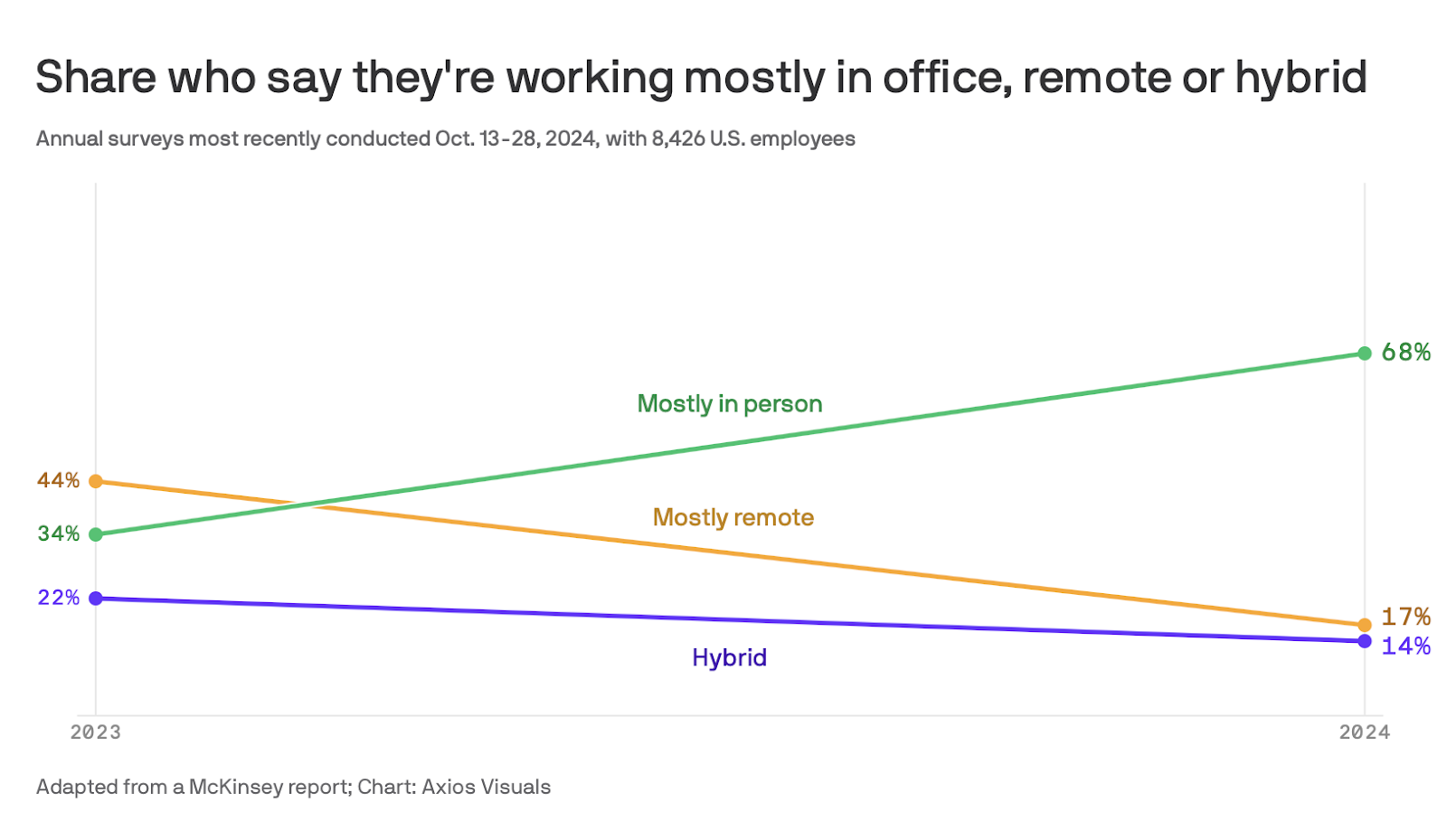
Axios reports that the amount of in-person work doubled this year as many employers start to enforce return-to-office mandates. Explore the data here.
Americans want paid leave. Just Capital data shows a clear and unmet demand for paid leave and parental support – 86% of Americans agree that it is important for companies to invest in expanded child care benefits, while just 44% agreed that companies are doing well on this issue. Polling shows these policies are a priority for the American public, and this election season, we saw paid leave measures advance in Nebraska, Missouri, and Alaska on the ballot. By implementing comprehensive paid leave programs, corporate leaders not only meet this expectation and support the well-being of their workers, but also deliver measurable returns through improved talent retention, enhanced productivity, and strengthened brand value.
This report makes the business case for maintaining and/or expanding paid leave policies, including:
Click on the image below to read or download the full report.

By Aleksandra Radeva, Lisa Simon (Revelio Labs), Zanele Munyikwa (Economist at Revelio Labs)
In today’s economic landscape – with looming uncertainty about the role of generative AI on the workforce and the pocketbook pinch of ongoing inflation – where and how can workers and their families find financial security and the stability it offers? When companies pay their employees a wage rate that meets local living expenses, they’re not only investing in operational success but also demonstrating leadership on one issue on which Americans across political affiliations agree, a seeming rarity in this election season.
To better understand the financial security of employees across America’s largest publicly traded companies, the Russell 1000, JUST Capital and Revelio Labs analyzed the amount by which employees’ wages exceed the local living wage necessary to cover basic budgetary needs. And while a living wage covers the basics, including housing, food, healthcare, and other essentials, the excess amount provides additional income that allows for the savings, discretionary spending, and improved quality of life necessary for true economic stability. The results – which indicate the financial viability of Russell 1000 employment, including among some entry-level positions, in some of America’s highest cost-of-living cities – may initially seem confounding. To learn more about how we made these calculations, click here.
When considering where workers can achieve financial stability, it’s surprising to find that some of the highest cost-of-living areas in the U.S. – like Seattle, cities in the Northeast, Silicon Valley, and Austin – also top the list for areas where a family of two working adults with two children can earn above a basic needs-based living wage. This finding indicates that the companies represented in these regions, as well as the wages offered in certain roles, can offset the high living costs.
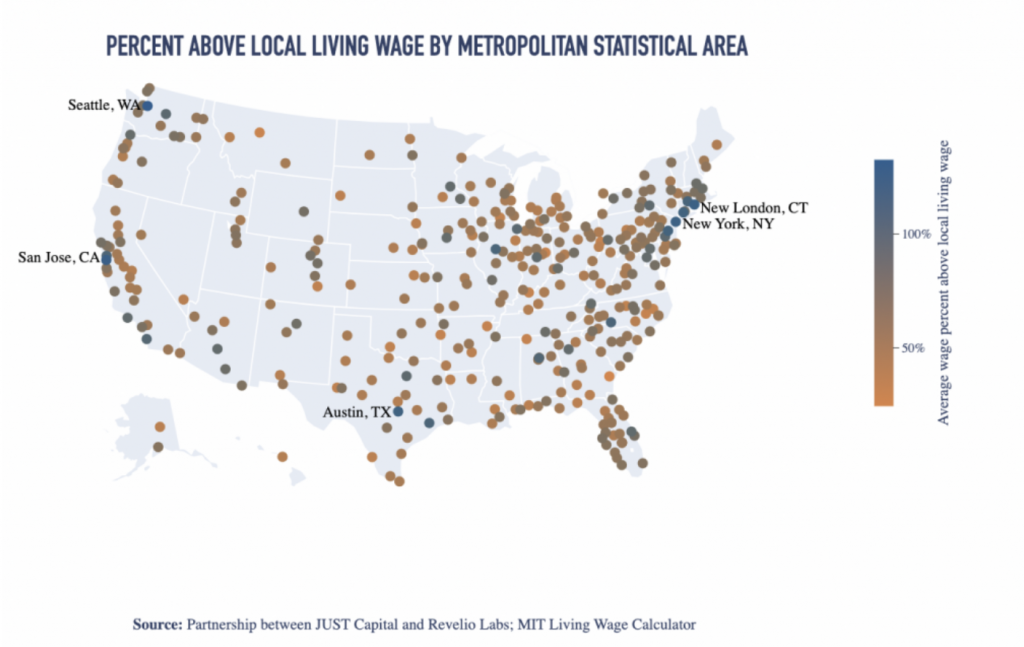
The map above shows where Russell 1000 company employees are paid a rate that, on average, exceeds the local living wage. For example, the living wage estimate, or amount needed to meet basic budgetary needs, for a family of two adults and two children in Austin, Texas is $52,800 per worker (assuming both adults work). Our data shows that on average, a Russell 1000 worker in Austin makes $114,000, which is 160% above the local living wage estimate for a family of four. This finding is certainly driven by the fact that Austin has a high concentration of high-paying companies with highly paid roles. But it also tells us that if one could be any worker with any role in a Russell 1000 company, a job in Austin would be more likely to ensure financial security.
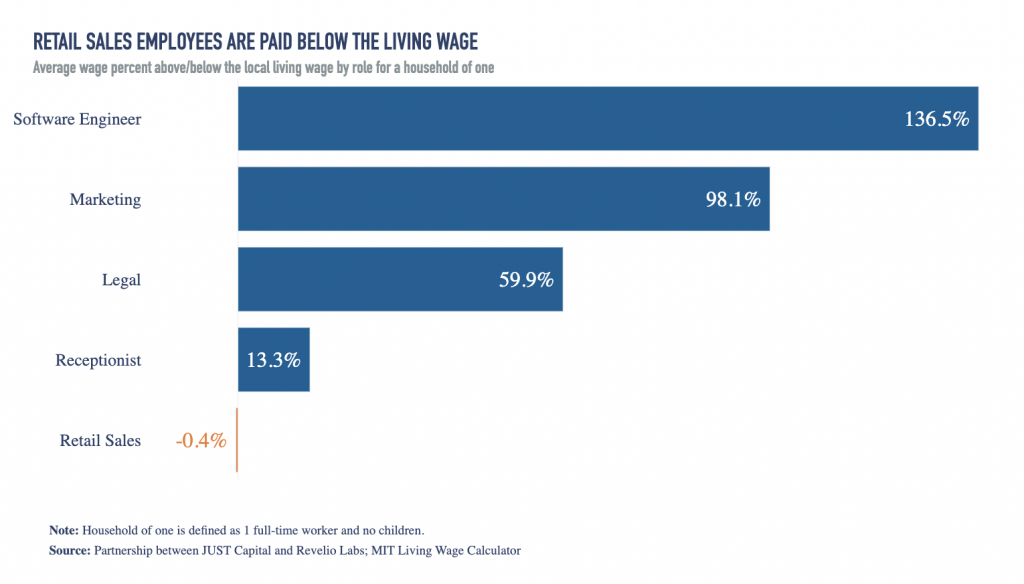
But when looking across different roles at Russell 1000 companies, not all tend to pay a living wage, let alone above it. The industry with some of the largest location-based variation in employees earning more than a local living wage is retail sales. That variation is driven by the industry’s large, diverse workforce and extensive presence across different regions. For those starting their careers in retail, the location of a given store plays a crucial role in determining financial viability. California, although a high cost-of-living state, not only provides a higher likelihood of achieving a wage exceeding the local living wage in retail roles but also maintains this advantage in entry-level positions.
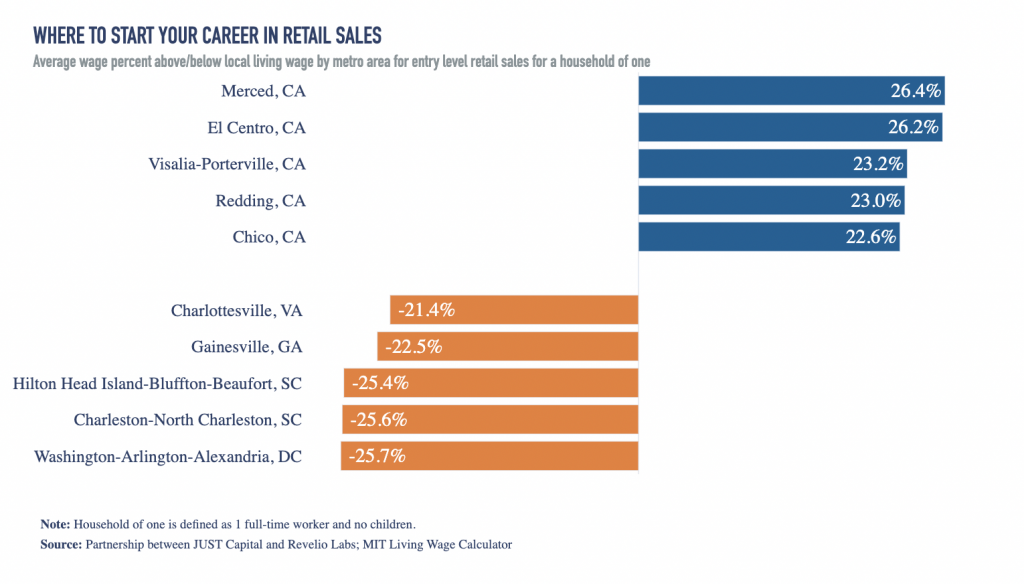
For example, an entry-level retail sales employee working at a Russell 1000 company can make on average 26.4% more than the living wage for a household of one in Merced, California. In Charlottesville, Virginia, on the other hand, employees will make 21.4% percent less on average than their local living wage.
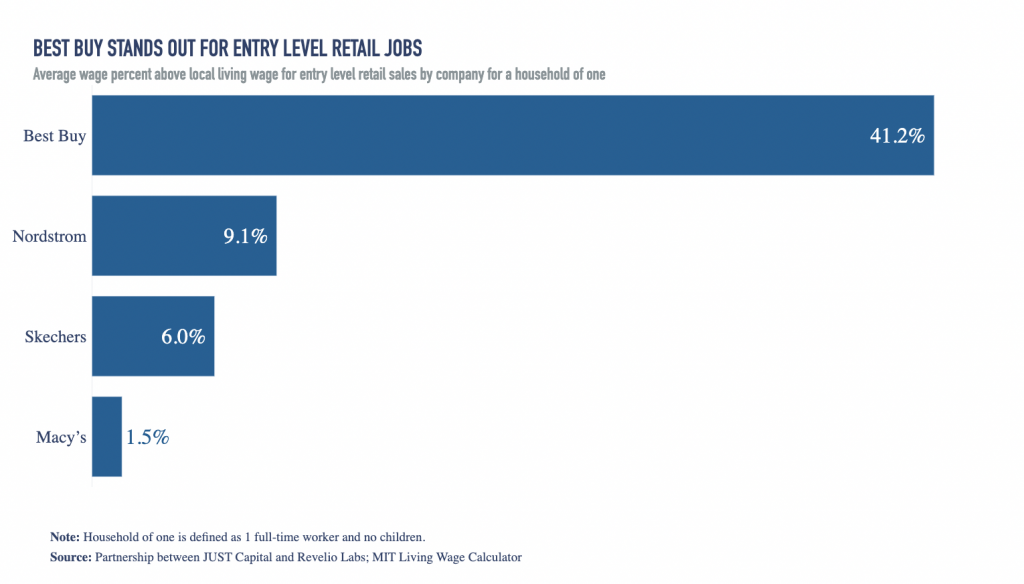
Besides location, the employer also plays a role in determining an entry-level role’s financial viability. Certain companies – including Best Buy – stand out for their higher pay for entry-level retail jobs. Best Buy, Nordstrom, Skechers, and Macy’s are notable for offering wages that exceed the local living wage estimates for a single adult working full-time, making them attractive options for those entering the retail sector. On average, entry-level sales employees at Nordstrom make 9.1% more than their local living wage for a household of one.
*The best companies for entry level retail positions are determined based on the percentage average wages fall above the local living wage for those positions.
And while some locations and employers offer a good starting point in retail, can such jobs support a family? A more detailed examination of retail roles reveals a sobering reality: supporting a family on a retail salary remains difficult in most areas. This finding is particularly true for entry-level positions, where wages often fail to meet the local living wage estimates. However, there are exceptions. California emerges as a state where retail sales roles can offer wages exceeding the local living wage, suggesting a more favorable economic environment for retail workers.
*For the purposes of this analysis, a family is defined as two full-time working adults with two children, and the living wage is what each of the adults needs to make to meet an estimated basic needs budget in their location.
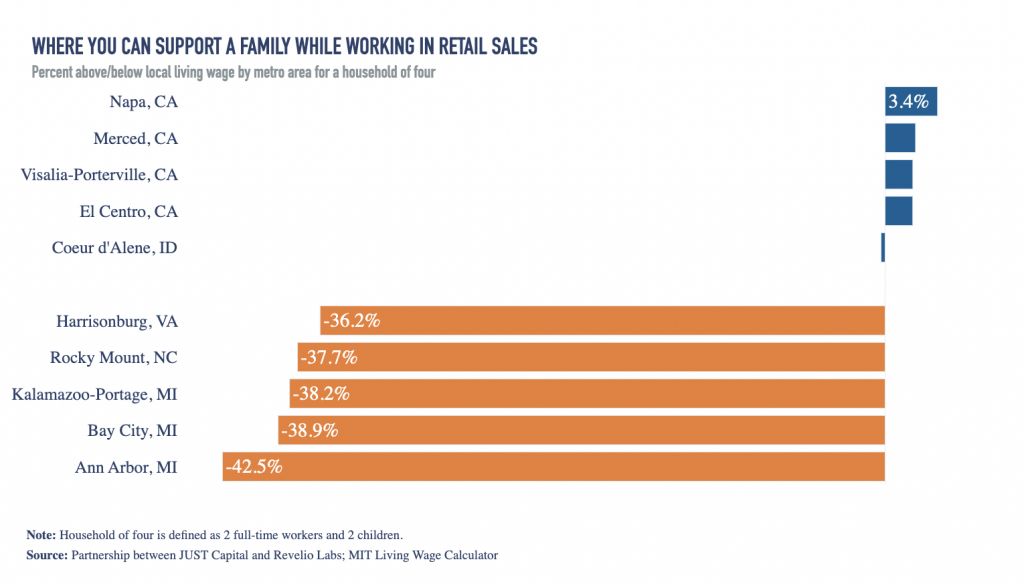
*The above graph represents the top and bottom five locations for relative wages earned by employees in retail sales roles compared to the local living wage .
These insights underscore the complex landscape of wages and living costs across the U.S., where variation exists even across Russell 1000 companies in the same industry. They highlight the importance of considering both geographic and role-specific factors when evaluating economic stability and opportunities for families.
JUST Capital and Revelio Labs are committed to identifying the corporate leaders on key workforce trends, particularly when it comes to companies investing in their workforce by paying a fair, living wage – a top priority of the American public for just business behavior. Learn more about leveraging the research insights, cabinet of experts, and peer-to-peer engagement available to corporate leaders through JUST Capital’s programming by reaching out at corpengage@justcapital.com.
Lisa Simon is the Chief Economist and Zanele Munyikwa is an Economist at Revelio Labs.
What is a living wage? A living wage is the amount of money needed for a given worker to cover the cost of their family’s minimum or basic needs where they live. Learn more about living wage as an important business benchmark here.
How do we calculate the percent that average wages fall below or above the local living wage in this analysis? To calculate the percentage average wages fall above or below the local living wage, we look at the average wage earned by employees working at Russell 1000 companies in a given metropolitan area, and compare that average to the local living wage. We then use the following formula to calculate the percentage above or below the local living wage:
(Average wages earned in MSA by Russell 1000 employees﹣Local living wage) / Local living wage
Why is a pay rate that exceeds the living wage important? For workers across incomes, knowing where your earnings are most likely to exceed the local, basic needs-based cost of living provides an indication of where your wages might be “worth” the most in terms of purchasing power. What’s more, the basic needs budget used to estimate living wage typically assumes the lowest-cost version of necessities, and does not include significant elements of financial security such as retirement savings. A worker earning a living wage would remain only one unexpected expense away from financial precarity. Learn more about how local living wage estimates are calculated here.
