
(Mario Tama/Getty Images)
I’ve spent much of the week talking to business leaders about what Tuesday’s election results could mean for corporate stakeholder leadership. The answer – like the outcome of a few key races – is not yet clear, although with the balance of power in the House and the Senate certain to be evenly distributed it’s unlikely there’ll be any fundamental shifts in company strategy required.
The general sense is that if a thin Republican political majority does materialize as expected in the House, hearings on the anti-ESG agenda are likely and CEOs would be summoned to testify. The business case for stakeholder leadership will therefore come under the spotlight – and perhaps that’s not a bad thing. Our research shows the case is pretty clear. A divided Congress also means CEOs will continue to be more cautious of making public statements on divisive issues, and may even embolden some to oppose ESG regulation. On climate, support for domestic fossil fuel production will increase, although a lack of governing majority means that “the policy status quo (on clean energy) remains fundamentally intact for the next two years,” as Goldman Sachs notes. Efforts to regulate ESG disclosure may come under closer scrutiny.
Perhaps the biggest takeaway, however, is that voters on both sides are concerned mostly about core inflation and economic issues. This year’s Americans’ Views on Business Survey, out this week, supports this view, along with our 2022 Issues Survey that focused on kitchen table issues like fair wages and good jobs. It is the most powerful bridge there is, and one where business can really lead by example. Suzanne P. Clark, President and CEO of the U.S. Chamber of Commerce, put it this way in a statement on the election results: “It has never been more important for elected officials to address our nation’s challenges by bridging divides and forging durable solutions – just like business leaders across this country do every day.”
For companies the best approach for now would therefore seem to stay focused on the thing that we know really matters: supporting their workers’ economic well-being.
Be well,
Martin Whittaker

Home Depot workers voted against forming its first store-wide labor union in Philadelphia.
Macy’s plans to invest $30 million into minority-owned businesses over the next five years.
Meta lays off 11,000 workers, or nearly 13% of its staff, and will extend its hiring freeze into Q1 2023.
Salesforce lays off hundreds of employees on Monday after demand lightens in some countries and industries.
Stripe lets go of 14% of its staff, but is praised by HR professionals for its humane approach, especially compared to other companies like Twitter.
This week we released our in-depth 2022 Americans’ Views on Business Survey Report, which provides unique and critically important insights into how everyday Americans think about business today, and when viewed in the context of our previous seven years of polling – how it has shifted over time. For instance, perceptions on whether capitalism is working for the average American plummeted 10 percentage points this year, with a stark difference in demographics. Peter Vanham at Fortune covered the report this week in the new Impact Report newsletter.
Martin joined Leslie Norton and John Hale from Morningstar on Twitter Spaces to discuss the election results and what they mean for ESG, as well as his thoughts on COP27. (The conversation starts at 4:40 in the recording.)
The data on the impact of human capital management is paltry. That’s why we’ve teamed up with the Ford Foundation and have opened up a request for grant proposals focused on advancing human capital management research and accessibility. Help us improve our collective understanding of how companies manage and support their workforces, and how it impacts their bottom line. Submit your proposal now through December 9!

(Fortune)
“This is about driving those four constituents [customers, employees, shareholders, and the larger community] in a way that aligns capitalism to what society needs from us. So that people see the value of capitalism.”
“With the talent wars so strong, we’ve needed to find other good avenues for recruiting folks. And guess what? We already have that with our veterans pipeline. They have great transferable skills, plus they bring additional skills of leadership, flexibility, dedication and all the other intangibles that veterans bring. So in 2021 and 2022, we’re up almost 400% in veteran hiring, versus 2020 and earlier years.
“Government targets, supporting policies and transition plans can provide clarity, predictability and the competitive landscape to encourage more businesses to take action and to make transition-aligned investments.”
Joe Nocera explores in NYT DealBook what the midterms results could mean for business, and the Financial Times describes how U.S. companies are preparing for a potential wave of congressional hearings to investigate businesses’ environmental and social positions.
Al Gore and David Blood of Generation Investment Management pen an editorial in the Wall Street Journal explaining why ESG investing is consistent with fiduciary duty, and Leslie Nortonat Morningstar builds a strong case for why ESG and sustainable investing won’t be stopped and will survive the current demonization and backlash.
Axios reports that to the extent that layoffs are underway, it’s currently largely contained to one sector – tech. Fortune and leadership consultant Scott Monty take a closer look at what Twitter(and others) could learn from how Stripe handled their layoffs.
Gizmondo reports on Microsoft’s push to create more climate-smart workers, finding that at most companies, “60% of sustainability team members joined without expertise in the field.”
The Wall Street Journal creates a compendium of all of its ESG coverage over the last several years.
Forbes counts down the Best Employers for Veterans.

With U.S. midterm elections dominating the news cycle, we’re showcasing one of the many charts from our 2022 Americans’ Views on Business Survey Report, which shows that even across political affiliation, Americans are more aligned than we may think when it comes to how they want companies to be supporting their workers. Explore the insights here.


Team JUST Capital had a blast running the New York City Marathon and raising $35k ($10k over our goal!) to create a more JUST economy. Here are some pictures from the day – and feel free to check out our Team JUST Capital fundraising page if you still want to donate.
The Americans’ Views on Business Survey was written by Jennifer Tonti, Managing Director of Survey Research & Insights.
As 2022 draws to a close, Americans are faced with a number of uncomfortable economic challenges, including fears over job security and layoffs, stubbornly high inflation, a looming recession, and a political climate rife with rancor and division. Suddenly, the already precarious path to prosperity for tens of millions of people seems even more out of reach.
Such is the backdrop to our Annual Survey on the Priorities of the Public, in which we poll Americans about their Views on Business – specifically, whether they think America’s largest companies are moving toward creating a more just economy and society. Since 2015, Just Capital has surveyed more than 160,000 Americans on a fully representative basis. This survey not only gives us unique and critically important insights into how Americans think about business today, it also gives us a pulse on their hopes and fears, and – when viewed in the context of our previous seven years’ of polling – how each have shifted in time.
In our 2022 Issues Report –The People’s Priorities we found that that across every demographic group, whether political affiliation, race, gender, age, or income group, Americans are united in wanting companies to prioritize Workers as the most important stakeholder and Paying a fair, living wage as the most important business Issue today.
In this companion survey, we find that Americans consistently believe that companies remain firmly wedded to the shareholder primacy model and that there continues to be a basic mismatch between what the public wants companies to prioritize (their workers) and what they perceive companies are actually prioritizing (their shareholders).
We also find that perceptions on whether capitalism is working for the average American plummeted 10 percentage points this year, with a stark difference between those who think capitalism is working (high-income workers, older Americans, Conservatives), and those who do not think capitalism is working (lower-income and hourly workers, Black and Hispanic Americans, younger Americans, and Liberals).
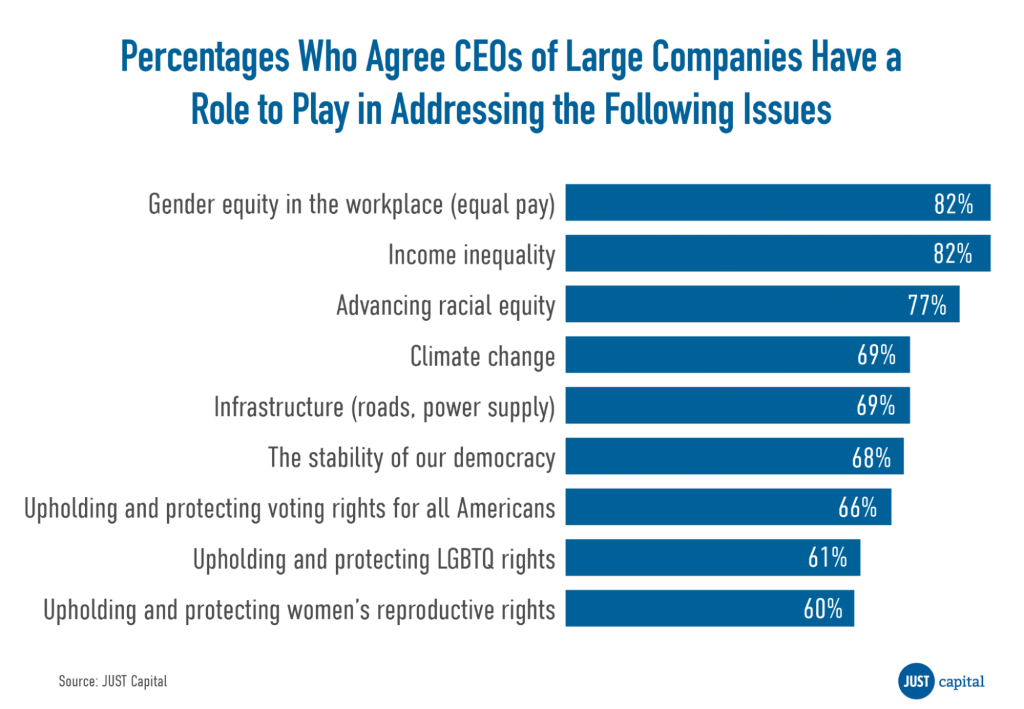
As Edelman saw in its new study, “The Changing Role of the Corporation in Society,” Americans believe businesses and CEOs have a role to play in addressing societal issues, agreeing most when it comes to tackling issues like gender equity in the workplace (equal pay), income inequality, and advancing racial equity. CEOs may experience more pushback when taking a stand to address issues like protecting LGBTQ rights, women’s reproductive rights, and climate change, as the political polarization around those issues is high.
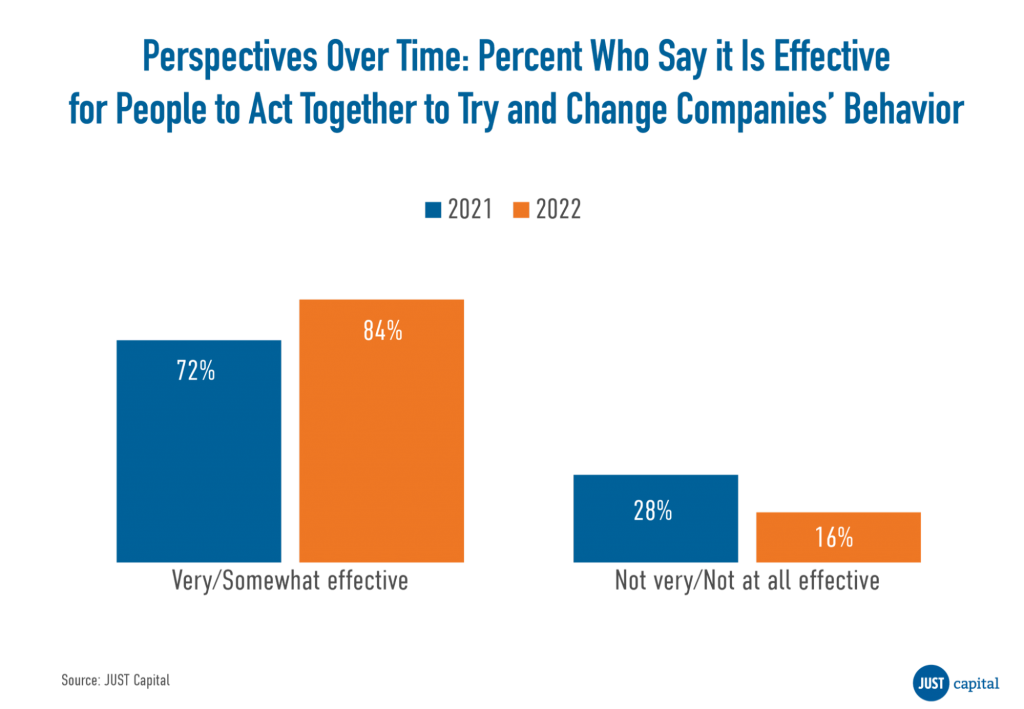
Despite an uptick in positive impressions during the first year of the COVID-19 pandemic that companies were stepping up to take care of stakeholders, Americans are now less likely to think companies are following through. They also expect business to talk less and act more. The good news: 81% of Americans believe that business can be a powerful force of societal change and 84% believe people can be effective when they act together to try to change companies’ behaviors. Americans are also willing to support change and help companies transition toward a just economy by paying more for just products and even accepting less pay to work for just companies.
In this year’s survey, we unpack these trends in detail, seeking to understand what matters most to Americans today, against the backdrop of our shifting economic and societal climate, and what corporate leaders should prioritize to live up to the expectations of the public. Let’s take a deeper look at the data.
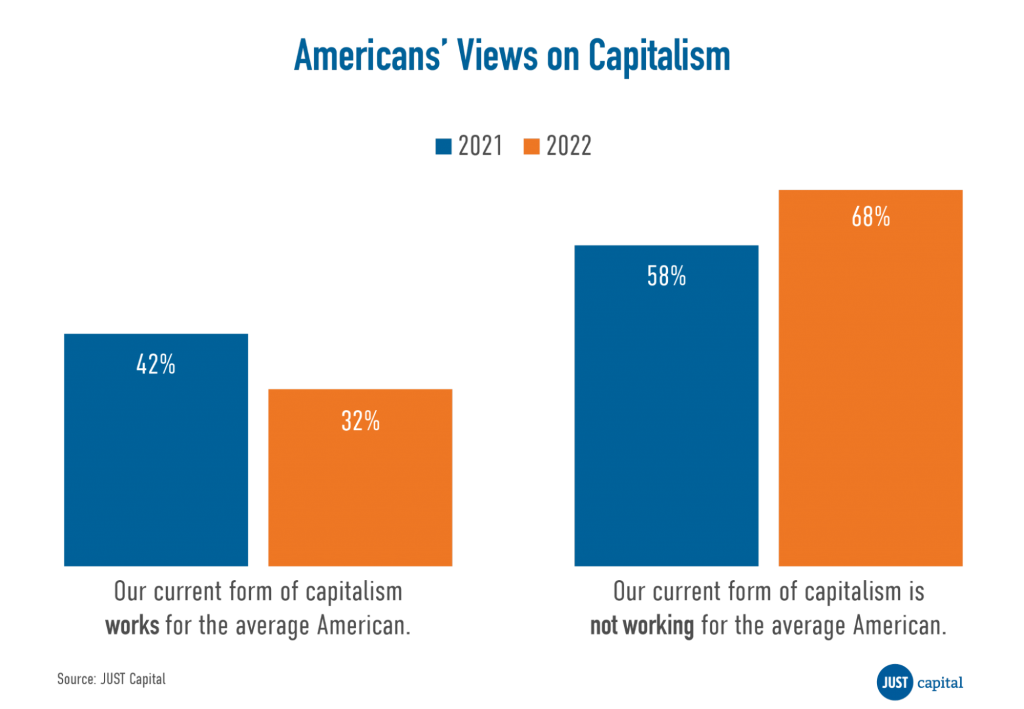
More than two in three Americans (68%) say that “our current form of capitalism is not working for the average American,” a 10-point increase in negative sentiment from just one year ago. In its recent survey on how Americans perceive capitalism, Pew Research similarly finds modest declines.
In a recent talk, PayPal CEO Dan Schulman discussed why capitalism needs an upgrade, warning, “To many people who are left out of the system, who struggle to make ends meet and don’t believe in the American dream anymore, they tend to radicalize to the far left or far right. So how do we strengthen our democracy by thinking more broadly?”

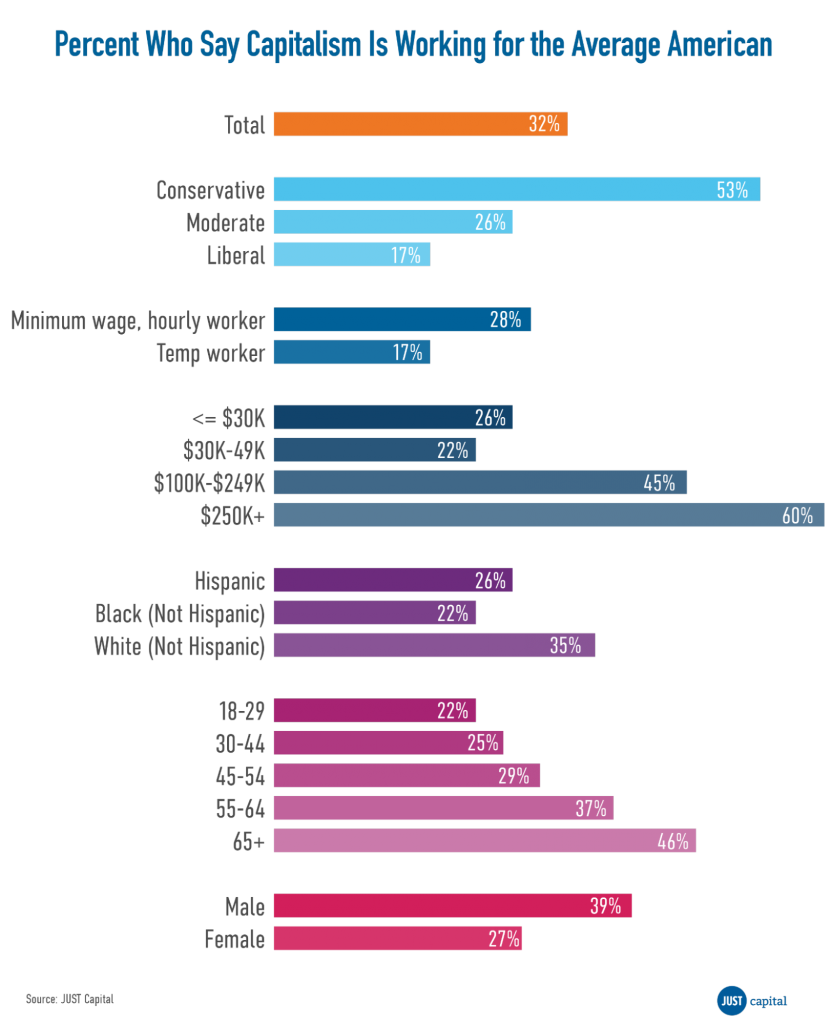
When we look across demographic breaks, we find substantial differences in Americans’ opinions of whether capitalism is working. Lower-income and hourly workers, Black and Hispanic Americans, temp workers, younger Americans, and Liberals are all far less likely to agree that “our current form of capitalism works for the average American” than white Americans, older Americans, those in high income households, and Conservatives.
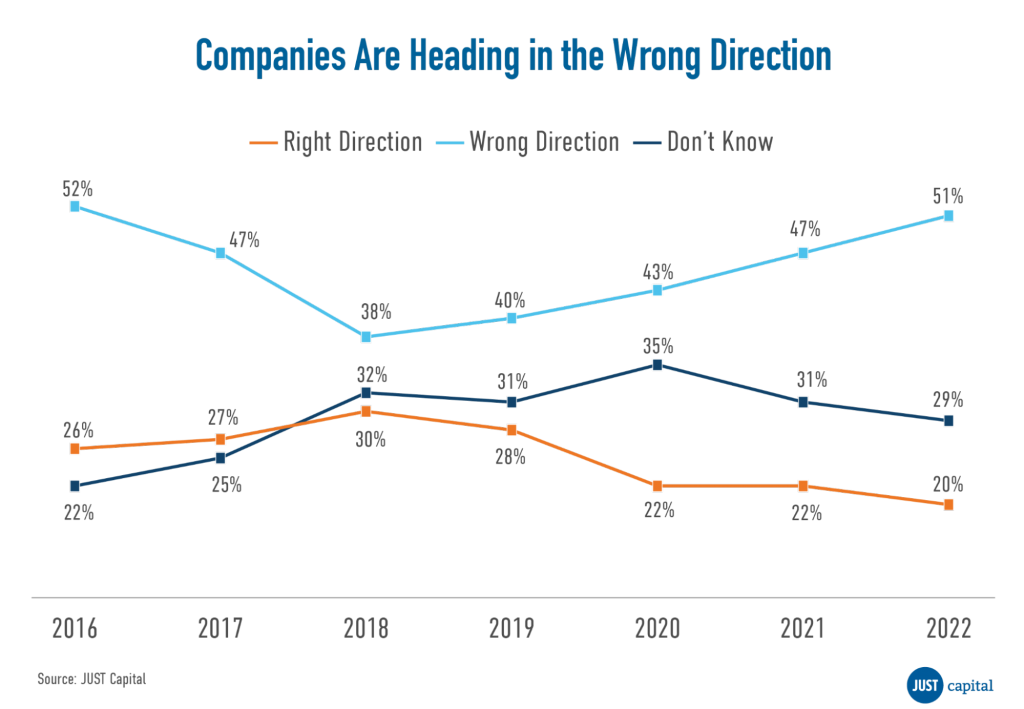
Americans agree that companies are on the wrong path, with just 20% agreeing that they’re heading in the right direction – a downward trend from a high of 30% in 2018. What’s more, over half of Americans (51%) now say companies are headed in the wrong direction, a steady trend upward, and a 13 percentage point increase, since 2018.
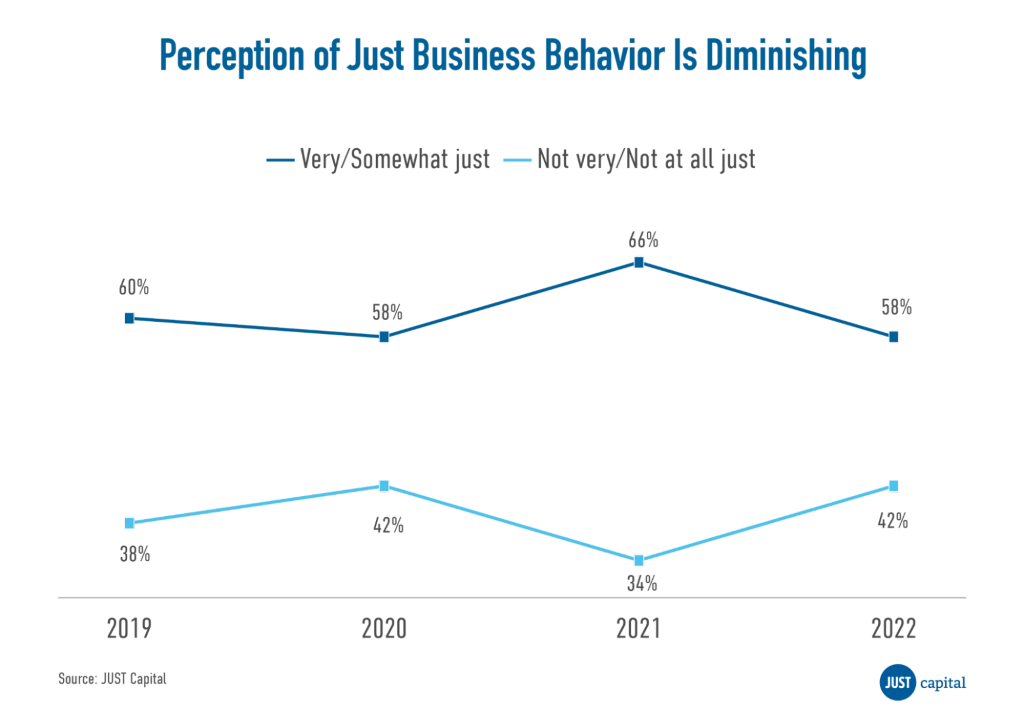
With regard to just business behavior specifically, more Americans (58%) say that companies are very or somewhat just than say they are not very or not at all just – however, that number is down from a high of 66% in 2021.
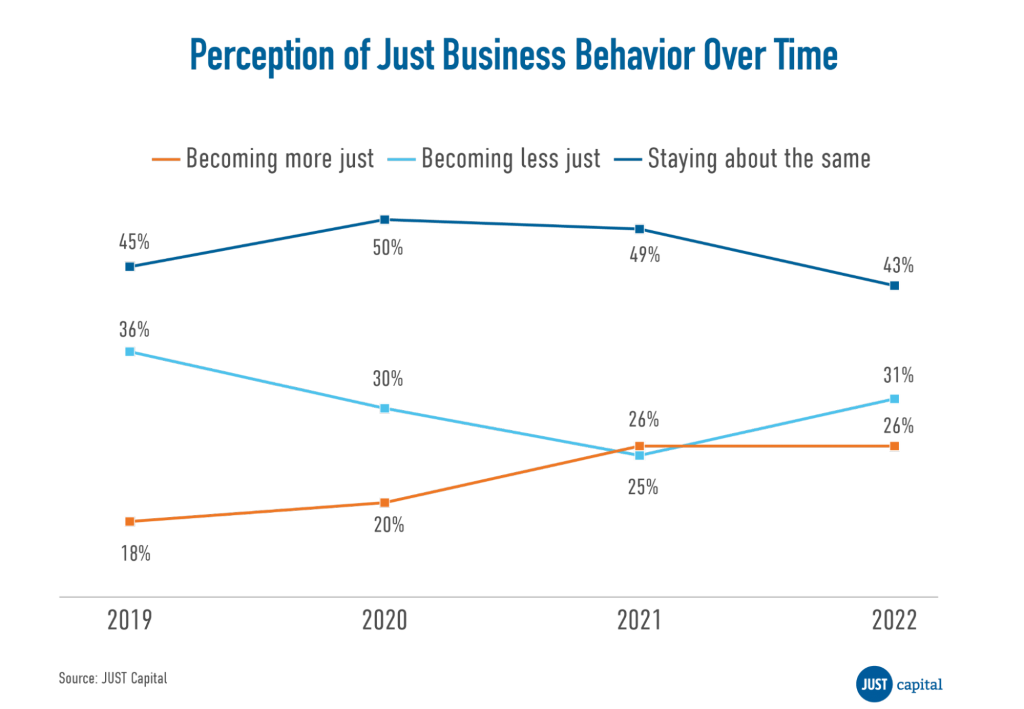
When we ask the public whether they think companies are becoming more or less just over time, even though a plurality say that they have stayed about the same, the percentage 0f respondents who say companies are becoming less just has grown in the past year, from 26% in 2021 to 31% in 2022.
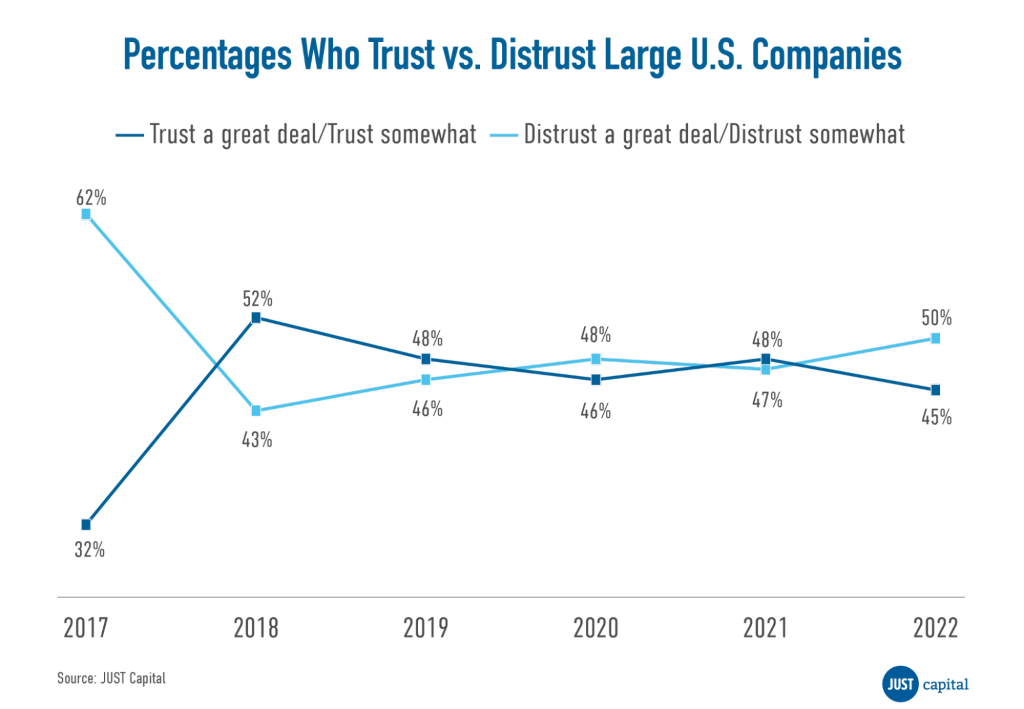
The proportion of Americans who trust versus distrust large U.S. companies had been roughly the same over the past few years, but in 2022 that changed, with more Americans now saying that they distrust companies (50%) than trust them (45%).
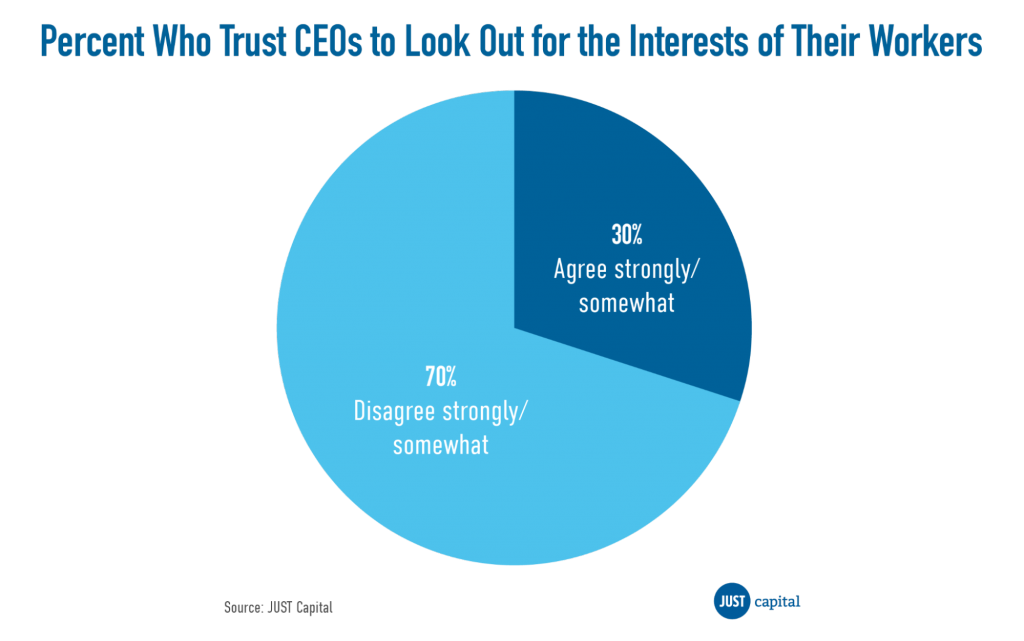
We see these findings further confirmed by a new question we asked this year – if people trust CEOs to do right by their employees – and only about one in three agreed that they “trust CEOs to look out for the interests of their workers.”
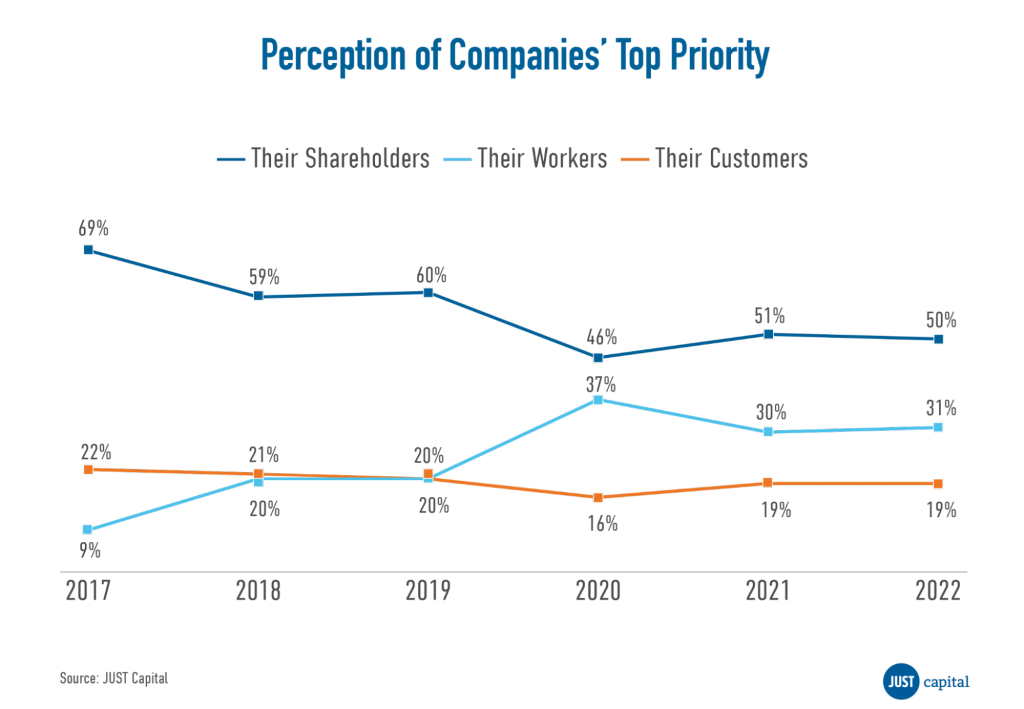
A key question in our Americans’ Views on Business survey asks the public’s thoughts about which stakeholder – shareholders, customers, or workers – they think companies prioritize most. For six years running, and by a significant but varied margin, half of Americans say that shareholders are the top priority in companies’ eyes, versus 31% who say workers and 19% who say customers. When comparing these responses to what the public said in our Annual Survey six years ago, we see two major changes over time.
First, while the percentage who say employees are the top priority has grown substantially, from 9% to 31%, the uptick in this view has now waned since 2020. And second, while the degree to which the public believes shareholders are the top priority has diminished – from 69% in 2017 to 50% in 2022 – it has actually risen since the challenges of 2020. Overall, this paints a picture of an opportunity perhaps lost – or at least not fully captured – by companies to show they are placing workers’ interests at least on par with shareholders’.
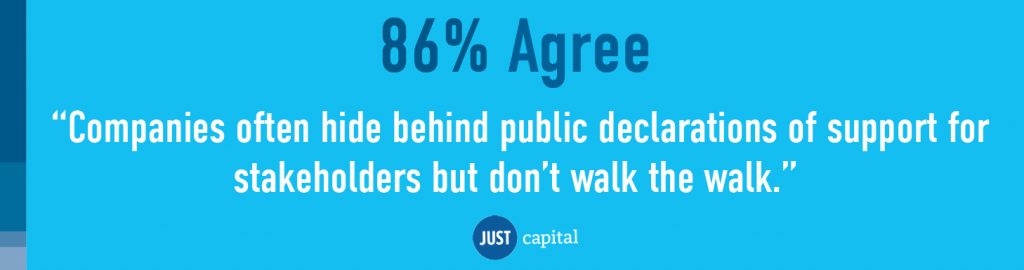
In keeping with these findings, the public also agrees that companies are not living up to their commitments to take action on critical societal challenges. In the two years since the Business Roundtable announced a movement away from shareholder primacy, our data show that the public remains skeptical on whether America’s largest companies are actually following through on their commitments to a stakeholder model, with 86% agreeing that companies “often hide behind public declarations of support for stakeholders but don’t walk the walk.”
The following chart shows that the public believes that companies have the most positive impact on their shareholders (75%) at a greater margin than other stakeholders, including customers (65%), the health & safety of their workforce (64%), quality jobs (56%), and local communities (55%).
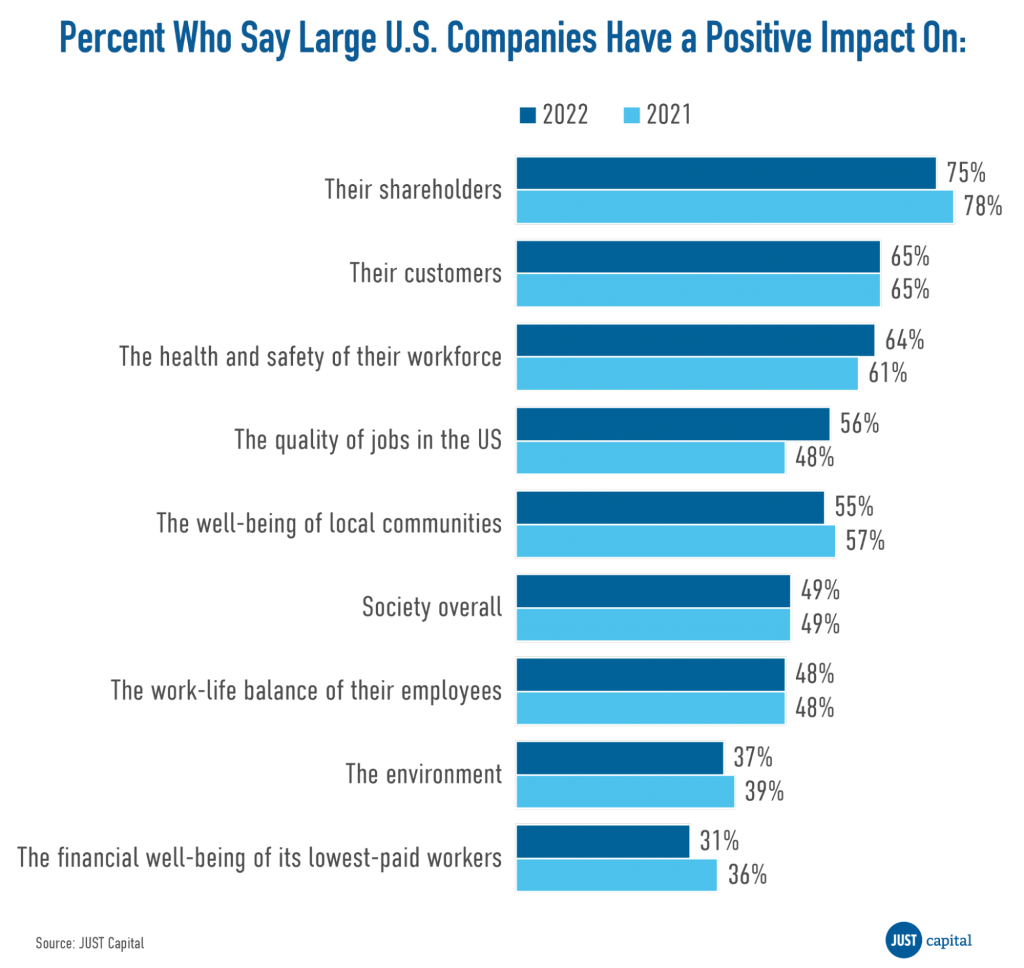
Far fewer say that the environment and low-wage workers are positively impacted by the behavior of large companies. Compare the one in three Americans who say companies have a positive impact on the “financial well-being of their lowest-paid workers” to nearly twice as many who say “their shareholders” in the chart above.
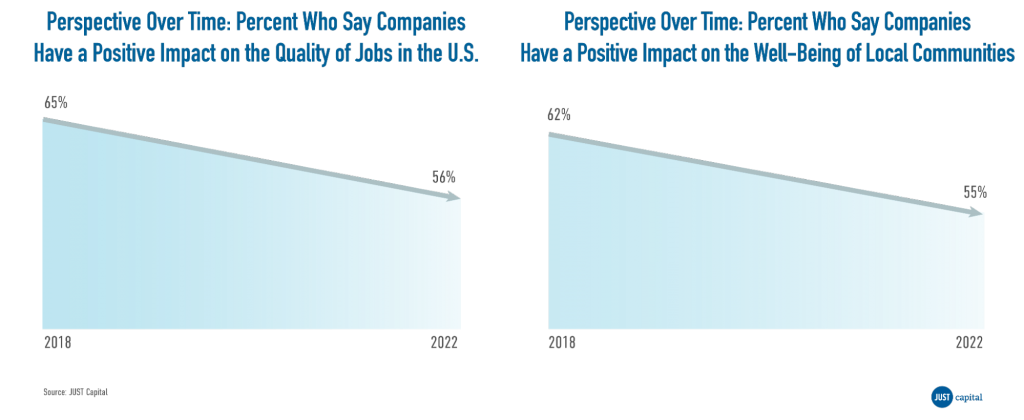
Looking at positive impact measures over time, the public’s perspective is that companies are moving in the wrong direction. For example, the percentage who say companies have a positive impact on society overall has fallen from a high of 58% in 2018 to just 49% of Americans in 2022.
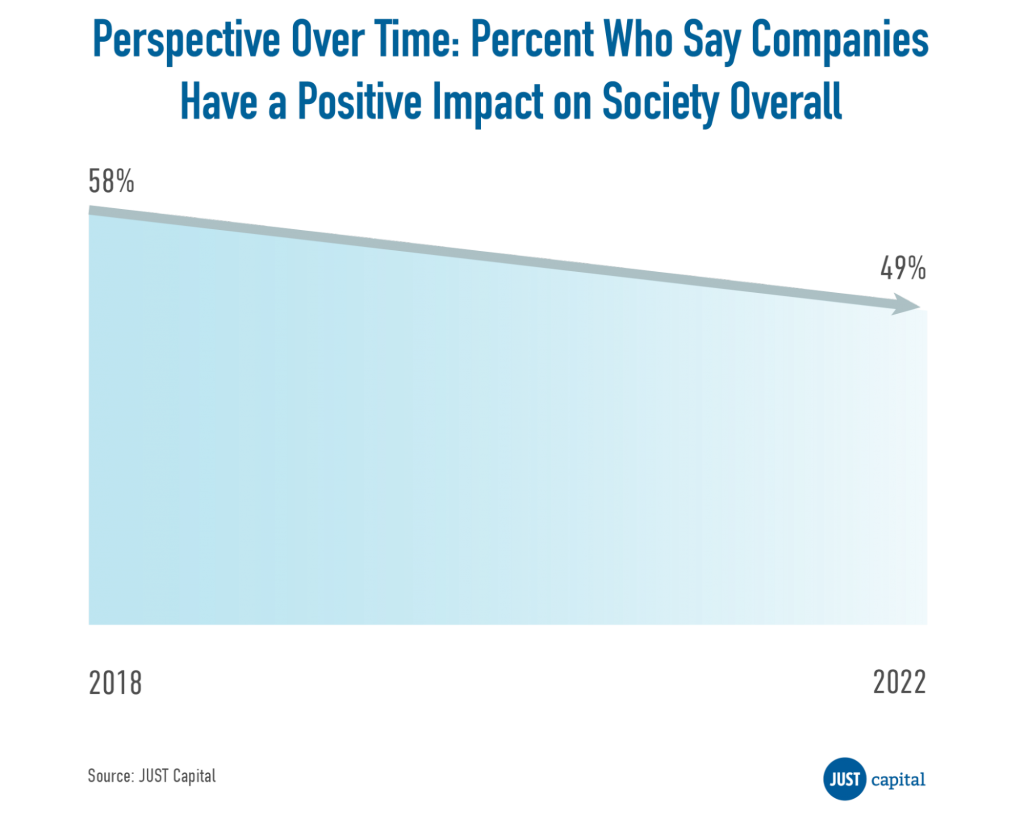
There are similar dips in the percentage of Americans who say companies have a positive impact on the quality of U.S. jobs and the well-being of local communities.
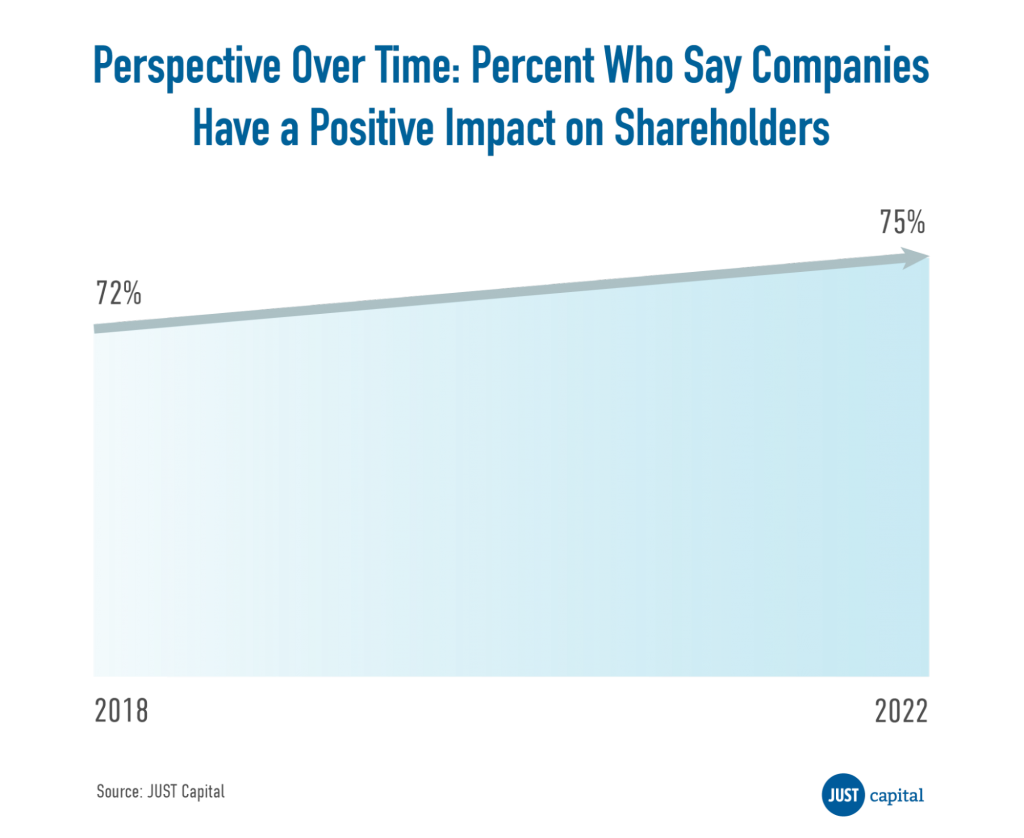
Yet the percentage who say companies have a positive impact on shareholders is substantially higher, and even increases slightly over the past five years.
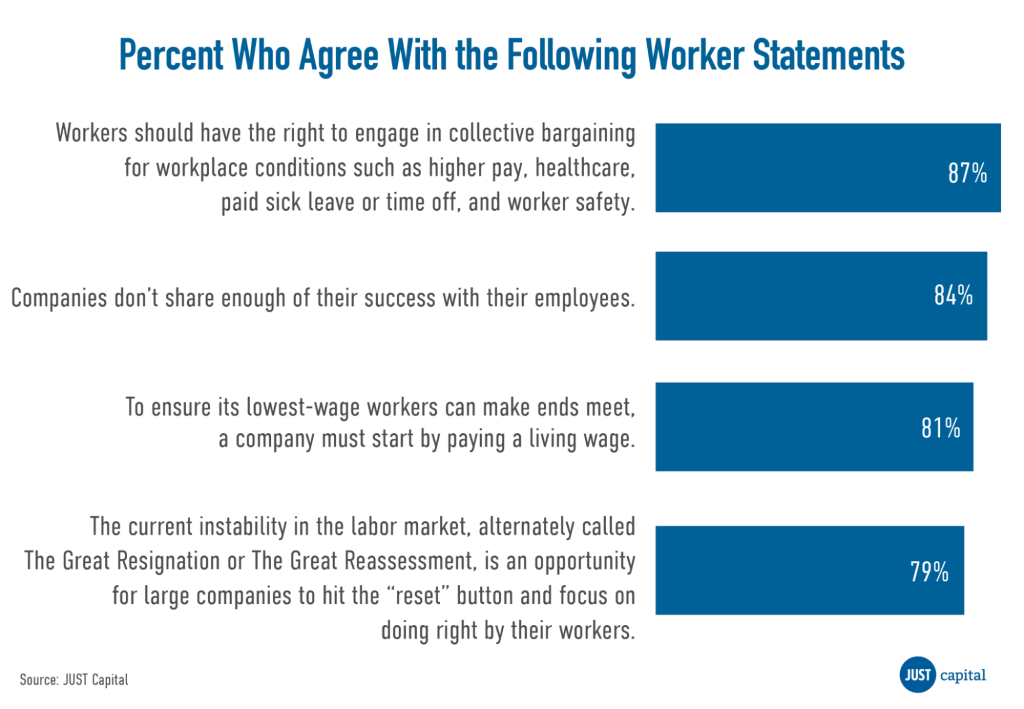
Workers are the engine of a company, and from our recent survey on workers and wages, it is clear that Americans firmly believe that companies that invest in their workers by paying a living wage are more competitive in their industries, better for the economy overall, and more profitable in the long term. In this survey, we find that Americans again agree that the focus of a just company should be its workforce, with majorities agreeing with the following statements:
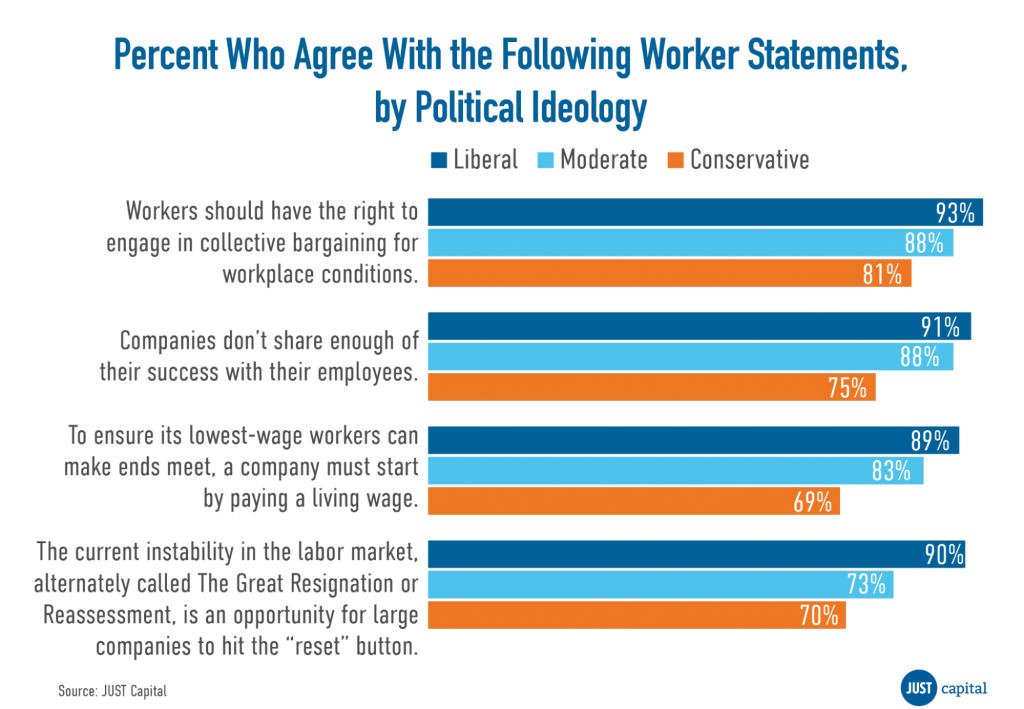
What’s more, there is remarkable consensus on these issues when looking across political divides, suggesting that, despite sentiment that the right and left are polarized when it comes to issues like a living wage or even forms of collective bargaining, liberals and conservatives are more aligned than we might think.
To protect workers’ right to fair treatment, almost nine in 10 say that workers should have the right to collectively bargain for pay and other protections. This strong agreement on collective bargaining tracks with public pollster Gallup, which finds that Americans’ approval of labor unions is at its highest point since 1965.
What’s more, we find that support for unionization of the workforce is consistent across all political ideologies. Consider what Amazon union leader Chris Smalls said at a hearing on Amazon’s labor practices in May of 2022:

Companies looking to stave off unionization trends should assess their workers’ financial wellness to ensure all employees are able to make ends meet. In this survey we heard that more than 80% agree that companies need to pay their lowest-paid workers a living wage – something we’ve seen reinforced with strong agreement from the public in our survey on workers and wages, which found that 84% agree that large companies should pay employees enough to make ends meet. Our 2022 People’s Priorities Survey also echoed this sentiment, with “Paying a fair, living wage” as the #1 Issue for the public, gaining more than 20 percentage points in importance over the last two years.
Inflation and an impending recession are already impacting the lives and pocketbooks of most Americans, meanwhile the lowest-wage workers in the U.S. unfortunately bear the brunt when wages don’t keep up with inflation.

In an effort to better understand the state of corporate America when it comes to paying a living wage, Just Capital has also refined its measurement of this issue for our upcoming 2023 Rankings. Among our initial findings? About half of Russell 1000 employees do not make a family-sustaining living wage.
With job quits rates hovering at about 4 million between August 2021 and August 2022, the phenomenon alternately called The Great Resignation and The Great Reassessment could flourish. To that end, a large majority of Americans think this was a key moment for worker power: 79% agree that The Great Resignation is an opportunity to hit the reset button and focus on workers.
Finally, when it comes to a company’s profits, Americans say that workers are not getting their fair share of the pie: 84% agree that companies don’t share enough of their success with their workers. With profits surging 35% last year, 2021 was the most profitable year for American corporations since 1950. And while employee compensation rose 11%, the so-called labor share of national income – the portion that’s paid out as wages and salaries – fell back to pre-pandemic levels. It’s clear that American workers aren’t sharing in the prosperity they are helping companies create.
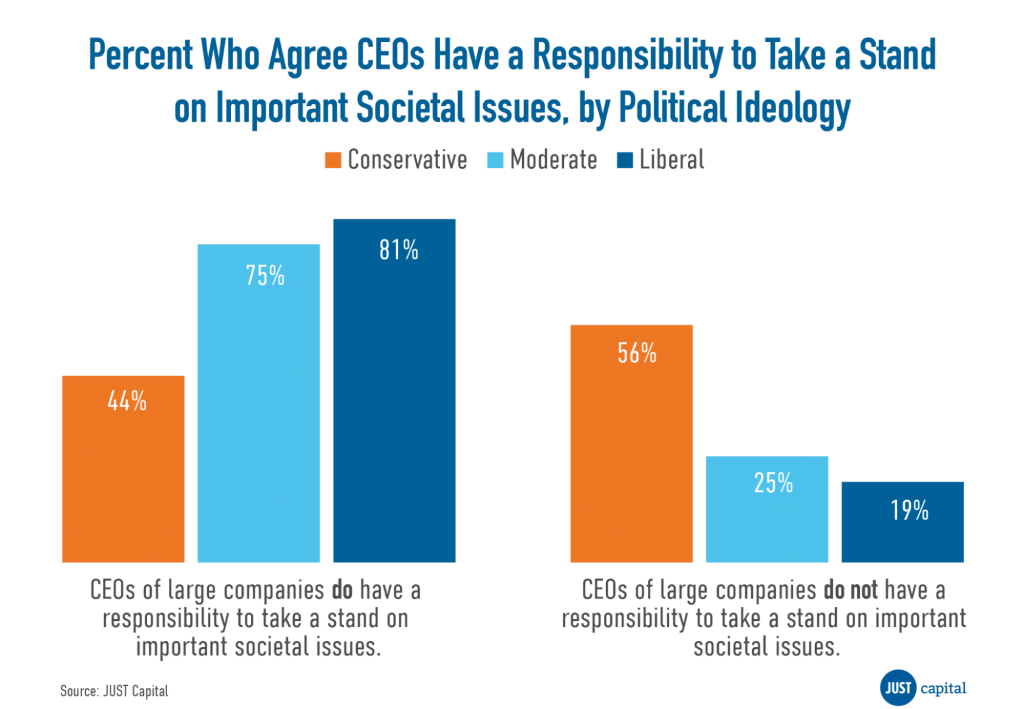
In recent years, CEOs have found themselves in the position of needing to speak out on both critical and contentious issues, and the landscape is becoming more challenging to navigate as more politicians attempt to bring companies into culture war issues as the election cycle heats up. To help corporate leaders understand public expectations during these tumultuous times, we’ve asked Americans each year for the last five years if they believe the CEOs of large companies have a responsibility to take a stand on important societal issues. This year, two-thirds of Americans overall – a number that has remained relatively stable in our years of polling – believe CEOs of large companies have a responsibility to take a stand.
There are, however, significant differences in the degree of agreement when looking at this question across political breaks: with far fewer Conservatives agreeing CEOs have a responsibility to take a stand (44%) compared to their Liberal (81%) or Moderate (75%) peers.
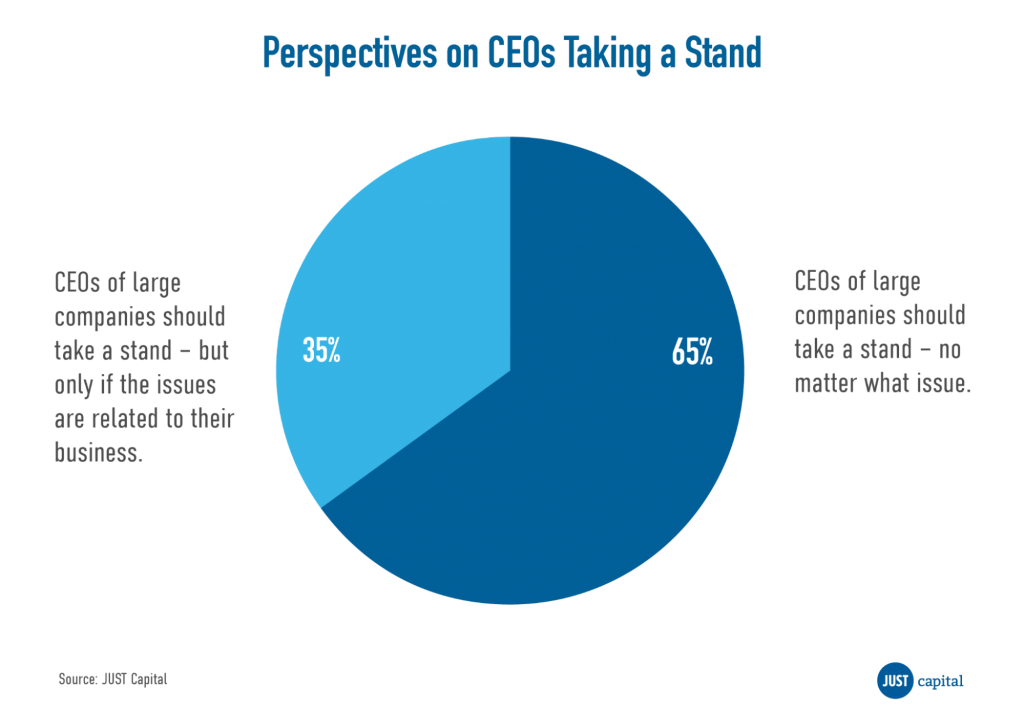
Of the almost two-thirds who say that CEOs have a responsibility to take a stand, another two-thirds of that group says they should do so no matter the issue, rather than focusing solely on issues that directly impact their business.
With a majority of Americans saying that CEOs should take a stand on issues, the question then becomes which societal issues should they address. In response to this year’s survey, a substantial proportion of the public says corporate leadership has a role to play in addressing all of the following issues, with income inequality and gender and racial equity receiving the highest levels of support (77% or more).
And although majorities say CEOs have a role to play in these issues, there is less consensus when looking across political breaks, with Conservatives less in support of CEOs taking a stand on these specific issues than their Moderate or Liberal counterparts. There is particularly low support from Conservatives when it comes to LGBTQ rights, women’s reproductive rights, and climate change (45% or less).
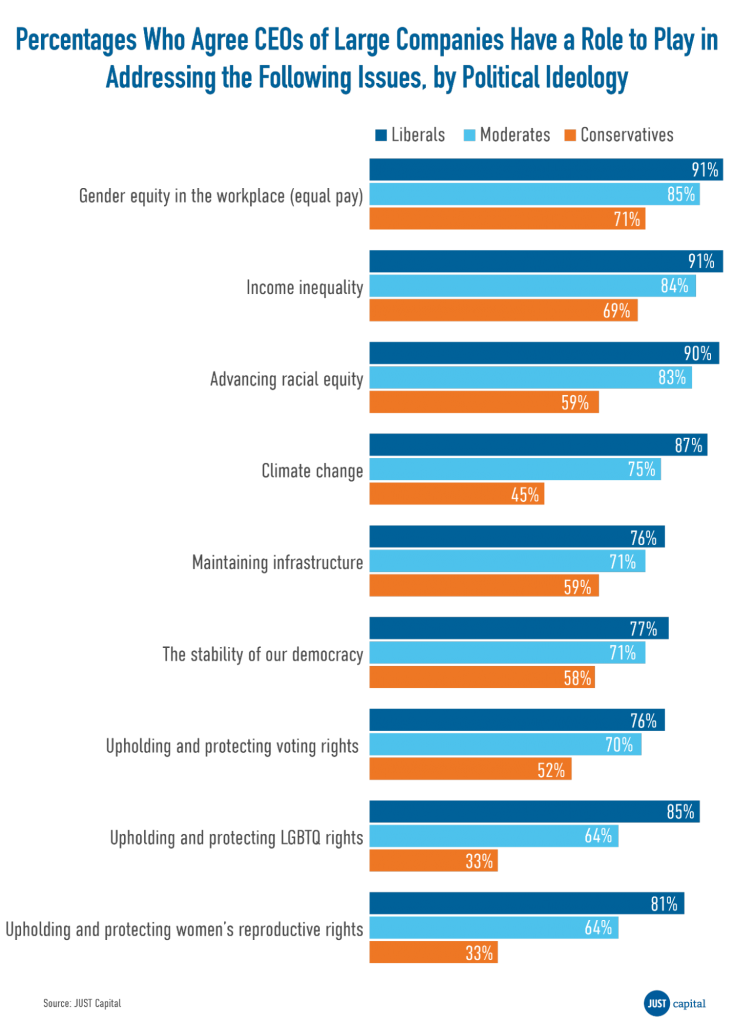
However, for the question of upholding our democracy – an issue that has become increasingly politically divisive – majorities of all three political ideologies agree that CEOs have a role to play in protecting both democracy and voting rights. Those numbers are bolstered by the 72% of Americans who say corporate America has a responsibility to protect the democratic process by promoting free and fair elections.
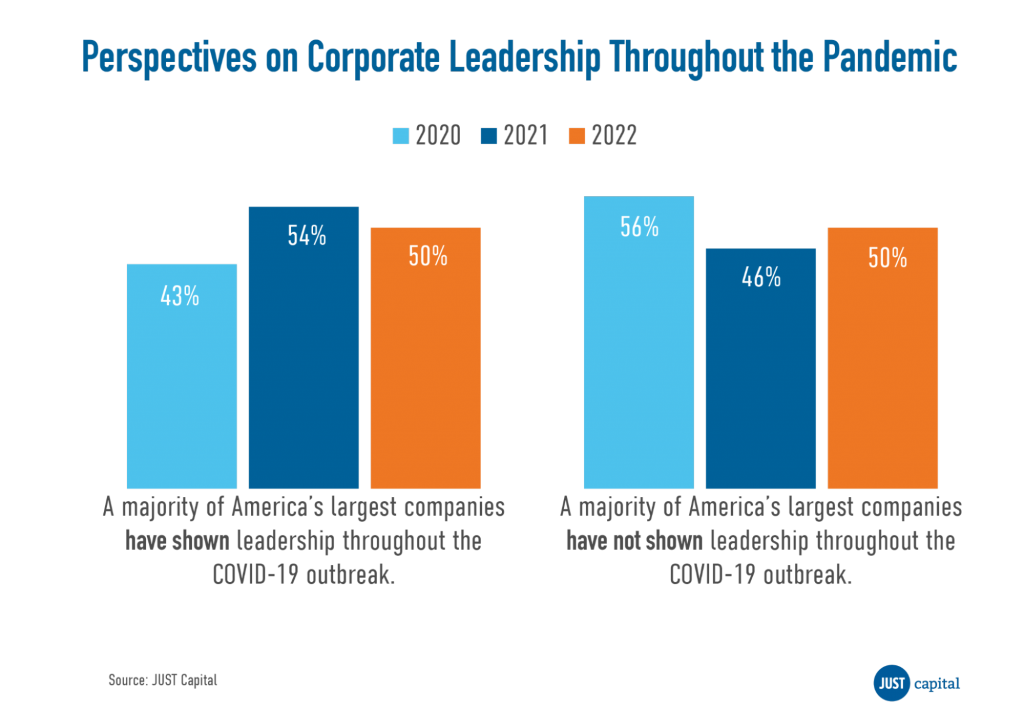
Positive assessments of corporate behavior are also informed by the public’s views on how companies have weathered recent events, including the COVID-19 pandemic. In 2022, half of Americans say companies have shown leadership throughout the pandemic, down from a high last year of 54%.
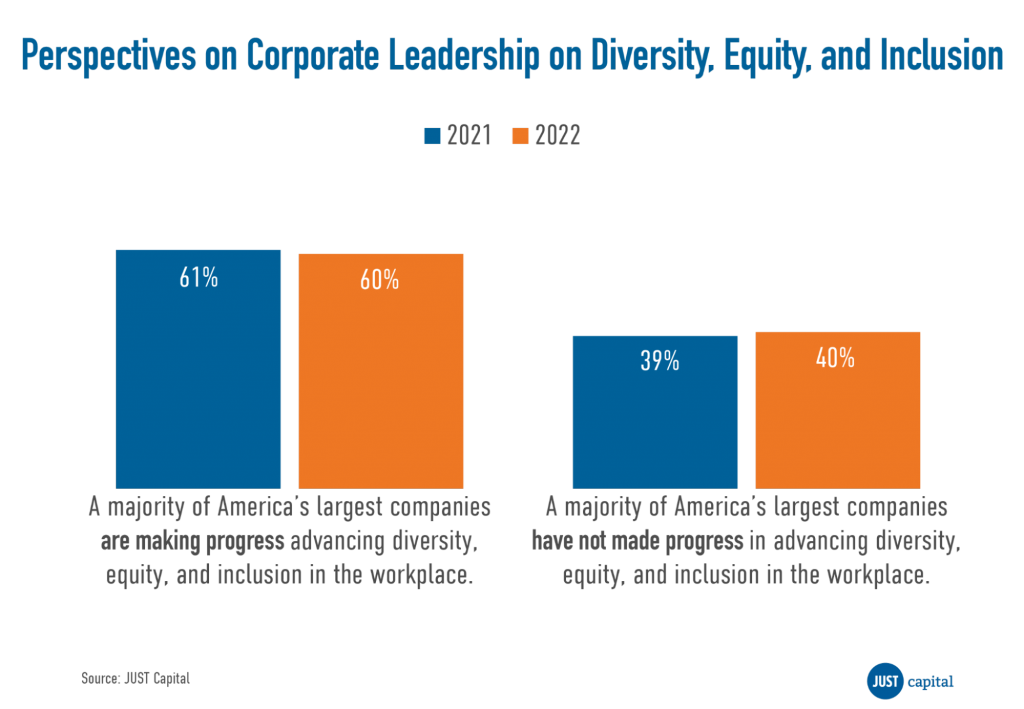
When we look at another pressing social issue – advancing racial equity – a higher percentage (60%) of Americans say companies are doing well demonstrating a commitment to diversity, equity, and inclusion in the workplace, a number that has stayed steady over the two years that we’ve tracked views on this issue.
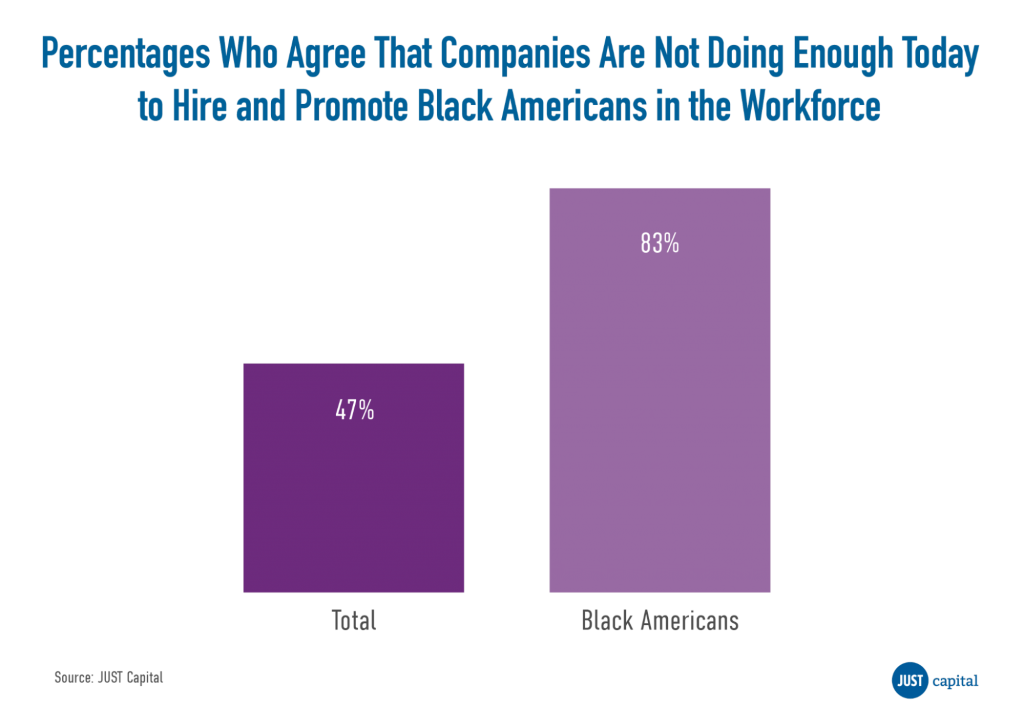
Still, there is ample room to improve: almost half (47%) of Americans agree that companies are not doing enough today to hire and promote Black Americans in the workforce. That number rises to 83% among Black Americans.
Action on these issues have lasting impact for the public, with a large majority of Americans saying they will remember the companies that took missteps in their response to the COVID-19 pandemic (68%) as well as those that took missteps on issues related to racial injustice (67%).
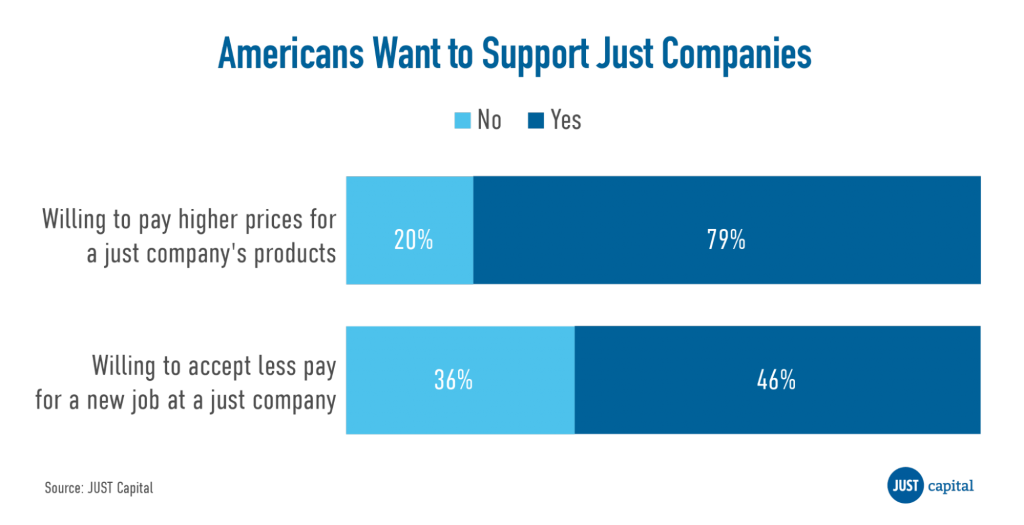
The good news? Americans are willing to support change and help companies transition to a just economy. We asked Americans to tell us whether they would take positive action in supporting companies that are more just, and two-thirds or more said that they would either accept less pay in a new job at a just company, and/or pay more for a product made or sold by a just company.
This comes at no surprise when we see that a whopping 84% of Americans believe that their own actions can shape the future: a level double-digits higher than when we first asked this question in 2017 (71%).
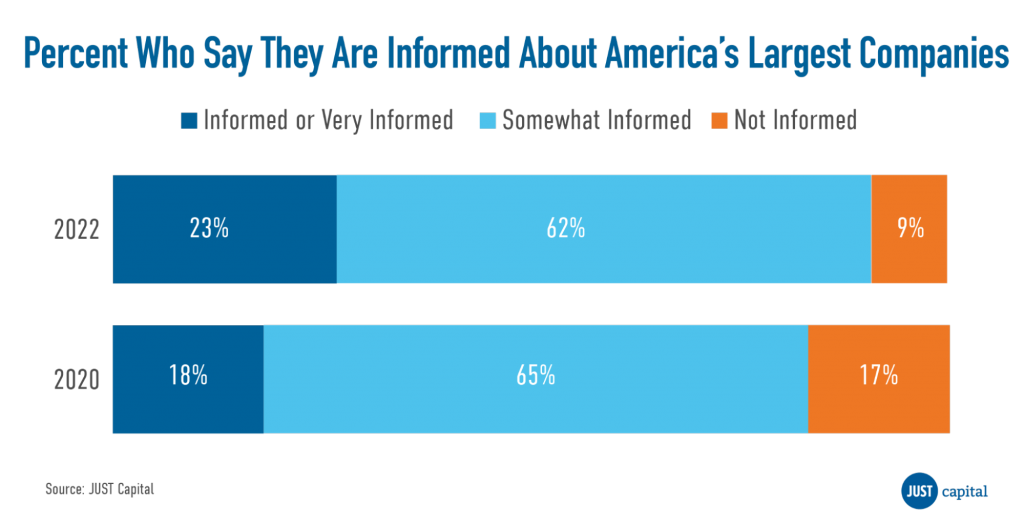
That Americans have strong opinions about large U.S. companies may be attributable to the degree to which the public is informed about corporate activities and behavior (in 2022, 23% say they are Informed or Very Informed, up from 18% in 2020).
While this year’s Americans’ Views on Business survey shows an overall less optimistic perspective on how companies are faring in transitioning from shareholder primacy toward a more just and equitable economy, our 2022 Issues Report – The People’s Priorities and full slate of polling reports from the last year, provide a clear, consistent, and unified message from Americans about how to turn the tide, and that is to put workers at the heart of business strategy.
For companies that are looking for solutions to everything from political polarization to the rise in unionization, or losing talent to competitors, the answers lie in listening to the voice of the public, and most importantly, to your workers. They will tell you, as they’ve told us for the last seven years, to focus on paying a fair, living wage, protecting their health and safety, supporting their development through training and upward mobility, providing good benefits and work-life balance, and more. The pandemic catalyzed a fundamental shift in expectations for workers, with many reevaluating what’s most important to them.
As we discussed in a recent Fortune editorial with the Ford Foundation, “Now is the time for employers to listen to their workforce and collectively ensure our economy delivers on the promise of the American Dream for everyone.” Business leaders are increasingly faced with complex economic, social, and political headwinds, but investing in workers is a powerful North Star to use to chart the path forward.
For additional resources on where to get started, visit:
We conducted this survey online with a probability-based sample attained through the exhaustive statistical sampling methods employed by SSRS. The SSRS Opinion Panel is a nationally representative probability-based web panel, and findings are generalizable to the general adult population.
The full survey was conducted from June 22 to July 11, 2022 among a general population sample of 3,002 English- and Spanish-speaking U.S. adults 18+ years of age, with an oversample of 540 Hispanic and 460 non-Hispanic Black respondents. Panelists were sent an email invitation to take the survey online as well as up to eight reminder emails throughout the field period. The survey program was optimized so that respondents could complete it using a desktop or laptop computer as well as a mobile device. In total, 1,063 respondents completed the survey on a computer and 1,939 completed it on a mobile device.
The margin of error is +/- 2.2% at the 95% confidence level. Results were weighted to U.S. Census parameters for age, gender, education, race/Hispanic ethnicity, and Census Division to ensure representativeness of the U.S. population. All margins of error include “design effects” to adjust for the effects of weighting.
Attending the CNBC Delivering Alpha Investor Summit this week it was clear that many believe we are likely to enter a recession at some point in the next year, with some – notably Stanley Druckenmiller – thinking it could be particularly deep and prolonged. Growing up in the UK in the 1970s and early 1980s, I remember what deep recession coupled with high inflation feels like. It’s not pleasant. Strikes, job losses, gutted communities, and a “Winter of Discontent.” Perhaps most of all, a pervasive feeling of anxiety and uncertainty. Inevitably, those in the lower and middle strata of the economic ladder suffer the most.
In such conditions, it’s going to be up to the private sector to find ways to do more. We need capitalism at its very best, as Meredith Sumpter from the Council for Inclusive Capitalism said to me recently. How does this happen? What should companies, especially large corporations, actually do to help society’s stakeholders? Eight years of polling Americans on this very topic has given us some pointers. And top of the list is the idea of investing in people.
This is why we launched JUST Jobs, a new umbrella program that applies the full JUST Capital playbook to support the nation’s largest companies in advancing just jobs. The work will build on our existing corporate engagement programs to lay out concrete pathways on all the top priorities of the public: paying a fair, living wage; creating jobs; providing key benefits; stable scheduling and on-the-job safety; better hiring, retention, development and advancement practices; retirement savings; and so on.
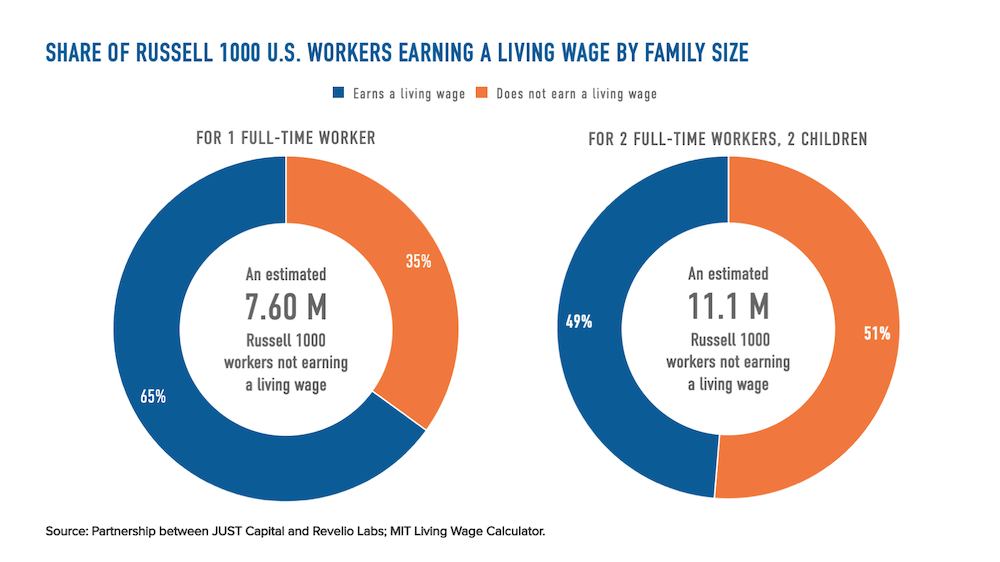
At our launch event this week, leaders from AEP, Mastercard, Franklin Templeton, and other organizations spoke eloquently about the power of the business case, why it’s better for shareholders, and also the scale of the potential social impact. And with an estimated 7.6 million workers in the Russell 1000 already not earning enough to support a single person with basic, local living costs, the need is clear.
If you’d like to learn more, please let us know.
Be well,
Martin Whittaker
Amazon raises hourly wages for delivery and warehouse workers to $19 per hour, from $18 per hour, as part of its plan to spend roughly $1 billion on pay hikes over the next year.
AT&T, T-Mobile, and Verizon plan to help customers hardest hit by Hurricane Ian, offering unlimited talk, text, and data, and waving overage charges in parts of Florida worst affected by the storm.
McDonald’s is facing a $10 billion lawsuit on claims that the company is intentionally excluding Black-owned media outlets from its advertising efforts.
Meta and Bain pilot a new platform designed to engage employees in corporate decarbonization goals, sharing insights into how they can reduce emissions within the company.
Microsoft pledges to support public policies that would reduce global carbon and decarbonize power grids. The tech giant hopes to achieve carbon negativity by 2030, though its emissions rose by 21.5% last year.
Starbucks announces that it’s ready to begin contract negotiations in October with the hundreds of stores that have voted to unionize across the country.
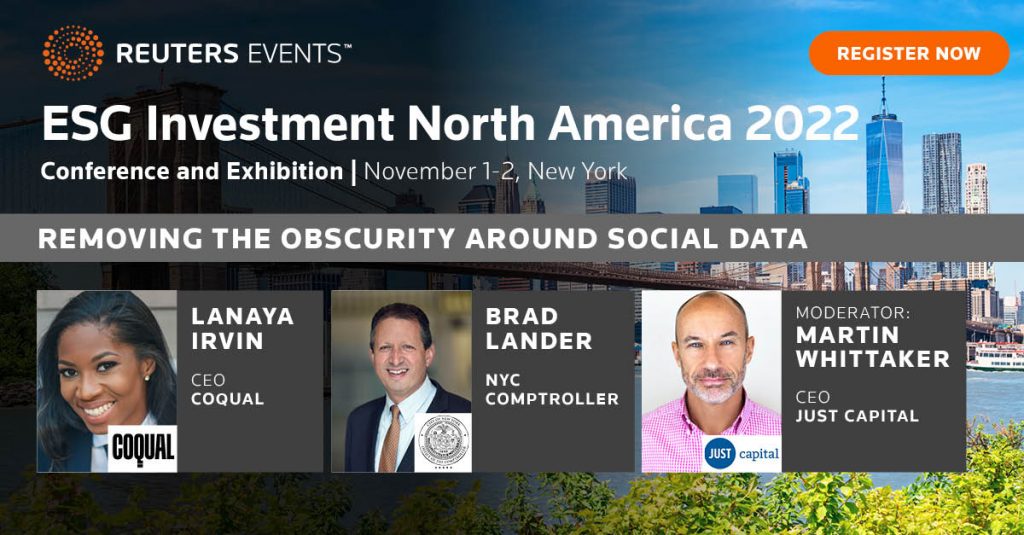
On November 2, Martin will join Reuters for its ESG Investment North America 2022 conference to discuss how best to quantify “S” issues like workforce diversity and financial security, and how to integrate these elements into investing strategy. Register here to attend this conversation and hear from senior leaders across the investment community.
Despite being the public’s biggest priority for companies, corporate data on wages is lacking. We’re proud to announce a new partnership with Revelio Labs, a leading labor market data provider, to help fill that gap. Together, our modeling has already found that about half of U.S. employees at Russell 1000 employees aren’t earning a family-sustaining income.
Our latest Insights to Impact virtual event focused on how to define, create, and scale JUST Jobs – and the strong business case for doing so. Hear from leaders at Amalgamated Bank and Franklin Templeton on the long-term value of investing in workers, American Electric Power and Mastercard on embedding equity and upward mobility into workforce strategies, and The Families and Workers Fund on the challenge of measuring job quality.
Hear from JUST Senior Director of Research Kavya Vaghul, alongside other speakers at this summer’s Good Jobs Summit, on why businesses and investors should make job quality a North Star in a newly released video from The Families and Workers Fund.
Last week, Martin joined Workday’s Senior Director of Environmental Sustainability Erik Hansen for a conversation at the Nest Summit on the state of corporate climate commitments and the company’s own climate leadership. Catch up on the full discussion here if you missed it.
This week, we also announced a new partnership with ESG Book, a leading ESG technology and data provider, to incorporate its data into the methodology for our Annual Rankings of America’s Most JUST Companies.

“The real economy of the United States is intangible. People are at the heart of the value.”
“We’re doing outreach to women who have the skills, have an interest, introducing them to what this kind of work is, but then we’re giving them mentors and we’re paying them to go through the training. And at the end of this program, in a year to14 months, we’re going to hire them into full-time jobs. … You have to sometimes build that pipeline and not wait for it to happen.”
“It’s a little nerve-racking right now as the money I’m getting from disability doesn’t even cover half my monthly mortgage payment. The 60% payments are based off my base salary, so it’s a significant drop in income. I had money saved up just in case, and I’ll have to go through it because I am not willing to give up days with my baby. I want to take 12 weeks, but I don’t know if the money I’ve saved is going to cover the whole time. It’s only my salary. It’s a huge stress.”
Axios reported union popularity is at a 57-year high, reaching 71% approval in a recent Gallup poll. It’s the highest approval rate since the1960s.
Airport workers are on strike at multiple airports across the country. The Washington Post has the story on the labor action that started with an open-ended strike on Monday at San Francisco International Airport and has spread to 21 airports nationwide.
A new working paper by economists in California and Europe argues that executives should be paid based on their ability to improve ESG metrics at their company. A growing number of companies have taken up the practice of ESG-linked pay over the last few years, including Apple, BP, and McDonalds.
Workers say their pay isn’t keeping up with inflation. A Bank of America-sponsored survey shared first with CNN found nearly three in four employees feel the cost of living is outpacing wage growth. NPR writes about the great resignation, dynamism, and the search for a job that can offer financial security in a turbulent economy.
Roy Swan of the Ford Foundation says ESG is a risk management framework on CNBC’s Squawk on the Street. Fortune reports on the need for ESG to protect companies’ profits. The Conference Board is out with a new report on shareholder voting trends, including an increase in ESG-related proposals.
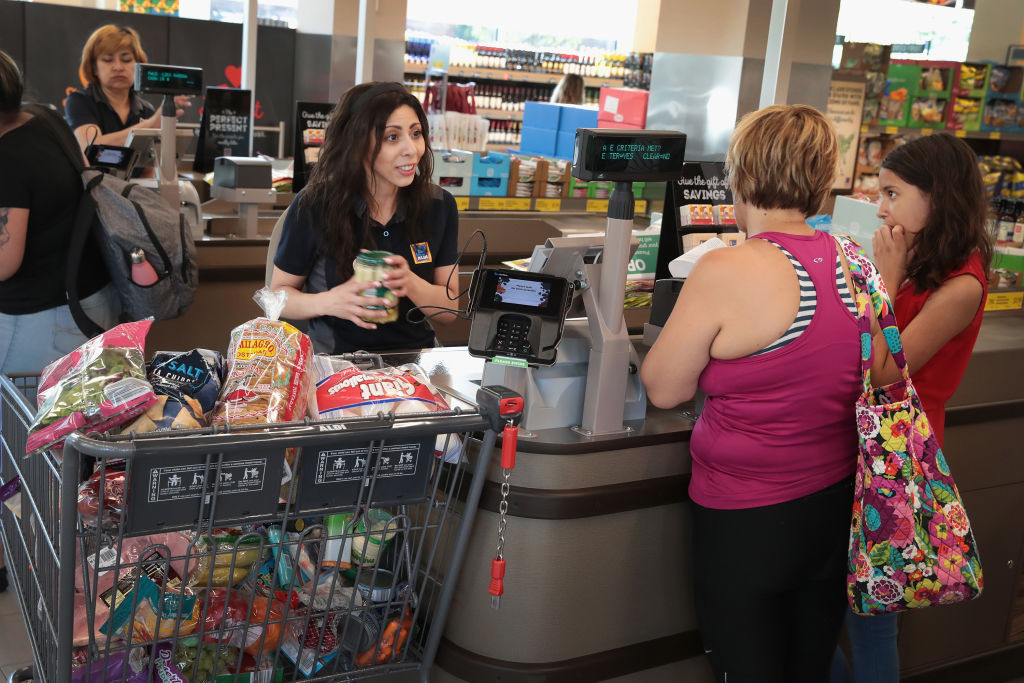
JUST and Revelio found that some of the largest U.S. employers among the Russell 1000 have a disproportionate share of low-wage jobs and still have a long way to go when it comes to meeting the expectation of the American public to pay a fair, living wage. Read more in our first collaborative article with Revelio about the state of workers at America’s largest companies.

Abigail Disney
CEO, Folk Films
JUST Capital Board Member
Abigail E. Disney is a filmmaker, activist and the Emmy-winning director of The Armor of Light. Abigail focuses on storytelling that fosters peace, justice, and human understanding. After years as a nonprofit volunteer and activist and stay-at-home mother, Abigail founded Fork Films and leads the production company as CEO.
Abigail released her feature documentary The American Dream and Other Fairy Tales last week, which provides a poignant view into America’s inequality crisis seen through the lived experience of Disney theme park workers.
For the third consecutive year, paying a fair and living wage ranks as the top priority for the American public when it comes to just business behaviors. JUST Capital’s 2022 Issues Survey – The People’s Priorities found that paying a fair, living wage was the most important business Issue this year, doubling in importance over the last two years, and will comprise 21% of our Annual Rankings of America’s Most JUST Companies model in 2023. To put this into context, the next highest priority – creating jobs in the U.S. – was the second most important issue at 11%. What’s even more compelling is that despite increasing rhetoric that the country is incredibly polarized, across every demographic group we surveyed – political affiliation, race, gender, age, or income group – Americans are united in wanting companies to prioritize paying a fair, living wage as the most important business Issue today.
Despite the overwhelming consensus that companies have a responsibility to pay workers enough to make ends meet and be transparent with job seekers about pay, there is remarkably little public data available to track explicit performance on wages by even the largest companies, like the Russell 1000 corporations JUST ranks. That’s why we are proud to announce our new partnership with Revelio Labs, a leading labor market data provider that is working to create the first universal HR database, to fill the measurement gap on corporate wages.
The current state of corporate wage disclosures is poor, non-standardized, and mostly voluntary
There are many reasons why publicly available wage data in the U.S. is sparse. They include concerns over privacy, perceived litigation risk, and exposure of corporate trade secrets. Some concerns are more real than imagined, and some are even shared by those tasked with oversight. Federal agencies, for instance, do not currently disaggregate results from tax records or employer surveys by companies in a nod towards worker and employer privacy. In an ideal world, companies would provide equitable access to such data. But as it stands, the vast majority of disclosure on human capital metrics is voluntary, and thus public companies seldom have the incentive to release information about wages in their corporate social responsibility or diversity, equity, and inclusion reporting.
In 2017, the Securities and Exchange Commission adopted the Dodd-Frank mandate requiring public companies to disclose the pay ratio between the CEO’s and median employee’s compensation in annual proxy statements, offering a rare window into the state of pay at public companies. The rule, however, provided companies with significant flexibility in identifying who the median worker is and how to calculate the median, with the ability to change this definition every three years. As a consequence, the publicly reported median worker pay data is incomparable and inconsistent.
The odds of finding standardized, non-mandatory disclosure on wage data are also low. If shared at all, companies voluntarily disclose three wage-related metrics: (1) the cost of salaries, benefits, and pensions; (2) pay equity analyses by gender or race and ethnicity; and (3) minimum wage rates for hourly employees. Even though we’re in an economic climate characterized by fierce competition for talent among employers and rising inflation, under 10% of Russell 1000 companies disclose their minimum wage rates for hourly employees, the only disclosure among the three that can actually tell us anything about the bottom end of the wage distribution.
Modeling estimates are required without comprehensive, standardized disclosure of data
While we wait for better company-specific wage data from government agencies and continue to push for increased voluntary disclosure among companies on key job quality issues like wages, we have to get creative by knitting together whatever wage data is available. That is a big reason why JUST’s annual Rankings has relied on models to help us estimate metrics on the state of wages among Russell 1000 companies. But not all models are created equal.
Historically, these models used a combination of crowdsourced data reported by current and former employees and data from federal agencies like the Bureau of Labor Statistics to construct a wage distribution for each company. But even this approach was a blunt instrument for assessing corporate wages: Without sufficient company-specific data, the results suffered from clustering and data bias.
JUST Capital and Revelio Labs have partnered to bring out the best and mitigate the worst of available wage and employment data
To develop a model that more accurately measures the state of corporate wages for JUST’s annual Rankings and beyond, JUST has partnered with Revelio Labs to leverage its unique workforce datasets and modeling capabilities. Together, we have radically improved our visibility into the wage and salary distribution for each Russell 1000 company, adopting Revelio’s innovative machine learning model to predict salaries. This new wage and salary distribution enables us to produce estimates for three data points within the “Pays a fair, living wage” Issue: (1) the median U.S. worker pay (to compare to CEO compensation), (2) the share of U.S. workers earning a living wage to support a family of two full-time workers and two children, and (3) a score that evaluates how fairly a company pays for similar occupations compared to its industry peers.
Read an overview of how it works in our methodology summary or dig into the full methodology for a deeper explanation.
What have we learned so far?
The results from our joint modeling work give us several new insights about the state of wages among Russell 1000 companies. Most notably, we’ve learned that while estimates show that these companies pay better on net than the typical American employer, a slim majority of their workers still may not be earning enough to make ends meet.
At the typical – or median – Russell 1000 company, for instance, 50% of full-time workers earn above roughly $65,000 annually, which is over $10,000 per year more than the median earnings of full-time workers nationwide.
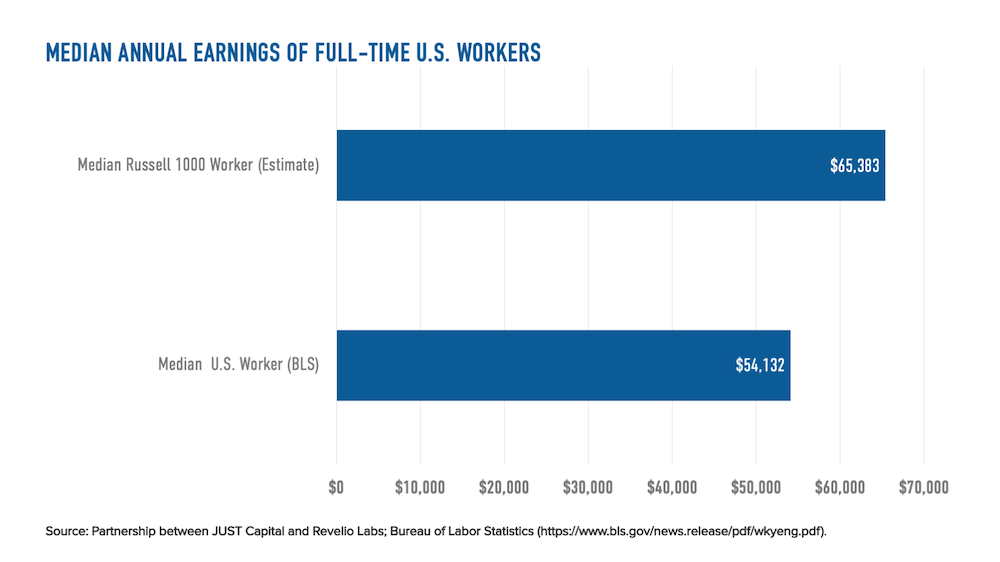
These higher salaries and wages at Russell 1000 employers overall, however, do not translate to greater economic security for all Russell 1000 workers. In fact, our estimates show that 51% of all the workers at Russell 1000 companies, who in total made up about 15% of the employed population in the U.S. in 2021, are not earning a family sustaining living wage, a national population-weighted average of $24.16 per hour in 2022 according to our partners behind the MIT Living Wage Calculator. That’s about 11.1 million workers who are not making enough working full-time to support a family that has another full-time working adult and two children. We further estimate that about 35% of Russell 1000 workers do not earn enough to meet their own basic needs – or a living wage for one full-time employee without dependents, a national population-weighted average of $17.46 per hour in 2022.
These findings underscore the reality that some of the largest U.S. employers among the Russell 1000 have a disproportionate share of low-wage jobs and still have a long way to go when it comes to meeting the expectation of the American public to pay a fair, living wage.
In the coming weeks, we’ll be exploring more insights from these wage models. While these modeled estimates are just that, estimates, they nevertheless provide an insightful starting point from which we will iterate and improve. We will use these findings to better understand how America’s largest companies are performing on what Americans are prioritizing more than ever – creating JUST jobs.
Lisa Simon is a Senior Economist and Daniel Firester is a Lead Data Scientist at Revelio Labs.
On September 28, JUST Capital held its latest Insights to Impact virtual event – Defining a JUST Job for Today’s Economy.
In an increasingly polarized country, the American public (and a growing number of institutional investors) are remarkably united in wanting companies to prioritize their workers. And investing in workers today requires creating truly “JUST Jobs.” But what is a JUST Job? This virtual convening set out to answer that question by exploring specific ways companies can close the gap toward all workers earning a living wage, advance equity & mobility, and deliver on the DEI commitments that are crucial to evolving the modern workforce.
JUST Capital’s Chief Strategy Officer, Alison Omens, kicked off the event highlighting our latest polling insights around jobs and wages in America. Our annual Issues Report, examining the public’s priorities for companies, found that once again “Pays a fair, living wage” is the most important issue to Americans across all demographics. And, four out of the top six Issues are Worker-related. Additional polling found that, not only do 84% of Americans believe large companies have a responsibility to pay full-time adult workers in frontline jobs enough to make ends meet, but large majorities of Americans also believe companies it’s a company’s responsibility to regularly increase wages to keep up with the rapidly rising cost of living (87%), provide quality, affordable health insurance to all adult workers, including part-time workers (84%), provide clear career pathways to job opportunities with higher pay (83%), and more.
It’s clear the American public supports the idea of a “JUST Job,” setting the stage for the conversations ahead.
Next up, JUST Capital’s Cambria Allen-Ratzlaff, Managing Director & Head of Investor Strategies, moderated a discussion on how creating JUST Jobs builds long-term value with speakers Meredith Miller, Director, Amalgamated Bank and Managing Member, Corporate Governance and Sustainable Strategies and Anne Simpson, Global Head of Sustainability, Franklin Templeton. Together, they addressed the very real challenges of prioritizing corporate investment in workers, fair wages, and DEI advancement. “People matter in investment. Value creation in a company doesn’t just come from deploying capital,” Simpson said, emphasizing that this is as much a mindset shift as it is a market one.
The next session focused on advancing equitable mobility, with insights from industry leaders from JUST Capital’s 2022 Workplace Equity and Mobility Ranking, American Electric Power and Mastercard, on how they’re supporting workers’ financial security and creating equitable pathways for their economic advancement. The session was moderated by Leslie Boissiere, Vice President, External Affairs from The Annie E. Casey Foundation (our partner on the ranking) with insights from Sandy Nessing, Vice President and Chief Sustainability Officer, American Electric Power, and Randall Tucker, Chief Inclusion Officer, Mastercard.
And finally, we concluded with a conversation on defining and measuring a JUST Job, which highlighted actionable takeaways about how corporate America can get closer to creating quality jobs. Moderator Kelley-Frances Fenelon, Director of Programs and Partnerships at JUST Capital, spoke with Rachel Korberg, Executive Director, The Families and Workers Fund and Kavya Vaghul, Senior Director of Research, JUST Capital.
Tolu Lawrence, Managing Director of Programs and Partnerships at JUST Capital, closed out our program with thanks to the cross-sector network of organizations that support our work on JUST Jobs including MetLife Foundation and The Annie E. Casey Foundation. If you’re interested in learning more about how to engage with JUST Capital on this topic, please submit this short interest form and a member of our team will be in touch soon.
If you weren’t able to attend or missed any part of the event, the full video is available below.
September 15, 2022
JUST Capital’s 2022 Issues Report – The People’s Priorities is by Jennifer Tonti, Managing Director, Survey Research & Insights.
The current economic environment is a marked difference from the one rocked by the COVID-19 pandemic and ensuing recession in 2020, and the “restart” we began to see in 2021. This year, ongoing pandemic-related supply shocks and repercussions from Russia’s invasion of Ukraine have helped to spark the highest inflation in decades. Soaring costs and economic uncertainty about a recession are impacting the national mood. And Federal Reserve Chair Jay Powell recently warned Americans that the Fed’s plans to continue rate hikes to slow inflation will “also bring some pain to households and businesses.” Economic inequality that was exacerbated by the pandemic could widen further in a sharper slowdown, understanding low-wage workers are often the first to lose hours and jobs.
It’s to be expected that the social, economic, and political disruptions at any moment will have some bearing on Americans’ attitudes and values during that time. In every year that we’ve been measuring which issues matter most to the public when it comes to just business behavior (what we call The People’s Priorities), the events of that year can determine which issues Americans deem more important than others, as well as the degree to which the public prioritizes each issue.
This year, the resounding refrain from the public is that America’s largest companies should put workers squarely at the heart of just business practices, foremost by paying their workers a fair and living wage.
Over the last six years, Worker Issues have consistently commanded the highest share of priority among the 20 stakeholder-related issues we measure, and this year is no different. Four of the five Worker Issues we track – including paying a fair, living wage; protecting worker health and safety; providing benefits and work-life balance; and investing in workforce training – are among the top six priorities of the public, and the collective prioritization of all five worker issues will comprise 44% of a company’s score in our Rankings of America’s Most JUST Companies.
What is more, despite increasing media attention and political rhetoric that the country is incredibly polarized, we are not divided as a country when it comes to just business behavior. There is broad consensus across all demographic and political cohorts that Workers should be corporate America’s top priority – something we also found in our recent survey on Workers & Wages. Specifically, among every demographic group – liberal, conservative, high-income, low-income, men, women, young generations, older generations, and white, Black, and Hispanic Americans – the Workers stakeholder is the top priority. And for every one of these demographic groups, the most important Issue is “Pays workers fairly and offers a living wage that covers the cost of basic needs at the local level.”
Every year we begin our annual Rankings process by facilitating a series of group conversations with a diverse mix of Americans across the U.S., to help us broadly understand the business behaviors and actions that they consider to be most “just.” These focus groups enable our research team to hear the unvarnished voice of the public speak to what issues matter most, and whether their opinions have changed over time. The polling team then distills the focus groups’ major themes into statements that capture these concepts, which we call “Issues.” In 2022, this work yielded 20 Issues, which is consistent with the number of Issues last year.
Since the public initially tells us that all of these Issues are of high importance, we then conduct a choice modeling exercise as part of our Annual Survey work, allowing us to derive the relative importance of these 20 Issues. From here, we extract a “weight” per Issue that we use as the foundation for our Rankings of America’s Most JUST Companies. The weights below reflect the probability that an individual would choose that Issue as most important to defining a just company, based on a representative sample of 3,002 Americans. These weights power our analysis of corporate stakeholder performance at the country’s largest companies, including JUST’s annual Rankings.
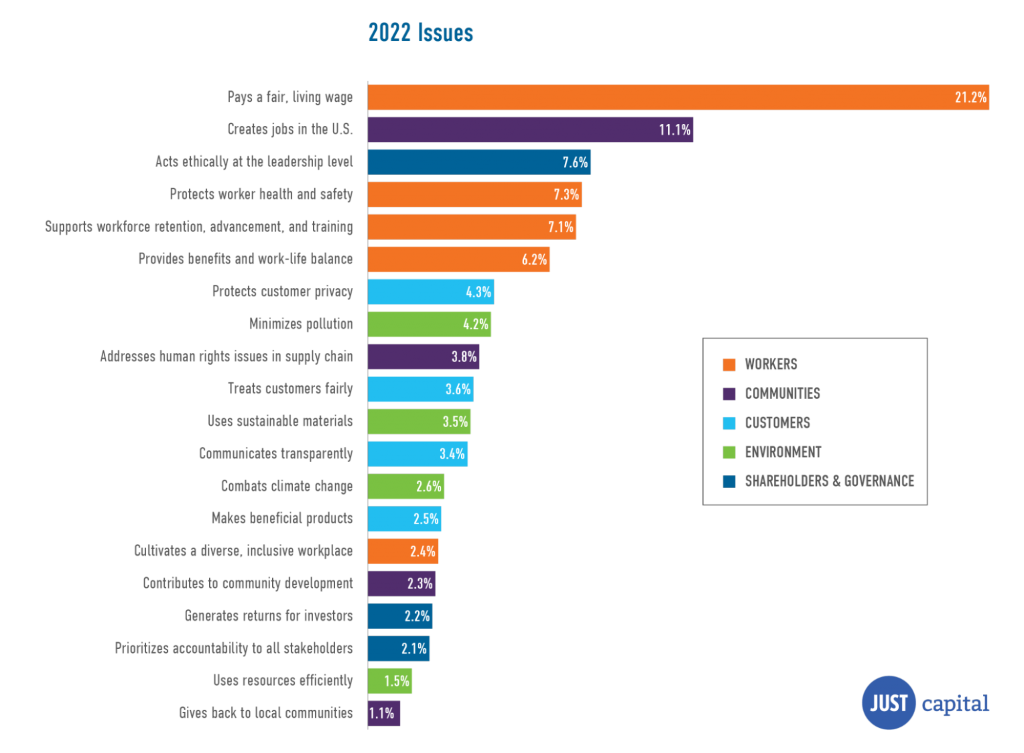
Each issue is color-coded by the stakeholder it most impacts. While we reference the prioritization of several Issues in this report, please note that the relative importance between many of these Issues often varies by a fraction of a percentage point.
Below we take a deeper look at these Issues, and focus on a few that have made substantial movement up or down in relative importance this year.
The above chart shows that four of the five worker Issues are among the top six overall. Most notably, “Pays workers fairly and offers a living wage that covers the cost of basic needs at the local level” is the top-most prioritized Issue for the third consecutive year, and will comprise a significant 21% of companies’ scores in our 2023 Rankings. This is a nearly six percentage point increase from last year, with three-quarters of Americans saying that this Issue is “more important” (including 50% saying it is “much more” important) than last year. And as we mentioned above, among each of our key demographic groups, this is consistently the top-prioritized Issue.
The current economic climate has undoubtedly impacted the public’s priorities. Findings from our partners at The Harris Poll show that 83% of Americans say their top concerns include the economy, inflation, and jobs. And despite the July U.S. job rate reaching pre-pandemic highs, eight in 10 Americans remain concerned about America entering a recession. Maintaining a stable job with a wage that enables a family to make ends meet each month is crucial staying afloat in today’s uncertain economy.
It is doubly important that wages rise in step with inflation. A recent JUST Capital poll shows that 87% of Americans say large U.S. companies have a responsibility to regularly increase wages to keep up with the rapidly rising cost of living. Large majorities of Americans also think that companies that pay a living wage are better for their workers, more competitive in their industry, and better for the U.S. economy overall. Unfortunately, this is more of an aspiration than a reality for workers in our economy today. As the U.S. Bureau of Labor Statistics reported last month, average weekly earnings may have risen 4.2% from June 2021 to June 2022, but real weekly earnings decreased 4.4% in that same time period.
This Issue also captures the concept of fair pay, which both ensures fairness of pay between peers as well as equal pay for equal work across gender, race, ethnicity, etc. Even in 2022, women continue to struggle to be paid at parity with their male colleagues – in 2022, women are paid 82 cents for every dollar earned by men, with even wider pay gaps for women of color, including Black, Hispanic, and American Indian women who earn 79, 78, and 71 cents to the dollar, respectively. Equitable pay – across gender and race/ethnicity – is a critical element in better, fairer treatment for companies’ most valuable assets: their workers.
In 2022, “Protects the health, safety, and well-being of workers beyond what is required by law” comprises 7.3% of a company’s score in our Rankings, showing that even two years from the height of the pandemic, protecting worker health and safety continues to be critical to the public. What’s more, two-thirds of Americans say that this Issue is more important this year than last.
Upward mobility for workers is an additional area of focus for Americans in an unsettled labor market. McKinsey finds that career advancement is the main reason people continue to leave jobs during the Great Reassessment. As such, “Focuses on workforce retention and employee advancement by providing training, education, and career development opportunities” has moved up five places, and comprises 7.1% of a company’s score in our Rankings.
Finally, “Offers a quality benefits package and supports good work-life balance for all employees” comprises 6.2% of a company’s score, a level unchanged from the previous year. As we saw in our August 2022 survey on workers and wages, majorities of Americans believe companies have a responsibility to provide quality, affordable health insurance to all adult workers, including part-time workers (84%) and match employee contributions to retirement savings plans (74%). And in our April 2022 survey focused on how companies support women in the workplace, 64% of respondents said it was important for companies to provide all workers at least 12 weeks of paid parental leave to promote equity at work.
There is a very clear business case for corporate leaders to focus on worker issues. Investments in good jobs can reduce the high costs incurred from absenteeism and turnover, increase a company’s labor productivity, and ultimately grow its revenue. Companies can also gain a competitive advantage as their corporate reputation attracts values-aligned job seekers, customers, and ESG investors. To help companies assess, measure, and improve performance on the worker issues that matter most to the public, we’re proud to announce the creation of a new JUST Jobs Program.
One Issue that falls under the Communities stakeholder, “Creates jobs in the U.S. and provides employment opportunities for communities that need them,” is once again #2 in relative importance, comprising 11.1% of a company’s score in our Rankings. 60% of respondents say that creating jobs in the U.S. is more important than last year.
Ethical leadership, an issue that falls under Shareholders & Governance, continues to be of high importance to Americans as well. “Compels leadership to act ethically and with integrity and to avoid wrongdoings” comprises 7.6% of a company’s score, and is the third most important Issue in 2022. Earlier in the year, our focus group participants told us that they are paying attention to how leadership acts – or doesn’t act – on important societal issues. Our polling confirms that Americans want corporate leaders to take ownership when companies make mistakes or become embroiled in a crisis or controversy. Action is perceived as good faith. Failure to own up to mistakes results in reputational damage.
The Environment stakeholder has grown to encompass 12% of the model. Americans told us that Minimizing pollution (up five places to become the eighth most important Issue) and Combating climate change (up two places to the 13th most important issue) are higher priorities for Americans in 2022, helping to propel the Environment stakeholder’s importance in our Rankings this year.
A need for increased transparency and disclosure from companies has been a key, recurring theme we heard in focus groups. This year, the refrain was louder than ever. As such, we modified the language in this Issue to broaden the focus to be more inclusive, and in turn, the Issue “Is transparent in communications with customers about its products, services, and operations” has moved up four places to become the 12th most important to Americans.
Another notable change is the “Cultivates a diverse and inclusive workplace with equal opportunity” Issue, which fell in priority from seventh most important in 2021 to 15th in 2022. Make no mistake: our polling shows that Diversity, Equity, and Inclusion continues to be an important element of just business behavior, with 92% saying that it is important for companies to promote racial equity in the workplace, and 77% saying that racial equity cannot be achieved until all workers are paid a living wage. What is more, half of respondents say this Issue is more important than last year.
One possible explanation for this decline is that we are two years removed from the racial justice movement our nation rose to in response to George Floyd’s death. And with economic matters such as inflation and recession closer to home for many Americans, when it comes time to prioritizing this issue over others, its relative importance falls.
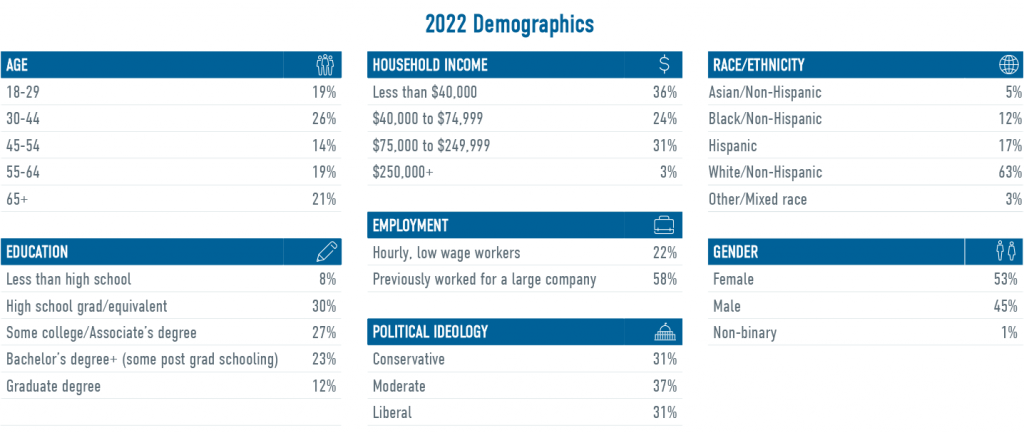
The Priorities of the Public are based on responses from more than 3,000 U.S. adults and are representative of a cross-section of Americans. This means we hear from a variety of voices, both by demographic such as race/ethnicity, gender, income levels, and age, as well as behavior such as political ideologies or active investors. Remarkably, we found that there is substantial consistency in the Issues most important to these groups, with nearly all cohorts prioritizing the same top three: Pays a fair, living wage; Creates jobs in the U.S.; and Acts ethically at the leadership level.
With a few exceptions, each demographic is fairly unified in how they want corporate America to prioritize the top five Issues, demonstrating remarkable unity and consistency in a year when companies are increasingly under scrutiny from politicians and pundits for “being out of touch with the values of everyday Americans” or that stakeholder-focused capitalism is not “a reflection of consumer demand.”

To provide further clarity around how to better balance stakeholder interests, we classify each Issue by the stakeholder it affects most, organizing the 20 Issues into five stakeholder groups: Workers, Customers, Communities, the Environment, and Shareholders & Governance.
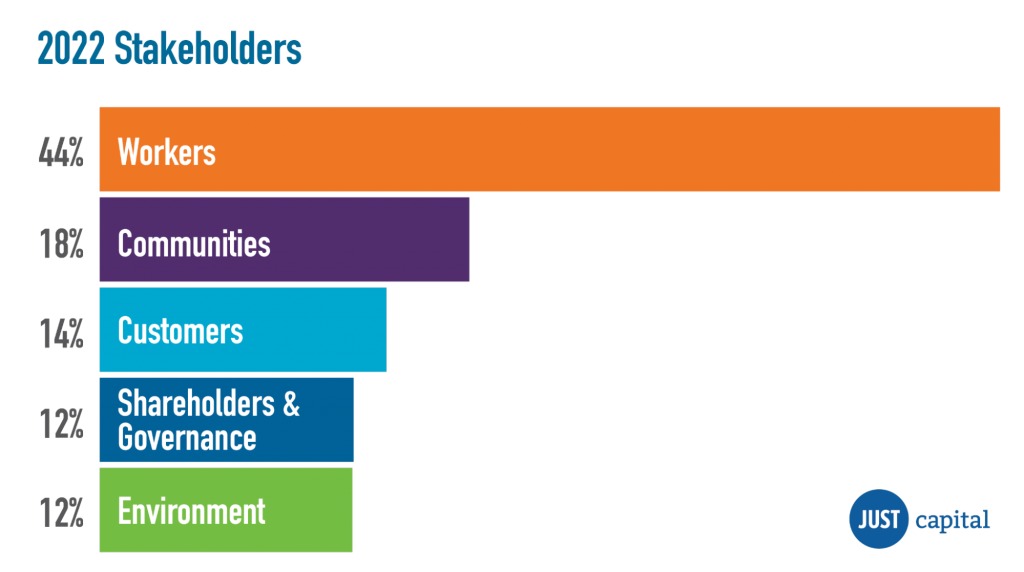
Specifically, we assign each of the 20 Issues to the one (and only one) stakeholder it most impacts. For example: “Compels leadership to act ethically and with integrity and avoid wrongdoings” is assigned to Shareholders & Governance, whereas “Makes products or offers services that benefit society” is assigned to the Customers stakeholder. The weight of each stakeholder group is calculated by summing all of its associated Issue weights.
For the sixth consecutive year, the American public prioritizes Workers as the most important stakeholder by a significant margin. The Workers stakeholder considers a company’s performance on factors related to how it invests in its employees, including (1) paying a fair, living wage, (2) protecting worker health and safety, (3) providing benefits and work-life balance, (4) cultivating a diverse and inclusive workplace, and (5) supporting workforce retention, advancement, and training.
The Communities stakeholder considers a company’s performance on factors related to how it supports its communities, including (1) creating jobs in the U.S., (2) addressing human rights issues in the supply chain, (3) contributing to community development, and (4) giving back to local communities.
The Customers stakeholder considers a company’s performance on factors related to how it treats its customers, including (1) protecting customer privacy, (2) treating customers fairly, (3) communicating transparently, and (4) making beneficial products.
In 2021 we added “Governance” to the Shareholders stakeholder be more representative of the Issues included in this grouping that explore how a company maintains good governance and delivers value to its shareholders by (1) acting ethically at the leadership level, (2) generating returns for investors, and (3) prioritizing accountability to all stakeholders.
The Environment stakeholder considers a company’s performance on factors related to how it reduces its environmental impact, including (1) minimizing pollution, (2) using sustainable materials, (3) combating climate change, and (4) using resources efficiently.
When looking at stakeholder prioritization across demographic groupings, we see significant alignment, with some specific areas of variance. For instance, Issues relating to the Environment are prioritized more highly among respondents under age 30 and Democrats, whereas Shareholders & Governance Issues are prioritized more highly by those age 65 and older.

There has never been a more urgent moment for corporate America to embark on the journey to becoming more just, and we hope this latest survey report provides clear guidance on how companies can reevaluate their priorities and better align their practices with the values of the American people. The data shines a clear, bright light on the specific actions businesses can take today to rebuild trust in business and markets as a force for good.
Since its inception, JUST Capital’s mission has been to build an economy that works for all Americans by helping companies improve how they serve all their stakeholders: workers, customers, communities, the environment, and shareholders. The goal is to encourage and incentivize real change in corporate America’s leadership.
At the core of our work is a robust research program that starts with focus groups in which we ask the American public to identify the policies, practices, and behaviors companies should prioritize to be considered just, (which we call “Issues”). These Issues include fair pay and living wage; a more diverse and inclusive workplace; stronger, healthier communities; good jobs; a cleaner environment; and more. Then, based on sophisticated polling of a representative sample of Americans, we estimate the relative importance of these behaviors – in other words, how important to defining a just company each behavior is relative to others.
Since 2015, JUST Capital has surveyed more than 160,000 Americans – representative of the U.S. adult population – asking them to define just business behavior. For the past two years, we have partnered with SSRS, an objective, non-partisan research institution that provides scientifically rigorous statistical surveys of the U.S. population, to survey more than 3,000 Americans on their perspectives.
Before answering questions about the just behavior of large companies, it is important for respondents to have a clear definition of the concept. Below is the definition we provided to our focus group and survey respondents in 2022: A just company operates in a way that serves its workers, customers, shareholders, the environment, and the communities it affects, even if it comes at a cost.
We conducted the 20 question survey online with a probability-based sample attained through the exhaustive statistical sampling methods employed by SSRS. The SSRS Opinion Panel is a nationally representative probability-based web panel, and findings are generalizable to the general adult population.
The full survey was conducted from June 22 to July 11, 2022 among a general population sample of 3,002 English- and Spanish-speaking U.S. adults 18+ years of age, with an oversample of 540 Hispanic and 460 non-Hispanic Black respondents. Panelists were sent an email invitation to take the survey online as well as up to eight reminder emails throughout the field period. The survey program was optimized so that respondents could complete it using a desktop or laptop computer as well as a mobile device. In total, 1,063 completed the survey on a computer and 1,939 completed on a mobile device.
The margin of error is +/- 2.2% at the 95% confidence level. Results were weighted to U.S. Census parameters for age, gender, education, race/Hispanic ethnicity, and Census Division to ensure representativeness of the U.S. population. All margins of error include “design effects” to adjust for the effects of weighting.
To identify the priorities of the public, we calculate for each Issue the probability that an individual would choose that as most important to defining a just company. As such, there are 20 probabilities calculated from the 20 Issues. These probabilities can be referred to as weights as each represents the relative importance of one Issue versus another. To illustrate more explicitly, the Issue “Creates jobs in the U.S.” was assigned a weight of 11.1% as there is a 1.11 in 10 chance that a respondent chosen at random will identify this Issue as most important in defining a just company. By comparison, the weight assigned to “Generates returns for investors over the long term” has a 2.2% weight.
Our full body of survey work for 2022 also includes six focus groups conducted in partnership with The Harris Poll and eight additional surveys fielded throughout the year. To learn more about how this survey data drives JUST Capital’s analysis and Rankings of the largest publicly traded U.S. companies, visit the Methodology section of our website.
