

Sixty-four percent of Americans agree that companies should offer a minimum of 12 weeks of paid parental leave as a way to foster gender equity, and research also suggests that paid parental leave helps companies attract talent, increase retention rates, and improve employee performance.
But the Bureau of Labor Statistics estimates only 23% of workers receive paid family leave, and a mere 9% of the largest U.S. companies currently offer parity of 12 weeks or more to both caregivers, according to a recent JUST Capital report.
Hewlett Packard Enterprise (HPE) emerged as one company that demonstrated a commitment to workers – especially working parents – through its paid parental leave policy. The policy offers 26 weeks of paid parental leave for all parents for any birthing or adoption event with the option to return part time for three years following the leave.
We recently spoke with Samanntha DuBridge, HPE’s Vice President of Global Benefits, Culture, & Engagement, to learn more about how HPE implemented its paid parental leave policy and the resulting impact on workers and the enterprise as a whole. Below are key takeaways from that conversation.
Expanding benefits, inclusively
“When Antonio Neri became CEO, he talked a lot about wanting culture to be a legacy feature for him,” DuBridge said. “He made it very clear early on. He had a strong commitment to what he referred to as a ‘world class culture that was inclusive,’ and that really was built around the lives of our people.”
As the HPE team considered how to address the needs of their workforce, the “star feature” of their cultural vision was enhanced parental leave for all parents. To make the policy as equitable and inclusive as possible, “executives all the way through to our hourly workers” can access all 26 weeks of the paid parental leave benefit. A report from the Urban Institute finds that those most likely to lack access to these paid leave benefits include part-time or hourly workers, people with lower family incomes, workers who are not U.S. citizens, have less formal education, are younger or Hispanic.
Dubridge highlighted HPE’s efforts to ensure that parents received support on their return to work by offering the option to work part time for up to three years. “When we benchmarked and talked to other organizations, part of the feedback we were hearing is, there were a couple of companies that were offering two or three months parental leave, and their employees appreciated it. But then they would come back and they would go from zero to 150 in terms of the amount of work that they had.”
Driving retention, engagement, and loyalty
DuBridge shared that the returns of offering expanded care benefits outweigh the short term costs. (Researchers also recently made the business case for paid leave.)
“There is certainly a reality that in a tighter economy, economic times, some of the programs that companies put in place are harder to hold to, but you’re also making an investment,” DuBridge said. “So you need to determine sort of where you’re making those investments and investing in your people, to me is a really critical component to being a successful company.”
In a JUST Capital interview in 2020, Neri remarked on the early successes of the paid parental program. ”When we looked at the business case, this was the way to retain the best talent,” she said. For us, it was an incredible return on investment. Our attrition rate declined dramatically. And our employee engagement scores improved by 20 points.”.
After conducting research on what policies might most help their employees, HPE’s leaders drafted and announced the plan within several months. To drive buy-in from shareholders and other stakeholders, DuBridge said HPE positioned the policy change as a business opportunity.
“What we found is what we hypothesized initially when we were pitching it, which is that there’s a significant amount of loyalty with people who feel like their company has gone way out of their way during a time that was very important to them,” she said.
HPE was already offering parental leave and had systems in place, “so it was just a matter of being clear about who was eligible and the rules around it and then making some adjustments in the system and training vendors,” DuBridge said. “It wasn’t like we were starting from scratch or that we never were offering anything. If you sort of step back and walk through a process, sometimes it feels a little less daunting than when you first think about the huge variation in the program that you’re going to be offering.”
DuBridge encouraged other companies to start small. “You can always take it step by step. It doesn’t mean that you have to go from offering nothing to what we’ve done at offering six months. People can start to make some progress in that space,” DuBridge said.
For leaders considering proposing or adopting similar policies, she suggests that employers get creative with policies they could offer. “I think there’s a way for employers to offer something that gives people a little more balance and flexibility. Even if it’s just short term, like three months, for example. It could make a significant difference for someone to be able to kind of get their life back in balance.”
Prioritizing family-friendly culture
DuBridge said HPE’s paid parental leave benefits for both primary and secondary caregivers has translated into a happier and more productive workforce.
“It means that you’ve got people that are focused and dedicated. They feel like they’ve had the time that they need to make adjustments so that when they are back at work, they can really be productive,” she said.
The paid leave benefits at HPE have also drummed up significant interest from prospective employees, both those who do plan to have children and those who don’t.
“It’s a signal to all workers that this is a family-friendly environment. It signals to them that we have the right type of culture, which I think has been very helpful for us,” she said.
JUST Capital, in collaboration with partners, established the Corporate Care Network to advance the well-being of workers and demonstrate the long-term value of investment in workers. The Network is committed to driving increased access to care benefits, including paid leave and flexible work policies, and highlighting leaders in the space.
If you’re interested in gaining insights into how to improve on the issues that matter most to the American public, and learning how your company can get involved in the Network, please reach out to JUST Capital impact@justcapital.com.
In her eight years working for Verizon, Edwenna (Eddie) Ervin has never stopped learning. “I want to be better and Verizon wants me to be better, and together we can do it.”
After starting out in frontline customer service, working directly with Verizon’s enormous consumer base, Eddie immediately began making use of her company’s robust training and career development benefits. “I started working on my Master’s degree as soon as I possibly could, and it did not cost me a dime.” Now a Senior Engineer Project Manager, she continues to pursue educational opportunities while working for Verizon (“I can’t stop training when it’s there for free”), earning certifications that help her be better at her job.
Eddie is just one of the nearly 1 million employees represented through the Worker Financial Wellness Initiative, which we launched in collaboration with PayPal, the Financial Health Network, and the Good Jobs Institute to help companies bolster the financial health of their employees. To learn how those actions have impacted their lives and livelihoods, we spoke with workers firsthand in a compelling new video series.
This is Eddie’s story.
Investing in people like Eddie is not just a nice-to-have – it’s part of Verizon’s long-term business strategy, something we learned in conversation with Kevin Cammarata, Verizon’s VP of Benefits. “You can’t build tomorrow’s network with yesterday’s skills,” he emphasized. “We’re very focused on intentionally growing and developing our employees because our customer’s needs are evolving. And so our skills and our ability to meet them needs to match.”
Last year, the company invested more than $175 million in learning and development initiatives for its employees, forging opportunities for individual advancement while improving customer service. Cammarata shared that tuition assistance and training are also just part of Verizon’s exemplary benefits program, which also encompasses paid parental leave, retirement savings, adoption services, and more – all of which “affect our employees in profound ways.”
Importantly, those benefits are not just available to Verizon’s corporate team, but extend to its call center and retail employees, engineers and more. This inclusive approach enables employees like Eddie to grow and thrive, no matter where they are in their career journeys. “The ability to train up makes me feel open and free to learn new things,” she shared. “It makes me less afraid to try something new.”
In addition to its strong benefits, Verizon is also a leader when it comes to wages, last year raising its minimum wage to $20/hour. “Companies need to pay attention to their employees’ financial wellness,” explained Eddie. “If your employee doesn’t have their basic needs – a car to get to work, money for lunch – they cannot show up and be their best for your customer.”
This is where the business case can and must be made. “We need to make investments in our people to help them balance both the needs of our customers and the needs of their families,” Cammarata underscored, echoing Eddie’s point that only when employees are able to meet their own needs can they meet the needs of their customers – in turn, generating revenue for the company. “By creating good jobs and taking care of your employees, you can achieve the business results that you need.”
This doesn’t come without its roadblocks, and for Cammarata, being part of the Worker Financial Wellness Initiative has provided the opportunity to work alongside like-minded companies wrestling with how to deliver greater value to their employees while balancing other business challenges. “There’s not one right path for every company,” he shared, but in establishing a shared philosophy for serving their workforces, “I think we all believe we’ve found ways to be able to benefit our workers and to be able to have successful business outcomes.”
This sense of striving fuels both Cammarata and Eddie, who told us that “Verizon is a place where we strive to be better. Yesterday was good, but tomorrow we’ll do better.” And because, as Cammarata said, “you can’t build tomorrow’s network with yesterday’s skills,” the key to doing better tomorrow is workers. And by investing in workers, ensuring that they have what they need to not just live their lives but to thrive, corporate leaders can also ensure a better, more thriving future for their companies.
Hear from other employees about the impact worker financial wellness programs have had on their lives:
The Worker Financial Wellness Initiative is a vibrant and growing community of business leaders dedicated to improving the financial health and security of their workers. The Initiative includes peer learning opportunities for C-Suite leaders; creating resources and events for HR and compensation professionals; providing direct assistance to companies on how to develop and deploy a Worker Financial Wellness Assessment, and use it to identify areas for improvement and immediate next steps; and public opportunities to celebrate corporate leadership.
To learn more about the Initiative and how you can join, click here.
For Chipotle Field Leader Eddy Ceballo, who started 12 years ago as a Crew Member in Manhattan, great companies invest in their people. “If I get a chance to see the CEO or anybody higher up, one thing that I always tell them is, ‘Let’s make sure that we keep investing in our people. This is why Chipotle’s so successful, is because of the people that we have. And we need to keep that going.’”
With training and support from his manager, Eddy quickly rose through the ranks in his first three years on the job – from Kitchen Manager to Service Manager to General Manager, and now makes over six figures as a Field Leader overseeing eight different locations.
Eddy is just one of the nearly 1 million employees represented through the Worker Financial Wellness Initiative, which we launched in collaboration with PayPal, the Financial Health Network, and the Good Jobs Institute to help companies bolster the financial health of their employees. To learn how those actions have impacted their lives and livelihoods, we spoke with workers firsthand in a compelling new video series.
This is Eddy’s story.
Following our conversation with Eddy, we also spoke with Chipotle’s Chief Operating Officer Scott Boatwright about the importance of investing in workers and his company’s involvement with the Worker Financial Wellness Initiative.
“We’re working to drive a culture where we reach down and pull people up,” Boatwright explained. “Each one of us in this organization had someone along the way in our career journey that really helped mold us, guide us, and develop us into the people that we are today. We have a distinct responsibility to do the same or give the same effort to every single person that makes the choice to join our brand.”
Both Boatwright and Eddy highlighted that over 90% of restaurant managers at Chipotle were promoted internally – demonstrating the company’s clear commitment to helping its employees advance from within. For Eddy, advancement came not only from internal promotions and management experience but from financial planning resources that helped him provide for his family, buy a house, and become a U.S. citizen.
Twelve years in, Eddy is continuing to develop his career at Chipotle – something Boatwright emphasized is key to the company’s ongoing success: “We’ve stated publicly, we plan to grow at 8-10% annually for the foreseeable future. That growth doesn’t happen without having committed, dedicated team members in every restaurant that have aspirations to continue to develop in their career here at Chipotle.”
Because of the many ways Chipotle makes that growth possible, employees like Eddy stick around. “Development from within is a key component where we keep people green and growing in their career. We don’t have to source talent from outside the enterprise, which as you know, can get very costly,” explained Boatwright. Chipotle’s investments in its workers ensure long-term sustainability and avoids hefty short-term costs that come from relentless turnover. “Investing in your people is probably one of the smartest decisions you’ll ever make as a leader, that’ll pay massive dividends to your organization today and in the future.”
As part of its growth targets, Chipotle plans to build 255 to 285 new restaurants in North America in 2023, with each needing crew members, kitchen managers, service managers, and a general manager, along with Field Leaders like Eddy. After promoting 22,000 team members in 2022, Chipotle is poised to provide more and more pathways for its current workforce. Boatwright put it simply, “The amount of opportunity that exists here is just enormous.”
When Chipotle came on board for the Worker Financial Wellness Initiative in 2021, the company was already strongly committed to investing in its employees, even beyond internal hiring – from wage increases to parental leave enhancements to debt-free degree programs. “Financial security, for me, has changed how I think,” explained Eddy, who also sees his own learnings as something he can share with his team. “And I think that definitely makes you feel good, because you are actually paying that forward and guiding our Crew Members, Managers, and even family.”
It’s this spirit of uplifting others that guides Boatwright as well. “If not for the investment in my personal development and growth throughout the years, I wouldn’t be where I am today,” he shared. “I feel a very strong responsibility to help just as many other people as I possibly can to achieve their career goals.”
With this sense of responsibility being core to Chipotle’s culture – from the kitchen to the boardroom – there are opportunities for growth at every rung of the organizational ladder. As Eddy shared, listening is the crucial first step that allows for both alignment and advancement. Thanks to his first manager who took time to listen to his needs, and the time he takes now to hear from his own team, Eddy is working to keep paying it forward – something he also expects to see from his C-suite colleagues like Boatwright. “It’s really important for companies to listen to their employees. That’s the way they show that they actually care.”
Hear from other employees about the impact worker financial wellness programs have had on their lives:
The Worker Financial Wellness Initiative is a vibrant and growing community of business leaders dedicated to improving the financial health and security of their workers. The Initiative includes peer learning opportunities for C-Suite leaders; creating resources and events for HR and compensation professionals; providing direct assistance to companies on how to develop and deploy a Worker Financial Wellness Assessment, and use it to identify areas for improvement and immediate next steps; and public opportunities to celebrate corporate leadership.
To learn more about the Initiative and how you can join, click here.
Working mothers make up a significant portion of the American workforce – nearly one-third of all employed women currently have children under the age of 18 – and many must find a way to delicately balance work and care responsibilities.
In our 2022 caregiving survey, 84% of women (compared to 68% of men) said access to child care is a problem for women in the workplace, and 70% of women (compared to 53% of men) say access to paid family leave is a problem for women in the workplace. Further, women are more likely than men to say the ideal number of weeks for parental leave is 12 or more weeks (56% of women, 46% of men). When not provided adequate caregiving support, many women are forced to make difficult decisions and nearly 43% end up leaving their careers.
With no federal oversight of paid leave and caregiving policies, and with women five-to-eight times as likely as men to experience a caregiving impact on their employment, corporate leaders are being asked to take the lead. More and more companies are taking action – as of September 2022, 60% of the companies we rank disclosed a paid parental leave policy, up from 47% the year before. But there’s a long way to go, with 40% of companies disclosing no such policies and an average of just 10.5 weeks for primary caregivers among those that do.
This year, in recognition of Mother’s Day, we’re highlighting three companies that stand out for their commitment to working mothers – going above and beyond on issues including paid parental leave, subsidized child care, and more. Among the 951 companies we ranked in 2023, we found that Eli Lilly, Intuit, and US Bancorp provide best-in-class support to parents – and especially mothers – in their workforce.
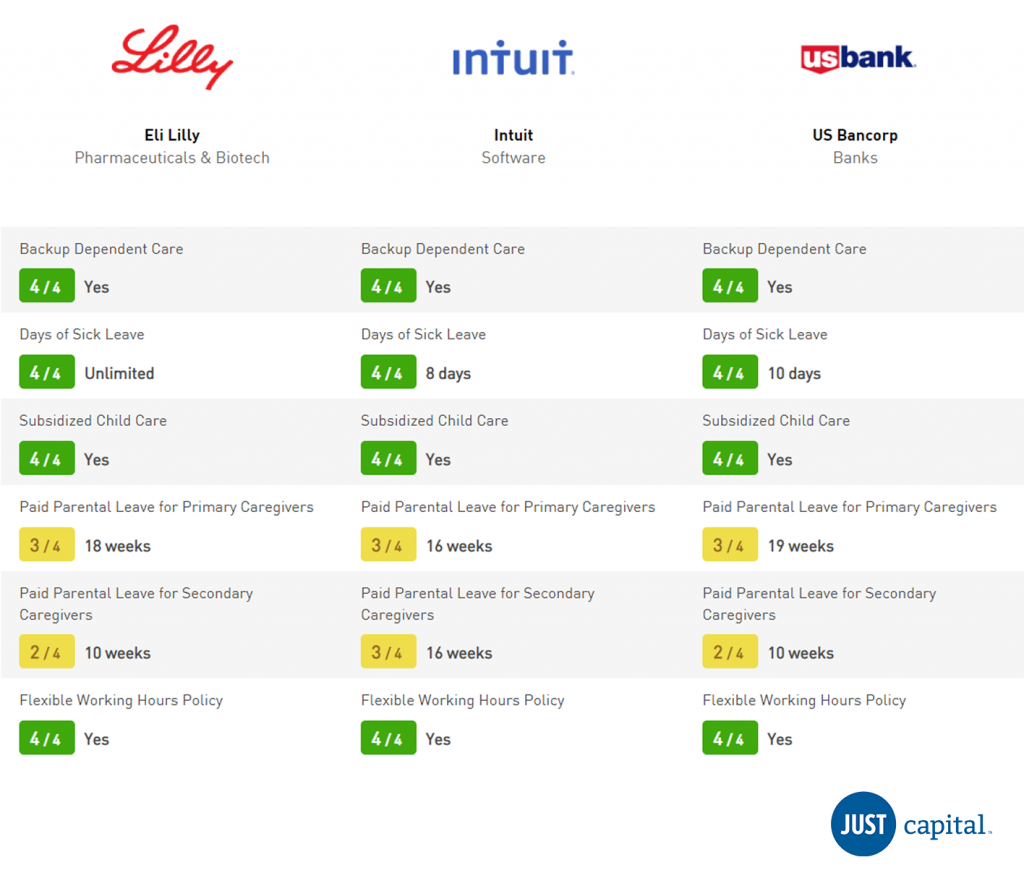
Each of these leading companies:
Read on below to learn more about key policies and disclosures and how these three companies support moms in the workplace as they navigate the challenges of caregiving in the “sandwich” generation – caring for both their children and their older relatives.
Intuit
Ranked 7th in Software and 65th overall
Software company based in Mountain View, CA
Intuit offers comprehensive caregiving policies to support working mothers, including 16 weeks of paid parental leave for both primary and secondary caregivers. By offering parity in parental leave and giving both parents the opportunity to bond with their children without worrying about work obligations, Intuit reduces gender-based discrimination, promotes gender equality, and combats the “motherhood penalty.” Intuit deepens its commitment to mothers by offering backup dependent care, flexible scheduling, and subsidized child care. Their dependent care program supports full-time and part-time employees working 20 or more hours a week, as well as seasonal employees, and covers regular and temporary child care, adult care, and elder care. Additionally, employees receive eight days of sick leave per year to attend to their own health needs or those of a dependent. Intuit aims to support employees “by offering benefits [they] need to stay healthy, achieve financial security, and enjoy peace of mind.”
US Bancorp
Ranked 9th in Banks and 56th overall
Banks company based in Minneapolis, MN
US Bancorp has implemented several policies and programs to support mothers in the workplace. All parents welcoming a new child through birth or adoption receive 10 weeks of paid parental leave, with an additional nine weeks of paid pregnancy leave for the parent giving birth. In addition, mothers have access to a maternity support program offered free through their insurance, and all parents can utilize an employee assistance program for practical advice and resources for help with health, finances, family and relationships, work-life balance, and more. US Bancorp also offers subsidies for childcare, flexible scheduling options, and backup dependent care reimbursement for up to five days of emergency care for both children and the elderly. Furthermore, US Bancorp offers 10 days of sick leave “for medical appointments, personal illness, the illness of a family member, to care for a family member when their school or place of care is closed due to a public health emergency.” US Bancorp asks employees to bring their best selves to work, and in return will “invest in benefits and programs that embrace what makes each of us unique and empowers all of us to thrive.”
Eli Lilly and Co
Ranked 16th in Pharmaceuticals & Biotech and 235th overall
Pharmaceuticals & Biotech company based in Indianapolis, IN
In 2019, Eli Lilly and Co expanded its paid parental leave to 10 weeks for both primary and secondary caregivers, with an additional eight weeks of leave for recovery for birthing parents. Eli Lilly and Co CEO Dave Ricks said of the expansion, “We’re proud to expand this benefit, reinforcing our commitment to a diverse, inclusive and flexible workplace, Lilly has always been a company grounded in strong family values. We hold a firm belief that the well-being of our employees – and those they go home to each day – is foundational to our purpose to create medicines that make life better for people around the world.” To further support mothers, Lilly also offers backup dependent care, as well as robust flexible scheduling through Lilly@Work, which allows employees to create custom schedules to best fit their needs, and based on their role, employees can work reduced schedules or work with other employees to create a job sharing arrangement. In addition, the company offers “Caregivers Time Off,” which is up to 64 hours of paid time off per year as a primary caregiver to an immediate or extended family member – whether natural, legally adopted, step, foster, or through marriage or domestic partnership – when they are ill or injured. Should mothers need to take time off to care for their own health, Lilly offers unlimited sick leave, which can be used to care for oneself or a dependent.
While there is still a long way to go, companies are increasingly supporting working parents, helping to ease their transition back to work and encouraging employees to stay with their companies long term. These actions help both working parents and their employers thrive – with 80% of companies that offer paid family leave reporting an increase in employee morale and 70% reporting an increase in employee productivity. By prioritizing retention of working parents, corporate leaders can support their companies’ bottom line and avoid unnecessary costs, with recent analysis showing that replacing an employee who leaves after childbirth can cost anywhere from 20% to 213% of their annual salary.
Furthermore, these benefits provide a key response to the urgent calls for more inclusive workplace practices. 64% of mothers overall are the primary earners in their homes, while a significant 84% of Black mothers fill this role – underscoring the need to support working mothers as part of the growing demand for corporate commitments to diversity, equity, and inclusion.
As we continue to navigate the ongoing caregiving crisis, employers play a pivotal role in ensuring that mothers have the support they need to remain in the workforce. Corporate leaders looking to build more inclusive practices that support working mothers can look to these three companies as examples of leading practices. By prioritizing this key workforce demographic, corporate leaders can help to build a sustainable future not only for working parents but for their companies overall.
JUST Capital, in collaboration with partners, established the Corporate Care Network to advance the well-being of workers and demonstrate the long-term value of investment in workers. The Network is committed to driving increased access to care benefits, including paid leave and flexible work policies, and highlighting leaders in the space.
If you’re interested in gaining insights into how to improve on the issues that matter most to the American public, and learning how your company can get involved in the Network, please reach out to JUST Capital impact@justcapital.com.
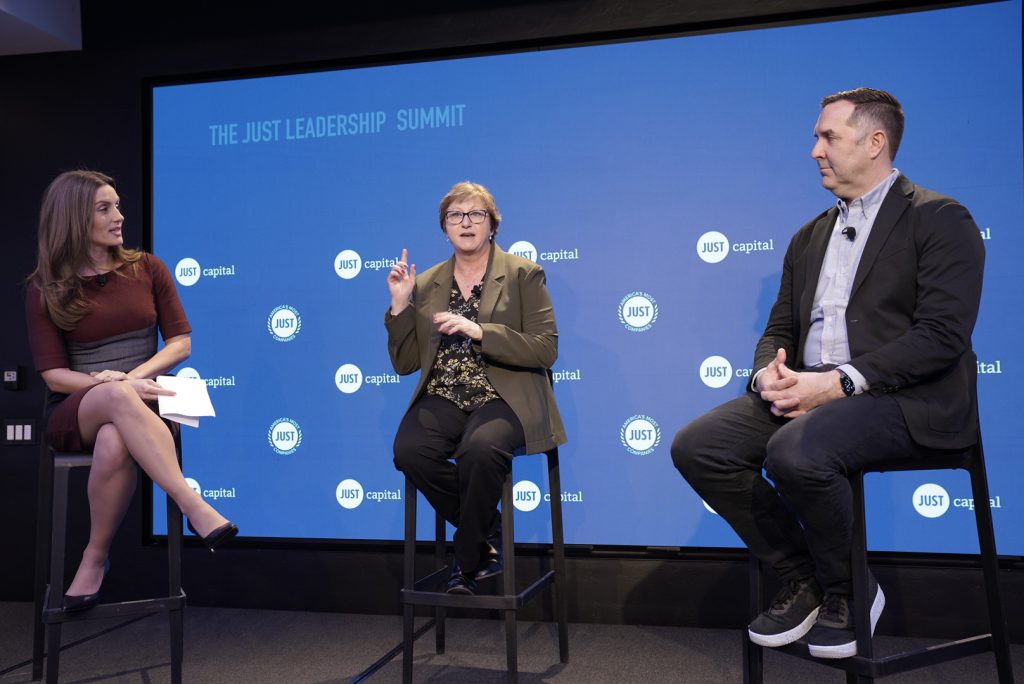
Amidst the rising ESG and sustainability backlash, it’s increasingly important to hear from corporate leaders taking concrete, meaningful steps to drive change on the key issues of our time. At last week’s JUST Leadership Summit, we heard from sustainability leaders of two of the top-performing companies in our 2023 Rankings – American Electric Power (AEP) (#14 overall and #1 in the Utilities industry) and Nike (#97 overall and #1 in the Clothing & Accessories industry).
In a panel moderated by CNBC Reporter Kristina Partsinevelos, AEP Chief Sustainability Officer Sandy Nessing and Nike Chief Sustainability Officer Noel Kinder highlighted the approaches and actions their teams have taken to create a more sustainable future for their companies, for their industries, and the planet overall. Nessing and Kinder spoke in depth about renewable energy and their companies’ efforts to reduce environmental impact, but both emphasized that a transparent, people-based approach is needed to drive lasting, meaningful change.
Watch the full conversation here, and dig into five key takeaways below – all of which provide broad tenets by which corporate leaders in any industry can forge their journey toward a more renewable and equitable future.
Operationalize sustainability
In talking about Nike’s “Move to Zero” goal to become both zero carbon and zero waste across operations, Kinder explained that setting clear targets and measurable outcomes is key, as well as identifying operational milestones to achieve along the way. These milestones represent an undeniable challenge to Nike’s leaders – holding the company accountable not only to its long-term ambitious goals, but to concrete steps on the path toward achieving them. These steps also provide an operational roadmap, detailing the role that teams across the organization can and must play to achieve larger carbon and waste reduction goals. They embed sustainability in all aspects of the company and deputize Nike’s team members to take ownership of the “Move to Zero” journey.
Think about people
For AEP, one of the nation’s largest generators of electricity, coal has historically been central to powering the communities the company serves. Faced with this monumental challenge to her company’s clean energy strategy, Nessing articulated the importance of putting people first – ensuring that the impact of this strategy on AEP’s employees and core communities is carefully considered. As the company prepared to close coal plants, AEP conducted economic analyses to better understand the impacts of doing so, seeing the plants themselves as community ecosystems that shape not only economic development but the lives of the people who live and work there. Nessing shared that almost all employees of closed plants have found jobs within AEP – emphasizing that, with a focus on communities and people, “there is a life after coal.”
Get out of your own echo chamber
As one of the founding members of the Sustainable Apparel Coalition, Nike has worked closely with its suppliers and direct competitors to develop shared practices and approaches to achieving sustainability goals. Key drivers of Nike’s carbon footprint include the materials and energy used to create its products – meaning that collaboration across its supply chain is crucial in the company’s renewable energy journey. This collaboration is often complex and challenging, necessitating discussion with competitors to ensure alignment and shared approaches in working with suppliers. Kinder noted that Nike’s success has been tied to his company’s willingness to step outside of its own “echo chamber” and instead harness the collective voice of its wider industry to drive change.
Look inward as you look outward
Unlike Nike, AEP’s global supply chain is not a major driver of its core operations – but the company profoundly impacts the communities where it operates both at home and abroad. Nessing explained that, as part of AEP’s people-based approach to sustainability, the company has begun to more carefully consider how its operations impact historically marginalized or disadvantaged communities, developing an Environmental & Social Justice Policy that commits to seeking input from impacted communities in its sustainability decision-making. By centering community voice in its clean energy transition, AEP has taken steps to shift its own priorities – ensuring an equitable approach to driving change. In discussing these leading efforts, Nessing noted that this is an “exciting time to be in this industry.”
Be transparent and show your work
Kinder emphasized that sustainability is a “catalyst for innovation,” and that in order for innovation to drive meaningful change beyond the walls of a single organization, transparency is key. With “ESG” currently a contentious term in corporate and investment communities, Kinder and Nessing both agree it’s important not to shy away from the conversation and most importantly, that corporate leaders stay the course. In coming to the table – with employees, investors, communities, partners, competitors, and more – it’s critical for corporate leaders to be able to show their homework, to demonstrate the reasons for their actions and the impacts of change. Nessing noted that AEP has gotten pushback, particularly from some of the company’s local communities. However, this pushback has not led her company to change course, but instead invite everyone into the conversation and share resources to ensure a just and equitable transition.
Watch the full conversation below.
For corporate leaders looking to unpack your company’s performance in the 2023 Rankings and gain insights into how to improve on the issues that matter most to the American public, please reach out to corpengage@justcapital.com.

Last week, JUST Capital launched an update to our Corporate Racial Equity Tracker – a comprehensive accounting of the state of disclosure from the 100 largest public U.S. employers on the commitments and actions they are taking to advance racial equity in their workplaces and communities, from pay equity analyses by race/ethnicity to workforce demographic disclosure to local community investments.
This year, we saw disclosure increase overall on workforce and board diversity data, as well as a 33% increase in the number of companies that disclosed conducting pay equity analyses. But corporate America continues to lag when it comes to disclosing the results of their pay equity analyses, racial and ethnic diversity targets, and details on anti-harassment training – additionally, few companies disclose commitments to advancing racial equity in the communities they most impact, like spending on local suppliers and whether they have re-entry or second chance policies. While our Tracker doesn’t reveal the lived experiences of employees, it shines an important light on the companies that are striving to do more in a time when advancing racial equity has become an increasingly urgent national priority of the public – as well as the work that still needs to be done.
Today, we’re looking under the hood of our 2022 Tracker to highlight companies – including Accenture, Intel, JPMorgan Chase, and Target – that stand out for having high numbers of disclosures (15 or more out of the 23 we track) or unique reporting practices, as well as some of the companies that disclosed the least.
“At Intel, we believe disclosure and action are not only important for our own advancement and accountability, but for creating change across the industry,” shared Dawn Jones, Intel’s Chief Diversity and Inclusion Officer and VP of Social Impact. Intel embodies these principles with its robust disclosure of diversity targets by race and ethnicity as well as its pay equity analyses. The company also discloses average hours of training and career development for employees, provides tuition assistance and anti-harassment training, and supports its communities by working with the Vera Institute of Justice and local governments to create more equitable outcomes for all in the criminal justice system. Since 2017, Intel has donated $3.25 million in grants for hands-on STEM education for middle schoolers.
Accenture stands out for its detailed race and ethnicity targets, which focus on increased representation across both management and non-management roles. By 2025 Accenture aims to increase representation of African American and Black employees from 9% to 12% and representation of Hispanic American and Latinx employees from 9.5% to 13%. The company strives to double the number of African American and Black and Hispanic American and Latinx managing directors. Additionally, Accenture reports its race and ethnicity pay ratio, discloses its diverse and local supplier spend amounts, and provides apprenticeship programs.
According to David Miree, JPMorgan Chase’s Global Head of Diversity, Equity & Inclusion, JPMorgan aims “to be the bank of choice for all” and believes that “Building diverse teams not only strengthens our business and our culture, but also broadens the range of ideas and solutions we can offer.” As part of its efforts to bring diversity to its workforce, JPMorgan discloses internal hiring rates and detailed racial/ethnic data on promotions and pay ratios and provides anti-harassment training, tuition assistance, and apprenticeship programs to employees. The company also works to support its communities through a robust second chance agenda for hiring formerly incarcerated candidates and by disclosing how much it spends on diverse suppliers as well as goals for increasing that spend.
While Target is among seven companies that disclose 15 of 23 metrics, the company stands out for its unique disclosure practices and efforts to connect racial equity issues back to socioeconomic inequities. Target discloses highly disaggregated EEO-1 level workforce data by gender, race, and job category like some of its peers, but it also departs from the typical EEO-1 reporting structure by inclusively counting workers who prefer not to report their gender or race. “At Target, we understand we all have a role to play in creating a more equitable and inclusive society,” shared Kiera Fernandez, Target’s SVP of Talent & Change and Chief Diversity & Inclusion Officer, “So when we’re successful, the wins are everybody’s.” The company also announced in February that it was increasing its starting wage range from $15 to $24, depending on job and local market, striving to pay a living wage to all its workers – the #1 priority for the American public, according to our survey research.
Other companies with high numbers of metric disclosures include IBM, Wells Fargo, Microsoft, and Anthem. On the other end of the spectrum, those with the fewest disclosures include Berkshire Hathaway and Tesla, respectively disclosing just two and three of the 23 metrics we track. According to our estimates, Berkshire Hathaway is among the top 10 largest U.S. employers, but its two disclosures reflect the racial/ethnic representation on its board rather than employees. Meanwhile, Teslas has faced serious allegations of racism and a slew of lawsuits from former employees, further indication that the electric automaker has significant work to do, not only in disclosing on and advancing racial equity but also addressing concerning practices.
These companies, like all of corporate America, are facing our nation’s collective reckoning with system racism sparked two years ago by the deaths of multiple Black Americans at the hands of police. While Tesla and poor performing peers are clearly at different points in their journey than companies like Target, JPMorgan, Intel, and Accenture, we hope that this moment – while revealing difficult truths about racism in corporate America – will compel more and more companies to act, disclosing the current state of their practices and setting goals for improvement. Our country has a long way to go to rebalance the scales, and the actions of our nation’s largest companies must play a key part in building an economy and society that truly serves all Americans.
