“Rebuilding Trust” is the official theme of this year’s World Economic Forum in Davos. Trust in what? you might ask. Trust in business and capitalism? Trust in the WEF itself? In fact, we’re talking about trust in the broadest sense – trust in “the future, within societies and among nations” – and the basics on which it is built, including “transparency, consistency and accountability.”
Judging from the notable moments so far – Jamie Dimon on Trump, Javier Milei on socialism, Marc Benioff on AI, the WTO’s Ngozi Okonjo-Iweala on Red Sea trade disruptions – it seems to me that trust, like beauty, is very much in the eye of the beholder.
The 2024 Edelman Trust Barometer, released this week, sheds light on specific trends in trust overall. Researchers note a gradual decline of trust in authority over the past decade, particularly in developed democracies, with governments viewed as being far less competent and ethical than business. There’s also a dearth of trust in leaders overall, with over 60% believing government, business and journalist leaders are purposely trying to mislead people by saying things they know are false or grossly exaggerated.
The good news for business is that it is still the most trusted institution, and CEOs are still the most trusted leadership group. Interestingly, business is also the most trusted institution to introduce new innovations into society in safe, beneficial and accessible ways (presumably AI is included in this). Consistent with JUST’s own research, safeguarding jobs and taking a stand on emerging ethical concerns were identified as being the standout issues.
In less than one month, we’ll be unveiling our 2024 JUST 100 and spotlighting which U.S. corporations are doing the best job on these and other critical societal issues. Please get in touch if you’re interested in engaging more deeply with our work!
Be well,
Martin

“Artificial intelligence will be more ‘transformational than the mobile phone.’ It will be everywhere and we have to adapt to it and we have to be trained how to use it … It’s not something that we should be afraid of, even if there will be a few years where the adaptation of AI may create some job destruction, but all in all AI will be a good thing for humanity.”
One of the major themes coming out of Davos this week is how generative AI will impact corporations around the world. CEOs are already feeling the pressure – this week AP News highlights a new survey by PwC which reveals that 45% of CEOs don’t believe their companies will be around in 10 years without a major overhaul due to the rapid growth of AI.
Bill Gates remains an optimist on AI’s effects on jobs and the economy. In his latest interview with CNN, he states, “As we had [with] agricultural productivity in 1900, people were like ‘Hey, what are people going to do?’ In fact, a lot of new things, a lot of new job categories were created and we’re way better off than when everybody was doing farm work.” Google’s SVP of Research, Technology, and and Society feels the same, but says, “people understand that AI will disrupt their lives–but they hope it’s for the better. We must not let them down.”
This week, The Financial Times reports that PwC has dropped some of its diversity targets and ended race-based eligibility criteria for a student internship program and several scholarships, and the New York Times reports that many corporations are rebranding their DEI efforts in anticipation of more pushback. Roy Swan, leader of the Ford Foundation’s Mission Investments team, takes to Fortune on Martin Luther King Jr. Day to decry the “bad-faith reverse discrimination claims” currently being aimed at universities and corporations.
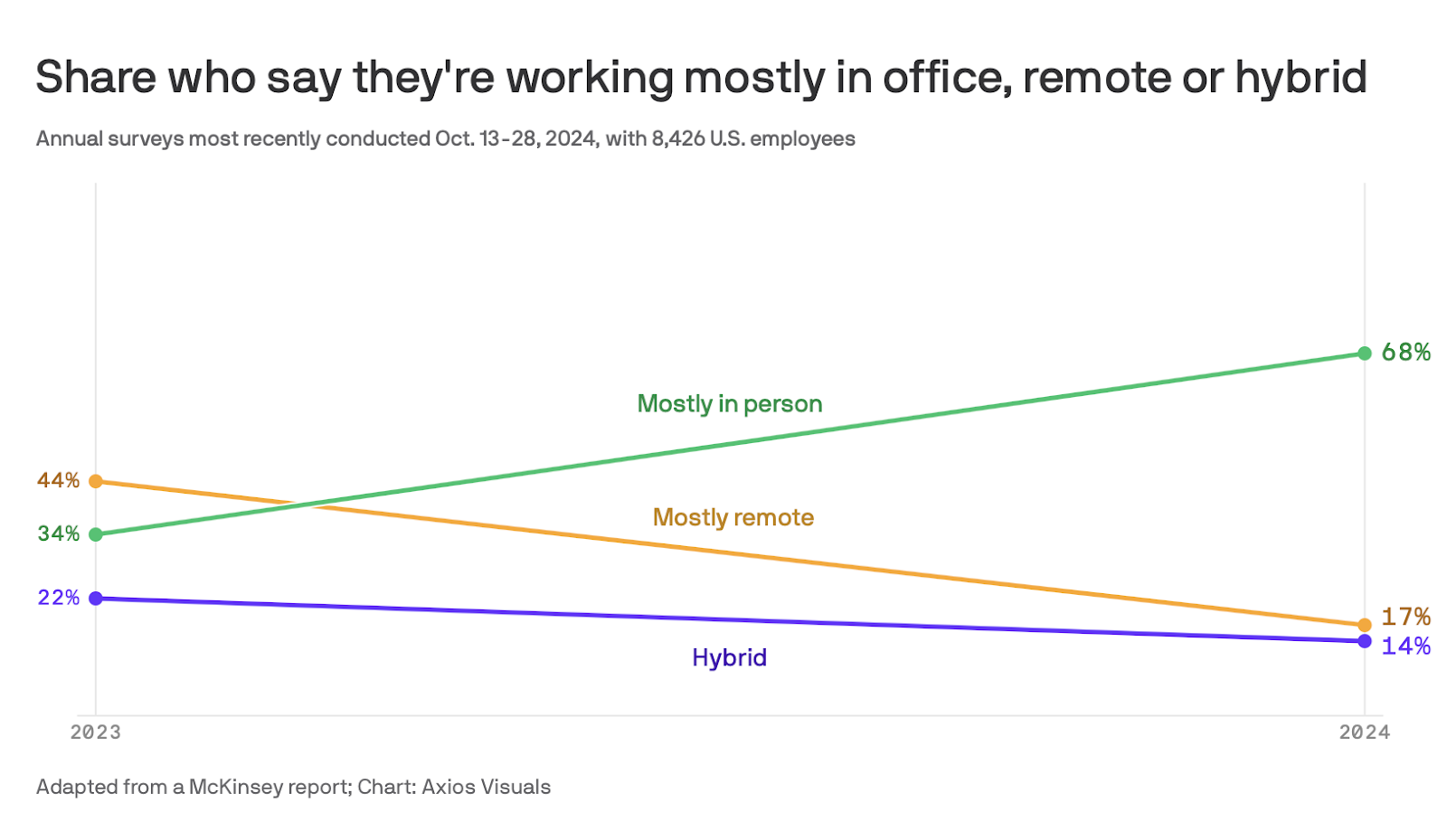
Face-time matters – and we’re not talking about zoom calls. Fortune highlights a study that despite there being no meaningful difference in work output, workers that show up in-person at a company are being promoted at a far higher rate than their hybrid counterparts.
NBC News reports on the death of Lincoln University’s VP of Student Affairs Antoinette “Bonnie” Candia-Bailey, who died by suicide weeks after family members say she told them her relationship with the university’s president had deteriorated. Candia-Bailey’s death is sparking much conversation on LinkedIn on race and gender, workplace culture, and respect in the professional world.
Fortune’s Executive Editor Peter Vanham writes about how climate talks and global health issues took a backseat at Davos, while concerns over war and geopolitical risk and AI dominated conversations. CNBC’s recap expressed similar themes.
A new study published on Harvard Law School’s website shows that just over 75% of S&P 500 companies now embed some type of ESG metric into their leadership compensation policies, per 2023 data, compared to about 66% in 2021.
In MIT Sloan’s Management Review, Lynda Gratton, a professor of management practice at London Business School, revisited predictions she made about work and business 15 years ago. She discusses her thoughts on worker sentiment, leadership traits, and more here.
This chart comes from the recently released 2024 Edelman Trust Barometer, highlighting the fact that for the majority of people, business remains the only trusted institution after years of eroding faith in others. Read the full report for more info on what Edelman calls the overall “decline of authority.”

Recruitment and retention remain key challenges corporate leaders faced this year. Against a backdrop of unionization drives, strikes, return-to-office plans, and AI evolution, workers are continuing to ask for what they want in a good job and are willing to voice their discontent – or find another role – if they feel overlooked. One central component they’re seeking? Opportunity. A majority of workers expect employers to prioritize advancement, career development, and skills-building – but too many executives are not following through.
JUST Capital’s polling of the American public consistently finds that Americans want to see investment in creating quality jobs that lead to opportunities for the workforce from companies. Americans we polled across party lines overwhelmingly agree that it’s a company’s responsibility to create quality jobs by providing clear career pathways to job opportunities with higher pay (83%) and regularly increasing wages to keep up with the rapidly rising cost of living (87%).
Investing in workers also makes operational sense for businesses. Research shows that when employers give workers learning opportunities in the workplace, they’re less likely to leave. Similar findings highlight that “employment capital” – non-wage components of work like benefits and career advancement prospects – are important to job quality and economic security. JUST data also finds that companies with better disclosure and performance on human capital issues don’t suffer financial consequences beyond short-term profit maximization and tend to outperform their Russell 1000 peers.
When companies invest in their employees’ careers and provide opportunities for advancement within and beyond the company, it’s something to celebrate. At JUST, we firmly believe in the importance of elevating business leadership on the issues of importance to the American people. It’s why we’ve been excited to partner on the Worker Financial Wellness Initiative, create Rankings that track performance on the issues that matter most in defining just business behavior, and highlight the state of disclosure on key workers metrics. It’s also why we’re excited to partner with The American Opportunity Index, which assesses economic mobility and opportunity generation for American workers at some of the largest employers in the country. The Index highlights leaders in real-world outcomes for workers. But what are companies doing to create the conditions that lead to those opportunity outcomes for workers?
JUST Capital is partnering with the Schultz Family Foundation and the American Opportunity Index to connect the dots on how corporate policies translate to real-world outcomes for workers.
In a series of leadership spotlights, we’ll lift up examples of corporate policies and performance, tracked in JUST Capital’s forthcoming JUST Jobs Scorecard, that respond to the American public’s expectations of business today and create the positive outcomes for workers assessed in the Index. This work will serve as an opportunity to learn from leaders about their company’s journey, challenges, and successes in creating opportunity in the workplace. It will illuminate how strategic inputs – commonly disclosed workplace policies – can serve as actionable catalysts for economic opportunity and overall job quality.
The Index assesses how well companies are investing in their workforce to drive business performance and individual employee growth by focusing on worker outcomes, i.e., the level of opportunity workers achieve within the company and beyond. And to understand what’s behind these leaders’ success, we must also look at the policies and practices in place that create an environment in which opportunities for workers to thrive exist.
The series of spotlights on leaders’ policies and practices aims to offer guidance on specific actions that companies can take to drive opportunity and mobility for their workers. It will highlight key practices from JUST Capital’s JUST Jobs Scorecard that yield the impacts measured in the American Opportunity Index. Insights from the forthcoming JUST Jobs Scorecard and the recently released Index can be used together to understand what policies and practices – or inputs – create conditions for opportunity outcomes – or outputs. These tools together offer a look at the corporate journey from policy to outcome and can be helpful in informing job quality and worker strategy.
At JUST Capital, our understanding of companies’ stakeholder performance is grounded in recognizing crucial inputs that lay the foundation for desired outcomes. These inputs, such as pay equity policies and apprenticeship programs, form the basis of our analysis and align with the Index’s five performance areas.

As we establish this connection, it becomes imperative to pinpoint key inputs, or policies, that companies should prioritize when shaping and investing in their workers to influence the outcomes tracked by the Index. Companies can view these inputs as potential actions to adopt, in turn creating the conducive conditions necessary to foster more opportunity for their workers. By strategically implementing and emphasizing these policies, companies can shape a work environment that not only meets performance standards, but also enhances overall job quality and opens up avenues for professional growth and development.
As we delve into upcoming leadership spotlights, there is a valuable opportunity for companies to glean insights and enhance their performance in terms of job quality, influencing the real-world experiences of countless workers. We encourage companies to actively engage with the Index, understanding their own strengths and growth areas, while keeping an eye out for the JUST Jobs Scorecard in early 2024 to delve into specific data details around policies and practices.
For more information on the American Opportunity Index, JUST Jobs Scorecard, our partnership, or more, please reach out to corpengage@justcapital.com.

Over the last nine years, JUST Capital has tracked and measured how just business – defined by the priorities of the public – is better business. We have worked hard to quantify and verify meaningful corporate action on just behavior, and believe it’s critical to understand what practices and policies are leading the pack. Truth and transparency are becoming more important than ever to employees, customers, shareholders, and others.
At JUST, we let data and measurement tell the real story, away from the noise of the public square. In an effort to capture a “real-time” look at how companies are taking action on key stakeholder issues, we recently analyzed new actions Russell 1000 companies have taken against some of the public’s biggest priorities this year. In Q1-2 of 2023, among Russell 1000 companies:
Importantly for JUST Capital, we are always seeking to understand the extent to which our work has a connection to actions taken. And we have strong correlation information to see the connection points between corporate action and JUST’s own work both at the company level and at the broader narrative level.
With increased political pushback against ESG and reports that corporate leaders are being more cautious about speaking out on key social and environmental issues (e.g. greenhushing, purpose-hushing), we’ve been closely tracking to see if any evidence is emerging regarding companies pulling back on investments, engagement, or reporting. And to date, we have not seen any. In fact, what we see is more and more companies engaging with our polling and our corporate performance data to understand how they stack up against their peers on the issues that matter most to the American public and also engaging more deeply with our key programmatic initiatives that help drive corporate behavior change to understand how take action and improve.
JUST has engaged a majority of the Russell 1000 companies, 82%, that have taken the actions listed above this year from our inception. Overall, we’ve engaged with over 60% of Russell 1000 companies since 2016, including through our Rankings of America’s Most JUST Companies. As the chart below shows, in 2016, our first-ever Rankings year, 21 companies reviewed the data that powers our Rankings – and took advantage of the opportunity to understand our methodology and submit suggestions or updates. Last year, we hit a record of 350 companies. Earlier this month we had 388 registrants across nearly 300 companies for our annual preview webinar, another record – and up 38% from this time last year.
All signals point to more interest and engagement from companies becoming more just this year.

Following last year’s data review period, we also conducted a survey of Russell 1000 companies that found a majority agreed that engaging with JUST helped inform and/or prompt implementation of new practices or disclosures on the issues we track, measure, and analyze. Those companies already leading on justness are also outperforming their peers. The 2023 JUST 100 (our top-ranked companies) had a 4.5% higher profit margin, 2.3% higher return on equity, and paid five times more in dividends compared to the rest of the Russell 1000. Learning from our Rankings, through the data review process for instance, is only the first step companies can take in engaging with JUST.
Over the last three years, we have launched three anchor initiatives designed to support large companies and business leaders seeking to ensure both their business and workers thrive. Through our Worker Financial Wellness Initiative, Corporate Racial Equity Alliance, and Corporate Care Network, we provide access to timely and informative resources and support on action planning through assessments, the opportunity to meet and learn in a peer community of practice, and receive guidance and technical assistance from a network of leading organizations and firms.

Through the Worker Financial Wellness Initiative, we’ve heard firsthand from workers at Chipotle, PayPal, Prudential Financial, and Verizon on how the investments their employers have made in them have positively affected their lives and livelihoods, as well as executives regarding how those investments have propelled positive business outcomes including increased engagement, productivity, customer satisfaction, and lower turnover.
In addition to the changes we tracked in company actions, we also examined how shareholders used JUST data and initiatives in their 2023 proxy season proposals. Across the Russell 1000, we found four shareholder proposals that cited JUST polling data, analysis, and other tools covering issues including wage increases and racial equity. These proposals came from investors at major companies in the Retail, Food, Beverage & Tobacco, Capital Markets, and Automobiles & Parts industries.
While these proposals were developed independent of JUST’s input, through our regular analysis we’ve observed an uptick in corporate disclosures when investors start to ask for more data. Workforce demographic disclosure is one example. Amid campaigns from institutional investors and an increase in shareholder proposals, our analysis found that EEO-1 disclosures (and other similar intersectional workforce diversity reports) more than tripled between 2021 and 2022 among the Russell 1000. We’ll continue to track what issues are gaining traction in shareholder proposals and how that might affect corporate actions and disclosures.
We also continue to monitor the market performance of the companies that perform best in our Rankings. In June, we celebrated the five-year anniversary of the JUST ETF, which tracks the top 50% of companies ranked by JUST Capital across all industries and is powered by our proprietary JUST U.S. Large Cap Diversified Index (JULCD). The JULCD has outperformed the Russell 1000 by 8.78% since inception through May 31, 2023.
Companies in the JUST ETF also outperform their peers on key stakeholder performance metrics like paying a living wage, creating jobs in the U.S., and providing paid parental leave.

In addition to investors, nonprofits and civil society are increasingly using both JUST data and insights to inform their own work and insights into the state of play on corporate leadership. As part of the Corporate Racial Equity Alliance along with FSG and PolicyLink, we’re using JUST’s data and insights on diversity, equity, and inclusion (DEI) to inform the development of standards to measure corporate action to advance racial equity. The process for developing these standards has included input from 300 individuals including social movement leaders, equity and sustainability experts, and academics.
As we continue to track corporate stakeholder behavior, this work is connected to engaging with some of the largest U.S. companies to drive change on the issues that matter most to the people who work for, buy from, and invest in them. Through our Rankings of America’s Most JUST Companies, programmatic initiatives, JUST Jobs Scorecard, and other tools, we’ve helped guide companies on how they can improve their performance and encourage disclosure of their progress along the way.
This update marks the first in a series of snapshots we plan to take of “real-time” action from Russell 1000 companies – keep an eye out for future editions. The actions captured here reflect one facet of how JUST Capital works to build a world where business and markets are a force for good, driving competition to build a better future for all. For more detail on how we drive change, explore the insights on our Mission & Impact page, subscribe to our weekly newsletter, or reach out to us at corpengage@justcapital.com.

JUST Capital is pleased to announce that Sushmita Banerjee, Managing Director & Senior Partner at Boston Consulting Group (BCG), and David Kamenetzky, Co-Founder of K4 Family Investments, have joined our Board of Directors. Banerjee and Kamenetzky are two of ten new members to have joined the JUST Capital Board over the past two years, and bring expertise in corporate strategy and growth to this group.
Banerjee has held several leadership positions throughout her 15-year career with BCG, and since late 2021 has served as the global leader of the firm’s Strategy business. She works with clients on strategy, growth, organization, large-scale transformation, operational improvement, total shareholder return, post-merger integration, and digital identity. She also currently sits on the North American leadership teams of BCG’s People and Organization and Transformation practices. Banerjee is a core member of BCG’s Social Impact practice as well, helping advance clients’ goals in a sustainable manner.
Kamenetzky is a values-based leader in the food and beverage industry. He previously served as Chairman of JAB Investors, Chief Strategy and External Affairs Officer at AB InBev, and member of the Mars’ management team. A life-long advocate of combating antisemitism and hate, he was also founding chairman of one of the largest European foundations for Holocaust remembrance and democracy promotion.
Banerjee and Kamenetzky join JUST Capital following the launch of our JUST Jobs Program in September 2022, integrating and building upon our pre-existing initiatives: the Worker Financial Wellness Initiative, Corporate Racial Equity Alliance, and Corporate Care Network, to help companies take action on job quality. In March, we also released an initial version of the JUST Jobs Scorecard – a tool that helps corporate leaders benchmark job quality performance.
“Sushmita and David are leaders when it comes to forward-thinking strategy, sustainable growth, and innovative investments. We’re thrilled to welcome them to the JUST Board, and especially fortunate to do so at a time when our own strategy further focuses on the direct and indirect influence we have on just corporate behavior, and the American worker in particular,” JUST CEO, Martin Whittaker, said.
JUST Capital welcomes Banerjee and Kamenetzky at a crucial moment as we approach our 10-year anniversary. Their expertise in corporate strategy, social impact, and human capital will be critical to JUST as we continue to strategize and measure our impact as an organization over the next ten years and beyond.
We continue to expand and diversify our Board following a commitment we made in 2020 which includes applying a diversity, equity, and inclusion lens on our recruitment; committee structures; bylaws and practices; and onboarding and offboarding procedures.

The events of the last few years — from the pandemic to the overturn of Roe v. Wade — have eroded the lines between corporate and public affairs, and CEOs are feeling the pressure. They’re being asked by internal and external stakeholders to weigh in and take action on social and political issues, from LGBTQ rights to climate change.
At the same time, they are hearing from others who believe corporate social responsibility has gone too far, a topic JUST recently discussed with Edelman’s U.S. Head of Social Impact and Sustainability, and who think it’s distracting them from the business of making money. With the 2024 presidential run right around the corner, CEOs aren’t likely to find reprieve.
JUST Capital is continuing our occasional interviews with experts on hot-button, in-the-news topics that CEOs and market leaders must navigate.
So to get a sense of how business leaders can navigate the debate around America’s democratic values, we turned to Rhett Buttle, Founder and Principal of Public Private Strategies, and Daniella Ballou-Aares, Founder and CEO of the Leadership Now Project. Both Buttle and Ballou-Aares’ organizations are founding partners of the Business and Democracy Initiative, a coalition that works to mobilize business to help restore trust in democratic institutions, recognizing the close ties between healthy democracies and healthy economies.
In his annual letter to shareholders, JPMorgan CEO Jamie Dimon reiterated that protecting democracy should be a priority across the political aisle. And JUST’s polling of the American public reinforces that.
We found that 72% of Americans say corporate America has a responsibility to protect the democratic process by promoting free and fair elections. Whether this sizable majority is in agreement with what exactly this means is not clear, however, regardless of politics we have also found that 81% of Americans think it is very or somewhat important for companies to disclose their political donations and lobbying efforts.
In other words, be more transparent about who and what you’re supporting with your corporate dollars. Notwithstanding, recent JUST analysis finds that only 31% of Russell 1000 companies are disclosing spending on political contributions and lobbying.
Buttle and Ballou-Aares explained the importance CEOs play in making change and why business leaders should continue to take meaningful action on issues that are important to them.
As trust in the government, media, and other institutions remains low worldwide, business leaders have emerged as relatively more trusted to be transparent and put the interests of their stakeholders first.
The 2022 Edelman Trust Barometer showed that business is the world’s most trusted institution. And the firm’s 2023 report found that business was the only institution seen as competent and ethical.
“People don’t feel that the government is responsive to their interests and needs and are looking for leadership elsewhere,” Buttle and Ballou-Aares said. “That’s part of why CEOs are in the hot seat.”
CEOs can exercise their power without getting deep into political quarrels, the experts explained. We heard similar sentiments from the American public in our recent focus groups. The public wants to see companies take action in a way that’s above the partisan fray, and relates to the core interests of their business and stakeholders.
“The reality is that companies have a lot of power politically, including to undertake efforts that make the political system more representative and accountable,” they said.
Buttle and Ballou-Aares pointed to recent historical examples of how CEOs have spoken out on issues that are important to their constituents, like the broad coalition of business leaders last year advocating for Electoral Count Act reforms that passed with bipartisan support.
“Business leaders have a legacy of supporting critical and lasting change. The trouble is that the conversation around this topic has been warped,” Buttle and Ballou-Aares said.
There is evidence that some business leaders are resorting to “greenhushing,” the act of refraining from speaking publicly on climate policy (and anything that could broadly be called “ESG”), in response to business getting sucked into polarizing political battles. And this, ultimately, could be more harmful than helpful to their relationships with their stakeholders, Edelman’s U.S. Head of Social Impact and Sustainability Alex Heath recently told JUST.
But Buttle and Ballou-Aares said CEOs should weigh the risks of speaking up with the costs of staying silent.
“Freedom of speech is fundamental to our democracy and our economic stability. Rather than standing down in the face of retaliation, companies have a vested interest in working together to uphold our democratic values,” they said. Ballou-Aares pointed to recent comments Disney CEO Bob Iger made at a shareholder meeting to illustrate her point.
Media bias, cancel culture, and managing different stakeholders make speaking out a difficult decision for CEOs. But Buttle and Ballou-Aares underscored that the American public wants to hear from its business leaders. “Business leaders should be confident that their voices matter and that the people they interact with – from employees to customers to communities – want to hear from them on critical issues.”
Buttle and Ballou-Aares draw explicit connections between democratic stability and economic strength, “Unstable governments are considered likely to interfere in free markets and to be generally unsafe global investments. Healthy democracies, meanwhile, are known to enable strong business environments.” This is true regardless of partisan politics, and it’s why business leaders must be ready to act on to protect our democracy, the cornerstone of a dynamic and inclusive economy.
Learn more about the Business and Democracy Initiative and explore additional steps the Leadership Now Project recommends business leaders take to protect democracy.
Note: Rhett Buttle and Daniella Ballou-Aares answered questions for this interview in writing and and both on behalf of the Business & Democracy Initiative.
This report was written by Jill Mizell, Director of Survey Research.
Against the backdrop of ongoing economic uncertainty, the American tech sector – long a bastion of growth, innovation, and prosperity – has been rolling out waves of layoffs over the past year, with companies including Microsoft, Amazon, Meta, Salesforce, and more letting go an estimated 168,000 tech workers in 2023 alone, already surpassing the total number of tech jobs cut in 2022 (161,000). And while the labor market is still holding strong, with 10.8 million jobs open in the U.S. today, tech layoffs could signal further economic complications, including job cuts across other industries, and even be a harbinger of recession.
With companies increasingly turning to layoffs as a cost-cutting measure, it’s expected that tens of thousands more workers will be impacted. Layoffs are, it seems, an inevitability for many of America’s knowledge workers, and the question on the minds of corporate leaders and workers alike is: can layoffs be “just?”
As part of Just’s ongoing work to understand how the public defines just business behavior, we turned to Americans to get their take on what it means to conduct ethical and just layoffs – and whether that is even possible. As we forge ahead in an increasingly unpredictable job market, the public’s views can offer critical insight for business leaders looking to consider the full impact of forthcoming and potential layoffs.
Key findings from Jusr Capital’s survey include:
With ongoing mass tech layoffs continuing to make headlines, it’s no surprise that Americans are in the know. When we asked respondents whether they were familiar with this issue, a large majority (85%) shared that they have heard about recent mass job cuts in the tech industry, and one-third (33%) told us they’ve heard a lot about the job cuts.
Beyond just being familiar with the latest news, large percentages of Americans also believe layoffs could have been avoided – in particular, strong majorities of younger respondents and those who have heard about the most recent waves of layoffs, as well as Democrats and Independents.
Overall, half of Americans (48%) believe these mass job cuts in tech could have been avoided with proper planning, while 28% believe they were unavoidable due to economic uncertainty and 24% aren’t sure whether the job cuts were avoidable or not.

Among those that told us they’ve heard a lot about recent tech layoffs, respondents are more likely than others to say these job cuts could have been avoided (55%, compared to 45% of people who have heard a little about tech layoffs and 43% of people who have not heard about the tech layoffs).

Younger cohorts are significantly more likely to believe layoffs could have been avoided. 69% of Gen Z respondents (people aged 18-26) believe these tech layoffs were avoidable with proper planning, compared to 52% of Millennials, 46% of Gen X, and 40% of Boomers. Nearly a third of Boomers (31%) and Gen X (31%) say the mass layoffs in tech were unavoidable, making them twice as likely as Gen Z to say so (just 15% of Gen Z respondents believe the layoffs were unavoidable).
We also see a stark contrast when we look at responses by political party. While 50% of Democrats and 55% Independents believe recent mass layoffs in tech could have been avoided, just 36% of Republicans see them as avoidable.
With mass layoffs ongoing, the question of ethics is an inevitable one, and we turned to the public to ask them whether they believe mass layoffs can be ethical. A plurality of 43% believes that the ethics of mass job cuts depends on the situation, while 28% believe mass layoffs are unethical corporate behavior. Just 3% of Americans believe job cuts are ethical corporate behavior, and 13% believe layoffs are not an ethical issue.

Whether a respondent believes these layoffs could have been avoided or not plays a significant role in their perception of corporate ethics around layoffs. People who believe these layoffs were avoidable are more than three times as likely to say mass layoffs are unethical corporate behavior than those who believe the layoffs were unavoidable (44% vs. 12%).
On the flip side, people who felt the layoffs were unavoidable are twice as likely to say that mass job cuts are not an ethical issue at all compared to those who believe the layoffs could have been avoided (20% vs. 9%). People who think the layoffs were unavoidable are also more likely to say that the ethics of layoffs depend on the situation compared to those who believe the layoffs could have been avoided (53% vs. 35%).

Regardless of the public’s perspectives on avoidability and ethics, layoffs show no immediate sign of stopping. We asked respondents what companies should consider in order to conduct layoffs in as just and ethical a way as possible. Americans agreed that, for corporations to conduct layoffs in an ethical way, they must give workers advance notice in a respectful manner (69%); provide generous severance packages to workers including pay and health care coverage (61%); provide access to job finding services at no cost (52%); and reduce the number of jobs to cut by decreasing other costs as much as possible (52%).

When it comes to severance packages specifically, there is significant divergence between respondents with differing political views. 46% of Republicans believe companies conducting mass layoffs should provide generous severance packages, compared to 75% of Democrats and 63% of Independents.
When we asked the public what they think the short- and long-term impacts of mass layoffs might be, strong majorities shared that they believe mass layoffs have a negative impact on workers’ sense of job security (85%) and the overall economy (71%).
A plurality of 41% believes that mass layoffs will have a positive effect on short-term profits, while 27% believe layoffs will have a negative impact and 19% believe layoffs do not impact short-term profits either way.
When it comes to long-term profits, a plurality of 35% believe layoffs will have a negative impact on long-term profits, while 26% believe layoffs will have a positive impact and 22% believe layoffs do not impact long-term profits either way.

As Americans weather the ongoing storm of economic uncertainty, it’s likely that layoffs will continue to unfold in the tech sector and spread to other industries, as we are already seeing in media and manufacturing – and this week, with McDonald’s closing its headquarters in anticipation of job cut announcements. Corporate leaders will continue to face difficult decisions on how to cut costs – and while mass tech layoffs may or may not have been avoidable, they are happening now, and Americans are watching closely to learn whether companies are conducting these layoffs in a way that is ethical and just, and that minimizes negative impacts. It’s not yet clear how widespread these layoffs could become, or to what extent they will impact that broader job market, but as corporate leaders prepare for what to come, the voice of the public provides crucial guidance on how to navigate this challenging time in as just and ethical a way as possible.
This survey was conducted online and by phone in both English and Spanish within the United States by SSRS on behalf of Just Capital. The survey fielded from March 3 to March 7, 2023. SSRS interviewed a representative sample of 1,027 U.S. adults (age 18 or older) for this survey from among its multi-mode Opinion Panel, a nationally representative, geographically diverse and probability-based panel reaching respondents in all 50 states.
The margin of error is +/- 3.6% at a 95% confidence level. Results were weighted to U.S. Census parameters for age, gender, education, race/Hispanic ethnicity, Census Division and specifically surrounding party identification in order to ensure representativeness of the U.S. population. All margins of error include “design effects” to adjust for the effects of weighting. Explore the topline results, question wording, and demographic breakdowns by question here. For complete survey methodology, including weighting variables and subgroup sample sizes, please contact jmizell@justcapital.com.