

We’re halfway through 2024 already, if you can believe it. So as the Independence Day celebrations continue, I thought I’d take a moment to reflect on where things stand in the world of corporate justness.
Overall, I’d say that despite a wider sense of societal instability, the corporate stakeholder space feels relatively steady. Americans’ chief priorities remain firmly centered on pay, jobs, and economic security. The debates and discussions around corporations’ role in society continue, but have become markedly less heated and divisive, and more private, measured and–dare I say–meaningful. Corporations for the most part are focused on gathering data, developing strategy, and generally getting on with the business of understanding what their stakeholders want and working hard to give it to them.
This inevitably means different things to different companies. Some are doubling down on worker-related investments. Some are focused more on branding and communication issues. Others are shifting their priorities entirely. The announcement this week by Tennessee-based rural retailer Tractor Services that it is discontinuing or reorienting certain practices (including its DEI and carbon emission commitments) to focus more on things that “tie directly to business” is an interesting case in point that has attracted a lot of attention. Whichever way you look at it, corporate leaders are very sensitive to the shifting sands of stakeholder expectations and how they align with their core business interests.
I expect things to get more challenging in the second half of the year. The next generation of ChatGPT will undoubtedly shock, amaze and pose some existential questions about morality and business in the modern age. The Presidential election will likely bring varying measures of disharmony and disruption whichever side of the aisle you’re on. According to many commentators, this week’s SCOTUS “Chevron” ruling could up-end the entire regulatory status quo facing businesses in America.
In my view, all of this makes JUST’s role more important. When it’s at its best, American business is an incredibly powerful force for good that is essential to a more just and perfect Union. It helps support the freedoms, liberties and opportunities that define our collective future. Creating the incentives for that is where we will stay focused.
Wishing you and yours a wonderful weekend!
Be well,
Martin
To understand the financial security of employees across America’s largest publicly traded companies, JUST Capital and Revelio Labs analyzed the amount employees’ wages exceed the local living wage necessary to cover basic budgetary needs. Here’s what we found.
CNBC looks at how AI is eating up corporate tech budgets, but not on the customer side–a majority of the investment is going to training and outfitting their employees.
Must Reads
The Wall Street Journal highlights how Tractor Supply Co has walked back their DEI and environmental initiatives after weeks of criticism on social media.
Bloomberg wonders if “social media labels” would wind up being even worse than “cigarette labels”, examining how that industry used those warnings to escape liability and regulation.
The New York Times examines the pros and cons of the growing list of top employers covering egg freezing, which, while immensely helpful for many workers, points to a potentially growing schism in work/life balance and expectations.
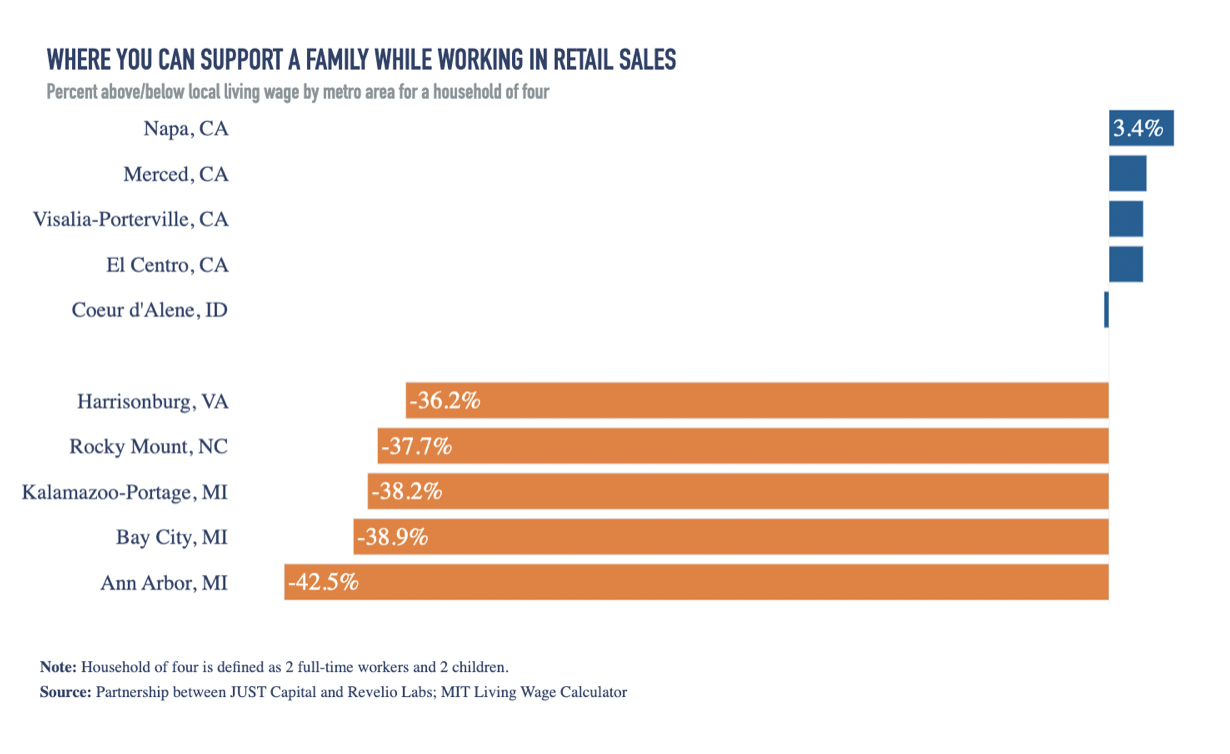
Our latest research partnership with Revelio Labs looks at the financial security of employees across America’s largest publicly traded companies, particularly when it comes to entry level and retail jobs. This chart shows the top 5 and worst 5 areas of the country when it comes to starting retail pay. Read more of our wage analysis here.

Extreme temperatures are shattering weather records around the world. Almost 100 million Americans were reportedly under some level of excessive heat warning this week. Extreme weather conditions are being documented across much of the world. Sea surface temperatures in the tropical North Atlantic are at record high levels, fueling the intensification of tropical cyclones and what is expected to be a “above-normal” Hurricane season. Heat-related deaths, sadly, are an all-too-frequent news headline.
Then there’s the economic impact. According to researchers, “under current climate conditions, lost labor productivity due to heat in the U.S. could reach $100 billion a year [and] that loss could reach $200 billion by 2030 and $500 billion by 2050.”
What this also points to is the growing opportunity for market-based solutions to help the world adapt to a more volatile climate. This spans everything from helping businesses deal with the effect of extreme heat on workers – something Bloomberg highlighted this week – to building resilience into supply chains, logistics, food and agriculture production, and physical infrastructure (buildings, roads, electric grids); to risk management and insurance solutions that protect against climate-related financial loss.
It’s an area where AI can play a strong supporting role, too. JUST 100 company IBM’s “Environmental Intelligence Suite,” which leverages AI to help clients improve risk management and decision-making on climate risk, is one example. PG&E’s use of AI to enhance fire and outage risks is another. Beyond AI, construction companies are working to find workforce solutions to enhance safety and productivity, and energy companies, like those in Michigan, are preparing to keep the power grid running. HP and Intel’s leadership on water management in the semiconductor industry and broader technology sector y also springs to mind.
Helping the world address climate risk and extreme weather is becoming an increasingly important facet of just business leadership and overall stakeholder performance.
Be well,
Martin

“You spend a lot of time at work. Just like we would for a consumer on our app, we asked: What’s easy? What’s hard to do? How do you access certain things quickly and seamlessly? We had a lot of work to do, end-to-end, on the experience. Just like we would on a customer journey, we looked at our colleague journeys as well.”
The Biden Administration unveils new rules to curb U.S. investment into Chinese AI and semiconductor technology that could also enhance their military. The New York Times has the story.
The Washington Post looks at the race for tech firms to devise new, potentially improbable energy solutions as AI development eats away at an aging power grid.
PwC reveals a fascinating bit of research on how AI is impacting work. A study of half a billion job ads from 15 countries suggests that AI is making workers much more productive, with sectors that are especially exposed to AI experiencing nearly 5 times higher growth in labor productivity.
Post Father’s Day, Nike increases its paid parental leave to 16 weeks for all U.S. employees, which can be used for birth, adoption, or foster placement.
The New York Times takes a deep look at how Meta continues to fail at protecting the safety of its most vulnerable users–children.
The Atlantic casts a critical eye on federal workforce-training programs, revealing how they accomplished little for the workers NAFTA displaced in the 1990s, largely because they targeted “in-demand” jobs that employers needed to fill, which often meant low-wage, high turnover positions.
The attacks on DEI continue. This week, Fortune covers the move from several high-profile tech CEOs, including Elon Musk, to move to MEI (Merit, Excellence, and Intelligence).
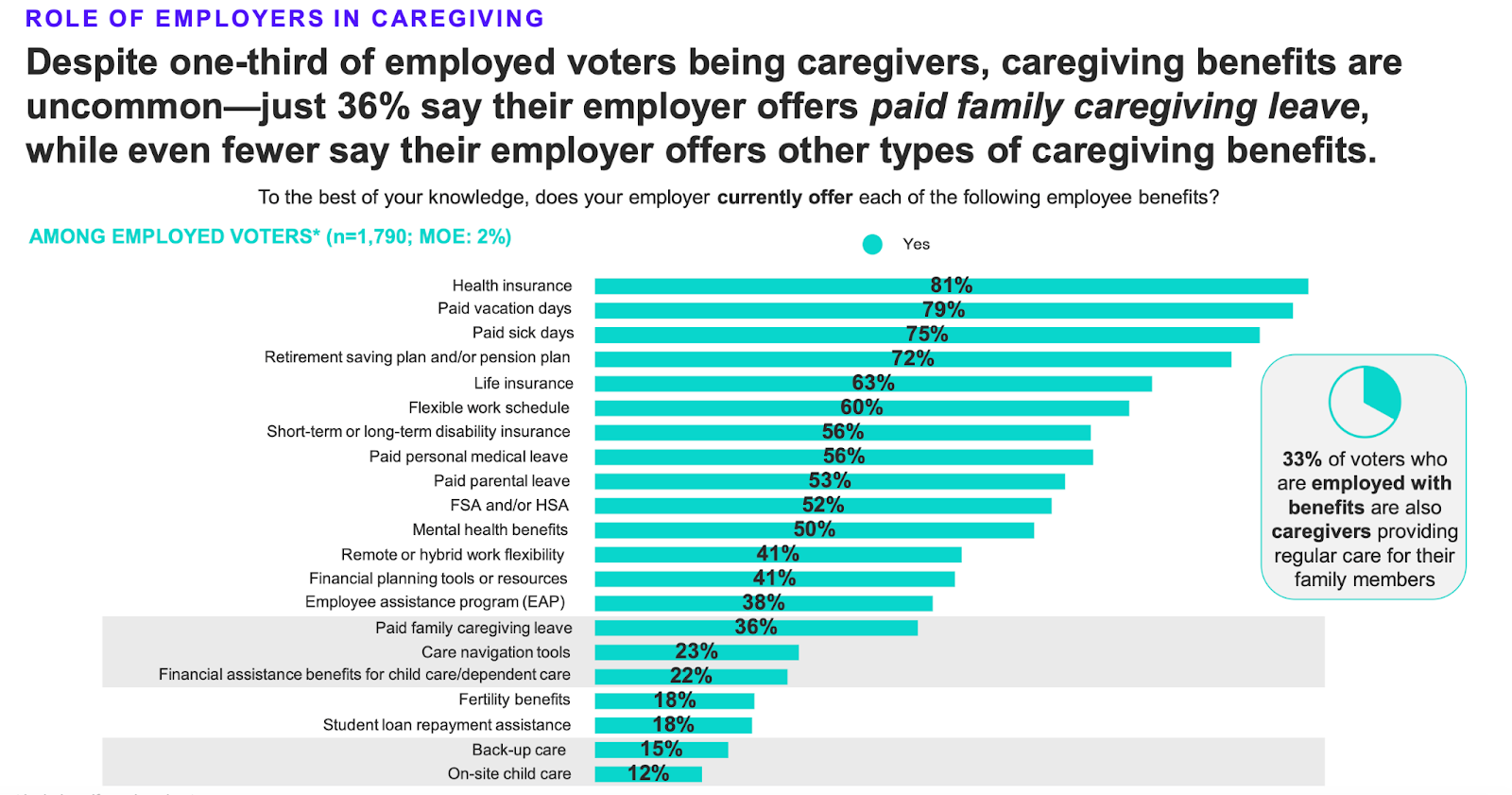
This chart comes from excellent research by Politico’s Morning Consult on Voter Sentiment on Caregiving in the U.S. The chart shows that only 36% of companies offer paid family caregiving leave, despite the fact that 59% of respondents would be more likely to stay at a job that has it. Explore the details here.
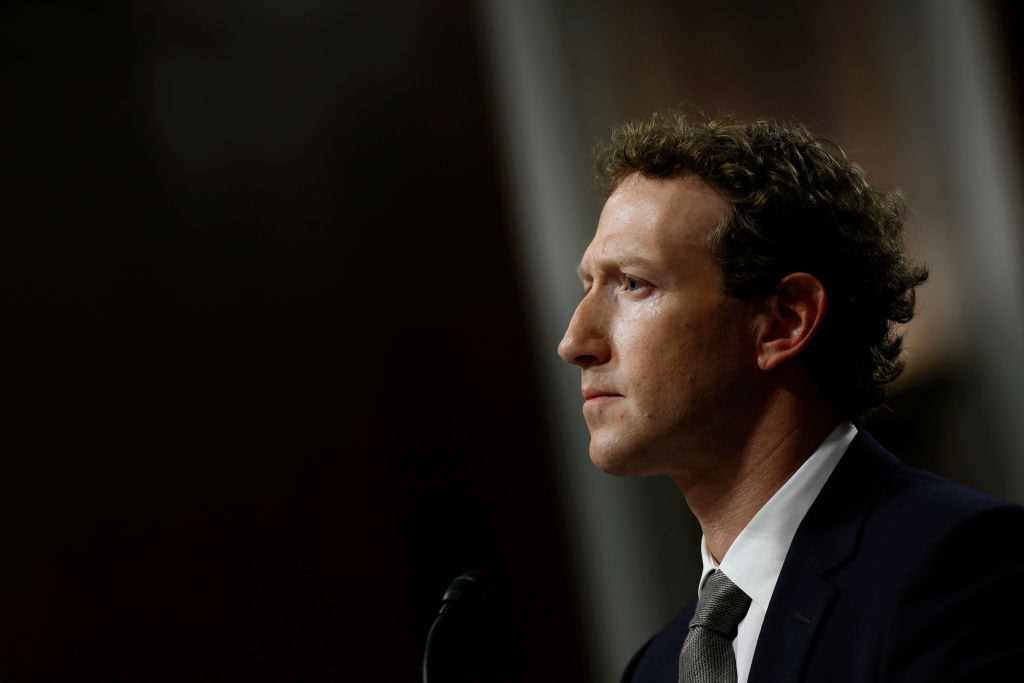
This week’s call by the U.S. Surgeon General for tobacco-style warning labels on social media products is the latest chapter in one of the defining corporate justness narratives of our time: the impact of social media on the mental health of children and teens.
It’s something that we at JUST have grappled with over the years. Public polling suggests that 86% of Americans are concerned about the impact of social media on children; that 50% of parents of children younger than 18 feel their child(ren)’s mental health has suffered because of social media use; and 83% of likely voters believe social media platforms should be required to protect their minor users.
In step with the polling, bipartisan political pressure for action is growing. For example, Over 40 states are suing Meta claiming the company designed addictive features which resulted in serious mental health problems for children.
As of writing, Meta has emphasized its position that Congress should pass legislation which would require parental consent to join social media if a child is under the age of 16. Currently most social media sites require the account holder to be at least 13-years-old. At the same time, big tech firms have implemented safety features to support a safe, positive online experience for teens.
The question at the center of this is a just one: how will these firms address a critical stakeholder issue that is central to their business model while balancing their near and long term profits?
Be Well,
Martin

“I want to touch on AI to close. There’s a lot of buzz about AI, we have 1,000 wildfire cameras in the state of California, and of the 1,000, 600 of them exist in our footprint. AI was enabled on all 1,000 cameras last year and the results are tremendous. AI is picking up wildfire hits faster than humans…so that’s a very effective post-ignition layer of protection that we intend to move forward and install more cameras.”
CNBC examines our data and highlights companies that are providing the best paternity leave for Father’s Day.
The BBC takes a look at one of the first sectors to be hit with AI job loss–copywriters–and how, amid massive team cuts, the sole job of many that remain is to make AI articles sound more human. Dystopian, much? And on a broader scale, the Financial Times reports that the IMF has “profound concerns” over AI labor destruction.
In a follow-up from last week’s article over the security concerns surrounding Microsoft’s new “Recall” AI feature, which automatically takes photos of your screen at random intervals, the company will now delay the release until it can tackle the security challenges it poses. Reuters has the full story.
For Father’s Day, GQ interviewed 13 new father’s on how having paternity leave (or not) affected the first weeks with their newborn.
SHRM analyzes the Supreme Court decision siding unanimously with Starbucks against their employees in a lawsuit over the firing of several workers who were attempting to unionize in Memphis.
Business Insider reports that the Surgeon General has called to implement a Surgeon General’s warning on social media due to plummeting mental health among teens, but others think that this “warning label” will prove infective when compared to actual government regulation.
The NY Post looks at the growing trend of companies eliminating middle managers, and how it is effecting new entrants to the workforce.
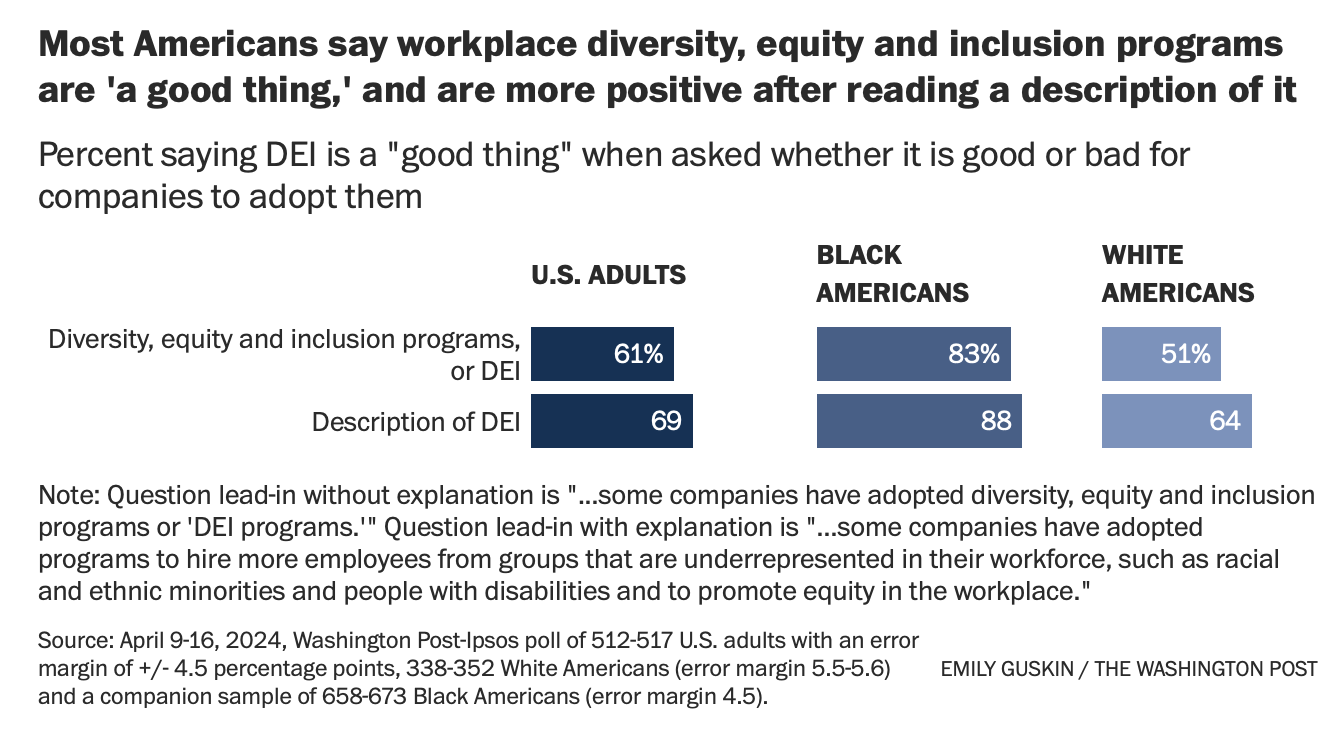
This chart comes from this Washington Post article highlighting the latest Ipsos polling that shows a majority of Americans support DEI initiatives, and even more so when they’re given a description of what those initiatives entail.

June can be a tricky month for corporate leaders. Between Pride, Juneteenth and Father’s Day, there’s a lot for companies to stake out a position on, support, or – in an era of backlash – potentially stay silent on. The cost of getting things wrong can be significant: remember last year’s controversy surrounding Target’s placement of LGBTQ apparel in stores?
Jon Stewart weighed in recently, “Why are we allowing ourselves to get worked up over whether corporations are pro-gay or have traditional American values?” he asked. “Because corporations have but one value: Shareholder value. That’s all they have […]There is nothing corporations do that is not in service of their bottom line.”
Our polling of the American public, as well as our investment research, suggest there’s more to it than that. Companies need to navigate issues around politics, society and values precisely because of their connection to future business performance. Whether it’s customers, workers, suppliers or local communities, corporations need to be the best they can be in order to compete effectively and create value. Our interview this week with Levi Strauss’s Chief Human Resources Office details how one aspect of being a great employer – expanding paid family leave – builds employee loyalty, improves performance, and hones culture.
Another key point is this: To the American people, it’s actions that count, not words. Companies need to know what their stakeholders want, understand the business case, lay out an authentic strategy for achieving it, and be prepared to live with their decisions. Put another way, companies should worry less about pride flags and statements of racial solidarity, and more about whether workplace practices, customer engagement, and other stakeholder strategies are genuinely producing results.
Be well,
Martin

“Paid family leave is a relatively small investment with a very meaningful return, our actual expense is tracking under initial projected expense. Our paid family care policy globally costs us only 36% of what we’d projected, and since our global enhancement in January, we’ve had over 260 leaves across 20 countries.”
JUST Board Member Xavier de Souza Briggs and co-writers Joe Parilla and Mayu Takeuchi take a deep-look at how small-and-mid sized cities around the U.S. can advance racial equity and inclusive economic growth in their latest piece for The Brookings Institution.
Microsoft’s “Recall” feature, which automatically takes screenshots of tasks performed on PC so that the data can be retrieved quickly in the event of a wipe, has come under fire from cybersecurity experts for being a security “disaster”. Forbes has the story.
Bloomberg reports that Citigroup Inc. is expanding their family leave policy, allowing new parents in the U.S. 16 weeks of paid leave (including adoptive and surrogate parents), and all employees to take two weeks of paid leave annually to care for an immediate family member who’s seriously ill and incapable of self-care.
Walmart will pay bonuses to 700,000 hourly U.S. workers, an idea that came from employee feedback to improve retention. Both part-and-full-time employees will be eligible. Reuters has the story.
Bloomberg chronicles IKEA’s renewed investment in its workforce after costly quitting spiked across the globe, pushing the company to improve compensation, create more flexible schedules, and ensure a smoother orientation for new hires.
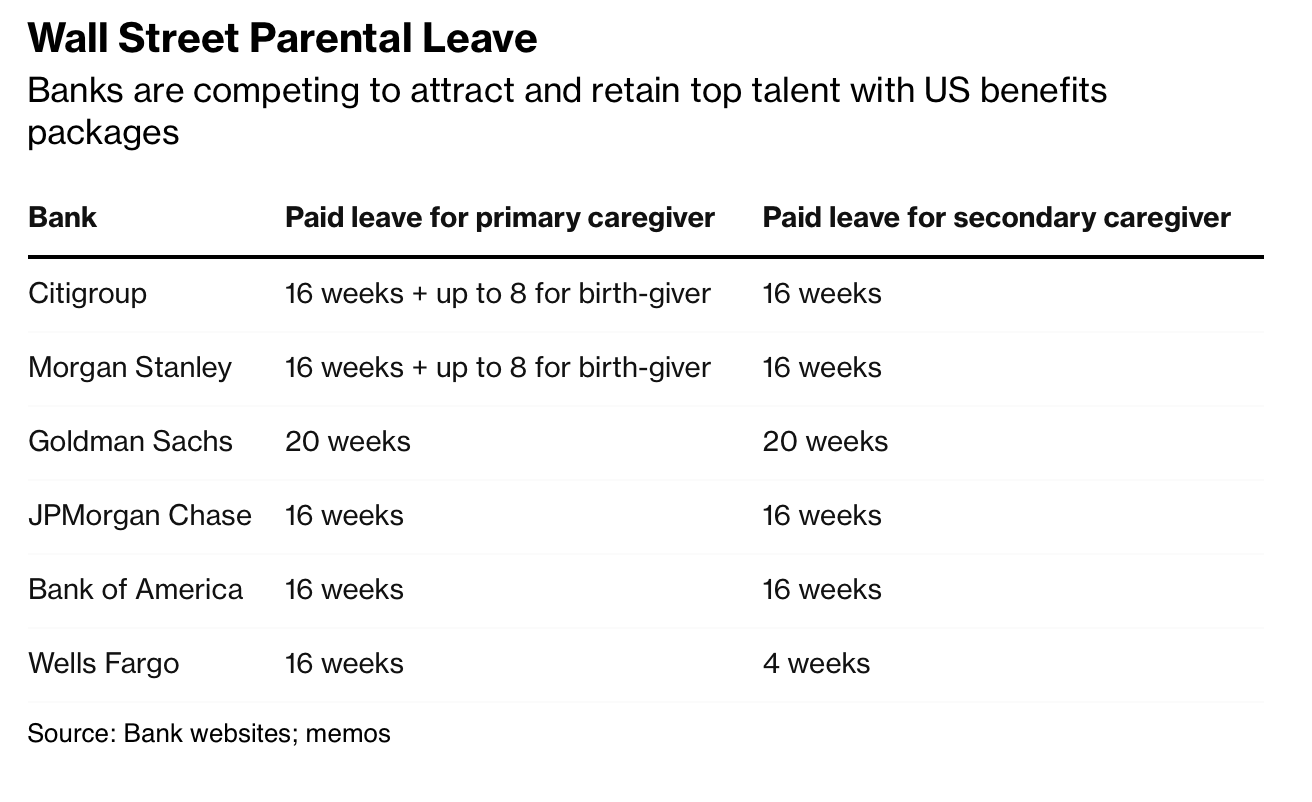
This chart comes from Bloomberg’s article on Citigroup’s new paid family leave policy, and shows how Wall Street and big banks are pushing to match each other with more expansive leave policies.

According to the annual Axios Harris Poll 100 Corporate Reputation Survey, there has been “a systemic loss in corporate reputation” over the past year. Consumer dissatisfaction with higher prices is part of the story, but 72% of those surveyed believe companies are taking advantage of inflation to increase their profit margins.
The study also suggests that in addition to wanting companies to prioritize fair prices (53%), Americans would prefer they focus on improving product quality, safety, and consumer satisfaction (48%) and paying good wages/promoting economic growth through job creation (48%) as opposed to ESG (23%), AI investment (13%), and taking proactive stances on societal or cultural issues (11%).
Certainly, companies are treading carefully on the latter issues in terms of public-facing statements. As Business Insider notes, “mentions of ESG on fourth-quarter earnings calls in 2023 compared to 2020’s Q4 dropped more than 78%. DEI’s decline was even larger during that time frame, falling 88%.” But the fact that kitchen table financial matters – wages, jobs, prices – are so important comes as no surprise to us. Worker-related issues, as regular JUST followers know, have been the priority of the public in our own polling for years.
Our new guide – The Corporate Guide to Human Capital Disclosure & Leading Practice – will make it easier to make progress in this critical area. We track the state of current disclosure, standard practice benchmarks, and leading practice examples across 6 areas: Wages & Compensation; Benefits; Training & Development; Workforce Composition; Employee Wellness; and Hiring & Stability.
Some of the best performers – including Waste Management (Tuition Reimbursement), Carmax (Veteran Hiring), ONEOK (Internal Hiring) and Mondelez International (living wage) – may surprise you.
Be well,
Martin

(Wikipedia)
“I believe we as a society have gotten better at instituting governance structures to help mitigate the problematic and harness the positive outputs and potential of technologies. While AI has the potential to both make our lives easier and more challenging…I believe the most prolific and efficient use cases for AI will also be the ethical ones, many of which we already see happening across the medical and education fields.”
This week, the Corporate Racial Equity Alliance (CREA) – a joint initiative led by PolicyLink, FSG, and JUST Capital – released a draft of the Business Standards for 21st Century Leadership to help companies maximize the impact of their social responsibility efforts. Forbes explores the standards in more detail.
Actress Scarlet Johansson is threatening legal action against OpenAI, alleging the company copied her voice for its latest update despite declining an offer from CEO Sam Friedman to lend her voice to the project. The Washington Post has the details. At the same time, The New York Times is reporting that former ChatGPT employees have raised concerns that the company is not doing enough to ensure its products don’t pose a threat to humanity.
According to Quartz, JPMorgan Chase is training all of its new hires on AI as the company pushes harder to be the industry leader in the technology.
More big news from JPMorgan Chase: The Wall Street Journal reports that its CEO, Jamie Dimon, plans to retire within the next few years.
Target is lowering prices on 5,000 of its most frequently bought items–including staples like milk, meat, bread, fruit and vegetables, as well as paper towels and diapers. NBC News has the full story.
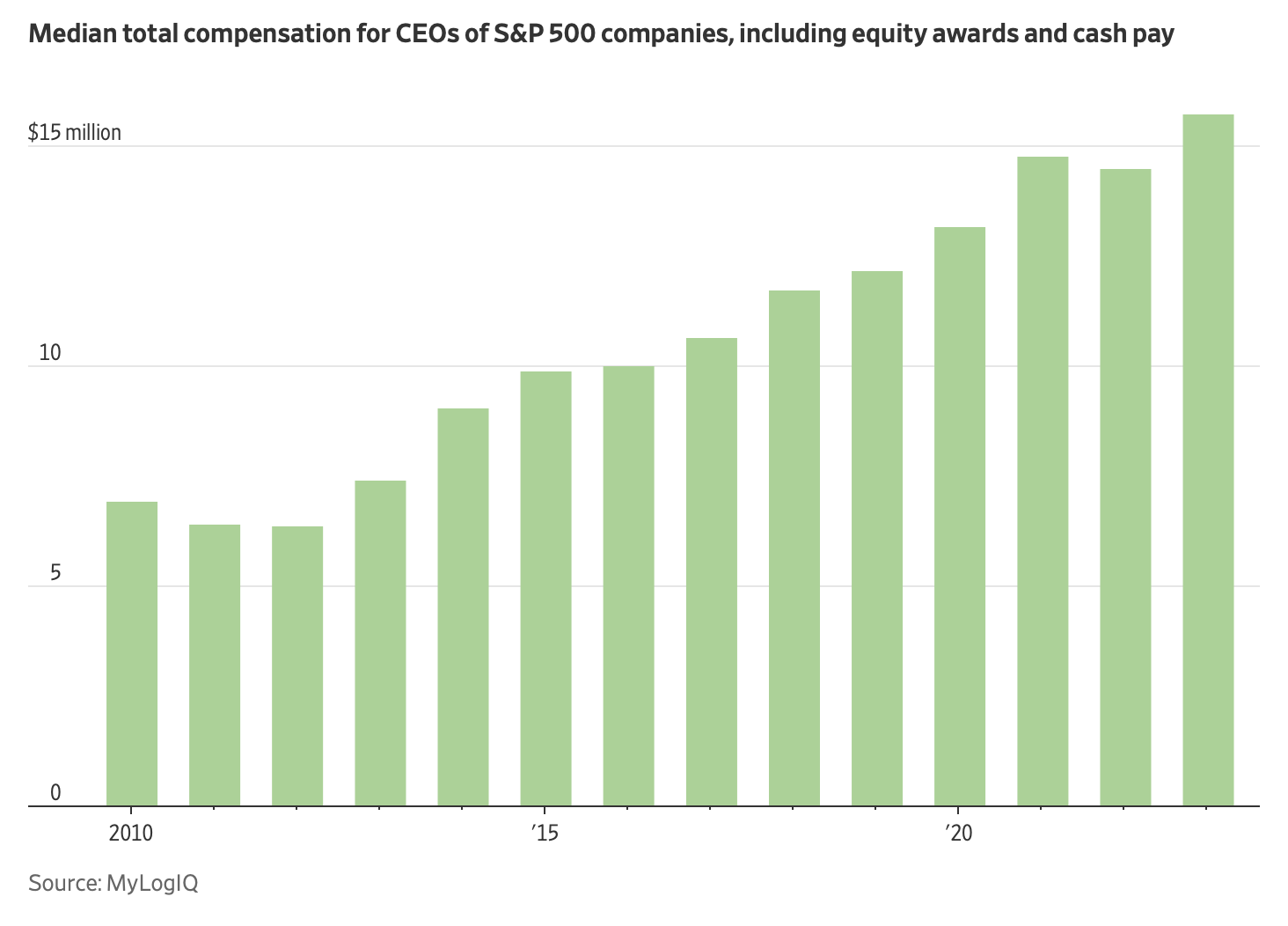
This week’s chart comes from the Wall Street Journal’s massive analysis of CEO pay across the business landscape. Above, you can see how the median pay for CEOs has more than doubled over the last 10 years. Explore the data here.

AI’s impact on the future of work continues to dominate the headlines in 2024, particularly when it comes to rapid adoption of generative and predictive AI algorithms.
Igor Tulchinsky is the Founder, Chairman, and CEO of WorldQuant, a global quantitative asset management firm with over $7 billion in assets under management. His 2023 book, The Age of Prediction: Algorithms, AI, and the Shifting Shadows of Risk, looks at how predictive AI technology is quietly reshaping our world in fundamental ways.
JUST Capital’s CEO Martin Whittaker sat down with him to discuss the benefits and dangers of this technology for America’s business leaders and workers.
Full interview below:
Martin:
You’ve discussed at length some examples of predictive technology being adopted right now – for example, the medical field tapping into the power of analyzing patterns in emerging infectious diseases. What are other ways AI’s predictive power can be used to help communities? What are some potential future uses that you envision?
Igor:
Over the next decade, I believe we can expect further disruption to economies and organizations, driven by increasingly sophisticated language models and the anticipated rise of artificial intelligence. This growth in intelligence is expected to enable the rapid analysis of vast amounts of information, enhancing productivity and innovation across various sectors.
Healthcare and medicine already seem to be benefitting from these tools, enabling advanced techniques that can provide better outcomes for people. The medical community appears to increasingly leverage predictive AI to understand patterns of emerging infectious diseases and to improve DNA and RNA sequencing from human patients.
Technology also holds the promise to revolutionize education by breaking down barriers to access and enabling rapid adaptation to evolving skills landscapes. From my perspective, we’ve only scratched the surface of predictive technology’s possibilities, yet these initial advancements present significant opportunities to utilize predictive AI in impactful ways in the future.
Martin:
There are technologies that radically transformed society – the wheel, gun powder, the printing press, the electrical conductor, the internet. Looking back at the adoption, spread, application, and regulation of these technologies – what’s one lesson from history that we can take to guide how we encourage just AI?
Igor:
As long as humans have been inventors, there have been positive and negative use cases of new technology. While the first axe could harm, it could also cut wood for the first fire. Over time, I believe we as a society have gotten better at instituting governance structures to help mitigate the problematic and harness the positive outputs and potential of technologies. While AI has the potential to both make our lives easier and more challenging, I view it as just a tool, driven by human-decision making that will determine the course of its use. Overall, I believe the most prolific and efficient use cases for AI will also be the ethical ones, many of which we already see happening across the medical and education fields.
Martin:
In your book, you discuss the challenges as much as you do the opportunities associated with predictive technologies. What are some examples of risks around AI and its predictive power that organizations and leaders should be aware of? What can be done to mitigate these risks and challenges? Is there a possibility that AI’s potential for harm outweighs its potential for good?
Igor:
Technological advancements, while improving daily life, can also present existential challenges. There are examples throughout history of new technologies that have had positive and negative impacts, and in many of these cases, humans have improved in implementing controls to focus on positive innovation. Take cars, for example – they revolutionized travel and productivity, but safety measures like maintenance, seatbelts, and airbags evolved to mitigate risks.
The adoption of predictive technologies also brings with it increased complexity that leaders will need to learn to manage. Importantly, what is underlying all this change and progress is how humans and machines will continue to have a symbiotic relationship. AI does not have the same intent or purpose that humans possess. Because of this, I believe that humans remain imperative in guiding and directing the technology in a way that ensures it is justly deployed. With AI, I think that it is critical that ethical considerations, guidelines, and potential regulatory frameworks are developed in tandem with technological progress as unforeseen outcomes make themselves known.
Martin:
How will AI impact our relationship with the future in terms of its effect on how we approach risk? With increased predictability, can we guarantee more certain outcomes?
Igor:
The proliferation of data is providing us with some clarity about what the future may look like, and AI is already helping us process data and use it to predict outcomes across a number of areas. With this transformation in the future – and partly because of it – may come a countervailing impulse: the desire to increasingly model a world that is confoundingly complex.
The range of potential outcomes is growing, particularly as we discover new use cases. Over time, it will become clear whether AI will make all risks quantifiable and comprehensible, or if our cognitive machines will merely generate new risks and anxieties. For now, the only certainty is that as this process plays out, we should adjust our conception of risk. Continuous testing and monitoring of evolving risks are crucial. The significant growth of data could allow us to create more predictive tools and increasingly strengthen our predictions, but I view it as critical that we refine our ability to process and utilize this information to both capitalize on untapped opportunities and mitigate potential risks.
Martin:
You’ve previously said that the nature of AI technology means a “variety of people have the potential to make an impact.” Talk to me about how we can drive diversity of thought and diversity of actors with AI. How can we ensure the technology is leveraged as a source of greater inclusion? What are you doing to help bring AI to a greater number of people?
Igor:
The commoditization of AI ultimately may mean the commoditization of intelligence. This could present an opportunity to enhance accessibility to education and in turn to the jobs that that education unlocks, therefore fostering a more inclusive workforce. I believe that by increasing accessibility to education through varied learning pathways and simplified interfaces, diverse groups of people can have access to quality educational opportunities that were previously unavailable. As an example, I founded WorldQuant University with the goal of expanding access to higher education. The organization utilizes technological capabilities to offer a comprehensive and accredited advanced education for free in fields like Financial Engineering and Data Science to diverse student groups worldwide. I have always held the belief that talent is globally distributed, opportunity is not. Through WorldQuant University’s online learning platform, we are able to bring these upskilling opportunities to talented individuals who might not have otherwise had access.
Martin:Who do you think will be the biggest winners and losers in the age of AI? As more and more actors enter the conversation around AI, what will be a key determinant for success?
Igor:
In the age of AI, I think the greatest beneficiaries will be those who actively embrace and collaborate with these emerging technologies. I believe intelligence will become commoditized and lead to increased mechanization across industries that rely on this kind of standardized intelligence. This evolution alone has the potential to revolutionize most sectors. Wherever people can find opportunities to scale, I believe that technology can be an effective propagator and provide tremendous power. To the extent that humans contribute beyond the components that can be commoditized, that will be our value.
