

Over the last nine years, JUST Capital has tracked and measured how just business – defined by the priorities of the public – is better business. We have worked hard to quantify and verify meaningful corporate action on just behavior, and believe it’s critical to understand what practices and policies are leading the pack. Truth and transparency are becoming more important than ever to employees, customers, shareholders, and others.
At JUST, we let data and measurement tell the real story, away from the noise of the public square. In an effort to capture a “real-time” look at how companies are taking action on key stakeholder issues, we recently analyzed new actions Russell 1000 companies have taken against some of the public’s biggest priorities this year. In Q1-2 of 2023, among Russell 1000 companies:
Importantly for JUST Capital, we are always seeking to understand the extent to which our work has a connection to actions taken. And we have strong correlation information to see the connection points between corporate action and JUST’s own work both at the company level and at the broader narrative level.
With increased political pushback against ESG and reports that corporate leaders are being more cautious about speaking out on key social and environmental issues (e.g. greenhushing, purpose-hushing), we’ve been closely tracking to see if any evidence is emerging regarding companies pulling back on investments, engagement, or reporting. And to date, we have not seen any. In fact, what we see is more and more companies engaging with our polling and our corporate performance data to understand how they stack up against their peers on the issues that matter most to the American public and also engaging more deeply with our key programmatic initiatives that help drive corporate behavior change to understand how take action and improve.
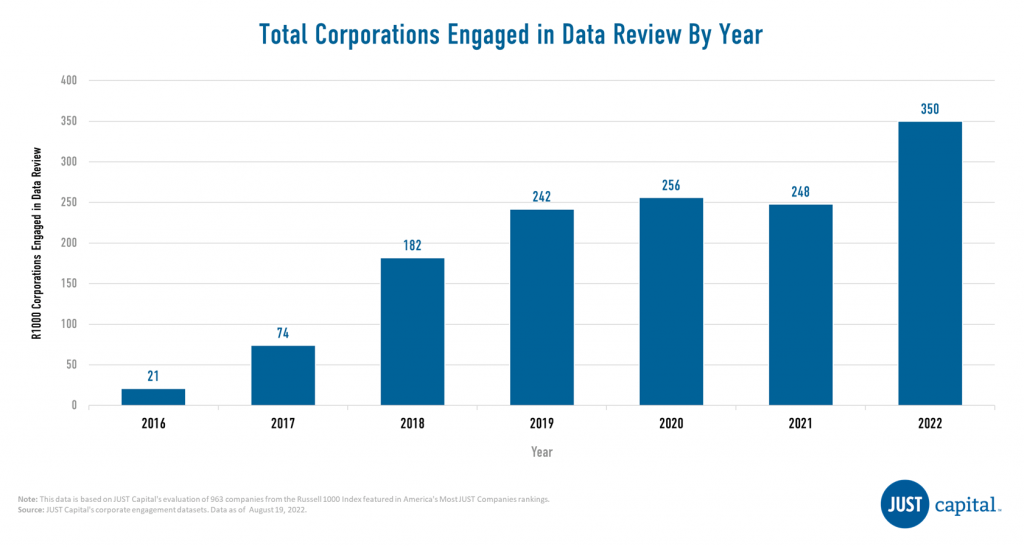
JUST has engaged a majority of the Russell 1000 companies, 82%, that have taken the actions listed above this year from our inception. Overall, we’ve engaged with over 60% of Russell 1000 companies since 2016, including through our Rankings of America’s Most JUST Companies. As the chart below shows, in 2016, our first-ever Rankings year, 21 companies reviewed the data that powers our Rankings – and took advantage of the opportunity to understand our methodology and submit suggestions or updates. Last year, we hit a record of 350 companies. Earlier this month we had 388 registrants across nearly 300 companies for our annual preview webinar, another record – and up 38% from this time last year.
All signals point to more interest and engagement from companies becoming more just this year.
Following last year’s data review period, we also conducted a survey of Russell 1000 companies that found a majority agreed that engaging with JUST helped inform and/or prompt implementation of new practices or disclosures on the issues we track, measure, and analyze. Those companies already leading on justness are also outperforming their peers. The 2023 JUST 100 (our top-ranked companies) had a 4.5% higher profit margin, 2.3% higher return on equity, and paid five times more in dividends compared to the rest of the Russell 1000. Learning from our Rankings, through the data review process for instance, is only the first step companies can take in engaging with JUST.
Over the last three years, we have launched three anchor initiatives designed to support large companies and business leaders seeking to ensure both their business and workers thrive. Through our Worker Financial Wellness Initiative, Corporate Racial Equity Alliance, and Corporate Care Network, we provide access to timely and informative resources and support on action planning through assessments, the opportunity to meet and learn in a peer community of practice, and receive guidance and technical assistance from a network of leading organizations and firms.
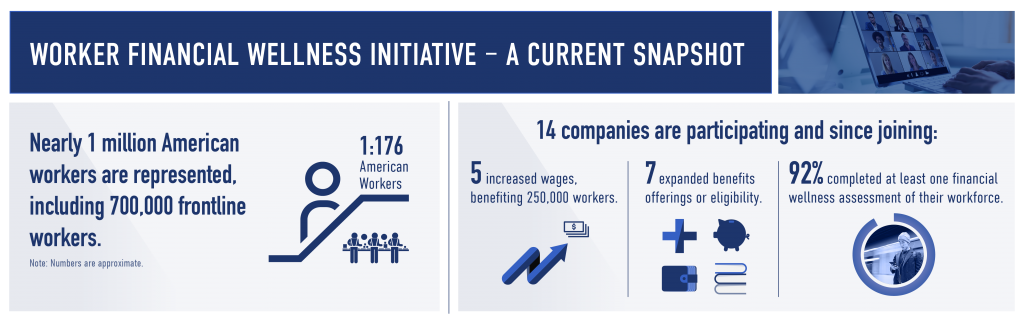
Through the Worker Financial Wellness Initiative, we’ve heard firsthand from workers at Chipotle, PayPal, Prudential Financial, and Verizon on how the investments their employers have made in them have positively affected their lives and livelihoods, as well as executives regarding how those investments have propelled positive business outcomes including increased engagement, productivity, customer satisfaction, and lower turnover.
In addition to the changes we tracked in company actions, we also examined how shareholders used JUST data and initiatives in their 2023 proxy season proposals. Across the Russell 1000, we found four shareholder proposals that cited JUST polling data, analysis, and other tools covering issues including wage increases and racial equity. These proposals came from investors at major companies in the Retail, Food, Beverage & Tobacco, Capital Markets, and Automobiles & Parts industries.
While these proposals were developed independent of JUST’s input, through our regular analysis we’ve observed an uptick in corporate disclosures when investors start to ask for more data. Workforce demographic disclosure is one example. Amid campaigns from institutional investors and an increase in shareholder proposals, our analysis found that EEO-1 disclosures (and other similar intersectional workforce diversity reports) more than tripled between 2021 and 2022 among the Russell 1000. We’ll continue to track what issues are gaining traction in shareholder proposals and how that might affect corporate actions and disclosures.
We also continue to monitor the market performance of the companies that perform best in our Rankings. In June, we celebrated the five-year anniversary of the JUST ETF, which tracks the top 50% of companies ranked by JUST Capital across all industries and is powered by our proprietary JUST U.S. Large Cap Diversified Index (JULCD). The JULCD has outperformed the Russell 1000 by 8.78% since inception through May 31, 2023.
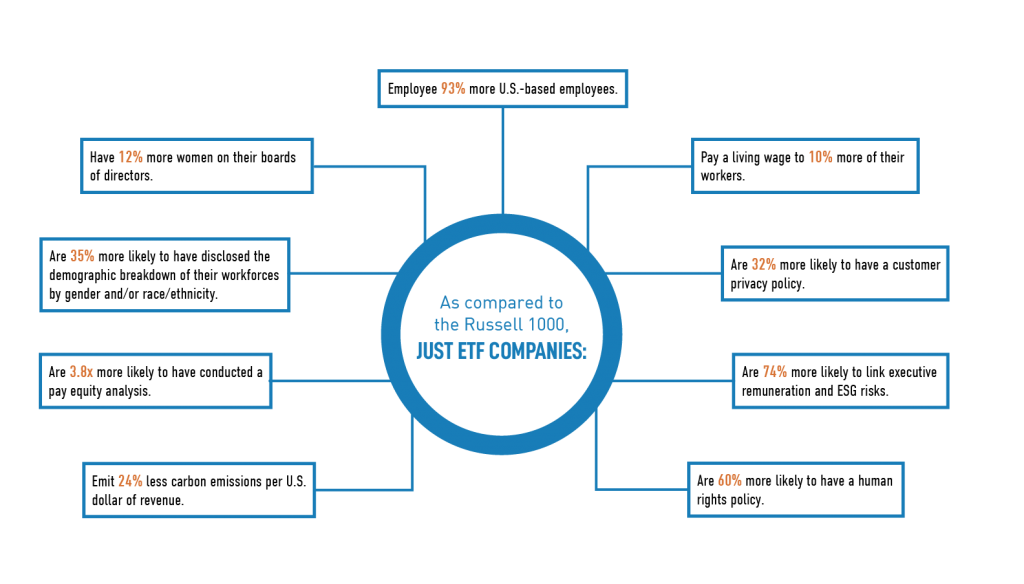
Companies in the JUST ETF also outperform their peers on key stakeholder performance metrics like paying a living wage, creating jobs in the U.S., and providing paid parental leave.
In addition to investors, nonprofits and civil society are increasingly using both JUST data and insights to inform their own work and insights into the state of play on corporate leadership. As part of the Corporate Racial Equity Alliance along with FSG and PolicyLink, we’re using JUST’s data and insights on diversity, equity, and inclusion (DEI) to inform the development of standards to measure corporate action to advance racial equity. The process for developing these standards has included input from 300 individuals including social movement leaders, equity and sustainability experts, and academics.
As we continue to track corporate stakeholder behavior, this work is connected to engaging with some of the largest U.S. companies to drive change on the issues that matter most to the people who work for, buy from, and invest in them. Through our Rankings of America’s Most JUST Companies, programmatic initiatives, JUST Jobs Scorecard, and other tools, we’ve helped guide companies on how they can improve their performance and encourage disclosure of their progress along the way.
This update marks the first in a series of snapshots we plan to take of “real-time” action from Russell 1000 companies – keep an eye out for future editions. The actions captured here reflect one facet of how JUST Capital works to build a world where business and markets are a force for good, driving competition to build a better future for all. For more detail on how we drive change, explore the insights on our Mission & Impact page, subscribe to our weekly newsletter, or reach out to us at corpengage@justcapital.com.

JUST Capital is pleased to announce that Sushmita Banerjee, Managing Director & Senior Partner at Boston Consulting Group (BCG), and David Kamenetzky, Co-Founder of K4 Family Investments, have joined our Board of Directors. Banerjee and Kamenetzky are two of ten new members to have joined the JUST Capital Board over the past two years, and bring expertise in corporate strategy and growth to this group.
Banerjee has held several leadership positions throughout her 15-year career with BCG, and since late 2021 has served as the global leader of the firm’s Strategy business. She works with clients on strategy, growth, organization, large-scale transformation, operational improvement, total shareholder return, post-merger integration, and digital identity. She also currently sits on the North American leadership teams of BCG’s People and Organization and Transformation practices. Banerjee is a core member of BCG’s Social Impact practice as well, helping advance clients’ goals in a sustainable manner.
Kamenetzky is a values-based leader in the food and beverage industry. He previously served as Chairman of JAB Investors, Chief Strategy and External Affairs Officer at AB InBev, and member of the Mars’ management team. A life-long advocate of combating antisemitism and hate, he was also founding chairman of one of the largest European foundations for Holocaust remembrance and democracy promotion.
Banerjee and Kamenetzky join JUST Capital following the launch of our JUST Jobs Program in September 2022, integrating and building upon our pre-existing initiatives: the Worker Financial Wellness Initiative, Corporate Racial Equity Alliance, and Corporate Care Network, to help companies take action on job quality. In March, we also released an initial version of the JUST Jobs Scorecard – a tool that helps corporate leaders benchmark job quality performance.
“Sushmita and David are leaders when it comes to forward-thinking strategy, sustainable growth, and innovative investments. We’re thrilled to welcome them to the JUST Board, and especially fortunate to do so at a time when our own strategy further focuses on the direct and indirect influence we have on just corporate behavior, and the American worker in particular,” JUST CEO, Martin Whittaker, said.
JUST Capital welcomes Banerjee and Kamenetzky at a crucial moment as we approach our 10-year anniversary. Their expertise in corporate strategy, social impact, and human capital will be critical to JUST as we continue to strategize and measure our impact as an organization over the next ten years and beyond.
We continue to expand and diversify our Board following a commitment we made in 2020 which includes applying a diversity, equity, and inclusion lens on our recruitment; committee structures; bylaws and practices; and onboarding and offboarding procedures.

Philanthropy plays a pivotal role in American society, helping to uphold, safeguard, and support some of our most important traditions, institutions, and key social and environmental causes. In 2021, Americans gave a record $485 billion to a multitude of good causes, making us once again among the most philanthropically generous people on Earth.
Why then do we seem to be unable to make a dent in some of our most pressing economic and social problems? Why are poverty rates so stubbornly high? Why does the U.S. routinely fall below other developed nations on literacy, education, and health outcomes? Why is economic inequality so rampant in the U.S. versus other countries?
The truth is that tackling the root causes of our most intractable societal challenges requires a new way to think about philanthropy. Specifically, it requires transformational philanthropy that’s focused on the systems that are creating and compounding these root causes. Often, we see philanthropy interact with and support broad-based public policy change, or make specific, tangible interventions in one area or another. But there’s something vital missing. And that’s a push to catalyze the private sector to do more of the heavy lifting.
The math is obvious: At $21.6 trillion, the private sector is more than four and a half times the size of the public sector and 44 and a half times bigger than the philanthropic sector. Just as importantly, however, focusing on the private sector helps create a leverage effect so these vast resources can be marshaled to help us solve our greatest challenges, rather than exacerbate them.
Consider this: 165 million Americans work. It’s one of the major through-lines of the American experience. The workplace connects people, families and communities in every county in the country. How people earn a living is directly connected to societal outcomes.Yet JUST research focused on the top 1,000 public U.S. companies shows that 51% of those workers still don’t earn a family sustaining living wage at the local county level. If the 50 largest companies alone increased their minimum wage to a local living wage, we’d lift up roughly 10 million families and boost economic growth. If we shifted a mere 1% of private sector capital flow in a more just direction, that’s still more than $600 billion a year being channeled to support higher wages, better benefits, stronger communities, better protection of human rights and the environment, and more.
Imagine if we could get companies to improve job quality and invest more in their people. Think of the incredible social and economic benefit we would see if workers today had enough to support their families, put food on the table, cover childcare and preventive care, buy a home, save to send their kids to college, and begin to build wealth for the future.
Imagine if we could incentivize companies to invest more in the communities where they operate – to prioritize veterans and second chance hiring, ensure equality of opportunity within every workplace, support women- and minority owned suppliers, and invest in better healthcare and community education.
Imagine if we could get companies competing to do more to lower greenhouse gas emissions, reduce their environmental footprints, develop solutions to climate risk, protect fragile ecosystems, and safeguard water and land quality.
All of this is good for business, and good for society. This is JUST Capital’s vision – to drive competition and change within the country’s largest corporations to build more just business practices, and through that, a more just society.
To bring our vision to life, we focus on the 1,000 largest publicly traded companies in America. They create jobs for tens of millions of people; affect the lives of hundreds of millions; touch communities and supply chains across the U.S. and around the world; and have enormous social, political, and environmental influence. They set the agenda for best practices and social norms for business throughout the country and the world.
Transformational philanthropy doesn’t produce change overnight. It requires patience, creativity, and commitment. It requires more complex system thinking. It requires proponents to form communities of practice and to forge unlikely alliances and collaborations. But when it works, it produces lasting change at real scale.
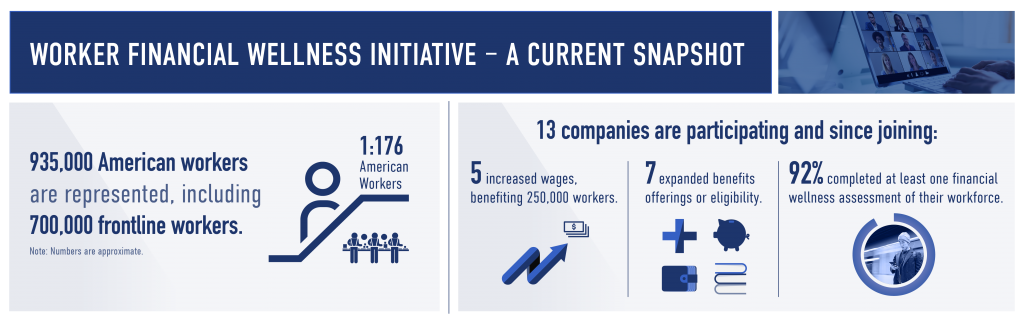
At JUST Capital, for example, over the last several years we’ve seen over 120 companies lift wages, benefiting 6.5 million workers. Over 350 companies now disclose conducting pay equity analyses (up from 132 in 2018), which is essential for fair pay practices to become the norm. Our Worker Financial Wellness Initiative comprises 13 corporations representing 935,000 workers, of which 12 have completed at least one financial wellness assessment of their workforce, five have announced wage increases for hourly workers, and seven have implemented new or expanded benefits programs.
Because we focus on the whole system, we also work closely with the media – our partnership with CNBC gets data on how companies are doing on these issues in front of millions of business and financial professionals on a regular basis – and with investors, so we drive capital to just companies as an incentive. We support 11 different investment products, including the JUST ETF, and we’re now working with some of the largest asset managers and asset owners in the country.
That’s just a snapshot of the transformational impact we’ve already achieved through our corporate engagement, partnerships, investor work, and more (take a deeper dive here). And, at JUST, all of this is grounded in the American public’s priorities. Our polling and public opinion research gets to the heart of what everyday Americans want companies to tackle – mainly, paying a fair, living wage and investing in workers. We use this as a base to incentivize change from the country’s largest employers, and partner with media outlets, nonprofits, and academics, and investors.
Taken together these efforts create a mutually-reinforcing suite of activities in support of systems change.
To be truly effective, transformational philanthropy also needs to be structured a bit differently.
It must have a scalable funding structure. That’s why, in JUST’s strategy, we are working to create pathways for funding flows from the corporations and investors we engage, in addition to increasing support from foundations, individuals, and other partners. In this model, philanthropic support is used to build the systems that will create a future funding flywheel, in much the same way that catalytic venture funding can help for-profit startups achieve financial sustainability.
It must also bring together people and partners who can provide more than simply grant money. It needs creative problem solving and expertise from those who understand the power of industry, believe in capitalism as a force for greater good, and see wealth and capital as a means to an end.
One of our longtime supporters, Darren Walker of the Ford Foundation, often points to a particular quote by Rev. Dr. Martin Luther King, Jr. when he talks about philanthropy, one that I believe embodies a transformational approach: “Philanthropy is commendable, but it must not cause the philanthropist to overlook the circumstances of economic injustice which make philanthropy necessary.” It is these circumstances that transformational philanthropy seeks to address. And unless and until the private sector is inspired to do more, traditional philanthropy will continue to fight an uphill battle.
To learn more and explore ways to get involved, please connect with us. An investment in JUST Capital will generate high-impact outcomes for workers, communities, and society at large, leveraging the power of business as a force for greater good – and transformational philanthropy – in America.

JUST Capital is pleased to announce that Holly Gordon, Chief Impact Officer at Participant, has joined our Board of Directors. Gordon is the eighth board member JUST has welcomed over the past year, and brings with her a wealth of experience and expertise in narrative change, strategic partnerships, and creative production.
Gordon joined Participant – the production company behind films including American Factory, Just Mercy, and Roma – in 2017 and leads its social impact strategy, helping accelerate the company’s work to tell stories that inspire positive social change through strategic partnerships and global, multi-year campaigns. Prior to Participant, Gordon co-founded Girl Rising, a global girls’ education campaign, and served as an Executive Producer of the award-winning documentary that sparked the initiative. In 2012, Forbes named Girl Rising the Most Dynamic Social Initiative of the year.
Gordon brings a crucial eye to JUST’s efforts to redefine corporate success beyond solely financial performance. Our new partnership with CNBC will work to arm executives and investors with the data and analysis needed to understand, and incentivize, corporate leadership in a stakeholder-driven economy. And, as our polling has shown, help provide the American public with the transparency and accountability they’re looking for from corporate America.
“Over the years at JUST, we’ve come to understand that moving from a shareholder-focused model of success to an integrated, stakeholder-driven model is just as much a narrative shift as it is an economic one,” JUST Capital CEO Martin Whittaker said. “We’re thrilled to have Holly’s expertise on our board to help accelerate a wider change, backed up by the right data and insights, in how we view corporate leadership.”
Gordon is a member of Fast Company’s League of Extraordinary Women and one of Newsweek’s/The Daily Beast’s 125 Women of Impact. In 2015, she was named a Presidential Leadership Scholar. Gordon currently also serves on the boards of MAKERS and Girl Rising.
“We’re honored to have Holly’s leadership on our board at such a critical time for JUST as an organization and for the stakeholder capitalism movement broadly. We look forward to working together to build greater understanding of what stakeholder-driven corporate leadership through the pandemic recovery looks like,” Laurel Britton, chair of our Board’s Nominating and Governance Committee, said.

JUST Capital is thrilled to share that Dr. Jason Wingard, President of Temple University and Founding Partner and Chairman of The Education Board, Inc., has joined our Board of Directors. Dr. Wingard joins us on the heels of a major board expansion we began in June – at which time we invited six new members onto our Board – and brings with him extensive expertise in the areas of organizational strategy, leadership development, and the future of work.
In addition to his role as President of Temple University, Dr. Wingard also holds a dual appointment as Professor of Policy, Organization, and Leadership and Professor of Human Resource Management – and prior to his time at Temple, served on the faculty of Columbia University, the Wharton School at University of Pennsylvania, and the Stanford Educational Leadership Institute at Stanford University. Outside of academia, Dr. Wingard also served as Managing Director and Chief Learning Officer at Goldman Sachs, developing strategy for and implementing leadership development solutions for the firm’s partners, global workforce, and clients.
Dr. Wingard’s experience comes to us at a crucial moment, as we deepen our focus on human capital disclosure (bolstered by the SEC’s increasing prioritization of these issues), provide guidance to C-suite leaders on how to advance racial equity, and work to make workers’ financial well-being a C-suite priority, shaping an equitable and inclusive recovery from the COVID-19 pandemic.
“Jason is an incredible leader, who will bring a unique blend of experience, expertise, and insight to the JUST board. We are beyond thrilled to welcome him to the organization,” shared JUST Capital CEO, Martin Whittaker.
“We’re thrilled to welcome Jason to our Board. His commitment to JUST’s mission of creating an economy that works for all and his expertise in leadership will be of great value to the organization in this period of growth and opportunity,” Laurel Britton, who chairs the Board’s Nominating and Governance Committee, said.
JUST Capital has recently joined forces with Laurel Strategies for Building a Just Future – a new live event series where we’ll explore how we can collectively build better together, coming out of the coronavirus crisis.

Our first session hosted on Yahoo Finance – Protecting Health, Safety, and Economic Security – convened top leaders for a discussion around the pragmatic steps we need to take to reopen our workplaces while protecting the health and safety of workers, customers, and communities, as well as a look at the latest data from our COVID-19 Corporate Response Tracker. JUST CEO Martin Whittaker was joined by:
Alan H.H. Fleischmann, Founder, Chairman & CEO, Laurel Strategies
Julie Hyman, Anchor and Co-Host, “On The Move,” Yahoo Finance
Raj Shah, President, The Rockefeller Foundation
Hans Vestberg, Chairman & CEO, Verizon
Watch the replay here:
