

The past year has put workers squarely in the spotlight for corporate America. Whether it was return-to-office plans, strikes, or the impacts of AI, corporate leaders have needed to turn their attention to their workforce in 2023. JUST Capital’s own polling reflects that, with worker issues once again topping the American public’s priorities when it comes to just business behavior.
As the year winds down, we turned to the leader on the Workers stakeholder in our 2023 Rankings – Bank of America – for insight into its workforce investment strategy, which includes the industry-leading move to recently raise its minimum wage.
In a recent episode of our ongoing LinkedIn Live interview series, “JUST Better Business,” Bank of America Chief Human Resources Officer Sheri Bronstein spoke with JUST Capital CEO Martin Whittaker about how the company approaches its people strategy and why it’s been a boon for business. To Bank of America, the number-one overall company in our 2023 Rankings, prioritizing workers is part of operating sustainably, Bronstein said. Watch the full interview below and read on for our key takeaways from the conversation.
Bronstein emphasized that data is the foundation for all of Bank of America’s HR decisions, from raising wages to expanding mental health support to investing in diversity, equity, and inclusion (DEI) practices. “I have an incredible data and analytics team that really sits behind all of our HR processes and services and products and helps us analyze and make sure that we’re using every dollar of that investment in the best way possible,” she said.
When it comes to DEI, Bank of America has disclosed its EEO-1 data since 2013 and uses it to guide practices and policies. “Here in the U.S., we really look like the communities and the customers that we serve,” she said of the bank’s 18% Hispanic and 13% Black employees. Data also grounds its work to advance women’s leadership in the company. Women make up over 50% of employees at Bank of America, with women comprising almost 40% of its management team and over 40% of those at the top levels of the company, she said. Bronstein also pointed to Bank of America’s own research that found that S&P 500 companies with at least 25% women executives saw higher returns on equity than the overall index.
Data from employee feedback also plays a role, Bronstein said using the company’s investments in mental health resources and support as another example. Following company-wide surveys conducted a few years ago, Bank of America began enhancing its benefits around mental health care and working to break down stigmas around mental health using the voice and influence of its leadership. It’s something that Bronstein said she’s grateful the company prioritized before the pandemic hit, because of the input of its employees.
While Bank of America employs over 210,000 individuals, Bronstein often considers the impact of the company’s decisions beyond its immediate workforce. “We help our customers live their financial lives every day and so it’s so important to us that our teammates, especially as you mentioned those in the lower compensation categories, that they have more than a living wage. We want them to make sure that they feel comfortable and that they can take care of their families,” she said of the company’s decision to raise its minimum wage to $25 per hour by 2025.
Since 2010, Bank of America has raised its minimum wage by 121%, and for over a decade hasn’t raised healthcare costs for employees earning under $50,000 per year. It’s employees’ families that motivate Bank of America to do right by their workers, Bronstein said.
“Every day we come in and we think about our 210,000 plus employees, but we also take care of their families. It’s almost a million people that I have the honor every day to think about – ‘how do we help them live their personal lives, their professional lives?’” she said.
This mindset has also played a role in the company’s DEI work. As part of Bank of America’s $1.25 billion commitment to advancing racial equity, the company has invested in low-moderate income communities in the 90 markets it operates in across the country. In partnership with nonprofits and Bank of America’s market leadership, the company ensures that whether it’s investing in private equity, jobs programs, or health care systems, that these investments serve the needs of low-moderate income communities and embrace diversity, Bronstein said.
For Bank of America, investing in its workforce has led to higher employee satisfaction and lower turnover, Bronstein said, noting that she believes 2023 will see record-low turnover for the company. Part of that stems from its commitment to providing training and re-skilling programs that promote long-term growth at the company. Bank of America tries to bring in talent at the entry level, Bronstein said, and help them build skills and learn over time.
The company does this through Pathways – its community hiring and development program – The Academy – its internal learning and development platform – and its college recruiting process. “Helping people build skills and be able to choose many different careers over the course of a lifetime, that is something that we think has really helped us continue to invest in women and our diverse talent in particular, but all of our employees,” she said.
Bronstein sees Bank of America as a company that’s always valued its teammates, a mindset that has become increasingly valuable through the labor market shifts of the last few years and will surely continue to be through 2023 and beyond.
For Shanelle Forde, an Associate Software Developer at Prudential Financial, the most important role in her life is that of mom. “What’s important to me, at the top of my list, is my son,” she said. Working at Prudential, in her own words, “absolutely allows” her to be there for her son, without having to worry about how she’ll make ends meet.
Shanelle is just one of the nearly 1 million employees represented through companies participating in the Worker Financial Wellness Initiative, which helps companies take steps like raising wages or expanding access to benefits to bolster the financial health of their employees. To learn how those actions have impacted their lives and livelihoods, we set out to hear from workers firsthand through a compelling new video series.
This is Shanelle’s story:
Shanelle, a single mother, first came to Prudential through the company’s partnership with Year Up, an organization working to increase access to job and education opportunities for young adults. After six months of classroom training, Shanelle joined Prudential for a six-month internship and has been with the company for four years since. During that time, she’s had the opportunity to complete leadership and software training that have allowed her to level up in a way she’d never been able to before.
“One of the biggest differences I notice from my other jobs and Prudential, is how supported we are as employees,” she said. “When you support your workforce, your workforce absolutely supports you.”
Importantly, Prudential’s support allows Shanelle to come into work and focus on just that – work. A big part of that came from the company’s efforts to increase its employees’ financial literacy, she said, including access to tools to plan out retirement and other savings goals. Having that knowledge and support has been transformational for Shanelle.
“It has allowed me to be a better parent,” she said. “But it also allows me to be a better worker because now when I come to work, I’m happy. I don’t have to focus on those things like, ‘oh, how am I going to pay my rent?’ I can just come to work and focus on the work.”
Providing these resources and support for its employees also aligns with Prudential’s core business, Lata Reddy, Senior Vice President of Inclusive Solutions at Prudential shared with us. “As a company, our purpose is to make lives better by solving the financial challenges of our changing world. That’s why we provide a robust suite of benefits and tools that includes savings, physical and mental health benefits, dependent care resources and financial wellness offerings like tuition reimbursement to support employees to be more financially secure,” she said.
Listening to and acting on employee experience is becoming increasingly important. The stories of workers like Shanelle are a potent reminder of the power that companies have to create meaningful change for their workforce. And Prudential’s leadership is recognizing that this ultimately translates into business success.
“A decade’s worth of research shows that when workers are more financially secure, key business outcomes improve such as productivity, customer satisfaction, and employee turnover and engagement. We have been creating financial wellness tools for employers and customers since we were founded almost 150 years ago,” Reddy said. “Shanelle is a shining example of how employees can thrive with the right support and resources.”
Hear from other employees about the impact worker financial wellness programs have had on their lives:
The Worker Financial Wellness Initiative is a vibrant and growing community of business leaders dedicated to improving the financial health and security of their workers. The Initiative includes peer learning opportunities for C-suite leaders; creating resources and events for HR and compensation professionals; providing direct assistance to companies on how to develop and deploy a Worker Financial Wellness Assessment, and use it to identify areas for improvement and immediate next steps; and public opportunities to celebrate corporate leadership.
To learn more about the Initiative and how you can join, click here.

This report was written by Rachael Doubledee, Senior Research Manager at JUST Capital, and Daniel Krasner, Research Manager at JUST Capital.
The impact of the U.S. Supreme Court’s decision to ban race-conscious college admissions, or affirmative action, has been playing out across corporate America. The ruling has added fuel to the anti-DEI backlash, placing leadership at some of the largest companies in the United States in a challenging position. Early indicators of this pressure have started to show – U.S. executives are openly speaking about their company’s diversity, equity, and inclusion (DEI) less frequently.
Despite this, JUST Capital data shows that the business and investor case for this work – one key area of which is supplier diversity – remains strong. Implementing programs aimed at doing business with minority- and locally-owned suppliers is an important way companies can advance racial equity and bolster their business, according to many esteemed corporate leaders, advisors, and researchers. Supplier diversity programs may face their own challenges following the Supreme Court’s ruling, but experts underscore that they remain core to building brand value and driving inclusion.
We’d previously tracked whether or not companies have supplier diversity policies in our annual Rankings of America’s Most JUST Companies. We expanded our approach in 2023 and started tracking diverse supplier spend – examining whether companies shared how much they spent with diverse suppliers rather than just a policy to do so. Notably, a supplier diversity policy is also a requirement of federal government contractors and we focused our tracking on spend to see if companies were going beyond compliance in this space. To examine if, and how, companies were following through on their stated commitments to spend with diverse suppliers, we looked at disclosures of both supplier diversity policies and spend among a subset of the Russell 1000 included in both our 2022 and 2023 Rankings.
We found that while a slight majority of companies (53%) in the Russell 1000 in both 2022 and 2023 disclose a supplier diversity policy, less than half of that group (22%) shares how much they spend with these contractors.
While spend is less commonly disclosed than a general program to promote supplier diversity, policies are not enough to convey action. We previously measured supplier diversity policy (not including spend) in three categories – diverse, veteran, and local suppliers. In our 2023 Rankings, we focused only on spend and expanded our groupings to include more commonly disclosed Small Business Association (SBA) designations by adding woman- and minority-owned suppliers as two additional categories. To understand if and how companies disclose spend in addition to policy, we examined three data points included in both the 2022 and 2023 Rankings: general supplier diversity policy and spend, local supplier policy and spend, and veteran supplier policy and spend.
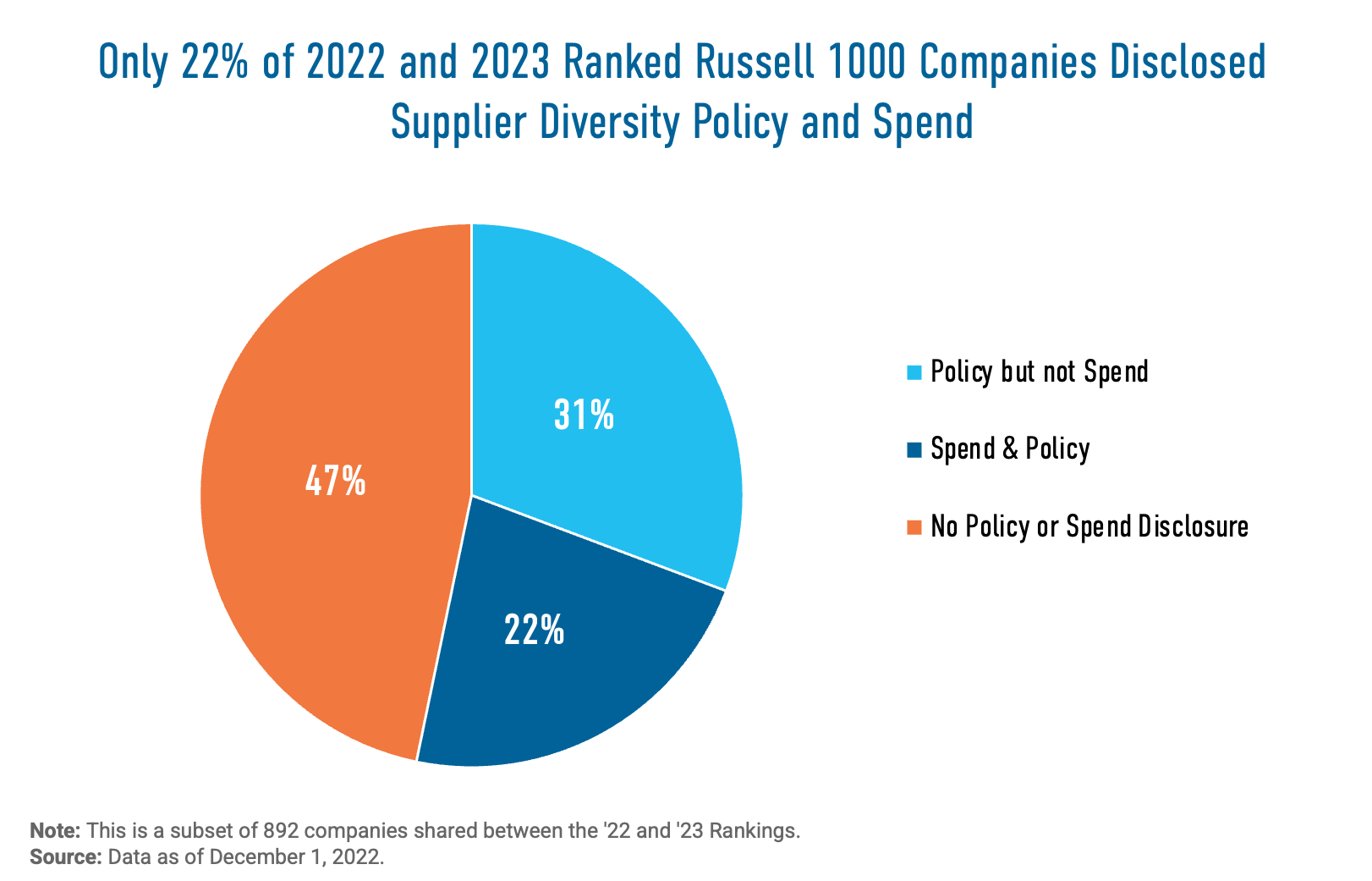
Of the 892 companies ranked in the Russell 1000 in both 2022 and 2023, 22% disclosed spend amounts in any of the three categories and 31% disclosed at least one of the three types of supplier diversity policies, but did not publicly disclose how much they spend with those communities.
Of the companies disclosing how much they spend with diverse suppliers, here’s how their spending breaks down per category:
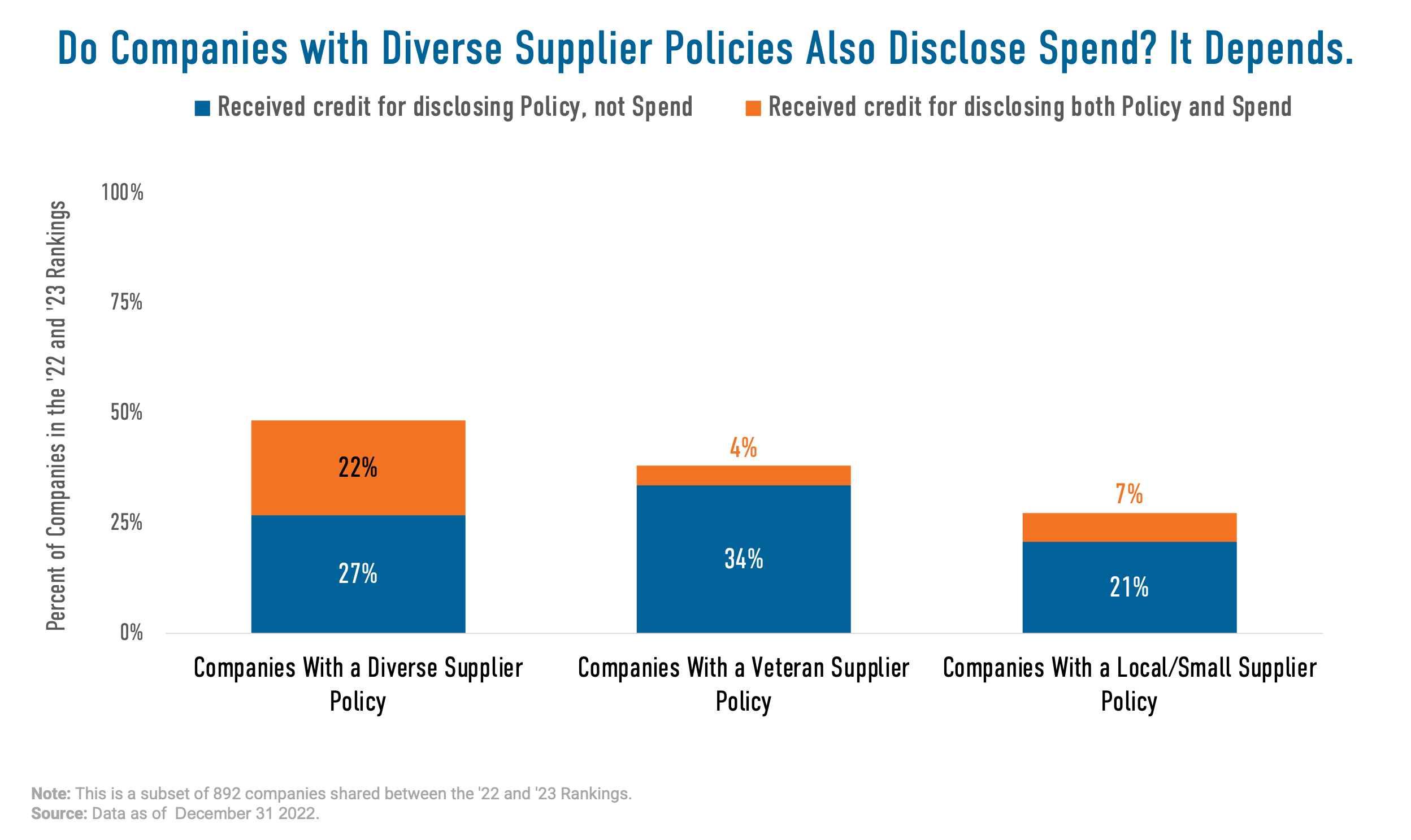
We found that having a policy does not necessarily translate into a clear and actionable spend disclosure. Of the 431 companies that got credit for having a general supplier diversity policy, only 45% disclosed spend. Among the 339 companies that got credit for having a veteran supplier policy, just 12% disclosed spend. In the group of 243 companies that got credit for local business supplier policies, only 24% disclosed spend.
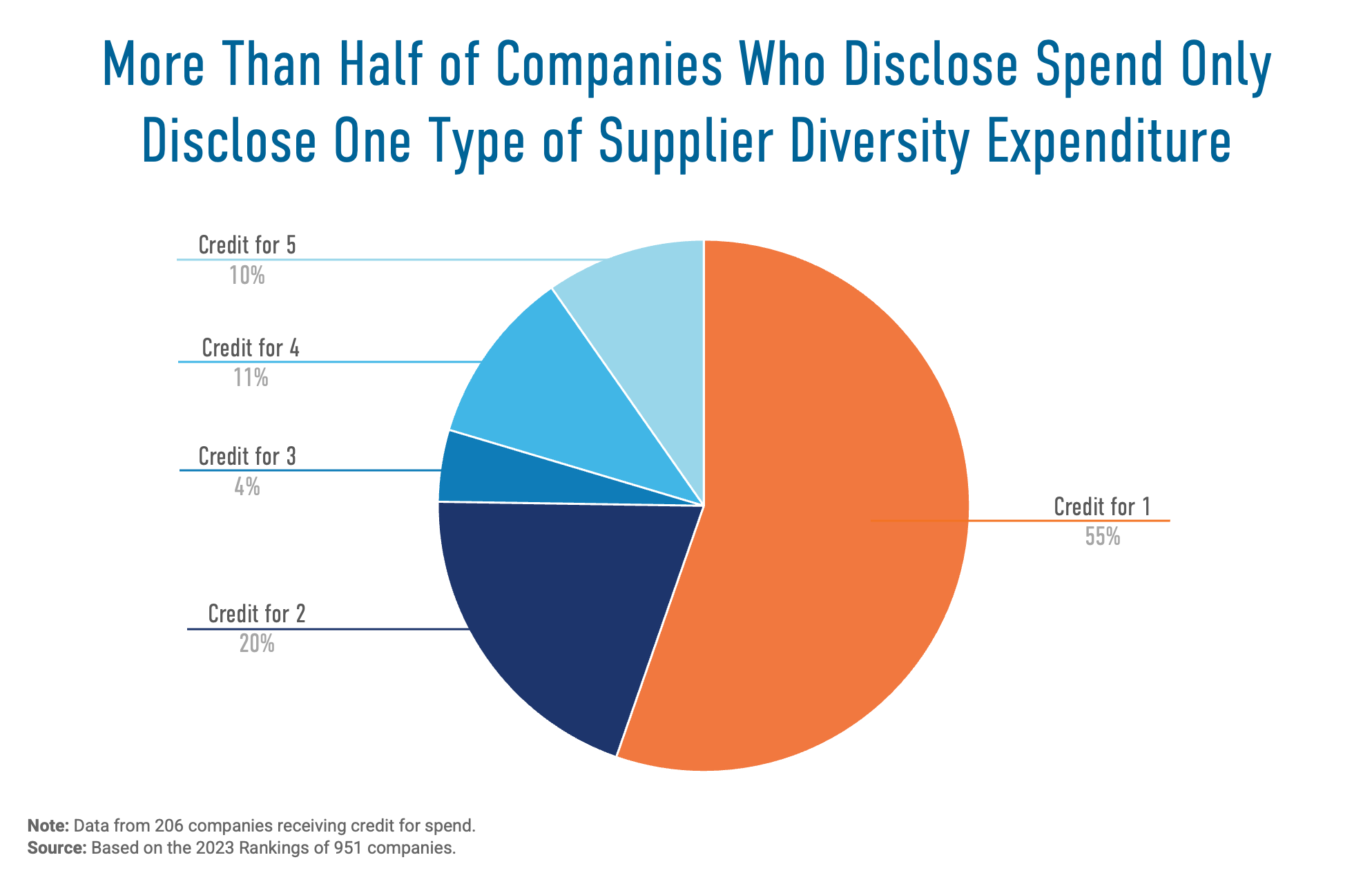
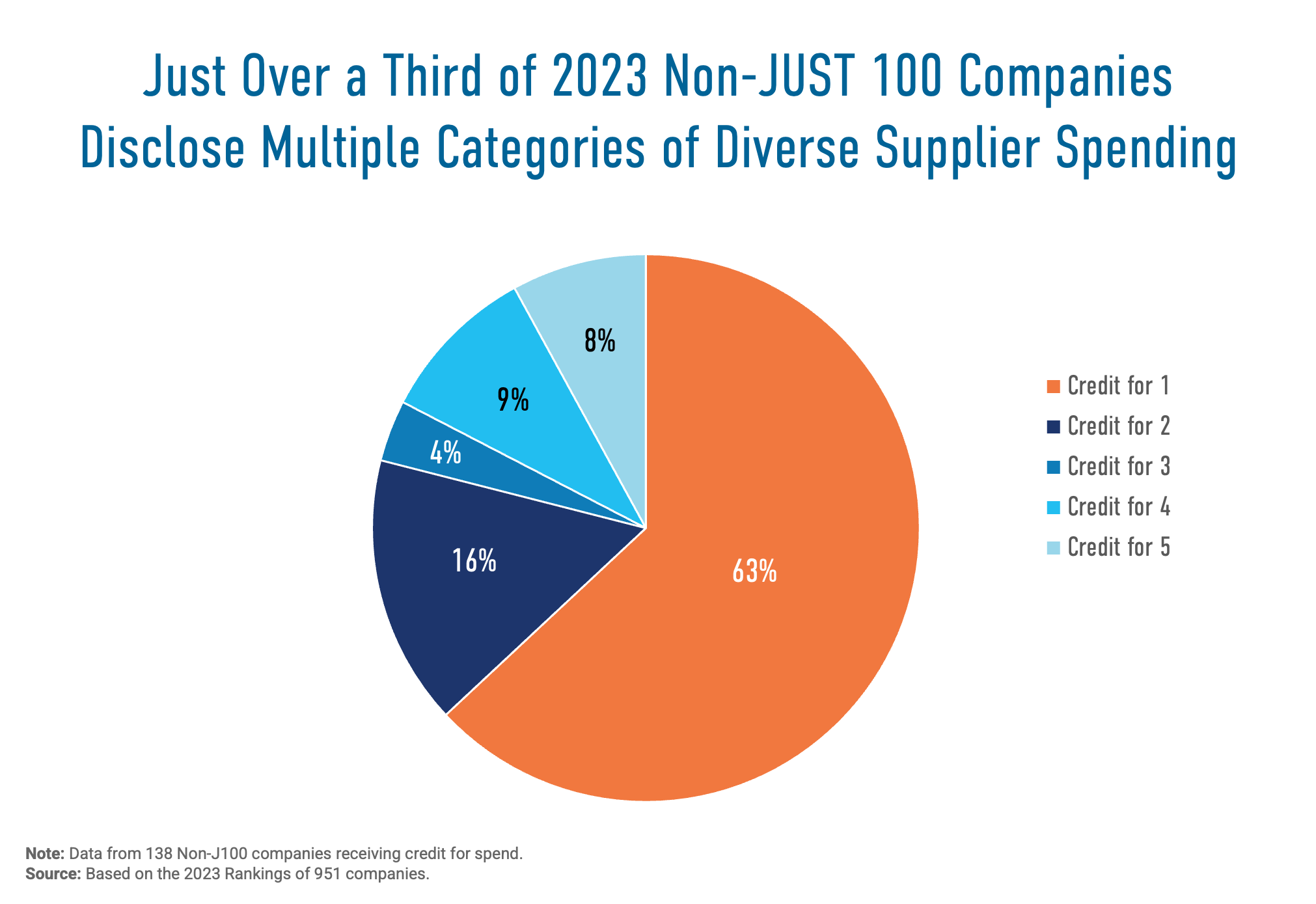
While it is important that companies disclose spending on diverse suppliers, breaking this spending down into categories demonstrates the impact and magnitude of supplier diversity efforts. In our 2023 Rankings, however, companies were more likely to disclose general supplier diversity spend than any of the more specific categories – including women- and minorities-owned suppliers. While 206 of the 951 Russell 1000 companies included in our 2023 Rankings disclose spend in at least one category of diverse suppliers, very few disclosed spending across all five categories, with 55% disclosing one and only 10% disclosing all five.
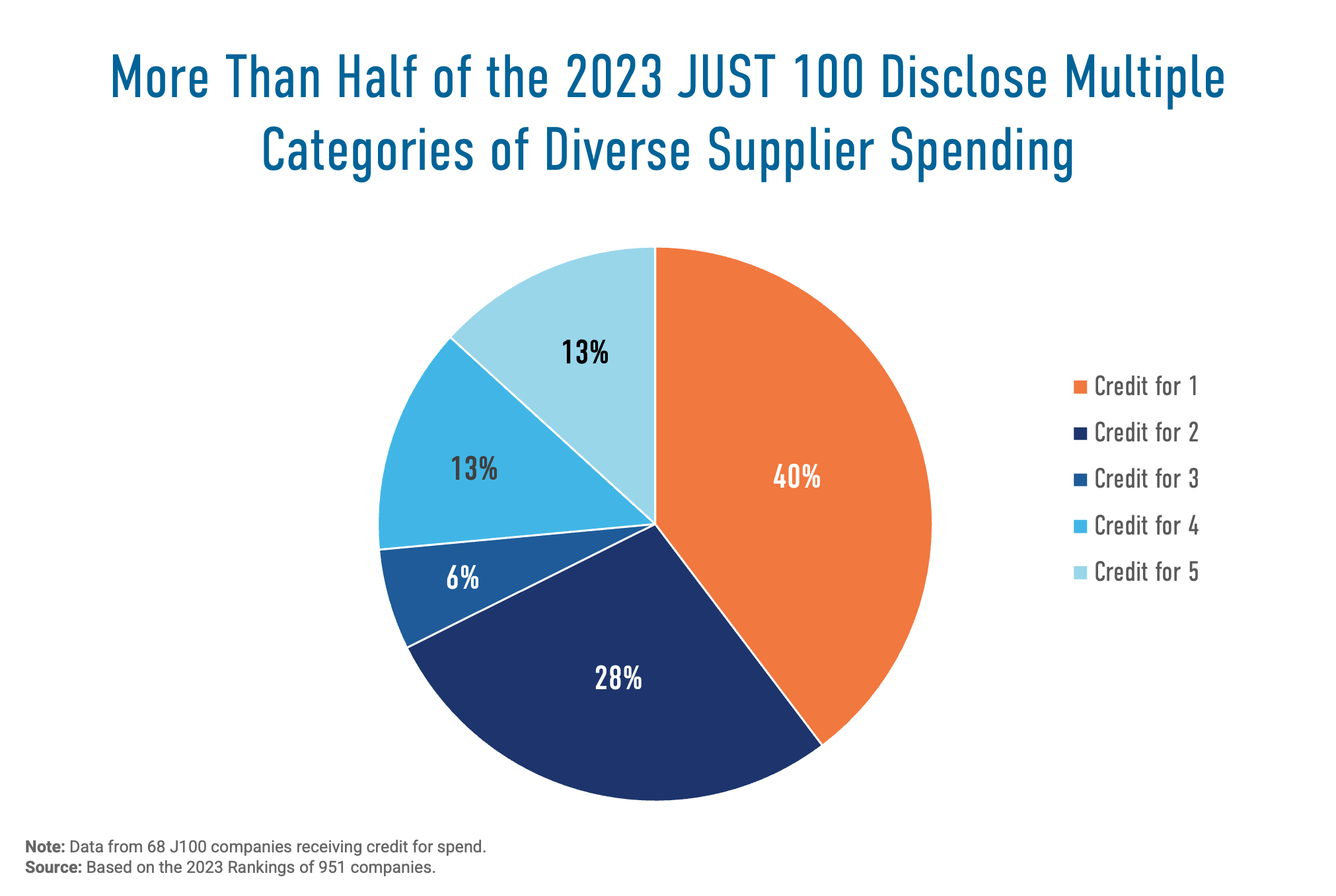
Companies ranked as more just in our 2023 Rankings were more likely to disclose a spend amount than their peers. In 2023, 68% of JUST 100 companies disclosed at least one kind of spending on diverse suppliers compared to 15% of the rest of the Russell 1000. In addition, 60% of 2023 JUST 100 companies who disclosed any diverse supplier spending disclosed multiple categories of diverse supplier spending. In comparison, only 37% of the 138 companies not in the 2023 JUST 100 who disclosed diverse supplier spend disclosed in more than one diverse supplier category.
HP Inc. provides a leading example for companies on supplier diversity spend, particularly with its clear disclosures and engagement with suppliers. Clear disclosures include specific categories, show progress across multiple years, share results, and include future goals. In addition, best practice for companies includes engaging with suppliers, ensuring they can attain certifications, and that they uphold company values. Additionally, ensuring that suppliers are representative in high-margin, high-growth sectors of business partnerships such as financial services is essential in demonstrating commitment to inclusion of people who may have lost trust in a system where they are rarely represented.
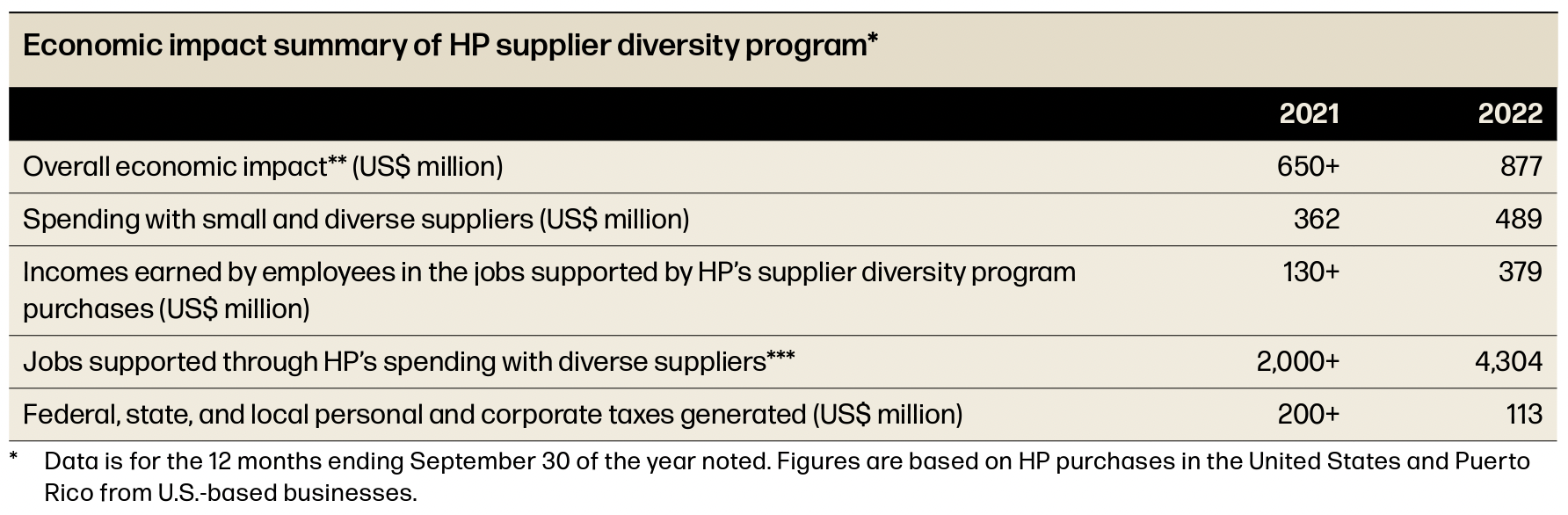
HP leads the way. The company has an active program to engage suppliers and meaningful partnerships and initiatives that support this work. In its annual report, HP clearly discloses spend amounts across all categories, and provides context for spend by breaking down the percent of supplier spending represented by each spend disclosure. The company has also included disclosures over multiple years so stakeholders can transparently see progress over time, and track future targets. This allows HP to demonstrate economic impact throughout its value chain.
Importantly, HP includes diverse business partnerships in high-growth sectors. In finance, HP considers diversity in its banking allocation decisions and partnerships every year, and partnered with Black-, Latino-, women-, veteran-, and disabled veteran-owned banks as part of its bond offering – distributing $100 million in bonds in the process. The company continues to partner with underrepresented businesses in this space, including around short-term borrowing and share repurchase programs.
HP has made similar strides in inclusion efforts with legal partners, where representation and diverse perspectives are important in tackling challenges. HP requires law firms to staff a minimum of one racially or ethnically diverse attorney and one underrepresented minority or woman attorney, and that these partners be responsible for at least 10% of all billable hours.
Firms who fail to meet these requirements have 10% of all invoiced spend withheld. In 2020, HP reported that 93% of their engaged firms met these requirements.
In addition, HP works to support diversity beyond Tier 1 suppliers by requiring their direct business partners and suppliers to spend a minimum of 10% of work contracted on behalf of HP with diverse businesses.
This approach to diversity in business partnerships demonstrates a deep commitment to improving diversity in key industries and across HP’s value chain. Deep and sustained commitments like these show measurable action, but also demonstrate larger economic impact and value.
In our 2022 Americans’ Views on Business Survey, 86% of Americans agreed that companies “often hide behind public declarations of support for stakeholders but don’t walk the walk.” As corporations navigate an environment where commitments and statements made by leadership are more closely followed, they should transparently disclose how they are honoring commitments in a measurable way.
The pledges many companies made in 2020 to advance racial equity have been difficult to track, and may be even more so post-SCOTUS ruling on affirmative action. While this is in part because of political headwinds, it’s also because companies struggle to balance disclosure of measurable and impactful actions with other business needs. If done well though, supplier diversity disclosures are actionable, high-impact opportunities to follow through on diversity commitments while boosting business.
“Companies can, by virtue of what they need to buy to exist, actually lift up Black, brown communities, women business owners in a way that I don’t think they truly understand,” Mellody Hobson, Co-CEO and President of Ariel Investments, said at a JUST-hosted roundtable in 2021. And, earlier this year, Ariel Investments announced it had raised $1.45 billion for Project Black – a private equity fund aimed at converting businesses to be minority-led and positioning them as suppliers to major companies. Supplier diversity makes up one part of an overall integrated business diversity – with workforce, leadership and board diversity as equally important components. However, supplier diversity is one of the more easily measurable ways that companies can demonstrate their commitment to advancing racial equity.
Incorporating a program that increases spending with diverse businesses encourages review of partnerships, introduces flexibility in procurement, and drives up product or service quality while keeping costs competitive. The benefits of purchasing relationships with minority business partners and suppliers extend beyond offered services, and is enhanced when companies can demonstrate that they extend contracts to minority suppliers in high-margin, high-growth sectors of the economy such as financial services, legal services, and technology fields.
These sectors have been traditionally underrepresented by minority suppliers and offer an outsized opportunity to drive both business value and economic opportunity. Introducing competition in these sectors drives innovation, increases competition, and wards off complacency in suppliers making supply chains more resilient and agile.
Incorporating diversity throughout a company’s value chain has numerous benefits for companies. Companies have enormous leverage to ensure success in these spaces, and the resources to do so. Demonstrating deep commitments that go beyond surface promises and show follow through helps companies develop strong reputations and fosters trust.
To dive deeper into JUST Capital’s Rankings, explore our research further, or learn about best practices in supplier diversity, please contact us.

America’s multi-billion dollar supplier ecosystem has slowly been getting more diverse over the past several years, with more top companies allocating million and billion-dollar contracts to suppliers from underrepresented backgrounds.
But the Supreme Court’s recent decision on affirmative action could put that in jeopardy, according to Reggie Williams, chief consultant at Procurement Resources, who’s been in the business for over four decades, having worked with companies like IBM, Delta, Coca-Cola, and Nissan.
Williams – who’s been credited with coining and popularizing the term “supplier diversity” in 1985 – sat down with JUST Capital to discuss the importance of supplier diversity and the potential challenges the recent SCOTUS decision could have on business.
The supply-chain leader said the issue is one all CEOs should consider devoting more time to. Indeed, JUST Capital’s own research shows a number of bottom-line benefits. And our latest analysis finds that while a slight majority of America’s largest public companies (53%) disclose a policy to spend with diverse suppliers, but just 22% disclose the amount they spend with those partners.
Supplier diversity expands the procurement bidding arena to promote broader participation in the procurement process through competitive access. It has become a critical element of customer value in the supply chain process – it drives up the quality of the product while keeping cost competitive, Williams and experts say.
It’s also a cost saving measure. McKinsey found that including Minority and Women Owned Businesses in a procurement strategy can save businesses 8.5% in annual procurement costs. And supplier diversity programs enable companies to connect with communities in meaningful ways, and impact brand awareness and consideration in positive ways, according to Hootology’s Corporate Diversity Index Study.
This interview has been lightly edited for length and clarity.

What potential repercussions do you see for the business community on supplier diversity in the wake of the Supreme Court’s recent decision?
The recent Supreme Court decision on affirmative action in college admissions, while unrelated to the work that practitioners undertake in supplier diversity, has further confused and divided the public on issues involving diversity, equity, and inclusion. Repercussions in the supplier diversity community have already begun.
Clients that we work with among the Fortune 500 have even ordered audits concerning practices and procedures with diverse suppliers to ensure they are legally defensible. In turn, this creates widespread uncertainty and even apprehension among stakeholders charged with ensuring competitive access for underutilized racial and gender business groups. We’re witnessing heightened anxiety in the corporate community.
It seemed that in 2020, CEO support for supplier diversity was so strong, but we’re not hearing about the topic as much in news headlines now. In fact, in our 2022 report, 86% of Americans agree that companies “often hide behind public declarations of support for stakeholders but don’t walk the walk.” Have CEOs scaled back their work on this?
The majority of diverse suppliers – Black, Hispanic, LGBTQ, Asian, Native American, Veteran, Disabled and Woman-owned firms – are already confronting a hostile business environment in the commercial and industrial mainstream that limits their business opportunities. Now they are confronted by this new barrier that questions even the legitimacy of business inclusion as a viable component of supply chain management.
For this reason, national leadership organizations such as the Stakeholder Impact Foundation and The Billion Dollar Roundtable are waging strategic information campaigns to educate a misinformed public over the erroneous proposition that diversity is misguided decision making.
Here are a few key points I’d like to underscore.
Supplier Diversity is not affirmative action. It is a voluntary process driven by marketplace realities: Women are the predominant decision makers of retail and consumer sales, and African Americans and people of color over-index as contributors to the revenue stream in most products and services. The LGBTQ community has a higher degree of brand loyalty than any other demographic group. In addition to reflecting market realities, supplier diversity is an organizational priority that ensures partnership with our broad multiracial, multicultural customer base that is ever changing.
Supplier diversity is a pillar that drives inclusion and creates brand value because there simply is no better way to grow our customers than to be business partners with them – it’s good business.
And lastly, there are multiple major studies confirming the marketplace advantage shared by corporations who practice supplier diversity as a core element of their supply chain strategy, including research by McKinsey & Co. and separate research published in Harvard Business Review.
Talk to me about how not only communities benefit from supplier diversity, but customers, employees, and other stakeholders.
There are a range of benefits derived from supplier diversity. Supplier diversity plants the seed that drives sales. It is made possible through partnerships that generate shared interest, shared purpose, and shared values. It demonstrates a company’s commitment to its mission and values, including ESG, through brand awareness and appreciation. In addition, it ensures regulatory compliance with existing law.
How has supplier diversity changed since the 80s and 90s? And where do you see it going in the future?
The evolution of supplier diversity has been in sync with society’s own evolution. Consider these realities: Minority purchasing programs in the 80s did not include women. Supplier Diversity programs in the 90s did not include veterans. Supplier diversity programs in the early 2000s did not include LGBTQ businesses. These changes evidence the growth in our thinking and our embrace of the power of inclusion as a core principle of stakeholder capitalism.
What would you tell a CEO who is hesitant to advance supplier diversity in a political environment that’s targeted efforts deemed “woke capitalism”?
Any chief executive that does not understand the value of leveraging the customer base through shared participation and shared partnership made possible through shared ownership will not survive as CEO. Companies that embrace their customers must commit themselves to investing in those customers as business partners, not just consumers.
Many corporate leaders already understand the importance of DEI in supplier diversity. They include Walmart, Chase, McDonald’s, Porsche, and others.
To unpack your company’s supplier diversity performance in the 2023 Rankings or gain insights into how to improve on the issues that matter most to the American public, please reach out to corpengage@justcapital.com.

When Dan Hesse became Sprint’s President and CEO in 2007, the company’s business plan had it filing for bankruptcy in six months. Over his seven years in the position, however, things took a turn. Sprint went “from hugely negative total shareholder return to the best total shareholder return of any company in the S&P 500.” The key to the company’s success, he said, came down to investing in its culture.
Hesse – now the Chairman of Akamai Technologies and board member of PNC – recently joined a group of executives from JUST Capital’s Partners and Corporate Supporters for a JUST Insights discussion on how best to build a purpose-driven culture that will, ultimately, set up a business for long-term growth. A JUST Capital board member since 2016, he has decades of leadership experience having spent over 20 years at AT&T and serving as the company’s President and CEO before joining Sprint.
Hesse has always seen purpose-driven culture and leadership as important to business throughout his career, but he recognizes that it’s now elevated and in the spotlight for C-suite leaders. “If you serve all stakeholders, your reputation improves, your customer base improves, employee productivity and retention improve,” he said. “People talk about shareholder capitalism vs. stakeholder capitalism. But the CEOs who think in stakeholder terms achieve the highest shareholder results.”
Hesse joined Sprint nearly three years after the company merged with Nextel. He recalled meeting with people who would, right away, tell him whether they were legacy Sprint or Nextel employees. To build a unified, Sprint-Nextel culture, he knew that he would have to take responsibility as CEO for creating a sense of unity. Hesse asked for the company’s input on ten elements that would make up the company’s culture.
“One of the ten…is going to be accountability. And I as CEO am accountable for culture,” he recalled saying. “I am going to have to walk the talk as CEO or we’re going to have the wrong culture.”
Hesse’s accountability for Sprint’s culture led to one that contained three elements – it was first focused on employees, second on customers, and third on a greater sense of purpose leveraging Sprint’s business model for positive impact. His role in advancing this culture became synonymous with his leadership. Hesse noted that when he retired from Sprint, employees had handouts with the company’s culture elements on them that they asked him to sign. To him, that signaled that culture was the “MVP” of the company’s transformation under his leadership.
“If a CEO is not on board, it’s going to be very, very difficult,” he said. Everybody’s always looking to him or her for all their signals, Hesse noted, emphasizing the tone-setting that comes from the top. When a CEO is not bought into this work, it’s not going to have much impact, he said. “Whether you’re the Chief People Officer or the Chief Sustainability Officer or what have you, you have to convince your CEO to focus on it.”
Once a company has the CEO’s buy-in, leadership needs to treat culture in the same way it would other business priorities, Hesse explained. He’d often hear from corporate leaders that their companies have really strong cultures, but they couldn’t define it. To Hesse, fixing a company’s culture deficit starts with measurement.
“You have to be able to measure it, just like your financial performance, your customer metrics,” he said. At Sprint, employees would complete a survey every quarter rating the company on each of the culture elements they’d previously identified. It was an easy way to gauge performance, Hesse noted, and also to signal that this work was important to the company.
A key way to solidify this importance is to tie it to how time and money is spent in an organization, Hesse added. “People will work on what you spend time on and what you pay for,” he said. A major aspect of Sprint’s culture was customer experience and Hesse noted that in a recurring meeting with his direct reports, customer experience was the first item on the agenda “no matter what.” That, in turn, helped colleagues in levels below theirs prioritize it.
When it comes to pay, Hesse emphasized that getting “cultural and purpose measurements” included at the senior levels is key. At Sprint, he shared that all employees had pay tied to those metrics. The percentages varied – for frontline employees it was a bonus of around $10,000 and for Hesse it was 90% of his compensation. “Everybody has to be involved…in our case, 60,000 employees needed to feel bought into these because if it’s just the job of the Chief Human Resources Officer or just the job of the sustainability office, nothing’s going to happen,” he said.
He noted that this has come up in his board service at Akamai as well, and the company now has metrics related to sustainability and DEI tied to senior leaders’ pay. “Monetarily, they’re not going to make or break someone. But if it’s in the plan, it says this is really important. It sends a message and you’ll get the focus of the entire organization,” Hesse said.
During Hesse’s time as Sprint CEO, the board could see the clear benefit to investing in culture when it came to brand building, he said. Sprint’s focus on culture led to it winning an award from the Reputation Institute as the most improved company in the world, among 1,500 global companies the firm rates. The 2014 American Customer Satisfaction Index recognized Sprint as the most improved U.S. company in customer satisfaction across all industries it evaluates over the previous six years. And that had a clear impact on share price, with Sprint coming in at number one for shareholder return among the S&P 500 in his last two calendar years as CEO, he said.
Hesse recognized that there’s still challenges to getting shareholders on board with this approach. “Shareholders don’t always know what’s in their best interests,” he said. But turning to the long term, instead of quarterly profits, has made the difference in his career.
This conversation occurred at a JUST Insights virtual event – a series of exclusive conversations hosted for JUST Capital’s Partners and Corporate Supporters that feature case studies, unique research and analysis, and engaging, private discussions on critical stakeholder issues with senior leaders from JUST and across our network. The series is just one of a number of benefits available to our Partners and Corporate Supporters. Learn more on how to join this group here or reach out to us at corpengage@justcapital.com.

Calls from both the American public and shareholders for greater transparency into corporate spending on political campaigns and lobbying efforts are not new, but they have grown louder and more insistent in recent years. Corporate America’s response to the attack on the U.S. Capitol on January 6, 2021 brought greater attention to if, and how, companies disclose their lobbying spend and contributions they make to political candidates.
A 2022 survey from JUST, Ceres, and Public Citizen found 80% of Americans think it is very/somewhat important for companies to disclose their political donations and lobbying. And 81% would support federal requirements on political spend and lobbying. Participants in focus groups reaffirmed the importance of greater transparency, suggesting that the American public would trust a company more if they clearly disclosed their actions, including spend on political and lobbying activities. The public wants to see that companies are following through on their commitments – especially as political spend is seen as affecting the regulatory processes that protect workers, the environment, and communities.
Companies’ hesitancy to clearly disclose political and lobbying spend has long been a source of scrutiny from shareholders. Investors have continued to push for more public data as reporting requirements on political contributions vary by state, making clear, detailed information even less accessible. As proxy season gets underway, investors’ focus is only intensifying. A recent report from As You Sow analyzing ESG-related shareholder proposals found one in five were on “political influence,” including lobbying and contributions, second only to climate.
Given this heightened call for transparency – and the opportunity companies have at hand to increase trust – we took a look at if and how Russell 1000 companies disclose their political spend and/or lobbying efforts through public-facing corporate materials.
Across the Russell 1000, our analysis found that 31% of companies disclosed spend for both political contributions and lobbying clearly through their brand’s public-facing online presence. On the other hand, 44% of companies did not disclose both political contributions and lobbying spending. Of the remaining companies, 24% disclosed political contributions, but not lobbying spend. Less than 1% of companies disclosed their lobbying spending, but not their political contributions.
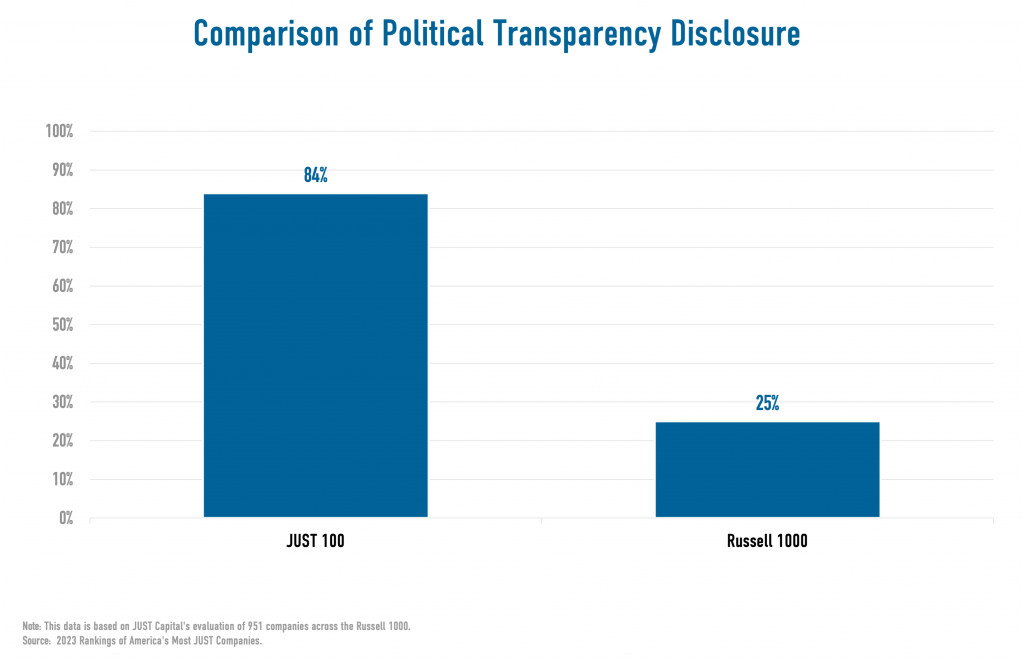
While disclosure of political spending is low across the full Russell 1000 companies within the JUST 100 – the top 100 companies in our 2023 annual Rankings – provided significantly more disclosure on their political spending than the remainder of the Russell 1000. Of the JUST 100, 84% provide disclosure on both political contributions and lobbying spending, compared to only 25% of the companies outside of the JUST 100. Similarly, only 1% of the JUST 100 provide the lowest level of disclosure with no mention of either practice, compared to 49% of the rest of the companies in our Rankings.
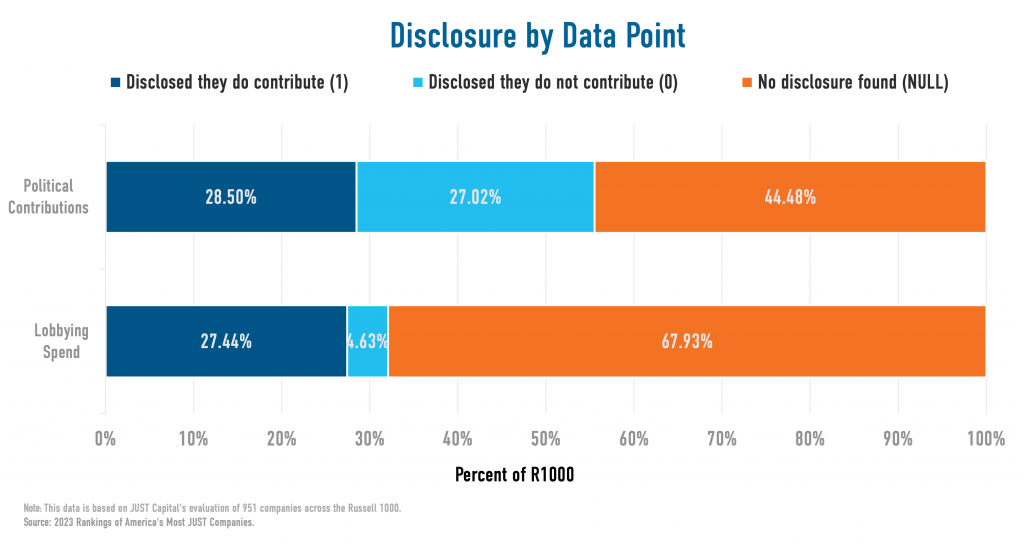
Overall, companies were less likely to disclose lobbying spending than political contributions. Across the Russell 1000 companies we rank, 55% disclosed that they made political contributions or explicitly stated that they did not make political contributions compared to 32% of companies who disclosed that they spent money on lobbying efforts or explicitly stated that they did not partake in lobbying. Following this trend, 67% provided no information on their lobbying spending compared to 44% of companies who did not provide disclosure of their political contributions.
Across all 36 industries JUST Capital analyzes, Utilities and Energy had the highest percentages of companies that disclosed clearly on both political transparency metrics. Utilities emerged as the clear overall leader with 82% of companies within the industry providing transparent political disclosure. Energy-related industries such as Energy Equipment & Services and Oil & Gas followed similar patterns of disclosure, with the largest shares of companies in those industries disclosing transparently on both lobbying and contributions.
Technology and Finance industries had the lowest rates of political transparency. Software emerged as the overall industry laggard, with the lowest percentage of disclosure on both political transparency data points – 72% of companies within the industry provided no disclosure on both political contributions and lobbying spending. Computer Services, Internet, and Technology Hardware follow a similar pattern of behavior, with the smallest share of companies disclosing both, the largest share disclosing neither, and the second largest share disclosing only political contributions.
Finance l industries similarly struggled to disclose their political and lobbying behaviors. Consumer & Diversified Finance was the overall runner-up behind Software for least transparent disclosure as 67% of companies in this industry provided no disclosure. Banks and Capital Markets follow a similar pattern, with the largest percentage of companies within these industries choosing not to disclose on both political and lobbying behaviors.
While disclosure may seem risky, transparency and trust go hand in hand for the American public. Providing more disclosure and transparency on their political behaviors is one way companies can help curb the public’s growing distrust of large corporations. The leading industries in this space are no strangers to scrutiny, and have benefitted from clear disclosures that allow them to stay ahead of messaging, reduce reputational risk, and increase trust in consumer confidence. Interestingly, the laggard industries in this space are now under scrutiny that the leaders have long occupied.
As activist shareholders and the general public continue to demand greater transparency in how companies follow through on commitments to their stakeholders, lobbying and political spending has increasingly been raised alongside the social and environmental efforts these funds are seen as helping or hurting. To weather scrutiny in the public square, companies looking to increase trust can ensure that their political and lobbying spends match their brand values and public commitments, and transparently disclose their spending.
To unpack your company’s political disclosure performance in the 2023 Rankings and gain insights into how to improve on the issues that matter most to the American public, please reach out to corpengage@justcapital.com.
