
This week, we saw some powerful numbers that support the investment case for just business leadership.
First, our own data. As of June 30, 2024, our flagship broad-based index of top companies in every sector – the JUST U.S. Large Cap Diversified Index – has out-performed the Russell 1000 cap-weighted benchmark by 1.5% year-to-date and by 13.8% since its inception almost 8 years ago. The JUST 100 (the top 100 companies in our overall rankings) has outperformed its benchmark by 6.7% this year and by 44.8% since its launch in 2019. The spread between the top 10% and bottom 10% of companies in JUST Capital’s rankings is especially impressive, and we’ll be releasing those numbers soon. As a reminder, these are companies that, compared to their peers, invest more in workers, pollute less, give back to communities more, create more jobs, and do right by all their stakeholders. Companies that are more just, in other words.
Second, a new report this week by Bain & Company determined that over a 10-year period, companies in the S&P 500 that created the most value for customers, employees, suppliers and communities also had the highest shareholder returns. The chart below summarizes the data so I won’t repeat it here, but it makes a compelling case for stakeholder value creation.
Finally, a word on fund flows. Even with ESG seemingly in decline and out of favor, it was fascinating to read in Axios this week that ESG funds made up 21% of all alternative capital raised this year as of April. Whereas US ESG stock-market funds saw $8.8 billion of outflows in the first three months of 2024 (and $13.2 billion of outflows in 2023), U.S. alternative asset firms raised $27 billion for ESG funds in 2023, and another $17 billion in the first four months of 2024. European firms reportedly raised $98 billion in total over the 16 months.
For investors, the search for superior risk-adjusted returns transcends pretty much everything. Whether it’s in more passive index investing, active trading, or strategic alternatives, applying a just, stakeholder-based lens can be the key to future success.
Be well,
Martin
Rather than our traditional “Quote of the Week”, we want to highlight that in the wake of the assassination attempt on former President Trump, CEOs across sectors are speaking out on what this means for America, the election, and business. Read anonymous interviews from Fortune or a collection of statements from Axios.
August 6th 2024: Investing in Care: Proving the Payoff of Caregiving Benefits
Join us for a candid discussion about the challenges and opportunities of investing in caregiving benefits and potential payoffs for doing so. How are companies currently leading on caregiving benefits? What do you need to know about your workforce to create quality offerings? Learn first-hand from a company’s journey to significantly expanding their caregiving benefits.
Speakers:
Donnebra McClendon, Global Head of Culture and Inclusion, Dayforce
Joseph Fuller, Professor of Management Practice, Harvard Business School
Nicole De Santis, Partner, BCG
Ashley Marchand Orme, Director of Equity & Stakeholder Leadership, JUST Capital
Fortune looks at how, across the board, bosses and employees differ in their perception of how much time and productivity will be saved by AI.
PwC estimates that AI will add over $15 trillion to the global economy in 2030, through productivity increases and consumption-side effects. Learn more here.
Axios reports that The Society for Human Resource Management (SHRM) dropped the word “equity” from DEI strategy, stating, “by emphasizing inclusion-first, we aim to address the current shortcomings of DE&I programs, which have led to societal backlash and increasing polarization.” While DEI continues to be under fire, USA Today reports that the majority of companies are standing by their commitments.
Similarly, Axios argues that ESG is not going away.
Marathon Oil agrees to pay $64.5 million in fines for violating the Clean Air Act, the largest penalty of its kind so far. The Washington Post has the full story.
Good news: There are fewer low-wage workers in America than ever before. Axios has the story.
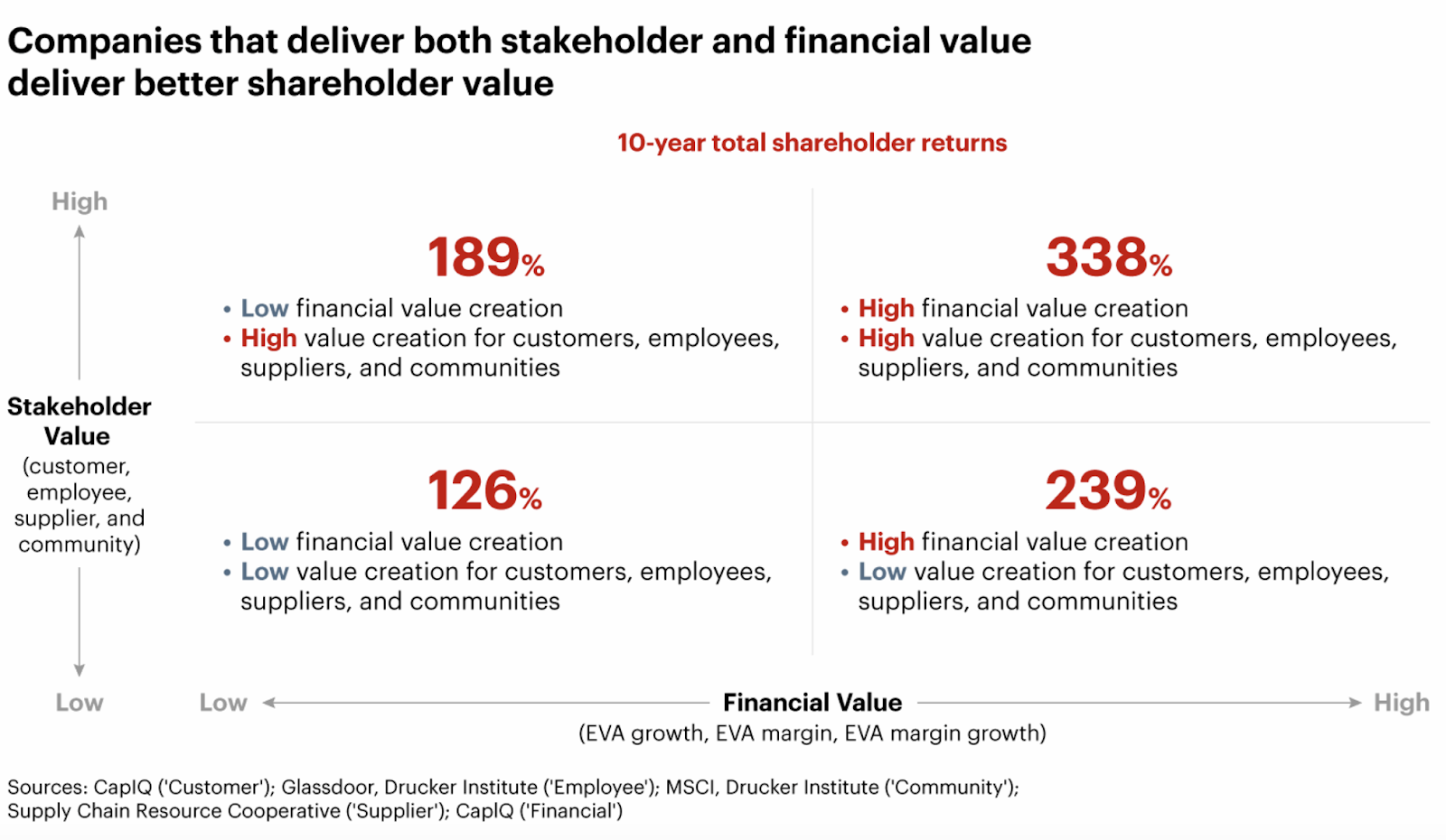
This chart comes from a 10-year study from Bain & Company that found that companies that saw high financial value and high stakeholder value delivered the highest shareholder returns. Explore the data here.
In the second quarter of 2024, global equity prices continued their robust performance, contributing to an impressive one-year rebound. The S&P 500 Index rose by 4.3% during this period, though many segments of the domestic stock market, including mid and small-cap indices, lagged behind and declined. Among large-cap stocks, the average stock fell by 2.6%, as indicated by the equal-weighted version of the S&P 500. The quarter experienced fluctuations, with April seeing a downturn that reversed some Q1 gains, but a rebound in May led the S&P 500 to set multiple new all-time highs. The quarter concluded with strong stock market gains, fueled by robust company earnings and easing inflation, elevating the S&P 500’s year-to-date performance to 15.3%.
The strong performance of the S&P 500 was primarily driven by the Information Technology and Communication Services sectors, with ongoing enthusiasm around AI boosting related companies amid strong earnings and optimistic outlook statements. The Information Technology sector alone accounted for 95% of the Index’s gain, with NVIDIA leading the charge and contributing nearly half of the S&P 500’s return. Conversely, cyclical sectors such as Financials, Industrials, Health Care, and Materials were the biggest underperformers.
As of June 30, 2024, our flagship index – the JUST U.S. Large Cap Diversified Index (JULCD) has out-performed the Russell 1000 (Cap-Weighted) benchmark by 1.51% year-to-date and by 13.78% since its inception. Additionally, the JUST 100 (equally weighted index) has outperformed the Russell 1000 (Equally-Weighted) index by 6.65% year-to-date and by 44.77% since its inception.
JUST Capital found that all of the five stakeholders we track delivered positive performance in Q2 2024. The Workers stakeholder delivered the strongest performance over this period with a long-short spread of 4.68%. Within the Workers stakeholder, outperformance was driven by both the top and bottom deciles whereas for remaining stakeholders outperformance was driven by top decile.
JUST Capital’s Overall Weighted Score takes into account the 20 core Issues determined through our annual survey research – including paying a living wage, creating a diverse, inclusive workplace, and helping combat climate change – across key business stakeholders: Workers, Communities, Shareholders & Governance, Customers, and Environment. This Overall Weighted Score had a positive long-short spread of 2.89% over the period ending June 28,2024.
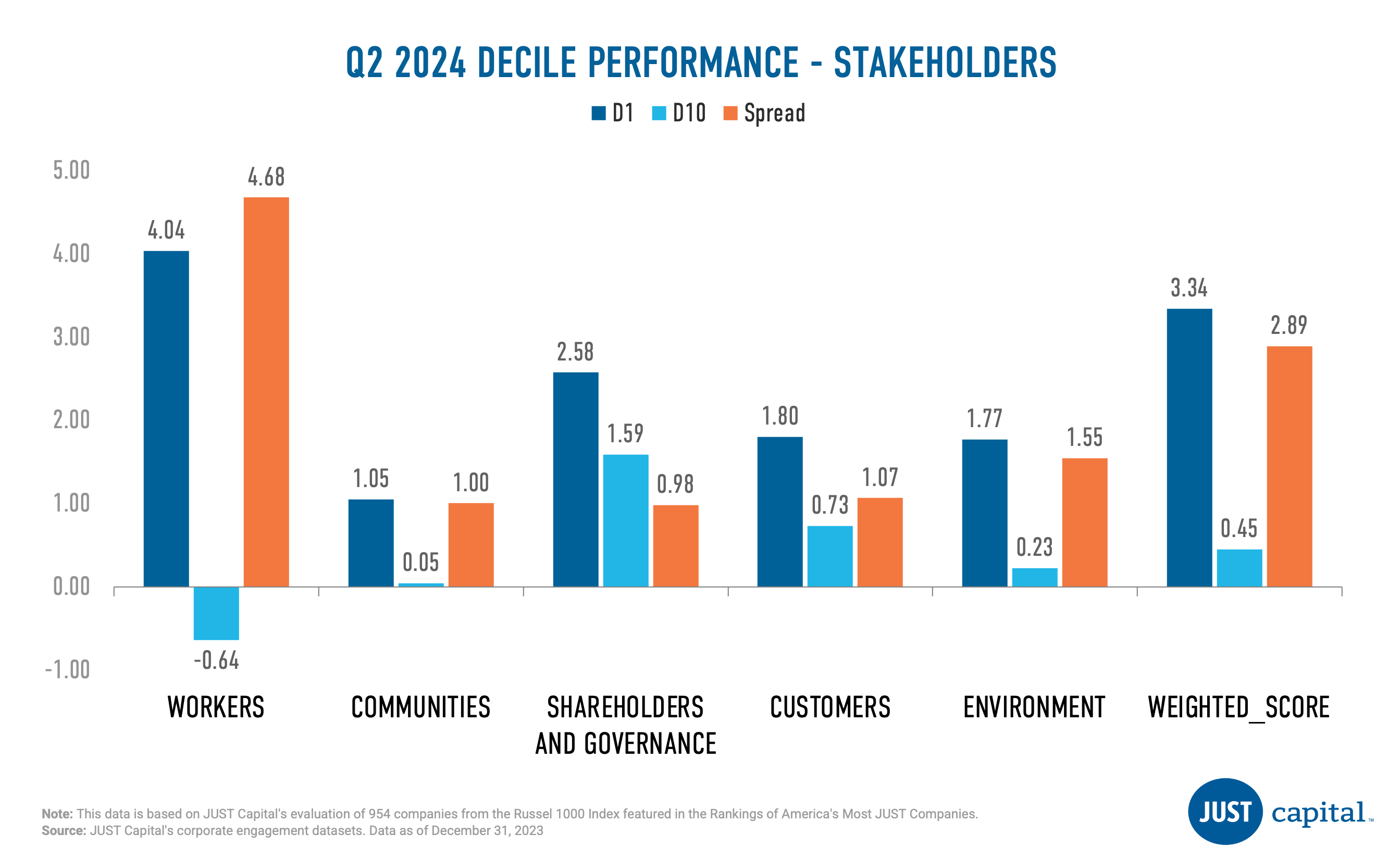
The Workers stakeholder measures a company across five Issues:
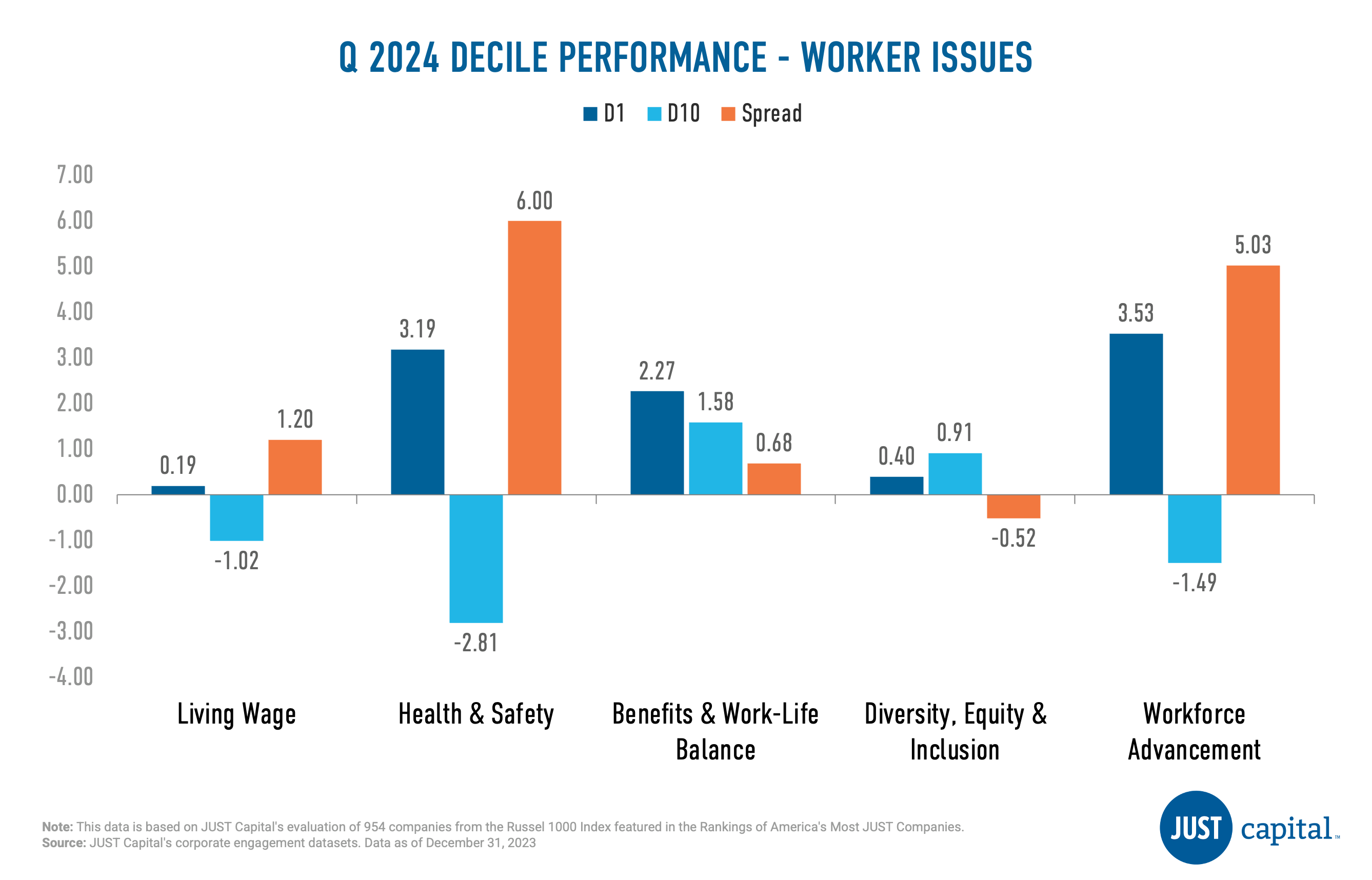
In Q2 2024, we saw four out of five issues deliver positive performance, with the Health & Safety Issue faring the best. Diversity Equity & Inclusion was the weakest performer amongst the Worker issues.
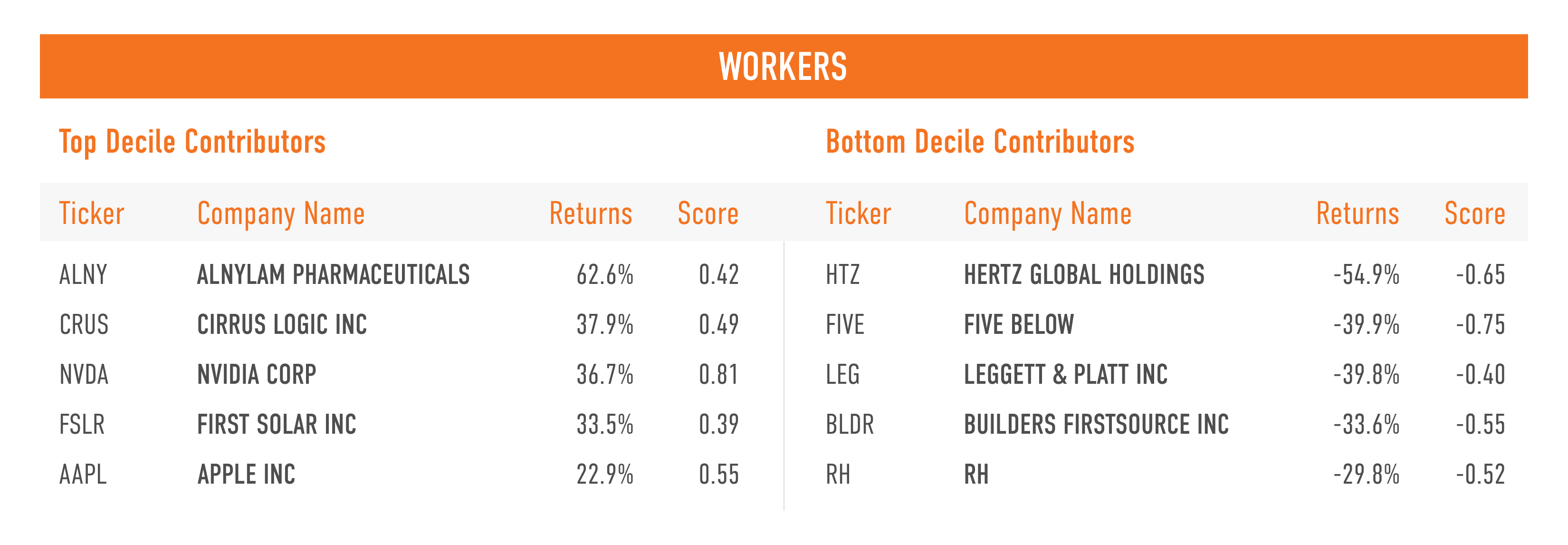
Shown below are the top and bottom five contributors to the top decile (D1), the top-ranked companies as measured by their Workers score, and the bottom decile (D10), the lowest-ranked companies as measured by their Workers score.
The Communities stakeholder measures a company across four Issues:
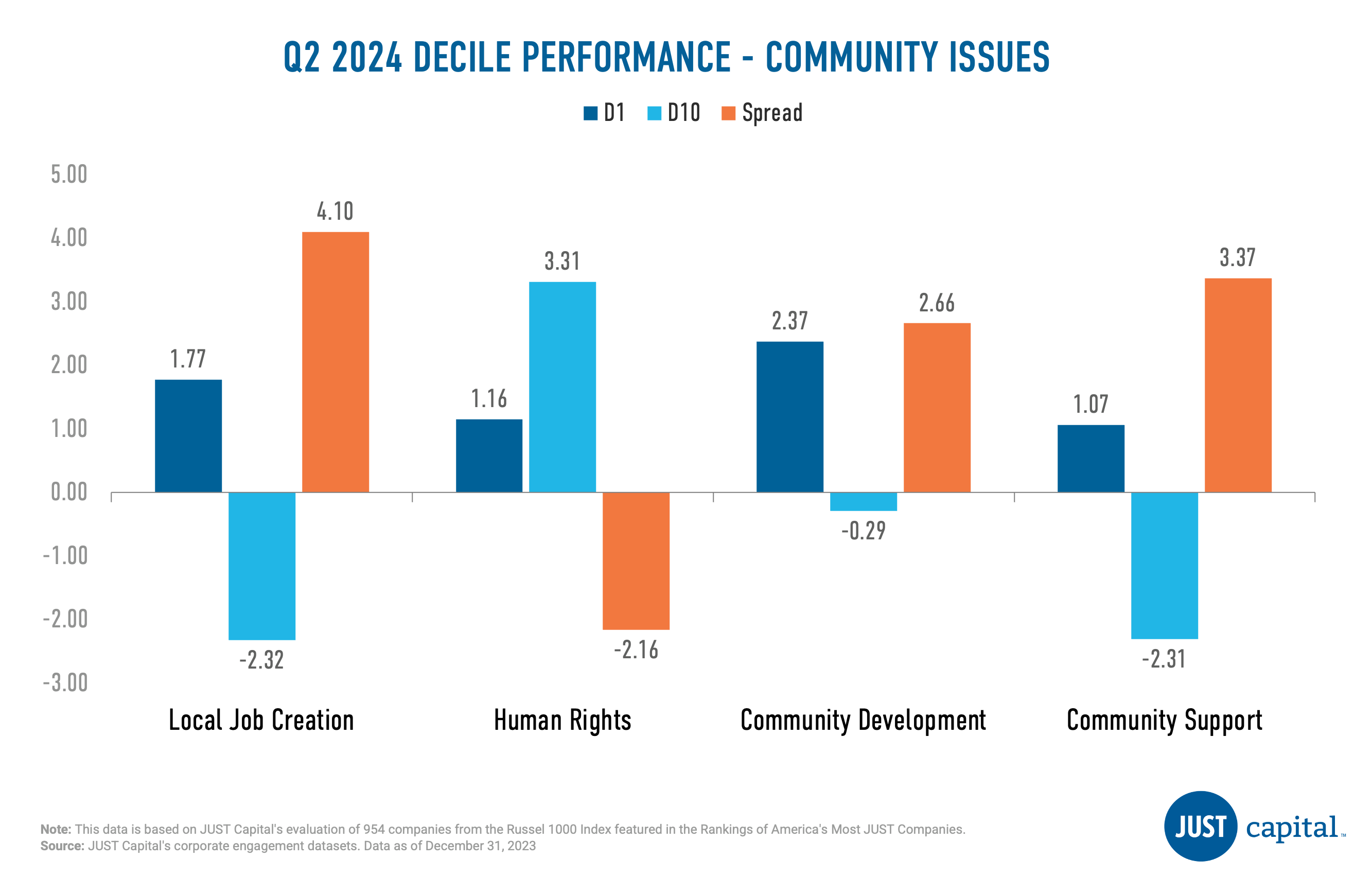
Local Job Creation was the strongest performer followed by Community Support. Human Rights was a negative contributor this quarter.
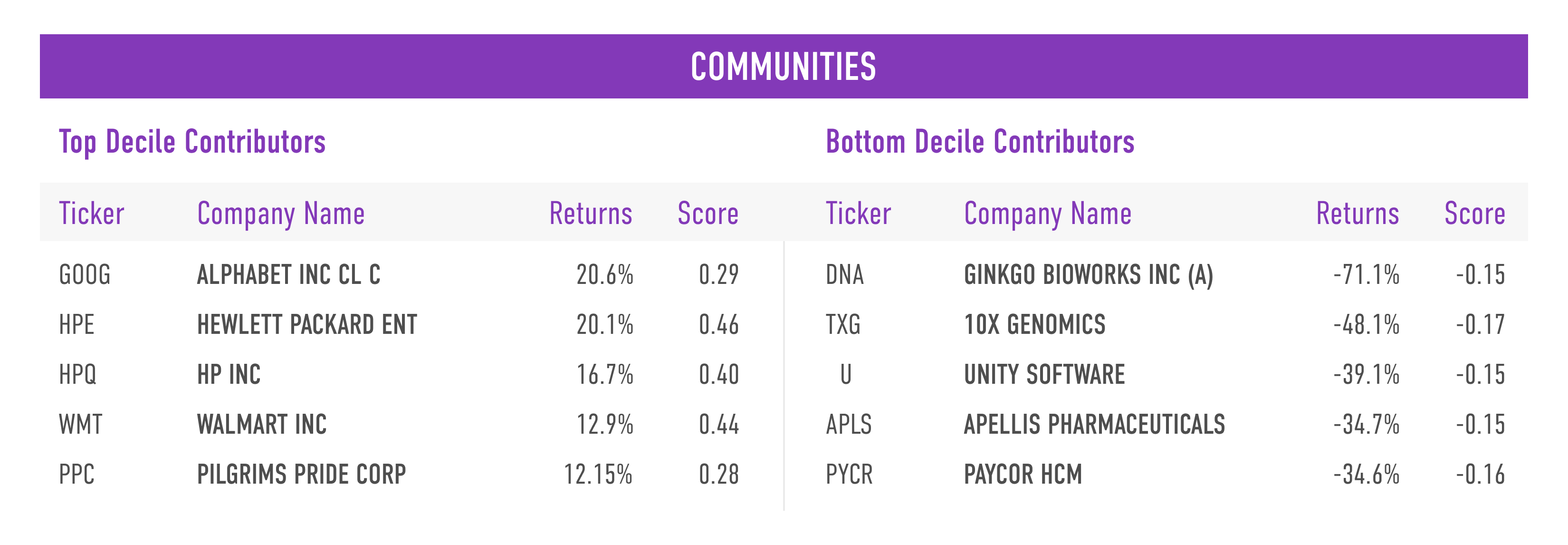
Shown below are the top and bottom five contributors to the top decile (D1), the best-ranked companies as measured by their Communities score, and the bottom decile (D10), the lowest-ranked companies as measured by their Communities score.
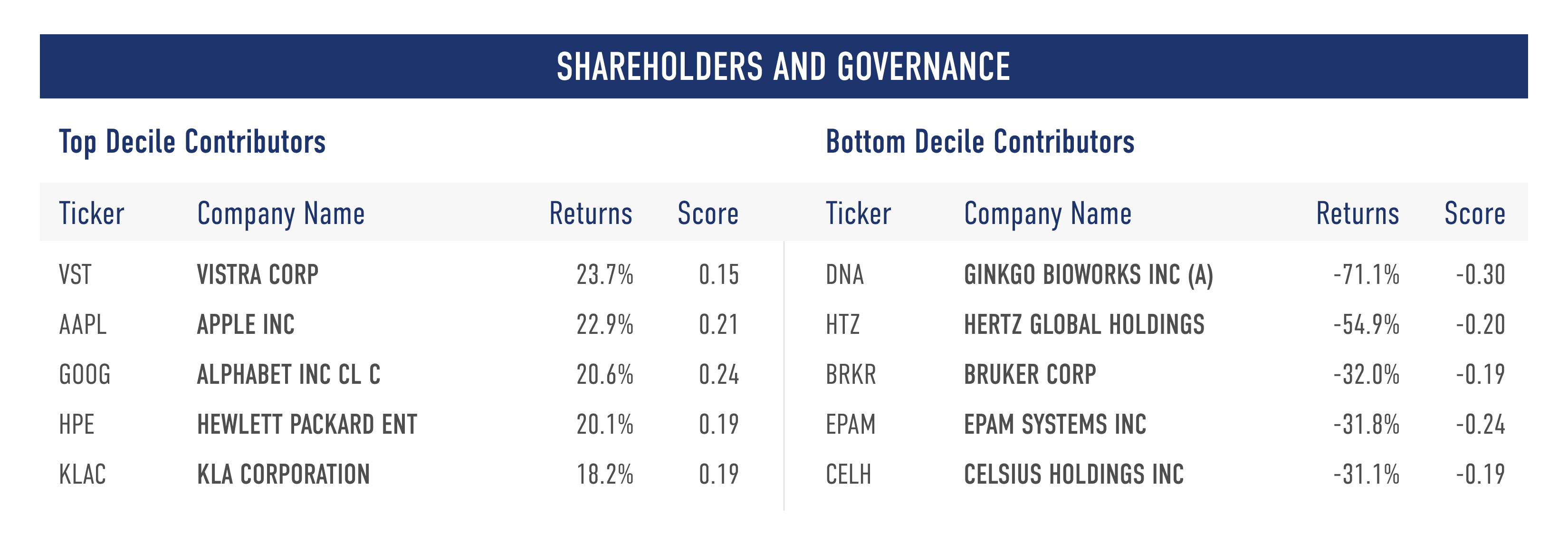
The Shareholders and Governance stakeholder measures a company across three Issues:
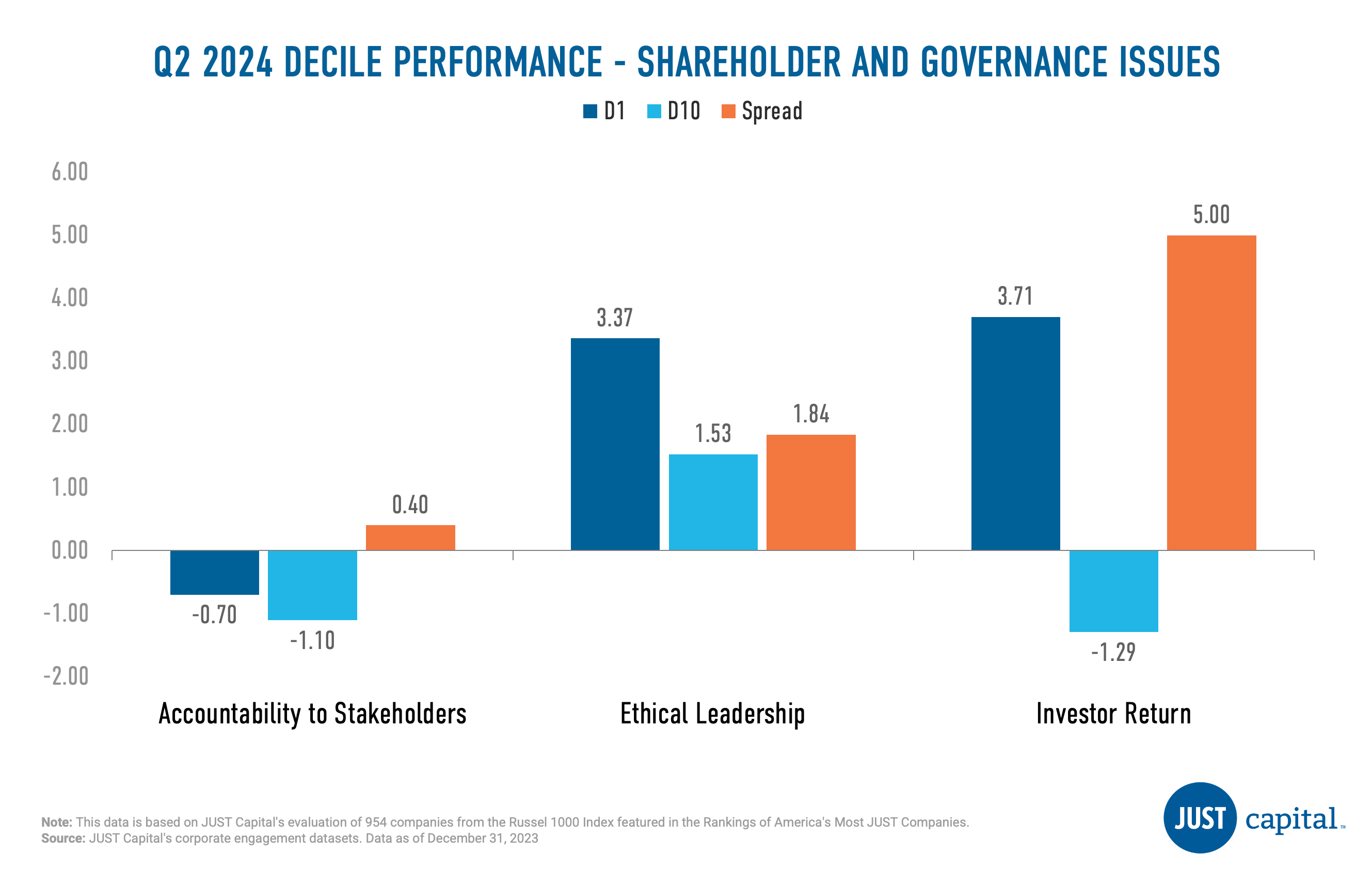
Investor Return Issue was the strongest performer in Q2 with a long-short spread of 5% followed by Ethical Leadership. All issues delivered positive performance in Q2 2024.
Shown below are the top and bottom five contributors to the top decile (D1), the best-ranked companies as measured by their Shareholders and Governance score, and the bottom decile (D10), the lowest-ranked companies as measured by their Shareholders and Governance score.
The Customers stakeholder measures a company across four Issues:
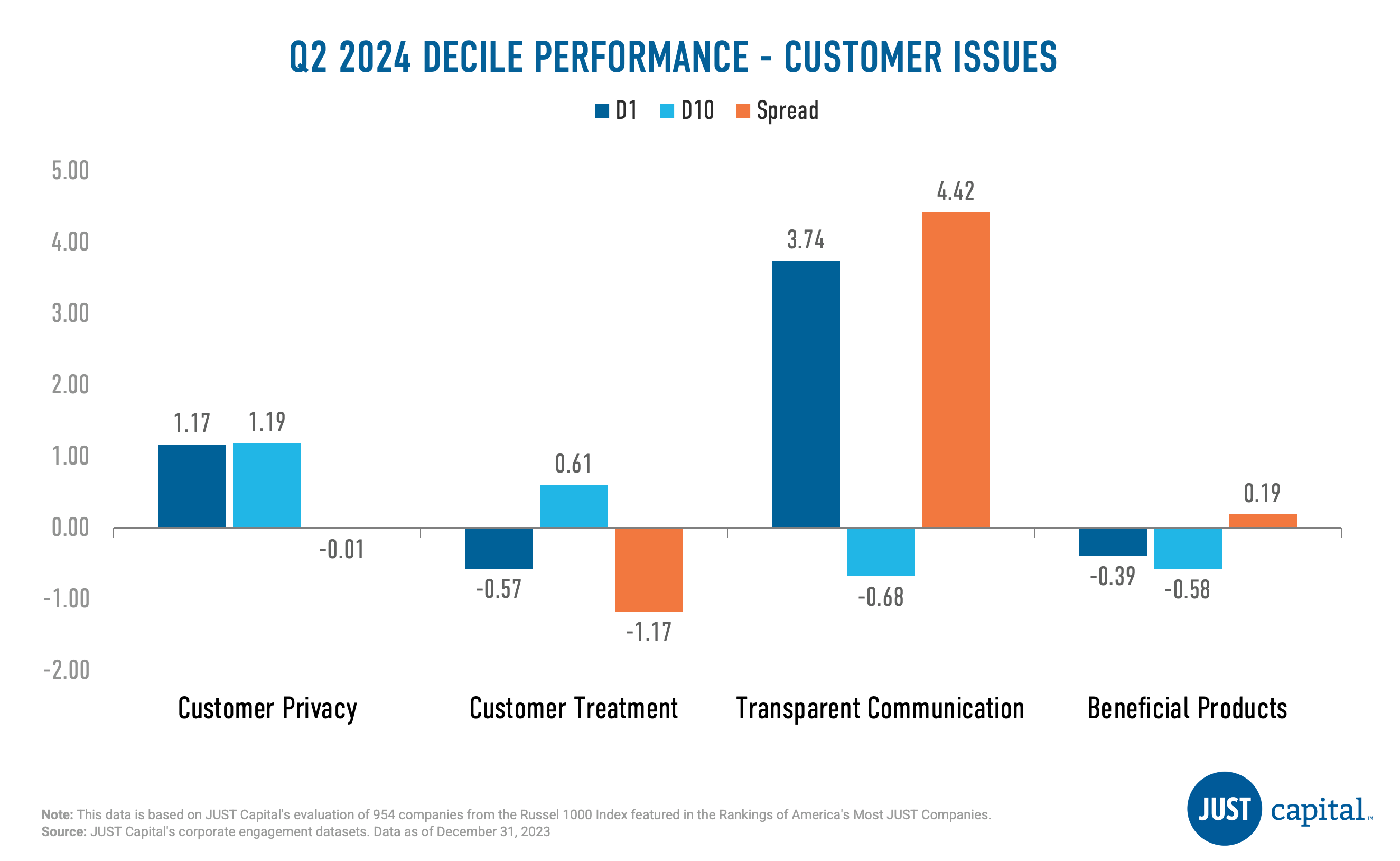
In Q2 2024, two out of 4 Customer Issues delivered negative performance. Transparent Communication was the best performer followed by Beneficial Products.
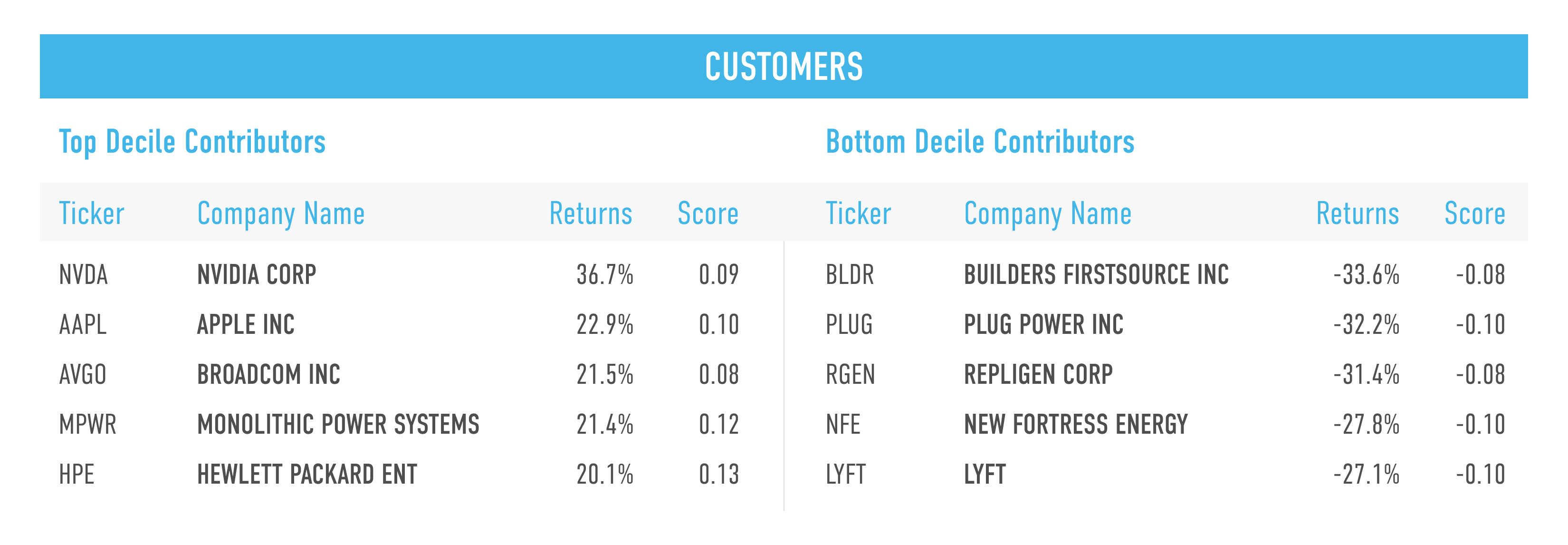
Shown below are the top and bottom five contributors to the top decile (D1), the best-ranked companies as measured by their Customers score, and the bottom decile (D10), the lowest-ranked names as measured by their Customers score.
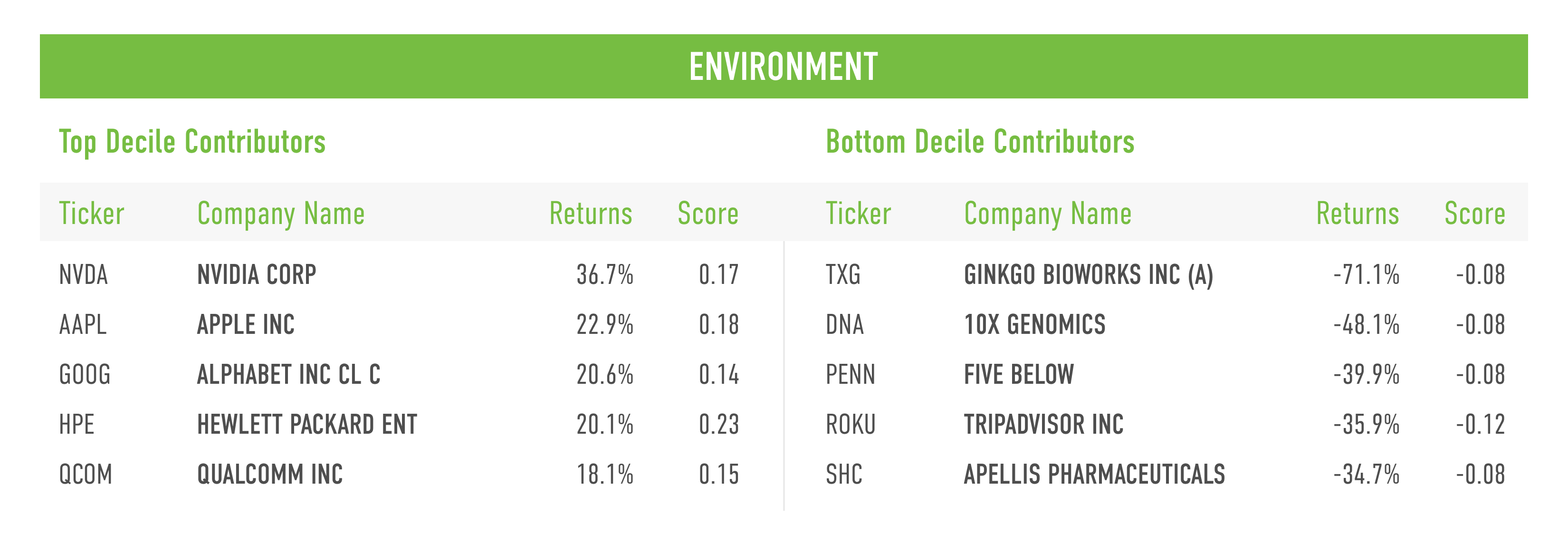
The Environment stakeholder measures a company across four Issues:
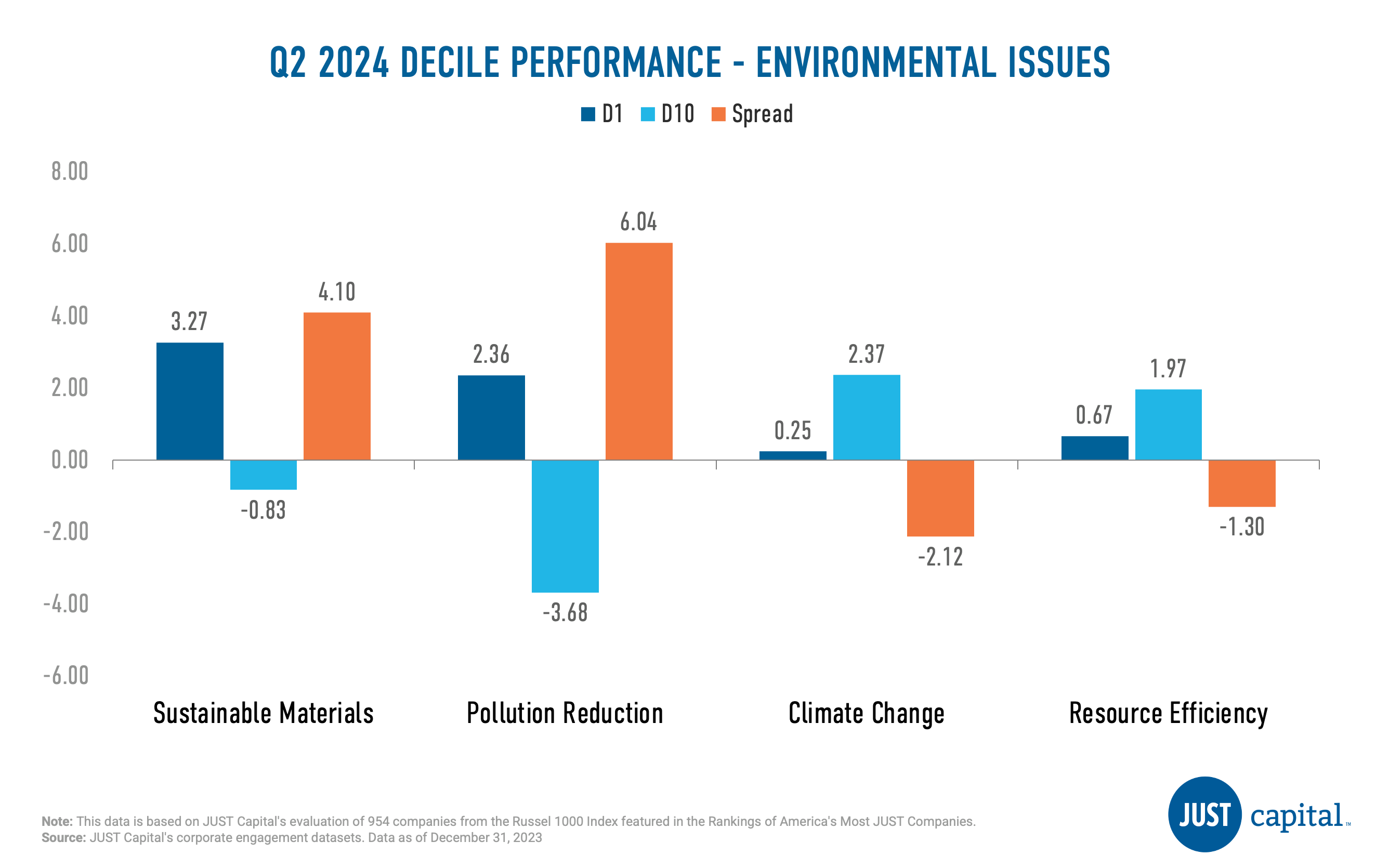
In Q2 2024, we saw two of four Environment Issues deliver positive performance. Pollution Reduction was the top contributor followed by Sustainable Materials in Q2. Climate Change and Resource Efficiency delivered negative performance this quarter.
Shown below are the top and bottom five contributors to the top decile (D1), the best-ranked companies as measured by their Environment score, and the bottom decile (D10), the lowest-ranked companies as measured by their Environment score.
Computation Methodology
We monitor the performance of these stakeholders and Issues on a long-short basis. The long and short portfolios are selected based on the factor scores as the top and bottom deciles within the universe of companies we track in the Russell 1000. Top decile (D1) companies are those that rank highest based on the factor score, and bottom decile (D10) companies are those that rank lowest based on the factor score.
D1 Performance is computed as
(Equally weighted average of returns of stocks in D1 bucket) – (Equally weighted average of returns of all stocks within the Universe)
D10 Performance is computed as
(Equally weighted average of returns of stocks in D10 bucket) – (Equally weighted average of returns of all stocks within the Universe)
Spread is computed as
D1 Performance – D10 Performance

The “ROI” of being just is critical to our overall strategy. Understanding if and how just leaders perform better financially than their peers supports the investor case for stakeholder capitalism and helps guide corporate executives and boards on where and how they can allocate capital to generate the biggest impact. That’s why JUST’s investment analysis – expertly led by former portfolio manager Mona Patni – is so important.
Some key takeaways from our Q1 2024 analysis:
There’s a lot to unpack here, but the headline is clear: just business is better business.
Be well,
Martin

“While we don’t run the company worrying about the stock price in the short run, in the long run we consider our stock price a measure of our progress over time. This progress is a function of continual investments in our people, systems and products, in good and bad times, to build our capabilities. These important investments will also drive our company’s future prospects and position it to grow and prosper for decades.”
Microsoft continues to expand aggressively into AI, investing 1.5 billion into an AI holding company in the United Arab Emirates. The Motley Fool takes a closer look at this move.
The Wall Street Journal explores how corporate diversity goals are disappearing from company annual reports thanks to increased pushback on DEI. Despite this, the one CEO who hasn’t been scared off is Jamie Dimon, who continues to defend DEI when so many of his contemporaries have gone silent. Axios explores why.
CNBC runs down what salary a family of four needs to live comfortably in every state.
Volkswagen workers in Chattanooga passed a historic vote to join the United Auto Workers on Friday, making the auto factory the first in the South to vote to unionize since the 1940s. The Washington Post has the story.
Delta Airlines is giving a 5% pay raise to all employees and is increasing starting salaries for several positions in order to improve hiring and retention during the upcoming summer travel season.
The Washington Post reports that President Biden has officially signed the “TikTok ban” legislation, giving the company 9 months to sell the app or face a national ban.
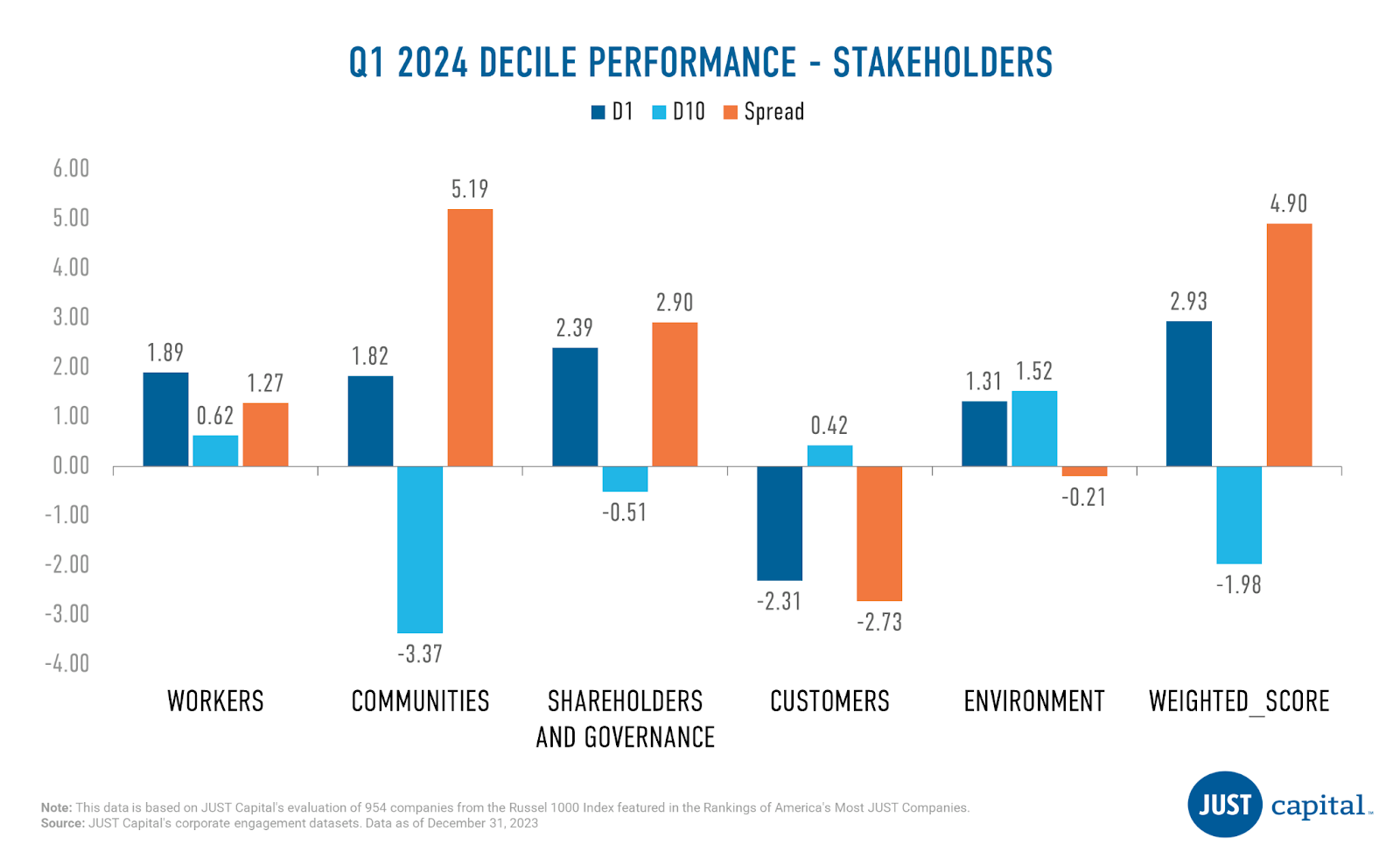
This chart comes from our Q1 Investment Analysis, and shows a quick-view of the stakeholders in our JUST ETF that showed high outperformance. Click here to explore the full analysis.
Following a remarkable 2023, stocks have once again surged in 2024, with the S&P 500 achieving its most impressive first-quarter performance since 2019, boasting a year-to-date return of 10.55%. This notable upswing can be attributed to encouraging economic indicators, alleviating concerns regarding a potential U.S. economic downturn. Investors have shifted their focus towards the Federal Reserve’s anticipated transition from monetary policy tightening to easing.
The Nasdaq experienced a significant uptick of 9.3% in the first quarter, propelled by a sustained rally in artificial intelligence-related stocks and optimistic remarks from Federal Reserve officials. Notably, the Magnificent Seven, comprising 29% of the S&P 500’s market value, contributed 37% to the year-to-date return. However, a new group, dubbed the Gang of Four, including Nvidia, Microsoft, Meta Platforms (formerly known as Meta), and Amazon.com, emerged, accounting for 18% of the S&P 500 and 47% of the year-to-date return.
Market breadth remained robust with 369 stocks advancing and 134 declining, showcasing a broad-based rally across sectors. Of the 11 sectors, 10 experienced gains, underscoring the market’s overall strength.
In terms of sectors, technology, consumer cyclical, and consumer defensive sectors led the market gains, each yielding total returns of approximately 8% or higher. Notably, the real estate sector was the sole sector to finish the quarter in negative territory, while the broader stock market rally exhibited resilience and breadth.
As of March 29, 2024, our flagship index – the JUST U.S. Large Cap Diversified Index (JULCD) has out-performed the Russell 1000 (Cap-Weighted) benchmark by 0.35% year-to-date and by 10.7% since its inception. Additionally, the JUST 100 (equally weighted index) has outperformed the Russell 1000 (Equally-Weighted) index by 4.47% year-to-date and by 43.46% since its inception.
JUST Capital found that three of the five stakeholders we track delivered positive performance in Q1 2024. The Communities stakeholder delivered the strongest performance over this period with a long-short spread of 5.19%, while the Customers stakeholder fared most poorly at -2.73%. Within the Workers stakeholder, outperformance was driven by the top decile whereas for Communities & Shareholders & Governance stakeholder outperformance was driven by both deciles. For the Customers stakeholder, underperformance was driven by both deciles whereas for Environment stakeholder negative contribution was driven by bottom decile.
JUST Capital’s Overall Weighted Score takes into account the 20 core Issues determined through our annual survey research – including paying a living wage, creating a diverse, inclusive workplace, and helping combat climate change – across key business stakeholders: Workers, Communities, Shareholders & Governance, Customers, and Environment. This Overall Weighted Score had a positive long-short spread of 4.9% over the period ending March 31,2024.

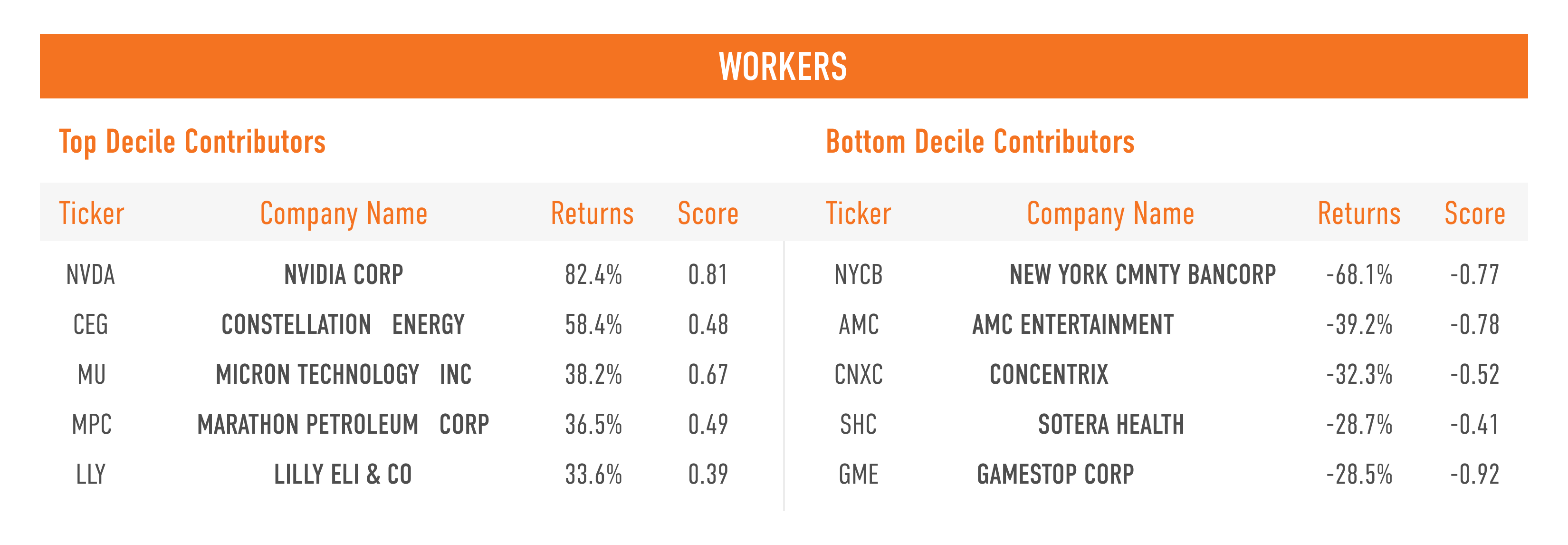
The Workers stakeholder measures a company across five Issues:

In Q1 2024, we saw all five issues deliver positive performance, with the Workforce Advancement Issue faring the best. Diversity Equity & Inclusion was the weakest performer amongst the Worker issues.
Shown below are the top and bottom five contributors to the top decile (D1), the top-ranked companies as measured by their Workers score, and the bottom decile (D10), the lowest-ranked companies as measured by their Workers score.
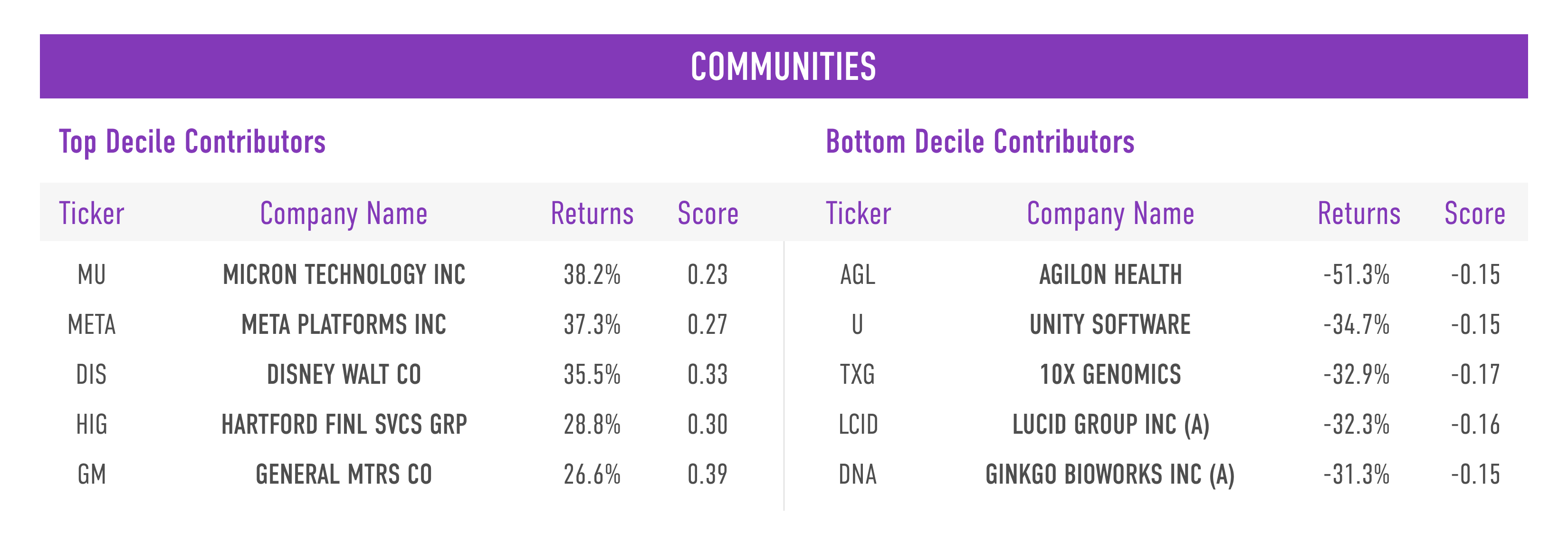
The Communities stakeholder measures a company across four Issues:

Local Job Creation was the strongest performer followed by Human Rights. All issues were positive in Q1 2024.
Shown below are the top and bottom five contributors to the top decile (D1), the best-ranked companies as measured by their Communities score, and the bottom decile (D10), the lowest-ranked companies as measured by their Communities score.
The Shareholders and Governance stakeholder measures a company across three Issues:
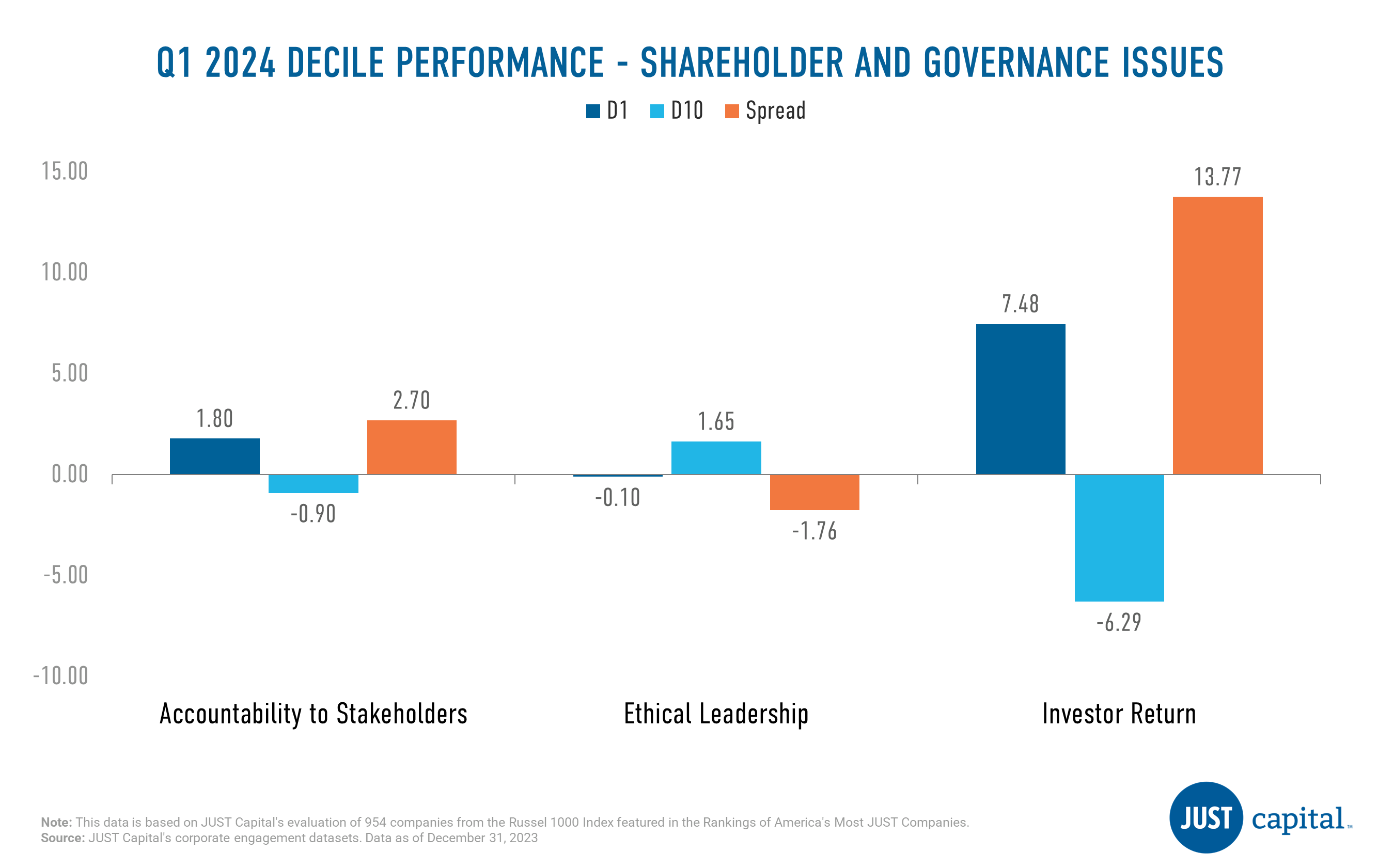
Investor Return Issue was the strongest performer in Q1 with a long-short spread of 13.77% followed by Accountability to Stakeholders issue whereas Ethical Leadership was negative this quarter.
Shown below are the top and bottom five contributors to the top decile (D1), the best-ranked companies as measured by their Shareholders and Governance score, and the bottom decile (D10), the lowest-ranked companies as measured by their Shareholders and Governance score.

The Customers stakeholder measures a company across four Issues:

In Q1 2024, three out of 4 Customer Issues delivered negative performance. Customer Privacy was the only positive contributor in Q1. Transparent Communication was the weakest performer followed by Customer Treatment.
Shown below are the top and bottom five contributors to the top decile (D1), the best-ranked companies as measured by their Customers score, and the bottom decile (D10), the lowest-ranked names as measured by their Customers score.

The Environment stakeholder measures a company across four Issues:

In Q1 2024, we saw two of four Environment Issues deliver positive performance. Resource Efficiency was the top contributor followed by Climate Change in Q1. Pollution Reduction and Sustainable Materials delivered negative performance this quarter.
Shown below are the top and bottom five contributors to the top decile (D1), the best-ranked companies as measured by their Environment score, and the bottom decile (D10), the lowest-ranked companies as measured by their Environment score.

We monitor the performance of these stakeholders and Issues on a long-short basis. The long and short portfolios are selected based on the factor scores as the top and bottom deciles within the universe of companies we track in the Russell 1000. Top decile (D1) companies are those that rank highest based on the factor score, and bottom decile (D10) companies are those that rank lowest based on the factor score.
D1 Performance is computed as
(Equally weighted average of returns of stocks in D1 bucket) – (Equally weighted average of returns of all stocks within the Universe)
D10 Performance is computed as
(Equally weighted average of returns of stocks in D10 bucket) – (Equally weighted average of returns of all stocks within the Universe)
Spread is computed as
D1 Performance – D10 Performance
Twice this week, JUST friend and Fortune Media CEO Alan Murray wrote about how challenging it is for CEOs to navigate today’s highly politicized world. JUST Board member Alan Fleischmann was quoted as saying “The CEO has to be able to articulate how he or she leads in this environment.” A hat tip to Alan, and to take it one step further: CEOs also need to be able to convincingly articulate how their strategy fits into their overall business strategy.
This is where our work comes in. Our Annual Rankings show which companies are making meaningful investments in their stakeholder leadership. And the platform we’ve created, as well as the stakeholder framework that underpins it – backed by 9 years of polling, 8 years of corporate performance data and over 1.3 million individual data points – cover many of the critical stakeholder issues that matter to CEOs today. It serves as a dynamic roadmap that can help any corporate leader navigate today’s political waters and take action on the things that matter most.
Throughout it all, the connection to financial performance remains pivotal. According to a piece released this week by Mona Patni, our quantitative financial analysis lead, “JUST Capital found that two of the five stakeholders we track delivered positive performance in Q4 2023. Over the longer term from January 2018 to December 2023, the leaders in corporate stakeholder performance across all five stakeholders have outperformed the laggards by 66.6% as measured by JUST Overall Score.”
With the pushback on ESG and ‘woke’ companies now maturing, we think there is room in America today for a more objective, data-driven framework that supports values-led business leadership, drives positive societal change and connects directly to business strategy. In other words, we think JUST’s time has come.
Be well,
Martin

“Media headlines about the creation and then elimination of corporate diversity, equity, and inclusion (DEI) positions at Big Tech companies have generated plenty of buzz. This kind of coverage can raise doubts about whether companies are committed to DEI in the long term. But these headlines aren’t telling the whole story […] In fact, our recent ‘Expanding Equity retrospective report’ suggests the opposite. Companies are doubling down on DEI as an essential part of their business strategy.”
CNBC Correspondent Sharon Epperson highlights our latest corporate data around diversity, equity, and inclusion policies in two on-air spots as part of the network’s ongoing coverage of the JUST Rankings.
On the podcast “Purpose 360,” hosted by business and nonprofit consultant and former Global Practice Chair of Edelman Business Carol Cone, JUST CEO Martin Whittaker explores JUST’s recently released 2024 Top 100 Rankings.
In his podcast, “The Mentor’s Radio,” JUST Capital Board Member Dan Hesse – former CEO of Sprint and current chairman of Akamai Technologies – discusses employee ownership and its contribution to economic justice and American competitiveness.
JUST Capital re-promotes its analysis on companies supporting diverse pipelines through investments in Historically Black Colleges and Universities. Separately, JUST Quantitative Research and Analytics Lead Mona Pati pens our latest review of quarterly stakeholder performance.
NVIDIA skyrocketed to a near $2 trillion-dollar market cap this week, riding the success of its expanding AI-focused chip production. Meanwhile, Google is working to fix its Gemini AI technology after it produced historically inaccurate images, which CEO Sundar Pichai has called “unacceptable.”
There’s pushback against the ESG pushback. This week Axios reports that a major climate advocacy group is launching a campaign to push back on the growing anti-ESG rhetoric, starting first in Arizona, which has become a hotbed of anti-ESG investing bills.
With companies fearing headlines about layoffs, more and more employers are turning to “quiet firing” – actively making employee jobs worse to encourage them to leave. Business Insider runs down the ways companies are trying to force employees out without having to explicitly lay them off in this recent piece.
It’s not just you – CNBC reports that Americans are spending the biggest share of their income on food in three decades due to grocery prices that just won’t fall. Data For Progress confirms that when voters say they are worried about the economy, their concern is almost entirely concentrated on the price of groceries. And while consumers wait for falling prices, many companies are actually fearing the drop.
Axios takes a close look at a major cybersecurity attack that affected the ability for millions of Americans to get their prescription medicine, revealing a major technology weakness in the healthcare industry that major companies are struggling to deal with.
Sony Playstation is laying off 8% of its workforce this week, joining a sweeping wave of layoffs affecting the video game industry. As of now, the first two months of 2024 have nearly matched the entirety of 2023 in layoffs.
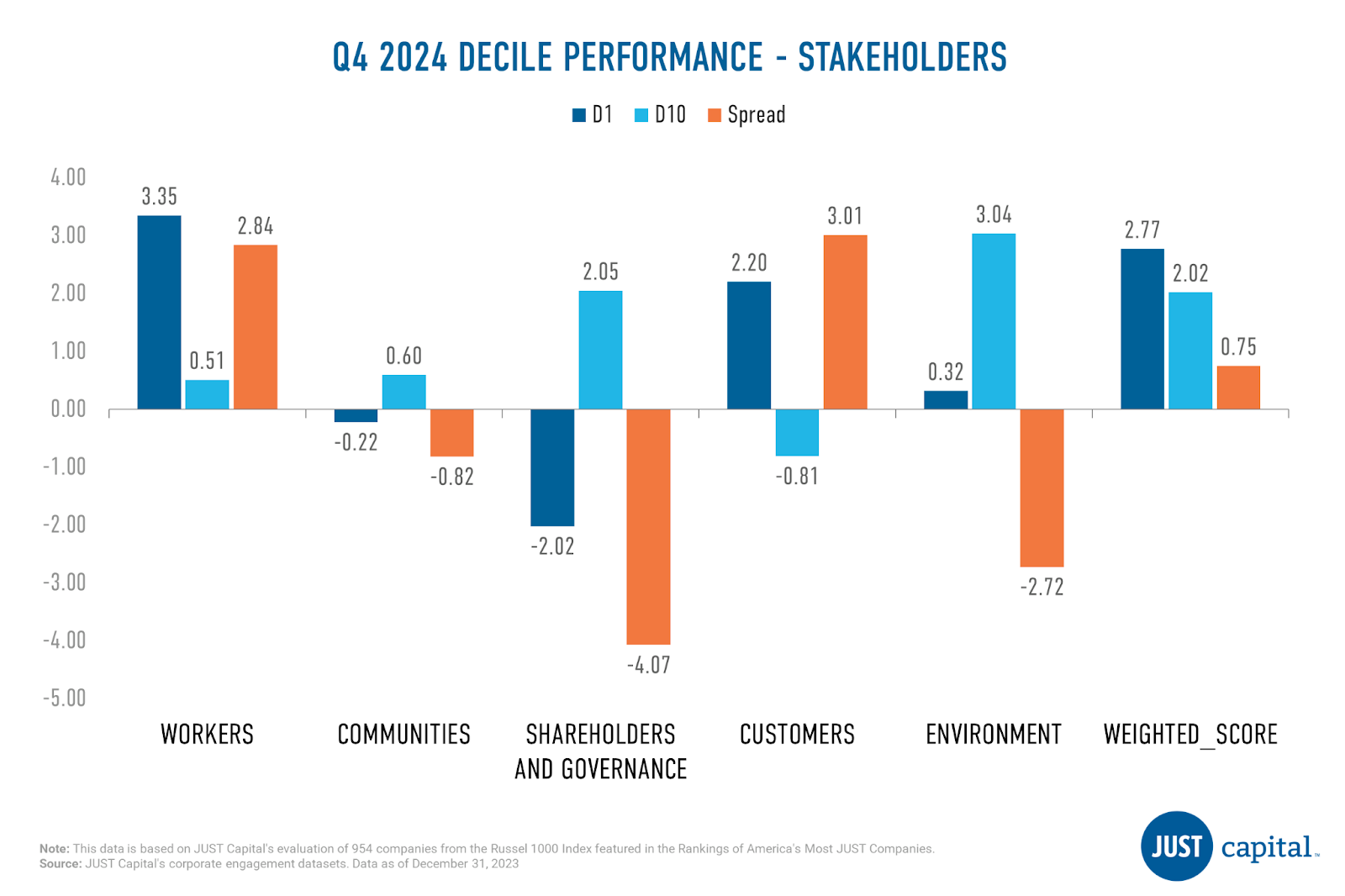
This chart comes from our latest review of quarterly stakeholder performance. In Q4 2023, two of the five stakeholders we track delivered positive performance, and the Customers stakeholder delivered the strongest performance with a long-short spread of 3.01%. Dive deeper here.
‘Business!’ cried the Ghost. ‘Mankind was my business’”
For me, the festive period is a time for family and celebration, but also a time for reflection. A moment to take stock – of our lives, our careers, our hopes and dreams. One thing I’ll be thinking about a lot is where we are at JUST Capital, and the state of our mission. Capitalism, it seems to me, is undergoing a transformation, not unlike Charles Dickens’s famed Christmas creation, Ebenezer Scrooge. The question is whether its future will be different from its present and its past. This was Dickens’ intention of course – to influence the national discourse on poverty and inequality by examining the true spirit of humanity. “A Christmas Carol” went viral – first published on December 19, 1843, it had sold out by Christmas Eve. It resonated with audiences and captured an essential ethos of the time. In that sense, and perhaps even to that scale, we hope to emulate its outsized impact.
In a way, our Rankings of America’s Most JUST Companies are a stocktake of sorts on how companies are doing on the defining characteristics of just business behavior today. They capture the reality of how companies are taking action on key stakeholder issues. Unlike Dickens’ novella, they are not a morality tale. They’re all about business. And to us, they represent the start of the conversation, not the end.
Our Rankings drive the kind of programmatic work with companies – such as our Worker Financial Wellness Initiative including Chipotle, Verizon, PayPal, and Prudential – that advances positive outcomes for thousands of employees in multiple industries (this video series tells the human stories behind the data). They help us set up innovative initiatives such as our Corporate Care Network, which is advancing the well-being of workers and demonstrating the long-term value of increasing access to care benefits (we announced it at the annual Global Citizen Festival in April). They also pave the way for critical direct work with companies, of which there is no better example than the workshop we hosted in October in partnership with The Rockefeller Foundation and PayPal at the Bellagio Center. Here, we brought together executives from global corporations collectively employing almost five million American workers to engage in peer learning and develop tangible action plans that benefit workers.
The stories behind the data are also becoming increasingly critical to our work. It’s why the conversations we had with TIAA’s Chief Information Officer on AI, with HPE’s leadership on paid care benefits, and Bank of America’s CHRO on human capital management and worker pay are so important. Connecting directly with business leaders – as we did in Atlanta with our Board member Roosevelt Giles, at the NEST Summit in New York City during Climate Week, and at the New York Stock Exchange to celebrate the fifth anniversary of the JUST ETF – is also becoming ever more important.
You’ll be hearing more about JUST’s own transformation in 2024 very soon, but for now, suffice to say that as we approach our 10-year anniversary, it is clear that JUST business leadership – that creates value for all stakeholders and gives more people access to a better future – is expected and needed more than ever. We’ve elevated key internal leaders, namely Alison Omens to President and Tolu Lawrence to our first-ever Chief Impact Officer. And thanks to our partnerships with Empower Media and CNBC, you’ll be seeing and hearing a lot more about us from January on.
If you’d like to support our essential work, please hit the donate button below and know that everyone at JUST is grateful. I’m going to take a break from my usual correspondence next week and return with an exciting update on what to expect from JUST Capital in 2024.
Meantime, Seasons Greetings, and Happy Holidays to you all!
Martin
JUST Capital brought together many industry leading executives, experts, and business changemakers over this past year. Here’s a look at some highlights:
JUST Capital sparked many engaging conversations this year. Here are several highlights:
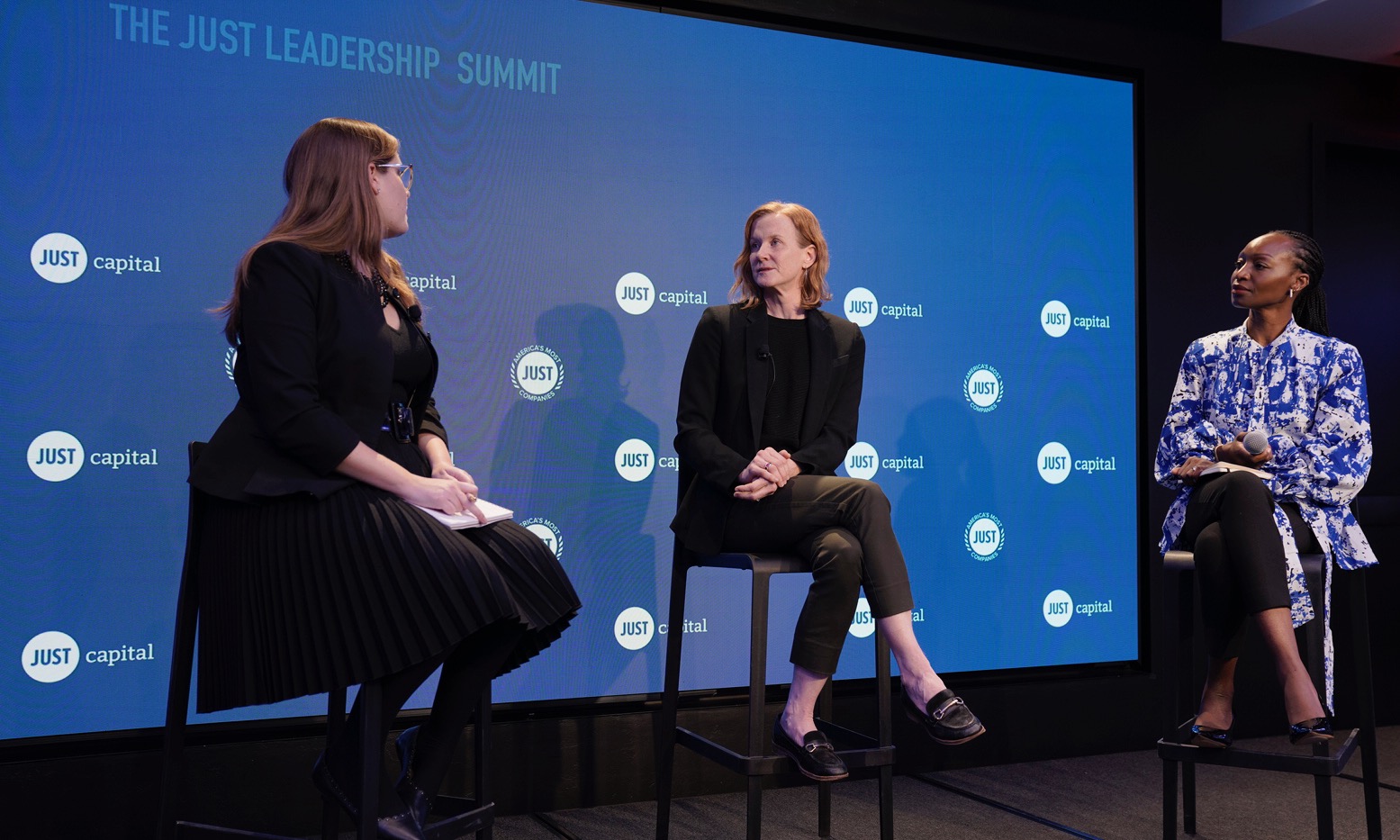
In March top corporate, investment, and sustainability leaders gathered for the 8th JUST Leadership Summit – a place to celebrate corporate leadership and spotlight action from investors and American companies to help build a more just economy. We discussed the broad state of play with Deloitte, why employee stock ownership is a winning strategy with KKR, how JUST jobs build better companies with Two Sigma, and recognized the achievements of this year’s JUST 100, the leaders topping our 2023 Rankings of America’s Most JUST Companies.
In April, Tolu Lawrence joined Global Citizen NOW to announce the creation of the Corporate Care Network, which connects and supports companies committed to advancing the well-being of workers through access to and awareness of inclusive care benefits, like paid leave, flexible work, and child care support.
In June, we celebrated the five-year anniversary of the JUST ETF at NYSE. The celebration included “The Value of Investing in Just Business,” a conversation featuring Priscilla Sims Brown, CEO of Amalgamated Bank, the financial institution self-described as “America’s socially responsible bank”, as well as Roy Swan, Director of Mission Investments at the Ford Foundation.
Back in September, Martin led a panel at The Nest Summit with three executives making real headway on environmental issues at Ecolab, Trane, and Workday. What does it actually take to drive major environmental action within a company or industry? What moves a company from making public commitments to executing scalable plans? Watch the full discussion here.
In November, Martin joined the New York Times’ DealBook Summit, to discuss the U.S. economy, stating: “We need more people to believe American capitalism is working for them, not against them. With politics bereft of long-term vision and serving only to divide, the private sector must lead. An economy in which companies compete by creating value for all their stakeholders is a powerful uniting force.”
Paying a fair, living wage was once again the No.1 issue for the American public when it came to just business behavior. We created our Living Wage Explainer to help explain the concept and why businesses should use it, and released a series of videos with our Worker Financial Wellness Initiative highlighting how investing in wages and career development dramatically impacts workers.
On a similar note, we released our annual list of the Top 10 Companies that Treat Employees the Best, providing business leaders insight into best practices on supporting their employees. Indeed, paid parental leave and pay equity both rose to the forefront of our research this year. The Top 4 Companies Leading for Women in 2023 and the Top Six Companies Leading on Paid Parental Leave in 2023 both highlighted companies implementing policies that help uplift working women and mothers.
ESG investing continued to face pushback on the national stage. Amid much debate, we gathered insights from focus groups with the American public and rounded up our five key takeaways for companies and investors to lead through increasingly difficult conversations.
Lastly, our yearly coverage of America’s 36 Industry Leaders on Environmental Performance in 2023 is a perfect snapshot of the progress being made across industries.
