Just Capital released the second edition of its monthly National AI Monitor, which asks Americans how they are experiencing AI in their daily lives and what drives positive and negative experiences.
The results show that despite the heightened national dialogue around AI safety, Americans are positive about their experiences with AI on a day-to-day basis, with productivity at work cited as a primary driver. Worries about environmental impacts, the trustworthiness of models, and threats to employment weigh heavily on their outlook for the future, especially among women, lower-income Americans, and older adults.
“There’s an assumption that Americans are against AI, but the people we’re hearing from continue to tell a more hopeful story,” said Just Capital CEO Martin Whittaker. “Americans’ optimism may be one of the most underappreciated signals in the AI conversation today. Leaders who listen closely have a real chance to build public trust.”
Scores are calculated as the percentage of positive responses minus the percentage of negative responses, producing a range from -100 to +100. Changes between September and August were not statistically significant.
Productivity at work
“AI takes care of the structured and logical work; this allows me time for bringing human expertise to bear.” – Male, 59, middle income, very positive respondent on AI at work
“I can do 10x the work I used to do, and can more confidently work in areas I dont have as much experience in.” – Male, 39, upper income, very positive respondent on AI at work
Speed, convenience, and personalization
“As a customer, I think companies’ use of AI makes products and services more convenient and personalised. It helps me get faster customer support, better recommendations, and quicker answers to my questions. At the same time, I am concerned about privacy and want companies to use my personal information responsibly.” – Female, 42, middle income, very positive respondent on AI as a customer
Exposure as an investor
“My 401k is doing pretty well and AI is driving the market.” – Male, 34, lower income, very positive about AI as an investor
Environmental impacts including data centers, water use, electricity use, and grid strain
“Water waste, water pollution, energy waste, the drain on resources of communities too poor to fight back against them.” – Male, 50, upper income, very negative respondent on AI and the environment
Distrust
“I do not trust AI or the makers. I don’t think it can be controlled.” – Female, 65, lower income, very negative respondent on AI overall
Job loss
“It’s very sad to see that AI is quite literally taking people’s jobs and copying people’s content and reusing their face and videos without their knowledge of consent.” – Female, 19, lower income, very negative respondent on AI at work
Attitudes vary considerably by respondent demographics:
The survey was conducted online within the United States by The Harris Poll on behalf of Just Capital from September 30 – October 2, 2026 among 1,010 U.S. adults ages 18 and older. The sampling precision of Harris online polls is measured by using a Bayesian credible interval. For this study, the sample data is accurate to within +/- 3.6 percentage points using a 95% confidence level. This credible interval will be wider among subsets of the surveyed population of interest.
Respondents were asked seven questions: one on AI’s overall effect on the respondent to date, one for each of the five stakeholder groups in Just Capital’s framework (workers, customers, communities, the environment, and shareholders), and one forward-looking question on how optimistic respondents are about where AI is headed and how it may affect them. All questions use a five-point scale ranging from “very negative” to “very positive,” with “I don’t know” offered as an additional, non-forced option so that uncertainty is not recorded as a neutral rating. Every question except the final one is followed by an open-ended “why,” which is synthesized to identify what drives responses and to serve as a diagnostic on how effectively companies are deploying AI. Scores are calculated as the percentage of positive responses (“somewhat positive” and “very positive”) minus the percentage of negative responses (“somewhat negative” and “very negative”), producing a range from -100 to +100. “I don’t know” responses are excluded from the calculation rather than counted as neutral.
For complete survey methodology, including weighting variables and subgroup sample sizes, please contact Just Capital.
Just Capital released its fourth quarterly survey of the American public, investors, and corporate leaders, an ongoing research initiative to track each audience’s expectations around AI development and deployment. Over the past year, the survey has identified declining predictions of large-scale job losses and increased concern about environmental impact. One area of consistency among all three audiences is the persistent prioritization of AI safety and security.
“The American public sees clear benefits of an AI-powered future, and they also have very real anxieties,” said Just Capital CEO Martin Whittaker. “Frontier labs and government both have immense responsibility to facilitate broader access to opportunity and to protect against the greatest harm. Yet, there’s a role for other CEOs and corporate leaders to help the public understand how AI is adding value while explicitly addressing key issues like model safety, data protection, and human oversight. Concrete actions and transparency are how trust is built.”
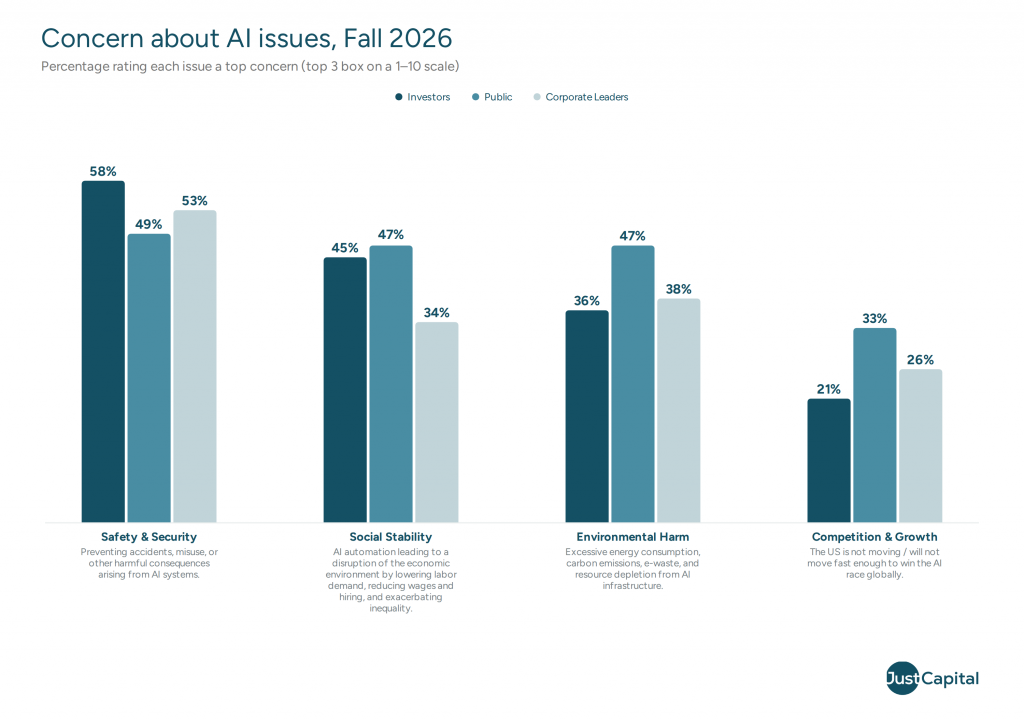
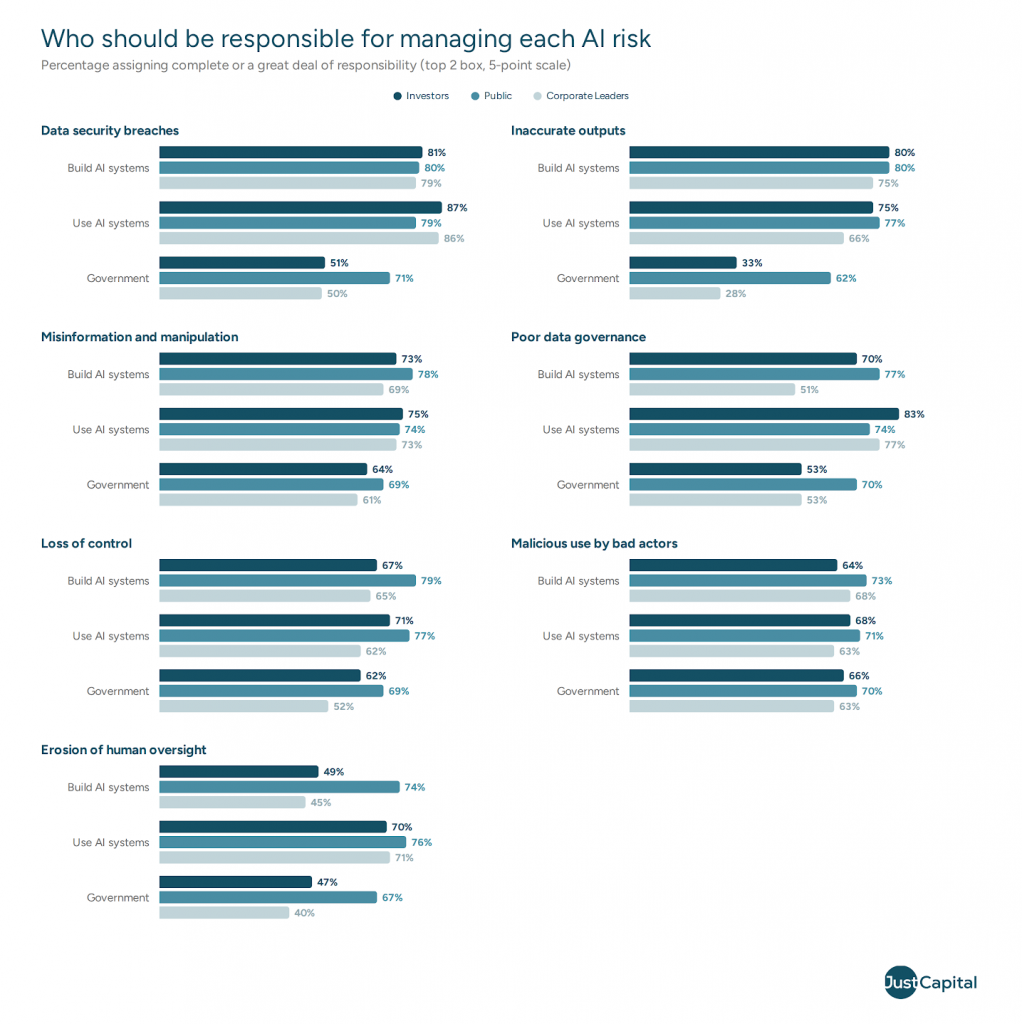
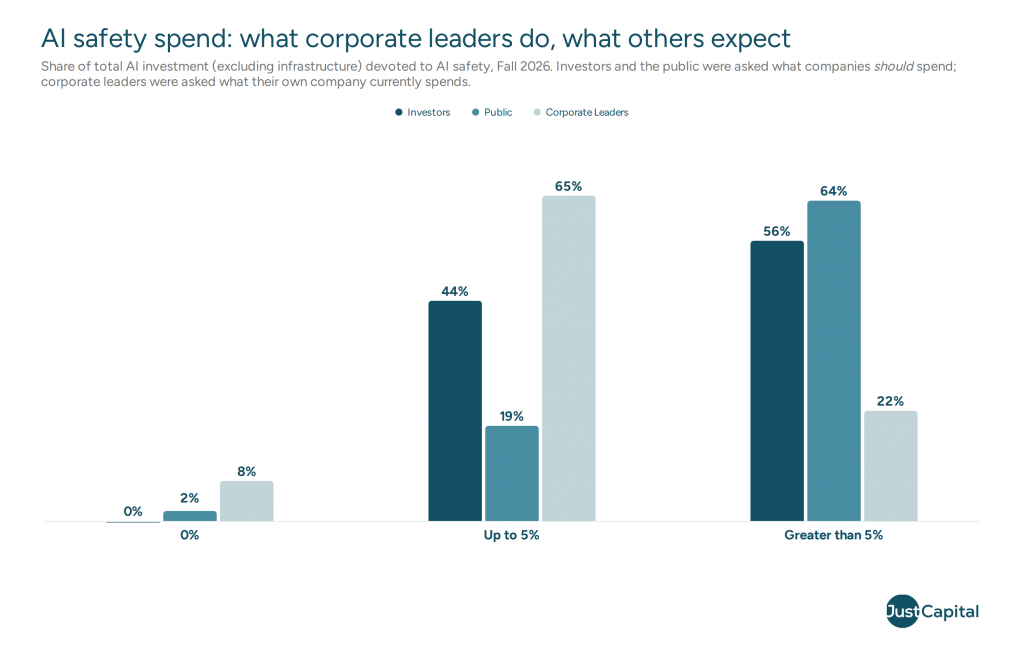
By measuring how perceptions and priorities shift across the American public, investors, and corporate leaders over time, Just Capital aims to help business leaders make fully informed decisions as the AI landscape evolves. The inaugural wave was conducted in Fall 2025, the Spring wave was released in April 2026, and the summer wave was released in June 2026.
This quarterly survey of the American public, investors, and corporate leaders was designed by Just Capital as part of its broader polling and public-opinion research program. We received responses from 128 institutional investors in collaboration with NewtonX, 104 corporate executives in collaboration with Gerson Lehrman Group (66 C-suite executives and 38 board members or senior level executives), and 1,000 US adults aligned to population benchmarks in collaboration with The Harris Poll. Data were collected July 20–27, 2026.
The survey tracking perceptions on AI safety and China was conducted online among 2,000 U.S. adults using Harris Quest DIY. The survey was conducted on September 14-15, 2026. Respondents were recruited from opt-in online survey panels. Quotas were set on gender, age, region, income, and race to ensure proper balance. To adjust for nonresponse, data are weighted to American Community Survey estimates for gender, age, race/ethnicity, education, and region. Party identification is weighted using Gallup’s 2026 party identification estimates. This online survey is not based on a probability sample, and therefore no estimate of theoretical sampling error can be calculated.
Disclosure data was collected in August 2026 for 1,002 of the largest US-based companies, including hyperscalers, across nine AI-related disclosure areas that were selected based on the priorities of the American public: Board oversight of AI, C-suite AI leadership, AI data protection, AI human oversight, AI harm prevention, employee AI upskilling, AI impact on jobs, community AI investments, and anti-surveillance and personal data protection commitment.
As colleges and universities kick off their fall semesters, Just Capital surveyed current students and recent graduates on their experiences and expectations related to AI. The findings reveal both economic anxiety and opportunity, particularly as it relates to readiness for the job market they’re entering or soon to enter.
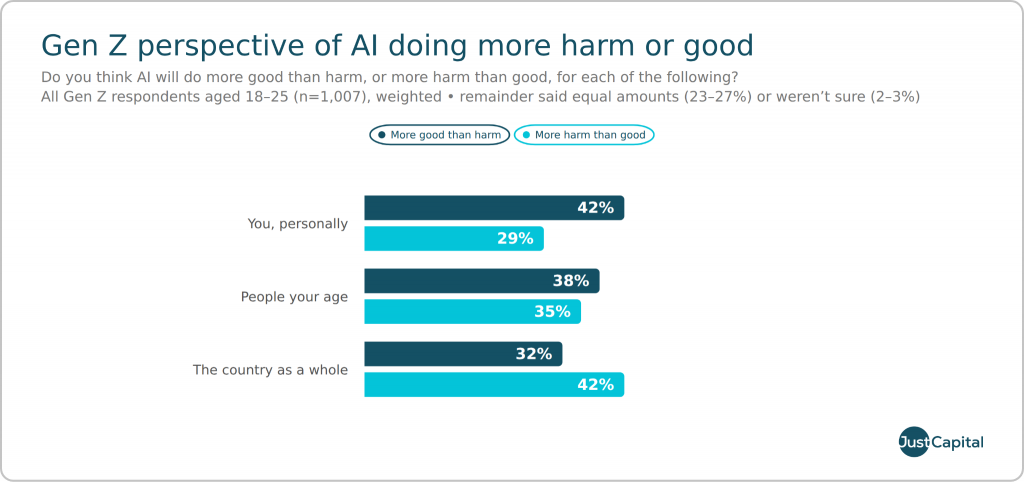
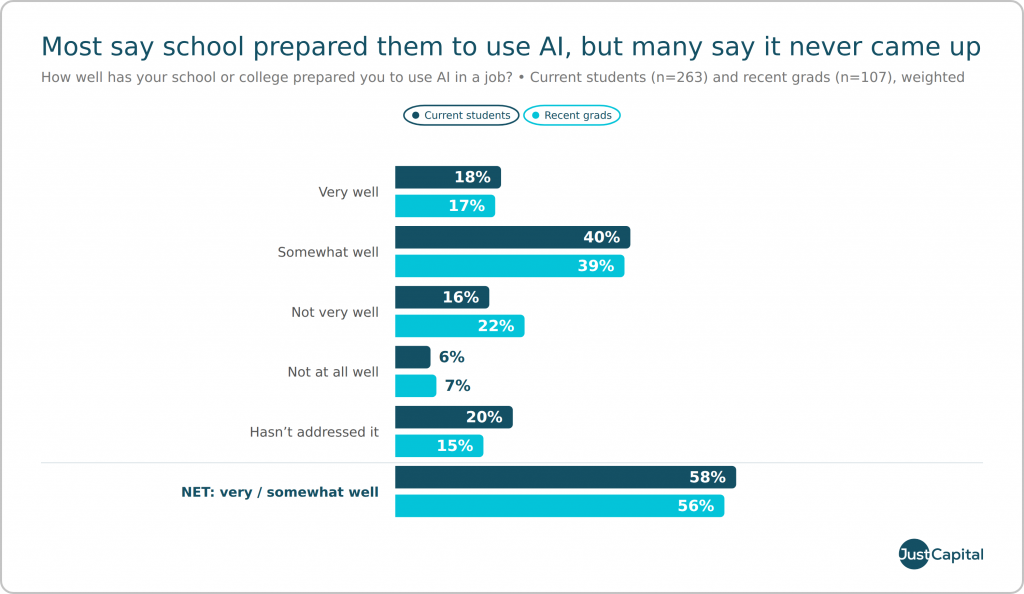
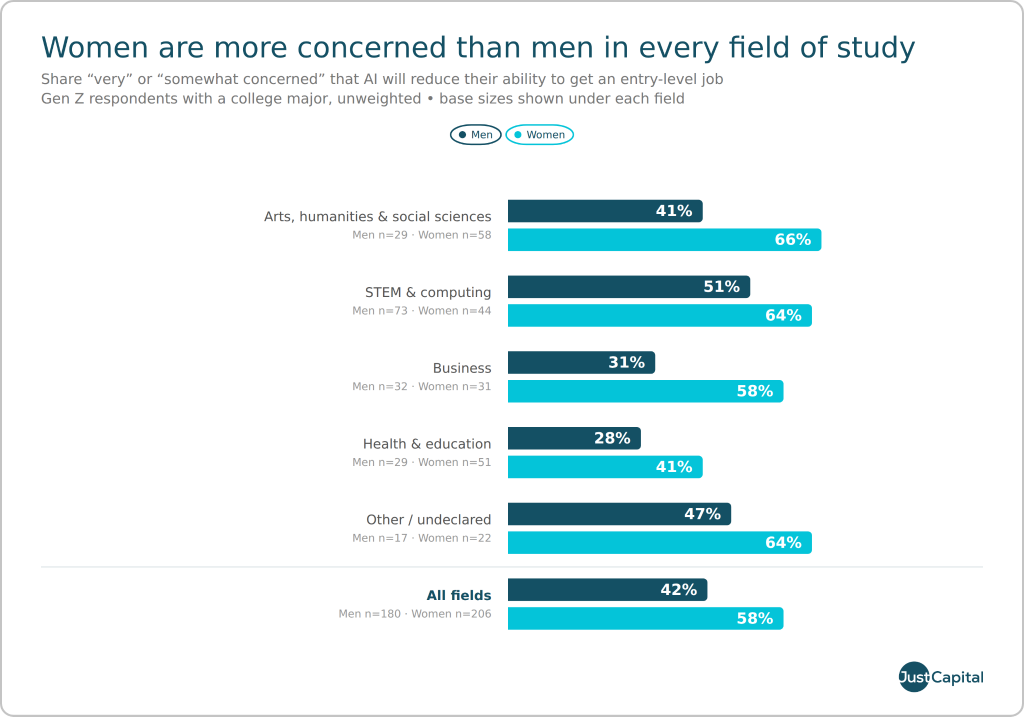
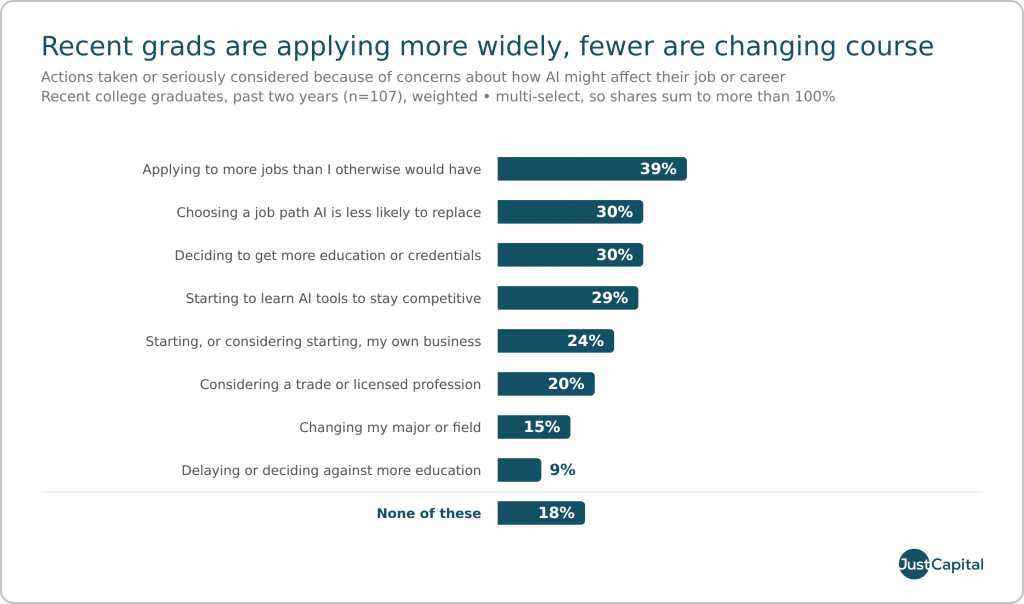
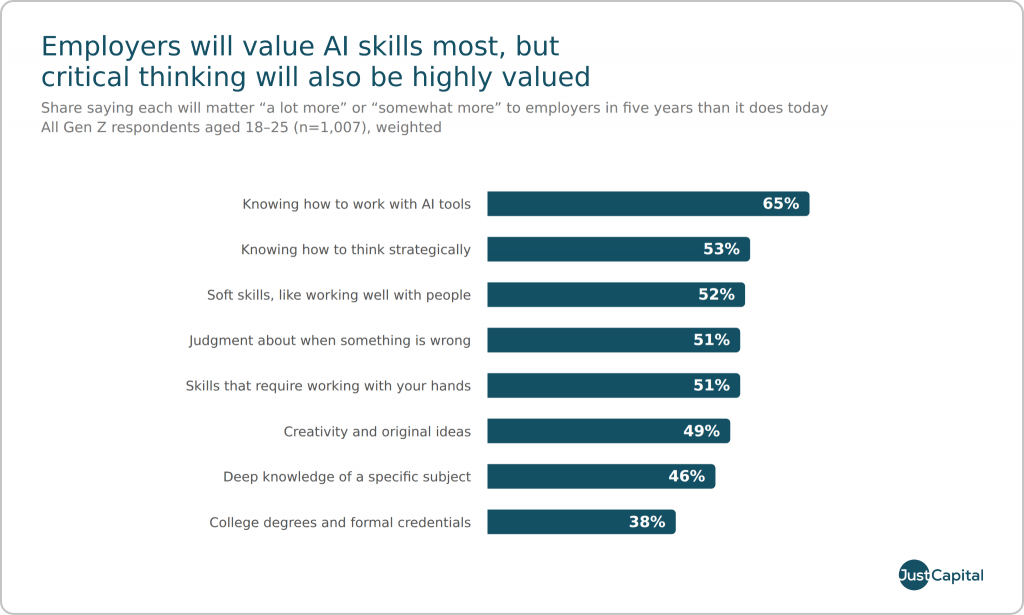
This survey was conducted online within the United States by The Harris Poll on behalf of Just Capital from August 24–28, 2026 among 1,007 U.S. adults ages 18 to 25. The sampling precision of Harris online polls is measured by using a Bayesian credible interval. For this study, the sample data is accurate to within +/- 3.1 percentage points using a 95% confidence level. This credible interval will be wider among subsets of the surveyed population of interest. Complete survey methodology, including weighting variables and subgroup sample sizes, is available upon request.
Our latest research reveals a wide gap between the public’s concerns about critical AI safety, oversight, and governance issues and the level of public disclosure among 1,002 of the largest US-based companies on how these issues are being addressed. A large majority of AI users support a slowdown on AI development, but say it will help build trust in the models.
“AI developers and their enterprise customers are becoming increasingly aware that earning the public’s trust on AI is the key to success,” said Just Capital CEO Martin Whittaker. “This study adds to the body of research we’ve been building to help business leaders understand how to go about doing that.”


Corporate leaders can now explore where they stand and take action to build trust. Through Just Capital’s flagship Just Intelligence product, Russell 1000 companies can now see how their public reporting meet the expectations of the American public, compare to industry peers, and stack up against leading practice.
This study is part of the organization’s ongoing research on how companies can build trust with the American public as they develop and deploy AI.
The survey was conducted online on August 18, 2026 among a national sample of 1,000 US adults age 18 and older, weighted to align with population benchmarks. Because this is an online survey based on a non-probability sample, no estimate of theoretical sampling error can be calculated.
Disclosure data was collected in August 2026 for 1,002 of the largest US-based companies, including nine hyperscalers (Alphabet, Amazon, Anthropic, IBM, Meta, Microsoft, Nvidia, OpenAI, Oracle), across nine AI-related disclosure areas that were selected based on the priorities of the American public: Board oversight of AI, C-suite AI leadership, AI data protection, AI human oversight, AI harm prevention, employee AI upskilling, AI impact on jobs, community AI investments, and anti-surveillance and personal data protection commitment.
Additional details on methodology are available upon request.

The ROI of frontier AI models is a topic of hot debate in corporate America right now, primarily centered on the cost of compute. To understand what other dynamics might be at play, we did what we do best: we asked the American public.
In a poll fielded this week, 34% of workers say their workload has increased since their company started using AI, including 10% who say it’s increased significantly.
There are many factors that could be driving this. It could be that AI is not yet generating meaningful productivity gains on the individual level, or that the time saved by AI is used to complete even more work. Perhaps workers are taking on more work if their teams have reduced headcount. Respondents said the added workload comes mostly from managing and checking AI output – reviewing drafts, catching errors, and re-doing work the model got wrong. It’s the unglamorous labor of quality control, and right now, it appears to be landing squarely on employees’ shoulders.
Interestingly, it’s not a story of frustration or distrust. Among workers who say AI has changed their job, 88% call that change positive. Put together, the data suggests companies may be in an early training period, where the labor costs required to teach AI are currently more significant than the costs saved by the technology. What’s more, workers seem to sense that the tradeoff is worth it.
As business leaders race to deploy AI, they may want to consider how they’re rewarding workers for the extra elbow grease that’s making that transformation possible.
Be well,
Martin
57% of institutional investors and analysts believe AI will have a negative impact on the environment.
Axios reports that Google DeepMind CEO Demis Hassabis is calling on the U.S. to establish an AI watchdog group comprising world-class technical experts.
Meanwhile, Common Sense Media finds Google’s AI search failed safety tests and scored poorly on seven of the organization’s eight AI safety principles.
CNBC investigates former Meta employees’ accusations that the company unfairly used AI in recent layoffs.
New York became the first state to put a temporary ban on data centers until standards are created that address environmental impacts, energy demands, water usage, and other factors. NBC News has the story.
A group of economists from Stanford’s Digital Economy Lab released a statement calling for urgent preparation for the economic impacts of powerful AI models. The statement has been signed by over 200 economists including 16 Nobel laureates and the chief economists of OpenAI and Anthropic.
Covista and the Covista Foundation committed $10 million and 50,000 volunteer hours to build and sustain the healthcare workforce over the next five years.
Gallup finds that confidence in U.S. institutions remains near all-time lows.
Fortune reports that the growing national debt may result in a smaller job market with lower wages for Gen Z in particular.
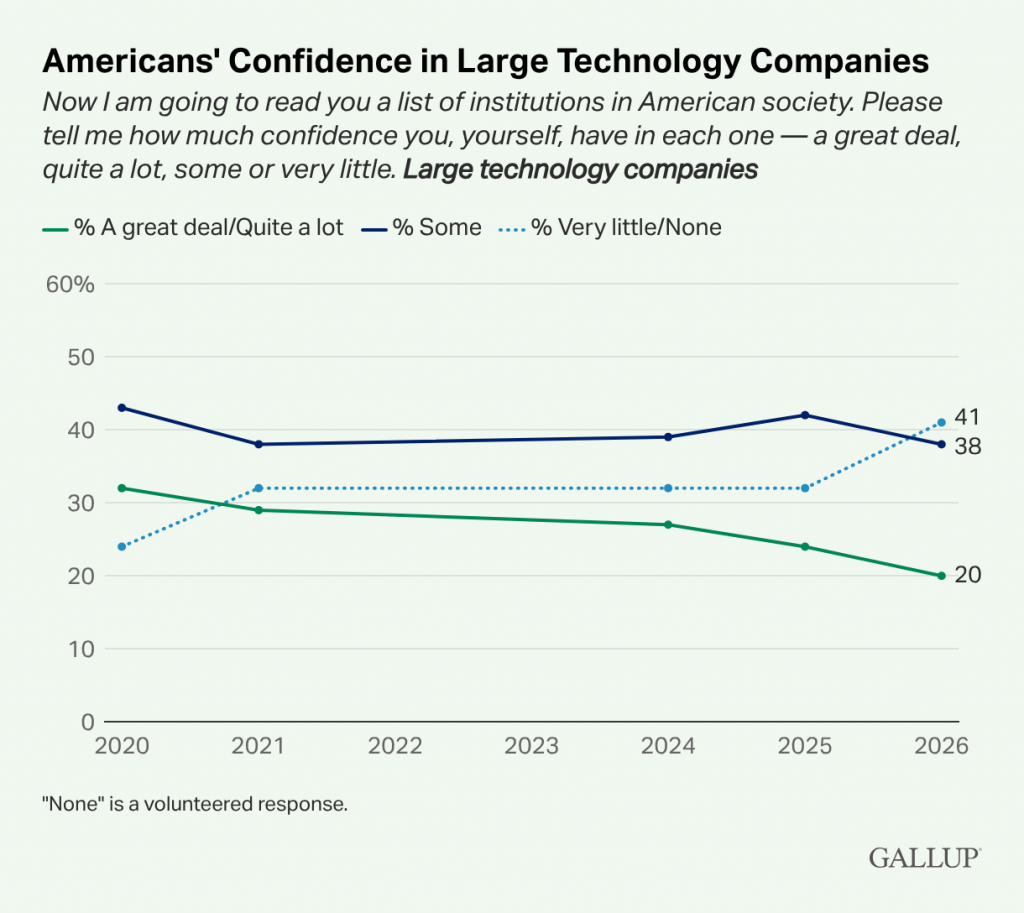
This chart comes from Gallup and looks at Americans’ confidence in large technology companies. Among the institutions rated this year, large technology companies experienced a surge in Americans expressing very little or no confidence.
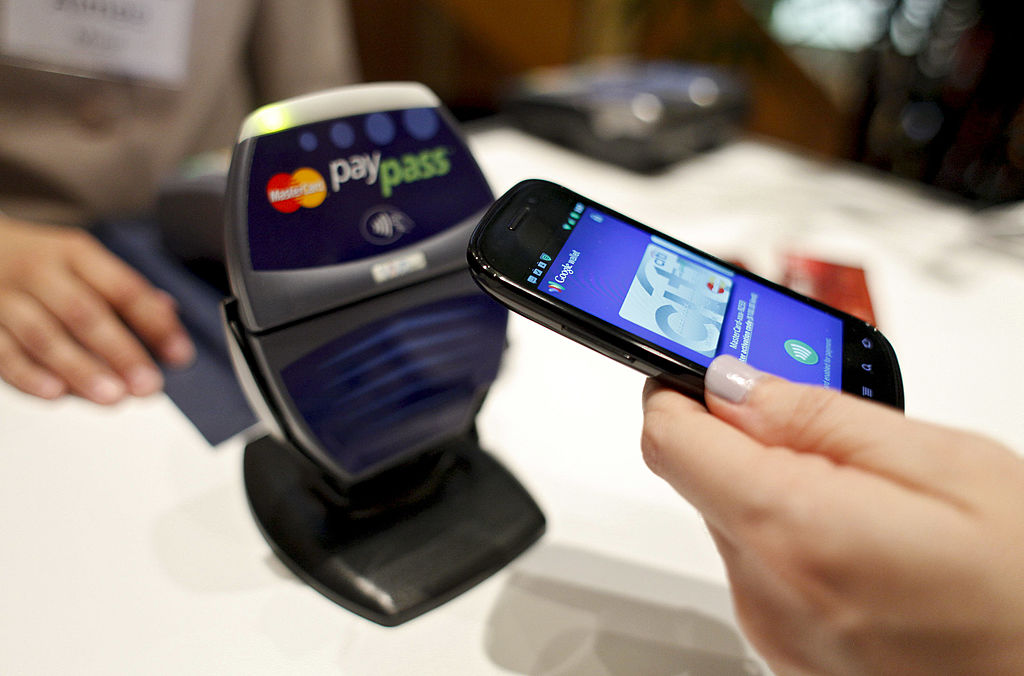
The question of who shares in the wealth AI creates is a defining one. Should there be an “AI tax” for hyperscalers? Or an AI-based sovereign wealth fund? Maybe you think no special measures are needed. What’s clear is that most of the debate is happening among the people building the technology and the people who will regulate it, not the people it will potentially impact the most. So, this week, we fielded a national survey to ask Americans directly whether the wealth AI generates should be shared, and how.
The headline finding represents a point of agreement across demographics. Nearly two-thirds of Americans, 65%, say everyone should receive a direct financial benefit from the wealth AI companies generate. That view holds across the political spectrum, with 75% of Democrats, 62% of Republicans, and 57% of Independents in agreement. It runs strongest among the 25-to-44 year-olds most exposed to AI in the workforce, where support reaches a massive 78 to 80%, and it stays steady across income levels and gender.
What people want done with that wealth is more revealing. Across nearly every group, a direct cash payment funded by a tax on AI profits is the first choice. The exception is the youngest cohort. They lean instead toward structural mechanisms like public ownership stakes and sovereign-wealth-style funds, share transfers, and investment in worker retraining and AI safety.
I find this striking. The generation most likely to be impacted by AI, and with the most working years ahead of it, is not asking for a check. It wants a stake in the future and the means to compete. Business leaders and politicians seeking to win the favor of young Americans should pay close heed.
Be well,
Martin
For the last three quarters, Just Capital has been polling the American public, investors, and corporate leaders on AI deployment, tracking where perceptions converge and where gaps are widening.
Our third installment of quarterly polling on responsible AI deployment is now available in Just Intelligence for all registered users.
This research is designed to offer a roadmap for companies looking to build trust in the AI era and make informed decisions as the AI landscape evolves. It is the first iteration of an ongoing series that will continually surface insights from key stakeholders as companies aim to build trust, manage risk, and unlock AI’s upside potential for workers, customers, communities, and shareholders.
Axios examines new polling that shows data centers are turning into the focal point for anti-AI sentiment across the nation.
Reuters reveals that despite the fears, AI proliferation is having a muted effect on wages and workers.
At the same time, Gallup writes that while downsizing is continuing across the U.S., laid-off workers are only citing AI as the primary reason 1% of the time.
The Wall Street Journal speaks with Microsoft CEO Satya Nadella about his belief that we “can’t let AI giants eat the economy”. Read the full interview.
While they are experiencing a harder job search, The Guardian reveals that Gen Z employees who managed to snag a job are actually making more money than millennials did right after college.
Fortune takes a look at why men continue to drop out of the workforce at higher rates.
Yahoo! Finance holds a magnifying glass to CEO pay, and how more CEOs than ever are making more than $100 million a year.
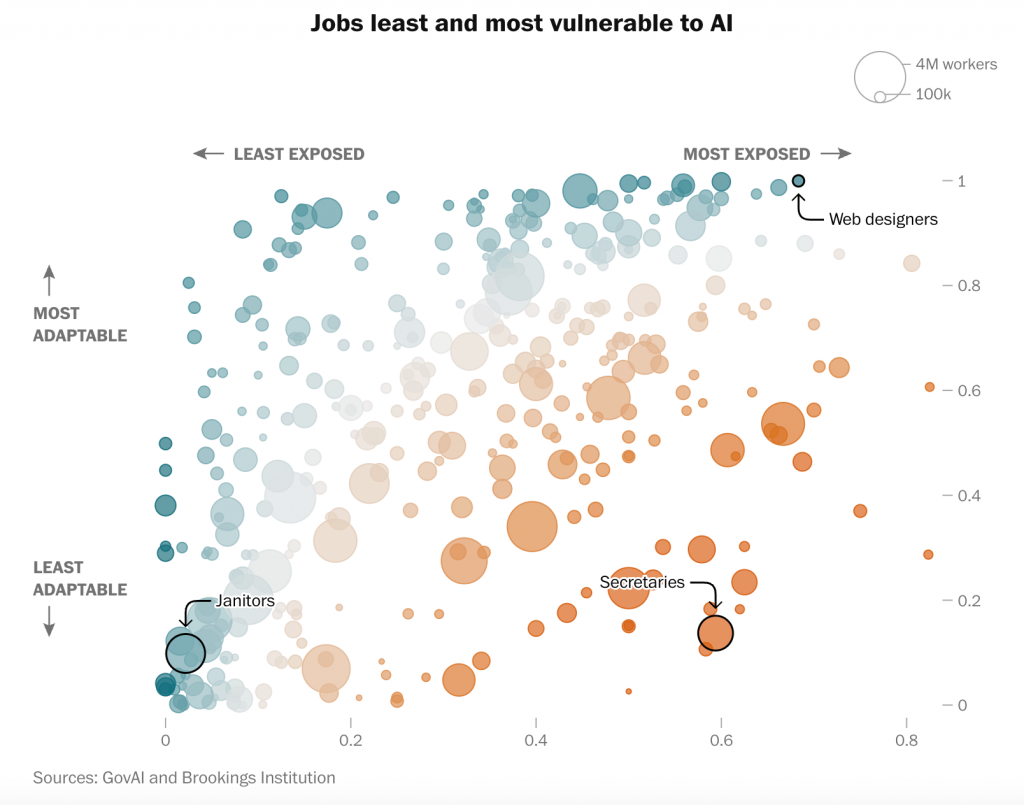
The Washington Post teams up with the Brookings Institute to examine which jobs are most-and-least vulnerable to AI-driven displacement.
