
Over the last nine years, JUST Capital has tracked and measured how just business – defined by the priorities of the public – is better business. We have worked hard to quantify and verify meaningful corporate action on just behavior, and believe it’s critical to understand what practices and policies are leading the pack. Truth and transparency are becoming more important than ever to employees, customers, shareholders, and others.
At JUST, we let data and measurement tell the real story, away from the noise of the public square. In an effort to capture a “real-time” look at how companies are taking action on key stakeholder issues, we recently analyzed new actions Russell 1000 companies have taken against some of the public’s biggest priorities this year. In Q1-2 of 2023, among Russell 1000 companies:
Importantly for JUST Capital, we are always seeking to understand the extent to which our work has a connection to actions taken. And we have strong correlation information to see the connection points between corporate action and JUST’s own work both at the company level and at the broader narrative level.
With increased political pushback against ESG and reports that corporate leaders are being more cautious about speaking out on key social and environmental issues (e.g. greenhushing, purpose-hushing), we’ve been closely tracking to see if any evidence is emerging regarding companies pulling back on investments, engagement, or reporting. And to date, we have not seen any. In fact, what we see is more and more companies engaging with our polling and our corporate performance data to understand how they stack up against their peers on the issues that matter most to the American public and also engaging more deeply with our key programmatic initiatives that help drive corporate behavior change to understand how take action and improve.
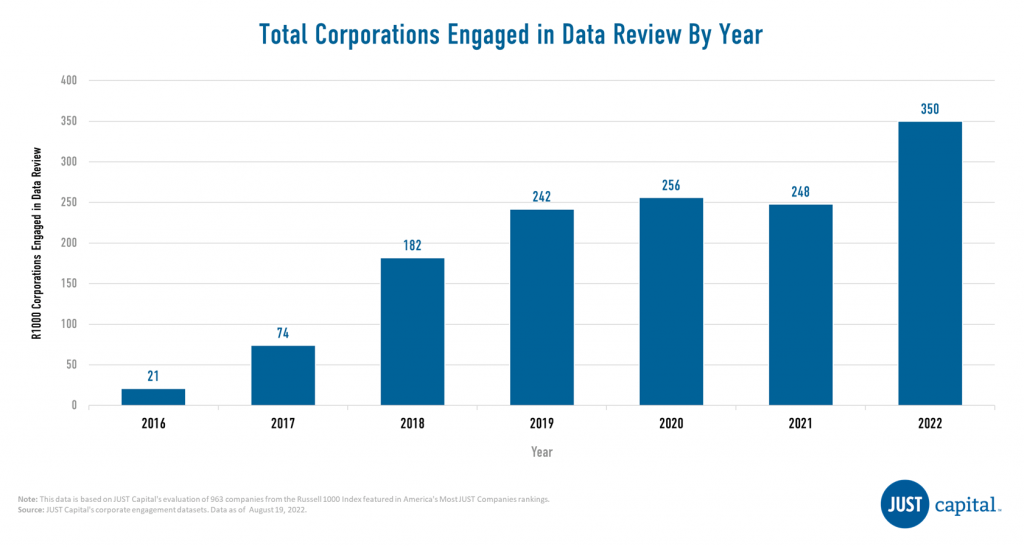
JUST has engaged a majority of the Russell 1000 companies, 82%, that have taken the actions listed above this year from our inception. Overall, we’ve engaged with over 60% of Russell 1000 companies since 2016, including through our Rankings of America’s Most JUST Companies. As the chart below shows, in 2016, our first-ever Rankings year, 21 companies reviewed the data that powers our Rankings – and took advantage of the opportunity to understand our methodology and submit suggestions or updates. Last year, we hit a record of 350 companies. Earlier this month we had 388 registrants across nearly 300 companies for our annual preview webinar, another record – and up 38% from this time last year.
All signals point to more interest and engagement from companies becoming more just this year.
Following last year’s data review period, we also conducted a survey of Russell 1000 companies that found a majority agreed that engaging with JUST helped inform and/or prompt implementation of new practices or disclosures on the issues we track, measure, and analyze. Those companies already leading on justness are also outperforming their peers. The 2023 JUST 100 (our top-ranked companies) had a 4.5% higher profit margin, 2.3% higher return on equity, and paid five times more in dividends compared to the rest of the Russell 1000. Learning from our Rankings, through the data review process for instance, is only the first step companies can take in engaging with JUST.
Over the last three years, we have launched three anchor initiatives designed to support large companies and business leaders seeking to ensure both their business and workers thrive. Through our Worker Financial Wellness Initiative, Corporate Racial Equity Alliance, and Corporate Care Network, we provide access to timely and informative resources and support on action planning through assessments, the opportunity to meet and learn in a peer community of practice, and receive guidance and technical assistance from a network of leading organizations and firms.
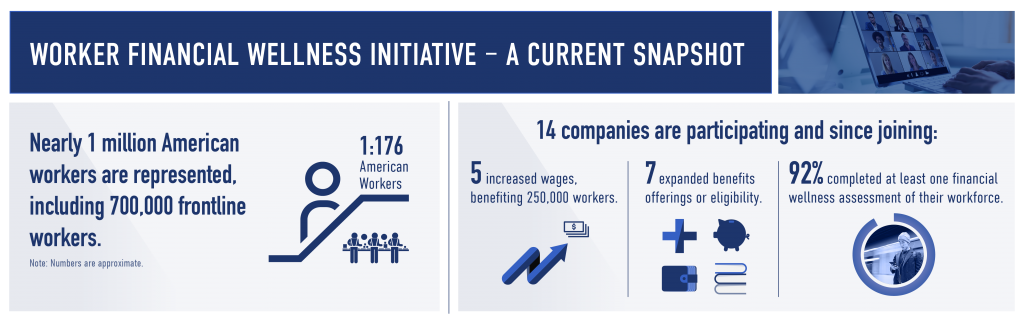
Through the Worker Financial Wellness Initiative, we’ve heard firsthand from workers at Chipotle, PayPal, Prudential Financial, and Verizon on how the investments their employers have made in them have positively affected their lives and livelihoods, as well as executives regarding how those investments have propelled positive business outcomes including increased engagement, productivity, customer satisfaction, and lower turnover.
In addition to the changes we tracked in company actions, we also examined how shareholders used JUST data and initiatives in their 2023 proxy season proposals. Across the Russell 1000, we found four shareholder proposals that cited JUST polling data, analysis, and other tools covering issues including wage increases and racial equity. These proposals came from investors at major companies in the Retail, Food, Beverage & Tobacco, Capital Markets, and Automobiles & Parts industries.
While these proposals were developed independent of JUST’s input, through our regular analysis we’ve observed an uptick in corporate disclosures when investors start to ask for more data. Workforce demographic disclosure is one example. Amid campaigns from institutional investors and an increase in shareholder proposals, our analysis found that EEO-1 disclosures (and other similar intersectional workforce diversity reports) more than tripled between 2021 and 2022 among the Russell 1000. We’ll continue to track what issues are gaining traction in shareholder proposals and how that might affect corporate actions and disclosures.
We also continue to monitor the market performance of the companies that perform best in our Rankings. In June, we celebrated the five-year anniversary of the JUST ETF, which tracks the top 50% of companies ranked by JUST Capital across all industries and is powered by our proprietary JUST U.S. Large Cap Diversified Index (JULCD). The JULCD has outperformed the Russell 1000 by 8.78% since inception through May 31, 2023.
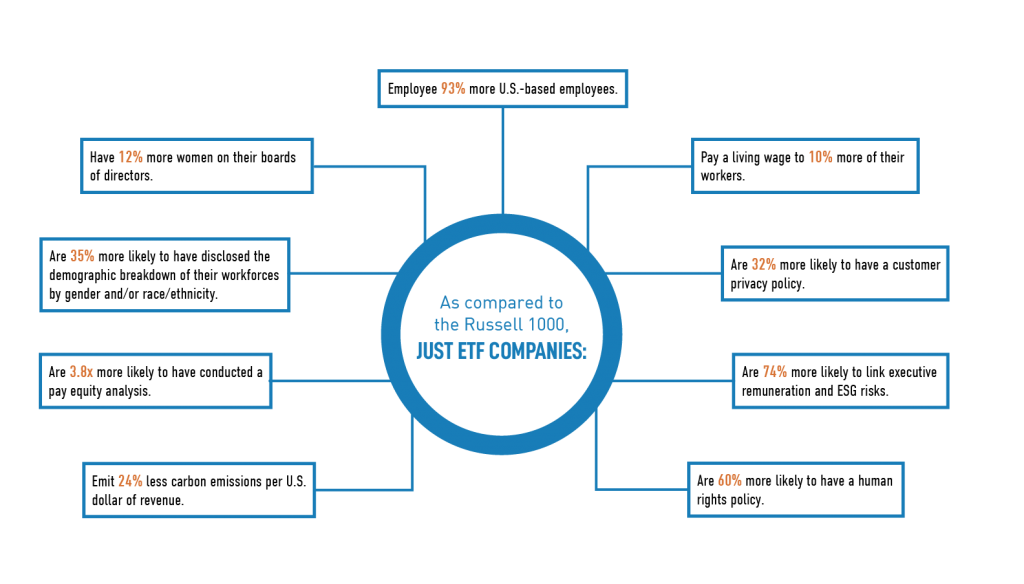
Companies in the JUST ETF also outperform their peers on key stakeholder performance metrics like paying a living wage, creating jobs in the U.S., and providing paid parental leave.
In addition to investors, nonprofits and civil society are increasingly using both JUST data and insights to inform their own work and insights into the state of play on corporate leadership. As part of the Corporate Racial Equity Alliance along with FSG and PolicyLink, we’re using JUST’s data and insights on diversity, equity, and inclusion (DEI) to inform the development of standards to measure corporate action to advance racial equity. The process for developing these standards has included input from 300 individuals including social movement leaders, equity and sustainability experts, and academics.
As we continue to track corporate stakeholder behavior, this work is connected to engaging with some of the largest U.S. companies to drive change on the issues that matter most to the people who work for, buy from, and invest in them. Through our Rankings of America’s Most JUST Companies, programmatic initiatives, JUST Jobs Scorecard, and other tools, we’ve helped guide companies on how they can improve their performance and encourage disclosure of their progress along the way.
This update marks the first in a series of snapshots we plan to take of “real-time” action from Russell 1000 companies – keep an eye out for future editions. The actions captured here reflect one facet of how JUST Capital works to build a world where business and markets are a force for good, driving competition to build a better future for all. For more detail on how we drive change, explore the insights on our Mission & Impact page, subscribe to our weekly newsletter, or reach out to us at corpengage@justcapital.com.

JUST Capital is pleased to announce that Sushmita Banerjee, Managing Director & Senior Partner at Boston Consulting Group (BCG), and David Kamenetzky, Co-Founder of K4 Family Investments, have joined our Board of Directors. Banerjee and Kamenetzky are two of ten new members to have joined the JUST Capital Board over the past two years, and bring expertise in corporate strategy and growth to this group.
Banerjee has held several leadership positions throughout her 15-year career with BCG, and since late 2021 has served as the global leader of the firm’s Strategy business. She works with clients on strategy, growth, organization, large-scale transformation, operational improvement, total shareholder return, post-merger integration, and digital identity. She also currently sits on the North American leadership teams of BCG’s People and Organization and Transformation practices. Banerjee is a core member of BCG’s Social Impact practice as well, helping advance clients’ goals in a sustainable manner.
Kamenetzky is a values-based leader in the food and beverage industry. He previously served as Chairman of JAB Investors, Chief Strategy and External Affairs Officer at AB InBev, and member of the Mars’ management team. A life-long advocate of combating antisemitism and hate, he was also founding chairman of one of the largest European foundations for Holocaust remembrance and democracy promotion.
Banerjee and Kamenetzky join JUST Capital following the launch of our JUST Jobs Program in September 2022, integrating and building upon our pre-existing initiatives: the Worker Financial Wellness Initiative, Corporate Racial Equity Alliance, and Corporate Care Network, to help companies take action on job quality. In March, we also released an initial version of the JUST Jobs Scorecard – a tool that helps corporate leaders benchmark job quality performance.
“Sushmita and David are leaders when it comes to forward-thinking strategy, sustainable growth, and innovative investments. We’re thrilled to welcome them to the JUST Board, and especially fortunate to do so at a time when our own strategy further focuses on the direct and indirect influence we have on just corporate behavior, and the American worker in particular,” JUST CEO, Martin Whittaker, said.
JUST Capital welcomes Banerjee and Kamenetzky at a crucial moment as we approach our 10-year anniversary. Their expertise in corporate strategy, social impact, and human capital will be critical to JUST as we continue to strategize and measure our impact as an organization over the next ten years and beyond.
We continue to expand and diversify our Board following a commitment we made in 2020 which includes applying a diversity, equity, and inclusion lens on our recruitment; committee structures; bylaws and practices; and onboarding and offboarding procedures.
Employees at C.H.I., a garage door-manufacturer headquartered in Arthur, Illinois, received life-changing news last May. In 2015, private equity firm KKR acquired C.H.I. and granted its entire workforce – from those working in its factory to its corporate offices – ownership in the company. Last year, KKR sold C.H.I. in a $3 billion deal, marking one of the firm’s largest returns and, for C.H.I. employees, an opportunity to share in the wealth. With the sale, employees received equity payouts based on their tenure at C.H.I., with the average hourly worker earning $175,000 as a result.
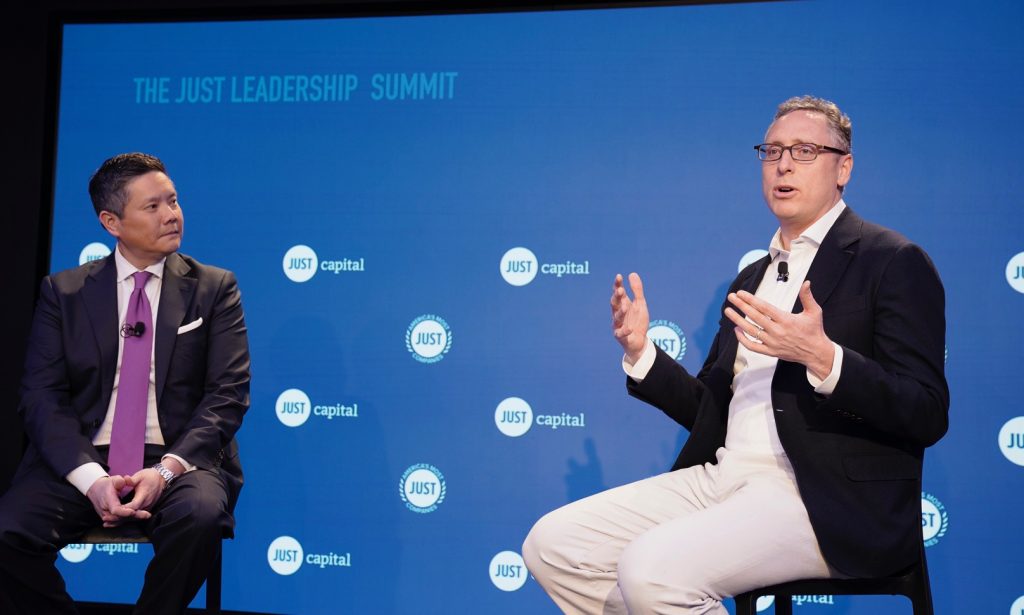
Hearing from C.H.I.’s workers themselves, the move was beyond what they had imagined from KKR’s employee ownership model and “all because someone held up their word to you.” These words grounded our conversation on employee ownership at the JUST Leadership Summit this week. KKR Partner and Co-Head of Private Equity Pete Stavros joined CNBC Senior Markets Correspondent Dominic Chu to discuss his work leading the firm’s employee ownership programs, how they’ve been successful, and their impact at the worker- and shareholder-level.
Stavros, who is also the Founder and Chairman of Ownership Works, a nonprofit supporting companies in implementing employee ownership models, touched on the origins of this work, referring to it as “an initial experiment” from his early days at KKR, but one that’s seen great success and has been in practice for nearly 14 years at 30 different companies.
“They don’t always go this well. This was a truly remarkable outcome,” he said. What’s been behind this outcome? For Stavros it’s come down to keeping the scale of opportunity top of mind, seeking CEO leadership that prioritizes accountability, and treating employee engagement at the same level as business.
At a time when jobs and the labor market remain at the forefront for corporate leaders, his points have weight for what companies should be prioritizing when it comes to employee engagement and job quality. Watch their conversation below and read on for key takeaways.
Stavros acknowledged that many employees at C.H.I. were understandably skeptical when KKR came in, not believing that this ownership program would amount to anything for them. And, six months later they still didn’t fully understand it, he said. The work to help workers understand how they could share in the company’s successes, and to tie that to more short-term outcomes, took years. Some of the results he shared for companies who have taken this long-term approach speak volumes to its benefits.
One of KKR’s biggest success stories, Ingersoll-Rand, saw its quit rate drop 90% over 10 years with this model in place, Stavros said. And C.H.I.’s profit margin rose from 20% to 35% under the employee ownership structure – a number that might be typical for a software company but is “unheard of” for a garage door-manufacturer. The longest-tenured employees at the company were given a payout worth 6.5 times their annual salary when it sold. Of the initial 10 companies the firm implemented this experiment at, half have sold with a return of more than three times the original equity invested and an additional four are projected to follow the same path, he said. “The track record is unparalleled in the history of private equity,” Stavros said. “None of our investors are sitting there going, ‘Wait a minute, who’s paying for this?’ and everyone is saying ‘How can we do more of this?'”
Chu opened the conversation noting that there’s a “touchy feely” aspect to this work that you don’t usually associate with private equity. And that, to Stavros, is an opportunity he’d like to see the industry capture. “For all of its problems, private equity is a very effective governance model and a very effective way of transmitting change,” he said. “If that governance model can be put to good use, it can be really powerful.”
The most important factor in the success of these programs, Stavros said, is leadership. “Like everything in the world, it starts and stops with leadership. If you have the right leader at the top this can be magic. If you don’t, forget it.”
As far as which companies are best suited to these programs, Stavros noted that public companies face quarterly reporting pressure, but that ultimately what matters more than company type or industry is leadership. CEOs with a lens and investment in the entirety of the company, including culture, are particularly primed for success he said. “One of the key screening criteria is, ‘what type of a human being is this?'”
Stavros believes this mindset is a mix of something inherent to CEOs and that comes over time. He pointed to the example of Kathy Bolahus, CEO of Charter Next Generation, a speciality film manufacturer that implemented an employee ownership program when KKR invested in the company in 2021. Kathy cries if her employee engagement scores aren’t good, Stavros said, because there’s a sincere, genuine passion for her people there – and a sense of responsibility. “They think the injustices in society exist, it is their problem to solve them for their people, and they can do it.” They’re not going to write off quit rates, for example, as just an industry problem, but take ownership for solving them, he said.
While some leaders may be more inclined toward this level of investment, Stavros believes all of them shift by merely going through the employee ownership process. “The process of going through this and rolling the model out and engaging, changes people. I don’t think you can coach them up in a room,” noting that one in three CEOs are moved to tears when they just start the process – not when the payouts come. Ownership Works is helping CEOs support each other through these changes, Stavros said, and build what Chu compared to a “coaching tree” in sports for executives to navigate these challenges.
That leadership mindset is most important when it comes to organizational culture. Stavros noted that what’s core to KKR’s approach is teaching CEOs and executives to approach culture-related issues and employee engagement in the same way they would operational issues. “The tools that we’ve developed are all about taking operational problem solving skills and applying them to fixing culture,” he said.
He brought up a hypothetical example of having a scrap problem at a manufacturing company. A CEO, in that instance, would run an analysis, problem solve on each of the issues, have a robust plan to measure against them, and “relentlessly” follow up with data, he said. He wants to see executives take the same approach to culture and engagement. “What we are trying to teach is ‘you know how to solve problems,'” he said. Using those problem solving skills to address low engagement and high quit rates has been key to KKR’s success.
And, importantly, to the ultimate reward for workers. By tying engagement and operational problem solving goals together, workers won out at C.H.I. “What had never been tried was engaging with the entirety of the workforce to drive operational improvement,” Stavros said of the previous C.H.I. owners’ strategies. C.H.I. had operational goals on issues like scrap reduction, labor productivity, and route density for deliveries that leadership would tie into short-term outcomes and investment for workers. Workers would receive reports on how they’d contributed to these goals day after day, he said, and receive rewards like a paid lunch if they’d met them.
“This was a million little things that took everyone pulling together to make happen,” Stavros said. Those small things added up to soaring profit margins, transformative payouts for employees, and a new example of the opportunity that lies in investing in workers.

Philanthropy plays a pivotal role in American society, helping to uphold, safeguard, and support some of our most important traditions, institutions, and key social and environmental causes. In 2021, Americans gave a record $485 billion to a multitude of good causes, making us once again among the most philanthropically generous people on Earth.
Why then do we seem to be unable to make a dent in some of our most pressing economic and social problems? Why are poverty rates so stubbornly high? Why does the U.S. routinely fall below other developed nations on literacy, education, and health outcomes? Why is economic inequality so rampant in the U.S. versus other countries?
The truth is that tackling the root causes of our most intractable societal challenges requires a new way to think about philanthropy. Specifically, it requires transformational philanthropy that’s focused on the systems that are creating and compounding these root causes. Often, we see philanthropy interact with and support broad-based public policy change, or make specific, tangible interventions in one area or another. But there’s something vital missing. And that’s a push to catalyze the private sector to do more of the heavy lifting.
The math is obvious: At $21.6 trillion, the private sector is more than four and a half times the size of the public sector and 44 and a half times bigger than the philanthropic sector. Just as importantly, however, focusing on the private sector helps create a leverage effect so these vast resources can be marshaled to help us solve our greatest challenges, rather than exacerbate them.
Consider this: 165 million Americans work. It’s one of the major through-lines of the American experience. The workplace connects people, families and communities in every county in the country. How people earn a living is directly connected to societal outcomes.Yet JUST research focused on the top 1,000 public U.S. companies shows that 51% of those workers still don’t earn a family sustaining living wage at the local county level. If the 50 largest companies alone increased their minimum wage to a local living wage, we’d lift up roughly 10 million families and boost economic growth. If we shifted a mere 1% of private sector capital flow in a more just direction, that’s still more than $600 billion a year being channeled to support higher wages, better benefits, stronger communities, better protection of human rights and the environment, and more.
Imagine if we could get companies to improve job quality and invest more in their people. Think of the incredible social and economic benefit we would see if workers today had enough to support their families, put food on the table, cover childcare and preventive care, buy a home, save to send their kids to college, and begin to build wealth for the future.
Imagine if we could incentivize companies to invest more in the communities where they operate – to prioritize veterans and second chance hiring, ensure equality of opportunity within every workplace, support women- and minority owned suppliers, and invest in better healthcare and community education.
Imagine if we could get companies competing to do more to lower greenhouse gas emissions, reduce their environmental footprints, develop solutions to climate risk, protect fragile ecosystems, and safeguard water and land quality.
All of this is good for business, and good for society. This is JUST Capital’s vision – to drive competition and change within the country’s largest corporations to build more just business practices, and through that, a more just society.
To bring our vision to life, we focus on the 1,000 largest publicly traded companies in America. They create jobs for tens of millions of people; affect the lives of hundreds of millions; touch communities and supply chains across the U.S. and around the world; and have enormous social, political, and environmental influence. They set the agenda for best practices and social norms for business throughout the country and the world.
Transformational philanthropy doesn’t produce change overnight. It requires patience, creativity, and commitment. It requires more complex system thinking. It requires proponents to form communities of practice and to forge unlikely alliances and collaborations. But when it works, it produces lasting change at real scale.
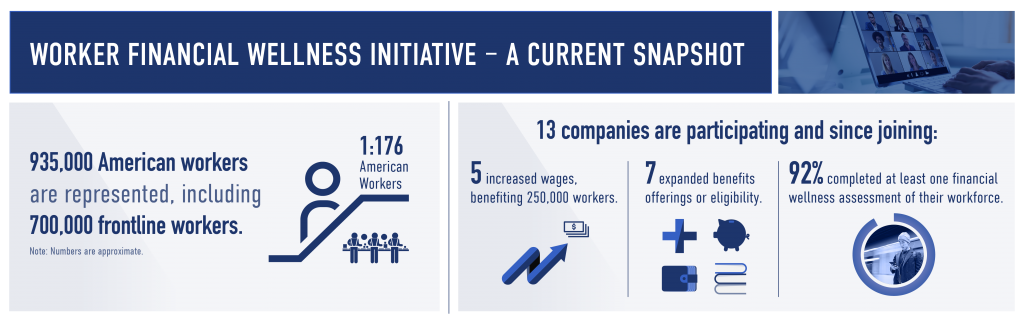
At JUST Capital, for example, over the last several years we’ve seen over 120 companies lift wages, benefiting 6.5 million workers. Over 350 companies now disclose conducting pay equity analyses (up from 132 in 2018), which is essential for fair pay practices to become the norm. Our Worker Financial Wellness Initiative comprises 13 corporations representing 935,000 workers, of which 12 have completed at least one financial wellness assessment of their workforce, five have announced wage increases for hourly workers, and seven have implemented new or expanded benefits programs.
Because we focus on the whole system, we also work closely with the media – our partnership with CNBC gets data on how companies are doing on these issues in front of millions of business and financial professionals on a regular basis – and with investors, so we drive capital to just companies as an incentive. We support 11 different investment products, including the JUST ETF, and we’re now working with some of the largest asset managers and asset owners in the country.
That’s just a snapshot of the transformational impact we’ve already achieved through our corporate engagement, partnerships, investor work, and more (take a deeper dive here). And, at JUST, all of this is grounded in the American public’s priorities. Our polling and public opinion research gets to the heart of what everyday Americans want companies to tackle – mainly, paying a fair, living wage and investing in workers. We use this as a base to incentivize change from the country’s largest employers, and partner with media outlets, nonprofits, and academics, and investors.
Taken together these efforts create a mutually-reinforcing suite of activities in support of systems change.
To be truly effective, transformational philanthropy also needs to be structured a bit differently.
It must have a scalable funding structure. That’s why, in JUST’s strategy, we are working to create pathways for funding flows from the corporations and investors we engage, in addition to increasing support from foundations, individuals, and other partners. In this model, philanthropic support is used to build the systems that will create a future funding flywheel, in much the same way that catalytic venture funding can help for-profit startups achieve financial sustainability.
It must also bring together people and partners who can provide more than simply grant money. It needs creative problem solving and expertise from those who understand the power of industry, believe in capitalism as a force for greater good, and see wealth and capital as a means to an end.
One of our longtime supporters, Darren Walker of the Ford Foundation, often points to a particular quote by Rev. Dr. Martin Luther King, Jr. when he talks about philanthropy, one that I believe embodies a transformational approach: “Philanthropy is commendable, but it must not cause the philanthropist to overlook the circumstances of economic injustice which make philanthropy necessary.” It is these circumstances that transformational philanthropy seeks to address. And unless and until the private sector is inspired to do more, traditional philanthropy will continue to fight an uphill battle.
To learn more and explore ways to get involved, please connect with us. An investment in JUST Capital will generate high-impact outcomes for workers, communities, and society at large, leveraging the power of business as a force for greater good – and transformational philanthropy – in America.
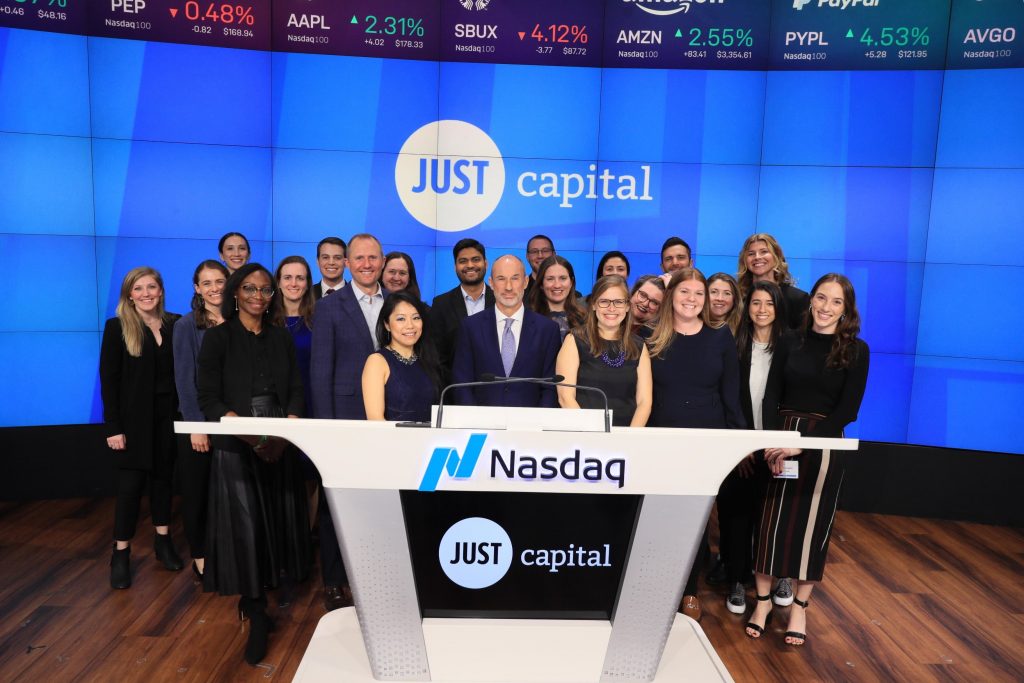
Monday was a monumental day for JUST and our mission. Ringing the Nasdaq closing bell to celebrate the JUST 100 was a major milestone on the road to a more just economy and a chance to both thank all those who’ve helped us get this far and reflect on where we’re going.
After the bell, and with the help of Nasdaq, our event sponsors, and media partner CNBC, we hosted “The Strategic Imperative of the ‘S’ of ESG,” an in-depth discussion among company leaders on the human element of business. Some personal highlights:
I also noted the hunger for more open and honest talk about some of the challenges of ESG, how leaders have handled failure and made tough choices, how companies can act with greater authenticity and accountability, and how the stakeholder approach connects to the future of free market enterprise and democracy itself. You can watch the entire conversation here.
On the walls of Nasdaq’s amazing event space hang pictures of notable IPO and bell ringing moments from the past, from Amazon to United Airlines. The images capture companies in a singular moment of transition, for them and perhaps in some cases for the market itself. I like to think Monday marked a similar moment of transition for all those who see just business behavior as the future.
Be well,
Martin Whittaker

GM CEO Mary Barra says that remote work actually allowed the company to make faster progress on its electric vehicle fleet.
JPMorgan Chase CEO Jaimie Dimon releases his annual letter to shareholders, declaring that the American economy is still strong, but that the inflationary environment and Russia-Ukraine War will require bold leadership.
Starbucks returning CEO Howard Schulz scraps planned stock buybacks to invest more into their workers amidst growing unionization efforts.
Synchrony becomes the newest company to join our Worker Financial Wellness Initiative and make the financial health of their employees a C-suite priority. For information on how your company can participate, go here.
Our director of corporate equity, Ashley Marchand Orme, was quoted in this article on tracking the racial equity and diversity investment promises corporations made in 2020.
CNBC compared our Rankings of America’s Most JUST Companies with LinkedIn’s “Best Companies to Work For” to discuss how different methodologies produce wildly different outcomes in these lists, particularly around Amazon.

(Christopher Galluzzo)
“First and foremost, it is about putting food on the table. So, to them, are the wages competitive? But then how do you create a pathway to economic mobility and growth? And for us, it really is about level access to education. We introduced debt-free degrees back in 2019, where it is that pathway for our employees to really thrive, but then pursue their passion whether it’s here as a leader or in the world as a leader.”
“It’s about taking leadership now and presenting guidelines that might help investors and others in the community understand what you’re doing. Prior to our rule, about 25% of the S&P 500 disclosed their board diversity, now over 60% have disclosed – and that’s in a year.”
“I don’t think ESG will ever be 100% of the decision-making of buy and sell. It just won’t. But five years ago, was it 5%? Today, is it 15-20%? Will it be 35-40%? Yes. Will that be an indicator of better culture, better long-term growth, more innovation? Yes.”
The United Nations’ IPCC released its latest report on the state of global climate change and progress toward mitigating it. It’s a giant report, but the Panel provides key findings and a breakdown by sector, and if you want just the most top level data, Bloomberg Green has a handy briefing. One takeaway: “Left unchanged, the world’s current emissions trend could result in warming of more than twice the target limit set forth in the 2015 Paris Agreement.”
The Wall Street Journal released an analysis of CEO pay, finding that it is on track to hit a new historic high, with the ratio of CEO pay to median worker pay up from the year before the pandemic, despite the tight labor market and inflationary environment.
The New York Times reported on what went on behind one of the bigger news stories of the week, Tesla CEO and notorious tweeter Elon Musk buying a controlling share of Twitter and joining its board – a move that could set the tech platform on a new course.
Fortune reports on new research that shows managers with business degrees are more likely to disproportionately distribute profit gains among leadership, instead of equitably across the workforce.
Corporate America has played a defining role in responding to the crises of the last two years – whether protecting workers’ safety at the onset of the pandemic or addressing racial inequities in the workplace. JUST polling has shown that the public continues to look to corporations for leadership on these and other environmental, social, and governance (ESG) issues. But, as the war in Ukraine has highlighted, there’s no clear model for how companies should step up in these moments.
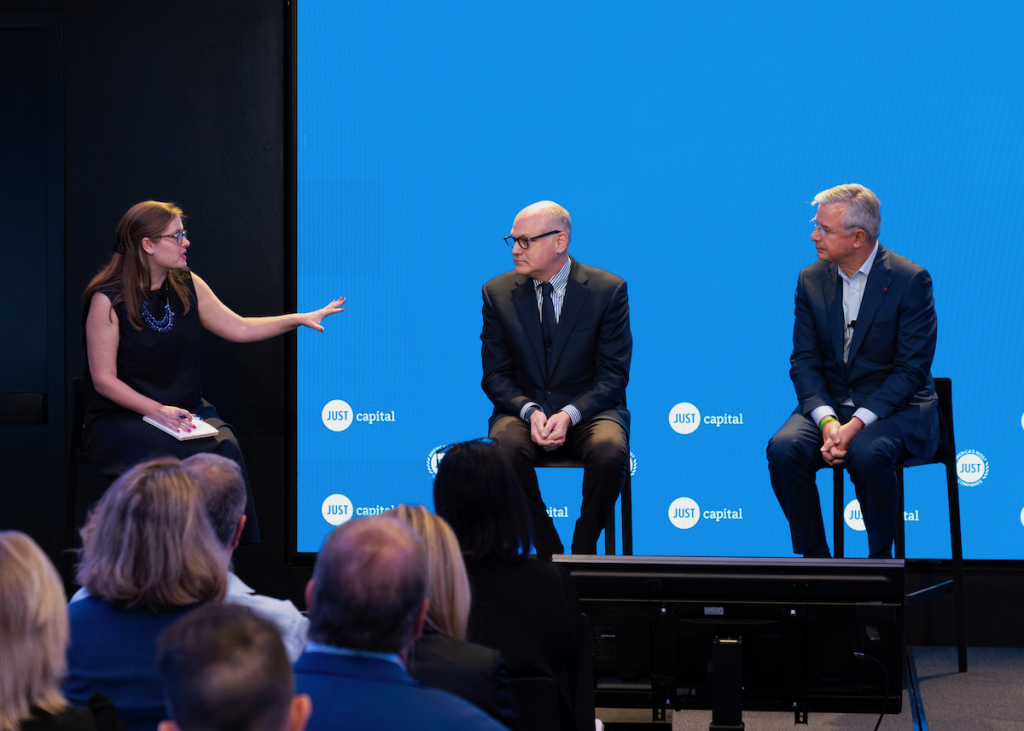
“The job of CEOs and leaders has become increasingly difficult, right? Because it’s a series of one crisis after the other with no playbook,” Hubert Joly, former CEO of Best Buy and JUST Capital Advisor said on how corporate leaders navigate these challenges at our event held Monday at Nasdaq, “The Strategic Imperative of the ‘S’ of ESG.” Joly was joined by PepsiCo EVP of Communications and PepsiCo Foundation President, Jon Banner, for a conversation on moving from commitment to action on ESG priorities.
Banner, who just returned from a trip to Poland around PepsiCo’s war relief efforts, and Joly, who authored the book “The Heart of Business” on his leadership philosophy, sat down with JUST Chief Strategy Officer Alison Omens to share how they’ve translated values into real action, with the outcomes to prove it. Read on for key takeaways and watch the full conversation below.
For PepsiCo, taking action on the company’s ESG agenda, PepsiCo Positive, has centered around “story-doing” instead of storytelling, Banner said. The company is focused on showing proof positive that it’s making progress on these goals, he said. That focus on story-doing has informed PepsiCo’s actions in response to the pandemic and, now, to the war in Ukraine.
“We spent close to a billion dollars to protect our workforce in the first year of COVID. It was a big investment, but we knew that unless we protected them and took steps to protect them, we didn’t have a company to run,” Banner said. In response to the war in Ukraine, the company is dedicated to protecting its 3,100 employees in the country – housing about a third of them, and their families, in its office in Warsaw. PepsiCo’s Warsaw office is now referred to as the “Warsaw hotel,” he said, and is equipped with 150 beds, washing machines, and a kitchen.
While the goal has first and foremost been the safety of its employees, PepsiCo’s also seen a unifying response from its actions. “The reality is there are, when you talk about story-doing, there are stories that coalesce the public in which there is so much divisiveness and hyper-partisanship, not just in this country, but there are certain stories that connect us on a human level. And that’s sort of what story-doing is all about,” Banner said.
Through the ongoing crisis in Ukraine, PepsiCo’s internal values are coming into play every single day, Banner said, and they reach into “every nook and cranny of the business,” including its factories’ walls. For him, living out those values puts a high bar and responsibility on leadership to embody them, particularly through crises like the pandemic or the war.
Joly echoed this sentiment, bringing up Best Buy’s immediate response to the onset of the pandemic. The company shut down stores to protect the safety of its workers and customers and while this meant a significant revenue hit, the board didn’t question it, Joly, who served as Best Buy’s board chair at the time, said. As the pandemic evolved, so did Best Buy’s response, continually guided by its values, he said. He raised the company’s partnership to expand broadband access in parts of rural Minnesota as one example.
“As leaders, when we go through a crisis, what do we go back to? We go back to our purpose. We go back to our values. We go back to understanding who are our stakeholders, and what good we can do for our stakeholders,” Joly said.
Omens raised the question of how best to measure or place value on these, in many cases, anecdotal ways companies are stepping up in times of crisis. For both Banner and Joly, the answer is not as straightforward. Banner, in particular, thinks that outcomes, instead of actions, are a better way of measuring how a company is living its values.
“I think when you look at what’s going on in Ukraine, when you looked at what certain companies did during COVID and certain companies did not, that wasn’t something you could measure. You could probably measure the outcome,” he said. In the case of war in Ukraine, PepsiCo has onboarded a dozen of its employees that have fled the country into new jobs in its Romanian operation. To Banner, that outcome of a dozen individuals with access to work is the measure of PepsiCo’s values in action.
Joly agreed and, on Ukraine, he thinks companies are being judged for their actions in a “naive” way, based solely on how quickly they are moving away from Russia. He contrasted the business of an oil and gas company, which may directly fund the Russian war efforts, to the business of Johnson & Johnson, a company where he and JUST board member Mark Weinberger sit on the board. “If you’re a pharmaceutical company. You’re not God, right? You don’t get to decide who’s going to die versus not die,” he said.
Joly also raised the importance of this nuance when it comes to looking at the materiality of ESG issues. “98% of questions that are asked as ‘either-or’ are better answered as ‘and,'” he said. He sees the role of business leaders as navigating this need to marry the short and long term, and not continue to operate as if people and profit are two separate entities. This is “the only way to run a business,” to him and he has future generations in mind with this outlook.
“I know in 10 years from now, 15 years from now, they’re going to ask me, ‘Happy, you knew right, the state of the world, you did know? What did you do?’,” he said, referring to his three granddaughters. “Not, ‘did you solve everything?’ but ‘did you do your best?’ ‘How did you behave?’ For me, that’s an important measure.”
