
If you ever get tired of the endless negativity, division, and cynicism dominating the airwaves, I urge you to check out American Optimist. Joe Lonsdale’s interviews never fail to shake me out of my torpor. One episode brought to my attention this week struck a particular chord because it spotlighted a market solution to one of the greatest challenges facing America: the wealth gap.
The program in question – called InvestAmerica – is championed by investor Brad Gerstner, founder of Altimeter Capital. The basic idea is that a private investment account seeded with up to $1,000 from the government is created every time a kid is born in the U.S. Parents or private companies would then set up a 401(k) match and contribute up to $2,000 tax free each year. A similar concept was advanced by Sen. Cory Booker under his proposed American Opportunity Accounts Act a few years ago.
Regardless of what you think about these specific initiatives, they represent the kind of directional thinking private sector leaders who want to leverage the power of markets to help build a more just America can embrace.
Our 2023 Views on Business Report echoes this. Some 62% of respondents believe “our current form of capitalism is not working for the average American.” According to a recent Harris Poll with U.S. News & Global Report, Americans feel that good, honest, solutions-oriented leaders are in short supply, and 86% are “largely disappointed” by leaders in society. As Gerstner notes, “we have increasing frustration, disenchantment, [and] a growing gap between capitalism and democracy.”
The chief of the U.S. Chamber of Commerce, Suzanne Clark, alluded to the leadership gap in a different way on Thursday. “If the business community isn’t out there telling the real story — the American story — of opportunity and progress in this country, then no one should be surprised when people believe it’s as bad as the headlines and the political ads say it is,” Clark said.
We agree with this point. In fact, we’re actively working with many companies and corporate leaders to not only implement just practices, but to spread the word too. If you’d like to share ideas on how business, markets and capitalism can work better for more Americans, please reach out and we’ll try to feature a few from time to time.
Be well,
Martin
JUST Advisor Carol Cone pens an article in Fast Company explaining how purpose will be a beacon for business leaders in 2024. She highlights “the four Cs” – colleagues, communications, collaboration, and courage” – and how they will shape the corporate landscape.
JUST Capital CEO Martin Whittaker speaks at a private virtual event “How Capitalism Should Tackle Income and Wealth Inequality” for The Council on Foreign Relations.

“We help our customers live their financial lives every day and so it’s so important to us that our teammates, especially as you mentioned those in the lower compensation categories, that they have more than a living wage. We want them to make sure that they feel comfortable and that they can take care of their families.”
The Guardian examines the pushback from some business experts and academics against the increasing use of algorithmic monitoring of workers, like the number of bathroom breaks a person takes, and are calling for stronger standards.
CEO Daily highlights a series of quotes from Corie Barry, CEO of Best Buy, on how she sees AI transforming business and people’s lives over the next 10 years. Barry highlights how AI and humanity will continue to merge together, and how business leaders need to ensure this melding happens in fair, safe, and responsible ways.
OpenAI parent company ChatGPT is reportedly in discussions with media firms CNN, Fox Corp. and Time to license their work, Bloomberg News reports. This comes as OpenAI and its financial backer Microsoft face multiple lawsuits accusing them of using copyrighted works to train AI products.
Tech layoffs persist. Amazon is laying off hundreds of jobs across it’s content division, with Twitch in particular losing an additional 500 employees after the 300 of last year. Meanwhile, Xerox is cutting 15% of its workforce in an attempt to “overhaul its operational model.” And Google cuts hundreds of jobs in its engineering division.
The Wall Street Journal reports on the continued pushback against ESG. Some companies are doing away with the acronym while still progressing on its goals under a different banner – typically under the idea of “responsible business.”
Axios reports that the past two years have seen shareholder activism reach record highs, with 464 activist campaigns being launched against major publicly traded companies – and the amount of activist challenges is expected to grow.
The fallout from the Boeing aircraft that lost its escape hatch mid-flight continues. The Washington Post reports that Alaska Airlines is canceling all Boeing 737 Max 9 flights for the week so that each plane can undergo a rigorous reinspection. This is happening while lawmakers are investigating the incident.
High-paying job openings are in ample supply, but they might not come with much flexibility. Fortune reports that less high-paying jobs are allowing for a hybrid work schedule.
The U.S. Securities and Exchange Commission plans to adopt 25 rules in 2024, Reuters reports, including measures on increased climate change disclosure, regulation of special purpose acquisition companies (SPACs), enhanced disclosures on environmental, social, and governance practices, among others.

With our 2024 Rankings of America’s JUST Companies dropping in a few short weeks, JUST Capital wanted to show you what the priorities of the American people are, per our most recent 2023 research, and how they influenced the ratings this year. The chart above breaks them down by stakeholder category, but you can dive deeper into the data in our full report here.
2024 marks JUST Capital’s official 10th birthday. Hard to believe, I know. The time has flown by, even for those of us privileged to have been involved since the very beginning.
I could easily spend the next few paragraphs waxing philosophical about lessons learned and the impact we’ve created, but let’s do that another time. It’s January 5th and things are already well underway.
On January 1st we launched a major media campaign with Empower Media to elevate JUST’s brand and celebrate the leadership of top-performing companies. Hopefully you’ll encounter it firsthand on TV, radio, and online. And in exactly one month, on February 5th, we’ll be releasing the JUST 100 list as part of our 2024 Rankings of America’s Most JUST Companies with CNBC, ringing the closing bell of the Nasdaq, and hosting a JUST Leadership Summit with some high-profile guests and executives.
We’re also freshening up how we bring the Rankings to market. In addition to the release of the JUST 100, we’ll be curating exciting lists, thematic Rankings, and data-driven insights throughout the year. Simultaneously, work is underway on methodological updates to make future Rankings more dynamic, more real-time and more actionable than ever before.
Our work with companies is also being accelerated. We’re bringing our various programs work under one single Corporate Impact Lab umbrella to facilitate more collaborative approaches to applied research, dialogue and corporate action. And we’ll be launching new products for companies to benchmark themselves, analyze performance, and identify the ROI for investing in their stakeholders. Our new Index Concepts, covering key issues like just transition, career development, and job quality, will drive capital toward just leaders and provide a robust basis for one of our core tenets – that just business is also better for investors.
So…exciting times ahead. Please do reach out if you want to learn more about any of these plans or support our endeavors, and thanks in advance for being there alongside us. We couldn’t do it without you.
Happy New Year and Be Well,
Martin
JUST Capital Board Member Peter Georgescu pens an op-ed in Forbes that underscores how stakeholder capitalism drives long-term profitability, citing examples such as Costco and Home Depot, and other industry leaders that have seen real market value from investing in workers and communities.
A Harvard Business Review article highlighting emerging themes in global sustainability such as the growing importance of sustainability reporting, driven by regulations in the EU, Canada, and Germany, cites JUST Capital’s research on the importance of providing workers in companies’ supply chains a living wage.
JUST Advisor Susan McPherson writes for Fast Company on what to expect from sustainability and social impact in 2024, gathering insights from experts in the field and reinforcing the value of prioritizing workers and workforce-related issues.
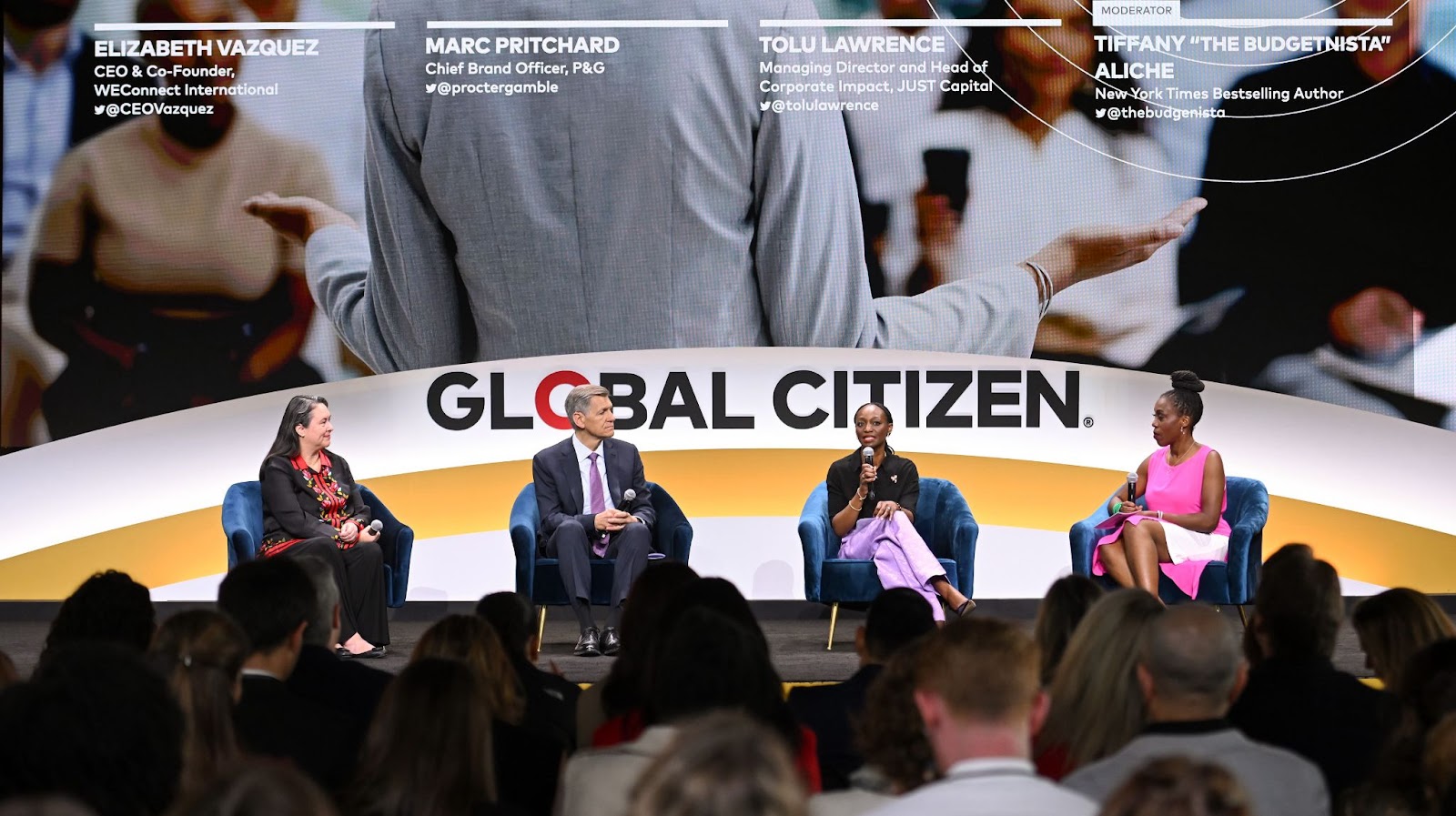
“Both my personal background as a Nigerian-American lawyer and mother as well as my professional experience with strategic cross-sector partnerships, corporate social impact strategy, and intersectional gender equity inform my work with JUST … There is a lot involved in demonstrating how certain investments can create long-term value for business and society while mitigating potential risks and negative consequences. I can’t wait to share what JUST has in store for next year and beyond.”
A Fast Company piece explores the potential implications of a recent lawsuit filed by The New York Times against OpenAI and Microsoft, claiming that the companies used its content without permission or compensation to train their AI models, such as ChatGPT and Bing Chat. An expert cited in the piece expects more lawsuits and licensing agreements to come in 2024.
Artificial intelligence is increasingly being deployed by researchers and companies to mitigate the impacts of climate change and reduce emissions, NPR reports. Uses include harnessing the technology to prevent and control wildfires and help locate minerals required for climate solutions like solar panels and electric vehicles.
2023 saw an AI-fueled market boom for tech companies, where the Nasdaq Composite saw a 43% jump year over year – its second-best annual performance in 15 years. However, the new year has seen a more cautious outlook, with tech stocks, including major gainers from the previous year, experiencing marked declines, The Wall Street Journal reports.
A New York Times piece explores the rise of “new collar” jobs – a phrase coined by former IBM CEO Ginni Rometty to describe careers that require advanced skills but not necessarily advanced degrees.
The Harris Poll, in conjunction with the U.S. News & Global Report, releases its first Best Leaders survey, finding that Americans feel that good leaders are in short supply. Nearly 9 in 10 (86%) Americans are “largely disappointed” by leaders in society today and added that they want more leaders to lead with honesty and put people first in their decisions.
After making public commitments following the murder of George Floyd in 2020, tech leaders at Google and Meta are cutting diversity, equity, and inclusion programs, according to CNBC. With fewer diverse voices represented as AI development scales up, the resulting products could be less accurate or more harmful to users, experts say.
A Wall Street Journal report highlights that 22 states are lifting their minimum wages, but many low-wage workers may not even notice due to robust private sector raises in recent years. Labor shortages during the pandemic and pressure from organized workers have led to increased hourly rates, surpassing the minimum wage in various states.
The New York Times’ DealBook newsletter dives into how Claudine Gay’s resignation as Harvard president is fueling debate around DEI in C-suites and boardrooms. In Fortune, Paradigm CEO Joelle Emerson pens an editorial on the rise of the anti-DEI movement and how companies should approach DEI work in light of it: “Instead of drawing a line in the sand, pro-DEI vs. anti-DEI, with us or against us, we should look for common values, consider how fairness can benefit everyone, and engage in meaningful dialogue.”
Climate scientists predict that El Niño patterns could bring record-breaking temperatures and dangerous weather events in 2024, The Washington Post reports. Related, The New York Times covers the biggest environmental stories that will dominate 2024, including America’s continuing fossil fuel production, new investments in solar power, and more.
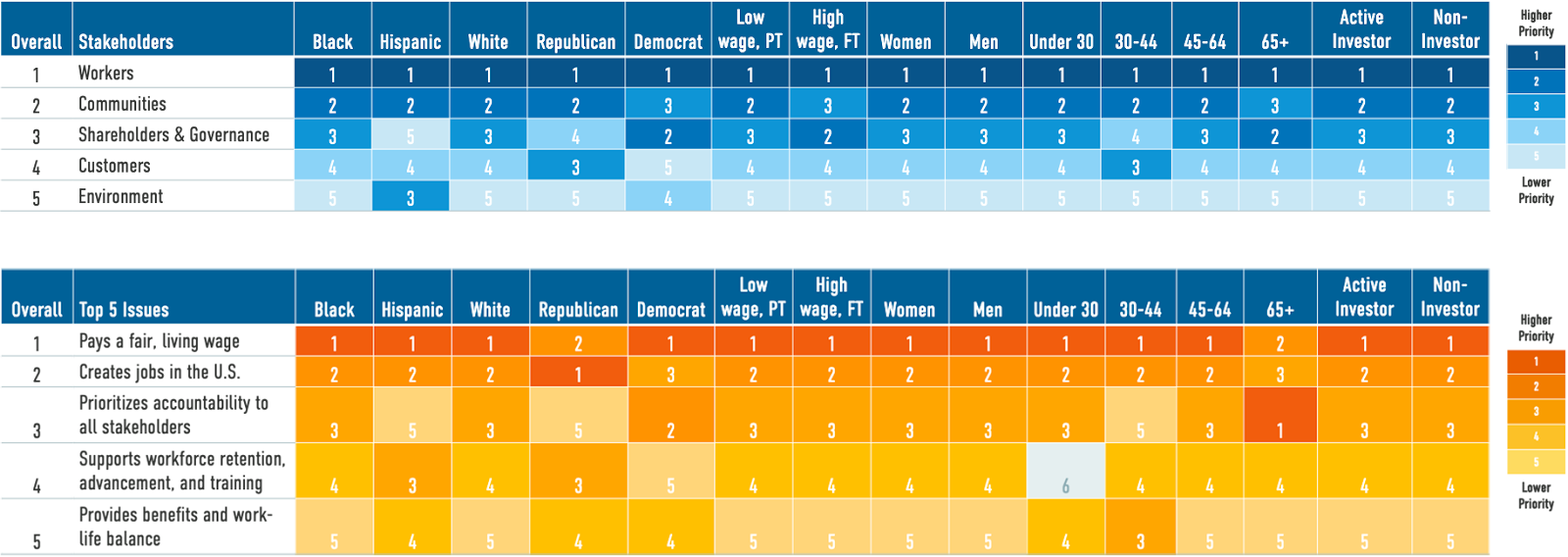
This week’s chart comes from our 2023 Issues Report – The People’s Priorities. As in years past, JUST polling finds broad consensus across demographic and political cohorts – liberal, conservative, high-income, low-income, men, women, young generations, older generations, and white, Black, and Hispanic Americans – that Workers should be corporate America’s top stakeholder priority and nearly all cohorts agree that paying a fair, living wage should be the number-one issue to prioritize.
The past year has put workers squarely in the spotlight for corporate America. Whether it was return-to-office plans, strikes, or the impacts of AI, corporate leaders have needed to turn their attention to their workforce in 2023. JUST Capital’s own polling reflects that, with worker issues once again topping the American public’s priorities when it comes to just business behavior.
As the year winds down, we turned to the leader on the Workers stakeholder in our 2023 Rankings – Bank of America – for insight into its workforce investment strategy, which includes the industry-leading move to recently raise its minimum wage.
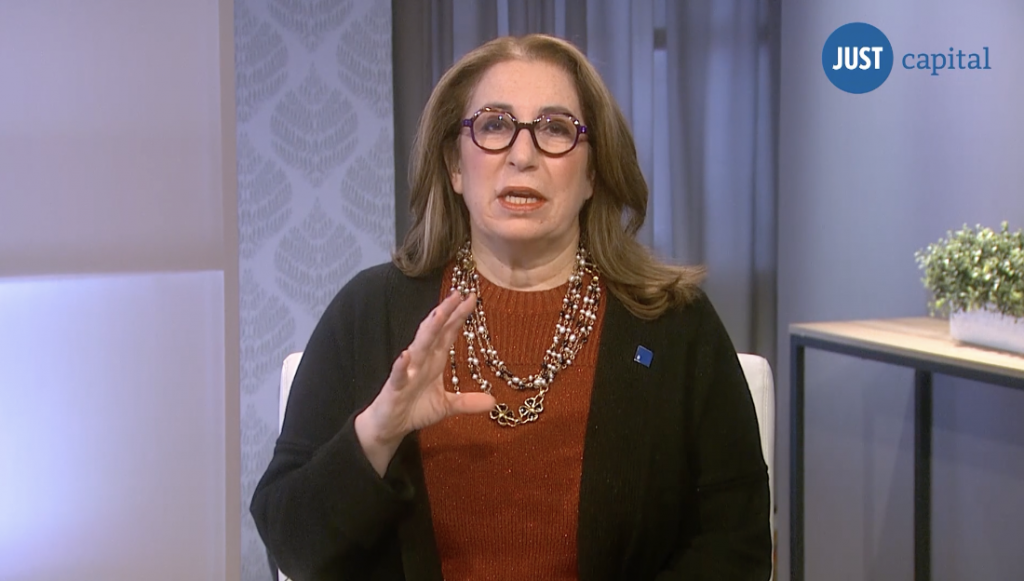
In a recent episode of our ongoing LinkedIn Live interview series, “JUST Better Business,” Bank of America Chief Human Resources Officer Sheri Bronstein spoke with JUST Capital CEO Martin Whittaker about how the company approaches its people strategy and why it’s been a boon for business. To Bank of America, the number-one overall company in our 2023 Rankings, prioritizing workers is part of operating sustainably, Bronstein said. Watch the full interview below and read on for our key takeaways from the conversation.
Bronstein emphasized that data is the foundation for all of Bank of America’s HR decisions, from raising wages to expanding mental health support to investing in diversity, equity, and inclusion (DEI) practices. “I have an incredible data and analytics team that really sits behind all of our HR processes and services and products and helps us analyze and make sure that we’re using every dollar of that investment in the best way possible,” she said.
When it comes to DEI, Bank of America has disclosed its EEO-1 data since 2013 and uses it to guide practices and policies. “Here in the U.S., we really look like the communities and the customers that we serve,” she said of the bank’s 18% Hispanic and 13% Black employees. Data also grounds its work to advance women’s leadership in the company. Women make up over 50% of employees at Bank of America, with women comprising almost 40% of its management team and over 40% of those at the top levels of the company, she said. Bronstein also pointed to Bank of America’s own research that found that S&P 500 companies with at least 25% women executives saw higher returns on equity than the overall index.
Data from employee feedback also plays a role, Bronstein said using the company’s investments in mental health resources and support as another example. Following company-wide surveys conducted a few years ago, Bank of America began enhancing its benefits around mental health care and working to break down stigmas around mental health using the voice and influence of its leadership. It’s something that Bronstein said she’s grateful the company prioritized before the pandemic hit, because of the input of its employees.
While Bank of America employs over 210,000 individuals, Bronstein often considers the impact of the company’s decisions beyond its immediate workforce. “We help our customers live their financial lives every day and so it’s so important to us that our teammates, especially as you mentioned those in the lower compensation categories, that they have more than a living wage. We want them to make sure that they feel comfortable and that they can take care of their families,” she said of the company’s decision to raise its minimum wage to $25 per hour by 2025.
Since 2010, Bank of America has raised its minimum wage by 121%, and for over a decade hasn’t raised healthcare costs for employees earning under $50,000 per year. It’s employees’ families that motivate Bank of America to do right by their workers, Bronstein said.
“Every day we come in and we think about our 210,000 plus employees, but we also take care of their families. It’s almost a million people that I have the honor every day to think about – ‘how do we help them live their personal lives, their professional lives?’” she said.
This mindset has also played a role in the company’s DEI work. As part of Bank of America’s $1.25 billion commitment to advancing racial equity, the company has invested in low-moderate income communities in the 90 markets it operates in across the country. In partnership with nonprofits and Bank of America’s market leadership, the company ensures that whether it’s investing in private equity, jobs programs, or health care systems, that these investments serve the needs of low-moderate income communities and embrace diversity, Bronstein said.
For Bank of America, investing in its workforce has led to higher employee satisfaction and lower turnover, Bronstein said, noting that she believes 2023 will see record-low turnover for the company. Part of that stems from its commitment to providing training and re-skilling programs that promote long-term growth at the company. Bank of America tries to bring in talent at the entry level, Bronstein said, and help them build skills and learn over time.
The company does this through Pathways – its community hiring and development program – The Academy – its internal learning and development platform – and its college recruiting process. “Helping people build skills and be able to choose many different careers over the course of a lifetime, that is something that we think has really helped us continue to invest in women and our diverse talent in particular, but all of our employees,” she said.
Bronstein sees Bank of America as a company that’s always valued its teammates, a mindset that has become increasingly valuable through the labor market shifts of the last few years and will surely continue to be through 2023 and beyond.
‘Business!’ cried the Ghost. ‘Mankind was my business’”
For me, the festive period is a time for family and celebration, but also a time for reflection. A moment to take stock – of our lives, our careers, our hopes and dreams. One thing I’ll be thinking about a lot is where we are at JUST Capital, and the state of our mission. Capitalism, it seems to me, is undergoing a transformation, not unlike Charles Dickens’s famed Christmas creation, Ebenezer Scrooge. The question is whether its future will be different from its present and its past. This was Dickens’ intention of course – to influence the national discourse on poverty and inequality by examining the true spirit of humanity. “A Christmas Carol” went viral – first published on December 19, 1843, it had sold out by Christmas Eve. It resonated with audiences and captured an essential ethos of the time. In that sense, and perhaps even to that scale, we hope to emulate its outsized impact.
In a way, our Rankings of America’s Most JUST Companies are a stocktake of sorts on how companies are doing on the defining characteristics of just business behavior today. They capture the reality of how companies are taking action on key stakeholder issues. Unlike Dickens’ novella, they are not a morality tale. They’re all about business. And to us, they represent the start of the conversation, not the end.
Our Rankings drive the kind of programmatic work with companies – such as our Worker Financial Wellness Initiative including Chipotle, Verizon, PayPal, and Prudential – that advances positive outcomes for thousands of employees in multiple industries (this video series tells the human stories behind the data). They help us set up innovative initiatives such as our Corporate Care Network, which is advancing the well-being of workers and demonstrating the long-term value of increasing access to care benefits (we announced it at the annual Global Citizen Festival in April). They also pave the way for critical direct work with companies, of which there is no better example than the workshop we hosted in October in partnership with The Rockefeller Foundation and PayPal at the Bellagio Center. Here, we brought together executives from global corporations collectively employing almost five million American workers to engage in peer learning and develop tangible action plans that benefit workers.
The stories behind the data are also becoming increasingly critical to our work. It’s why the conversations we had with TIAA’s Chief Information Officer on AI, with HPE’s leadership on paid care benefits, and Bank of America’s CHRO on human capital management and worker pay are so important. Connecting directly with business leaders – as we did in Atlanta with our Board member Roosevelt Giles, at the NEST Summit in New York City during Climate Week, and at the New York Stock Exchange to celebrate the fifth anniversary of the JUST ETF – is also becoming ever more important.
You’ll be hearing more about JUST’s own transformation in 2024 very soon, but for now, suffice to say that as we approach our 10-year anniversary, it is clear that JUST business leadership – that creates value for all stakeholders and gives more people access to a better future – is expected and needed more than ever. We’ve elevated key internal leaders, namely Alison Omens to President and Tolu Lawrence to our first-ever Chief Impact Officer. And thanks to our partnerships with Empower Media and CNBC, you’ll be seeing and hearing a lot more about us from January on.
If you’d like to support our essential work, please hit the donate button below and know that everyone at JUST is grateful. I’m going to take a break from my usual correspondence next week and return with an exciting update on what to expect from JUST Capital in 2024.
Meantime, Seasons Greetings, and Happy Holidays to you all!
Martin
JUST Capital brought together many industry leading executives, experts, and business changemakers over this past year. Here’s a look at some highlights:
JUST Capital sparked many engaging conversations this year. Here are several highlights:
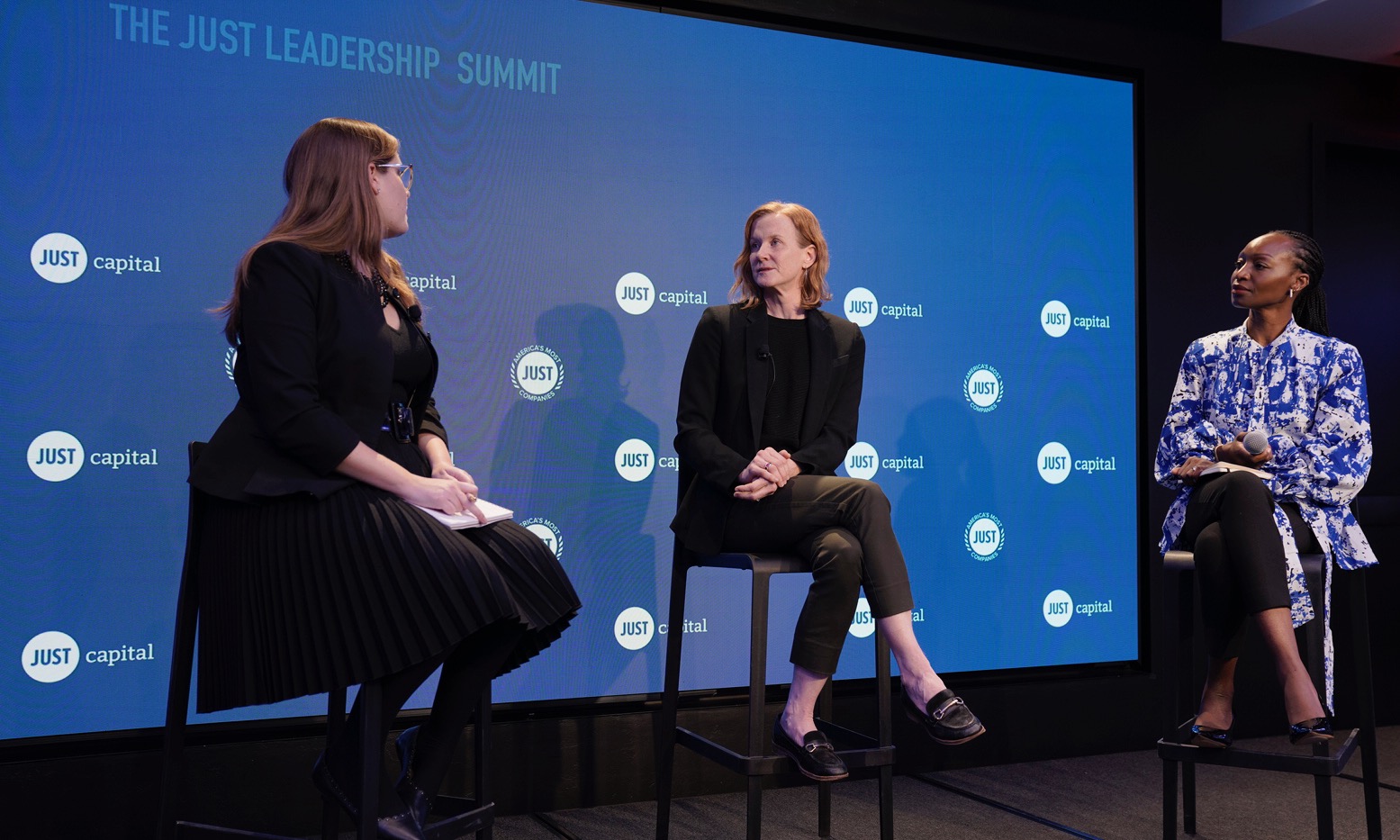
In March top corporate, investment, and sustainability leaders gathered for the 8th JUST Leadership Summit – a place to celebrate corporate leadership and spotlight action from investors and American companies to help build a more just economy. We discussed the broad state of play with Deloitte, why employee stock ownership is a winning strategy with KKR, how JUST jobs build better companies with Two Sigma, and recognized the achievements of this year’s JUST 100, the leaders topping our 2023 Rankings of America’s Most JUST Companies.
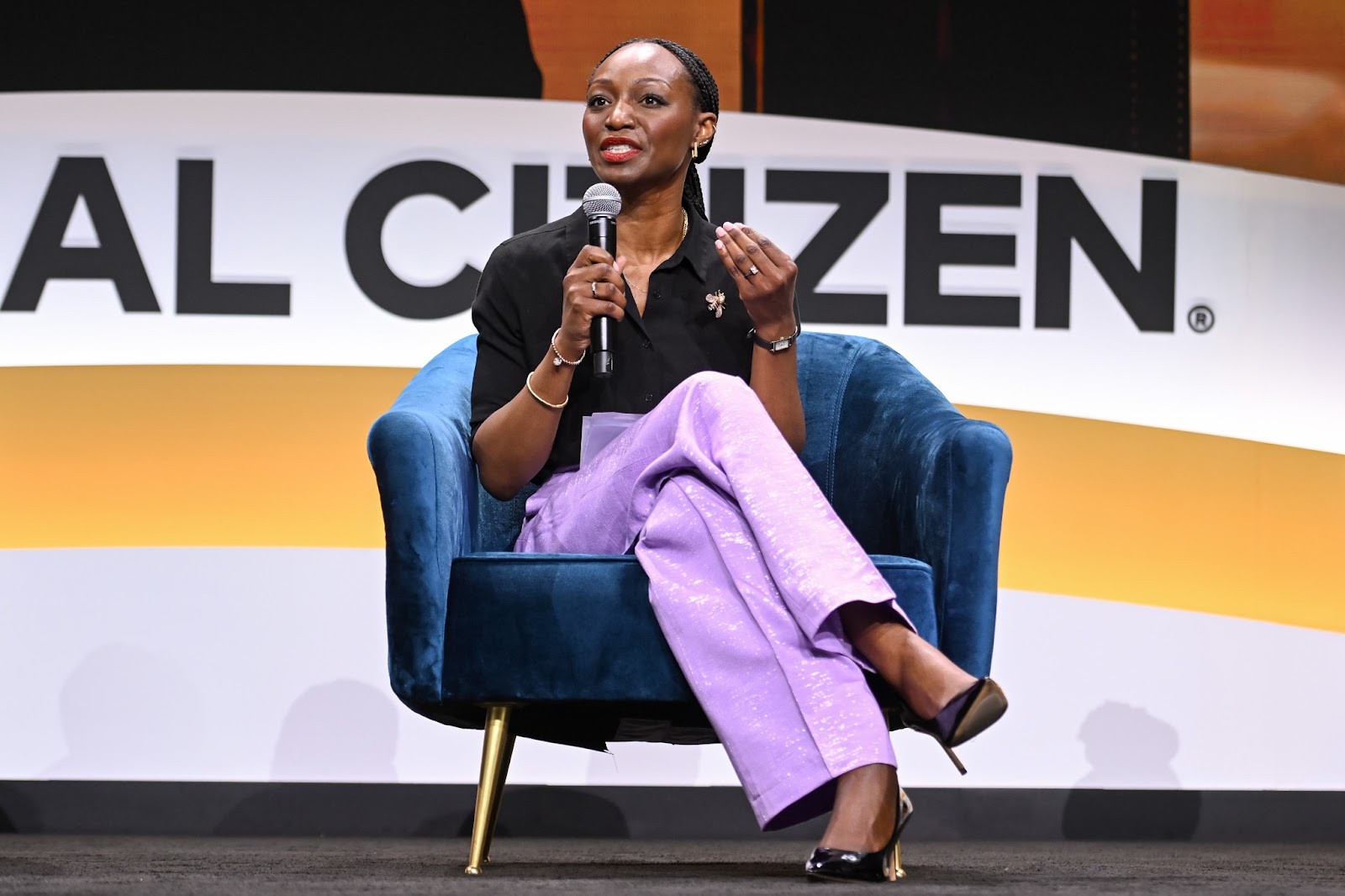
In April, Tolu Lawrence joined Global Citizen NOW to announce the creation of the Corporate Care Network, which connects and supports companies committed to advancing the well-being of workers through access to and awareness of inclusive care benefits, like paid leave, flexible work, and child care support.
In June, we celebrated the five-year anniversary of the JUST ETF at NYSE. The celebration included “The Value of Investing in Just Business,” a conversation featuring Priscilla Sims Brown, CEO of Amalgamated Bank, the financial institution self-described as “America’s socially responsible bank”, as well as Roy Swan, Director of Mission Investments at the Ford Foundation.
Back in September, Martin led a panel at The Nest Summit with three executives making real headway on environmental issues at Ecolab, Trane, and Workday. What does it actually take to drive major environmental action within a company or industry? What moves a company from making public commitments to executing scalable plans? Watch the full discussion here.
In November, Martin joined the New York Times’ DealBook Summit, to discuss the U.S. economy, stating: “We need more people to believe American capitalism is working for them, not against them. With politics bereft of long-term vision and serving only to divide, the private sector must lead. An economy in which companies compete by creating value for all their stakeholders is a powerful uniting force.”
Paying a fair, living wage was once again the No.1 issue for the American public when it came to just business behavior. We created our Living Wage Explainer to help explain the concept and why businesses should use it, and released a series of videos with our Worker Financial Wellness Initiative highlighting how investing in wages and career development dramatically impacts workers.
On a similar note, we released our annual list of the Top 10 Companies that Treat Employees the Best, providing business leaders insight into best practices on supporting their employees. Indeed, paid parental leave and pay equity both rose to the forefront of our research this year. The Top 4 Companies Leading for Women in 2023 and the Top Six Companies Leading on Paid Parental Leave in 2023 both highlighted companies implementing policies that help uplift working women and mothers.
ESG investing continued to face pushback on the national stage. Amid much debate, we gathered insights from focus groups with the American public and rounded up our five key takeaways for companies and investors to lead through increasingly difficult conversations.
Lastly, our yearly coverage of America’s 36 Industry Leaders on Environmental Performance in 2023 is a perfect snapshot of the progress being made across industries.

COP28, the UN Global convening hosted by the United Arab Emirates, concluded Wednesday. Success was in the eye of the beholder.
For some, the first explicit mention of reducing use of fossil fuels in any official UN climate talks text (a fact I find quite astonishing) was a major breakthrough. For others, the shift in language from a “phasing out” of said hydrocarbons to a “transition” away fell short of what’s needed. A tripling of renewable energy capacity and a doubling of energy efficiency measures, together with funds to address the impact of climate change in poorer countries, were universal positives.
Judging by my news feeds, business leaders and countries still economically tied to coal, oil, and gas revenues – this COP also saw a significant increase in the presence of fossil fuel lobbyists – will generally like the outcome. Activists, scientists and anyone living in vulnerable areas will not. I see that small island nations most at risk from climate change were reportedly not in the room when the final text was approved.
Will it keep temperatures under 1.5 degrees? If corporate pledges are anything to go by, unlikely. Since we started tracking corporate climate commitments in the Russell 1000, Net-Zero pledges have tripled and science-based commitments have doubled, but emissions have not fallen.
I don’t pretend there’s an easy or obvious path here. To me, this is a global stakeholder balancing act of the highest order. How does the world address climate change while safeguarding economies, acknowledging disparities, protecting worker well-being and jobs, meeting consumer needs, and supporting communities? How do we advance a just transition? These are questions that JUST’s work is grounded in. I’ll close with this – according to our data, companies doing the best job of both prioritizing workers and mitigating environmental impacts outperform their peers by over 20%. Perhaps a win-win is achievable after all.
Be well,
Martin
This week we hosted our latest “JUST Better Business” conversation with Sheri Bronstein, the Chief Human Resources Officer of Bank of America, our 2023 Most JUST Company and No. 1 when it comes to Workers. We discussed the bank’s standout employee practices – from offering an industry leading minimum wage and global sabbatical programs to its robust mental health and wellness offerings to how it’s boosting opportunity across its workforce. See the full video and summary here.
“The market operates as a massive system, and like all systems, there are drivers that influence the direction in which they move and how they operate. We truly believe that as we merge into the natural flow of the system – instead of fighting the current – while partnering with market leaders to introduce factors and incentives that shift the targets, we can ultimately and incrementally reorient the flow of that system to deliver the kind of positive outcomes we know are possible.”
ChatGPT has reached an agreement with Axel Springer, owners of Politico and Business Insider, to pay for using content from those sites within its algorithm. It’s a first-of-its-kind contract as media companies push for compensation when their writing is utilized on AI platforms.
Last Friday, the EU agreed on The Artificial Intelligence Act, the world’s first comprehensive set of AI rules. AP breaks down how the legislation will regulate uses of AI based on risk factors. The Financial Times reports that French President Emmanuel Macron believes that the AI Act will hamper innovation from European tech companies, and place the continent behind the U.S., UK, and China.
Following up on last week’s story, Sports Illustrated has officially fired its CEO after it was discovered that many articles on the site were generated by fake AI writers. Futurism has the story.
Fortune reports that many employers are receiving pushback from harsh return-to-work mandates from an unlikely group – investors – who have seen companies with hybrid work models deliver better returns over the past few years.
The New York Times covers the discouraging trend of companies intentionally changing and raising product prices to see at what point, if any, American consumers are scared off.
CVS Health is planning to upend how much drugs cost across its pharmacies. The Wall Street Journal reports that, rather than relying on complex formulas typically used to set the price of prescription drugs, the company is planning to shift prices to just include the cost for them to buy the drug, plus a small markup and fee.
The Verge covers the ruling in the lawsuit between Epic and Google, with a jury finding Google guilty of maintaining an illegal monopoly with its app store. While the changes Google will have to make to its policies have not been revealed yet, it’s bound to lead to a sea change in app and game development for all Google platforms.
U.S. construction worker wages have hit $35 an hour on average, and with record job openings and significantly fewer workers to fill them, wages in the field are expected to rise even higher.
In the absence of a global price on carbon, Reuters looks into the rise in companies setting their own. An analysis from CDP found an increase in companies using an internal carbon price or planning to do so in the next two years, though some experts worry this trend lends itself to greenwashing.
In a year marked by strikes across industries, Microsoft states that it plans to remain neutral should its U.S. workforce seek to unionize. The New York Times reports on the unprecedented announcement.
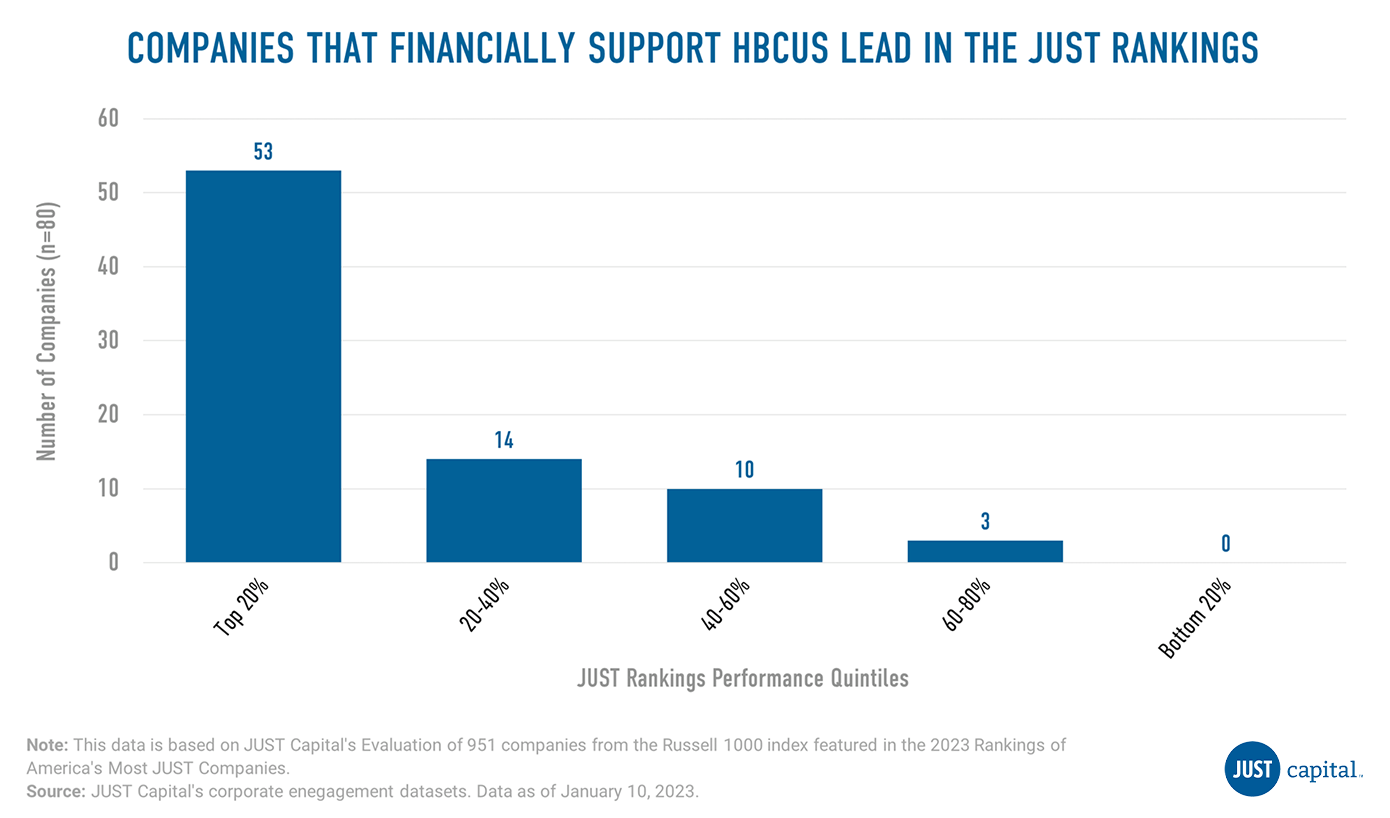
This chart comes from our latest report, How Corporate America Can Work With HBCUs to Boost Economic Mobility and Build Diverse Talent Pipelines. Our analysis found that 66% of companies that support HBCUs sit in the top 20% of our Rankings, and 44% sit in the top 10% of companies – the JUST 100. Learn more about what this means in the full piece here.

In the U.S., there is currently no federally mandated paid sick leave, despite the vast majority of countries (an estimated 179 of 193) ensuring some form of paid leave for workers in need. Paid sick leave policies are often left in the hands of state and local governments: as of June 2023, 15 states, four counties, and 17 cities have or will soon enact laws regarding paid sick leave to meet the needs of their communities.
In the absence of legislation for all Americans, companies have stepped in, with 77% of workers in private industry able to access paid sick leave as of February 2023. However, nearly 28 million workers still do not have access and just 51% of part-time private industry workers had access compared to 86% of full-time workers. Additionally, compared to their public sector peers who receive 11 days of paid sick leave after one year of employment, private sector workers receive just seven days on average. Perhaps most disheartening is that low-wage workers are significantly less likely to have paid sick leave compared to high-wage workers (38% vs. 96%, respectively).
In analyzing the Russell 1000 companies included in our 2023 Rankings of America’s Most JUST Companies, 28% disclose a paid sick leave policy for exempt employees as of September 2022, an increase of seven percentage points compared to the year prior. Note that this does not include paid time off policies (PTO), paid vacation, short-term disability leave, or unpaid leave through the Family Medical Leave Act (FMLA).

While this increase in disclosure is a positive sign, only 9% of companies disclose the number of days of paid sick leave they provide. This is unchanged compared to the year before, suggesting that – despite renewed attention on the issue during the COVID-19 pandemic – progress on paid sick leave has stalled.
Of the 951 companies JUST Capital analyzed and ranked in 2023, 89 disclose the days of paid sick leave in their policies (meaning that 862 companies do not disclose). Of those 89 companies, six offer unlimited paid sick leave.
Excluding those six, the range of paid sick leave is 3-30 days, the mean or average is 8.3 days, the median 8 days, and the mode – or most common number of days – is 10. Looking across all companies that disclose the number of days, the majority (53 or 60% of those companies) offer less than two business weeks.

Looking across sectors, seven out of 36 industries have no companies disclosing the days of paid sick leave in their policies. These include Aerospace & Defense, Basic Resources, Clothing & Accessories, Commercial Support Services, Commercial Vehicles & Machinery, Consumer & Diversified Finance, and Food & Drug Retailers. In addition, 12 other industries have only one company disclosing.
The Banks industry leads with 12 companies disclosing (29% within industry), followed by Software (12 companies or 19%), and Pharmaceuticals (8 companies or 20%).
While tens of millions of American workers do not currently have access to paid sick leave, multiple studies show that it provides tangible benefits to companies – reducing absenteeism (absence from work) and presenteeism (working while sick), in turn increasing employee satisfaction and productivity, and lowering recruitment and turnover costs. The CDC estimates that absenteeism alone costs businesses $225.8 billion per year due to productivity losses, and one cost-benefit analysis found that while a paid sick leave law would result in a weekly cost of $6.87 per employee, that cost would be more than offset by a weekly benefit of $12.32 per employee due to higher productivity and lower turnover.
In addition, paid sick leave results in fewer occupational injuries, lower healthcare costs for employers, and better public health in general. Finally, providing paid sick leave can increase a company’s brand reputation, which positively influences a company’s market value.
Looking closer at the 89 companies that disclose the number of days in their paid sick leave policies, we identified three that stand out, offering policies that range from four weeks to unlimited: Alphabet, Axis Capital Holdings, and Advanced Micro Devices. These three companies demonstrate that paid sick leave is not a one-size-fits-all type of policy, but one that should be iterated to meet the needs of workers and company culture.
Ranked 1st in Internet and 12th overall
Alphabet recognizes “that vacation days are not the only time Googlers may need to take time away from the office,” and for that reason offers a range of “supportive leave options.” Highlighting the honor system, Alphabet offers unlimited sick time that is used at the discretion of the employee. Policy
Ranked 8th in Insurance and 135th overall
Among many other time off benefits, Axis Capital Holdings provides unlimited paid sick leave. Striving to lead its industry, Axis states that it seeks “dedication and accomplishment” from employees, which the company incentivizes through its comprehensive benefits and perks program. Policy
Ranked 8th in Semiconductors & Equipment and 128th overall
Advanced Micro Devices (AMD) provides up to four weeks of paid sick time to support the well-being of its employees. This policy allows employees to take time off when they are unwell without financial consequences. The sick leave policy reflects AMD’s commitment to prioritizing employee health and ensuring a supportive work environment. Policy
In a survey conducted in the early days of the COVID-19 pandemic, JUST Capital found that 74% of Americans agree that companies should provide at least 14 days of paid sick leave to all workers. The circumstances that yielded this strong majority may have shifted, but paid sick leave remains a strong priority for American workers. In late 2022, a massive railroad strike was narrowly avoided when Congress intervened to impose an agreement ensuring that 60% of unionized workers at major railroads now have access to paid sick leave.
Despite the clear push for stronger paid sick leave, corporate America lacks transparency on the issue – with just 9% of America’s largest companies disclosing the number of days they provide to workers, unchanged year over year. 28 million workers continue to lack access to paid leave – and many of these workers are part time, low wage, and/or service sector employees, all of which disproportionately tend to be women and people of color, further increasing racial and gender equity divides.
With paid sick leave providing a clear path toward healthier workplaces and communities, corporate leaders should consider investing in policies (if they don’t already exist) and stronger disclosure (if they do). With greater transparency comes a clearer picture of the state of paid leave today, a deeper understanding of what “good” looks like, and the ability for different stakeholders – such as investors and prospective employees – to evaluate companies and make informed decisions. Companies like Alphabet, Axis, and AMD offer a playbook for best practices, as business continues to recognize the benefits of paid sick leave.
JUST Capital, in collaboration with partners, established the Corporate Care Network to advance the well-being of workers and demonstrate the long-term value of investment in workers. The Network is committed to driving increased access to care benefits, including paid leave and flexible work policies, and highlighting leaders in the space.
If you’re interested in gaining insights into how to improve on the issues that matter most to the American public, and learning how your company can get involved in the Network, please reach out to JUST Capital impact@justcapital.com.
We also invite you to explore additional reports generated by JUST Capital’s Corporate Care Network, focused on paid leave and caregiving benefits:
Top Six Companies Leading on Paid Parental Leave in 2023
Top Companies for Working Mothers
Top Companies for Working Fathers
Spotlight on HPE’s Leading Parental Leave Policies
Morgan Stanley Chief Medical Officer on Enhanced Care Benefits
